You have to write a condolence note, and suddenly every greeting feels wrong. "Dear" might sound too casual. "To" feels like a form letter. You freeze. That blank card stares back at you. You are not alone. The opening line in bereavement communication carries enormous emotional weight. Get it right, and the rest flows. Get it wrong, and you risk adding discomfort to grief.
Why the greeting matters more than you think
The first words in a sympathy letter signal respect and awareness. A generic "To whom it may concern" feels cold. An overly familiar "Hey" can seem flippant. The right greeting shows you understand the relationship and the situation. It sets a tone of genuine care. When you choose wisely, you create space for the rest of your message to land.
Using a letter template or sample for the greeting is not cheating. It is a smart time-saver. You get a professional correspondence structure that you can adapt. The key is to customize it so your voice still comes through. A good sample gives you the bones; you add the warmth.
How do you choose the right greeting?
Start by asking: how close are you to the bereaved person? For a close family member or best friend, a simple "Dear [Name]" is fine. Sometimes "Dearest" or "My dear [Name]" feels more natural. For a colleague or acquaintance, stay with "Dear [Name]" using their title and last name if you normally use that level of formality. In a business context, "Dear Mr. Smith" keeps things respectful without being stiff.
Now consider the context of the loss. If the death was sudden or tragic, a slightly more formal opening can signal seriousness. If you are writing to someone who is traveling abroad after a loss, you might acknowledge their location gently. That is why a condolence message for a friend traveling abroad often starts differently than one for a neighbor you see daily.
Mistakes to avoid in your salutation
One common error is using an outdated or overly casual greeting like "Dear Sir" or "Hi there." In bereavement, avoid nicknames unless you are very close. Also, do not assume the family name. For example, if you are writing to a couple, "Dear John and Jane Doe" is better than "To the Doe family" if you know both individuals. When in doubt, err on the side of warmth without familiarity.
Another pitfall: ignoring the format. A handwritten card can be a bit more personal. A typed letter should follow business letter format with a proper date and address block. For email, the salutation still matters. Use "Dear [Name]," even in digital form. The digital letter format often makes people too casual. Do not let that happen.
Tailoring the greeting to the situation
If the loss involves a pregnancy or a young child, extra care is needed. Many people struggle with what to say. A sympathy card message for pregnancy loss might start with "Dear [Name]," but you could add a tender line like "I was so sorry to hear about your loss." The greeting itself stays simple. The tone is set by what follows.
For a miscarriage, a support-oriented opening works well. Something like "Dear [Name], I'm thinking of you" feels gentle. You can find guidance in a condolence message for miscarriage support that balances empathy with respect for privacy.
If you are writing to someone you have known for many years, the greeting can acknowledge that long history. "Dear [Name], after all these years, I don't have the right words" is honest and warm. A sympathy letter structure for a long relationship often includes a greeting that reflects shared memories.
When you are unsure, keep it simple
The safest default for most bereavement letters is "Dear [First Name]" or "Dear [Title and Last Name]." Using both first and last name in the greeting can feel distant. If you know the person's preferred name, use it. Authenticity beats perfection every time.
One more tip: avoid starting with "I was sorry to hear" as part of the greeting itself. That belongs in the first sentence. The greeting is just the door. Let it be simple and genuine.
Common mistakes I have seen
Over the years, I have read many sympathy notes that fall flat because the greeting felt off. For example, "To the family of [Name]" is too generic when you know the recipient personally. Also, do not use "Dearly Beloved" or other dramatic phrases. They sound like a script, not a real person. Stick with what you would say if you were face to face.
Proofread the name. Misspelling a name in a condolence letter is painful. Double-check the spelling, especially for uncommon names. That small act shows care. Proofreading your letter before sending is a simple courtesy that prevents embarrassment.
An invitation to adapt
Think of a sample greeting as a starting point, not a final draft. You can change "Dear" to "To my dear friend" if that feels right. You can add a brief phrase like "In this difficult time," but keep it short. The tone in writing should match who you are. If you are normally warm, do not become stiff. If you are more reserved, do not force a gushy opening.
Remember that the greeting is the first thing the bereaved person sees. It sets the emotional tone. Take thirty seconds to get it right. Then write the rest of your message from the heart. If you want more guidance on what to avoid, check out what to avoid in a sympathy letter to make sure your entire note feels thoughtful from start to finish.
Practice makes this easier
The more you write condolence letters, the more natural the greeting becomes. You stop second-guessing. You learn to trust your instincts. The sample is there as a safety net, not a cage. Use it, adapt it, and let your genuine care shine through. That is what truly matters.
Everyday Writing Examples
Appropriate Greetings for Condolence Letters
Simple Condolence Note
Dear [Recipient Name],
I was deeply saddened to learn of the passing of your [relationship, e.g., mother, father]. Please accept my heartfelt condolences during this incredibly difficult time. I remember [specific fond memory or quality, e.g., her warmth and kindness], and I will miss her dearly.
You and your family are in my thoughts and prayers. Wishing you strength and peace in the days ahead.
With sympathy, [Your Name]
Condolence for Loss of a Colleague
Dear [Recipient Name],
I was shocked and saddened to hear about the sudden loss of your [relationship, e.g., husband, partner]. [Name] was not only a valued colleague but also a wonderful person with a great sense of humor and generosity. I have fond memories of working alongside him.
I can only imagine how difficult this must be for you and your family. Please know that I am thinking of you all and offer my sincere sympathy.
If there is anything I can do to help, please do not hesitate to let me know. I am happy to assist with [specific task, e.g., contacting HR or handling work tasks].
With deepest sympathy, [Your Name]
Condolence Letter with Memorial Donation
Dear [Family Name],
It was with great sadness that I learned of the passing of your beloved [Name]. [He/She] lived a full and generous life, and it was an honor to know him/her. Please accept my deepest sympathies to you and your family.
In memory of [Name] and his/her love for [cause, e.g., nature, education], I have made a small donation to [Charity Name]. I hope this gesture brings some comfort, knowing that his/her legacy continues to make a difference.
Thinking of you at this sorrowful time.
With heartfelt sympathy, [Your Name]
Condolence for Loss of a Child
My dear [Name],
There are no words that can truly express my sorrow upon hearing of the loss of your precious [child's name]. This is a devastating tragedy that no parent should ever have to endure. My heart breaks for you and your family.
I remember how radiant [child's name] was, always smiling and full of life. The light he/she brought into this world will never be forgotten. Please know that I am holding you close in my thoughts and prayers.
I am here for you if you need someone to talk to or just need a quiet presence. I will keep [child's name] in my heart forever.
With all my love, [Your Name]
Condolence for a Former Teacher
Dear [Family Name],
I was deeply grieved to learn of the passing of your [relationship, e.g., father, husband, Mr. Smith]. Mr. Smith was a remarkable teacher who truly shaped my life. His patience and encouragement inspired me to pursue [subject or career].
I will always carry his lessons of curiosity and kindness with me. He touched so many lives and will be sorely missed.
My sincere condolences to you and your family during this time of loss. I am thinking of you all.
With gratitude and sympathy, [Your Name]
Condolence for Neighbor
Dear [Neighbor's Name],
I was so sorry to hear about the passing of your [relationship, e.g., mother, sister, Mrs. Jones]. She was such a wonderful neighbor and friend—always there with a warm wave and a kind word. I will miss our chats over the fence and her lovely garden.
Please accept my heartfelt condolences. If you need anything—whether it’s someone to watch your house, pick up groceries, or just sit with you—I am just next door.
I’m holding you and your family in my thoughts.
With sympathy, [Your Name]
Condolence for Loss of a Pet (Sympathy Letter)
Dear [Name],
I was heartbroken to hear that you had to say goodbye to your beloved [pet's name]. It’s so difficult to lose a dear companion who was such a big part of your life. I know how much [pet's name] meant to you—loyal, loving, and always happy to see you.
Take all the time you need to grieve. I am here for you if you want to talk or simply spend quiet time together.
With deepest sympathy and understanding, [Your Name]
Condolence Letter from an Organization
Dear [Recipient Name],
On behalf of the board and staff of [Organization Name], I extend our sincerest condolences to you and your family on the loss of your [relationship, e.g., spouse, Mr. Smith]. [Mr. Smith] was a highly valued member of our community for many years, contributing tirelessly to [cause or project].
We will remember his dedication, energy, and the warmth he brought to our team. His presence will be deeply missed.
Our thoughts are with you during this difficult time. We have enclosed a floral arrangement as a small token of our sympathy.
With sincere sympathy, [Your Name] [Your Title]
Condolence for Sudden Loss
Dear [Name],
I am absolutely devastated to hear the shocking news of [Name]'s sudden passing. I have no words to describe how sorry I am. It all seems so unfair and unbelievable.
Please know that my heart goes out to you and your family. In times like these, I hope you find strength in the love of those around you. I will keep you all in my prayers and thoughts.
I am here to help in any way you might need, whether it’s running errands or just being someone to talk to. I will cherish the memories of [Name]’s wonderful laugh and generous spirit.
With deepest sympathy and shock, [Your Name]
Condolence for a Grandparent
Dear [Name],
I was so sad to hear about the passing of your beloved grandmother/grandfather, [Name]. She/he was an extraordinary person—so full of stories, wisdom, and warmth. I have such lovely memories of visiting her home and listening to her recount her childhood adventures.
She/he was a guiding light and anchor in your life, and I know her loss leaves a big hole. Please accept my heartfelt sympathies. I hope the beautiful memories you share bring you comfort in the days ahead.
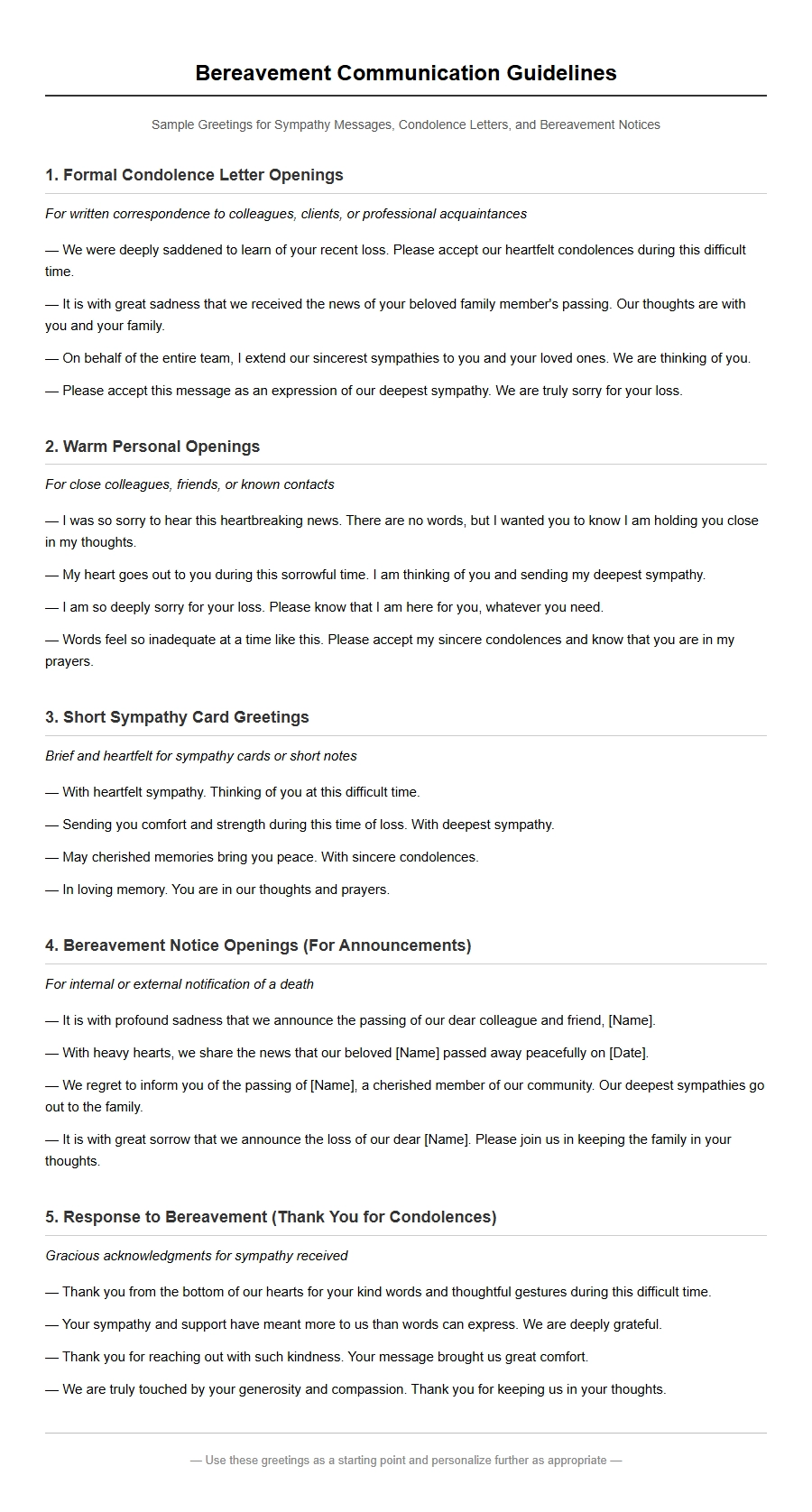
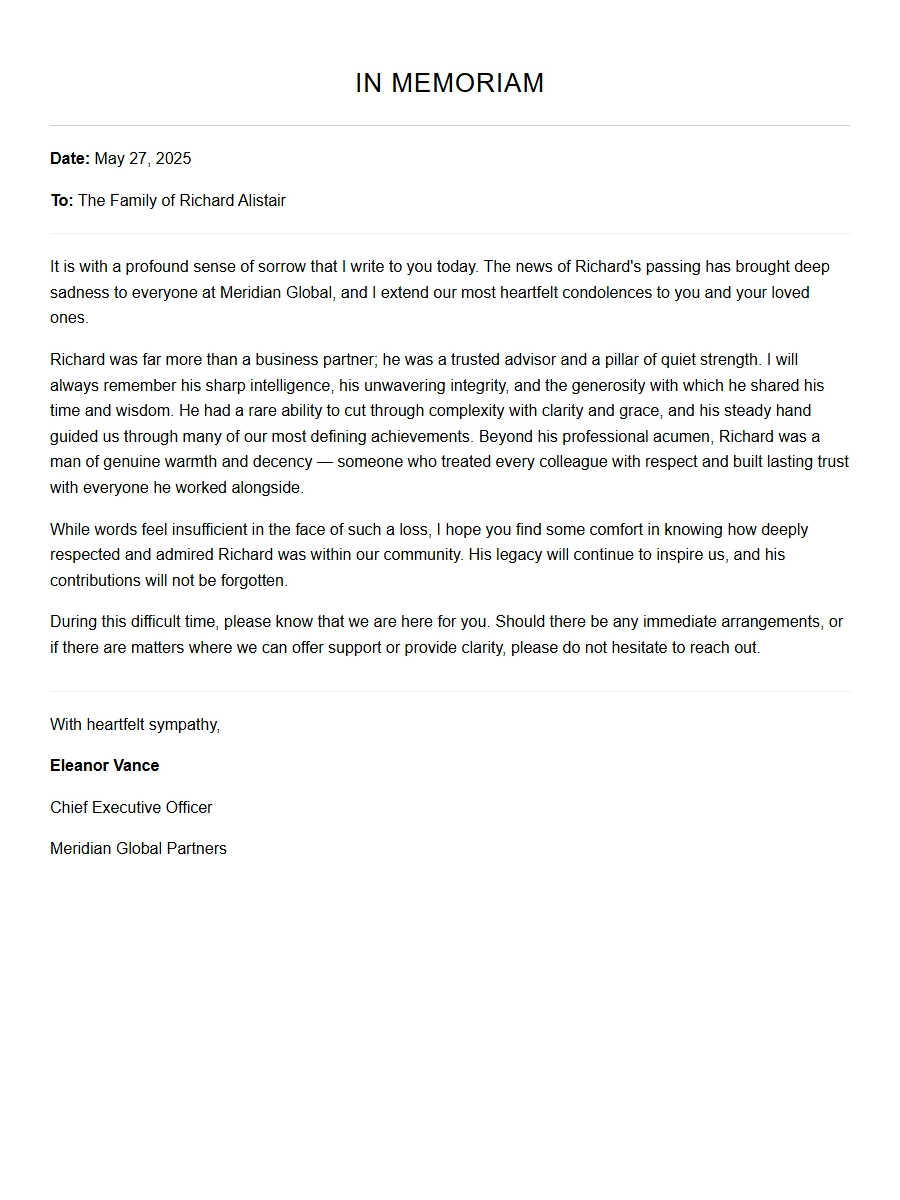 Formal Condolence Message for a Business Partner
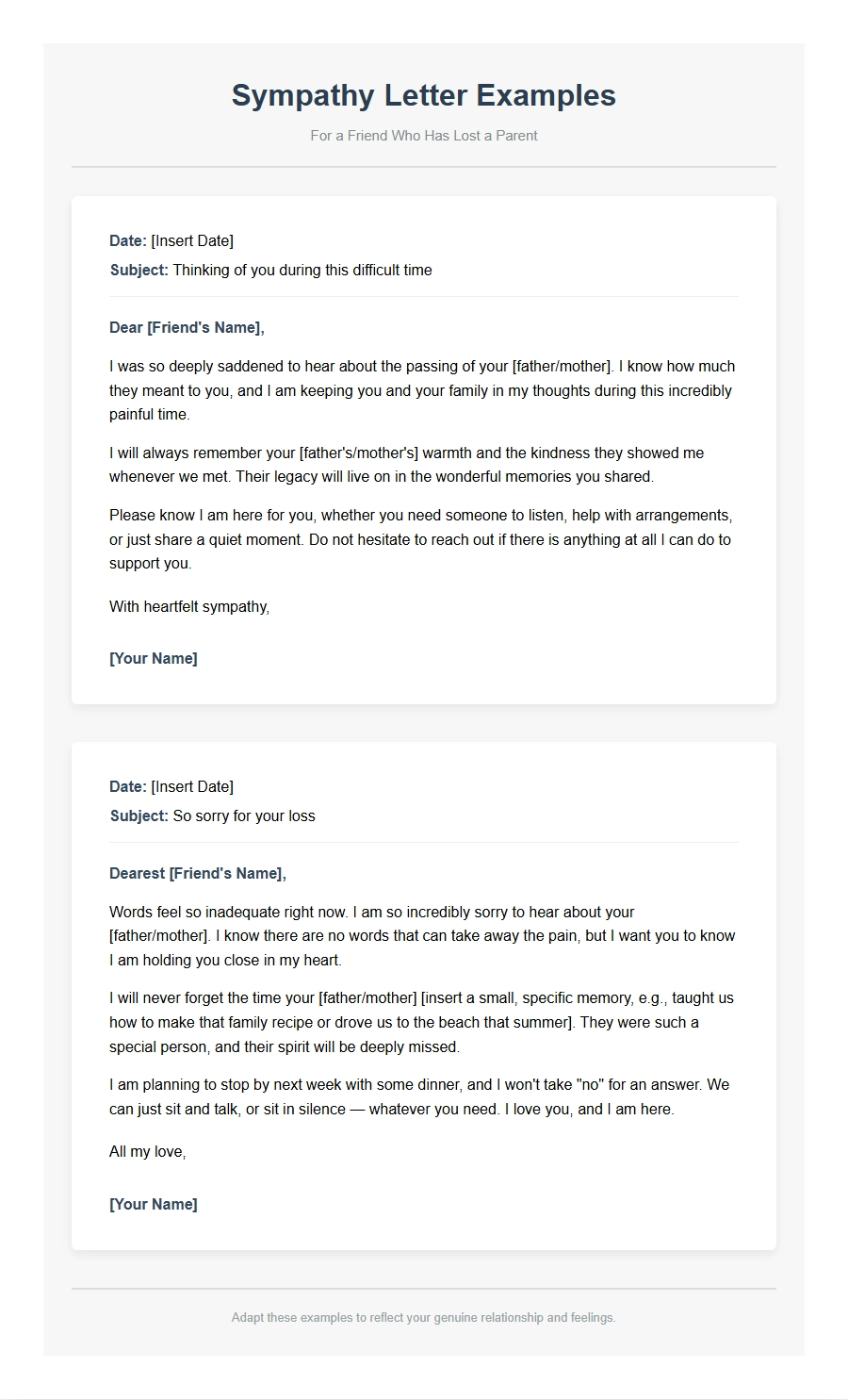 Sympathy Letter Examples for a Friend Who Lost a Parent
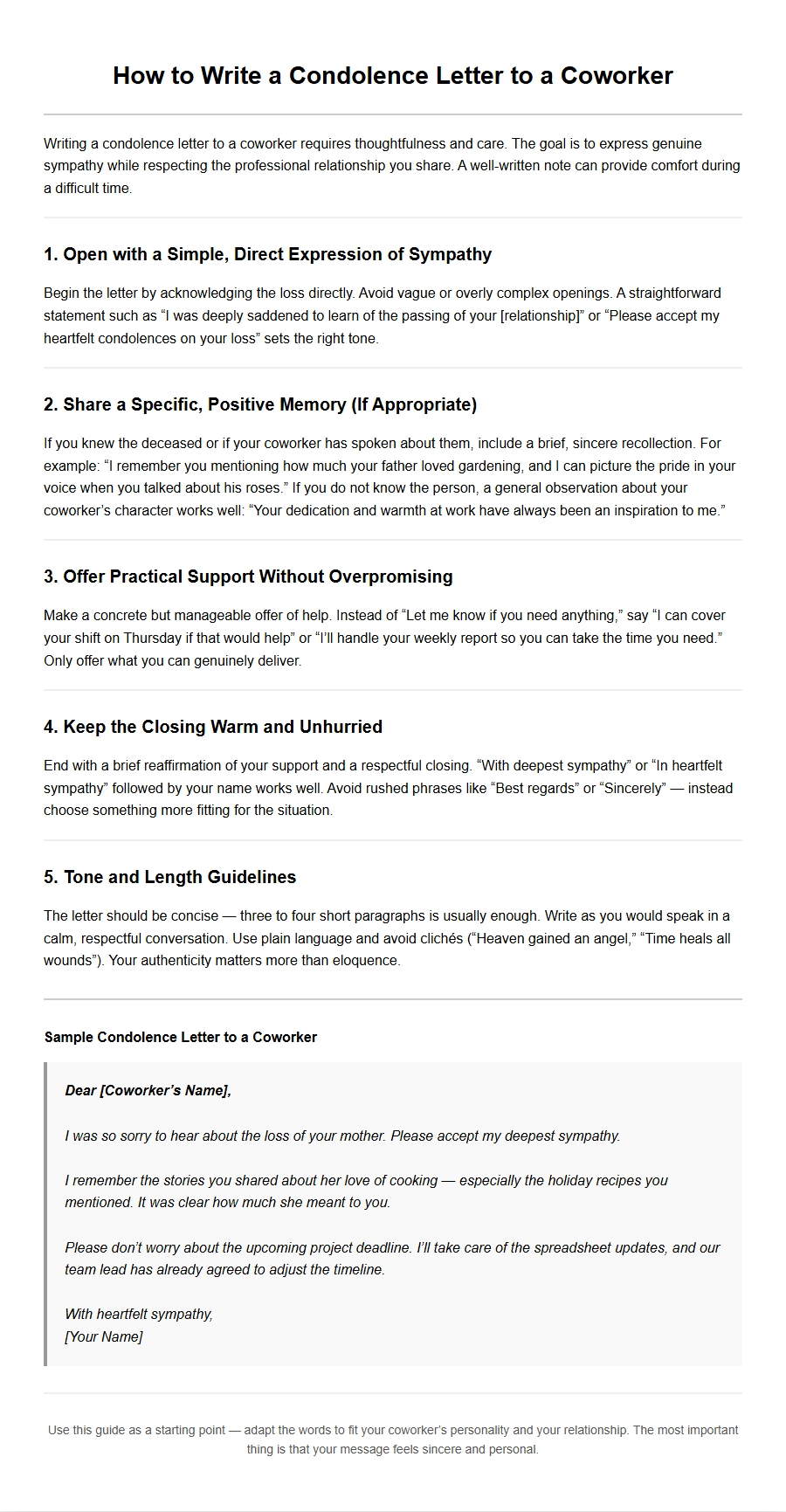 How to Write a Condolence Letter to a Coworker
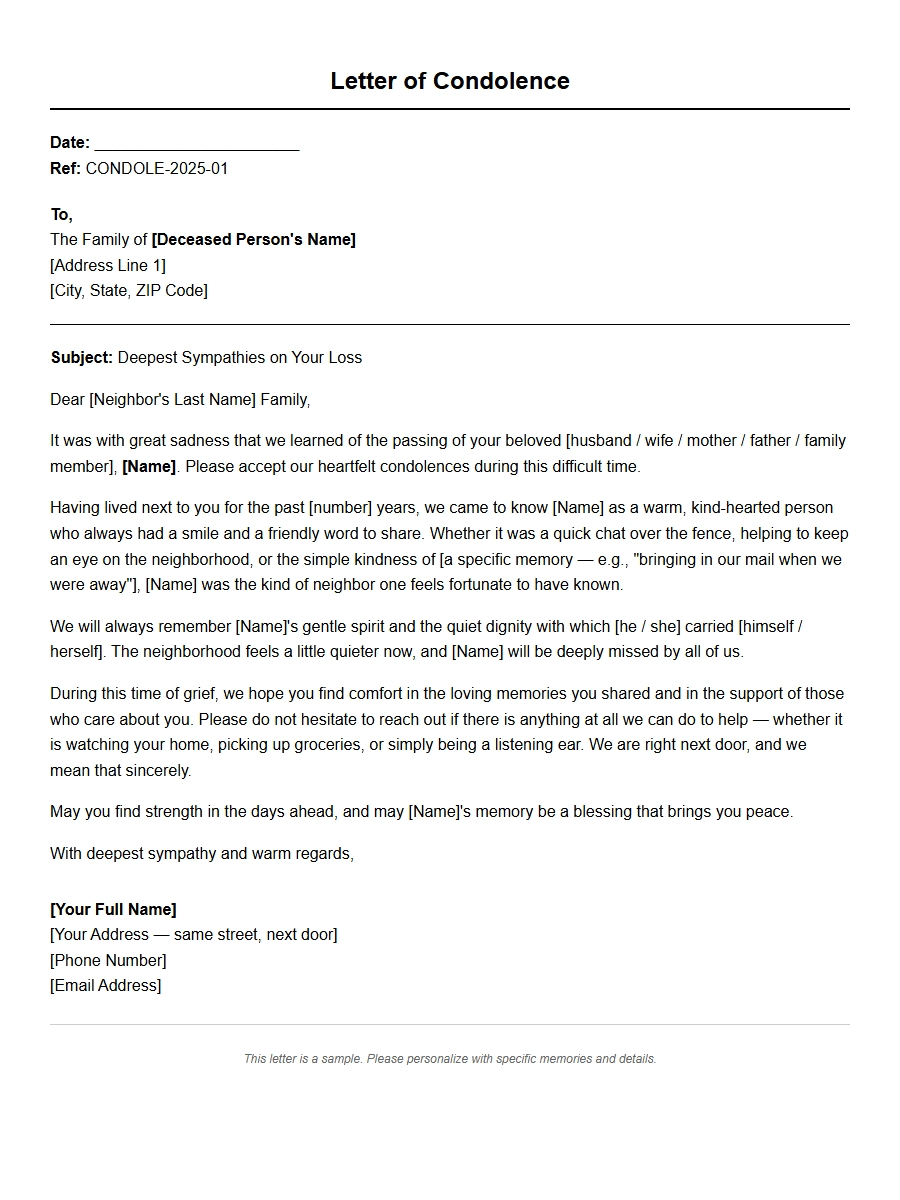 Condolence Letter Sample for a Neighbor
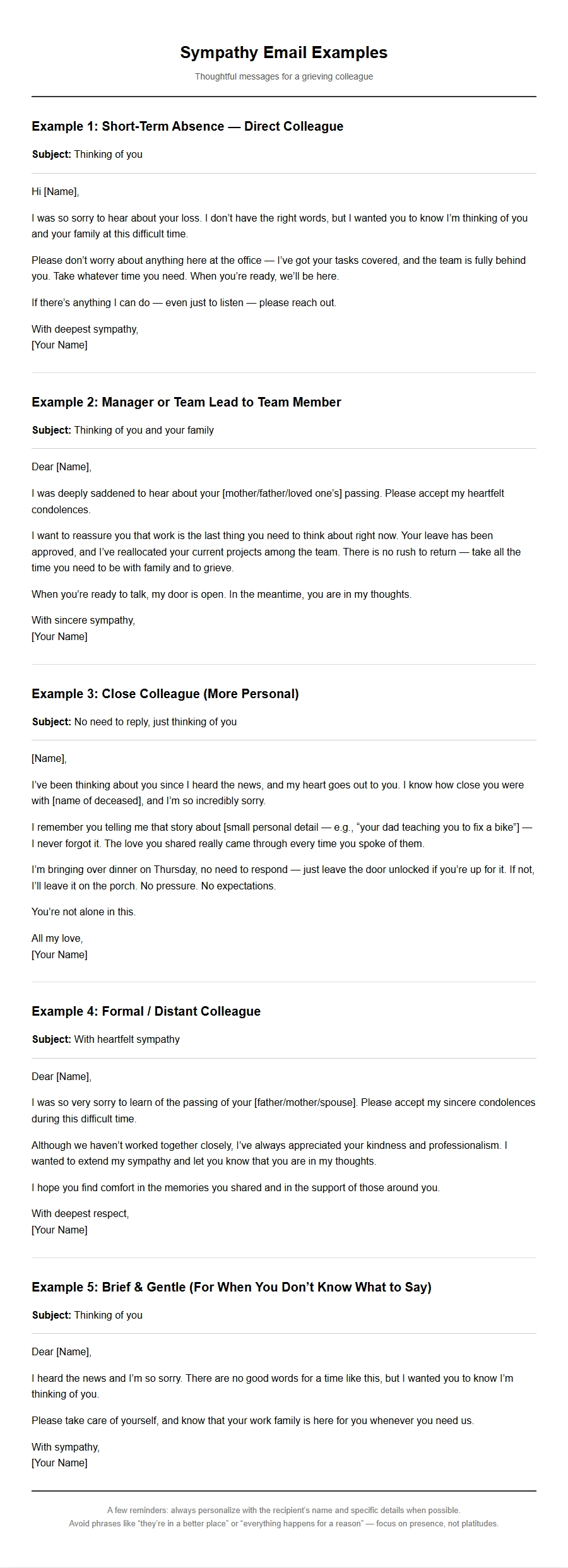 Sympathy Email Examples for a Grieving Colleague
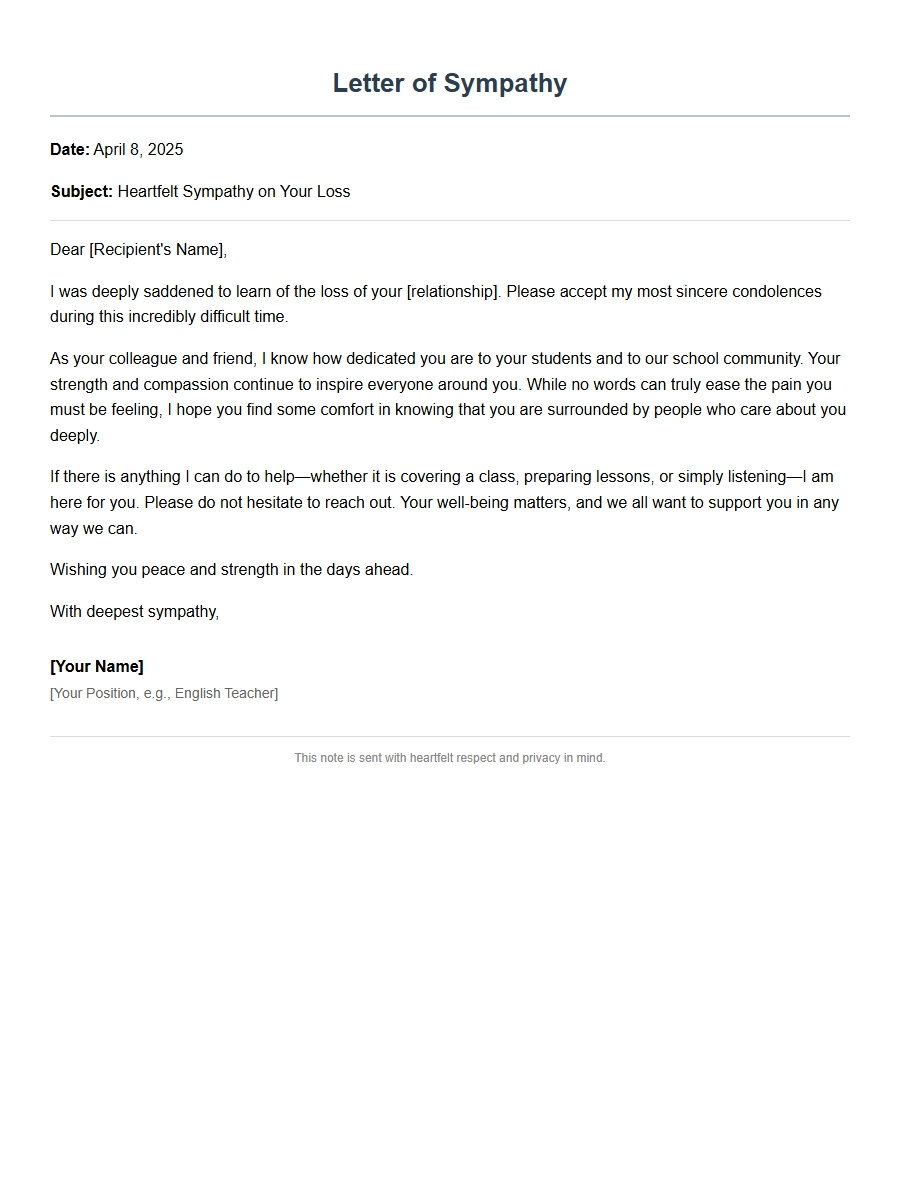 Condolence Words for a Teacher