You sit down to write a sympathy email to a grieving colleague and suddenly every word feels wrong. Too formal sounds cold. Too casual feels disrespectful. You delete the sentence and start over three times. That blank page can make a difficult task even harder.
But here’s the truth: using a sample email isn’t cheating. It’s a smart strategy. A good example gives you a structure, a tone that works, and key phrases you can personalize. Think of it as a starting point—not a script to copy word for word. The best professional correspondence balances warmth and respect. A sample helps you find that balance faster, especially when you’re already worried about saying the right thing.
Why use a sympathy email example?
When a coworker loses someone close, you want to show you care without adding to their burden. A thoughtful note matters. But if you’ve never written one, it’s easy to freeze. A letter template shows you what a proper business letter format looks like in digital form—minus the letterhead and formal address block. Most sympathy emails follow a simple structure: subject line, salutation, short message of support, offer of help, and a respectful closing.
[Category: Workplace Communication]
Starting with a template saves you from guessing the letter structure. You can focus on what to say instead of how to lay it out. That matters when you’re emotional or pressured to respond quickly.
Choosing the right sample for the situation
Not every sympathy email fits every relationship or loss. You wouldn’t write the same note to a close teammate as you would to a senior leader you rarely talk to. Think about your relationship with the person, the nature of their loss, and the culture of your workplace. Some offices expect a more formal tone. Others appreciate a shorter, warmer message.
Look for cover letter examples or resignation letter sample references? That’s the wrong category. Instead, search specifically for condolence notes written for colleagues. If the loss involves suicide or sudden tragedy, a standard message may miss the mark. For those cases, you’ll want guidance like our sympathy message for suicide loss survivor—the tone needs extra care and no clichés.
Cultural background also plays into what feels respectful. If your colleague comes from a different cultural tradition, certain phrases might land poorly. Our article on handling cultural differences in condolence letters can help you avoid unintentional missteps.
How to adapt a sample without losing your voice
Nobody wants to receive a form letter when they’re grieving. Your colleague will notice if you copy-paste without changing a thing. The trick is to use the sample as a skeleton and then add your own words.
Start by reading the sample aloud. Does it sound like you? If not, swap phrases. Change “I was deeply saddened to hear” to something that feels more natural, like “I’m so sorry about your loss.” Keep the salutation and closing appropriate—use their first name if you normally do, and sign off with a simple “With sympathy” or “Thinking of you.”
One common mistake is ignoring the tone in writing when switching from printed letter to email. A printed note might include a full address and formal date. An email should be short and scannable. Leave out the letterhead design—stick to a clean digital letter format without extra clutter.
Always proofreading letter is non-negotiable. A typo in a sympathy note sticks out. Read it once, step away, then read it again. If possible, ask a trusted friend to glance at it before you send.
Tailoring the opening to feel genuine
The first sentence sets the tone. Don’t start with “I heard about your loss.” That feels distant. Instead, mention the person’s name if you knew them, or simply say, “I was so sorry to learn that your father passed away.” If you didn’t know the deceased, it’s okay to say, “I can’t imagine what you’re going through right now.”
Keep the message brief. A paragraph or two is enough. Offer a specific, realistic way to help—like bringing lunch next week or covering a meeting—rather than a vague “let me know if you need anything.” That shows you’ve thought about what might actually help.
Avoiding common etiquette pitfalls
Even with a good example, people slip up. Avoid outdated salutation and closing like “To whom it may concern” or “Sincerely yours”—those feel too stiff for a personal condolence. Also, don’t include a long list of your own memories unless you were close to the deceased. The email is about the colleague, not you.
The perfect condolence email doesn’t exist. What matters is that you sent it. Your colleague will remember that you reached out, not that every word was flawlessly chosen. Over time, writing these messages gets easier. The first few are the hardest, so give yourself permission to lean on a sample.
Adapt it, add your voice, double-check the details, and send it. You won’t regret showing up for a coworker when they need it most.
Samples for Inspiration
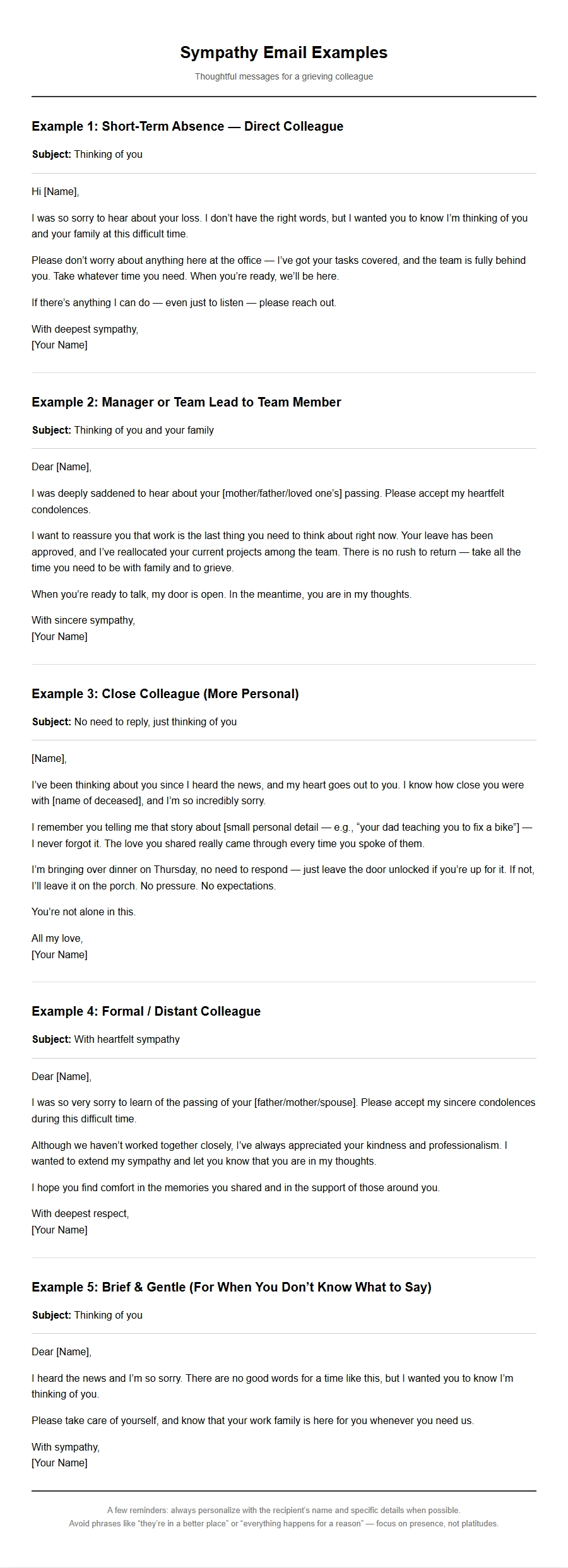
Sympathy Email Examples for a Grieving Colleague
A Brief Message of Sympathy
Dear [Colleague's Name],
I was deeply saddened to hear about your loss. Please accept my heartfelt condolences during this difficult time. You are in my thoughts and prayers.
If there is anything at all that I can do to help—whether it is covering a meeting, handling a task, or just being someone to talk to—please do not hesitate to reach out. I want to lighten your load in any way possible.
Take all the time you need to grieve and be with your family. We are all thinking of you here at the office.
With sincere sympathy, [Your Name]
Offering Practical Support
Dear [Colleague's Name],
I was so sorry to learn of your recent loss. I know words cannot fully express how I feel, but please know that I am here for you.
During this challenging time, sometimes practical help can make a difference. Please consider the following ways I can assist:
Taking over your current project tasks for the next two weeks
Coordinating meal deliveries from the team
Handling any urgent email or client calls
Walking your dog or picking up groceries (if needed)
Do not feel you have to respond right away—just accept the help when you need it. You are a valued colleague and friend, and your well-being comes first.
With warm regards, [Your Name]
Sharing a Fond Memory
Dear [Colleague's Name],
I was heartbroken to hear about the passing of your [relationship, e.g., father]. I will always remember the story you told me about him teaching you how to fix a bicycle—his patience and sense of humor shone through in everything you shared.
That memory makes me smile, even as I grieve with you. He clearly raised a wonderful person, and his legacy lives on in you.
I know no one can replace him, but I hope you find comfort in the wonderful memories you have. I am here to listen whenever you want to talk more about him.
Thinking of you, [Your Name]
For a Loss of a Parent
Dear [Colleague's Name],
I am so sorry to hear about the passing of your mother. Losing a parent is one of life's most profound losses, and I cannot imagine what you are going through. Please know that the entire team is holding you close in our thoughts.
Your mother was clearly a remarkable woman, as reflected in the kind and hardworking person you are. I am grateful for the times you shared stories about her—they painted a picture of a loving and supportive family.
If you ever feel overwhelmed, please remember that we are here to support you without hesitation. I have already spoken with [Manager's Name] to ensure you have ample time to be with your family and attend to arrangements.
Wishing you peace and comfort, [Your Name]
For a Loss of a Spouse
Dear [Colleague's Name],
I was devastated to learn of the passing of your husband. Words cannot adequately express the sorrow I feel for you. Please accept my deepest condolences.
I know that your husband was your rock and your best friend. The love you shared was evident in every conversation we had about him. The memories you built together will be a lasting treasure.
During this incredibly difficult time, please allow yourself the grace to grieve and heal. I will coordinate with the team to ensure all your responsibilities are covered for as long as you need. We are also planning to have meals sent to your home—details will follow from [Colleague's Name] who is organizing it.
You are not alone. We are here for you every step of the way.
With heartfelt sympathy, [Your Name]
For a Colleague Who Lost a Child
Dear [Colleague's Name],
I am at a loss for words upon hearing the tragic news of your son's passing. There is no greater sorrow than losing a child, and my heart aches for you and your family.
Please know that you are surrounded by love and support here. We are all thinking of you, and we respect your need for privacy during this unimaginable time. Feel free to step away from work completely; we will manage everything.
I have compiled a short list of resources that some colleagues have found helpful in times of grief:
Employee Assistance Program (EAP) confidential counseling: [Phone Number]
Local grief support groups: [Link/Name]
GriefShare: [Website]
You do not have to respond to this message. Please just know that we care deeply. I am holding you in my thoughts.
With deepest sympathy, [Your Name]
A Group Message from the Team
Dear [Colleague's Name],
On behalf of the entire [Department Name] team, we want to express our deepest condolences on your recent loss. We were all saddened to hear the news, and each of us is thinking of you during this painful time.
To show our support, we have put together a few things:
Item
Status
Sympathy card signed by everyone
Delivered via mail
Meal delivery voucher
Sent to your email
Additional time off approved
Arranged with HR
Weekly check-in by [Colleague's Name]
Will begin when you are ready
Please let us know if there is anything else we can do. You are a cherished part of our team, and we will be here whenever you need us.
With love and sympathy, The [Department Name] Team
For a Colleague on Extended Leave
Dear [Colleague's Name],
I heard about your loss and wanted to send my warmest condolences, even though you are currently away from the office. I hope this message finds you in a moment of peace among the chaos of grief.
Please do not worry about work at all. We have everything covered. I have taken over your main accounts, and [Other Colleague's Name] is handling routine tasks. A detailed summary of current projects is ready for you when you return—but not a moment sooner. Your health and healing are what matter most.
I have also arranged for your emergency contacts to be updated so that you will not receive any non-essential work notifications. If there is anything you need from the office (files, contact numbers, etc.), just let me know and I will get it to you discreetly.
You are missed, but we want you to take all the time you need. Sending strength and comfort your way.
Warmly, [Your Name]
Acknowledging a Difficult Time
Dear [Colleague's Name],
I was so sorry to learn about your loss. Grief can be an overwhelming and unpredictable journey, and I want you to know that you have my full support every step of the way.
It is okay to not be okay right now. Please give yourself permission to feel whatever comes—sadness, anger, numbness. There is no right or wrong way to grieve. Your well-being is the priority, and the office can wait.
I want to remind you of a few things that might be helpful:
Your workload is being redistributed, so no deadlines are looming.
You can access our EAP for free confidential counseling 24/7.
Your closest colleagues are ready to take you out for coffee or a walk whenever you feel like company.
You are a wonderful person and colleague, and we are all here for you. Lean on us as much as you need.
With compassion, [Your Name]
With an Offer of Confidential EAP
Dear [Colleague's Name],
I was deeply sorry to hear about your recent loss. My thoughts are with you and your family during this painful time.
Aside from offering my personal support, I want to remind you that our company provides an Employee Assistance Program (EAP) that offers confidential counseling and resources for grief. Sometimes speaking with a professional can provide an outlet that friends and family cannot. I encourage you to take advantage of it when you feel ready.
Here are the key details:
Service
Contact
EAP Hotline (24/7)
1-800-555-0199
Counseling sessions
Up to 6 free sessions per issue
Online resources
www.example-eap.com/grief
Local support group referrals
Available upon request
Please also remember that you have a supportive team here. We are ready to cover your duties for as long as necessary. Take good care of yourself.
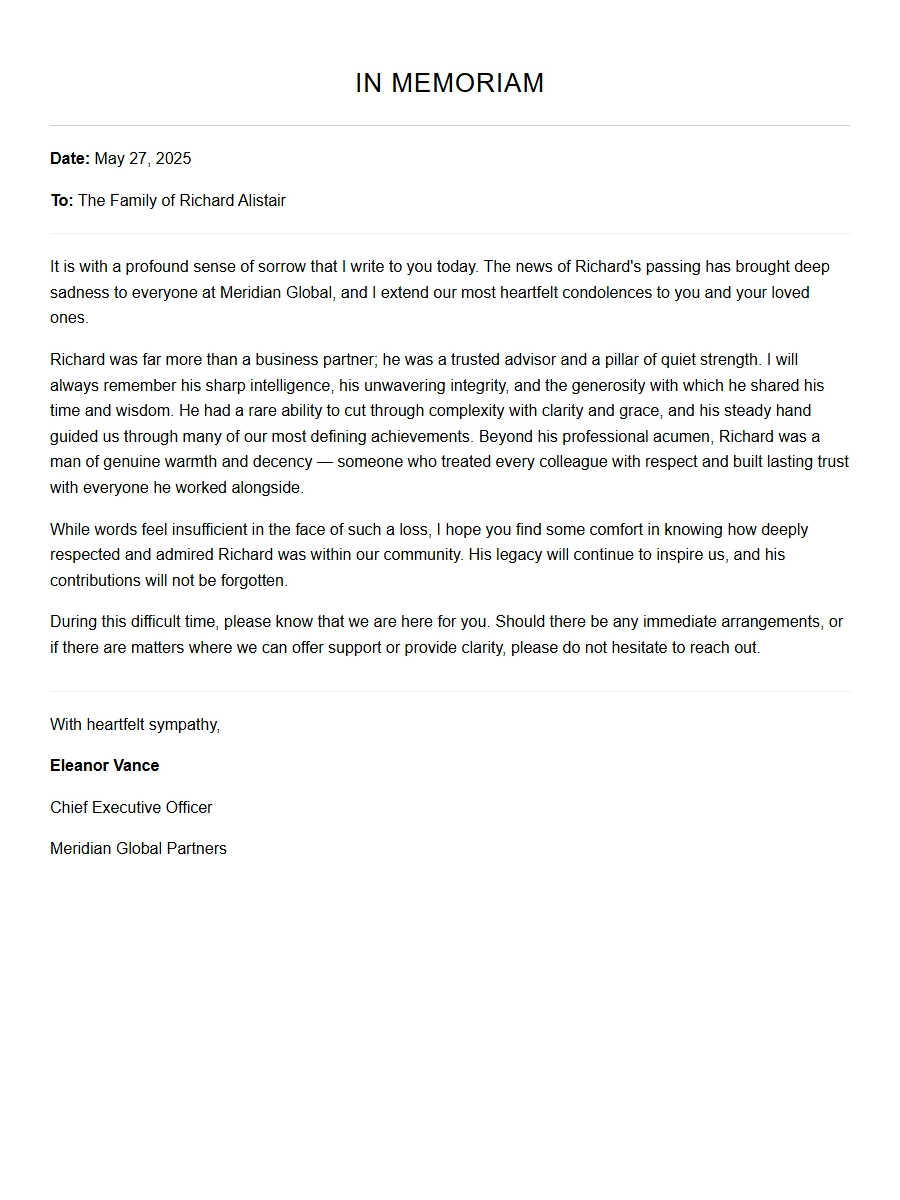 Formal Condolence Message for a Business Partner
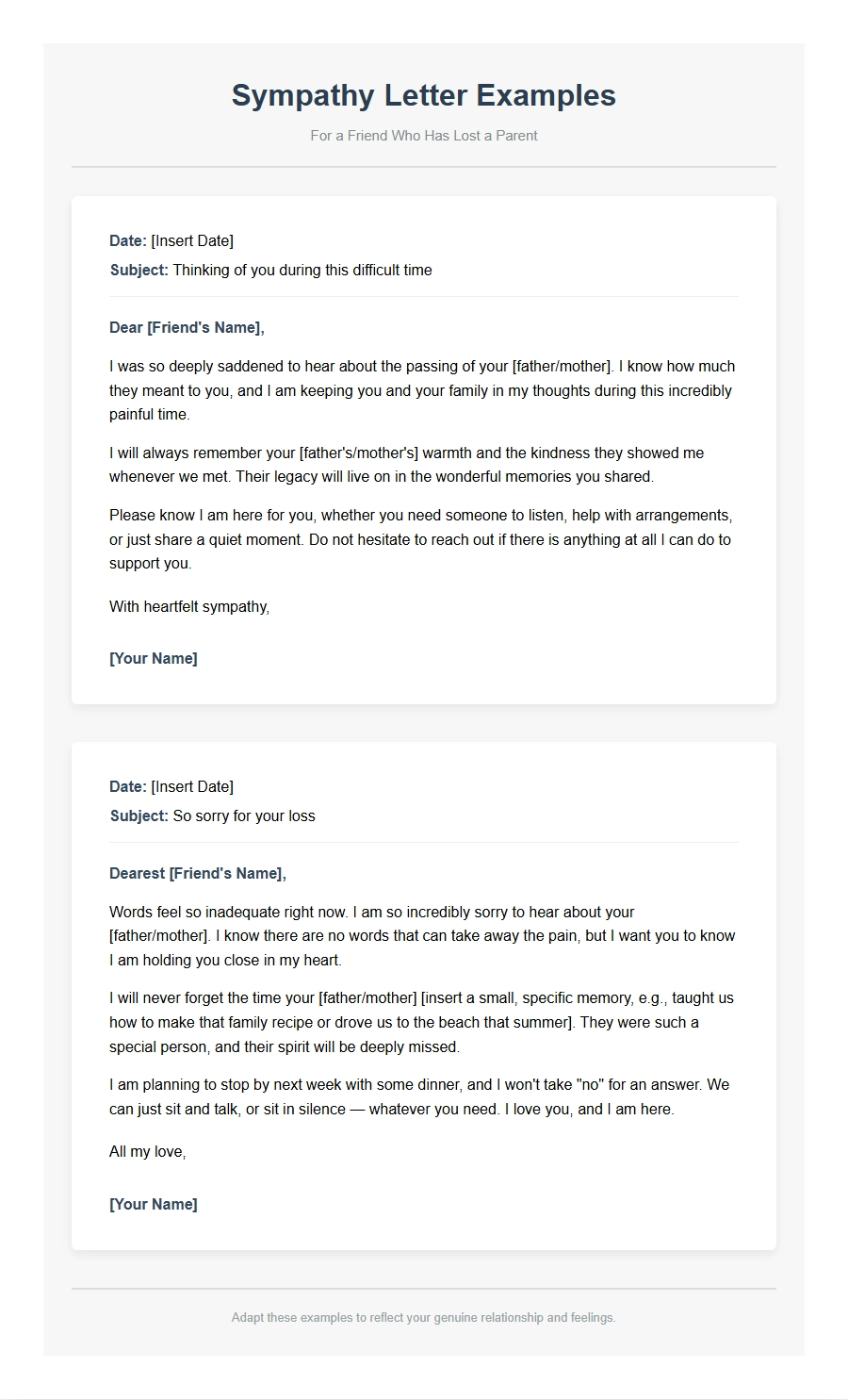 Sympathy Letter Examples for a Friend Who Lost a Parent
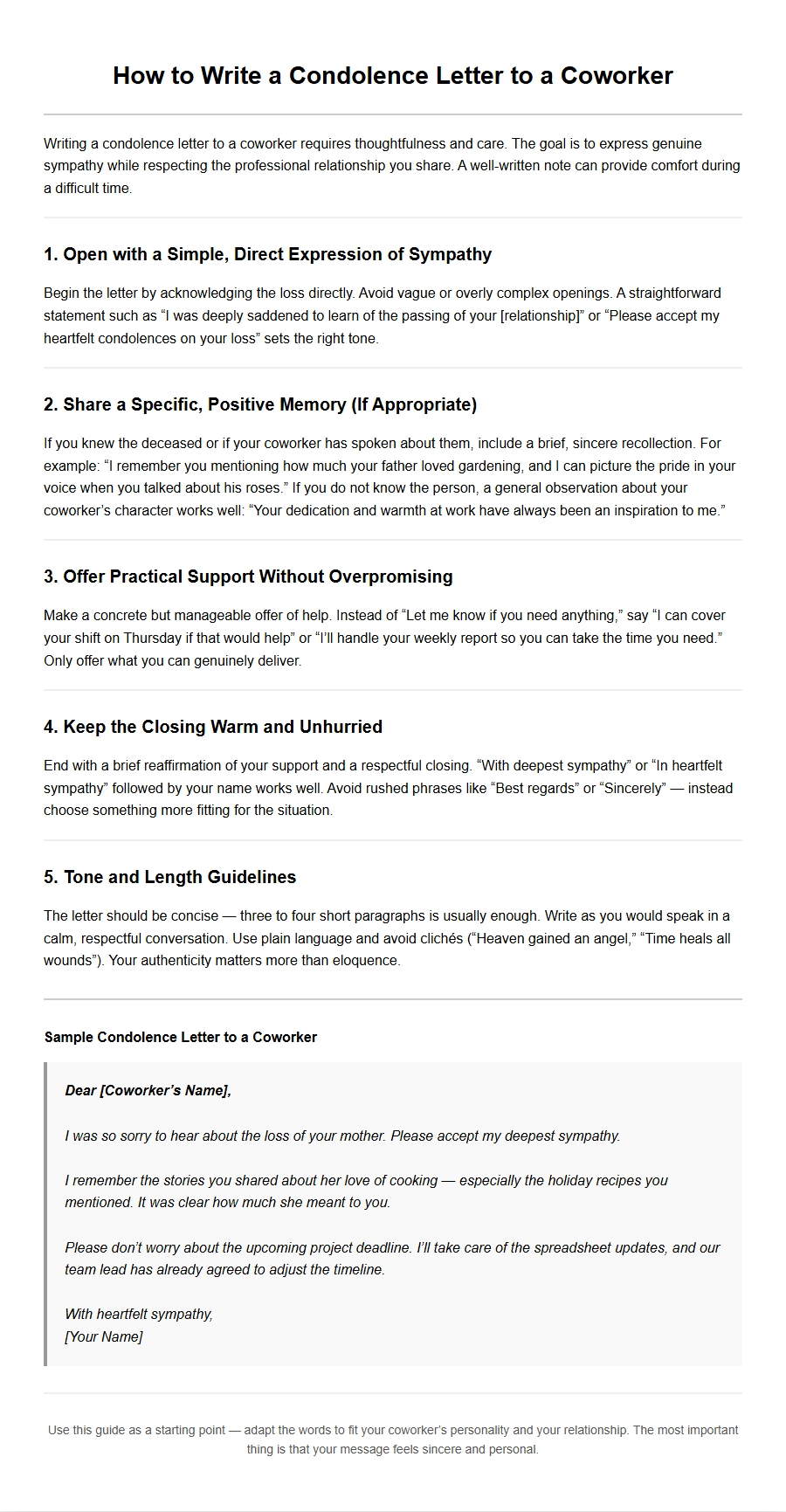 How to Write a Condolence Letter to a Coworker
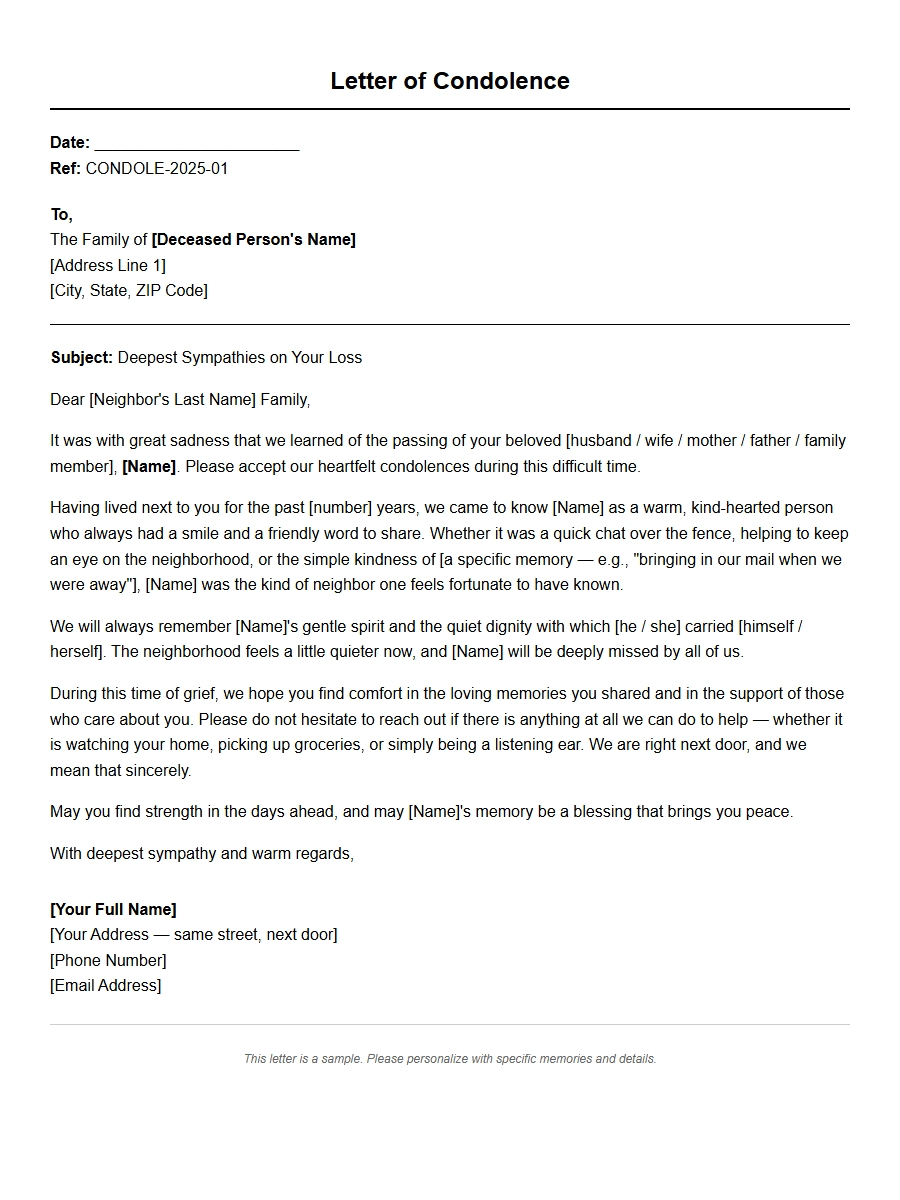 Condolence Letter Sample for a Neighbor
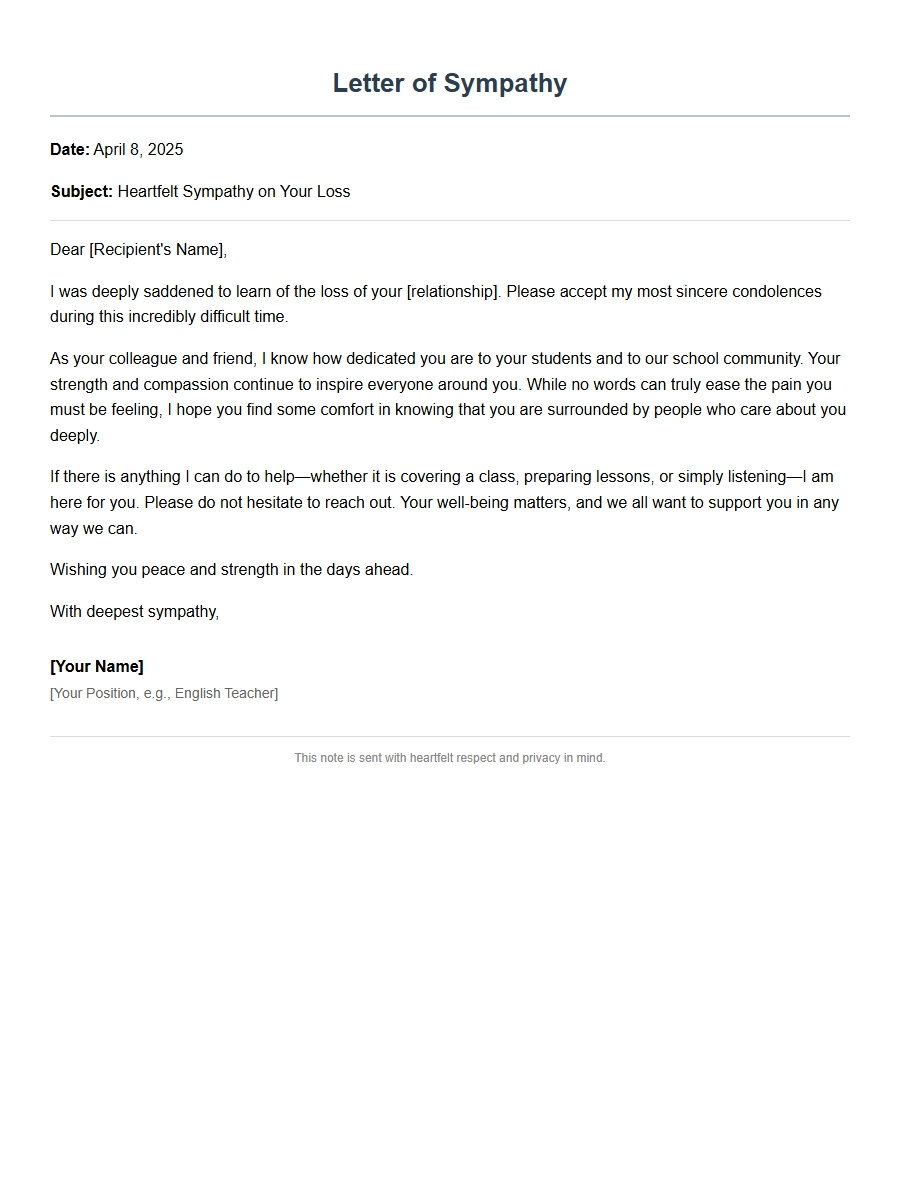 Condolence Words for a Teacher
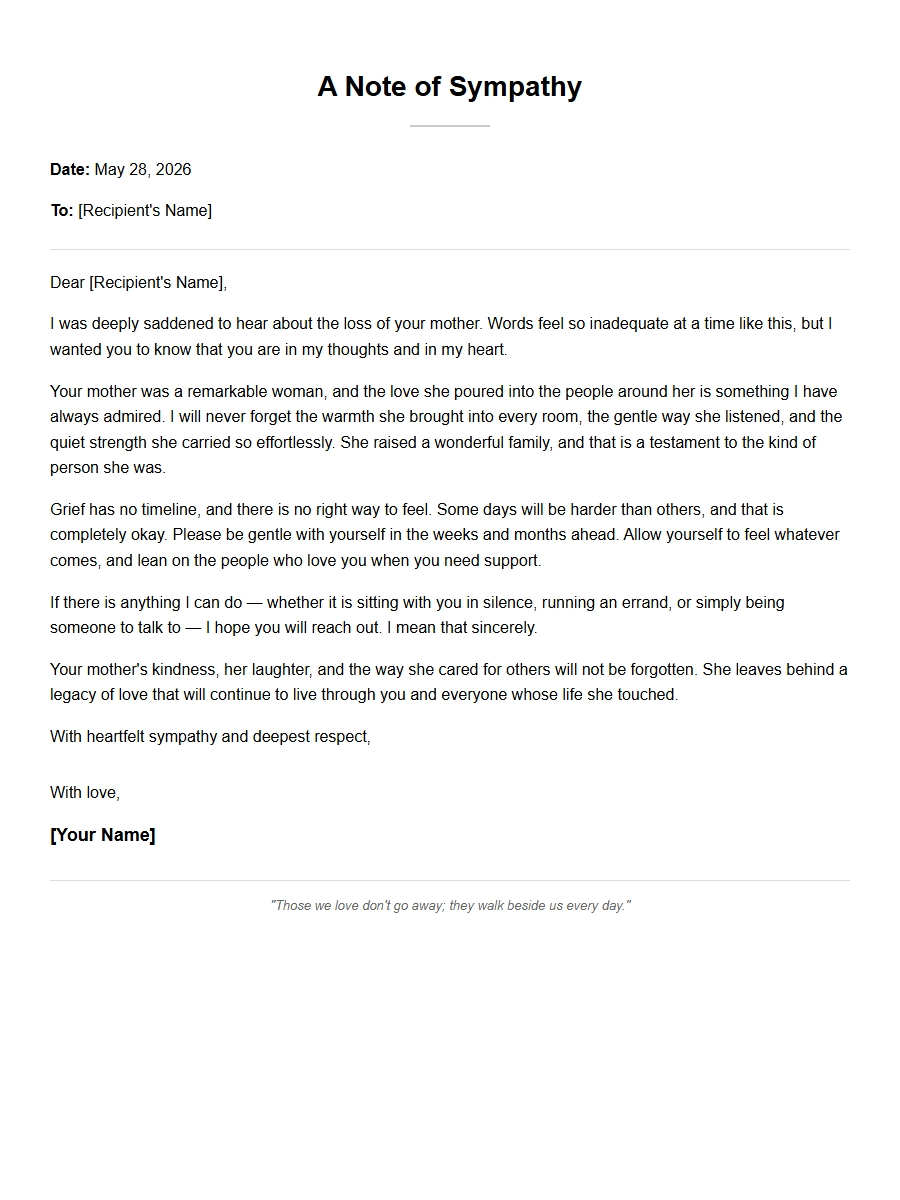 How to Write a Condolence Note for Loss of Mother