Finding the right words to express sympathy to a teacher can feel awkward. You want to be supportive but also respectful of your role as a parent or student. A well-chosen phrase can make a big difference.
Using a sample message is not cheating—it gives you a solid letter structure and appropriate tone, while leaving room for your personal touch. Think of it as a customizable letter that you adapt to your specific situation.
Category: Sympathy Letters for Teachers – This guide covers both formal and informal approaches, depending on your connection with the teacher.
What Makes Sympathy Words Appropriate for a Teacher?
The most appropriate sympathy words are sincere, respectful, and tailored to your relationship. A teacher is a professional, so your tone in writing should reflect that even if you’re close. Avoid slang or overly casual phrases. Stick to letter writing etiquette—use a proper salutation like “Dear Mrs. Johnson” and a closing such as “With heartfelt sympathy.”
If you’re sending an email, keep the digital letter format simple: a clear subject line, a brief message, and your name. For a handwritten card, choose a tasteful design and use your best handwriting. Proofreading your letter is crucial—typos can make your message feel rushed or insincere.
How to Choose the Right Sample for Your Situation
Not all sympathy notes are the same. If the teacher has lost a family member, you’ll need a more formal professional correspondence tone. If it’s a beloved pet, a warmer, shorter note works. Look for a letter template that matches the depth of your relationship. For example, a parent you’ve known for years can include a personal memory; a new parent might stick to general condolences.
When adapting a sample, read it aloud. Does it sound like you? If not, change a few words. Swap “deeply saddened” for “so sorry to hear” if that feels more natural. The key is to be genuine without losing the respectful tone.
Common Mistakes to Avoid
Using outdated salutations like “To whom it may concern” makes the note feel cold. Going too far the other way—saying “That’s rough” or “Hang in there”—can feel dismissive. Also, don’t forget to consider the medium. A printed letter might include a letterhead design if it’s from an organization, but for a personal note, simple stationery is fine.
Another pitfall: ignoring the teacher’s preferred communication style. Some appreciate a long email; others prefer a short, handwritten card. If you’re unsure, err on the side of formality.
Practical Tips for Tailoring Your Message
Start your note by acknowledging the loss, then offer a kind thought or memory. Keep the salutation and closing consistent with the tone. For example, “Dear Mr. Adams” and “With deepest sympathy” work for a formal note. For a warmer tone, “Dear Sarah” and “Thinking of you” might be better.
If you need help with the follow-up, our guide on how to follow up after sending a condolence letter can help you stay connected without overstepping. For a comforting email for a friend with anxiety during grief, check out this related article—some phrases there can be adapted for a teacher.
The best sympathy words for a teacher come from a place of kindness. Use a sample as your starting point, then add your own memories or specific details. For example, “I’ll always remember how you encouraged my daughter in math” is far more personal than a generic phrase. With practice, writing these notes becomes quicker and more natural. You’re not just following a template—you’re building a bridge of care that the teacher will truly appreciate.
Simple Examples
Condolence Words for a Teacher
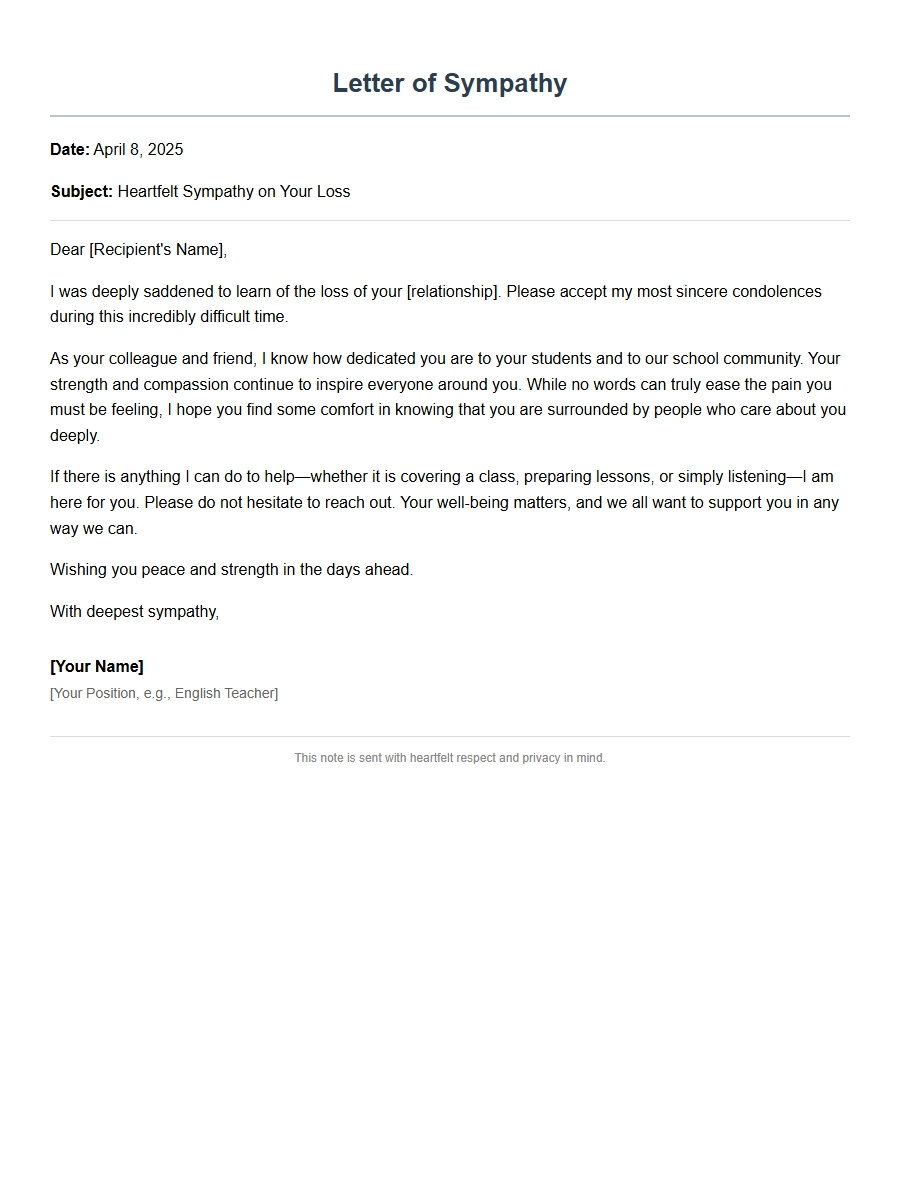
From a Colleague to the Bereaved Teacher
Subject: With Deepest Sympathy
Dear [Teacher's Name],
I was deeply saddened to learn of the passing of your mother. Please accept my heartfelt condolences during this difficult time. Your dedication to our students and the grace you bring to every lesson have always inspired me. I know that your mother was very proud of the educator you have become.
Having taught alongside you for the past six years, I have witnessed your kindness and strength. Now I hope you can feel some of that same support from all of us. Our school community is holding you in our thoughts.
With sincere sympathy,
[Your Name]
9th Grade English Department
From a Student to a Grieving Teacher
Dear Mr. Johnson,
I heard about the loss of your brother. I am so sorry. You have always been more than a teacher to us — you have been a mentor and a friend. Your lessons about perseverance and compassion have stayed with me long after I left your classroom.
Please know that your students are thinking of you. If there is anything we can do — even just bringing in a coffee or covering a duty — please let us know. You have given so much to us; it is our turn to support you.
With deepest gratitude, Sarah M. (Class of 2022)
From a Parent to a Teacher Who Lost a Spouse
Dear Mrs. Patel,
Our family was heartbroken to learn that your husband passed away. Your calm presence in the classroom and the way you nurture every child’s potential have made such a difference in our son’s life. I cannot imagine how difficult this time must be for you and your children.
Please do not hesitate to ask for help with school tasks or anything at home. Our PTA has created a meal schedule and a fund to assist with immediate needs. You are not alone.
With love and sympathy, Jennifer and Tom Adams
From a Former Student to a Retired Teacher
Dear Dr. Williams,
I was so very sorry to read about the loss of your sister. After I graduated, you remained a voice of wisdom in my life. I still use the critical thinking skills you taught me in your history classes. Your sister must have been a remarkable person to be so cherished by you.
I am sending this note from across the country, but please know my thoughts are with you. Enclosed is a copy of my first published paper — it carries your influence on every page.
With eternal gratitude, Alex R.
Condolence Letter from School Administration
To: Mr. Thomas Chen, 5th Grade Teacher
On behalf of the entire administration and staff at Lincoln Elementary, I extend our deepest sympathy on the loss of your father. Your father was a pillar of our community, and we know how close you were to him.
During this time, please take all the time you need. We have arranged substitutes for your classes for the next two weeks, and your colleagues will handle all extracurricular duties. Below are key contacts:
Support Resource
Contact Person
Phone
Leave Coordination
Ms. Rivera (HR)
ext. 3201
Class Coverage
Mr. O'Brien (VP)
ext. 4520
Counseling Services
Dr. Park
ext. 5110
With heartfelt sympathy, Principal Susan Gale
From a Fellow Teacher: Loss of a Pet
Dear Emily,
I am so sorry that your beloved dog, Buddy, passed away. I know how much Buddy meant to you — he was your faithful companion during late-night grading sessions and a regular visitor to our school’s “bring your pet to work” day. He brought joy to everyone who met him.
Please don’t feel pressure to come back too soon. We will manage your morning duty schedule. Take time to grieve. Buddy was truly a good boy.
With warmest regards, Jake (Room 204)
Expression of Sympathy from a Student Group
Dear Ms. Clarke,
The entire student council was devastated to learn about the loss of your grandmother. She must have been an extraordinary woman to have raised such a dedicated teacher. You always speak about her with such love.
We would like to honor her life and your support to us. On Friday, we will hold a moment of silence before the assembly. We have also collected handwritten cards from each grade — they are in the envelope with this letter. You are the heart of our school.
With love from your students, Student Council, Class of 2025
Condolence Note from a Substitute Teacher
Dear Mr. Foster,
Though I only substitute in your class occasionally, I have always admired your patience and creativity. When I heard your mother passed away, I wanted to express my sincere sympathy. I cannot imagine the pain of losing a parent.
If you need someone to cover a day at short notice, please call me. I am keeping you in my thoughts.
In sympathy, Katie L., Substitute Teacher
From a Mentor Teacher to a New Teacher
Dear Amanda,
I was so sorry to hear that your aunt has passed away. I know she was the one who encouraged you to become a teacher, and her influence is visible in your classroom every day. Your students are lucky to have you.
Please do not worry about your lesson plans this week. I will cover your 3rd period class and handle any parent calls. Grieving is important — let yourself feel.
Thinking of you, Barbara (your mentor teacher)
Condolence Letter from a School Board Member
Dear Dr. Harrison,
On behalf of the School Board, I extend our most sincere condolences on the loss of your husband. He was a beloved community figure and a constant supporter of our schools. Your grace and dedication through this tragedy is a testament to your strength.
The board has approved an extended bereavement leave with full pay. Please take all the time you need. We have arranged memorial support through our district’s family assistance program. Below are available resources:
Service
Provider
Details
Bereavement Counseling
Wellness Center
6 free sessions
Meal Delivery
PTA
Contact Mrs. Lee
Financial Aid
School Board
Call ext. 999
With deepest respect, Margaret Collins, School Board President
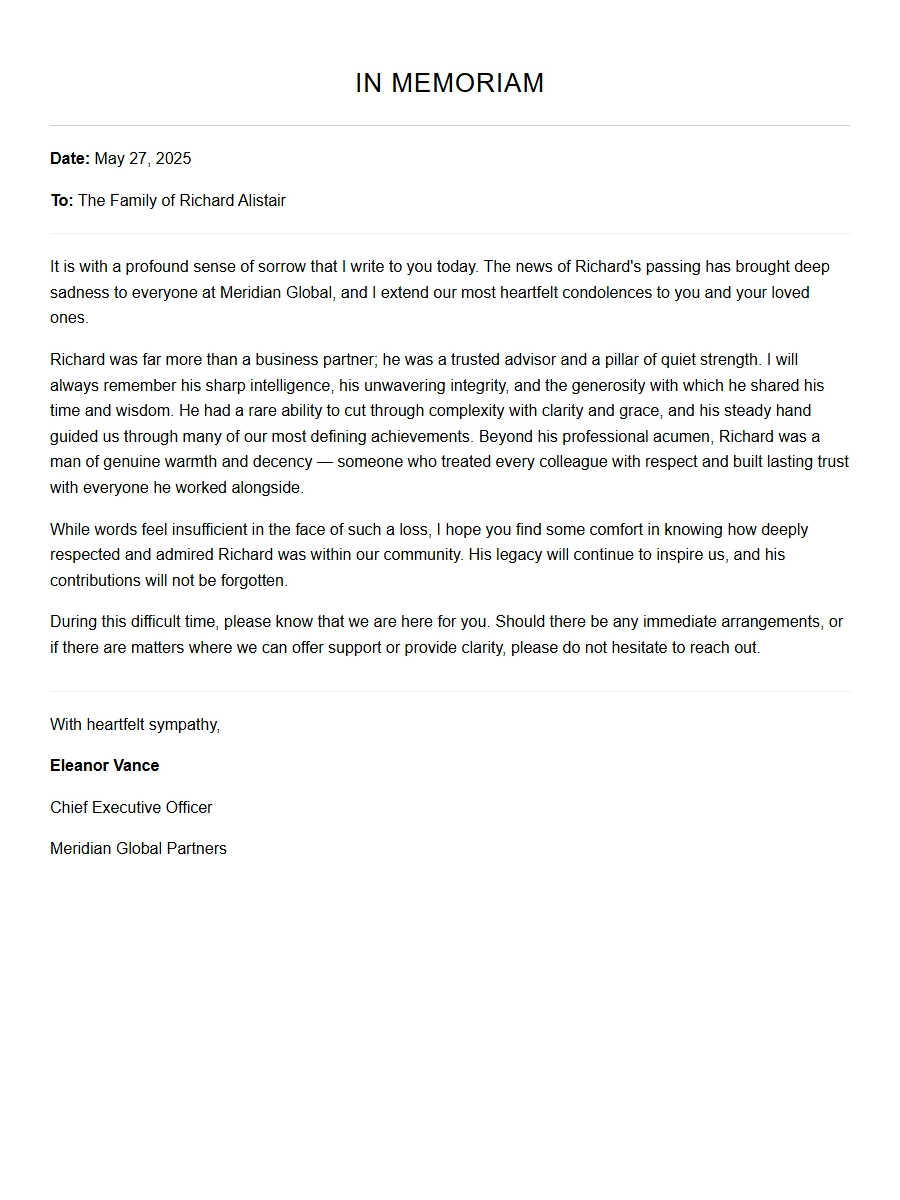 Formal Condolence Message for a Business Partner
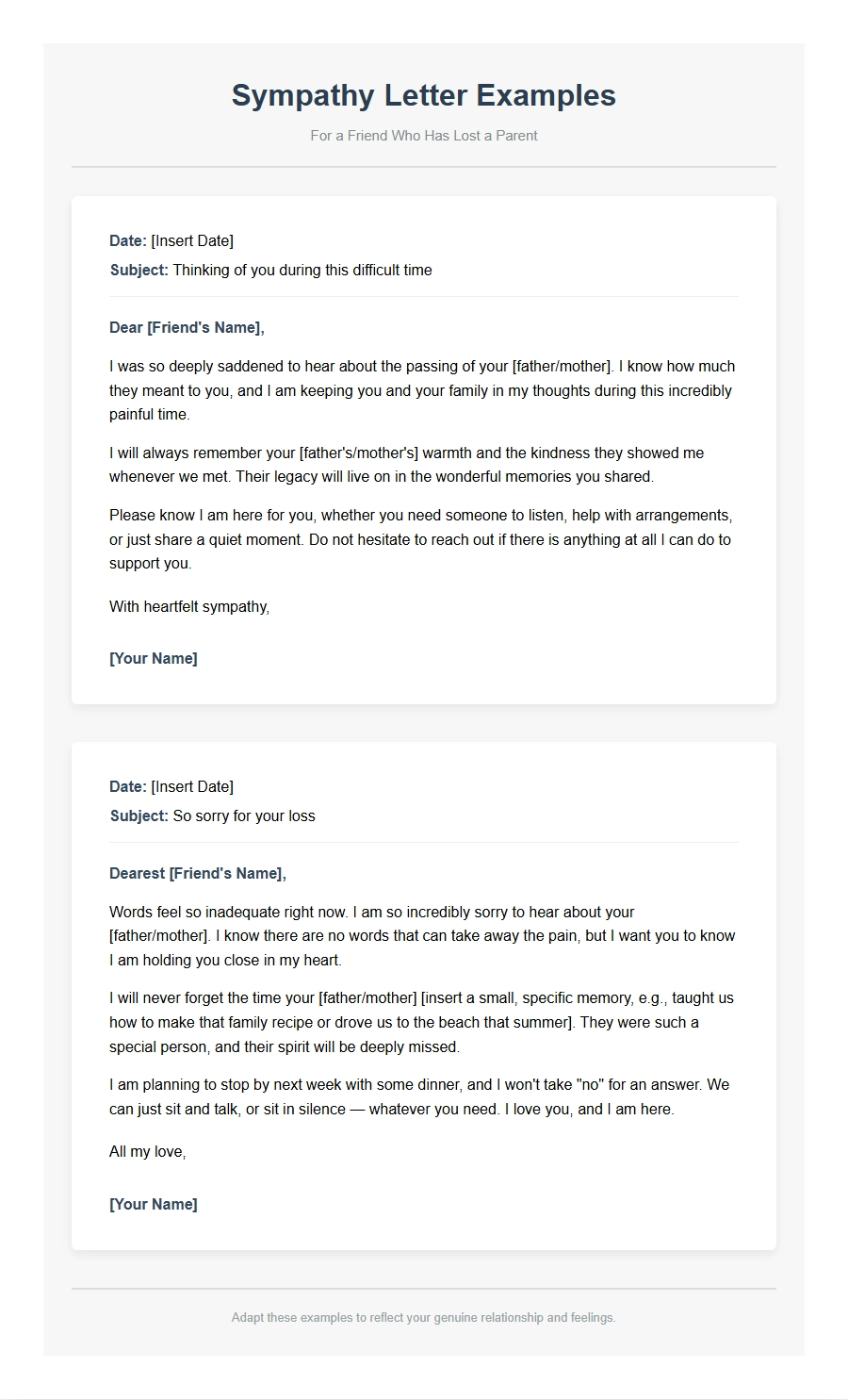 Sympathy Letter Examples for a Friend Who Lost a Parent
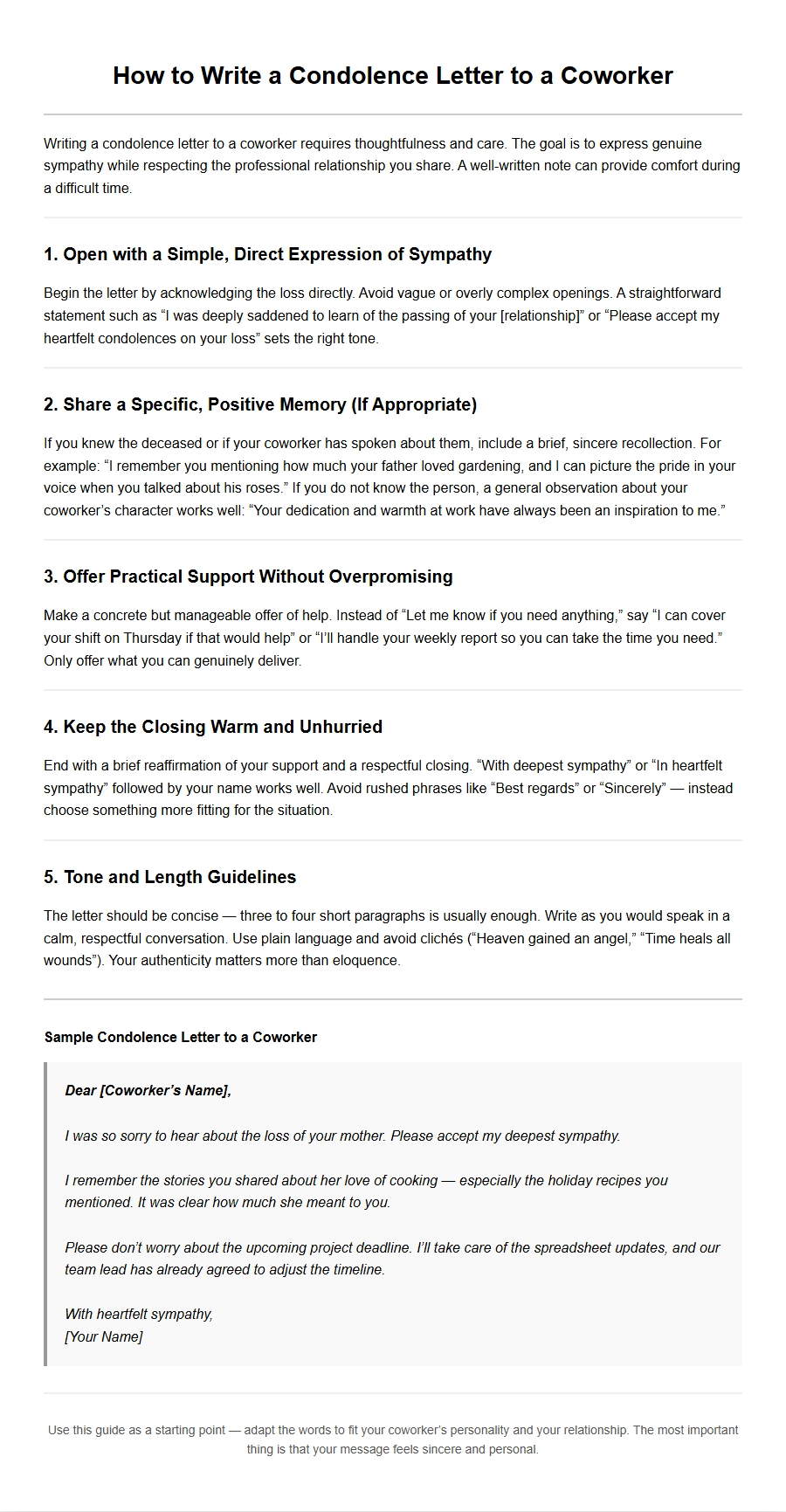 How to Write a Condolence Letter to a Coworker
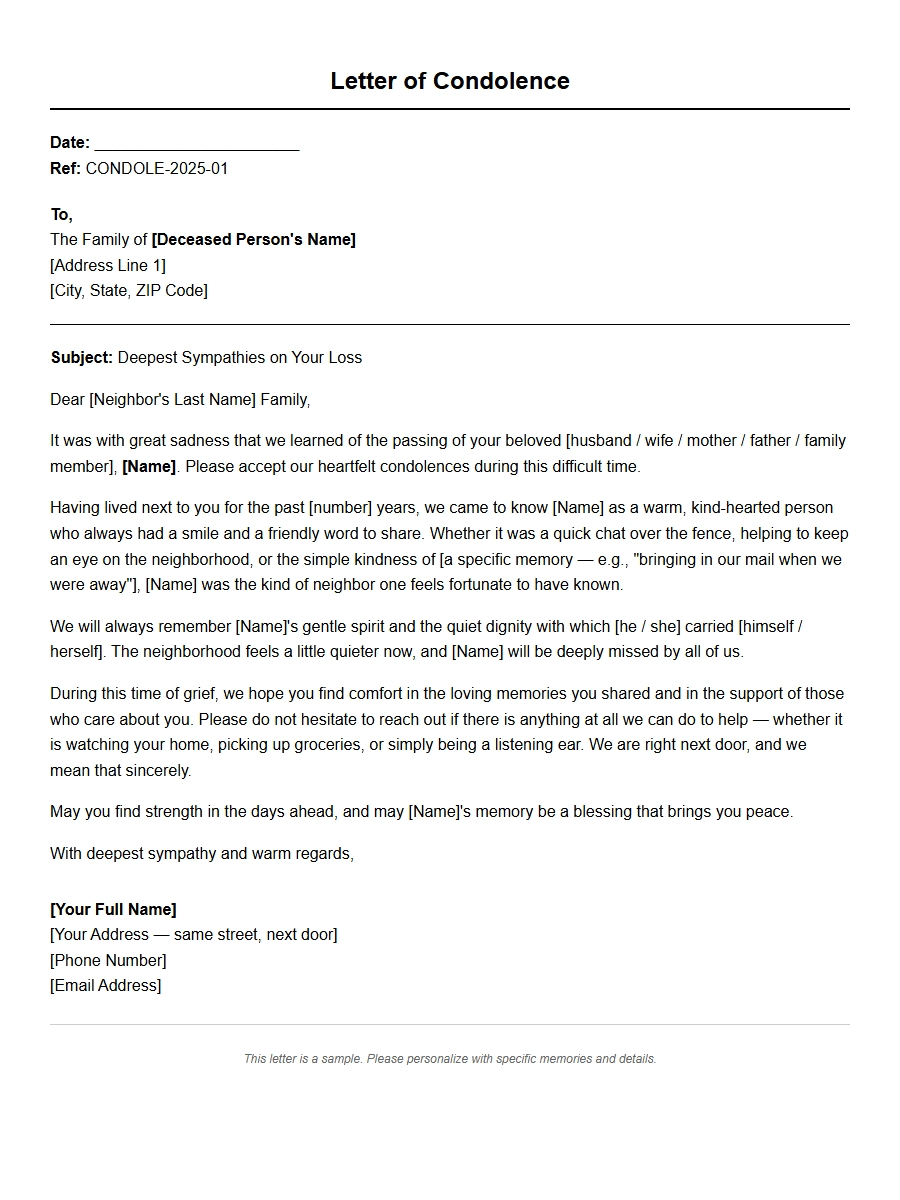 Condolence Letter Sample for a Neighbor
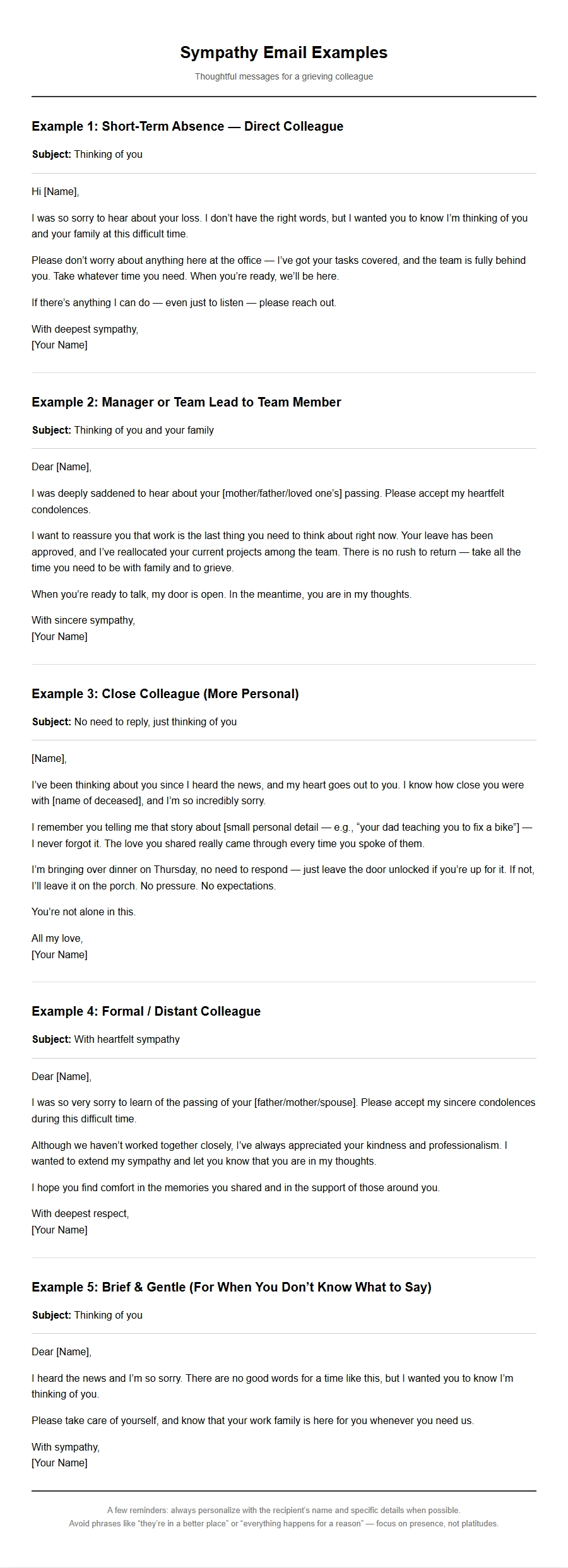 Sympathy Email Examples for a Grieving Colleague
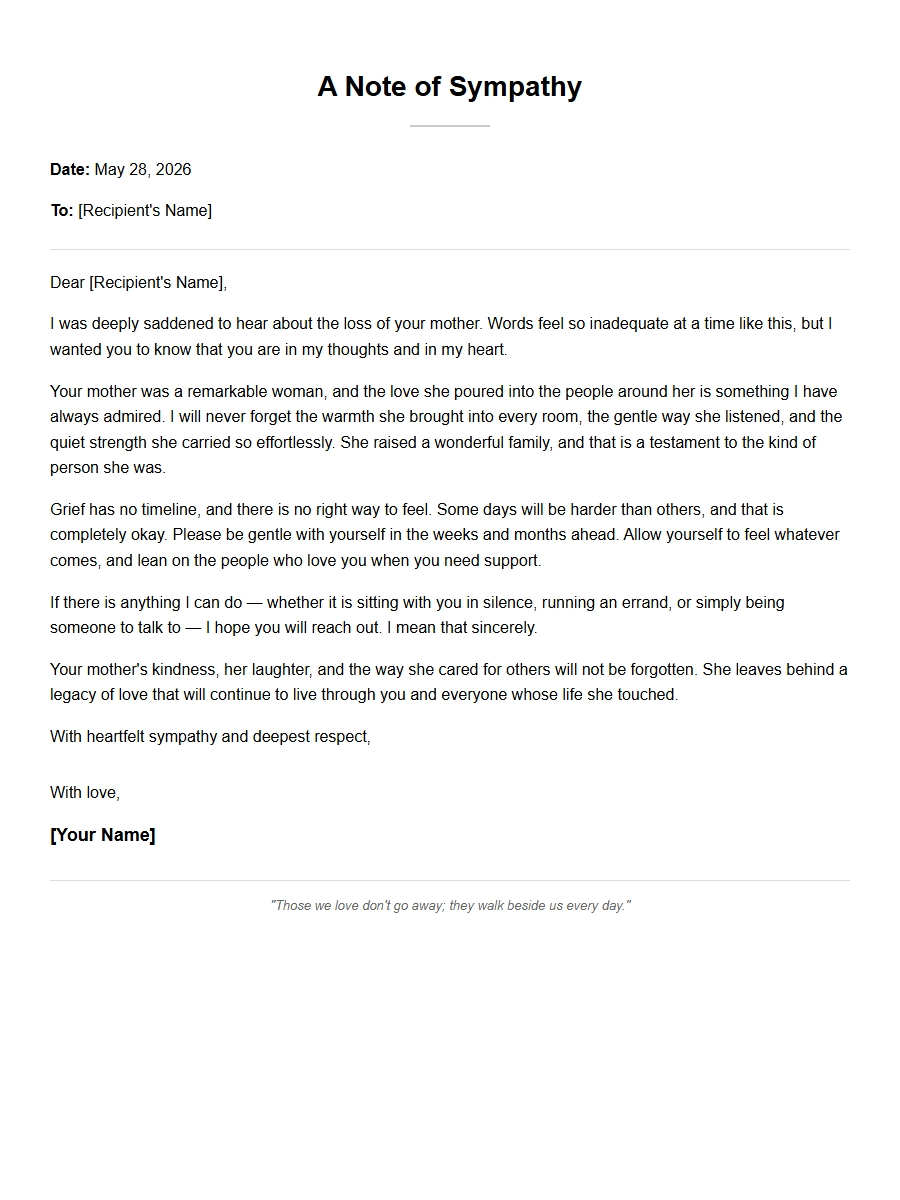 How to Write a Condolence Note for Loss of Mother