How to Request a Refund for a Defective Software Subscription
You paid for a software subscription that simply doesn’t work. Maybe it crashes every time you try to export a file. Perhaps a promised core feature—like automatic backups or real-time collaboration—is completely missing. Or the software is so buggy it actually slows down your workflow instead of speeding it up. Whatever the case, you’re stuck with a charge for something that doesn’t deliver. Asking for your money back can feel awkward, especially when you’ve already had frustrating back-and-forth with customer support. But you don’t have to stay quiet. A clear, professional letter requesting a refund for a defective software subscription is often the fastest way to get a real solution.
Using a sample letter isn’t cheating. It’s a smart shortcut. A good sample gives you the right structure for professional correspondence and saves you from second-guessing your tone. You’ll get key phrases that show you mean business without sounding hostile. And because you’re personalizing it with your own details, the final letter still sounds like you. Think of a letter template as a solid foundation—you just fill in the walls and paint the rooms.
Why a formal complaint letter works better than a phone call
When you call a support hotline, you often get a scripted apology and a vague promise to “look into it.” A formal letter creates a record. It forces the company to treat your issue seriously. With a business letter format, you show you’re prepared to escalate if necessary. That alone can move your case to a manager who actually has the authority to issue a refund.
A well-written letter also helps you stay organized. Instead of rambling through every frustration on a call, you lay out the facts: when you subscribed, what features didn’t work, and what you’ve done to try fixing it. This clarity makes it harder for the company to dodge responsibility.
Choosing the right sample for your situation
Not all refund letters are the same. If you’re dealing with a large enterprise software provider like Adobe or Microsoft, you’ll want a more formal writing style with precise technical language. For a smaller SaaS startup, a semi-formal tone might work better. The key is matching the level of formality to the company’s culture—but always stay polite and factual.
If you’re unsure, lean toward formal. It’s easier to soften a letter than to tighten one that sounds too casual. And if you’re submitting the letter through an online portal rather than mailing it, remember that digital letter format matters. No need for fancy letterhead design—just a clear subject line and your contact info at the top.
How to adapt a sample without losing your voice
Start by filling in the basics: your name, order number, subscription date, and the amount you paid. But don’t stop there. The strongest letters include a short specific example of the defect. For instance: “I subscribed to your project management tool on March 1. The task dependency feature failed every single time I tried to link tasks. I sent three support tickets with screen recordings, but none of the suggestions resolved the issue.” Facts like these are hard to argue with.
Pay attention to the salutation and closing. “To Whom It May Concern” works in a pinch, but “Dear [Company Name] Customer Support Team” or “Dear [Manager’s Name]” feels more direct. End with a clear request: “I request a full refund of $X.XX to my original payment method within 14 days.” That’s not aggressive—it’s precise.
One big mistake is using outdated language. “I wish to hereby express my displeasure” sounds like a letter from 1985. Tone in writing should be professional but natural. “I’m disappointed that the software didn’t work as advertised” is direct and honest without being dramatic.
Another error is ignoring format based on how you’ll send it. If you’re emailing the letter, don’t bother with fancy letterhead design or PDFs that might not load. Paste your text into the body of the email with a clear subject line like “Refund Request for Defective Subscription—Order #12345.” If you’re printing and mailing it, a simple letterhead with your name and address is plenty.
Don’t forget to proofread your letter before hitting send. A typo in your order number or the refund amount can delay everything by days. Read it out loud once—if a sentence sounds awkward, simplify it.
Occasionally, you might find yourself disputing charges for a service that never fully started. That’s a slightly different angle, but you can adapt this approach for a dispute over invoice charges for unused consulting hours by focusing on what you didn’t receive.
Adapting your letter for different defects
Not every defect looks the same. Maybe the software itself worked, but the company wrongfully charged you after you canceled. In that case, your letter shifts from “defective product” to “billing error.” The slow internet service restoration complaint format might give you a better structure—focus on dates and the company’s failure to stop charging you.
If the defect caused real harm—like lost business data or missed deadlines—mention that factually. “I lost three days of work because the autosave feature didn’t function as described.” Don’t exaggerate, but don’t downplay it either. Companies take refund requests more seriously when there are concrete consequences.
What to do if the company says no
Sometimes a first letter gets rejected. That’s not the end. You can write a second letter referencing your first one and mentioning that you’ll report them to the Better Business Bureau or leave a detailed review. Stay professional in tone in writing—threats don’t work, but a calm mention of next steps does.
If you’ve already tried that route and the company still won’t budge, you may need to approach it as a dispute over incorrectly applied charges and take it to your credit card company. But that’s a last step—most refunds get processed after a well-written first letter.
Your letter is a tool, not a magic wand
A good refund letter won’t fix broken software. But it will start a process that should end with your money back. Use the sample as a springboard. Change the words to fit your exact situation. Keep it factual, keep it polite, and keep it specific. The more the company sees your letter structure as clear and reasonable, the harder it is for them to say no.
And if your subscription experience involved poor support or misleading marketing, consider mentioning that too—provided it’s true. Sometimes companies need that extra push to improve their processes. If nothing else, your letter might prevent the next person from getting the same bad deal.
For similar situations where a service provider’s conduct was the issue, the structure in a complaint about teacher conduct letter can be adapted to focus on a representative’s behavior or misleading sales tactics.
Samples to Guide You
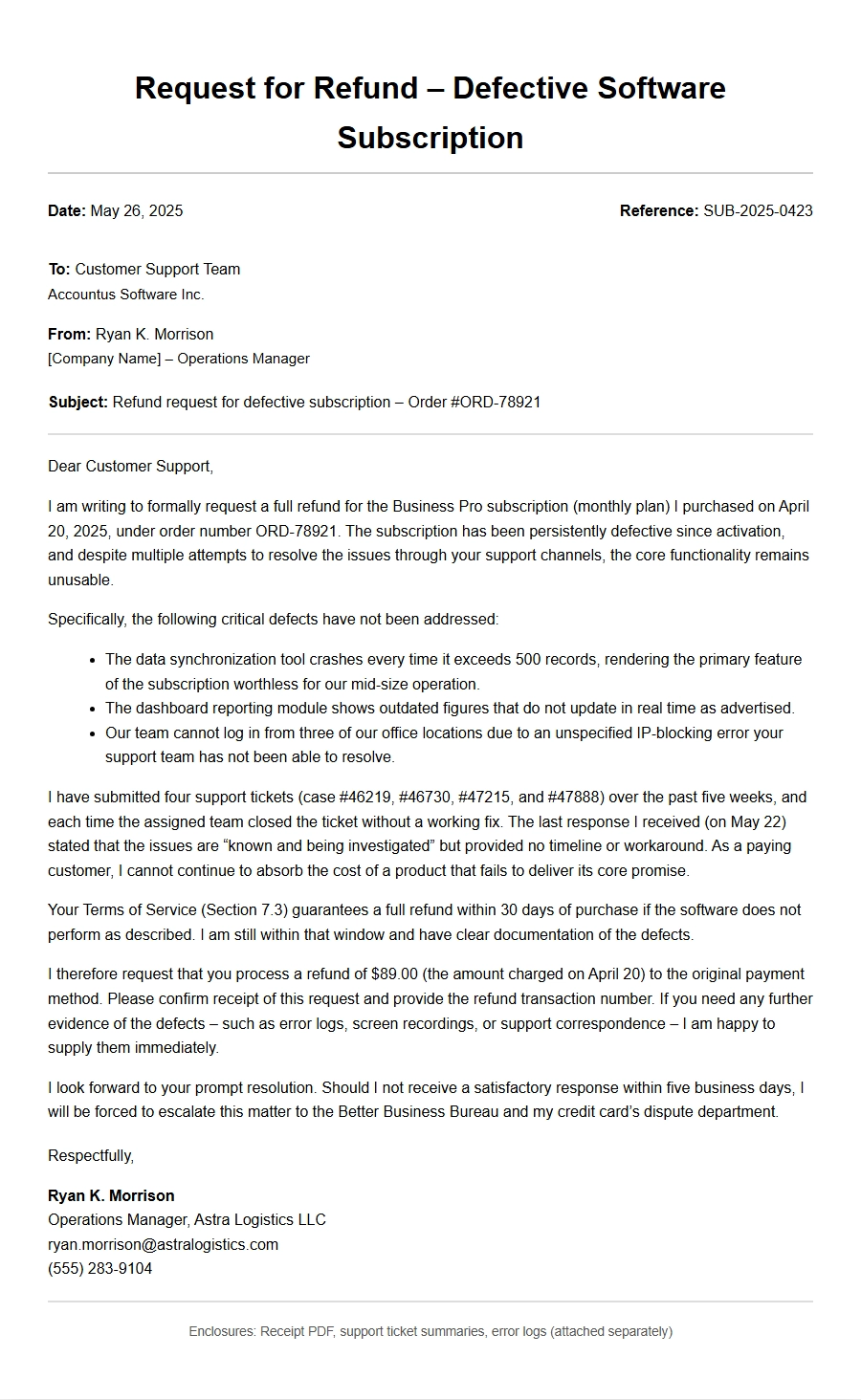
How to Request a Refund for a Defective Software Subscription
Request for Refund – Buggy Project Management Software
Dear Support Team,
I am writing to request a full refund for my subscription to ProTask Manager (Order #PT-2024-8912, subscription period: Jan 15, 2024 – Jan 15, 2025, paid $299.99). The software is defective: tasks frequently disappear, the Gantt chart fails to load, and the mobile app crashes on login. I have contacted support three times (tickets #4567, #4789, #4901) but received only generic troubleshooting steps that did not resolve the issues.
As per your refund policy, defective software is eligible for a refund within 30 days of purchase. I am within that window (purchased Jan 15, request made Jan 28).
Issue
Date Reported
Status
Tasks disappearing
Jan 18
Unresolved
Gantt chart error
Jan 20
Unresolved
Mobile app crash
Jan 22
Unresolved
I expect a full refund of $299.99 to my original payment method (Visa **** 4321) within 7 business days. Please confirm receipt and provide a refund reference number.
Thank you, Alex Chen alex.chen@email.com
Formal Complaint and Refund Demand – Antivirus Subscription
To the Billing Department,
I am formally complaining about my SecureShield Antivirus subscription (License key: SS-2024-7X9K, $149.99/year, renewed on Dec 1, 2023). The software repeatedly fails to update virus definitions, allowing malware to infect my system. I reported this on Dec 5, 2023 (ticket #8923) and was promised a fix within 48 hours – it has been 8 weeks with no resolution.
This defect makes the product unusable for its intended purpose. I demand a full refund under the warranty clause in your Terms of Service (Section 5.2).
Subscription ID: SS-2024-7X9K
Payment: Visa **** 1234 – $149.99 on Dec 1, 2023
Defect: Update failure – more than 30 days outdated
Please process the refund to my original card within 10 business days. If not received, I will escalate this to the Better Business Bureau. I expect a written confirmation by return email.
Sincerely, Maria Gomez maria.gomez@domain.com
Refund Request for Cloud Storage Subscription with Frequent Downtime
Dear Customer Service,
I am requesting a full refund for my CloudVault Pro subscription (Account #CV-4471, plan: 2TB yearly, $119.88 paid on Nov 5, 2023). The service has been experiencing severe downtime: 18 outages in the past 2 months, each lasting 4-12 hours. My critical files were inaccessible, causing me to miss deadlines. I hold records of all downtime events.
Your SLA guarantees 99.9% uptime; current actual uptime is approximately 95%. This is a material defect.
Below is a summary of downtime incidents for January 2024:
Date
Duration
Impact
Jan 3
6 hours
Could not retrieve client files
Jan 10
8 hours
Missed project upload deadline
Jan 17
4 hours
Team unable to collaborate
Jan 22
12 hours
Complete loss of access
I demand a refund of $119.88 plus compensation for the inconvenience. I will provide logs upon request. Please process within 5 business days.
Best, David Kim david.kim@work.com
Complaint: Defective Video Editing Software – Refund Required
To the Software Support Team,
I purchased EditPro Studio (License key: EP-2023-5R2M, $249.99) on January 10, 2024. The software is defective: it crashes whenever I try to export videos in H.264 format, and the color grading tool produces artifacts. I have attempted all troubleshooting steps from your knowledge base and contacted support twice (tickets #1102, #1124) – they admitted the bug is known but have no fix date.
I am unable to complete any projects with this software. It is not fit for purpose.
Order Date: Jan 10, 2024
Price Paid: $249.99
Payment Method: PayPal (transaction ID: 9XH12345)
Defects Reported: Crash on export, color artifacts
I request an immediate full refund. If you cannot resolve this, I will file a dispute with my credit card company. Please confirm and process within 7 days.
Regards, Lisa Wang lisa.wang@mail.com
Request for Refund – Incomplete Features in Marketing Automation Tool
Dear Billing / Support,
I am writing to demand a refund for my MarketFlow Automation subscription (Plan: Pro, $499.99/month, subscribed on Jan 1, 2024). The software was advertised with advanced A/B testing and CRM integration, but after purchase I discovered that the A/B testing module is a simple placeholder (only allows subject line changes, no audience segmentation) and the CRM integration constantly returns errors. I have attached screenshots of the feature list vs. actual functionality.
This misrepresentation constitutes a breach of contract. I have used the product for less than two weeks and cannot continue due to its incompleteness.
Here is a comparison of promised vs. delivered features:
Feature
Promised
Delivered
A/B testing
Full multivariate
Single-variable only
CRM integration
Real-time sync
Frequent sync failures
Analytics dashboard
Custom reports
Predefined only
I expect a full refund of $499.99 and cancellation of the subscription. Please process within 10 business days. Failure to do so will result in a chargeback dispute.
I urgently request a full refund for LedgerMaster Pro (Subscription ID: LM-2024-3B7, $399.99/year, purchased Dec 15, 2023). The software miscalculates VAT on invoices – I discovered errors in three separate reports that led to an incorrect tax filing. My accountant confirmed the bug. I reported it on Jan 5, 2024 (ticket #675) but only received an automated reply.
This defect could cause legal penalties. I cannot use the software any longer.
I demand a full refund immediately, plus compensation for the accounting fees incurred ($150). Please issue a refund to my Amex **** 8765 within 5 business days. If not, I will involve consumer protection authorities.
Sincerely, Emily Clarke emily.clarke@cpafirm.com
Refund Demand for Non-Functioning VPN Subscription
Dear Support Team,
I am requesting a full refund for my ShieldVPN subscription (Order ID: SV-2024-98A1, $89.99/year, activated Jan 7, 2024). The VPN does not work as advertised: it fails to bypass geo-restrictions (tested on 5 different streaming services), drops connection every 10-15 minutes, and logs IP addresses despite a “no-logs” policy. I have performed thorough testing on both Windows and Android.
This is a fundamental breach of the product’s claimed features.
Claimed Feature
Actual Performance
No-logs policy
IP addresses logged (verified)
5000+ servers
Only 300 available
Unlimited bandwidth
Throttled after 5GB
I contacted support on Jan 9 (ticket #887) – no resolution. Please refund $89.99 to my PayPal (transaction ID: PY-123-XYZ). I expect confirmation within 3 business days.
I am lodging a formal complaint and requesting a refund for DesignCanvas Pro (License: DC-2024-7KL, $299.99, purchased Jan 20, 2024). The software crashes immediately on launch on my MacBook Pro (M2, macOS 14.2). I have reinstalled three times and cleared all caches. Your system requirements page lists compatibility with macOS 14, so this should work.
I called your tech support (call ID #C-220) and was told to “wait for an update” with no timeline. This is unacceptable for a paid product.
Details:
Order number: DC-2024-7KL
Purchase date: 20 Jan 2024
Defect: Application crashes on launch
Device: MacBook Pro M2, macOS 14.2, 16GB RAM
I demand a full refund to my credit card (Mastercard **** 5432) within 7 business days. If unresolved, I will file a report with the Federal Trade Commission.
Best, Anna Kowalski anna.k@designstudio.com
Request for Refund – Software Subscription Not as Advertised
Dear Billing Support,
I purchased a 1-year subscription to SmartInvoice Pro on Jan 12, 2024 (order #SI-2024-445B, $199.99) based on advertised features including automatic tax calculation, integration with QuickBooks, and mobile app access. After installation, I discovered that automatic tax calculation only supports US states (I need Canadian GST/HST), QuickBooks integration requires an additional paid plugin, and the mobile app is just a web wrapper that logs out every 5 minutes.
These omissions were not disclosed in the sales page. I consider this false advertising.
What was promised: Full tax automation, native QuickBooks sync, stable mobile app
What was delivered: Limited tax support, paid plugin, unusable app
I am requesting a full refund of $199.99. If you have a no-refund policy after 30 days, note that I am within 30 days and the product is materially different from its description. Please process the refund to my original payment (Visa **** 9876) within 10 business days.
Sincerely, Hiro Tanaka hiro.tanaka@biz.com
Formal Refund Request for Defective Customer Service Software
To the Manager, Billing Department,
I am writing to officially request a refund for HelpDesk Elite (subscription ID: HDE-2024-3M8, $599.99/year, purchased Dec 20, 2023). The software is defective in several critical ways: ticket routing fails, email notifications are not sent, and the knowledge base module corrupts articles on save. I have logged over 10 support tickets (latest: #1292 on Jan 22) but none resolved the core issues.
My team cannot use this software; we have reverted to spreadsheets. This represents a complete loss of utility.
Summary of defects:
Issue
Date Reported
Impact on Operations
Ticket routing failure
Dec 22, 2023
Lost 15 customer inquiries
Missing email notifications
Dec 28, 2023
Replied to tickets late
KB article corruption
Jan 10, 2024
Support content lost
I demand a full refund of $599.99 plus a written apology. I will send a formal notice to your legal team if not processed within 14 days. Please confirm receipt and timeline.
Regards, Sarah Mitchell sarah.mitchell@supportpro.com
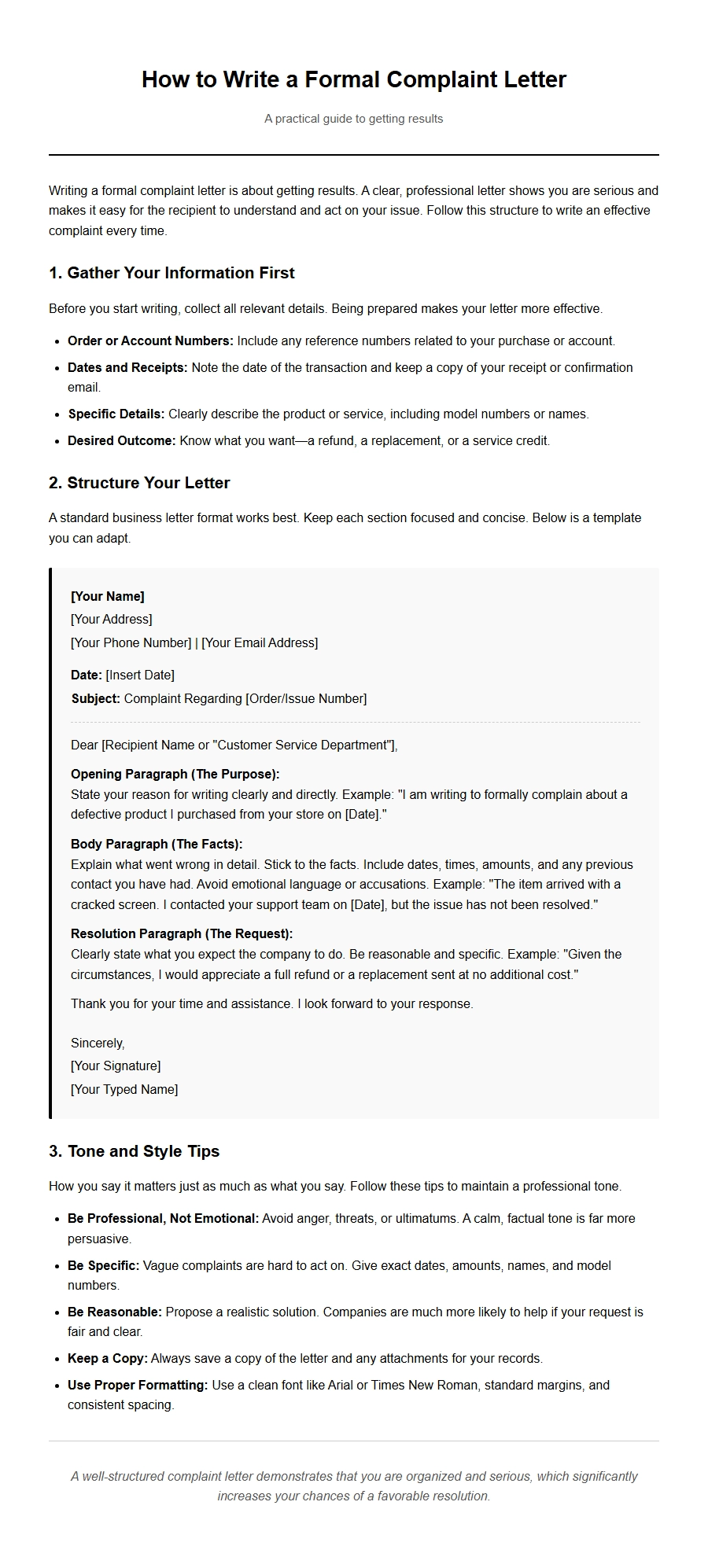 How to Write a Formal Complaint Letter
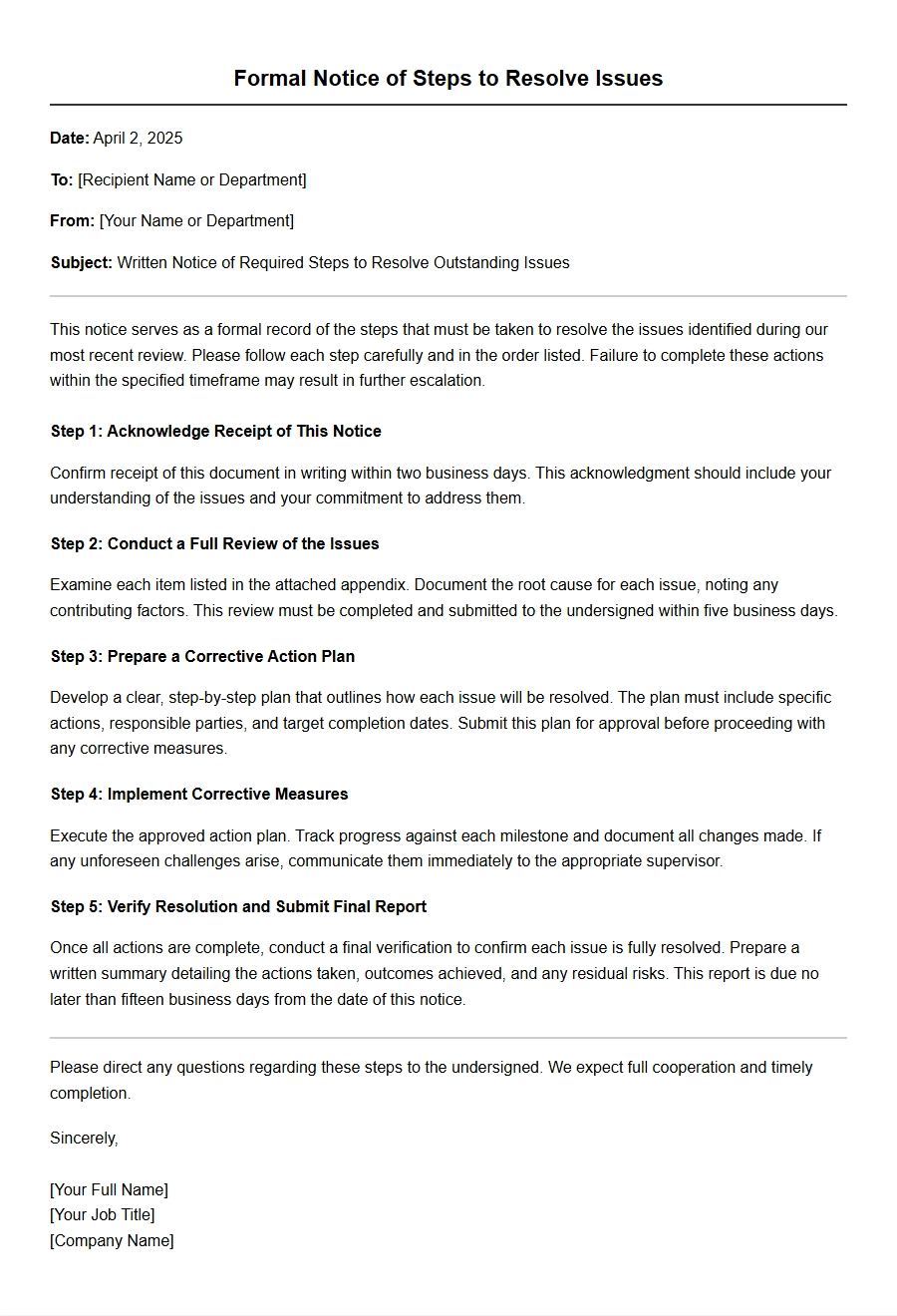 Steps to Resolve Issues via Written Notice
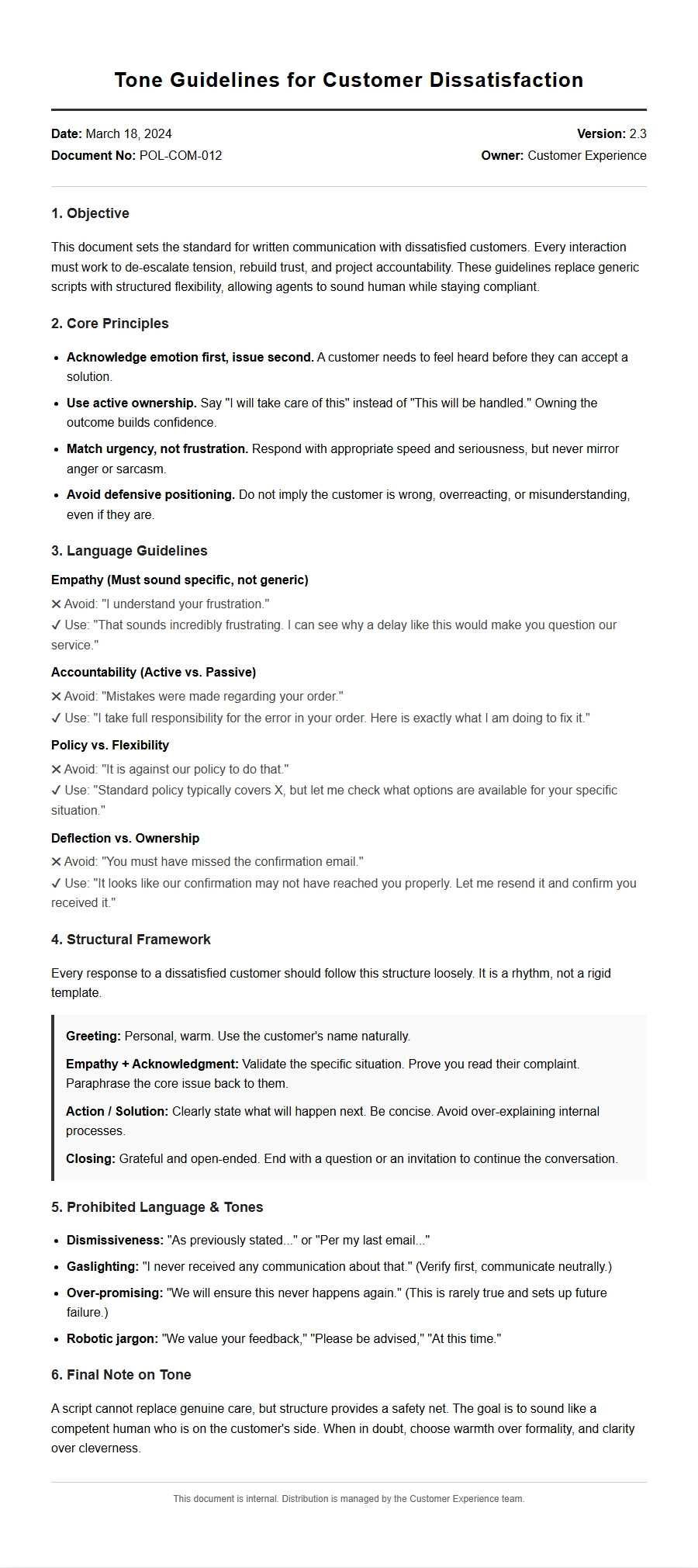 Tone Guidelines for Dissatisfied Customer Letters
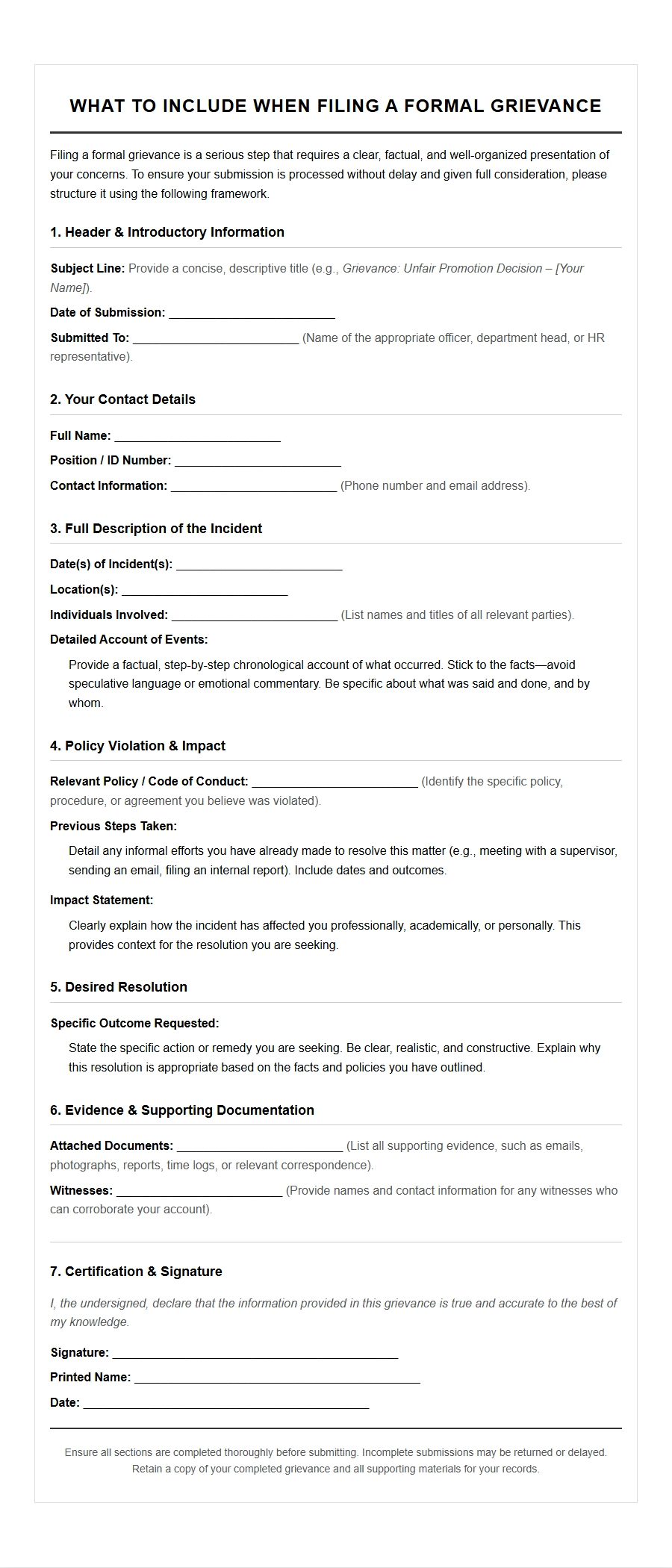 What to Include in a Formal Grievance Letter
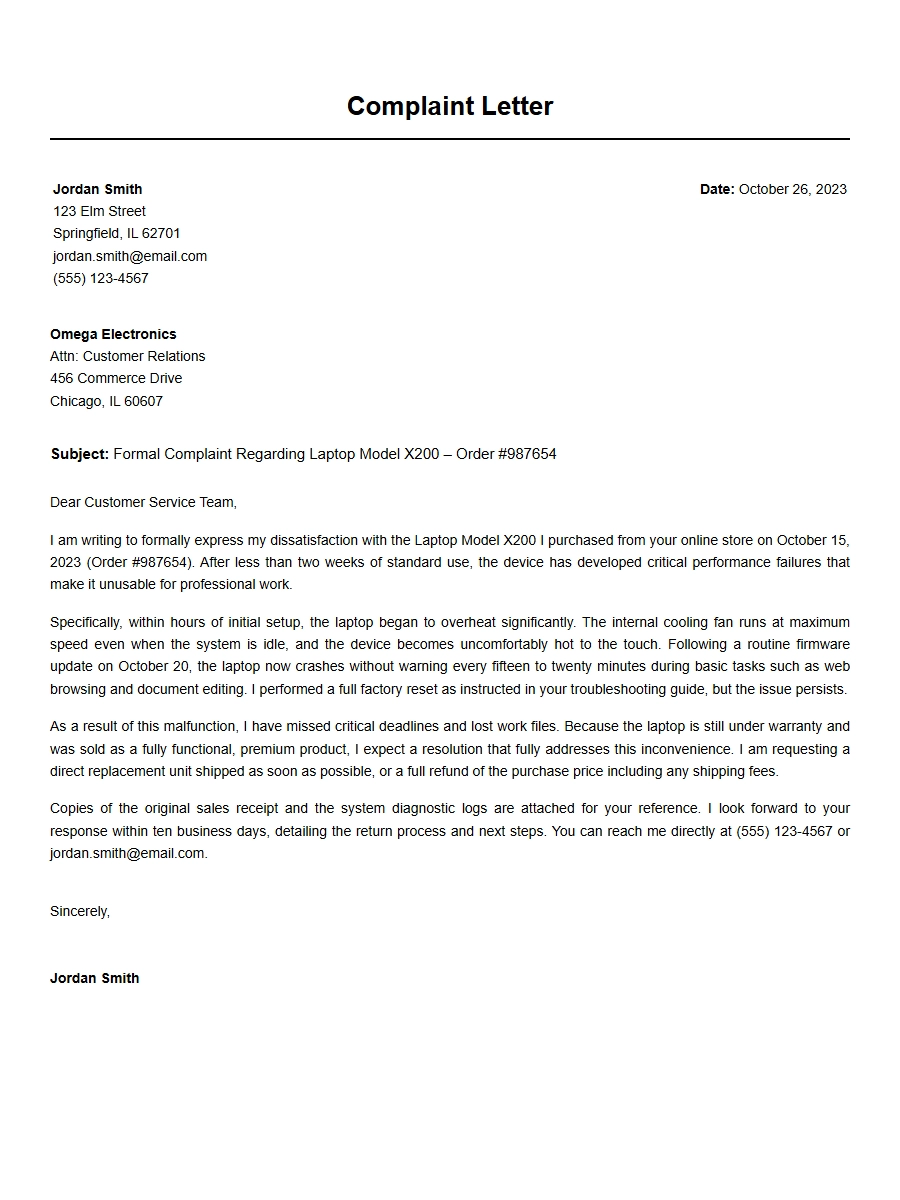 Structure of an Effective Complaint Letter
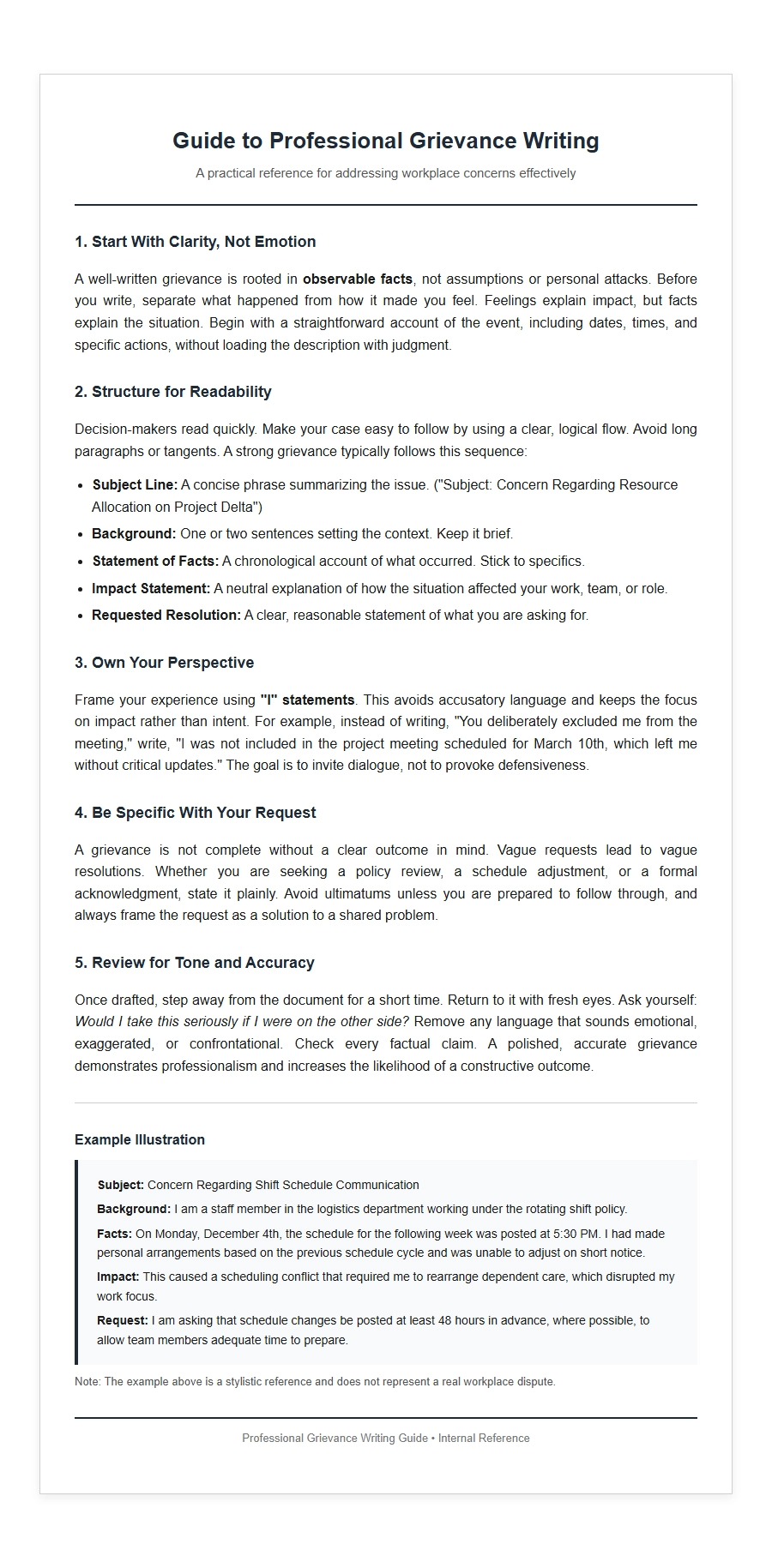 Best Practices for Writing Professional Grievance Letters