Complaint Letter: Slow Internet Service Restoration
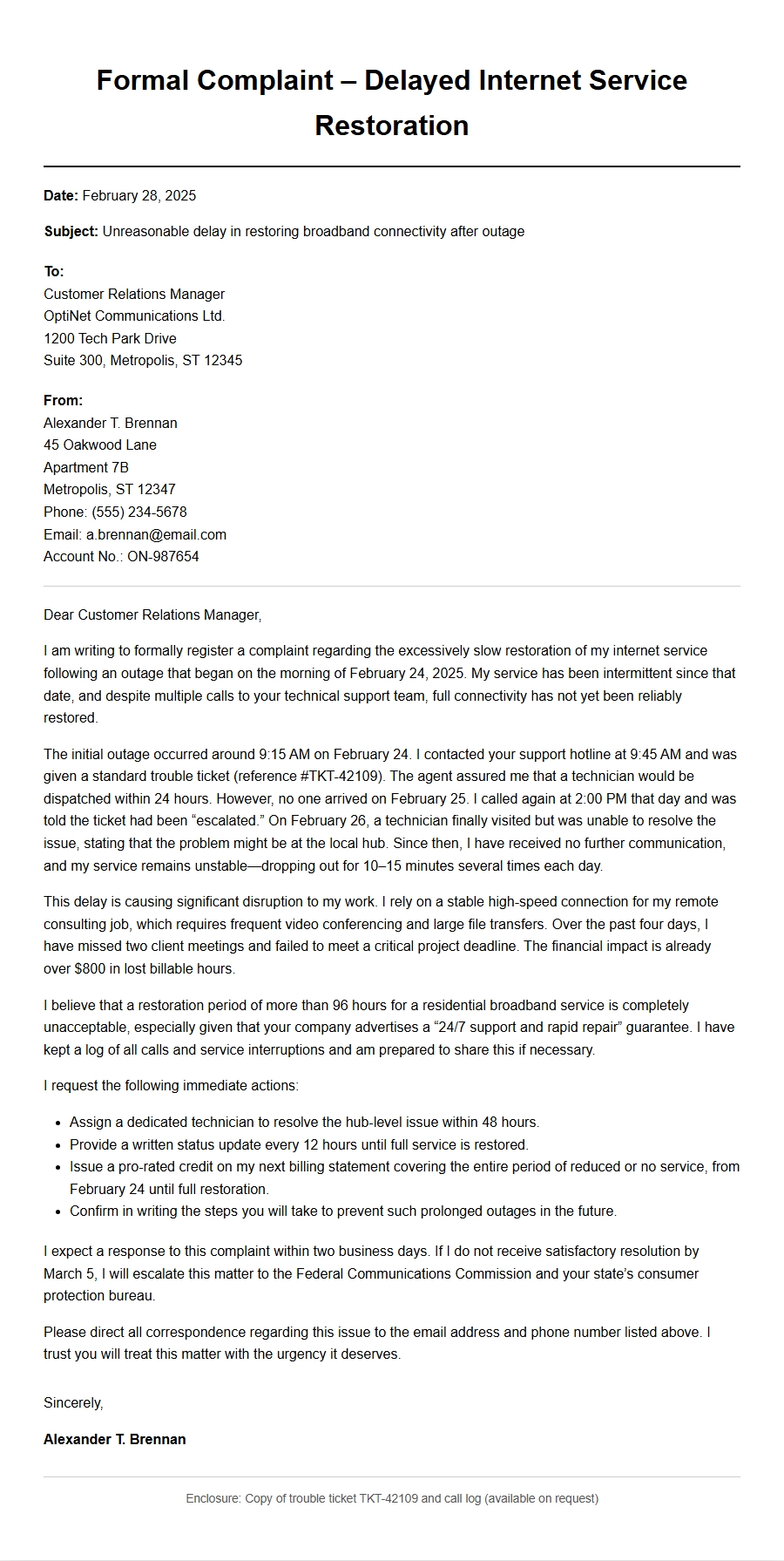
You’ve been waiting days for a technician. Your work is piling up. The kids are streaming, and your video calls keep dropping. A slow internet restoration is more than annoying—it costs you time and money. The natural reaction is to call customer service and vent. But a well-written letter or email often gets faster results and creates a paper trail. That’s what this guide is for.
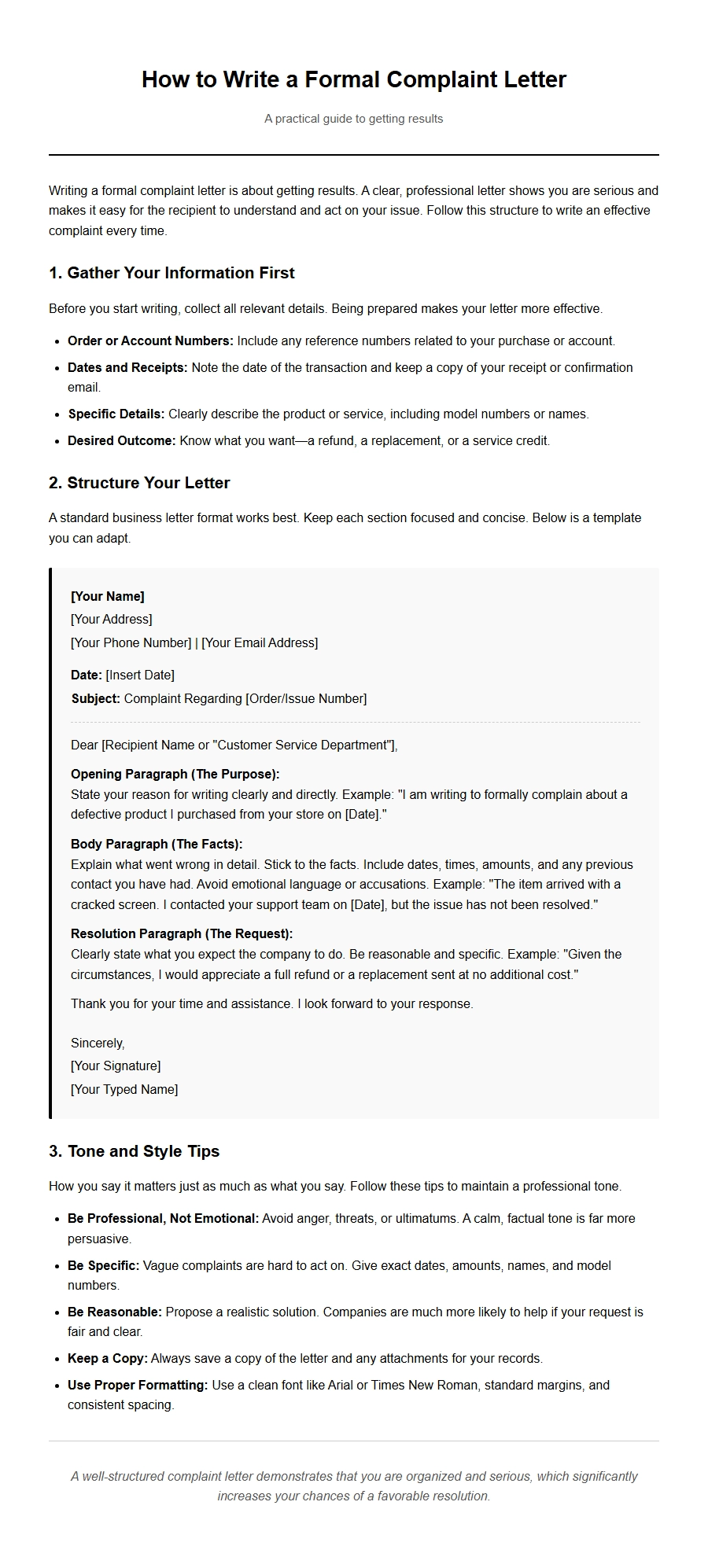
A good complaint letter about slow internet service restoration isn’t about venting. It’s about stating facts, referencing your contract, and asking for a clear remedy like a service credit. You don’t need to be a lawyer. You just need the right structure and tone. That’s where a letter template helps. Using one isn’t cheating. It gives you a solid business letter format so you can focus on filling in your specific details—dates, account numbers, and the actual outage length.
This type of letter falls under professional correspondence about service failures. Your goal is to sound reasonable but firm. You’re not yelling. You’re documenting.
What should your letter actually say?
Start with your account details and a clear subject line. Something like “Complaint Regarding Slow Internet Service Restoration – Account #[number].” Then state the problem plainly. Example: “My internet has been running at less than 1 Mbps since March 10, despite multiple calls. As of March 15, service is still not restored to the speed promised in my plan.”
Next, explain the impact. “I work remotely and have missed three client deadlines.” This makes the complaint concrete. Then state what you want. “I request a full credit for the period March 10 to [current date] and a timeline for full restoration.”
Formal writing tips for this situation
Keep your tone in writing calm and direct. Avoid emotional language like “incompetent” or “horrible.” Stick to facts. If you need to send a legally binding notice because the delay has caused real damages, you might reference a breach of contract. That’s a heavier step, but it’s sometimes necessary when a provider ignores your requests. You can see how to phrase that in our article about legally binding notice phrasing for breach of contract.
For most cases, a firm letter writing etiquette works fine. Use a proper salutation and closing—Dear [Name], Sincerely, [Your Name]. If you don’t know the name, use “Dear Customer Service Manager” or “To Whom It May Concern.”
Common mistakes in internet outage letters
One big mistake is being too vague. Saying “my internet is slow” doesn’t help. Include speed test results, dates of downtime, and ticket numbers from your support calls. Another mistake is ignoring the digital letter format. Most providers prefer email or a support portal form. If you print and mail the letter, use simple letterhead design—just your name, address, and account number at the top.
Also, don’t forget to proofread the letter. A typo in your account number or date can slow things down.
How to personalize a template without sound generic
Templates are great for structure, but the details make yours stand out. Swap generic phrases like “I am writing to express my dissatisfaction” with something direct: “My internet has been unusable since Tuesday. I have called four times with no resolution.” That’s your voice, not a robot’s.
If the slow restoration is causing you to miss work, mention that. If you’re a student, say so. Real context gets real responses.
When should you escalate beyond a complaint letter?
If the provider ignores your letter or offers no resolution after a reasonable time—usually 7–14 days—you may need to escalate. That could mean a complaint to your local consumer protection agency or a formal request for disciplinary action against staff member if an employee mishandled your case. In extreme cases, you might even send an eviction warning notice sample language if the issue involves equipment rental or property access. But that’s rare for residential internet.
Most of the time, a clear, factual letter with a specific request gets you a credit and a faster fix. If you’re dealing with a related billing issue—like being charged for service you couldn’t use—our guide on appeal for tuition refund due to course cancellation might offer useful phrasing even though the context is different.
Your next step
Open a blank document. Paste a simple template as your starting point. Then replace every placeholder with your actual details. Read it once out loud to catch awkward spots. Send it as a printed letter or a clear email. Keep a copy for yourself. A slow internet problem won’t fix itself, but a good letter moves things along faster than another phone call.
Writing Examples
Complaint Letter: Slow Internet Service Restoration
Delayed Restoration Follow-up
Subject: Repeated Delays in Internet Service Restoration
Date: March 10, 2025
To: Technical Support Manager ISP TechCare
Reference Ticket ID: TKT-89432
I am writing to express my growing frustration over the repeated delays in restoring my internet service, which has been down since March 2, 2025. Despite logging two earlier complaints and receiving promises of a technician visit within 48 hours, no one has arrived, and the outage persists. My household relies on internet for remote work and school, and the extended disconnection is causing significant hardship.
Below is a timeline of my interactions:
Date
Action Taken
Promised Resolution
March 2
Called helpline
Technician visit within 48 hrs
March 4
No visit, called again
Escalated, visit in 24 hrs
March 6
Third call
Parts shortage, 3–5 days
March 10
Still no service
No update provided
I request that you prioritize this case, provide a confirmed appointment, and consider a service credit for the days of outage. Please acknowledge receipt and escalate urgently.
Sincerely, Jane Morrison Account # 987654
Business Impact Complaint
To: ISP Business Support Team
From: Apex Digital Solutions
Account: BIZ-45678
Date: March 12, 2025
Our company has been without stable internet since March 5, 2025, following an unexplained outage. Your support team assured us 24–48 hour restoration, yet after seven days, service remains intermittent at best. This has direct financial consequences:
Lost client video calls – estimated $1,200 in canceled projects.
Unable to process online transactions – average daily revenue $3,500 affected.
Remote team productivity dropped by 70%.
We hold a premium business SLA (99.9% uptime guarantee) and expect prompt, effective restoration. The current response—three technician visits that failed to diagnose the issue—does not meet that standard.
Please escalate this to a senior engineer, provide a definitive resolution date, and issue a pro-rated refund for the outage period. I also request a written explanation of what caused the failure and steps taken to prevent recurrence.
Regards, Mark Chen Operations Manager
Formal Complaint to Consumer Agency
To: National Consumer Protection Bureau Consumer Complaints Division
I wish to formally register a grievance regarding the sluggish restoration of my internet service, which has been non‑functional since February 28, 2025. To date, I have filed six complaints with FastNet, each met with automated acknowledgments but no tangible action. Their customer service consistently promises a callback within 24 hours, but I have received none. My attempts to reach a supervisor have been blocked or transferred to dead ends.
The lack of service violates their advertised “guaranteed restoration within 72 hours.” I request that your agency investigate FastNet’s practices regarding outage response times and compensation. I have attached copies of my bills, complaint logs, and correspondence.
Key points:
Outage duration: 15 days and counting.
Number of follow‑up calls: 12.
Promised credits: none applied to my account.
I expect your office to mediate a resolution and, if necessary, levy penalties for non‑compliance with service standards.
Thank you, Laura Diaz Account # 334-887-421
Compensation Request Letter
To: Billing Department – SkyNet ISP
Date: March 18, 2025
Reference: Outage incident #OUT-67320
My home internet has been either severely degraded or completely unavailable since March 7, 2025. I have documented the outage times and submitted weekly reports to your technical team, yet no permanent fix has been provided. In accordance with your published “Fair Service Policy,” I request compensation for the period of lost service.
Details of the outage:
Period
Status
Duration
Mar 7 – Mar 10
Full outage
3 days
Mar 11 – Mar 14
Intermittent (speed
4 days
Mar 15 – Mar 18
Still unstable
4 days
I calculate a total of 11 days of unusable service. At my monthly rate of $79.99, that amounts to a credit of approximately $29.33. I also request a goodwill adjustment of $20 for repeated phone calls and lost productivity.
Please process this credit on my next bill. If there is a specific claim form I need to complete, kindly send it immediately.
Regards, Peter Novak Account # 557-123-890
Complaint About Poor Communication
To: Customer Care Manager – Waves Broadband
Date: March 20, 2025
My internet service has been down since March 11, 2025. While I understand that outages occur, what I cannot accept is the complete lack of proactive communication from your side. Every time I call your support line, I am told “we will update you” but receive no follow‑up either by email, SMS, or phone. Yesterday I was transferred four times before being disconnected.
I have no information regarding:
The root cause of the outage.
An estimated time of restoration.
Any technician visit schedule.
Steps you are taking to prevent recurrence.
This opacity is unacceptable, especially for a premium service I have subscribed to for three years. I demand that your escalation team contact me within 24 hours with a detailed status update and a firm timeline. Additionally, I expect a designated point of contact for this case who will communicate regular progress reports.
If this is not possible, I will be forced to report your company to the Better Business Bureau and consider switching providers.
To: Vice President of Customer Service GlobalNet Communications
Via: Certified Mail
Date: March 22, 2025
I am escalating a chronic issue that lower‑level support has failed to resolve for sixteen days. My internet service was disconnected on March 6, 2025, and remains offline. I have submitted five formal complaints (IDs: CMP-5671, CMP-5723, CMP-5800, CMP-5892, CMP-6011). Each was closed without resolution, marked as “resolved” despite no restoration.
This pattern of neglect suggests systemic problems in your restoration process. I am copying the state Public Utilities Commission on this letter.
Key demands:
Immediate restoration within 48 hours.
A formal investigation into why earlier complaints were mishandled.
Compensation equal to two months of service fees ($179.98).
Written assurance of improved outage communication protocols.
I expect a response from your office within five business days, or I will pursue legal remedies for breach of contract.
Respectfully, David Kim Account # 100-234-5678
Technician Visit Failure Complaint
To: Field Service Supervisor – LinkUp ISP
Date: March 24, 2025
I am writing about the failed attempt by your technician to restore my internet service on March 22, 2025. The technician arrived two hours late, spent only ten minutes checking the modem, declared the issue “likely an outside line problem,” and left without completing any repairs. He said another team would follow up, but I have received no appointment.
My service has been out since March 8, 2025 – now seventeen days. This is the third technician visit that has resulted in no improvement. I have incurred overtime charges to use mobile hotspot data, which is not reimbursed.
I request that you assign a senior line technician who has the authority and equipment to test the outside drop. Please confirm a 4‑hour appointment window and call me one hour before arrival. Also, please note on my account that no further “basic check” visits are acceptable—only a definitive fix.
Thank you, Sarah Patel Account # 778-334-221
Slow Restoration After Storm
To: Storm Recovery Team – StormNet ISP
Date: March 26, 2025
My neighborhood was hit by a severe storm on March 14, 2025, causing widespread power and internet outages. While electricity was restored within 36 hours, my internet connection remains down after twelve days. StormNet initially promised a 72‑hour restoration but has repeatedly pushed back the estimated repair date. My current ETA is now “within 7–10 days.”
I understand that storm recovery is challenging, but the lack of transparent updates is frustrating. I have called four times and received four different stories: fiber damage, node failure, crew shortage, and software issue.
Please provide me with:
A confirmed date for restoration.
A daily SMS or email status update.
A discount on my next bill for the extended outage.
I have attached photos of the downed lines in front of my house. I hope this helps your field team locate the problem faster.
Sincerely, Emily Rodriguez Account # 654-987-321
Complaint Regarding Misleading SLA
To: Legal Department – TrueSpeed Communications
Date: March 28, 2025
I reference your Service Level Agreement (SLA), section 4.2, which guarantees restoration within 24 hours of reporting an outage for business clients. On March 16, 2025, my business line went down; I reported it immediately. To date — twelve days later — the service has not been restored.
Your support staff have been courteous but ineffective. They have repeatedly said “we are working on it” without providing any technical details or firm deadline. I consider this a material breach of our contract.
Below is a summary of my attempts to enforce the SLA:
Contact Date
Representative
Promised Action
Mar 16
John (tier 1)
24h restoration
Mar 17
Maria (tier 2)
Escalated, 48h max
Mar 20
Ken (supervisor)
Parts ordered, 5 days
Mar 28
No update
Silent
I demand enforcement of the SLA penalty clause: one month free service for each full 24‑hour period beyond the restoration deadline. If not honored, I will take the matter to the Small Claims Court.
Await your prompt response, James O’Brien Business Account # 456-789-012
Final Notice Before Cancellation
To: Customer Retention Department – ZoomNet ISP
Date: March 30, 2025
This is my seventh and final complaint regarding the internet service outage that began on March 1, 2025. Despite numerous promises and four technician visits, the connection remains unusable (down completely or speeds under 0.5 Mbps). I have spent over 14 hours on the phone with your support, and I have not received a single follow‑up as promised.
I am giving you 7 days from today to fully restore stable service and to apply a 100% credit for the month of March. If this is not done, I will cancel my account without penalties, file a complaint with the Federal Communications Commission, and post a detailed review on consumer forums.
My account details:
Account name: Anna Whitfield
Account number: 221-987-654
Service address: 47 Oak Lane, Springfield
Monthly plan: Fiber 500 Mbps, $89.99
I expect a written confirmation of your action plan within 48 hours. Do not call me—send an email with a ticket number and a timeline.
 How to Write a Formal Complaint Letter
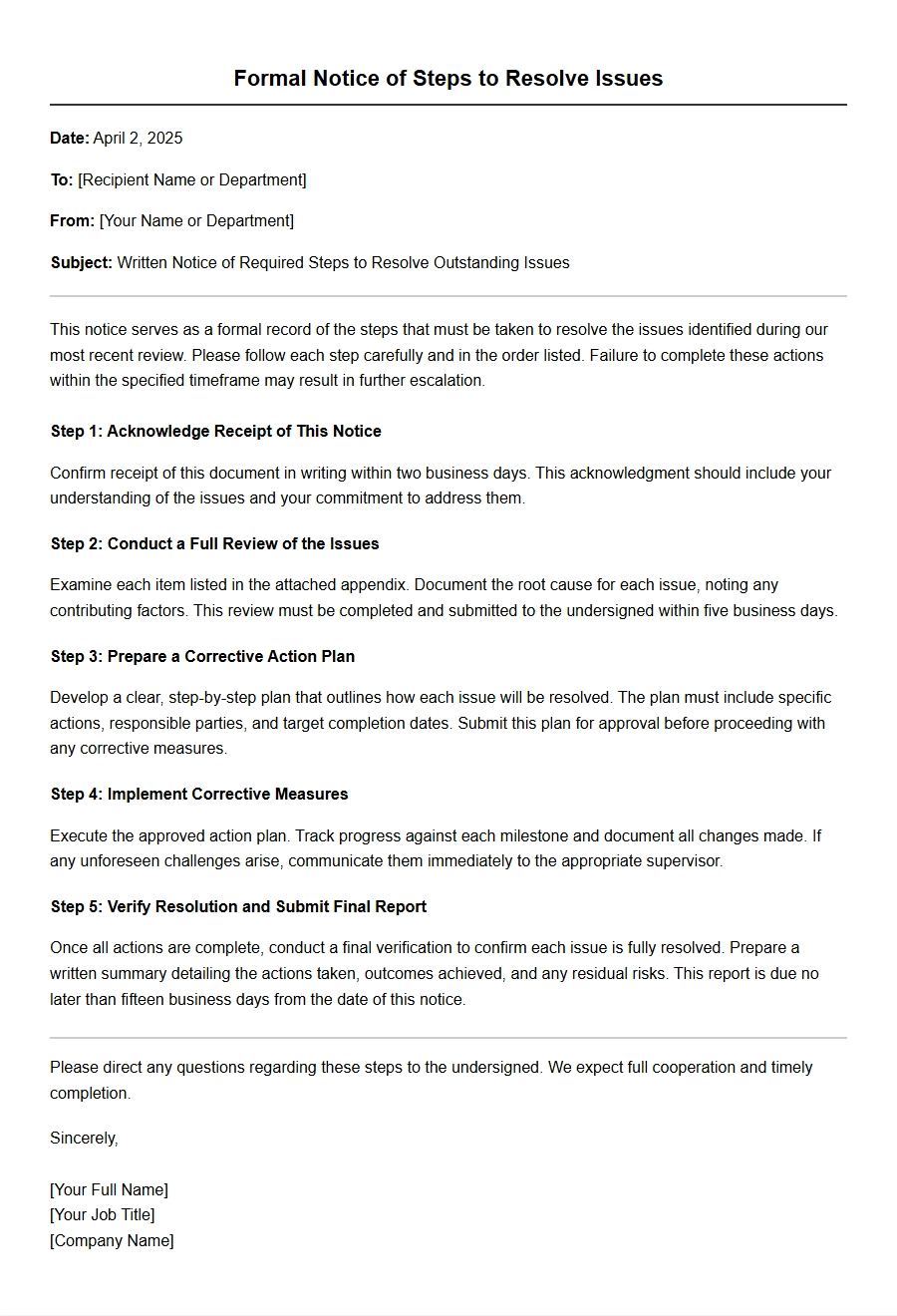 Steps to Resolve Issues via Written Notice
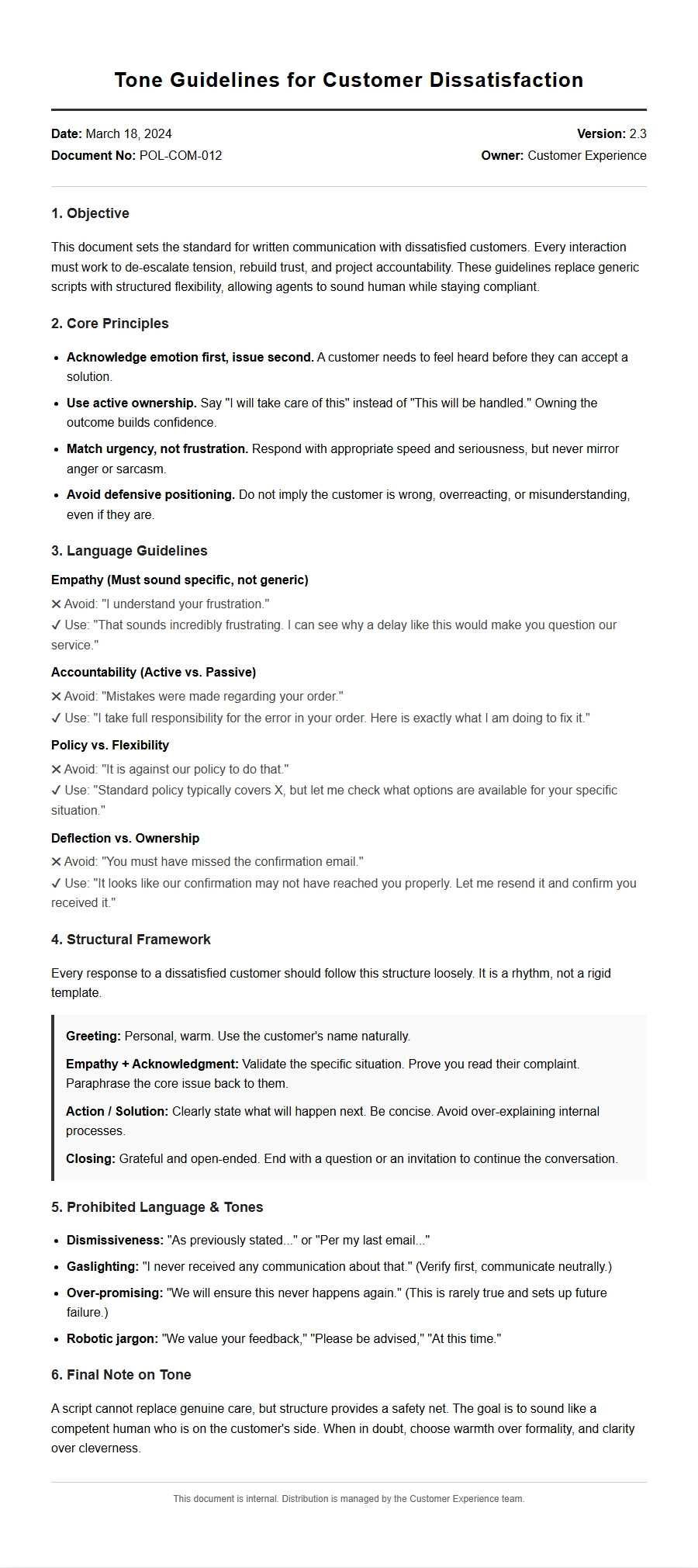 Tone Guidelines for Dissatisfied Customer Letters
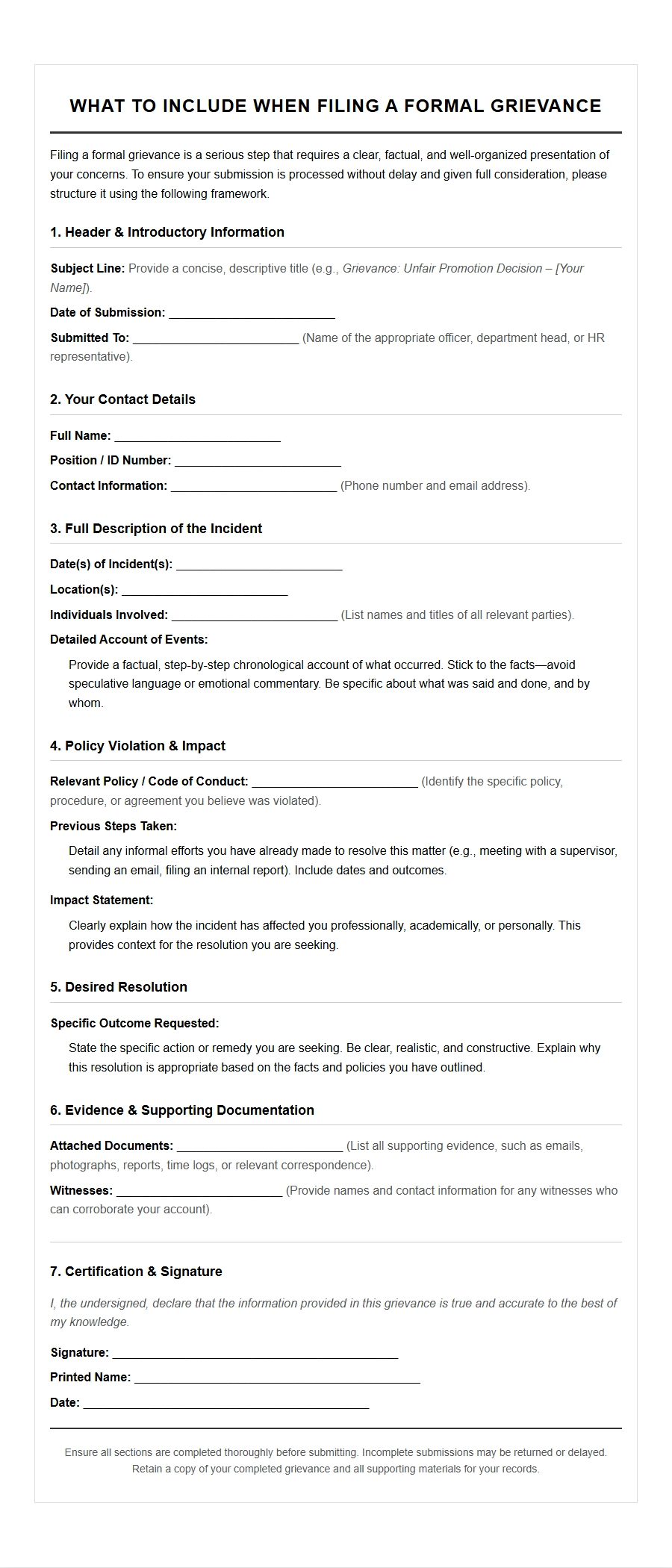 What to Include in a Formal Grievance Letter
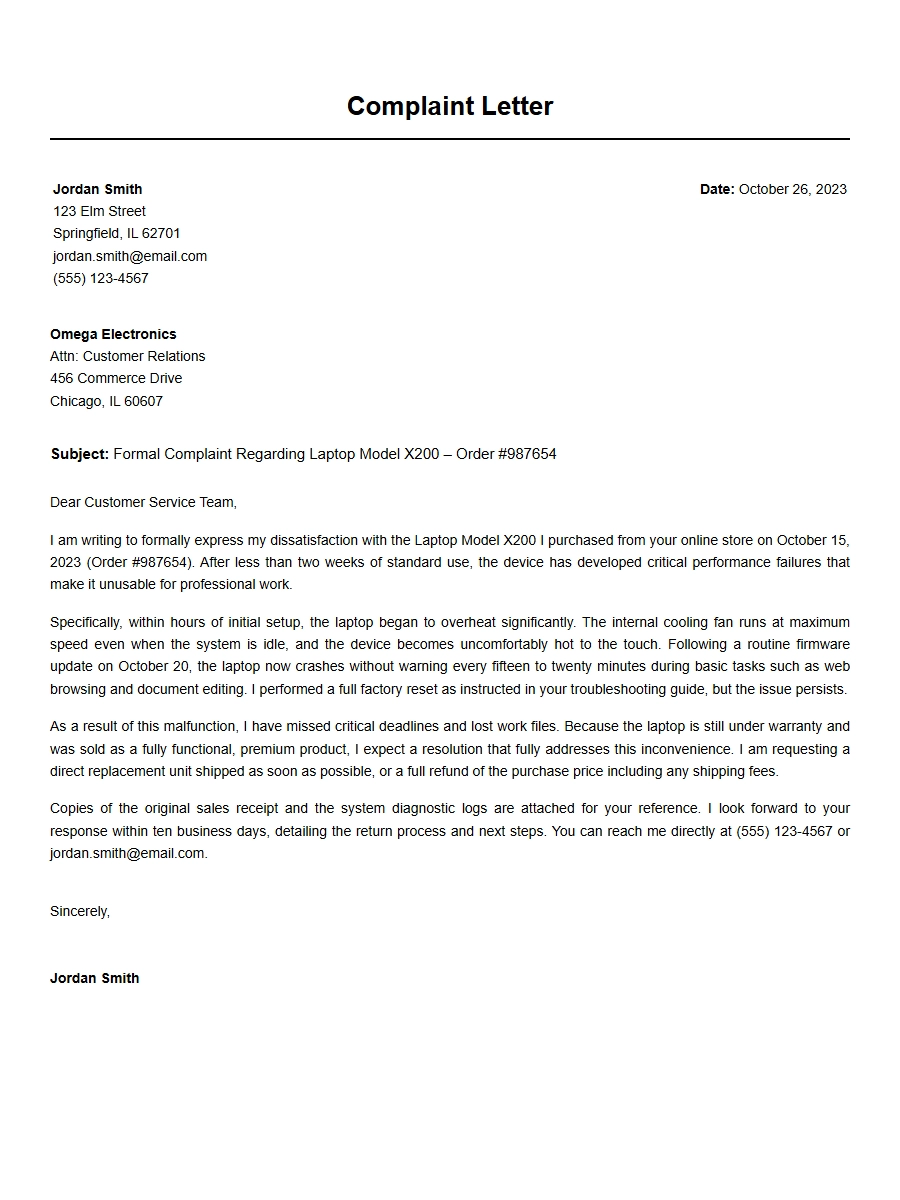 Structure of an Effective Complaint Letter
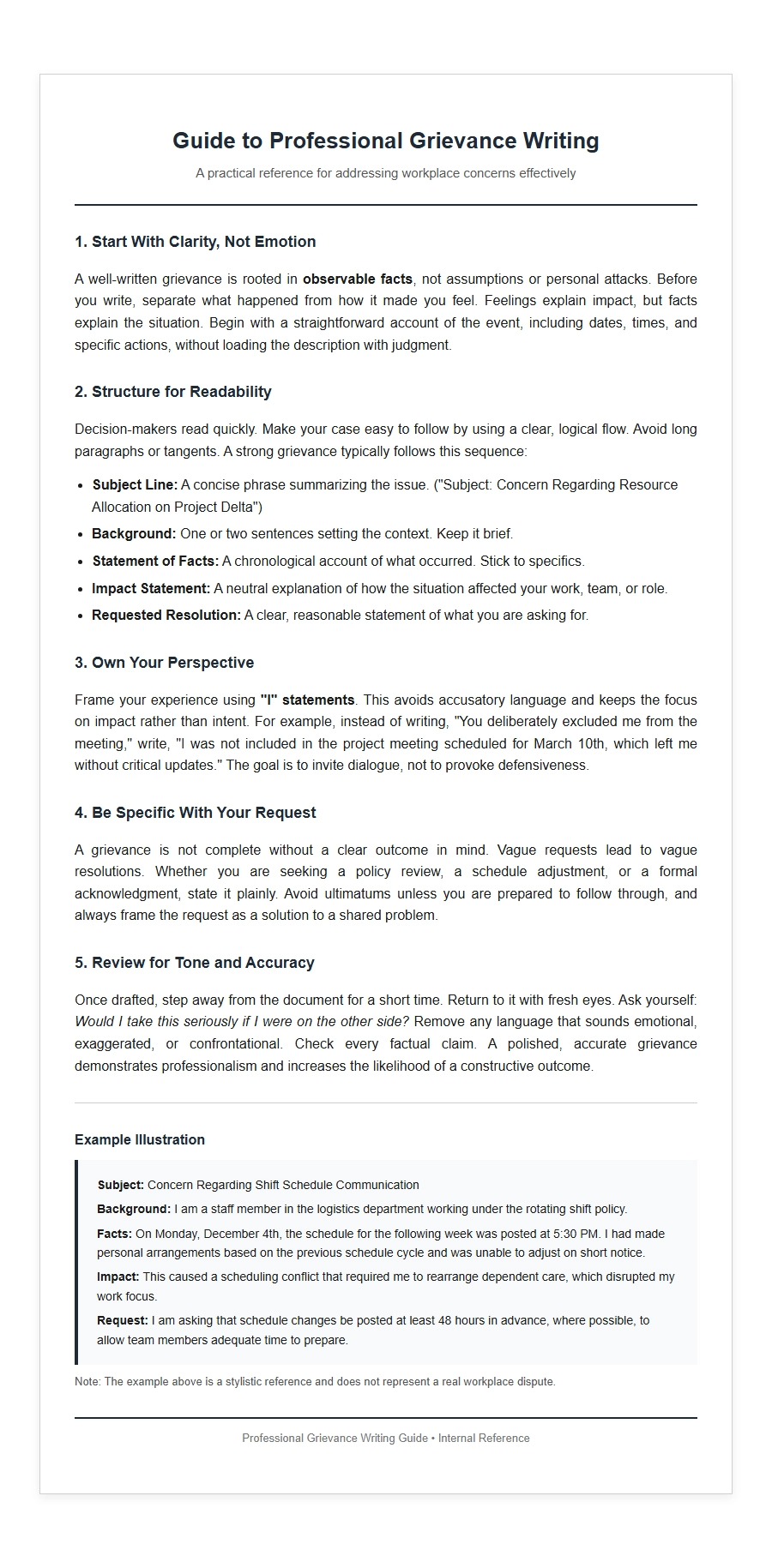 Best Practices for Writing Professional Grievance Letters