Complaint Letter for Teacher's Conduct Toward Student
You’ve just heard about a teacher’s behavior that crosses a line, or maybe your own child came home upset. Now you need to write a formal complaint. Staring at that blank page can feel paralyzing—but the right sample turns that anxiety into a confident, polished draft in minutes. It’s not about copying; it’s about having a solid framework so you can focus on what matters: describing the conduct and how it affected the student.
Using a letter template is a smart, time-saving strategy, not cheating. A good sample gives you structure, tone, and key phrases while leaving plenty of room for personalization. Think of it as training wheels—once you get the hang of professional correspondence, you’ll adjust and eventually write faster each time. The goal is to produce a clear, respectful complaint that gets read and acted upon.
Category: Teacher Conduct Complaints
Why a sample helps more than a blank page
A complaint about teacher conduct toward a student needs to be taken seriously. Without a proper business letter format, your message might come across as scattered or emotional. Samples teach you the expected salutation and closing, how to state the facts neutrally, and how to request a specific outcome. They also remind you to include dates, names, and any previous communication. Ever received a letter that felt too stiff or too casual? The right sample helps you land somewhere in the middle—professional but human.
How to choose the right letter sample
Not every complaint situation is the same. If you're writing to a principal about a single incident, a formal but brief letter works. If the conduct is ongoing or involves safety, you might need a more detailed version addressed to the school board or district office. Look for a letter template that matches the audience and severity. Formal writing tips often suggest erring on the side of politeness, even when you're angry. Avoid accusatory language; instead, describe what happened and why it violated school policy or student well-being. For example, “On March 10, Ms. Johnson told my son that he ‘would never succeed’ in front of the class,” is specific and factual.
Adapt the sample without losing your voice
The best customizable letter still needs your personal touch. Replace generic placeholders with real details—teacher names, student names, dates, and the exact behavior. Keep your natural tone, but trim emotional words like “horrible” or “unfair.” Use calm, clear language. A complaint that sounds measured and rational is more likely to be investigated. If you’re unsure about tone in writing, read your draft aloud. Does it sound like you? Good. Does it also sound like someone who expects a serious response? Perfect.
Tailor the opening paragraph to grab attention
The first few sentences should state the purpose immediately. “I am writing to formally complain about the conduct of Mr. Adams toward my daughter, Sarah, during class on April 5.” Don’t bury the lead. Then briefly explain why this matters—academic impact, emotional distress, or a pattern of behavior. Avoid vague phrases like “I’m not happy with.” Be direct. This is professional correspondence, so treat it like a document that someone will file and review later.
Common mistakes to avoid
Using “To Whom It May Concern” when you know the principal’s name makes you look unprepared. Always address the letter to a specific person. If you’re sending it via email, follow digital letter format rules: a clear subject line, a polite greeting, and your contact info. For printed letters, use a simple letterhead design with your name and address at the top. Another big mistake is forgetting to proofreading letter—typos undermine your credibility. Have someone else read it, or read it backward to spot errors. And never send a complaint without keeping a copy for yourself.
Making your complaint more effective
Just like when you file a complaint about a product or service, the same principles apply: document everything, stick to facts, and be clear about what you want. If the teacher’s conduct was a single incident, requesting a meeting might be enough. For repeated behavior, ask for a formal investigation. If you need to escalate, follow the structure of an effective complaint letter to ensure nothing gets overlooked. Sometimes parents face obstacles similar to challenging travel agent itinerary changes—denial, delay, or vague answers. Stay persistent and keep copies of all correspondence.
If the conduct involves safety hazards (like neglect or verbal abuse that puts students at risk), you might need to notify the school board of safety hazards as part of your complaint. That’s a different format, but the core need—clear, actionable facts—remains the same. And if you feel the school isn’t responding, treat it like a grievance about contract terms: know your rights, reference policies, and demand a written response.
Use the sample as a springboard, not a crutch
The best letters feel both professional and personal. A sample gives you the bones; you add the heart. After writing a few complaints, you’ll notice the process gets faster. You’ll know what letter writing etiquette requires, and you’ll tweak the letter structure naturally. Don’t be afraid to edit the sample heavily—cross out sentences that don’t fit, merge sections, or add a paragraph explaining the impact on the student’s learning. Practice makes the process smoother, and each time you do it, you’re advocating for a student who deserves to feel safe and respected.
Everyday Writing Examples
Complaint Letter for Teacher's Conduct Toward Student
Formal Letter Regarding Inappropriate Classroom Remarks
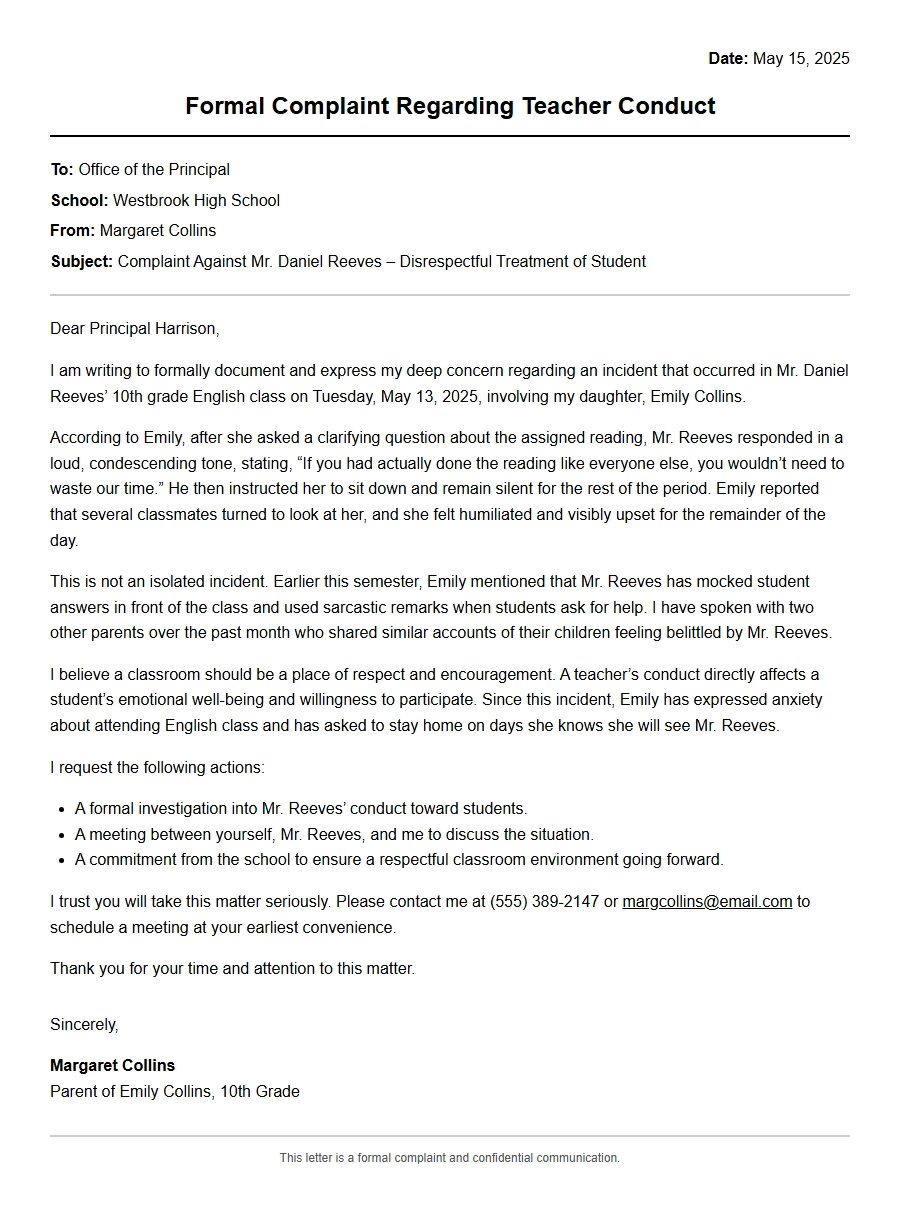
To: Principal, Lincoln High School From: Maria Gonzalez, Parent of Student ID 2047 Date: October 15, 2023
I am writing to formally complain about the conduct of Mr. David Chen, my son’s 10th-grade math teacher, toward my child. On several occasions, Mr. Chen made derogatory remarks about my son’s learning pace, calling him “slow” in front of peers. This has caused my son significant emotional distress and a reluctance to attend class.
I request an immediate investigation into this matter. Below are specific incidents:
September 20: Mr. Chen said, “You’ll never get this if you keep staring at your desk,” in a loud tone.
October 5: Mr. Chen compared my son unfavorably to another student, stating, “Even he understands faster than you.”
I expect a written response within 10 business days outlining steps taken. Thank you for your attention.
Email to School Board on Discriminatory Behavior
Subject: Urgent Complaint: Discriminatory Conduct by Teacher
To: School Board, Oakwood District From: James and Linda Park Date: November 2, 2023
We are parents of Emily Park, a 7th grader at Oakwood Middle School. We believe her teacher, Mrs. Sandra Lee, has shown discriminatory behavior toward Emily based on her ethnic background. Specifically, Mrs. Lee has repeatedly singled out Emily for stricter rules, such as requiring her to sit alone during group work while allowing other students freedom.
We have documented the following instances:
Date
Incident
Oct 12
Emily was told to move to a separate desk for no reason
Oct 25
Mrs. Lee ignored Emily’s raised hand three times
This behavior violates district policies and must be addressed immediately. We request a meeting with you and Mrs. Lee, and appropriate disciplinary action.
Student Grievance About Humiliation in Class
To: Dean of Students, Riverside Academy From: Alex Torres, Grade 11 Date: December 1, 2023
I am filing a grievance against my history teacher, Mr. Patrick O’Neil, for publicly humiliating me. Last week, I answered a question incorrectly, and Mr. O’Neil laughed and said, “Did you even read the chapter?” in front of the class. This is not the first time; he often mocks students who struggle.
I feel this creates a hostile learning environment. Specific events include:
November 15: Mr. O’Neil mimicked my accent while I was speaking.
November 28: He called me “clueless” during a discussion.
I ask that you review this complaint and take corrective measures. I am willing to provide more details in a private meeting. Please respond by December 8.
Parental Concern About Teacher's Aggressive Tone
To: Superintendent, Pine Hills School District From: Karen Walsh Re: Complaint Against Ms. Jennifer Ross, Grade 3 Teacher Date: January 10, 2024
I am deeply concerned about the aggressive tone Ms. Ross uses with my daughter, Lily Walsh. Lily has reported that Ms. Ross yells at her for small mistakes, such as dropping a pencil, and once said, “You’re wasting everyone’s time, Lily.” This has caused Lily to cry before school daily.
I request an immediate classroom observation and a review of Ms. Ross’s conduct. Below is a summary of what Lily described:
November 8: Ms. Ross slammed a book on Lily’s desk and shouted.
December 2: Ms. Ross told Lily she was “too slow for third grade.”
Please contact me at 555-1234 to schedule a meeting. I expect action to ensure my child’s emotional safety.
To: Principal, Westview Elementary From: Ethan Cole, Parent of Lucas Cole Date: February 5, 2024
I am filing a complaint about Mr. Robert Hayes, my son’s 5th-grade teacher, for failing to intervene when my son was bullied. On January 30, during recess, another student shoved Lucas and called him names. Mr. Hayes was nearby but did nothing. When Lucas reported it, Mr. Hayes said, “Boys will be boys,” and took no action.
This is unacceptable and has worsened the bullying. I have documented the following:
Date
Event
Teacher Response
Jan 30
Physical shove and name-calling
No intervention
Feb 2
Verbal taunting
Dismissed as minor
I demand that Mr. Hayes receive training on handling bullying and that he apologize to my son. Please respond by February 12.
High School Student's Report of Unfair Grading
To: Academic Affairs Office, Central High From: Sarah Kim, Student ID 3048 Date: March 18, 2024
I am reporting Mr. Thomas Baker, my English teacher, for unfair grading practices that I believe are targeted at me. On my recent essay, I received a C- with the comment “Lacks effort,” but my friend’s similar essay got a B+. When I asked for clarification, Mr. Baker said, “You should just try harder,” and refused to review it.
This pattern includes:
February 10: I was graded lower than peers for the same work.
March 5: Mr. Baker deducted points for “incorrect format” not on the rubric.
I request a regrade of my essay and an investigation into Mr. Baker’s grading consistency. I attach copies of my work for comparison. Please contact me at sarah.k@email.com.
To: Human Resources, Bridgeport School District From: Monica Rivera, Parent of Jake Rivera Date: April 22, 2024
I am writing to report concerning physical conduct by Coach Alan Torres toward my 8th-grade son. During a basketball practice, Coach Torres grabbed Jake’s arm forcefully when he missed a shot, leaving a bruise. When I raised this, Coach Torres claimed it was “motivational,” but my son felt threatened.
Incidents reported to me include:
March 30: Coach Torres pushed Jake into a wall, saying “Toughen up.”
April 5: He poked Jake’s chest repeatedly during a drill.
This is unacceptable. I request an immediate investigation, a written apology, and that Coach Torres be removed from coaching duties. Please confirm receipt within 48 hours.
Letter About Teacher's Favoritism Impacting Student
To: Guidance Counselor, Hilltop High School From: David Nguyen, Parent of Mia Nguyen Date: May 9, 2024
I am concerned about Mrs. Patricia Young’s favoritism in her 9th-grade science class, which is harming my daughter. Mia has noted that Mrs. Young consistently calls on same students, gives them extra credit opportunities, and ignores her raised hand. Last week, Mia’s well-prepared project was marked down while a friend’s similar project earned full marks.
Specific examples:
Date
Situation
Apr 20
Mia was not called on despite raising hand 5 times
May 2
Different grading on identical lab reports
This unfair treatment has discouraged Mia from participating. I request a meeting with Mrs. Young and a review of grading practices. Thank you.
Complaint Against Teacher for Making Threats
To: School Safety Office, Northwood High From: Claudia Martinez, Parent of Diego Martinez Date: June 15, 2024
I am filing a serious complaint against Mr. Kevin Gray, my son’s math teacher, for threatening behavior. On June 10, Mr. Gray told Diego that if he didn’t finish his work, he would “end up like the dropouts” and later said, “I’ll make sure you regret being in my class.” Diego felt terrified and has been anxious about attending school.
We have evidence from a classmate who heard the remarks. Mr. Gray’s conduct violates policy P-402 on staff-student interactions. I demand:
An immediate investigation
A written reprimand for Mr. Gray
Transfer of Diego to another class
Please act urgently. My phone number is 555-9876.
Student Complaint About Teacher's Sarcastic Comments
To: Vice Principal, Eastside Academy From: Emily Zhang, Grade 10 Date: July 7, 2024
I am submitting a complaint against my social studies teacher, Ms. Carol Evans, for persistent sarcasm that amounts to bullying. Last week, when I asked for clarification on an assignment, she replied, “Maybe if you listened for once, you’d know.” She often says things like “Nobel prize for you” when a student makes a mistake.
List of specific incidents:
June 25: Ms. Evans said to me, “Oh, you’re asking again? Surprise.”
July 1: She rolled her eyes and sighed loudly when I answered slowly.
This creates a negative classroom atmosphere. I request that Ms. Evans be reminded of respectful communication policies. I am happy to discuss this further with you in person.
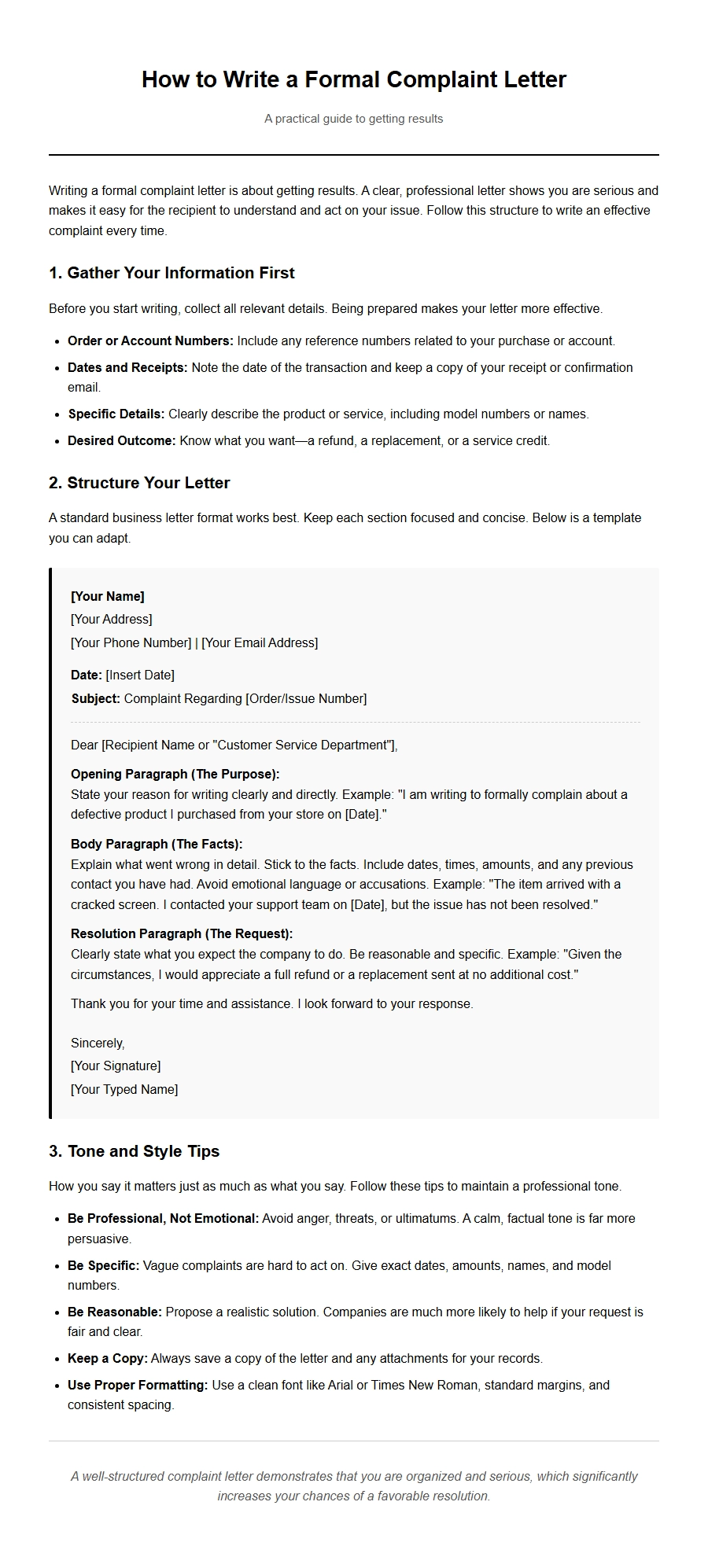 How to Write a Formal Complaint Letter
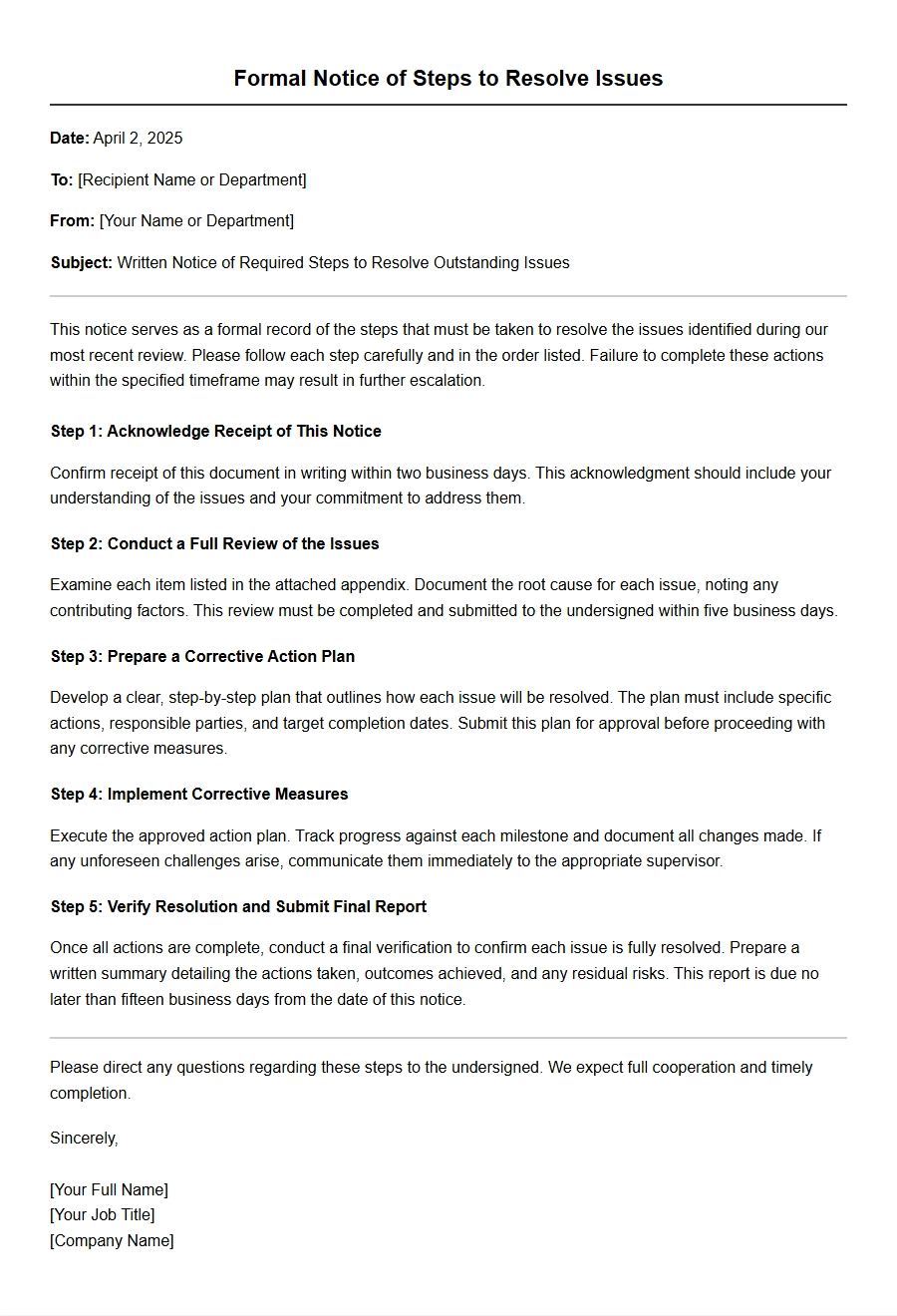 Steps to Resolve Issues via Written Notice
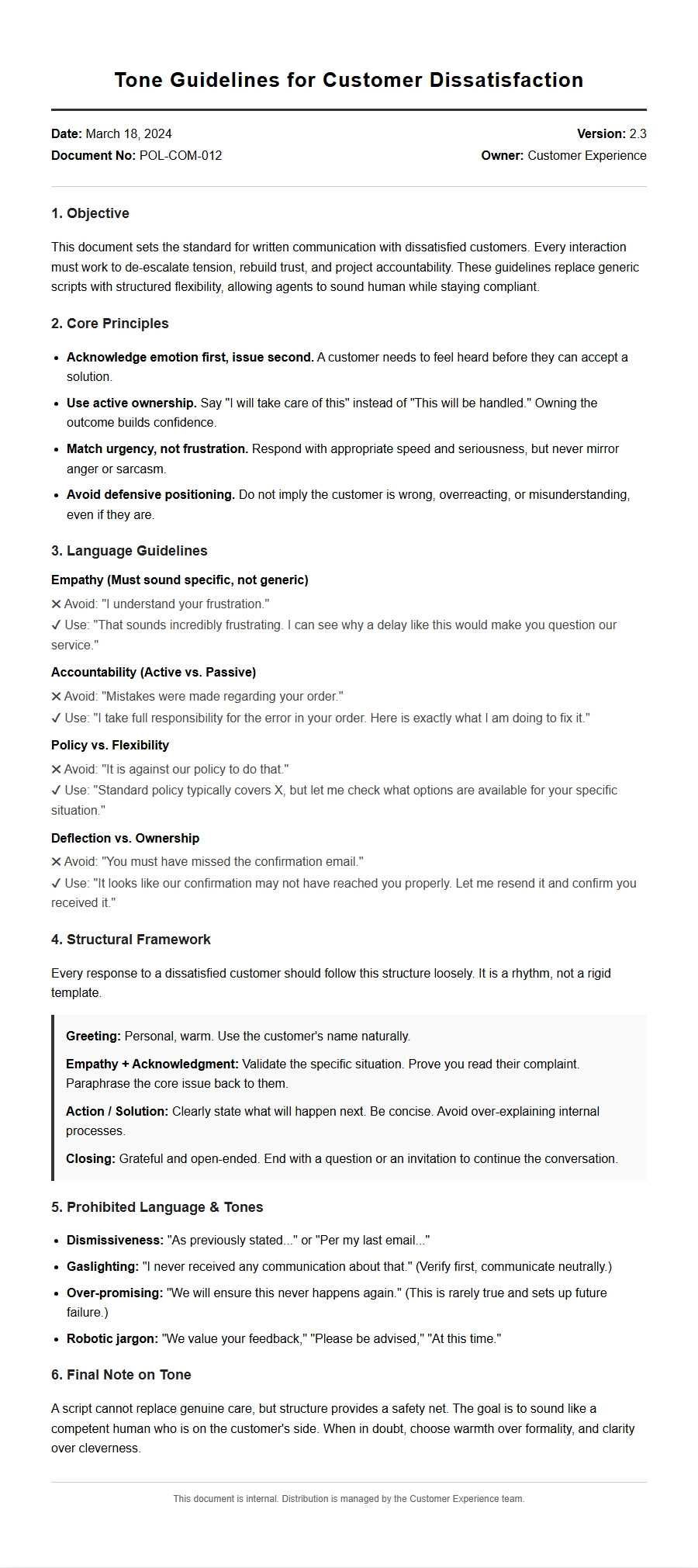 Tone Guidelines for Dissatisfied Customer Letters
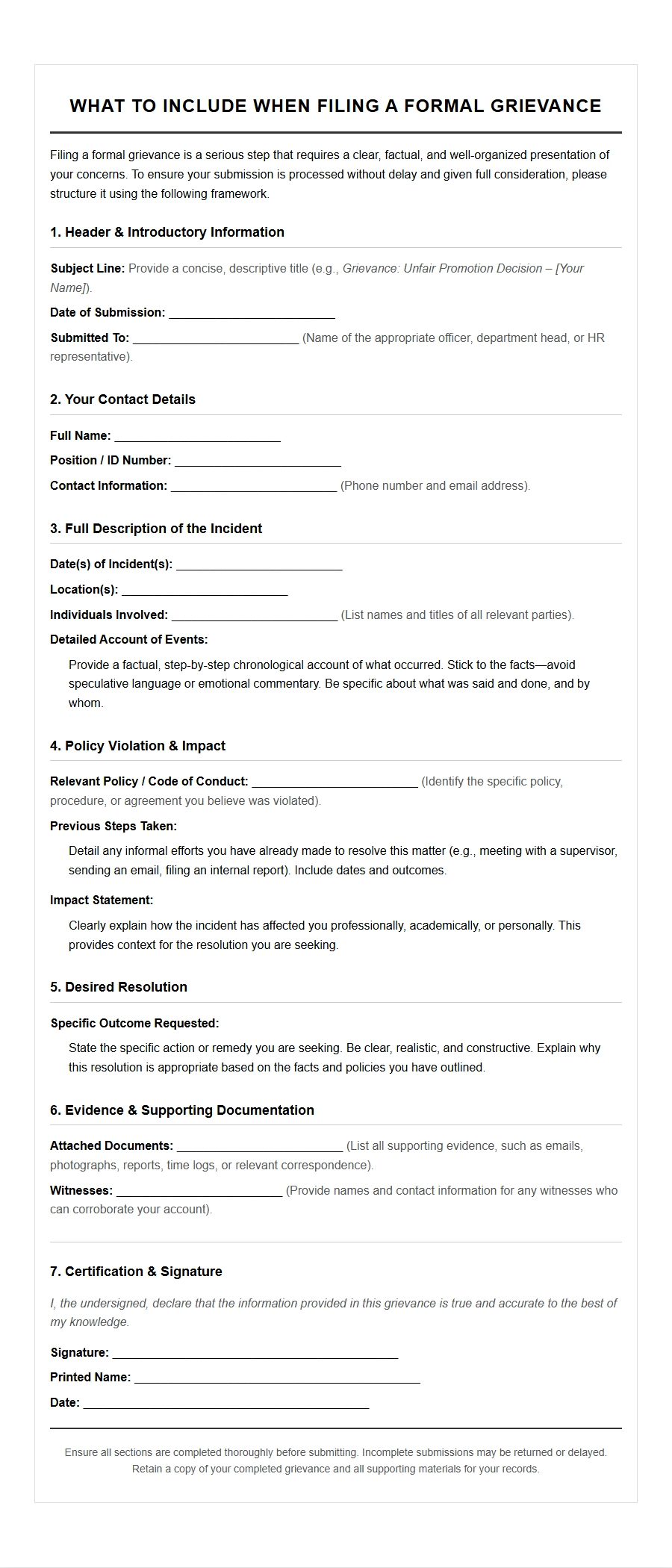 What to Include in a Formal Grievance Letter
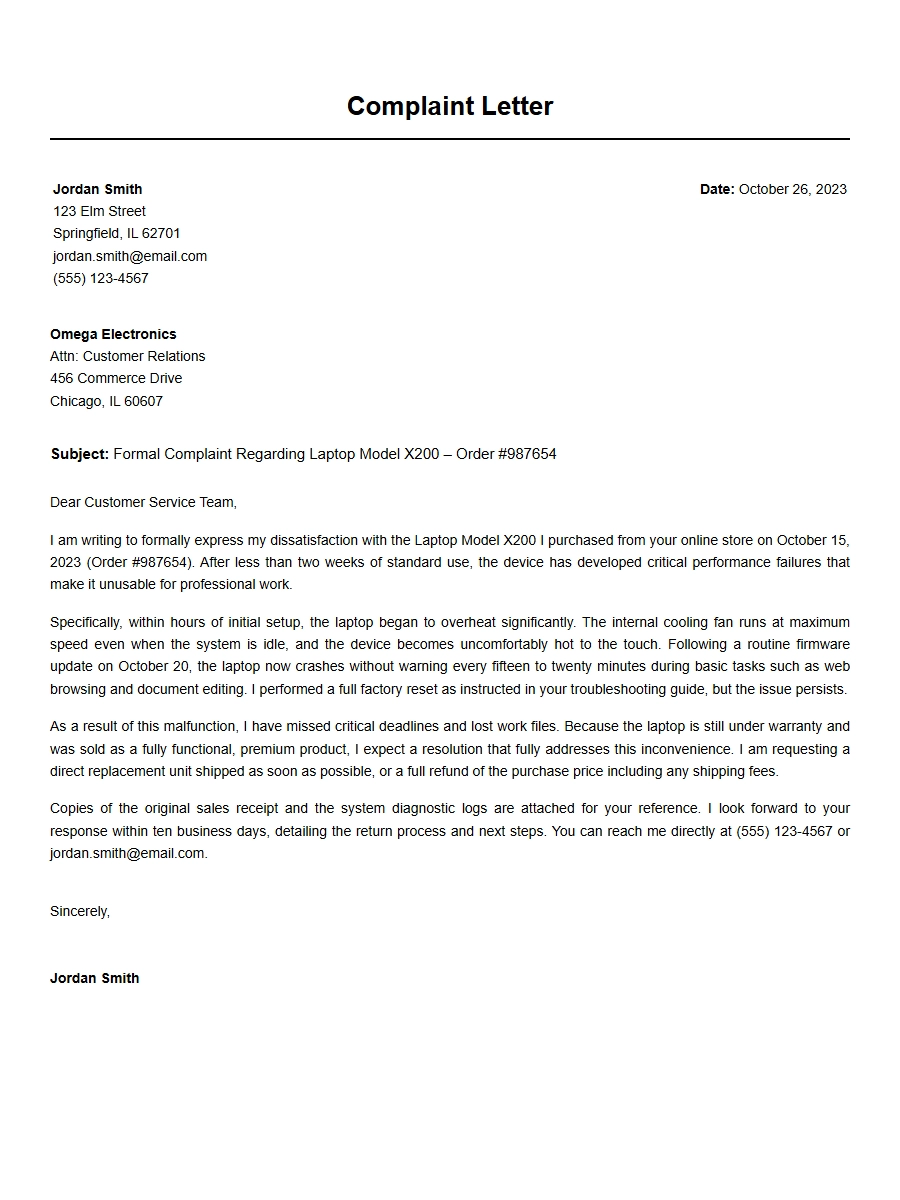 Structure of an Effective Complaint Letter
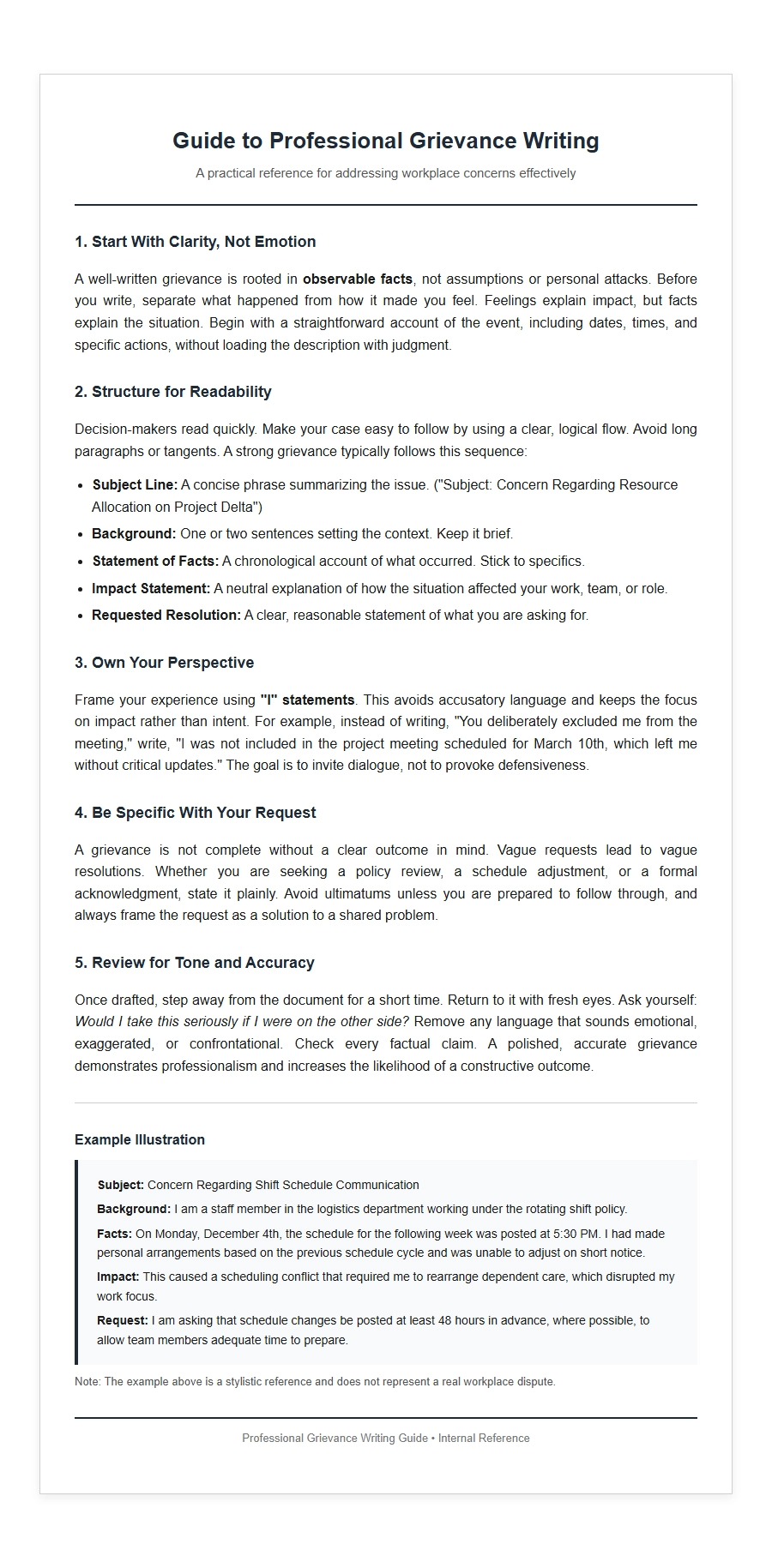 Best Practices for Writing Professional Grievance Letters