You’re staring at a blank page, trying to figure out how to write a letter that actually gets someone to fix a problem—maybe a late payment, a broken product, or a service that went wrong. The pressure is real, and it’s easy to freeze. But you don’t have to invent the wheel. Using a well-chosen sample is not cheating; it’s a smart shortcut that gives you structure, the right tone, and key phrases you can adjust. Think of it as a solid starting point that saves you time and keeps you from missing important details.
Category: Complaint Letters
So what are the actual steps to resolve issues via written notice? It starts with picking the right foundation. For a formal complaint, you’ll want a letter template that follows business letter format—your address, date, recipient’s address, a clear subject line, and a polite but firm salutation. If you’re emailing, skip the letterhead but keep the structure. A good professional correspondence sample will show you how to balance politeness with assertiveness. For example, if you’re writing about a faulty appliance, your opening should state the issue directly: “I am writing to formally notify you about a defect in the washing machine I purchased on [date].” That’s not rude—it’s clear.
How to adapt a sample without losing your voice
Once you have a customizable letter in front of you, don’t just fill in the blanks. Read it all the way through, then rewrite the first paragraph in your own words. That’s where you grab attention. For instance, instead of copying “I wish to express my dissatisfaction,” try “The issue with my order has been going on for three weeks, and I need it resolved by Friday.” That sounds like a real person talking. Keep the tone in writing professional but human. Avoid stiff phrases like “pursuant to our conversation” unless you’re in a very formal industry. Most of the time, “following up on our call” works just fine.
Ever received a letter that felt too stiff or too casual? Finding the right balance is key. If you’re writing to a large company, use letter writing etiquette—formal salutation (“Dear Mr. Smith” or “Dear Customer Service Team”) and a respectful closing (“Sincerely” or “Best regards”). If it’s a small business or a personal matter, you can be slightly more relaxed: “Hi Jane” might be okay, but still keep the body structured. Also, pay attention to salutation and closing—they set the tone. A common mistake is using “To Whom It May Concern” when you actually have a contact name. Always try to find a name; it shows you did your homework.
Common pitfalls and quick fixes
One big mistake people make is ignoring the format for digital versus printed letters. If you’re sending an email, skip the letterhead design and use a clean subject line like “Issue with order #12345 – Request for resolution.” In a printed letter, you’ll want your name and address at the top, and maybe a simple letterhead if you have one. Also, don’t forget to proofread the letter before sending. A typo in a complaint can weaken your credibility. Read it aloud, or have a friend glance at it.
Another pitfall: being too vague. Instead of saying “I’ve had problems with your service,” give specifics: the date, the person you spoke to, what was promised, and what actually happened. That makes your notice ironclad. If you need a prompt resolution, you might reference an urgent demand letter for immediate resolution sample to see how to phrase a deadline. And if you’re unsure about the overall structure, check out a guide on the structure of an effective complaint letter—it breaks down each section.
Putting it all together
Now, let’s walk through the steps quickly. First, pick a sample that matches your situation—whether it’s a resignation letter sample if you’re leaving a job, or a complaint letter about a faulty service. Second, personalize the opening and the closing to feel like you. Third, include all necessary details: what went wrong, what you want (refund, replacement, apology), and a reasonable deadline. Fourth, proofread. That’s it. You don’t need to overthink it.
One last thing: think of your letter as a springboard, not a crutch. The best written notices feel both professional and personal. They don’t sound like a robot copy-pasted a template. With a little practice, you’ll get faster and more confident. Next time you have an issue, you’ll know exactly where to start.
Examples You Can Adapt
Steps to Resolve Issues via Written Notice
Formal Complaint Regarding Defective Appliance
I am writing to formally notify you of a defect in the Model X123 Refrigerator purchased on January 15, 2025 (Order #78901). The unit stopped cooling within 30 days of delivery, contrary to the one-year warranty.
I have taken the following steps to resolve this issue via written notice:
Contacted your customer service on February 10, 2025, and was advised to send a written complaint.
Gathered relevant documentation: purchase receipt, warranty card, and photos of error codes.
Prepared this letter demanding a replacement unit or a full refund within 14 days.
Below are the product details for your reference:
Item
Details
Model
X123 Refrigerator
Serial No.
SN-456789
Date of Purchase
2025-01-15
Price Paid
$1,299.00
I expect a written acknowledgment of this complaint within five business days. Failure to resolve this will force me to escalate to the Better Business Bureau and pursue a chargeback.
Notice of Dissatisfaction with Home Repair Service
This letter serves as a formal written notice regarding the unsatisfactory repair work performed on my kitchen plumbing by your company on March 3, 2025 (Invoice #INV-2025-03-003). The new pipes you installed have leaked continuously, causing water damage to my cabinets.
My steps to resolve this issue via written notice:
Step 1: Reviewed the service agreement and noted your guarantee of workmanship for 90 days.
Step 2: Took photographs of the leak and water stains as evidence.
Step 3: Calculated initial repair cost of $450 and estimated damage at $200.
Step 4: Sent this letter demanding a free redo of the work and compensation for the cabinet damage.
I require a response by March 25, 2025, and a schedule for corrective work within the following week. If you fail to act, I will hire another plumber and seek reimbursement through small claims court.
Written Notice to Landlord for Repair Neglect
I am writing to formally notify you of unresolved maintenance issues at my rental unit (Apartment 4B, 123 Oak Street). These conditions violate our lease agreement Section 7, which requires the landlord to keep the premises in habitable condition.
Below are the outstanding repairs and my attempts to resolve them via written notice:
Issue
Date First Reported
Current Status
Mold in bathroom ceiling
Feb 1, 2025
Not addressed
Broken heater in living room
Feb 15, 2025
Temporary patch only
Leaking kitchen faucet
Feb 20, 2025
No response
I request that all repairs be completed within 14 days as required by state law. If you fail to comply, I will exercise my right to withhold rent or terminate the lease, and I will file a complaint with the local housing authority.
Complaint Letter for Incorrect Billing
I received your invoice #BILL-5678 dated March 1, 2025, which contains a significant error. You charged me $350 for a service plan that I explicitly cancelled on February 10, 2025 (confirmed via email). My written steps to resolve this billing issue:
Reviewed my account records and found the cancellation confirmation email.
Compared the incorrect invoice to my previous correct bills.
Prepared this formal notice demanding a corrected invoice and a credit of $350 to my account.
Here is the billing discrepancy:
Item
Incorrect Charge
Correct Charge
Service Plan (Monthly)
$350.00
$0.00
Late Fee (erroneous)
$25.00
$0.00
Total
$375.00
$0.00
I expect a revised invoice within 10 business days. If this is not resolved, I will dispute the charge with my credit card company and file a complaint with the Consumer Financial Protection Bureau.
Notice of Breach of Contract by Vendor
This letter constitutes a formal written notice of breach of contract regarding our agreement dated December 1, 2024 (Contract #C-2024-122). You agreed to deliver 500 units of Widget A by February 28, 2025, but as of today (March 10, 2025) only 200 units have been received.
My steps to resolve this issue via written notice:
1. Reviewed the contract terms and noted the delivery deadline and liquidated damages clause.
2. Verified that no force majeure event applies.
3. Sent prior reminders via email on February 15 and March 1, 2025.
4. Now issuing this formal demand for performance.
I demand that you deliver the remaining 300 units within 10 days of this notice, as per Section 12 of the contract. Failure to cure this breach will result in termination of the contract and a claim for damages of $5,000 plus legal fees.
Complaint to HOA Regarding Noise Violation
I am writing as a formal written notice to the Homeowners Association regarding a recurring noise violation from Unit 7C at 456 Pine Drive. The resident plays loud music after 10 PM on weeknights, which violates HOA rules Article III, Section 5 (quiet hours).
Documented incidents and my steps to resolve the issue:
Date
Time
Duration
Action Taken
Feb 28, 2025
11:15 PM
45 minutes
Verbally asked neighbor
Mar 2, 2025
10:30 PM
Over 1 hour
Filed informal complaint to HOA
Mar 5, 2025
11:45 PM
2 hours
Police called (unresolved)
I request that the HOA enforce the noise rules by sending a written warning to the resident. If the violation continues, I expect a fine to be imposed. Please provide a written response within seven days outlining the steps taken.
Formal Grievance Against Insurance Claim Denial
This letter is a formal written notice of my grievance regarding the denial of my insurance claim #CLM-98765 under Policy #POL-ABC123. The claim, for water damage to my basement on January 20, 2025, was denied on February 28, 2025, citing a "pre-existing condition" which is inaccurate.
My steps to resolve this via written notice:
Gathered the denial letter and reviewed the policy language.
Obtained an independent plumber's report confirming the damage was sudden and accidental.
Compiled supporting documents: photos, receipts, and the plumber's statement.
Sent this formal appeal requesting reconsideration within 30 days.
Enclosed documents (copies):
Original claim denial letter
Plumber's inspection report dated March 5, 2025
Photographs of the damage
Copy of policy coverage page
I demand that you reverse the denial and process payment of $3,200 for repairs. If I do not receive a favorable response within 30 days, I will file a complaint with your state insurance commissioner.
Written Notice to Neighbor About Property Damage
This notice is sent formally and in writing to address damage caused to my property by recent landscaping work at your residence (789 Elm Street). On March 8, 2025, your contractor's equipment knocked over my fence, breaking three wooden panels and damaging a shrub.
My steps to resolve this issue via written notice:
Step 1: Documented the damage with timestamps and photographs.
Step 2: Obtained a repair estimate from a local fencing company.
Step 3: Attempted to discuss with you on March 9, but no resolution was reached.
Step 4: Now sending this formal demand for compensation.
Itemized costs:
Item
Cost
Fence panel replacement (3)
$450.00
Labor for installation
$150.00
Shrub replacement
$75.00
Total
$675.00
I request that you pay this amount within 14 days. If payment is not received, I will pursue a claim in small claims court and notify my homeowner's insurance.
Complaint Letter Regarding Delayed Shipment
I am writing to formally complain about the significant delay in my order #ORD-54321 placed on February 1, 2025, for Office Chair Model ErgoPro. Your website promised delivery within 5-7 business days, but as of March 10, 2025, I have not received the item.
Steps I have taken to resolve this via written notice:
Checked tracking updates – no movement since February 10.
Called your customer service on February 20 and February 28 – both times told to wait.
Sent an email on March 3 requesting a status update (no reply).
Now sending this formal written notice demanding immediate action.
Order details:
Order #
Item
Amount Paid
Promised Delivery
ORD-54321
ErgoPro Office Chair
$899.00
Feb 7-9, 2025
I demand that you ship the chair via overnight delivery at no extra cost, or issue a full refund within 10 days. Failure to resolve this will lead me to file a dispute with PayPal and a complaint with the Federal Trade Commission.
Notice of Intent to Escalate to Consumer Protection
This letter serves as my final written notice before I escalate this matter to the Consumer Protection Division. I have been trying to resolve a defective laptop purchase from your store (purchased January 10, 2025, receipt #RCPT-10023) through multiple communications.
Below is a record of my previous attempts to resolve the issue via written notice:
Date
Method
Summary
Outcome
Jan 20, 2025
Email
Reported screen flickering
No response
Feb 5, 2025
Letter
Demanded replacement
Replied: send laptop for repair (refused)
Feb 25, 2025
Registered mail
Requested refund or new unit
Denied
I now give you 10 days from receipt of this notice to provide a full refund of $1,299 or a brand-new replacement. If no satisfactory resolution is reached, I will file a complaint with the Consumer Protection Division and post a public review detailing your unwillingness to honor the warranty.
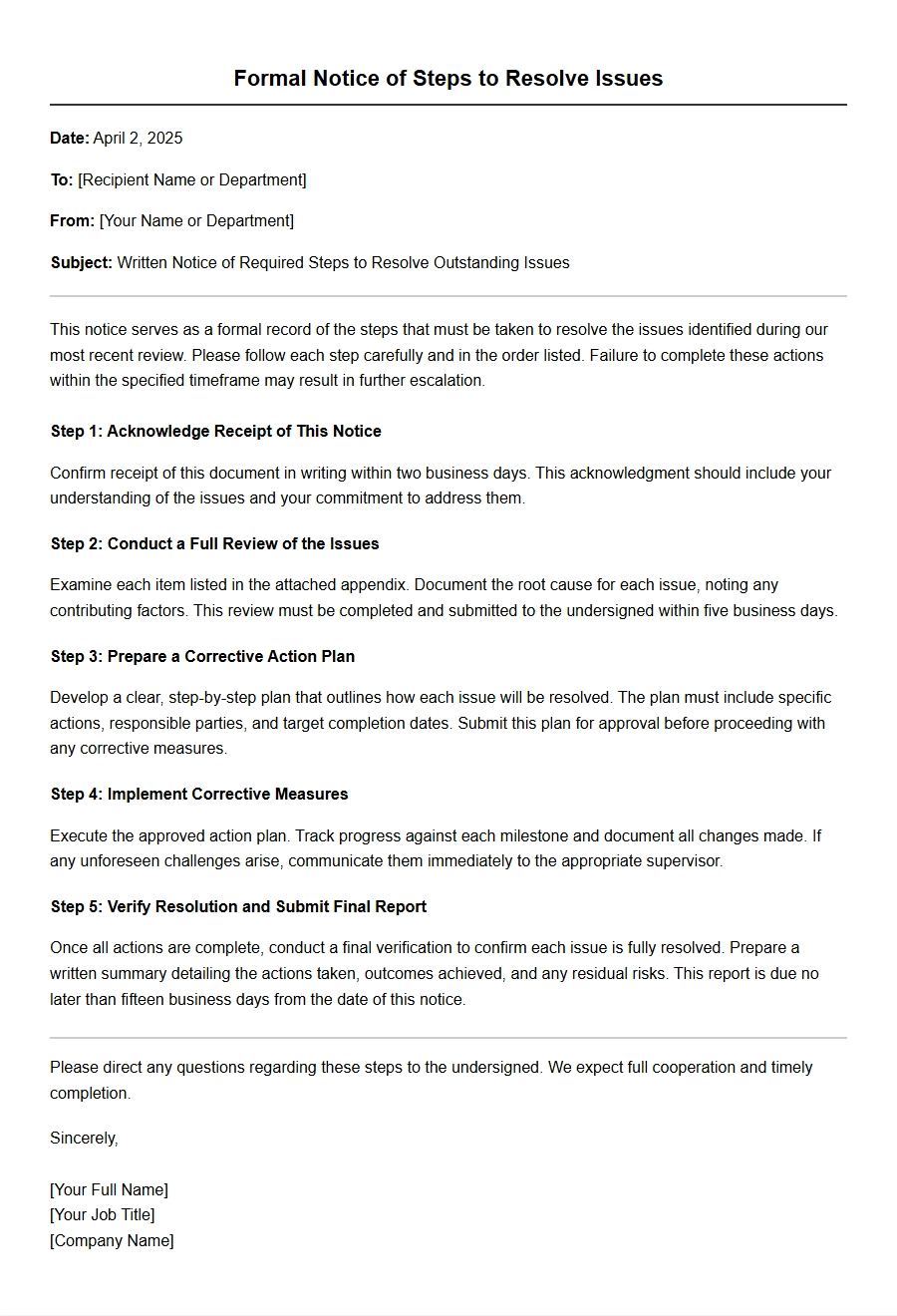
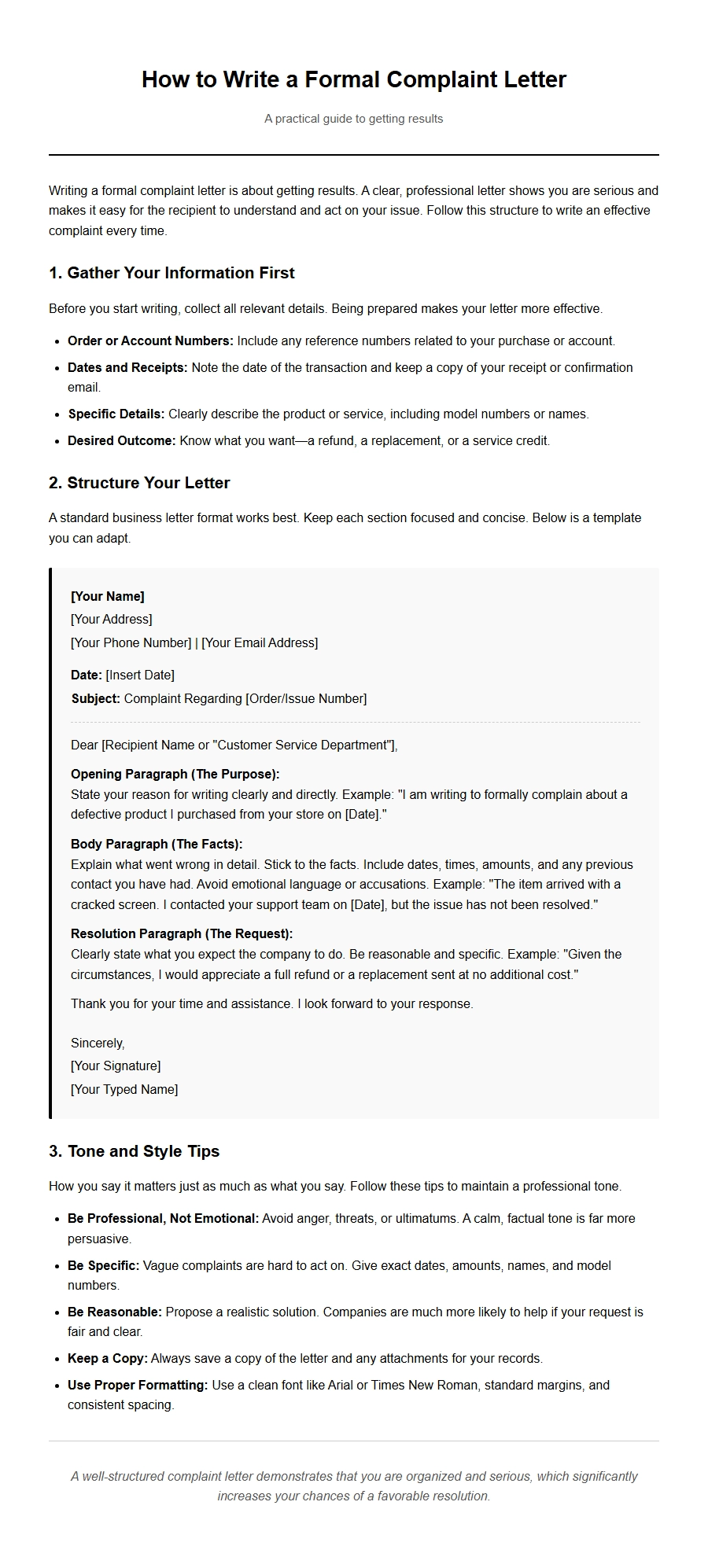 How to Write a Formal Complaint Letter
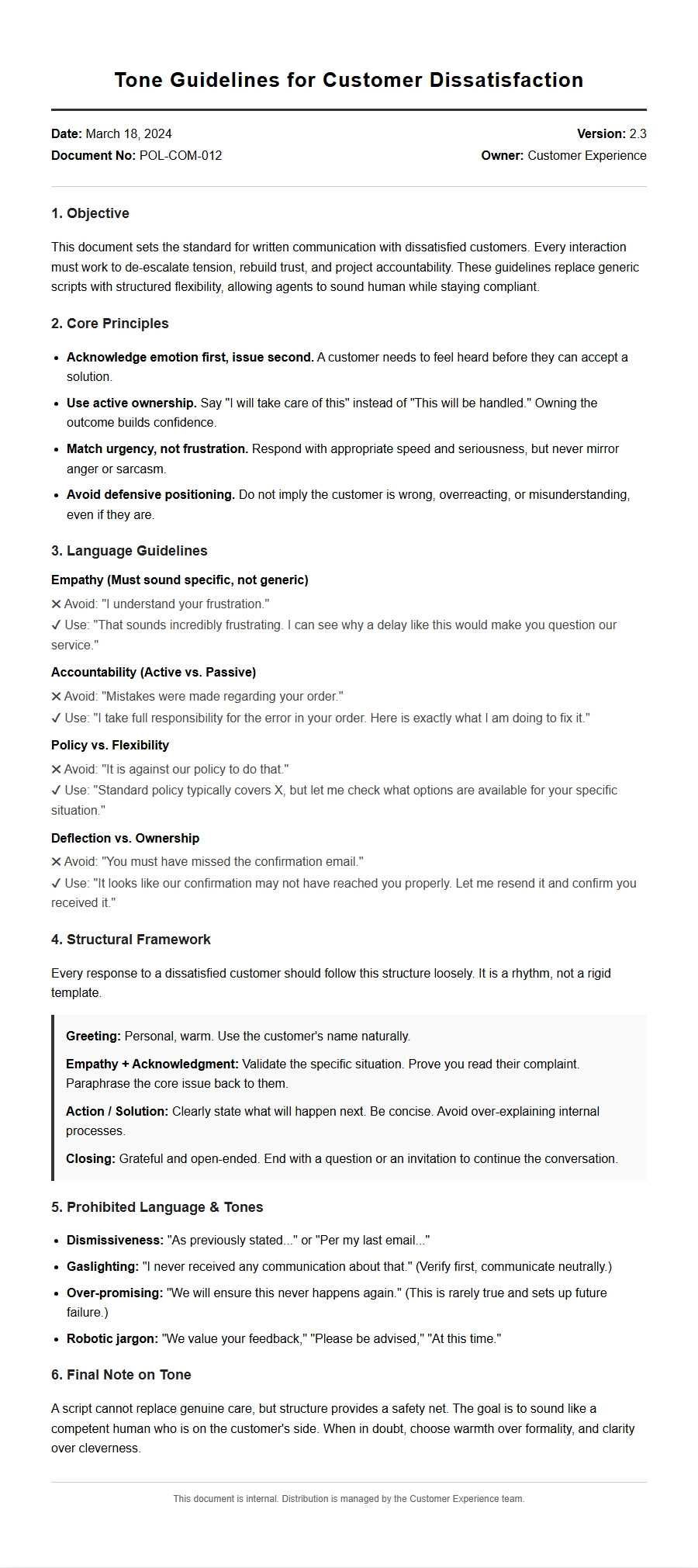 Tone Guidelines for Dissatisfied Customer Letters
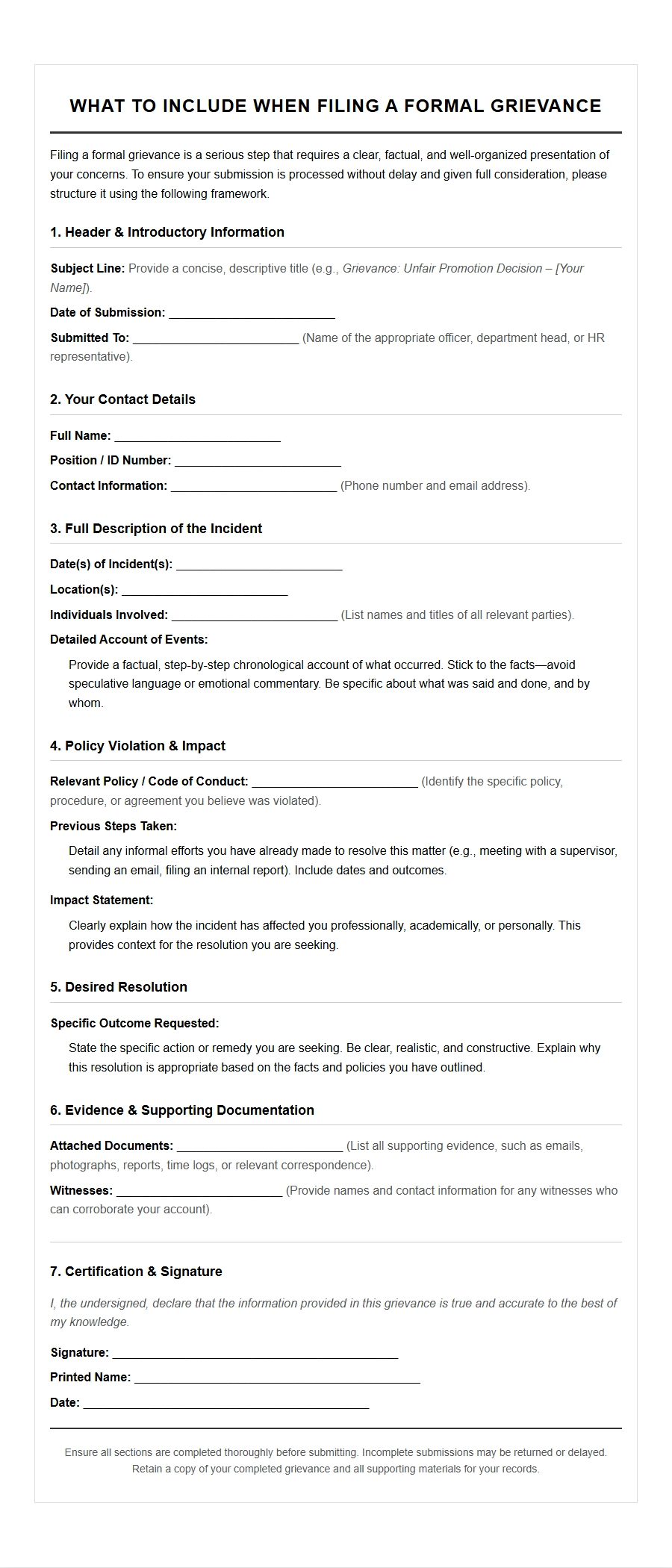 What to Include in a Formal Grievance Letter
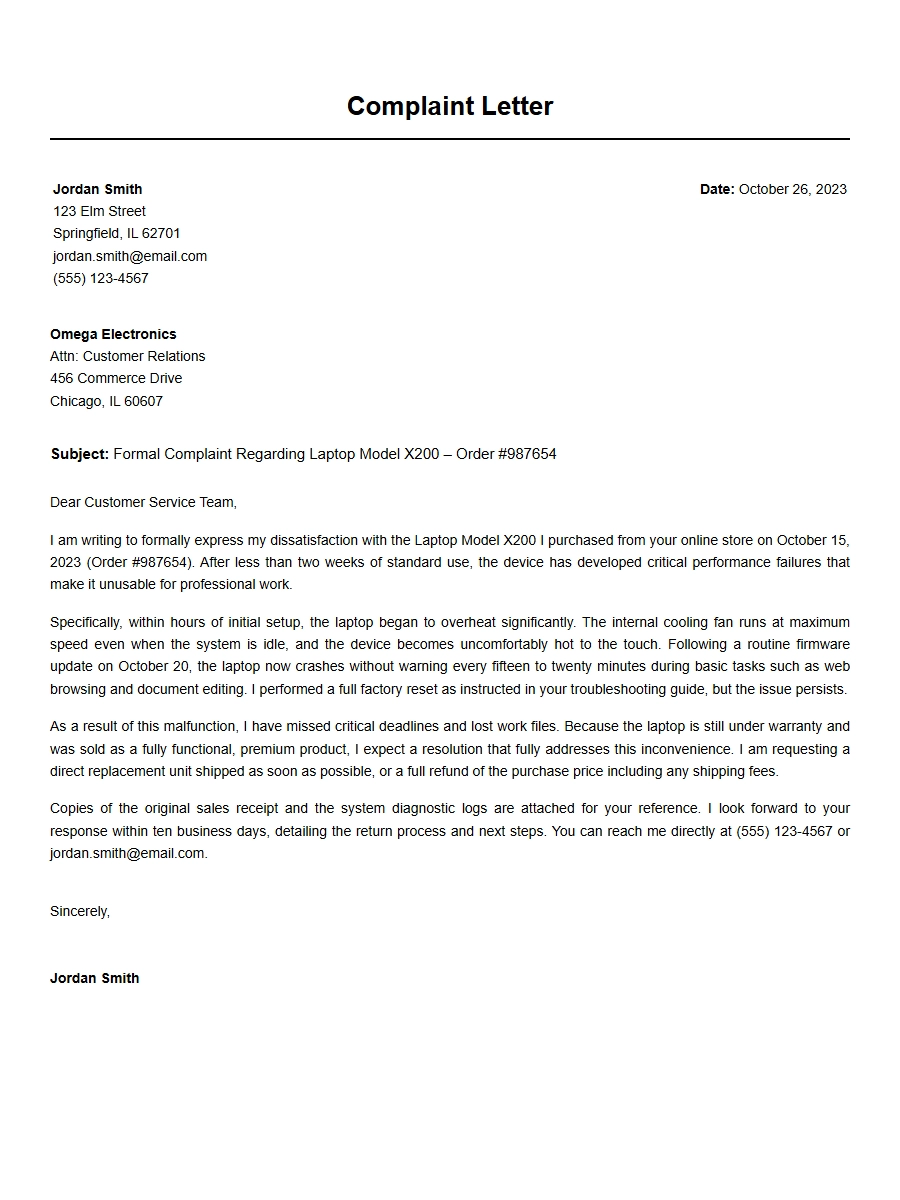 Structure of an Effective Complaint Letter
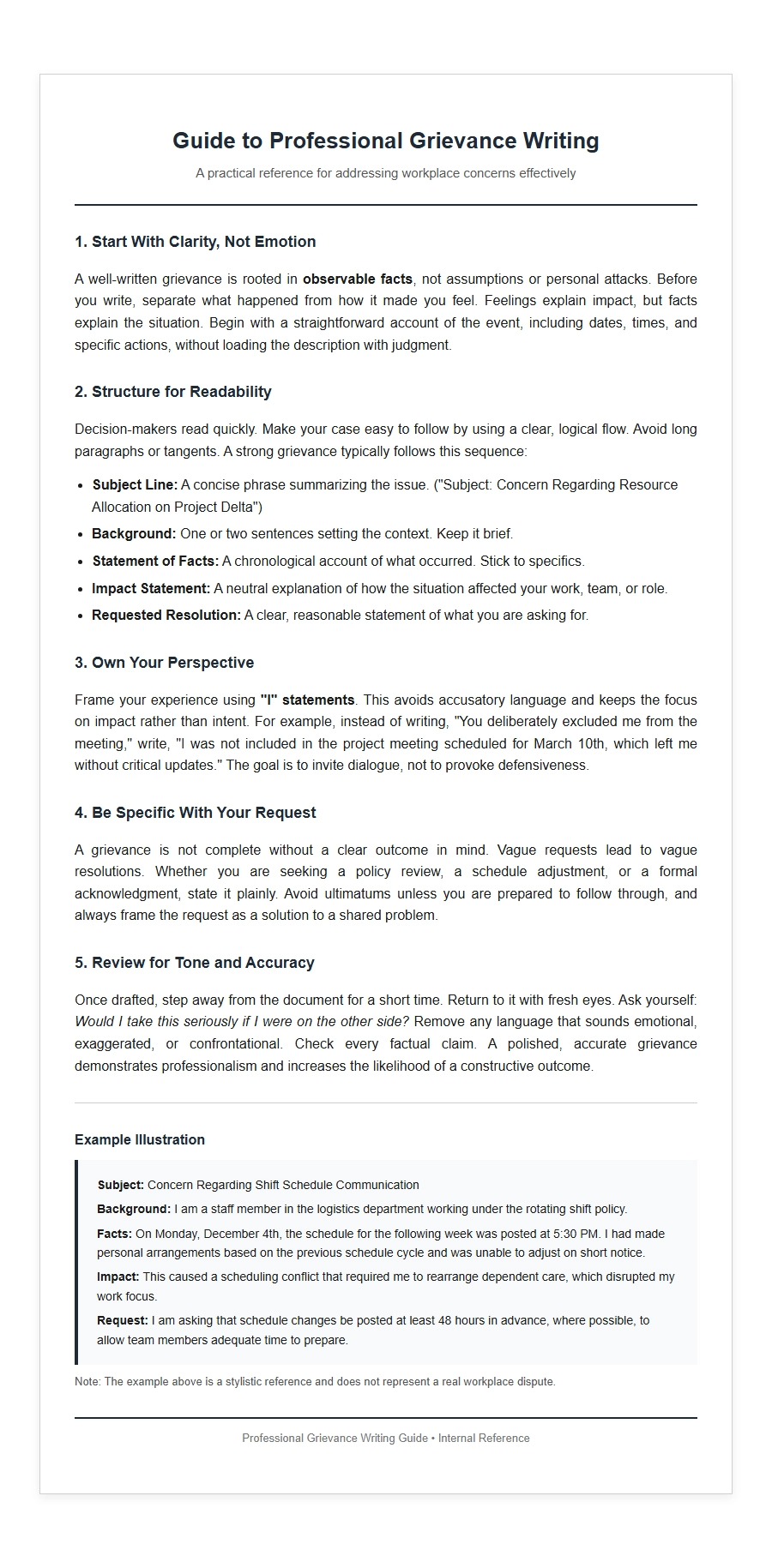 Best Practices for Writing Professional Grievance Letters
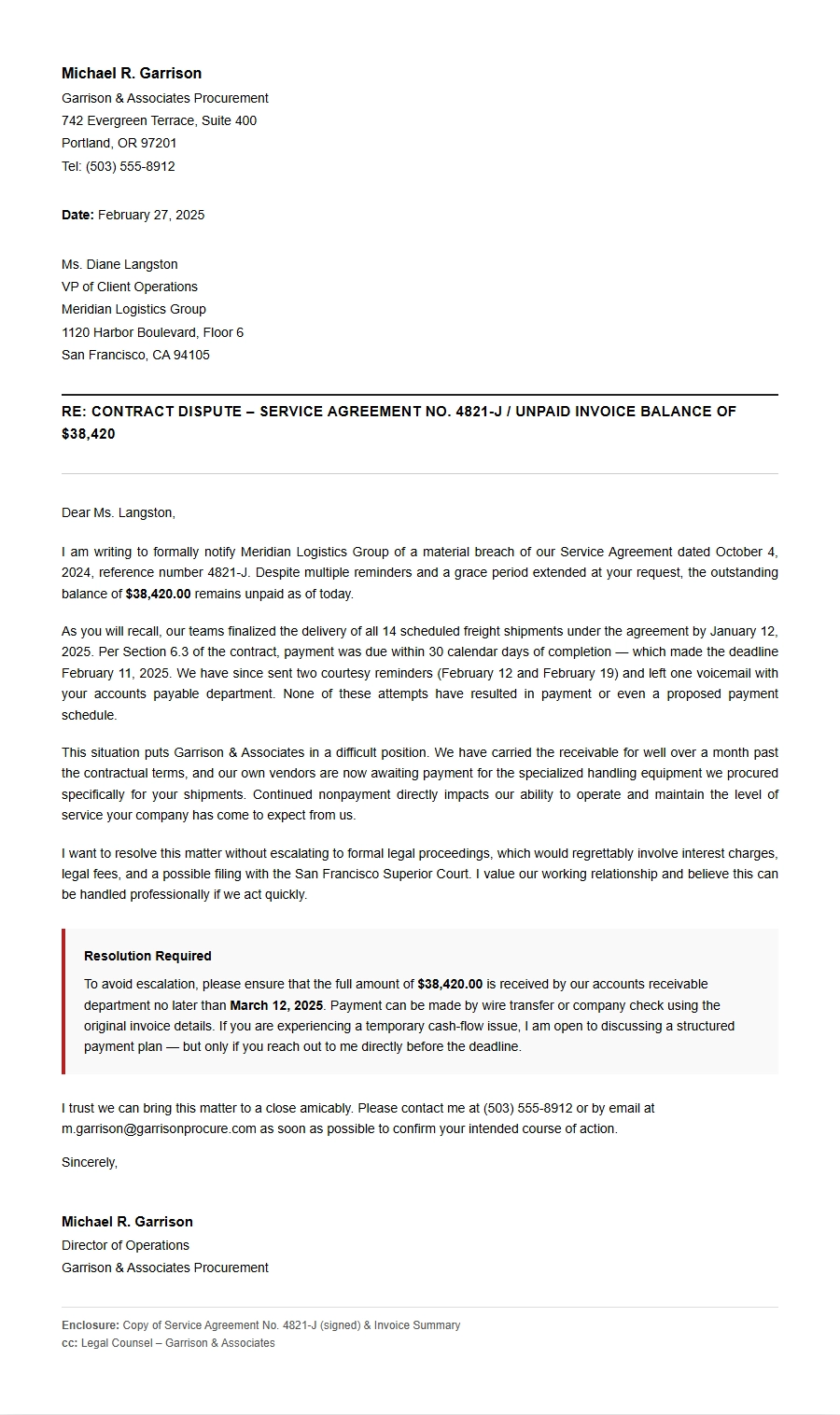 Key Elements of a Business Dispute Letter