Best Practices for Writing Professional Grievance Letters
Staring at a blank page when you need to write a professional grievance letter can feel paralyzing—but the right sample turns that anxiety into a confident, polished draft in minutes.
You know the feeling. Maybe a coworker’s behavior has crossed a line, or a landlord is ignoring a repair request. You’re angry, frustrated, and you need to put it in writing. But where do you start? The good news is you don’t have to reinvent the wheel. Using a letter template isn’t cutting corners—it’s a smart way to borrow proven structure, tone, and key phrases while leaving plenty of room for your own story.
Category: Grievance Letter Samples
Why use a sample? It’s not cheating
Professional grievance writing is about clarity and credibility. A good sample gives you a roadmap: where to put the date, how to address the recipient, what facts to include, and how to close without sounding aggressive. Professional correspondence like this has unwritten rules. Samples help you follow them without guessing. Plus, they save you from spending an hour staring at a cursor.
Think of a sample as a coach, not a crutch. It shows you the business letter format and the kind of language that gets results. Whether you’re writing a formal complaint against workplace harassment or a grievance about a broken heater, a customizable letter lets you plug in your details while keeping the framework solid.
How to pick the right sample for your grievance
Not all samples are created equal. If you’re filing a complaint about a rental unit, you need a sample that speaks to housing codes and landlord obligations. For workplace issues, look for samples that address company policy or harassment. Letter structure varies by context—a grievance to an HR department looks different from one sent to a property manager.
For example, if you’re dealing with unsafe conditions in an apartment, a sample for requesting an inspection notice for a rental unit will include specific language about health and safety violations. On the other hand, a formal complaint against workplace harassment needs a different tone—more neutral, with references to company policies and legal protections. Matching the sample to your situation saves you from rewriting half of it.
Adapting a sample without losing your voice
Once you’ve found a sample that fits, don’t copy it word for word. Read it through, then rewrite the opening paragraph in your own words. That’s where you grab attention and state why you’re writing. For example, instead of “I am writing to file a grievance,” try “I need to report an ongoing issue with my manager that started three weeks ago.” It’s direct and personal.
Keep the sample’s salutation and closing as guides. Use “Dear [Name]” if you know it, and close with “Sincerely” or “Best regards.” Avoid outdated phrases like “To Whom It May Concern” unless you truly don’t know the recipient. Digital letter format matters too—if you’re sending by email, skip the full letterhead design and just use a clear subject line and a polite greeting.
Common mistakes in grievance letter writing
Even with a sample, people trip over the same things. One big one is emotional language. Saying “This is outrageous and unacceptable” can weaken your position. Stick to facts: “On three occasions, I notified my supervisor about the broken lock, and no action was taken.” Another mistake is ignoring tone in writing. You want firm but respectful. Too stiff sounds robotic; too casual sounds unprofessional.
Also, don’t forget to proofread. Proofreading letter is not just about typos—it’s about making sure your facts line up and your request is clear. If you’re lodging a grievance about an eviction warning, for example, you’ll want to reference the specific notice. A sample like eviction warning notice sample language can show you the right terms to use.
The specifics that make a difference
Letter writing etiquette says always keep a copy. Whether you print and mail or send electronically, save your version and any responses. For internal grievance procedures, you often need to follow a specific chain of command. A sample for grievance procedure internal communication can walk you through that hierarchy step by step.
If your grievance involves a business dispute—say, a vendor who didn’t deliver—focus on contract language and timelines. A sample covering key elements of a business dispute letter will remind you to include dates, amounts, and your desired resolution.
Last check: format and tone
Before you send, ask yourself: does this sound like me? Formal writing tips often push people toward overly complicated sentences. Shorten them. Use active voice. And remember that cover letter examples and resignation letter sample both share one thing with grievance letters—they’re better when they sound human. If you’ve used a sample, good. But if the final letter feels stiff, rewrite a paragraph until it sounds like something you’d actually say.
Use a clean letterhead design if it’s printed, or a simple signature block for email. The goal is to be taken seriously, not to impress with design.
Treat the sample as a springboard. The more you practice, the faster writing becomes. And the best letters feel both professional and personal—like a real conversation, but on paper.
Simple Examples
Best Practices for Writing Professional Grievance Letters
Structuring Your Grievance Letter
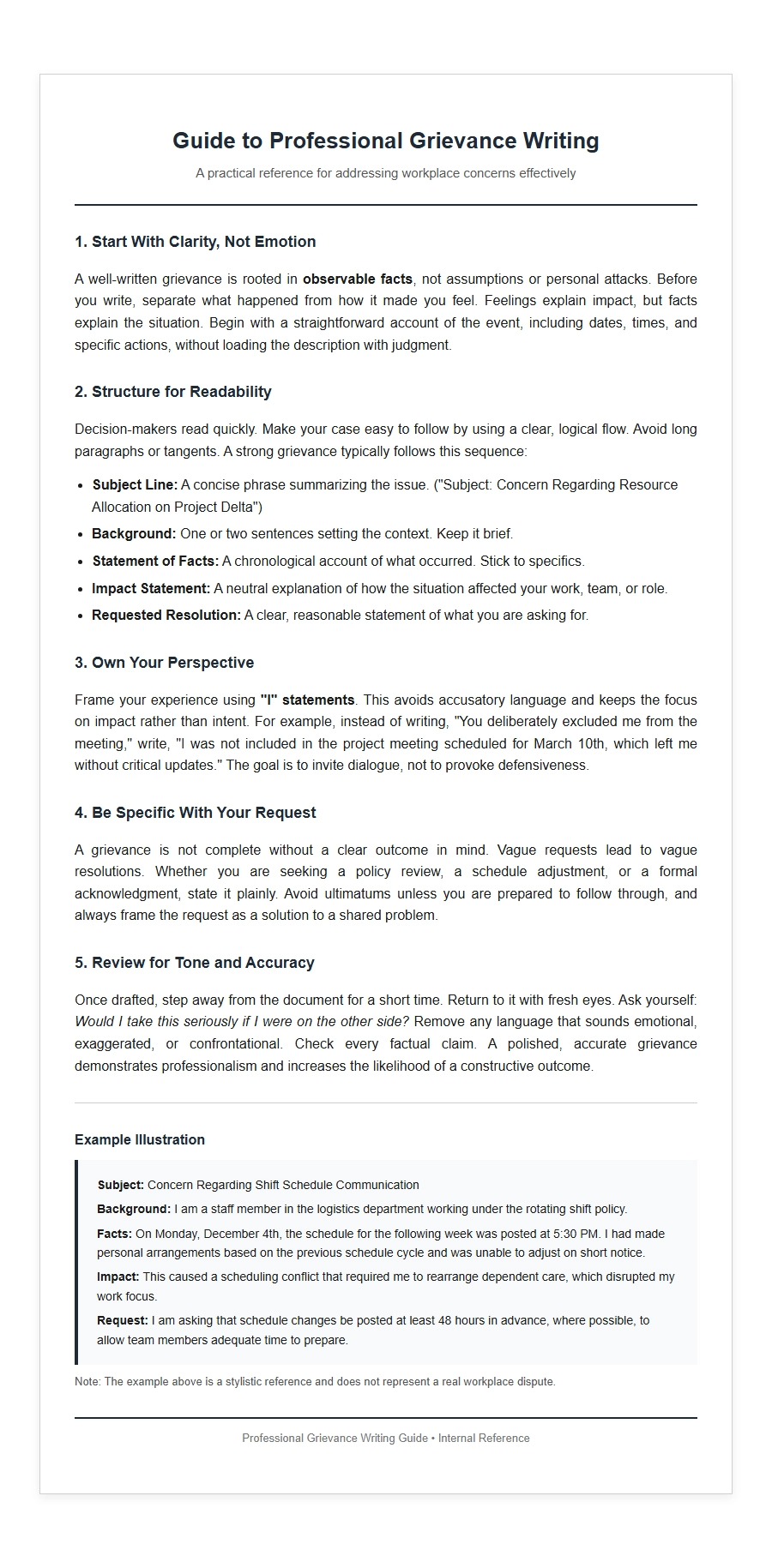
A well-structured grievance letter improves clarity and demonstrates professionalism. Use the following sections in your document:
Place each section as a separate paragraph or break. This structured approach helps the reviewer follow your complaint logically.
Maintaining a Professional Tone
Professional tone is critical in grievance writing. It ensures your complaint is taken seriously and avoids damaging your credibility. Follow these do's and don'ts:
Do use factual language: "The report states 12 errors, not 5 as claimed."
Do remain respectful: avoid personal attacks or sarcasm.
Do focus on behavior and outcomes, not character. Example: "The manager's repeated interruptions prevented me from completing my presentation."
Don't exaggerate or use emotional words like "outrageous" or "unfair".
Don't assume intent: instead of "they deliberately ignored me," write "my request was not acknowledged despite three follow-ups."
Don't use all caps or excessive punctuation.
Review your letter for any accusatory or inflammatory phrases before sending.
Providing Concrete Evidence
To strengthen your grievance, include specific evidence that supports each claim. Avoid vague statements without backing. Use the following table to organize your evidence:
Claim
Evidence Type
Details
Unfair performance review
Copy of review document
Attach original review with annotations
Hostile remarks by supervisor
Email or witness statement
Forward email; request witness to provide written account
Denied promotion opportunity
Policy reference and job posting
Quote relevant policy section and show posting date
Reference each piece of evidence in your letter (e.g., "See attached email dated March 3, 2024"). Never rely solely on memory — documentation adds credibility.
Establishing a Chronological Timeline
A timeline helps the reviewer understand the sequence of events. Present it as an ordered list within your grievance letter:
January 15, 2024: Submitted quarterly report on time.
February 10, 2024: Received email from supervisor requesting modifications without specific guidance.
February 12, 2024: Attended team meeting where supervisor publicly criticized the report as "sloppy".
February 14, 2024: Requested a private meeting to discuss feedback — no response.
February 20, 2024: Filed internal complaint with HR.
Each entry should be a concise fact. Avoid judgments — let the timeline speak for itself. If relevant, include dates of follow-ups or responses from the other party.
Clearly Stating the Desired Resolution
End your grievance letter with a specific, reasonable request for resolution. This shows you are solution-oriented. Avoid vague demands like "I want this fixed." Instead, use the following options as a guide:
Desired Outcome
Example Statement
Reversal of decision
"I request that the performance review be revised to reflect my actual contributions."
Apology
"I ask for a written apology from the supervisor for the public comments."
Policy change
"Please implement a formal feedback process to prevent future misunderstandings."
Compensation
"I request reimbursement for the training I was required to attend without notice."
Keep your request realistic and aligned with organizational policies. Indicate a willingness to discuss alternatives if necessary.
Addressing Confidentiality and Privacy
When writing a grievance, you often share sensitive information. Protect yourself and others by following these confidentiality best practices:
Use neutral identifiers: Refer to colleagues by role (e.g., "Department Manager") instead of name if possible.
Mark the letter as confidential: Add "Confidential" in the subject line or header.
Limit distribution: Send only to the required parties (HR, supervisor, ombudsman).
Avoid detailed gossip: Do not include irrelevant personal details about coworkers.
Remove unnecessary attachments: Only include evidence directly supporting your claims.
Request confidentiality from recipient: Politely ask that the matter be handled discreetly.
Example: "I respectfully request that this grievance be treated as confidential to protect all parties involved."
Formatting for Clarity and Readability
A cleanly formatted grievance letter improves readability and shows attention to detail. Apply these formatting best practices:
Use single spacing within paragraphs and a blank line between paragraphs.
Left-align all text (block format is standard).
Keep paragraphs short — 3 to 5 sentences each.
Use bullet points or numbered lists for timelines or multiple items (but sparingly).
Include a clear subject line in bold (not using inside body, but you can use for emphasis).
Avoid fancy fonts or colors — plain black text on white background is best.
Number pages if longer than one page.
Before finalizing, read the letter aloud to catch awkward phrasing or formatting errors.
Including Relevant Policies and References
Citing company policies or legal references strengthens your grievance by showing you understand your rights and obligations. Use this table to organize references:
Policy/Reference
Section
How It Applies
Employee Handbook
Section 4.2 – Performance Reviews
Requires annual review to be discussed in person; my review was emailed without meeting.
Anti-Harassment Policy
Definition of hostile environment
Supervisor's repeated belittling comments create a hostile work environment.
State Labor Law
Wage and hour regulations
Mandatory training outside work hours without compensation violates overtime rules.
Quote the exact policy wording where possible. If referencing a law, state the statute number (e.g., "Fair Labor Standards Act, 29 U.S.C. § 207").
Reviewing and Revising Before Submission
Never submit a grievance without careful review. Use the following checklist to polish your letter:
Check tone: Remove any emotional or aggressive language.
Verify facts: Double-check dates, names, and document references.
Confirm evidence: Ensure all attachments are referenced and included.
Read for clarity: Ask a trusted colleague or friend to read it objectively.
Spell and grammar check: Use a tool or read backward to catch errors.
Ensure correct recipient: Address the letter to the proper person or department.
Test the resolution request: Is it actionable and reasonable?
Allow at least 24 hours between writing and final review — you may spot improvements with fresh eyes. A polished grievance demonstrates your professionalism and increases the chance of a favorable outcome.
Sample Grievance Letter Following Best Practices
[Your Name] [Your Job Title] [Date]
To: [Recipient Name], HR Director Subject: Formal Grievance Regarding Unfair Performance Evaluation – [Your Name]
Dear [Recipient Name],
I am writing to formally grieve the performance evaluation I received on [Date] from my supervisor, [Supervisor Name]. I believe the evaluation contains multiple factual inaccuracies and was conducted without the required documentation or discussion as outlined in company policy Section 4.2.
Key points of concern include:
The evaluation claims I missed three project deadlines, but project logs show all were submitted on time.
I requested a meeting to discuss the evaluation but received no response.
The evaluation contradicts my previous quarterly reviews, which were rated "exceeds expectations."
Attached please find: (1) the evaluation in question, (2) project timeline records, (3) my email request for a meeting, and (4) relevant policy excerpts.
I request a full review and revision of the evaluation to reflect accurate data. I am also open to a mediated discussion to resolve any misunderstandings.
Thank you for your attention to this matter. I look forward to your response within 10 business days.
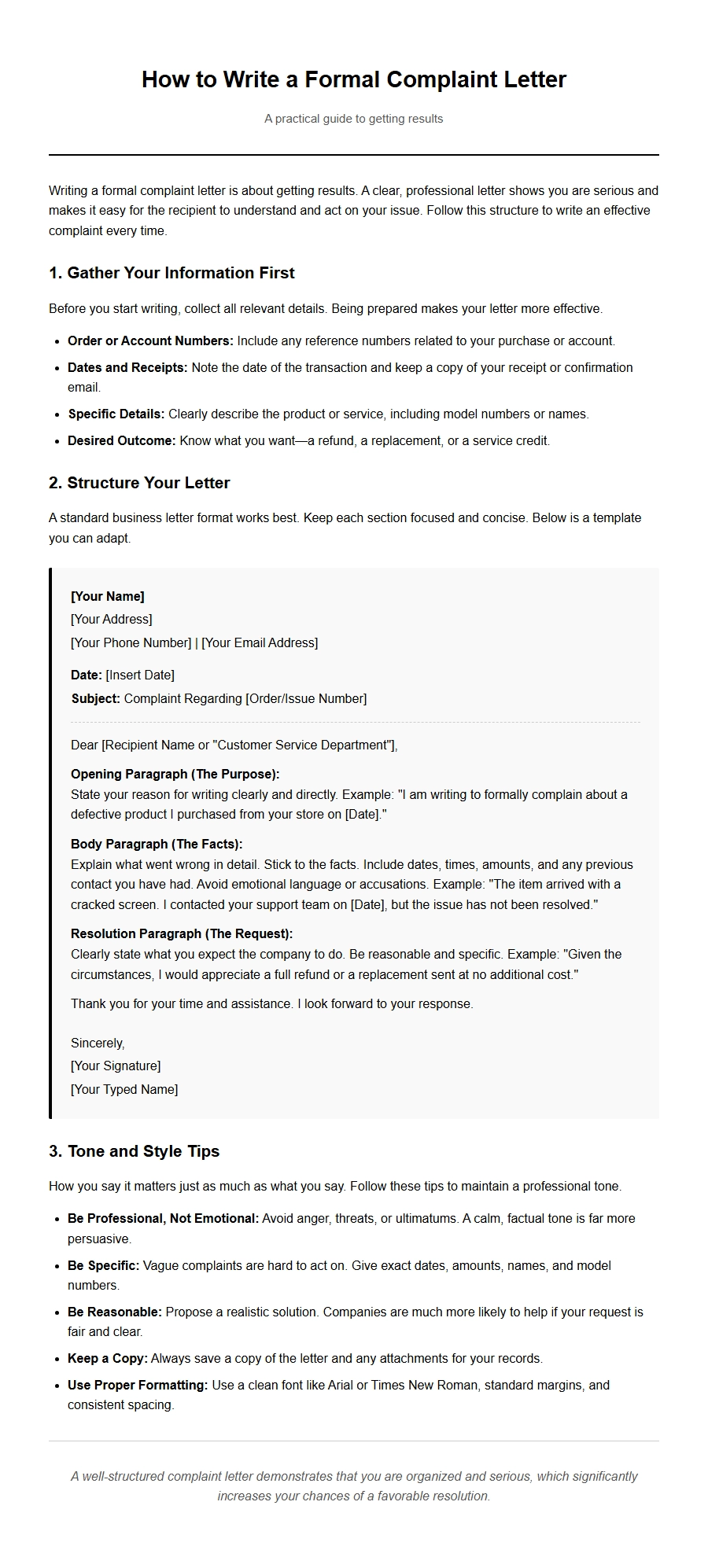 How to Write a Formal Complaint Letter
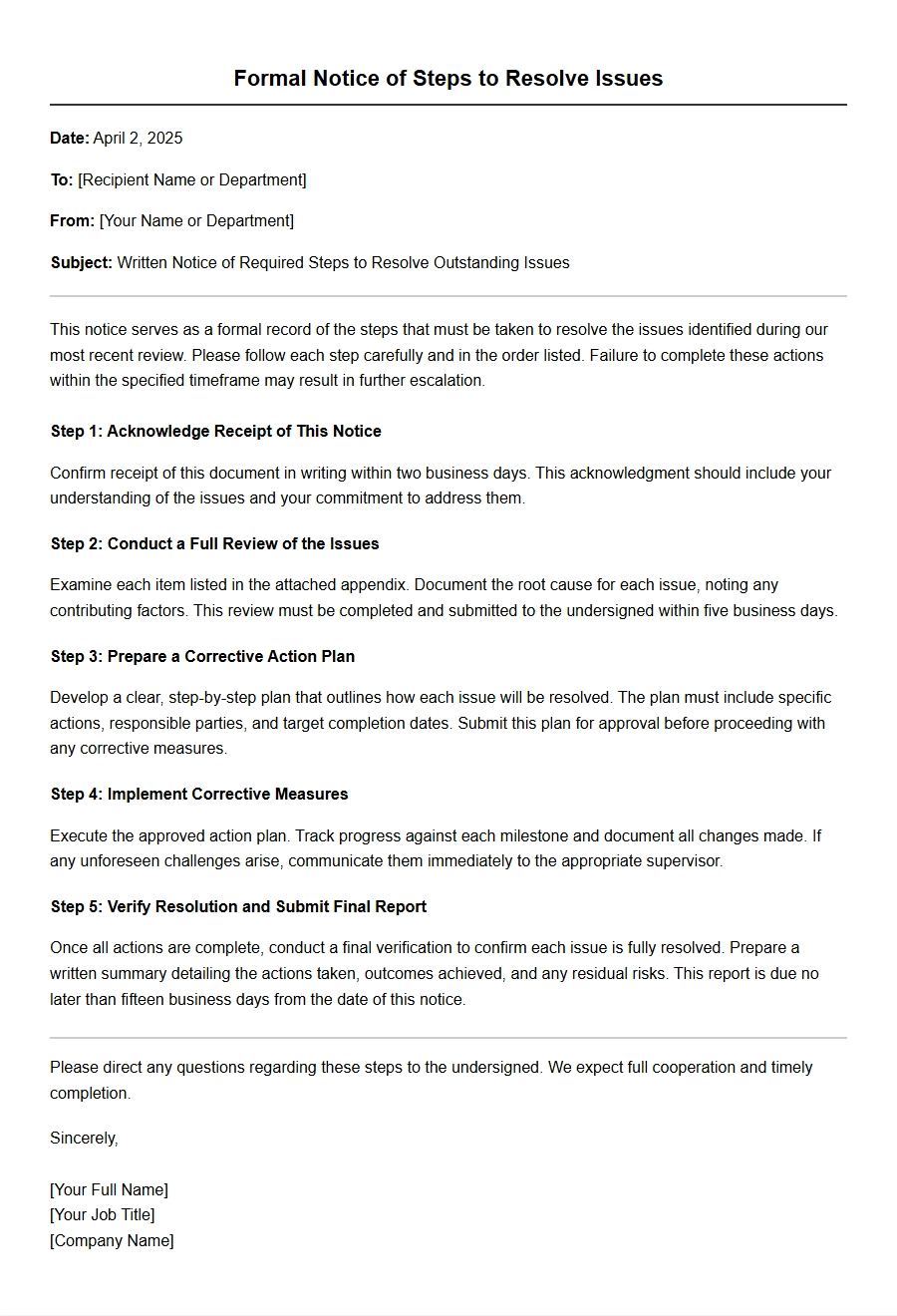 Steps to Resolve Issues via Written Notice
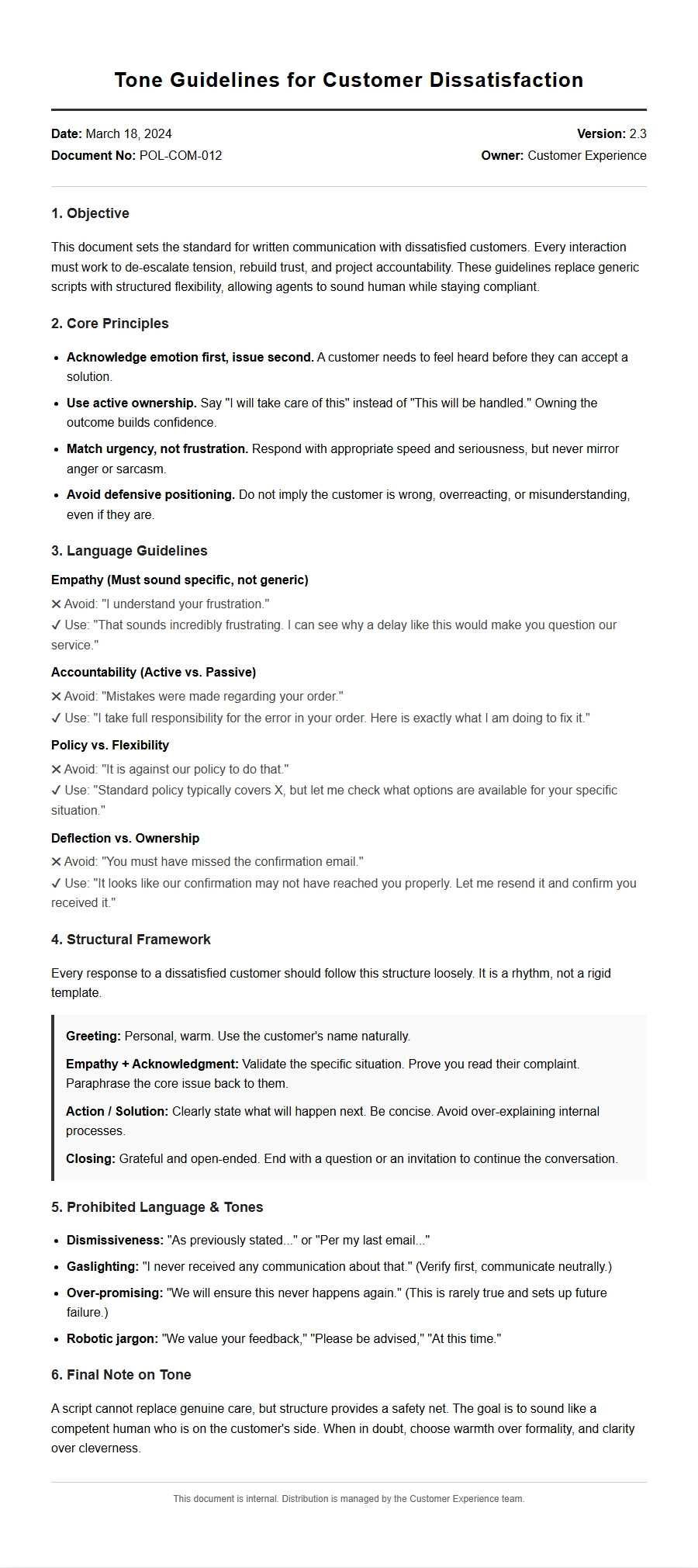 Tone Guidelines for Dissatisfied Customer Letters
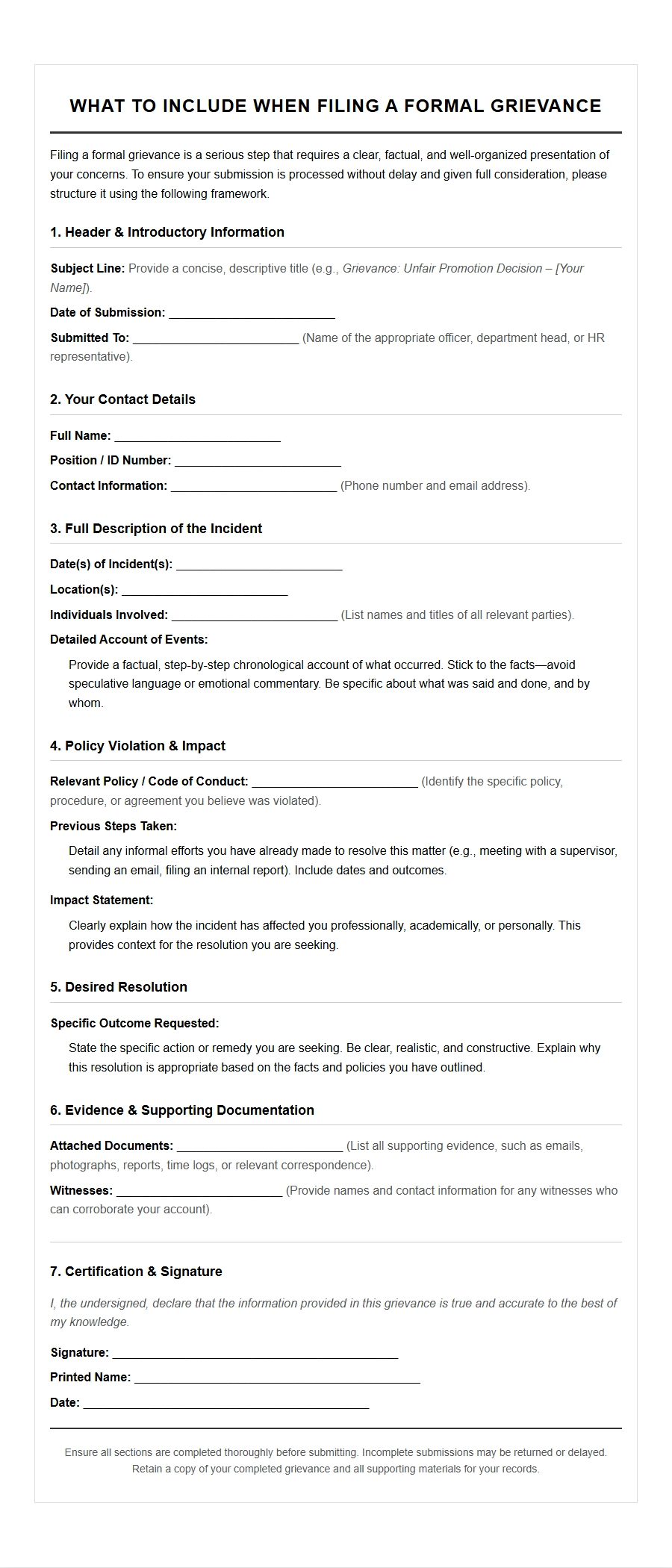 What to Include in a Formal Grievance Letter
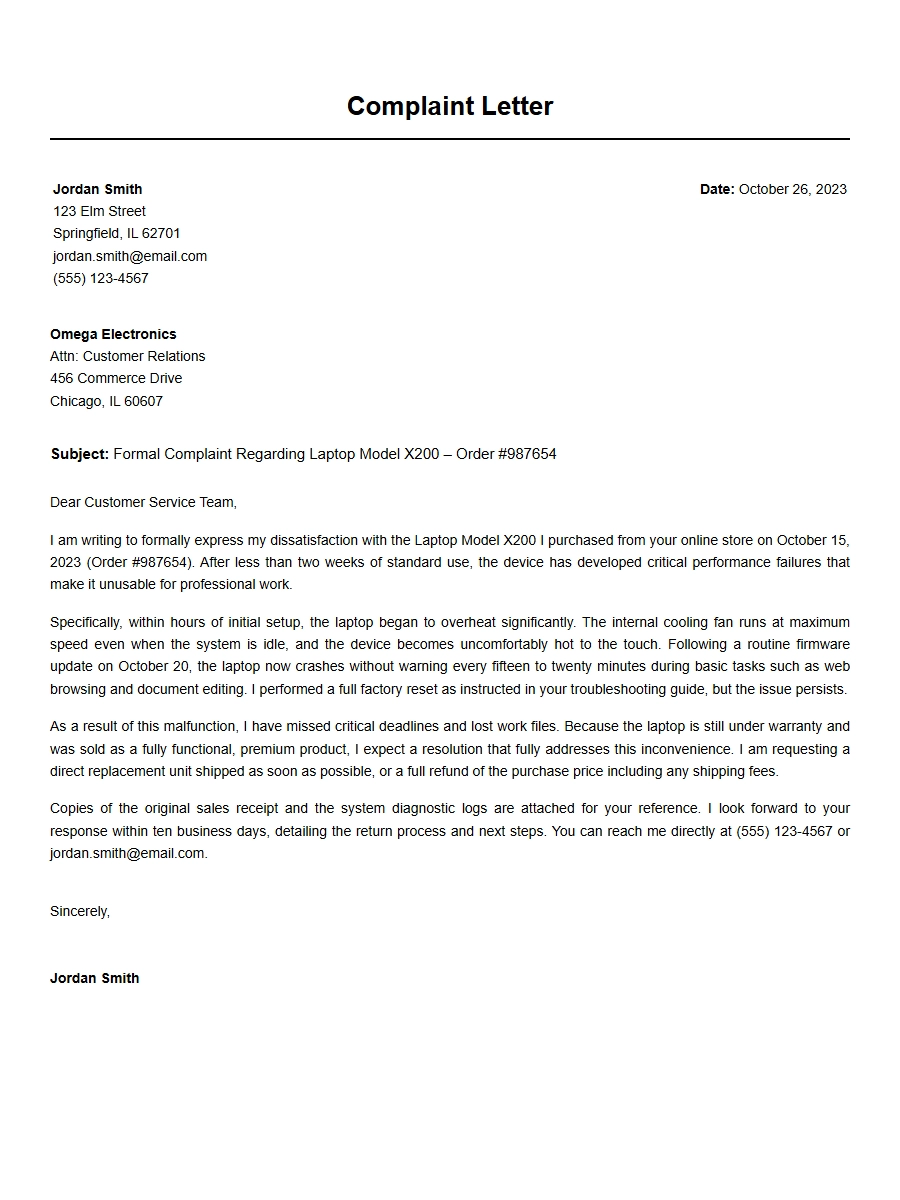 Structure of an Effective Complaint Letter
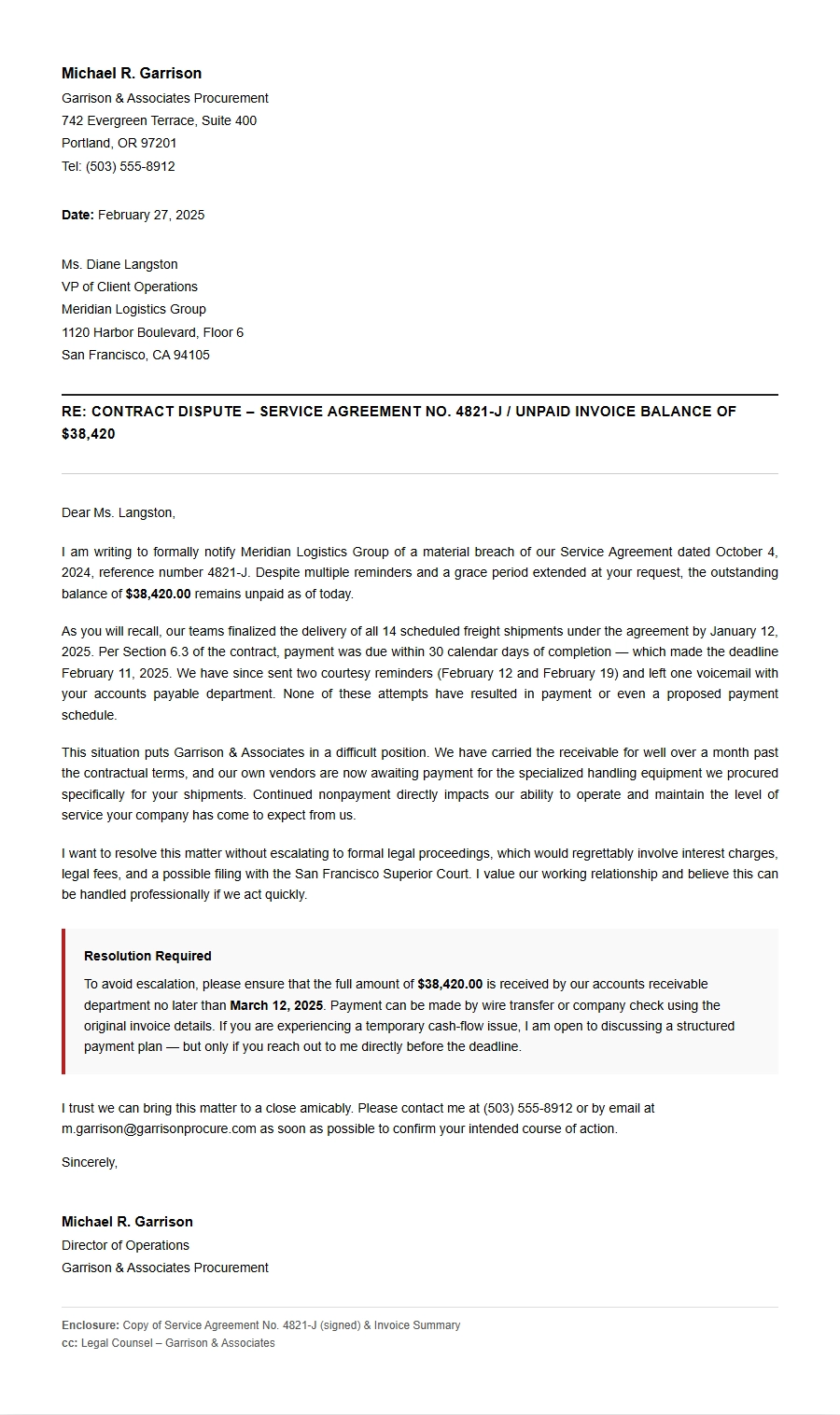 Key Elements of a Business Dispute Letter