How to Apologize for Missing a Funeral in a Letter
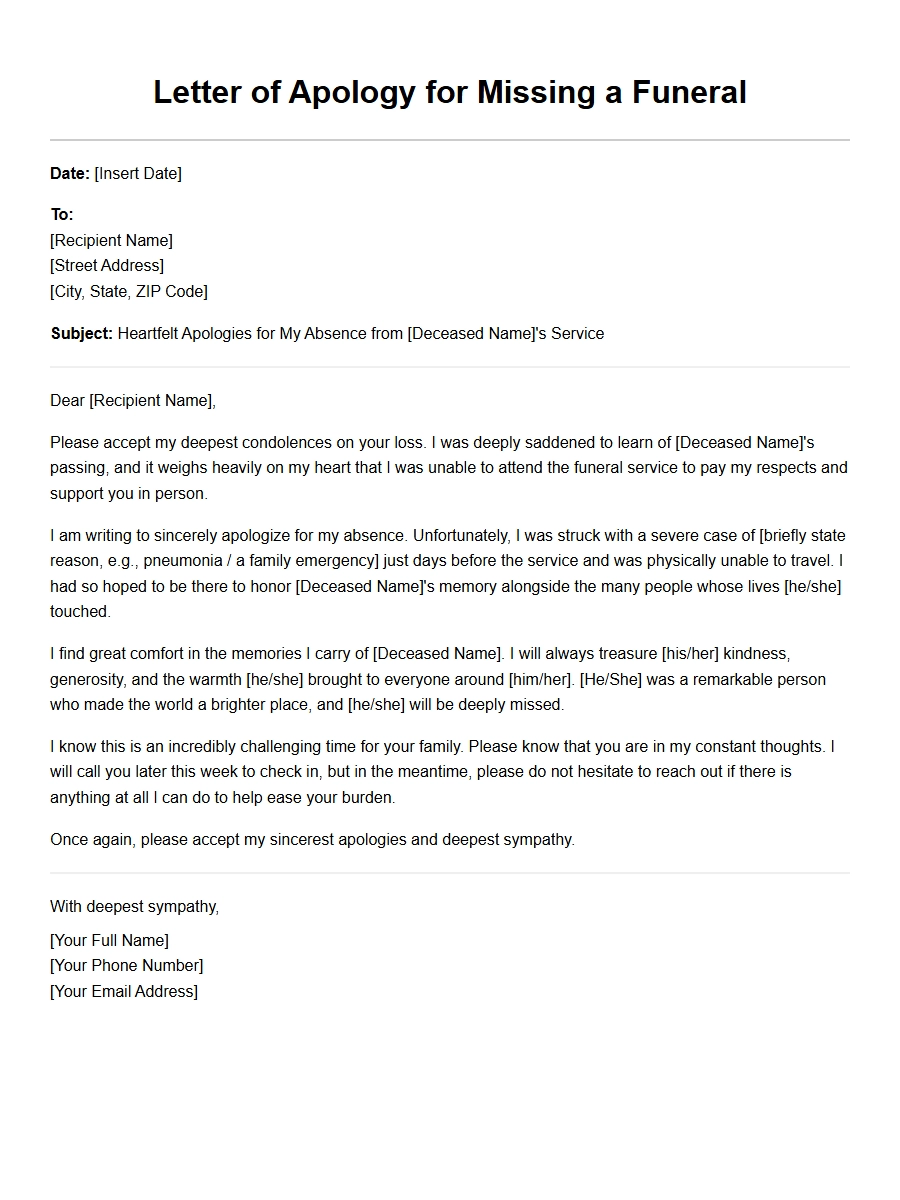
Staring at a blank page when you need to write a letter apologizing for missing a funeral can feel paralyzing. You're already dealing with guilt or regret, and now you have to find the right words to explain your absence without sounding like you're making excuses. A sample letter isn't cheating—it's a smart way to get the structure right so you can focus on the part that matters most: showing genuine care.
Why an Apology Letter Still Matters
Even if you've already called or texted, a written apology for missing a funeral carries weight. It shows you took the time to sit down and think carefully about what you want to say. The letter becomes something the bereaved can hold onto, read again later, and share with other family members. It's a tangible sign that you understand the significance of what you missed and that you regret it.
What to Include in Your Letter
A good apology letter for missing a funeral follows a simple structure, but the tone matters more than the format. Start with a warm salutation—"Dear [Name]" works fine, but "Dearest [Name]" feels more personal if you're close. Open by acknowledging the loss directly: "I was so sorry to hear about your mother's passing." Then state your apology clearly: "I deeply regret that I was unable to attend the funeral." Don't bury the apology under paragraphs of explanation.
Give a brief, honest reason for your absence. You don't need to overshare. "A family emergency came up that required my immediate attention" is enough. "I was unwell and couldn't travel" works too. The key is to keep it factual and not defensive. Follow up with a specific memory of the person who died—this is the most meaningful part of the letter. Share something real: "I'll never forget how your father made everyone laugh at the neighborhood barbecue last summer." This shifts the focus from your absence to the life that was lived.
Mistakes to Avoid in Your Apology
The biggest mistake people make is overselling their regret or over-explaining their absence. Phrases like "I can't even imagine how you feel" can sound hollow. Instead, say "I'm thinking of you during this difficult time." Another common error is using outdated salutations like "To Whom It May Concern" in a letter meant for a grieving family. That feels cold and impersonal. Stick with the person's first name if you know them well, or use their full name and title if the relationship is more formal, such as with a business partner or colleague.
Don't forget to close the letter warmly. "With deepest sympathy," "With love," or "Sincerely" all work depending on your relationship. Include your full name if the letter is somewhat formal, but just your first name is fine for close friends. Before you send it, proofread the letter out loud. This catches awkward phrasing and helps you hear whether your tone sounds genuine or stiff.
When the Loss Involves Multiple Family Members
If the family has experienced multiple losses recently, your apology letter needs extra care. Acknowledge the compounded grief without making it about you. You can say, "I know this has been an incredibly heavy season for your family, and I'm so sorry I couldn't be there to support you in person." This shows you understand the bigger picture. For guidance on handling this situation well, look at examples for multiple family losses to phrase it appropriately.
How to Send the Letter
If you're mailing a physical letter, use simple letterhead design—a clean piece of stationery or a plain card works best. Handwrite it if your handwriting is legible; otherwise, a printed letter is perfectly acceptable. For email, keep the digital letter format simple without fancy fonts or colors. Use a clear subject line like "Thinking of you and your family." For more advice on timing and delivery, check out the best practices for sending a condolence letter.
Making the Letter Feel Personal
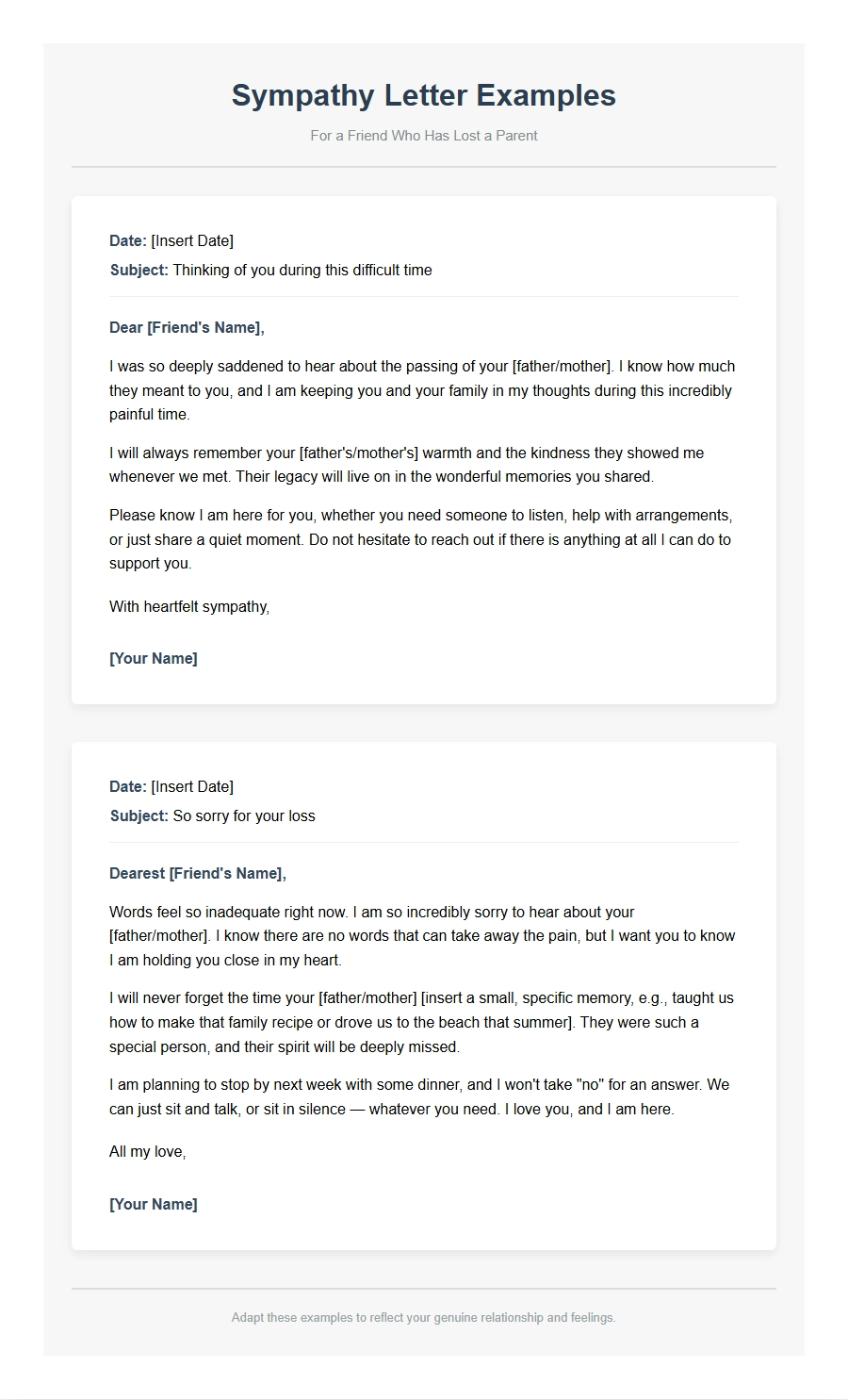
A sample gives you the framework, but your voice makes it real. After stating your apology, add one sentence that only you could write. If you're writing to a friend who lost their aunt or uncle, include that shared memory of the person. You can find helpful phrasing in examples for a message for loss of uncle or aunt. The goal is to sound like yourself, not like you copied a template.
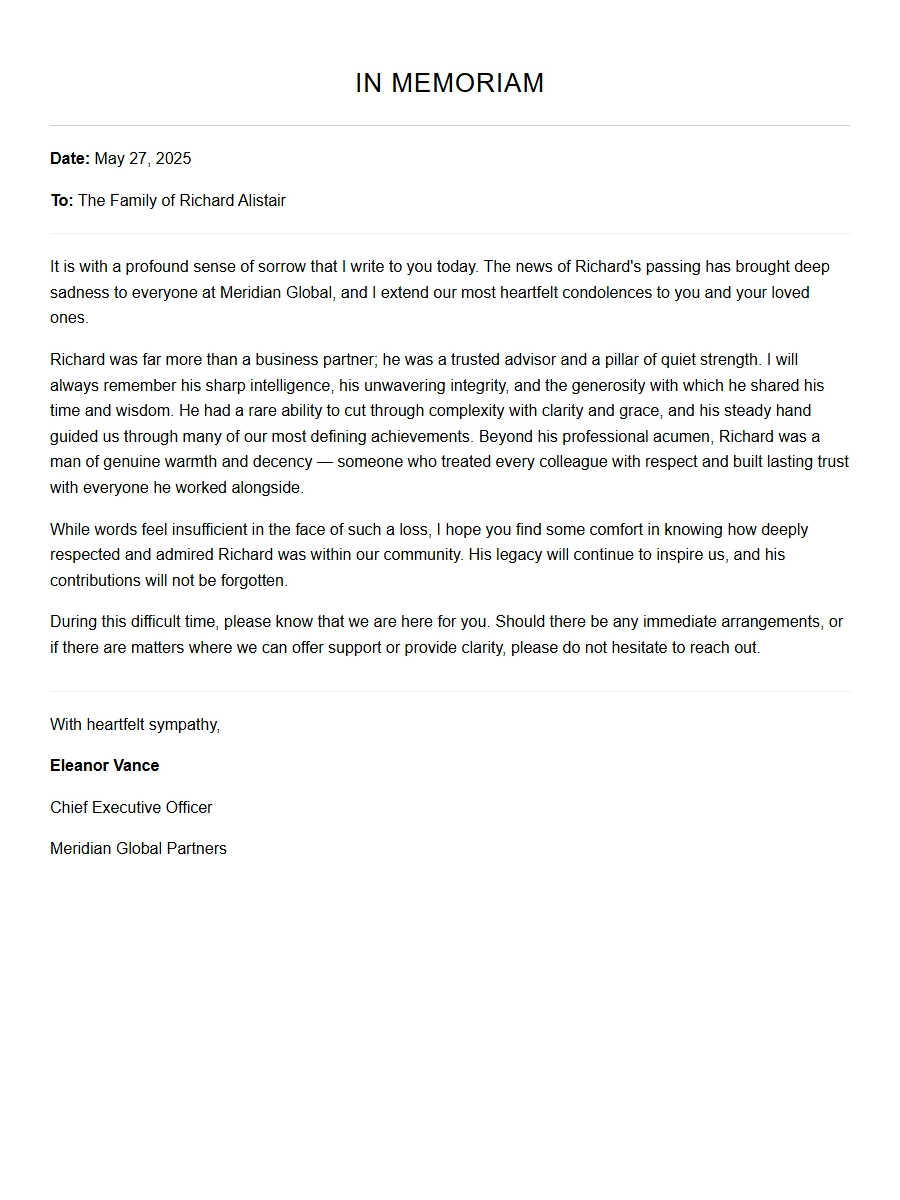
If the funeral was for a business associate, keep the tone professional but warm. Skip personal stories and focus on expressing sincere regret and respect for the deceased. In that case, "I wanted to express my deepest condolences and my regret at not being able to attend the service" is appropriate. Then add a line about the person's professional contributions or character.
Remember that the best apology letters feel both thoughtful and natural. Use the sample to get started, but let your real feelings guide the final draft. The person reading it will appreciate your effort far more than they'll judge your wording.
Browse Sample Ideas
How to Apologize for Missing a Funeral in a Letter
Apology for Missing Funeral Due to Sudden Illness
Date: June 12, 2025
To: Mrs. Evelyn Graves
Dear Mrs. Graves,
Please accept my deepest apologies for not being able to attend John’s funeral yesterday. I was struck with a sudden, severe case of influenza and my doctor strictly advised me to stay home to avoid spreading the illness. It tore at my heart to miss saying a final goodbye to a man I respected so much.
I wanted to be there to support you and to honor John’s memory among those who loved him. Instead, I lit a candle at home and took a quiet moment to remember his kindness and humor.
I will call you later this week to see how you are doing. If there is anything I can do to help ease this difficult time—whether it’s running errands, bringing a meal, or simply listening—please do not hesitate to ask.
With heartfelt sympathy,
Margaret Turner
Apology for Missing Funeral Because of Work Commitment
Date: March 2, 2025
To: The Bennett Family
Dear Bennett Family,
I am writing to express my sincere apologies for missing the funeral of your beloved mother, Clara. An unexpected, mandatory business trip that could not be rescheduled kept me out of the country, and I was unable to attend in person.
Please know that my thoughts were with you all during the service. I have taken the liberty of making a donation to the Alzheimer’s Association in Clara’s name, as I know this cause was close to her heart.
To ensure that I can pay my respects properly, I would like to visit the cemetery with you next month. Please let me know a date that works for the family. I deeply regret not being there to share memories and offer comfort in person.
With deepest sympathy,
David Chen
Apology for Missing Funeral Due to Travel Issues
Date: October 15, 2024
To: The Okafor Family
Dear Mr. and Mrs. Okafor,
I offer my heartfelt apologies for my absence at Auntie Amara’s funeral. My flight from Lagos was cancelled due to severe weather, and no alternative arrangements could get me there in time.
I was devastated to miss the service and the chance to join our extended family in mourning. I have compiled a small remembrance of Auntie Amara:
Her famous jollof rice recipe, written in her own handwriting
A photograph of her at the 2022 family reunion
A short video message from me that was played during the reception
I will mail these items to you this week. I also plan to visit the grave site next Saturday to pay my respects privately. Please know that my heart is with you all during this mourning period.
Yours in sorrow,
Chidi Okafor
Apology for Missing Funeral of a Close Friend
Date: August 8, 2024
To: Laura Simmons
Dear Laura,
I cannot find the words to say how sorry I am that I missed Mark’s funeral. I was in the hospital with a sudden medical emergency and could not be discharged until the evening after the service. Not being there to say goodbye to my best friend of twenty years is a weight I will carry.
Mark was the kind of person who would have understood, but that does not lessen my regret. I want you to know that I have been remembering him every day. Here are a few things I treasured about him:
His unwavering loyalty and honesty
Our late-night phone calls about music and philosophy
The way he made everyone laugh even in tough times
I would like to come over next Tuesday with some homemade lasagna and a photo album we made together. We can talk, or sit in silence—whatever you need. You are not alone.
With love and deepest condolences,
Rachel
Apology for Missing Funeral of a Distant Relative
Date: January 22, 2025
To: Cousin Patricia
Dear Patricia,
I am so sorry that I was unable to attend Uncle Frank’s funeral last week. A severe ice storm made the roads impassable, and I could not risk the drive. I know that my absence was noticed, and I deeply regret not being there to support you and the rest of the family.
To make amends, I have prepared a small tribute that I would like to share with you:
Item
Description
Memory card
Digitized photos of Uncle Frank from his 70th birthday
Handwritten letter
My personal recollections of fishing trips with him
Donation receipt
$100 donated to the American Heart Association in his name
I will bring these to you this Sunday afternoon, if that is convenient. Please call me if you need anything sooner. My thoughts are with you always.
With sympathy,
Your cousin, Henry
Apology for Missing Funeral with a Personal Note of Remembrance
Date: November 5, 2024
To: The Hernandez Family
Dear Mr. and Mrs. Hernandez,
I write with a heavy heart to apologize for missing the funeral of your son, Miguel. I was out of town for a pre-scheduled medical treatment and could not return in time. Not being able to stand beside you in your grief is something I deeply regret.
Even though I was not physically present, I spent the hour of the service in quiet reflection, remembering Miguel’s vibrant spirit. These are the moments I hold close:
His infectious laugh during our community soccer games
The way he always helped elderly neighbors carry groceries
His passion for painting murals around the neighborhood
I have painted a small canvas in his honor, which I would love to deliver to your home next week. You are in my prayers daily.
With deepest respect,
Anna Reyes
Apology for Missing Funeral and Offering Support
Date: July 30, 2024
To: Mrs. Dorothy Williams
Dear Mrs. Williams,
I am truly sorry that I could not attend Robert’s funeral yesterday. A family emergency that required my immediate presence prevented me from being there. I know this has been a devastating time for you, and my absence only adds to the pain.
I want to offer you tangible support during the coming weeks. Below is a list of things I can do to help:
Prepare and deliver meals every Monday and Thursday
Drive you to your doctor’s appointments
Help with any paperwork related to Robert’s estate
Simply sit with you if you need company
Please choose any (or all) of these offerings. I will call you tomorrow to see what would be most helpful. My heart aches for you, and I want to make sure you are not alone.
With deepest sympathy,
Sarah Miller
Apology for Missing Funeral Due to Family Emergency
Date: April 18, 2025
To: The Patel Family
Dear Patel Family,
I extend my sincere apologies for not being present at Mrs. Patel’s funeral. On the morning of the service, my own mother was rushed to the hospital with a stroke, and I had to be with her in the intensive care unit. I was torn between two urgent duties.
I know that Mrs. Patel was a pillar of our community, and I wanted to honor her legacy by being there. Instead, I have arranged for a floral tribute to be delivered to the funeral home, and I have made a donation to the local hospice that cared for her.
I hope you can understand my difficult choice. Once my mother is stable, I would like to visit you personally to express my condolences. Please let me know when would be a good time.
With heartfelt sorrow,
Anita Sharma
Apology for Missing Funeral with a Promise to Visit
Date: May 9, 2024
To: Grandma June
Dear Grandma June,
I am so sorry I could not be at Grandpa’s funeral. My flight was canceled due to a strike at the airport, and I could not get another one in time. I know you were counting on me, and I feel terrible that I let you down.
I have already booked a train ticket to come see you next weekend. I will stay for three days to help you sort through Grandpa’s things and share our favorite memories. I also want to visit his grave with you and place a small bouquet of his favorite flowers—sunflowers.
I know nothing can replace my presence at the service, but I hope this visit will bring us both a measure of peace. I love you very much.
Your loving grandson,
Michael
Formal Apology for Missing Funeral of a Colleague's Family Member
Date: September 10, 2024
To: Mr. Thomas Reid
Dear Mr. Reid,
Please accept my formal apologies for my absence at your father’s funeral on September 8th. I was attending a mandatory client conference out of state that could not be rescheduled. I understand how important family support is during such times, and I regret not being able to offer mine in person.
As a gesture of my condolences, the team at work has contributed to a memorial fund in your father’s name. Here is a summary:
Contributor
Amount
Accounting Department
$250
Sales Team
$150
Executive Office
$100
Total
$500
The donation has been sent to the American Cancer Society. Additionally, I have taken over your project deadlines for this week so you can take the time you need. Please do not hesitate to reach out if you require any further assistance.
 Formal Condolence Message for a Business Partner
 Sympathy Letter Examples for a Friend Who Lost a Parent
 How to Write a Condolence Letter to a Coworker
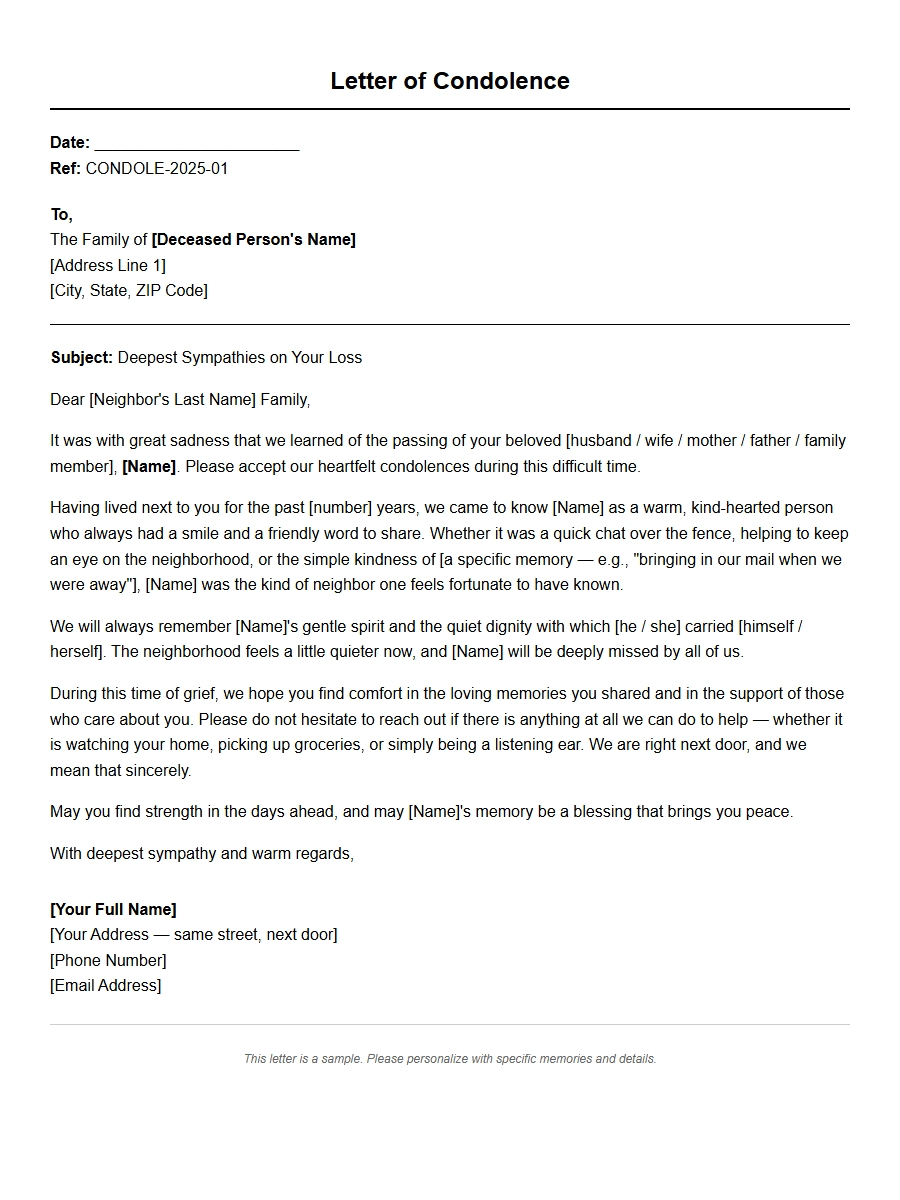 Condolence Letter Sample for a Neighbor
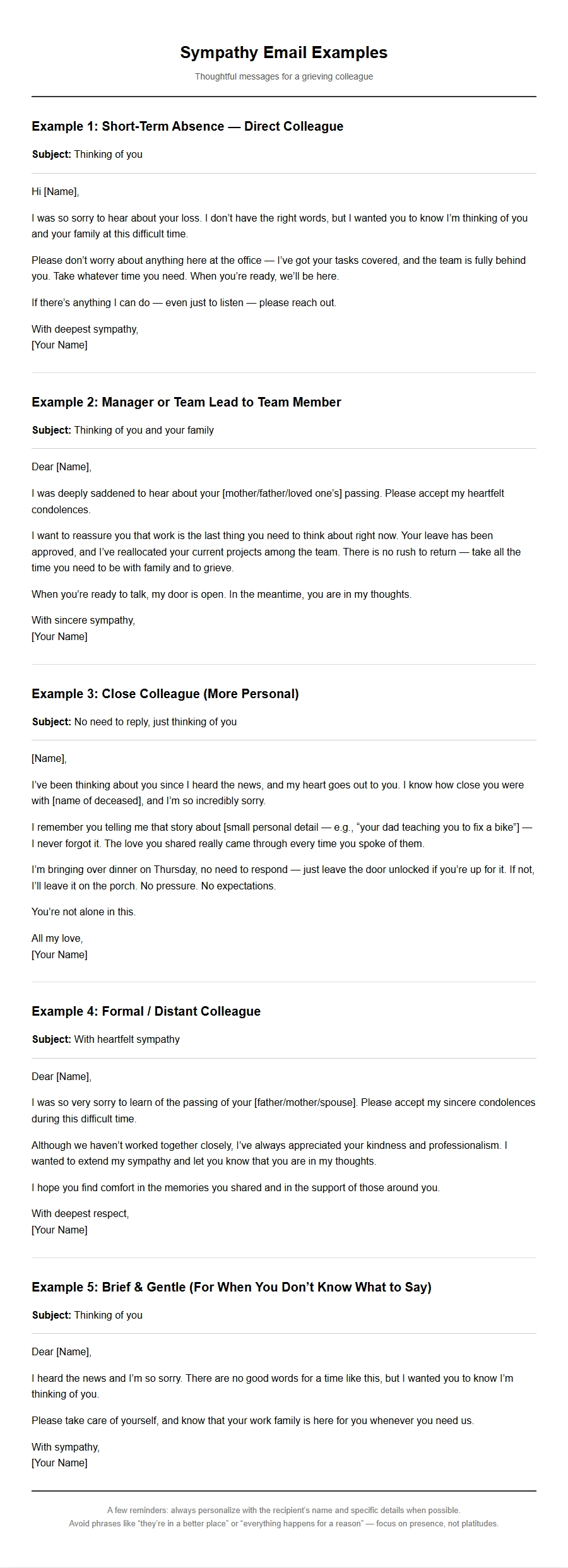 Sympathy Email Examples for a Grieving Colleague
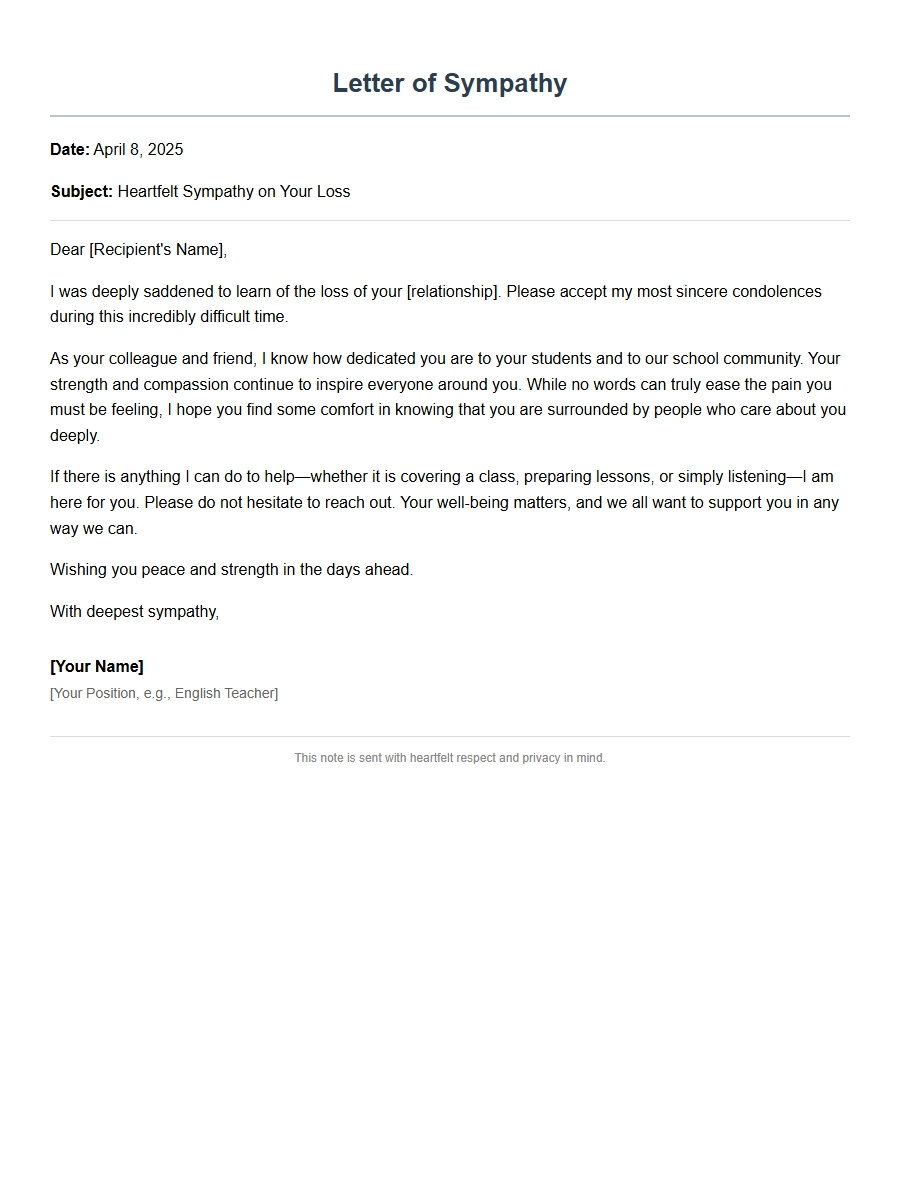 Condolence Words for a Teacher