You have to send a condolence letter to a business client, but every word feels too cold or too personal. That blank page stares back. You want to honor the loss without sounding like a form letter or overstepping professional boundaries. It’s a tough balance.
Using a sample is not cheating. It’s a smart shortcut. A well-written letter template gives you the structure, tone, and key phrases you need—while leaving room to add your own voice. The best condolence letters feel both professional and human. A template helps you get there faster.
Category: Business Condolence Letters
Why a formal tone matters in business condolence letters
A condolence letter in a business setting serves a dual purpose: it shows respect for the person who passed away and maintains the professional relationship with the recipient. Too casual and you risk sounding insincere. Too stiff and you seem cold. A formal tone strikes the middle ground—warm but not chummy, respectful but not distant.
Think of it as professional correspondence that happens to carry personal grief. The same business letter format you’d use for a proposal or a thank-you note applies here: a proper salutation, clear body paragraphs, and a sincere closing. But the language shifts from transactional to compassionate.
Choosing the right sample for your situation
Not all condolence letters are the same. The tone changes depending on who you’re writing to. A letter to a coworker’s family will feel different from one to a client whose spouse died. When you pick a letter template, match it to your specific context.
For example, if you’re writing to a colleague who lost a loved one during the holidays, the message needs to acknowledge the added pain of that timing. We have a guide on condolence message for loss during holidays that shows how to adjust warmth without losing professionalism. Similarly, if the family is secular, a secular sympathy message avoids religious references while still being comforting.
The key is to use a sample as a starting point, not a final draft. Change names, modify the story, and rewrite the middle paragraph so it reflects your actual relationship with the recipient.
How to adapt a sample without losing authenticity
Many people worry that using a sample makes the letter sound generic. That only happens if you copy it word for word. Instead, treat the sample as a scaffold. Read it, understand the flow, then rewrite the opening in your own words.
A strong opening does two things: it expresses sympathy directly and it names the loss. “I was deeply saddened to learn of your husband’s passing” is better than a vague “I’m sorry for your loss.” Personalize it further by mentioning a specific memory or quality of the deceased if you knew them. If you’re writing to a client you barely know, keep it simple—just be sincere.
One common mistake is using an outdated salutation like “To whom it may concern” or “Dear Sir/Madam.” It’s too cold for a condolence letter. Use the recipient’s name if you have it. If you don’t, “Dear [Company] Team” works for a group message. Also, think about the medium. A printed letter on company letterhead carries weight, but an email is acceptable in many modern workplaces. For digital letter format, keep the same tone but drop the formal address block.
Mistakes to avoid in formal condolence letters
Even with a good sample, there are traps. First, don’t overexplain or justify the loss. Avoid phrases like “It was their time” or “Everything happens for a reason.” Those can feel dismissive. Stick to simple empathy: “I have no words, but I wanted you to know I’m thinking of you.”
Second, proofread carefully. A typo in a condolence letter can come across as careless. Read it aloud to catch awkward phrasing. Use letter writing etiquette—check your salutation, closing, and sign-off. “Sincerely,” “With deepest sympathy,” or “Warm regards” are all appropriate, but match them to your relationship.
Finally, don’t make it about you. A brief personal note is fine, but the focus should remain on the recipient’s loss. Save long stories for a separate conversation.
When to use a more personal or a more formal tone
This is where tone in writing becomes crucial. If the recipient is a close business partner you’ve known for years, you can write a warmer note, similar to what you’d send a friend. If the recipient is a distant client or a senior executive, stick to a formal structure.
Consider the circumstances. A condolence letter for financial hardship due to death might need extra sensitivity because the loss also creates practical stress. In those cases, offer a specific way you can help rather than just words. Similarly, a condolence letter to a spouse requires a more intimate tone, even in a business context—focus on support and shared history if you have it.
For a condolence letter to a coworker, you can mention the team’s sympathy and offer practical help like covering their duties. The tone can be slightly less formal, but still respectful.
Make the sample work for you
Think of the template as training wheels. The first time you use one, you’ll rely on it heavily. The second time, you’ll start writing your own sentences. After a few letters, you won’t need a sample at all. The goal is to internalize the structure and the tone so you can write a confident, polished letter in minutes.
Start with a sample that matches your situation. Customize the opening and closing. Keep the body concise and sincere. Proofread once, then send. That’s it. The more you practice, the easier it becomes. And if you ever freeze again, you know where to find help.
Common Sample Formats
Formal Tone Condolence Letter for Business
Condolence to a Client on Loss of Founder
Dear [Client Name],
It is with profound sadness that we learned of the passing of [Founder Name], the visionary founder of your organization. On behalf of everyone at [Our Company], we extend our deepest sympathies to you, your team, and the entire [Client Company] family.
[Founder Name] was a remarkable leader whose dedication and innovation set a benchmark in our industry. We personally witnessed [his/her] unwavering commitment and the values that shaped [Client Company] into the trusted partner it is today.
During this difficult time, we want you to know that we are here to support you. Please find below a summary of the immediate support measures we can provide:
Support Area
Contact Person
Details
Project continuity
[Project Manager Name]
Will reach out to reschedule any non-urgent timelines
Administrative assistance
[Admin Contact]
Available for any documentation or billing queries
Personal support
[HR Contact]
We can offer a listening ear or refer you to professional resources
Please accept our heartfelt condolences. We hold [Founder Name] in great respect and will always remember [his/her] contributions. May you find strength and peace in the days ahead.
Sincerely, [Your Name] [Your Title]
Condolence to a Business Partner on Loss of CEO
Dear [Partner Name],
We were deeply saddened to hear about the sudden passing of [CEO Name], the chief executive officer of [Partner Company]. Please accept our most sincere condolences during this time of immense loss.
[CEO Name] was a pillar of integrity and collaboration, and [his/her] leadership was instrumental in forging the strong partnership we share today. We have fond memories of working side by side on [mention a joint project], and [his/her] wisdom will be greatly missed.
We understand that this transition may raise immediate operational concerns. To assist you, we have outlined a few steps:
Interim liaison: Our senior account manager [Name] will serve as your direct contact for all ongoing matters.
Flexible deadlines: We are prepared to extend delivery dates for current contracts by up to [X] days as needed.
Check-in meeting: We propose a brief virtual meeting next week to discuss long-term continuity plans.
We are committed to supporting you through this period. Please do not hesitate to reach out for any assistance. Our thoughts are with you and everyone at [Partner Company].
With heartfelt sympathy, [Your Name] [Your Company]
Condolence to Employee on Death of Spouse
Dear [Employee Name],
It is with great sorrow that I learned of the passing of your spouse, [Spouse Name]. On behalf of the entire leadership team at [Company Name], I extend our deepest condolences to you and your family.
We recognize that no words can truly ease your pain, but we want you to know that you are not alone. Your [Company Name] family is here to support you in every way possible.
As you take time to grieve, please be aware of the following resources and benefits available to you:
Resource
Details
Bereavement Leave
Up to [number] paid days off, with the option to extend using personal or sick leave
Employee Assistance Program (EAP)
Free, confidential counseling sessions – call [phone] or visit [website]
Flexible Work Arrangement
We are happy to adjust your schedule or allow remote work as needed
Company Bereavement Fund
A modest contribution to help with immediate expenses – please contact HR for details
Please take all the time you need. Your colleagues are ready to cover your duties during your absence. If there is anything else we can do, please let us know. You are in our thoughts and prayers.
With deepest sympathy, [Manager Name] [Title]
Condolence to Vendor on Loss of Key Contact
Dear [Vendor Name],
We were truly saddened to learn of the passing of [Contact Name], your valued colleague and our primary liaison. Please accept our heartfelt condolences.
Over the years, [Contact Name] demonstrated professionalism, dedication, and genuine warmth that made every interaction a pleasure. [He/She] was not only a trusted partner but also a friend. We will miss [his/her] insightful guidance and cheerful presence.
We understand that this loss may affect your operations. To ensure a smooth transition, we propose the following:
New point of contact: [New Contact Name] will serve as our interim counterpart, and we are happy to schedule a handover meeting.
Ongoing orders: We will honor all existing purchase orders and extend payment terms by [X] days if needed.
Special consideration: For any urgent requests, please mark them with priority code [Code] for immediate attention.
We are confident that [Contact Name]'s legacy of excellence will continue through your team. Please let us know how we can support you during this period of mourning.
With sympathy and respect, [Your Name] [Your Company]
Condolence to Industry Colleague on Bereavement
Dear [Colleague Name],
I was deeply saddened to hear about the recent passing of your [relationship, e.g., father/mother]. On behalf of our professional association and myself, please accept my sincere condolences.
Your [father/mother] was a remarkable [profession/role] whose contributions to our field left an indelible mark. I personally recall [his/her] inspiring talk at the [Event Name] and the wise counsel [he/she] offered so generously. [His/Her] legacy will continue to guide us.
During this difficult time, I want to extend a helping hand. As a gesture of support, I have arranged for the following temporary assistance:
Task
Will be handled by
Duration
[Project X] oversight
[Name 1]
Up to [2] weeks
[Committee Y] reporting
[Name 2]
Until further notice
Meeting facilitation
[Name 3]
For upcoming [Z] meetings
Please do not hesitate to reach out if you need additional support. Your well-being is our priority. May you find comfort in cherished memories and the support of our community.
With deepest sympathy, [Your Name] [Your Title / Association]
Condolence to Customer on Passing of Company Owner
Dear [Customer Name],
It is with great sadness that we learned of the passing of [Owner Name], the founder and heart of your company. We extend our heartfelt condolences to you, [his/her] family, and the entire [Customer Company] team.
[Owner Name] was a person of exceptional vision and generosity. [He/She] treated every business relationship with genuine care, and it was an honor to serve [his/her] needs over the years. We will remember [his/her] kindness and the way [he/she] always put people first.
Please be assured that we remain fully committed to supporting your business through this transition. To minimize any disruption, we have prepared a summary of our continuity plan:
Account management: [Account Manager Name] will continue as your dedicated contact.
Service level: All current service agreements remain unchanged with priority response.
Financial flexibility: We can offer deferred payment terms for the next [X] months if needed.
We know that no words can ease your loss, but we hope that our steady support provides some comfort. [Owner Name]'s legacy will live on in the values [he/she] instilled. We are here for you, today and always.
With sincere sympathy, [Your Name] [Your Company]
Condolence to Executive on Family Loss
Dear [Executive Name],
On behalf of the Board of Directors and the entire senior leadership team at [Company Name], I wish to express our deepest condolences upon the passing of your [relation, e.g., mother/father/sibling]. We are thinking of you and your family during this profoundly difficult time.
We understand that personal loss can affect even the most dedicated professional. Please know that your leadership and responsibilities are well covered. An interim arrangement has been established to ensure smooth operations while you take the time you need:
Area
Interim Lead
Contact
Strategic initiatives
[SVP Name]
[Email/Phone]
Team management
[Director Name]
[Email/Phone]
Client relations
[Account Head]
[Email/Phone]
We have also made the following resources available to you and your immediate family:
Extended bereavement leave with full pay for up to [X] weeks.
Access to confidential counseling services through our Employee Assistance Program.
Personal assistance with travel or arrangements if needed – please contact [HR Name].
Take all the time you require. We are confident in our team's ability to maintain momentum until you return. You are in our thoughts.
With heartfelt sympathy, [Board Chair Name] Chair of the Board, [Company Name]
Condolence to Supplier on Sudden Loss of Founder
Dear [Supplier Name],
We were shocked and deeply saddened to learn of the untimely passing of [Founder Name], the founder of your esteemed organization. Please accept our most sincere condolences.
[Founder Name] built a company known for excellence, integrity, and reliability. [His/Her] personal touch in every interaction made our business relationship truly special. We will miss [his/her] guidance and the warmth [he/she] brought to our dealings.
In recognition of the difficult transition you now face, we wish to offer the following immediate support:
Order flexibility: We will not hold you to urgent delivery schedules for the next [30] days.
Payment terms: Existing invoices can be settled on extended terms; please contact our finance team at [email].
Dedicated liaison: [Name] from our procurement team will serve as your single point of contact to minimize administrative burden.
We also encourage you to let us know if there are any other ways we can assist. Our partnership is built on mutual trust, and we are committed to standing by you during this difficult period. [Founder Name]'s legacy of quality will continue through your dedicated team.
With respect and sympathy, [Your Name] [Your Company]
Condolence to Former Employee on Family Bereavement
Dear [Former Employee Name],
I was deeply saddened to learn of the passing of your [relation, e.g., grandmother/grandfather]. On behalf of the alumni community at [Company Name], I extend our heartfelt condolences to you and your loved ones.
Though you are no longer with us, you remain a valued member of our extended family. We remember the dedication and spirit you brought to our team, and we want you to know that our support extends beyond your tenure here.
As part of our alumni bereavement support program, we are pleased to offer the following resources:
Resource
How to Access
Grief counseling referral
Contact our alumni office at [email] for a list of trusted professionals
Alumni emergency assistance fund
Limited grants available for immediate needs – details at [URL]
Virtual remembrance gathering
A space for former colleagues to share memories – sign up at [link]
We also invite you to reach out directly to [Alumni Coordinator Name] if you need a listening ear or practical help. You are not alone. May the memories of your [relation] bring you comfort and strength.
With deepest sympathy, [Your Name] Alumni Relations, [Company Name]
Condolence to Community Business Leader on Loss of Partner
Dear [Leader Name],
It is with profound sorrow that I learned of the passing of your beloved partner, [Partner Name]. On behalf of the [Chamber of Commerce / Business Association] and its members, I extend our deepest sympathies.
[Partner Name] was an integral part of our community and a pillar of support for your business. [He/She] touched many lives through [his/her] generous spirit and unwavering commitment to local entrepreneurship. We will deeply miss [his/her] presence at our events and the wise counsel [he/she] so freely gave.
During this time of mourning, we want you to know that your business community stands with you. We have arranged several support measures:
Interim business coverage: Fellow association members [Names] have volunteered to oversee urgent operational tasks for the next [X] weeks.
Memorial fund: A special fund has been established in [Partner Name]'s honor to support [cause/charity].
Personal assistance: Please call [Contact Name] at [phone] for any immediate needs, from errands to meal delivery.
We invite you to the [Association Name] Annual Gathering on [Date], where there will be a moment of silence and a tribute to [Partner Name]'s contributions. In the meantime, know that you are surrounded by a community that cares.
With heartfelt condolences, [Your Name] President, [Association Name]
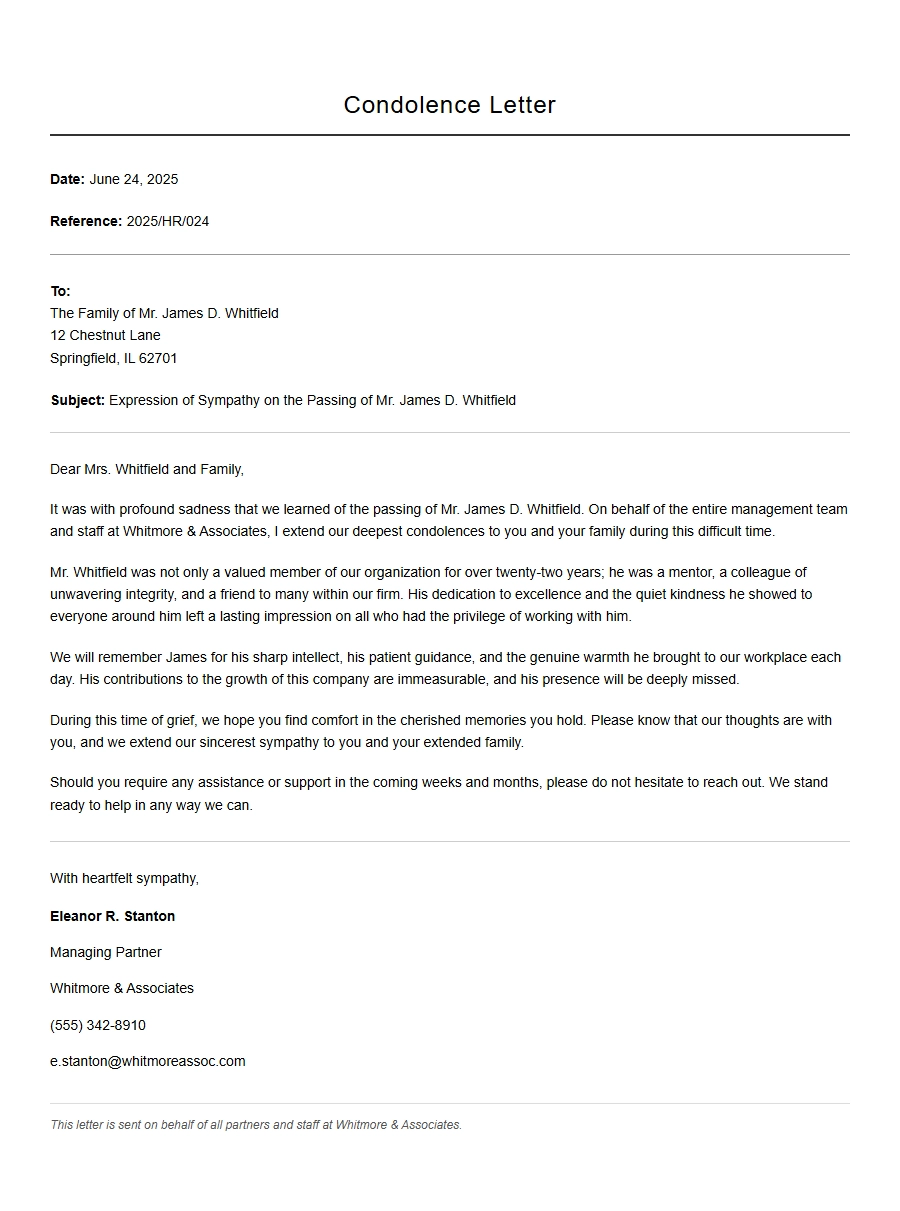
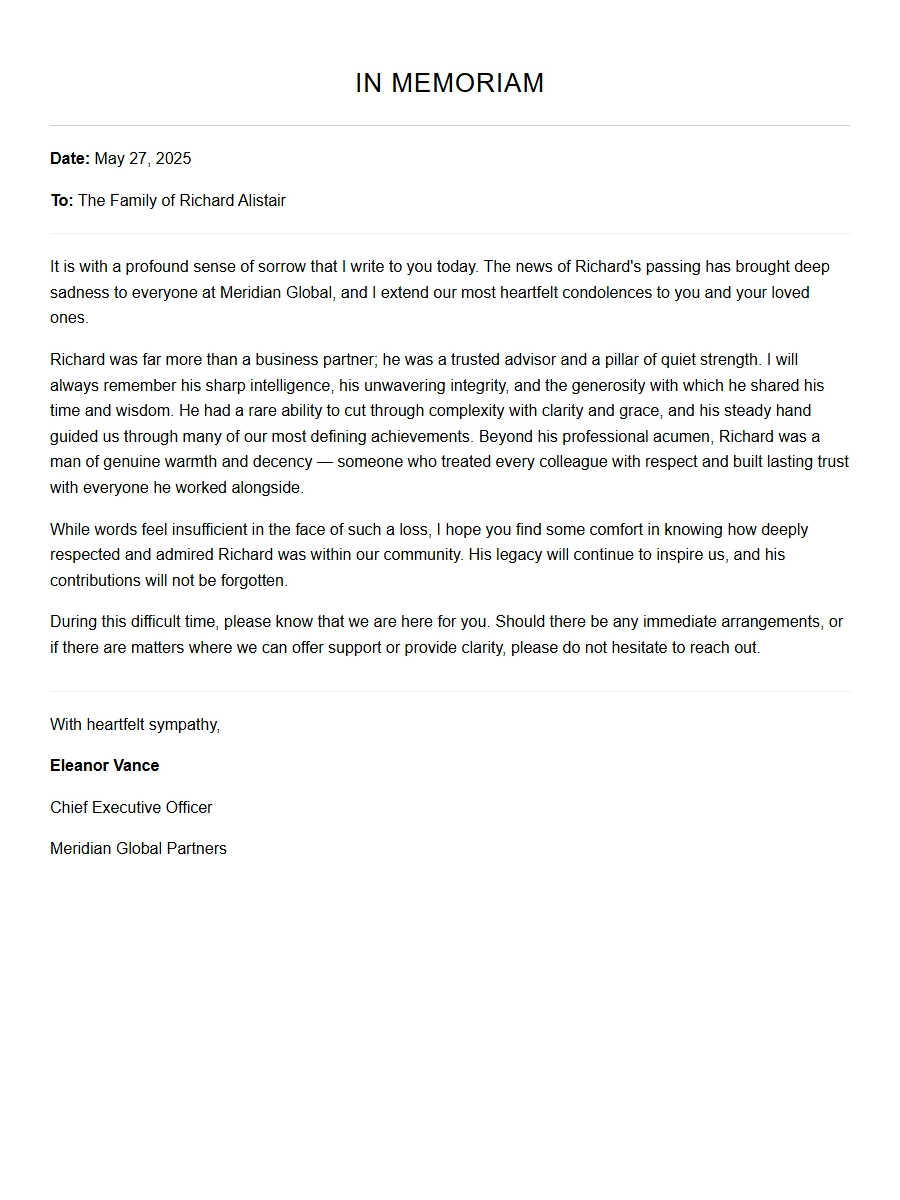 Formal Condolence Message for a Business Partner
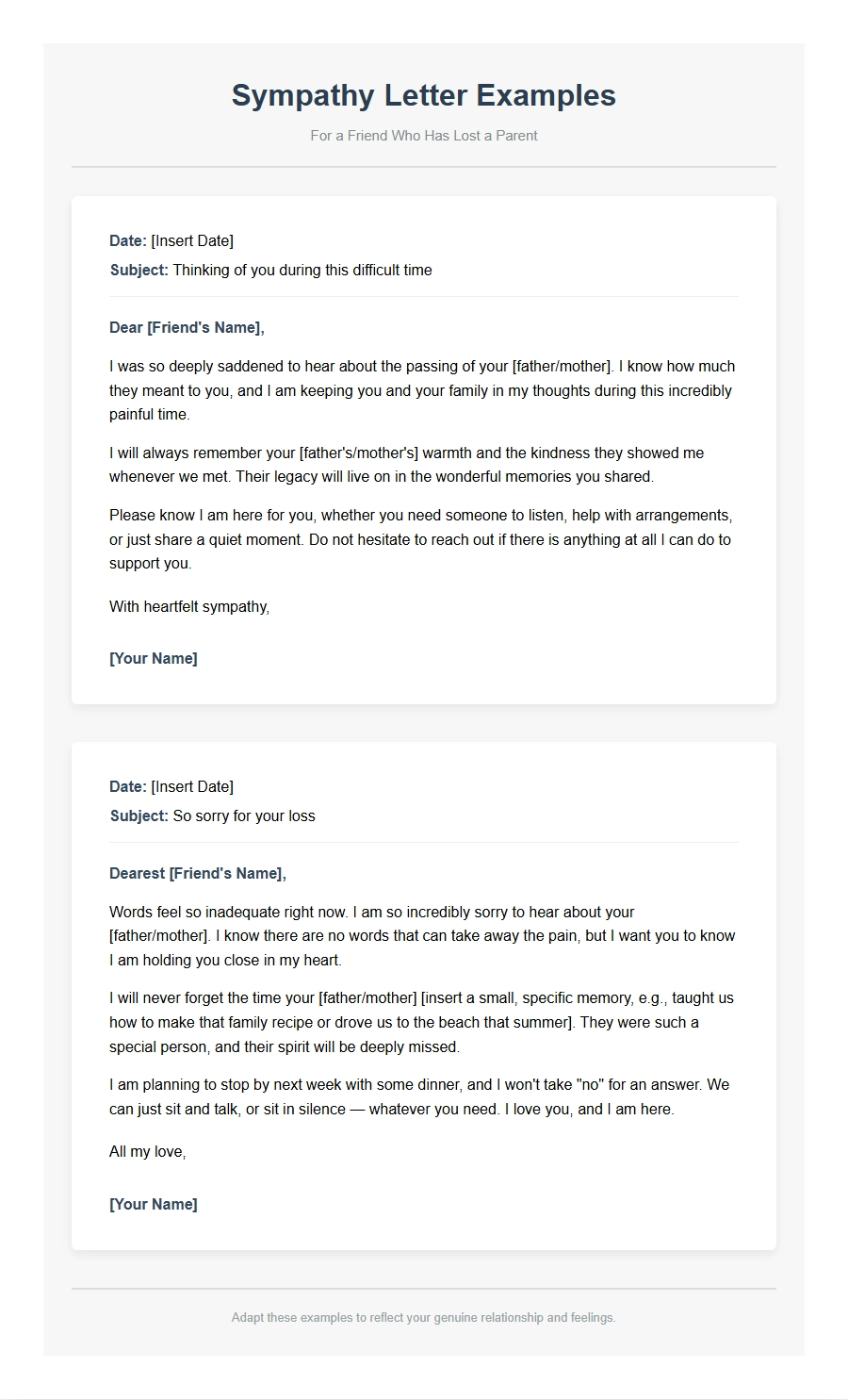 Sympathy Letter Examples for a Friend Who Lost a Parent
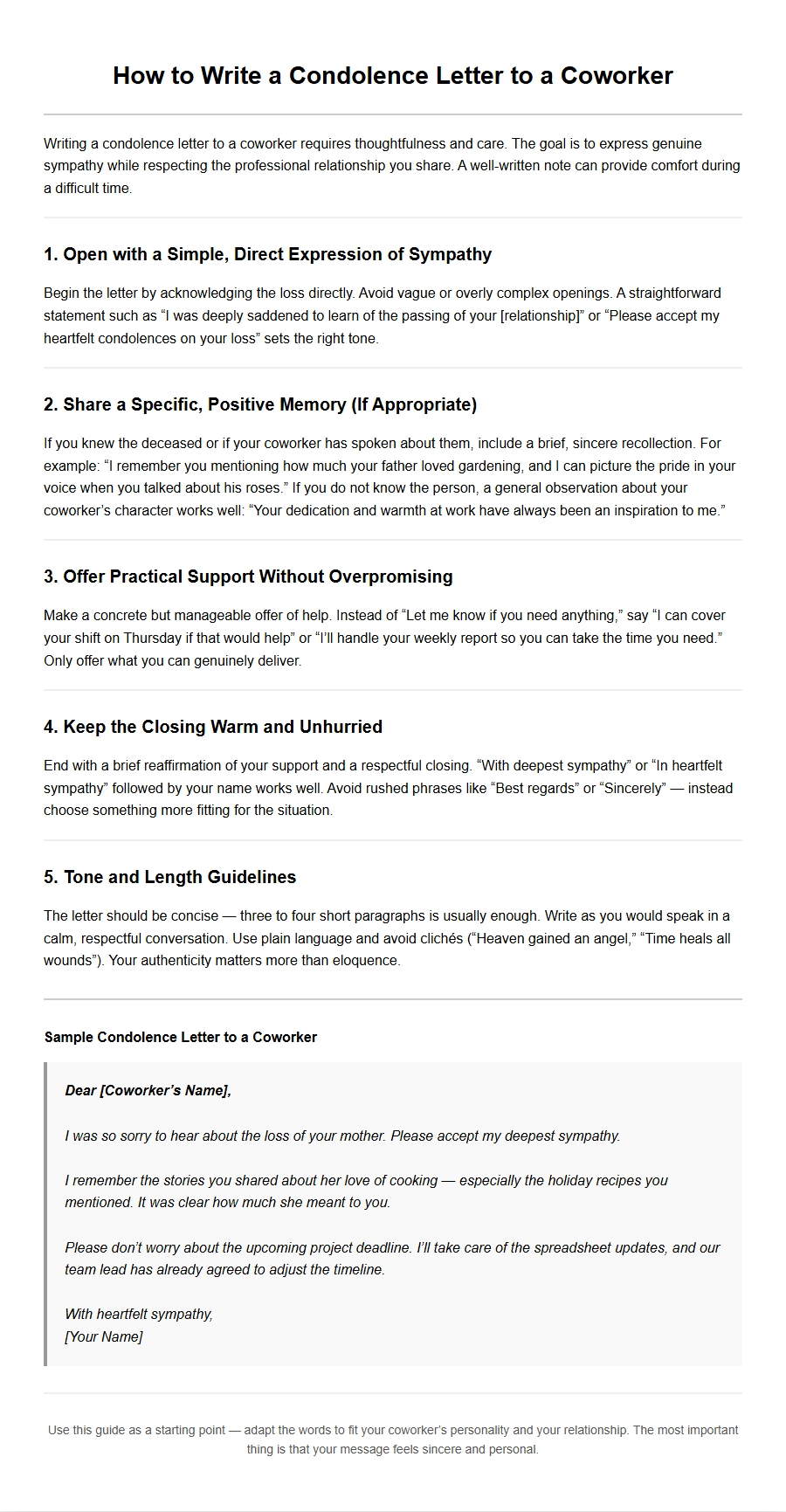 How to Write a Condolence Letter to a Coworker
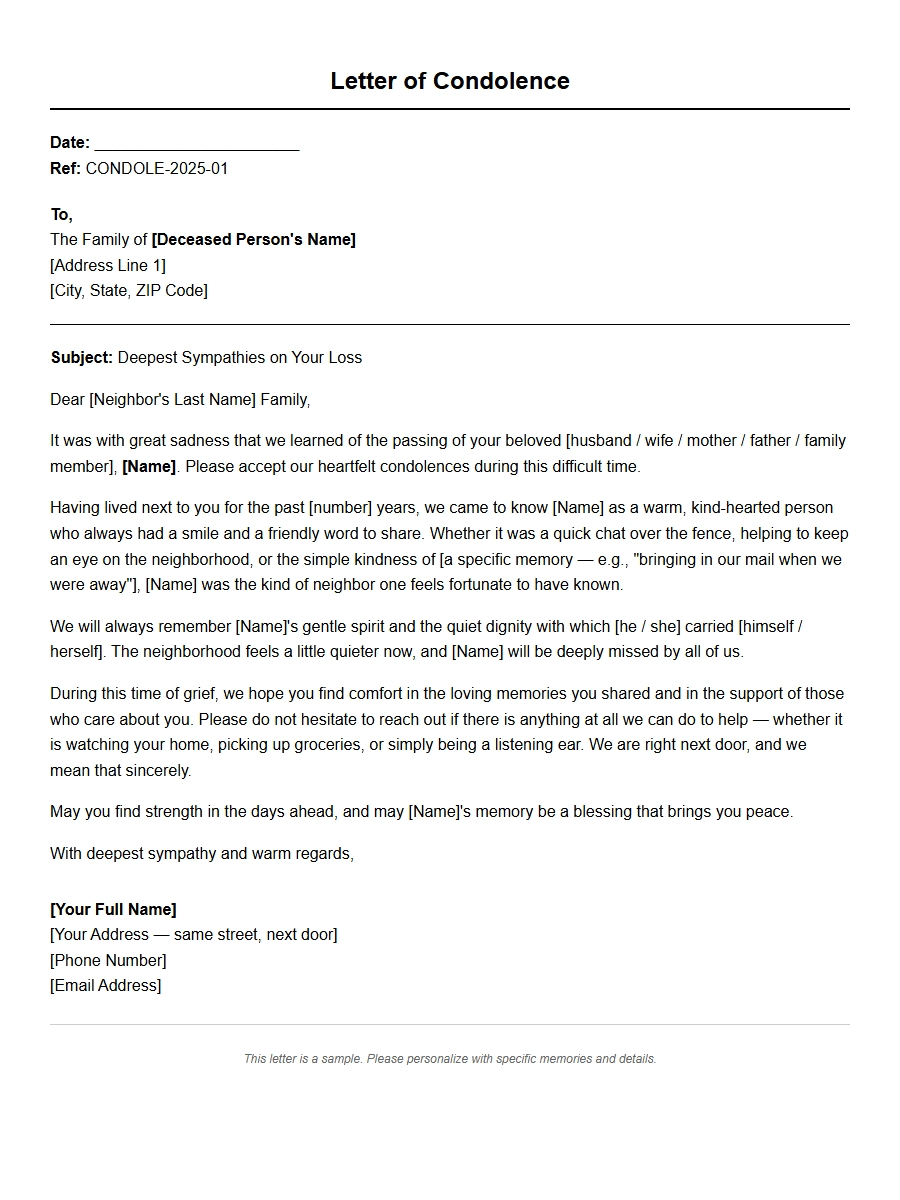 Condolence Letter Sample for a Neighbor
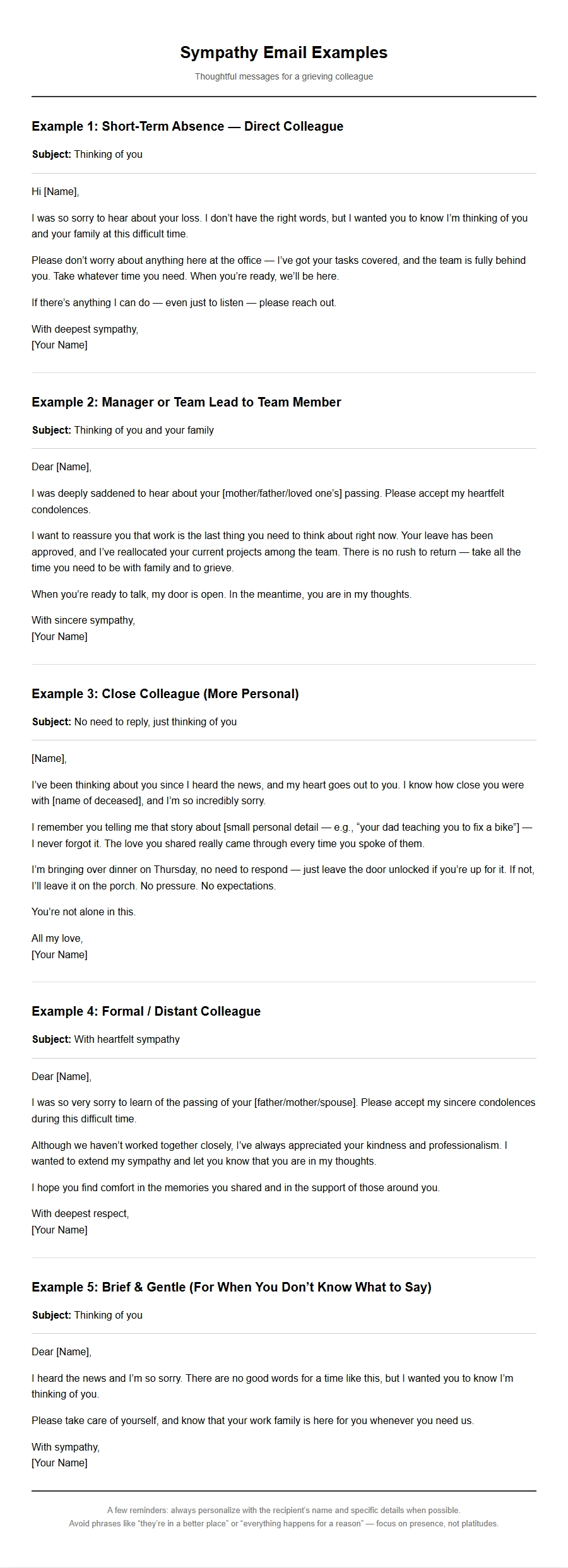 Sympathy Email Examples for a Grieving Colleague
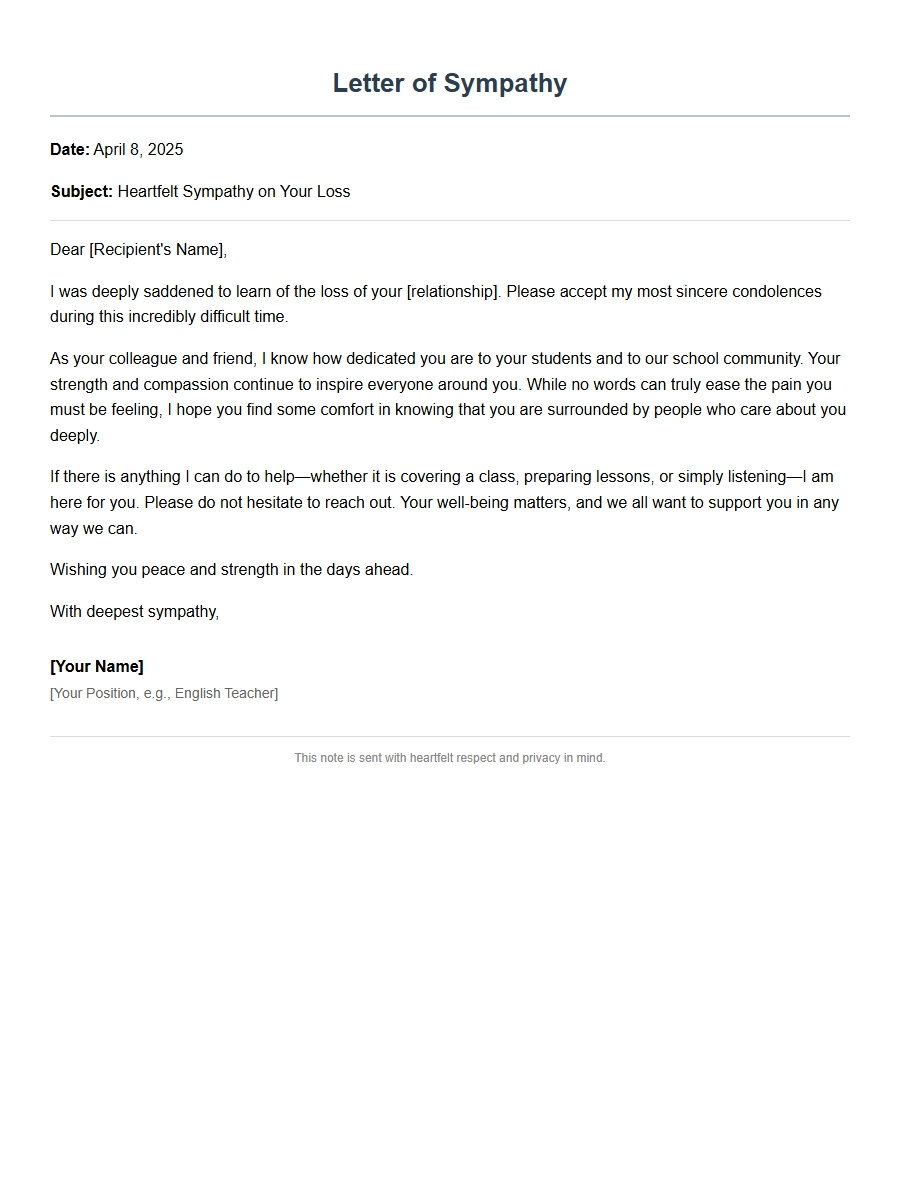 Condolence Words for a Teacher