Writing Comfort Letters for a Recently Departed Patient
You’re sitting down to write a comfort letter for a recently departed patient’s family, and the blank page feels like a wall. You know the family is grieving, and you want your words to bring genuine solace—not sound like a form letter. The pressure is real. But you don’t have to start from scratch. A well-chosen sample can turn that anxiety into a draft that’s both professional and personal.
Using a letter template isn’t cheating—it’s a smart shortcut. A good sample gives you the right structure, tone, and key phrases, while leaving room for your own voice. Think of it as a road map: it shows you where to go, but you still decide how to get there. This approach saves time and helps you avoid common missteps like awkward salutations or rushed closings.
Category: Condolence Letters
Why a sample works for this kind of letter
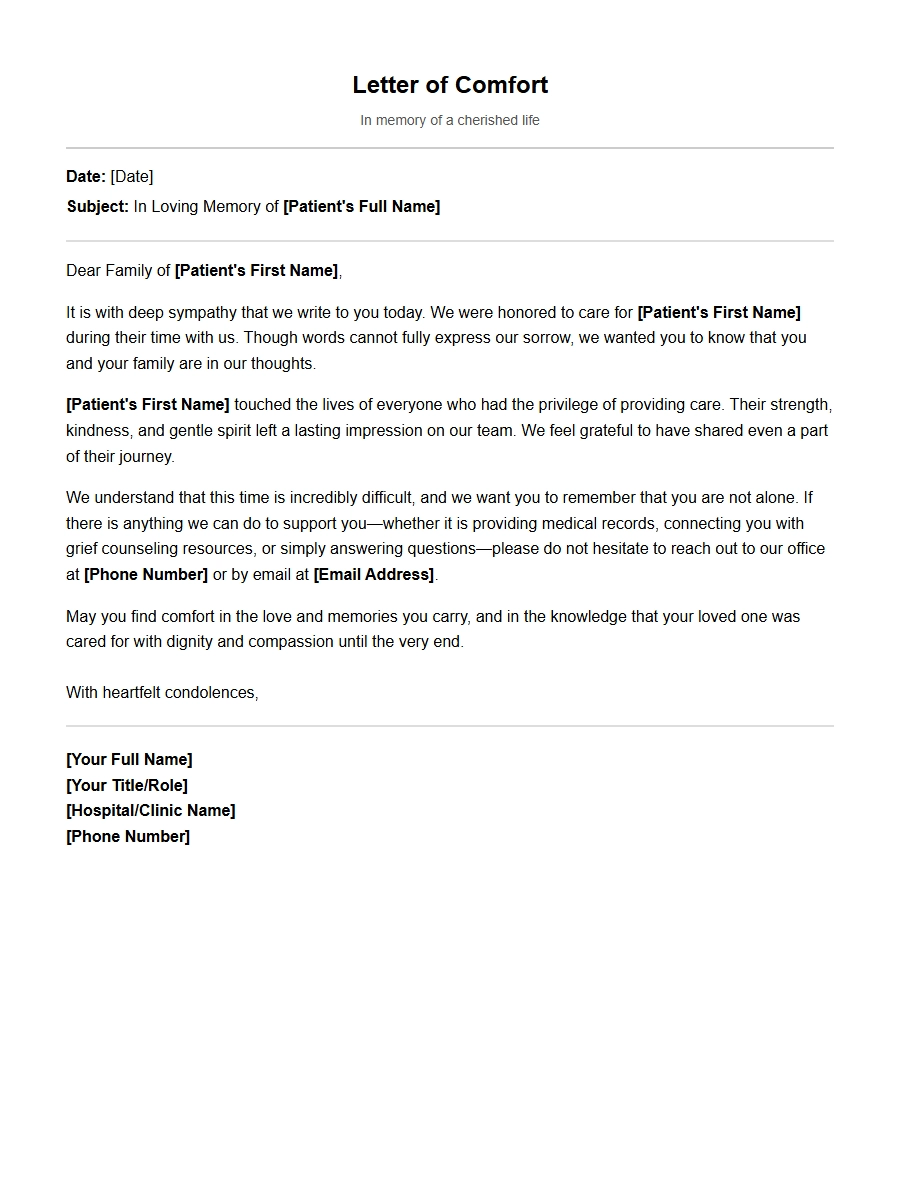
A comfort letter for a recently departed patient sits somewhere between formal business correspondence and heartfelt personal note. The family needs to know you cared, but they also need a respectful, calming presence on the page. A sample helps you strike that balance. It provides a reliable letter structure—a clear opening, a warm body, a dignified close—so you can focus on the words that matter most.
For example, a sample might suggest starting with something like, “I was saddened to learn of [Patient Name]’s passing. During the time I had the privilege of caring for them, I came to know…” That opening immediately establishes empathy and professionalism. You can then personalize it with a specific memory or quality you observed.
How to choose the right sample
Not every condolence letter template fits every situation. If you’re writing on behalf of a large practice or hospital, you’ll want a more formal tone, with a proper salutation and closing (e.g., “Dear Mr. and Mrs. Smith” and “With deepest sympathy”). If you’re a solo practitioner or have a closer relationship with the family, a slightly more personal tone in writing works better—maybe using “We will miss her warm smile” instead of a generic phrase.
Also consider the digital letter format. If you’re emailing the letter, keep the subject line clear and avoid heavy letterhead design that could look cluttered on screen. For a printed version, a simple letterhead with your practice’s name and your signature at the bottom adds a touch of care.
Adapting a sample without losing your voice
Once you have a sample, read it aloud. Does it sound like you? If not, tweak it. Swap out phrases that feel too stiff. For instance, if the sample says “This news came as a great shock,” but you actually saw the decline coming, change it to something honest like, “We knew the last weeks were difficult, but her courage always inspired us.” Authenticity matters more than perfect wording.
A common mistake is copying the sample verbatim and then forgetting to replace placeholders. Always double-check names, pronouns, and dates. And don’t be afraid to cut whole sentences if they don’t fit. A shorter, genuine letter is better than a long, generic one.
Tailoring the opening paragraph to grab attention—gently
The first line sets the tone. Instead of starting with “I am writing to express my condolences,” try something more direct: “I was so sorry to hear about your father.” Or reference a specific detail: “I remember how [he/she] always asked about the flowers in the waiting room.” That small personal touch makes the family feel seen. For more ideas, you can browse examples of condolence messages for social media and friends to see how other professionals balance warmth and formality.
Common mistakes to avoid
One error is using outdated salutations like “To whom it may concern” in a letter meant for a specific family. Another is ignoring the format difference between email and print. For email, avoid long paragraphs and heavy formatting. For a printed letter, make sure the letterhead design isn’t too flashy—keep it clean and respectful. Also, always proofreading letter is essential. A typo in a condolence note can feel careless. Read it twice, or ask a colleague to glance at it.
Tone in writing can be tricky too. You don’t want to sound overly clinical, but you also don’t want to sound like a close friend if you only met the patient a few times. Let the relationship guide you. If you’re unsure, err on the side of respectful warmth. You can always reference how to express sorrow without being awkward for practical phrasing tips.
Using the sample as a springboard, not a crutch
The best comfort letters feel both professional and personal. A sample gives you the scaffolding—you provide the heart. After you’ve written a few, the process becomes quicker and more natural. You’ll start developing your own go-to phrases and a rhythm that matches your voice. Over time, you won’t need a sample every time. But when you do reach for one, it’s a tool that helps you do your job better, not a shortcut that replaces your empathy.
If you’re writing a eulogy or a tribute alongside the comfort letter, you might find this guide on writing a eulogy letter useful for capturing the patient’s life in a few paragraphs. And for families who have experienced a second loss event, a gentle acknowledgment can mean the world. Remember: your letter is a small act of care that can carry a big weight. Start with a sample, make it yours, and send it with confidence.
Samples to Guide You
Writing Comfort Letters for a Recently Departed Patient
Comfort Letter for Grieving Spouse
Dear Mrs. Harrison,
We were deeply saddened to learn of the passing of your beloved husband, John. During this difficult time, please know that you are in our thoughts and prayers.
John was a kind and gentle soul who always had a warm smile for everyone. We will remember him fondly for his dedication to his family and his sense of humor. As you navigate this new chapter, we hope you find strength in the cherished memories you shared together.
If there is anything we can do to support you—whether it is running errands, preparing meals, or simply listening—please do not hesitate to reach out. You are not alone in your grief.
With heartfelt sympathy, Clara and Mark Thompson
Letter to Recently Departed Patient's Adult Child
Dear Sarah,
We were so sorry to hear about the passing of your mother, Eleanor. It was an honor to know her and to witness the loving care you provided her over these last few years.
Your mother often spoke of you with immense pride, especially your accomplishments as a teacher. She was a woman of grace and resilience, and her legacy lives on through you. We hope you can find comfort in knowing how deeply she was loved by her community and family.
To help you during this time, we have compiled a list of resources that may assist with practical matters:
Grief counseling: Harbor Hospice offers free sessions for family members.
Legal assistance: Lawyer Jane Miller specializes in estate planning—we can connect you.
Meal support: The church will deliver meals twice a week for the next month.
With love and sympathy, Father David
Formal Condolence Note from a Doctor
Dear Mr. and Mrs. Lim,
It is with a heavy heart that I write to express my deepest condolences on the loss of your son, Kevin. As his primary physician for five years, I had the privilege of witnessing his bravery and resilience in the face of illness.
Kevin always approached his treatments with a positive spirit that inspired our entire medical team. His laughter during visits, even on tough days, is a memory I will treasure. You raised an extraordinary young man.
Please know that I am available to discuss any medical questions you may have regarding his care. Additionally, I have arranged for a social worker from our clinic to reach out to you for bereavement support. Here is a swift overview of who to contact:
Service
Contact
Phone
Bereavement Counselor
Maria Santos
(555) 123-4567
Medical Records
Hospital Admin
(555) 234-5678
Spiritual Care
Chaplain Osei
(555) 345-6789
With deepest sympathy, Dr. Rebecca Chen
Comfort Letter for a Friend Who Lost a Parent
My dear Alex,
I was heartbroken to hear about your father’s passing. He was such a vibrant part of our lives, always telling stories and fixing things around the neighborhood. I will miss his laughter echoing from your garage.
I know words feel insufficient right now, but I want you to remember that grief is not a straight line. Some days will be heavier than others, and that is okay. Please give yourself permission to feel everything without judgement.
I am planning to bring dinner over on Thursday at 6:00 PM—no need to prepare anything. Also, I have gathered a few people who want to help:
Lawn care: Mike will mow your yard until the end of summer.
Pet care: Julie can walk Pepper on weekdays.
Errands: I can pick up groceries or prescriptions anytime.
You are not alone in this. Lean on us.
With love, Your friend, Jenna
Letter to a Patient's Grandchild (Child's Perspective)
Dear Lily,
We are so sorry that your Grandma Rose has gone to heaven. She loved you very much and talked about you all the time—especially about your drawings and how you won the spelling bee.
It is okay to be sad, and it is also okay to remember the happy times. Maybe you can draw a picture of you and Grandma Rose together, and that can be your special memory.
Here are some things that might help when you miss her:
Look at photos of your favorite moments together.
Write her a letter—you can keep it in a special box.
Plant a flower in her memory, like the yellow roses she loved.
Your mom and dad are sad too, so it might be nice to give them a hug. If you ever want to talk, we are here for you.
With hugs and kindness, Nurse Molly
Condolence Letter from a Hospice Team
Dear Carter Family,
On behalf of the entire hospice team, we extend our most heartfelt condolences on the passing of your beloved matriarch, Evelyn. It was our privilege to provide comfort and care for her during her final months.
Evelyn’s grace, wit, and unwavering love for her family left a lasting impression on each of us. The stories she shared about her childhood on the farm and her years as a nurse will stay with us always. Her room was always filled with laughter because of her.
We have compiled a memory sheet to honor her life, which we hope brings you some peace:
Memory
Shared by
“She taught me how to bake apple pie.”
Volunteer Diane
“Her daily crossword puzzles were legendary.”
Nurse Tom
“She always asked about my grandchildren.”
Chaplain Ruth
We are here for you in the days ahead. Please call us anytime for grief support or just to talk.
With deepest respect, The Sunrise Hospice Team
Short Sympathy Note for a Coworker
Dear Patricia,
We were so saddened to learn of the passing of your husband, Mark. He was a warm and generous man, and we know how much he meant to you and your family.
At work, we have pulled together some small gestures to lighten your load during this time:
Meal train: Colleagues will deliver dinner on Mondays, Wednesdays, and Fridays this month.
Task relief: Your projects have been reassigned until further notice—no need to worry.
Charitable donation: The team has donated $500 to the American Cancer Society in Mark’s name.
Please take all the time you need. We miss you at the office but want you to prioritize your healing. When you are ready, we are here for you.
With caring thoughts, Your Team at Acme Corp
Pastoral Comfort Letter to a Bereaved Family
Dear Baker Family,
Grace and peace to you in this time of loss. I write to you today with a heavy heart as we mourn the passing of your dear brother, Samuel. He was a faithful servant of our church, a deacon, and a friend to many.
Samuel’s life was a testament to kindness, service, and unwavering faith. He organized the food pantry for a decade, mentored our youth, and sang in the choir with such joy. His was a life well-lived.
In the coming days, we invite you to lean on our church family for support. Here are some ways we are walking with you:
Support Schedule:
Prayer gatherings: Wednesday at 7:00 PM at the church (all are welcome).
Meal ministry: Meals will be provided for the next two weeks—please call the church office to arrange deliveries.
Memorial service: Friday at 11:00 AM, followed by a reception.
May the God of all comfort hold you close.
In faith and sympathy, Pastor Thomas
Letter of Comfort from a Nurse to the Family
Dear Rivera Family,
I am writing to express my deepest condolences on the loss of your father, Carlos. As his night nurse for the past six months, I came to know him as a gentle, grateful, and dignified man.
Carlos and I often talked about his love for gardening—he would describe his tomatoes and roses with such detail that I felt I could smell them. He was proud of his children and grandchildren, and he carried photos of you all in his bedside drawer.
I want you to know how peaceful he was in his final moments. He was comfortable and surrounded by the music he loved. Here are some details you may find helpful:
Item
Information
Last words
“Tell them I love them.”
Favorite song played
“What a Wonderful World” by Louis Armstrong
Personal belongings
Returned to family via social worker (list available)
Please take care of yourselves. It was an honor to care for your father.
With deepest sympathy, Nurse Rachel
Condolence Letter for a Patient Who Had No Close Family
To the Community of Pine Hills,
It is with great sadness that we share the passing of our dear neighbor, Mr. Harold Finch. Harold had no surviving relatives, but he was family to all of us who had the privilege of knowing him.
Harold was a quiet giant—often seen tending his front garden or sitting on his porch reading. He never missed a community potluck and always brought his famous cornbread. He was a friend to the local library and volunteered with children’s reading programs for over twenty years.
We invite you to honor his life by participating in the following community tributes:
Memorial bench: A bench will be placed in his favorite spot at Elmwood Park. Donations accepted at City Hall.
Book donation: Donate a children’s book to the library in his name.
Comfort meal: The church will host a community dinner on Saturday at 6:00 PM to share stories.
Harold may not have had blood family, but he had us. And he will not be forgotten.
With love and remembrance, The Pine Hills Neighborhood Association
 Formal Condolence Message for a Business Partner
 Sympathy Letter Examples for a Friend Who Lost a Parent
 How to Write a Condolence Letter to a Coworker
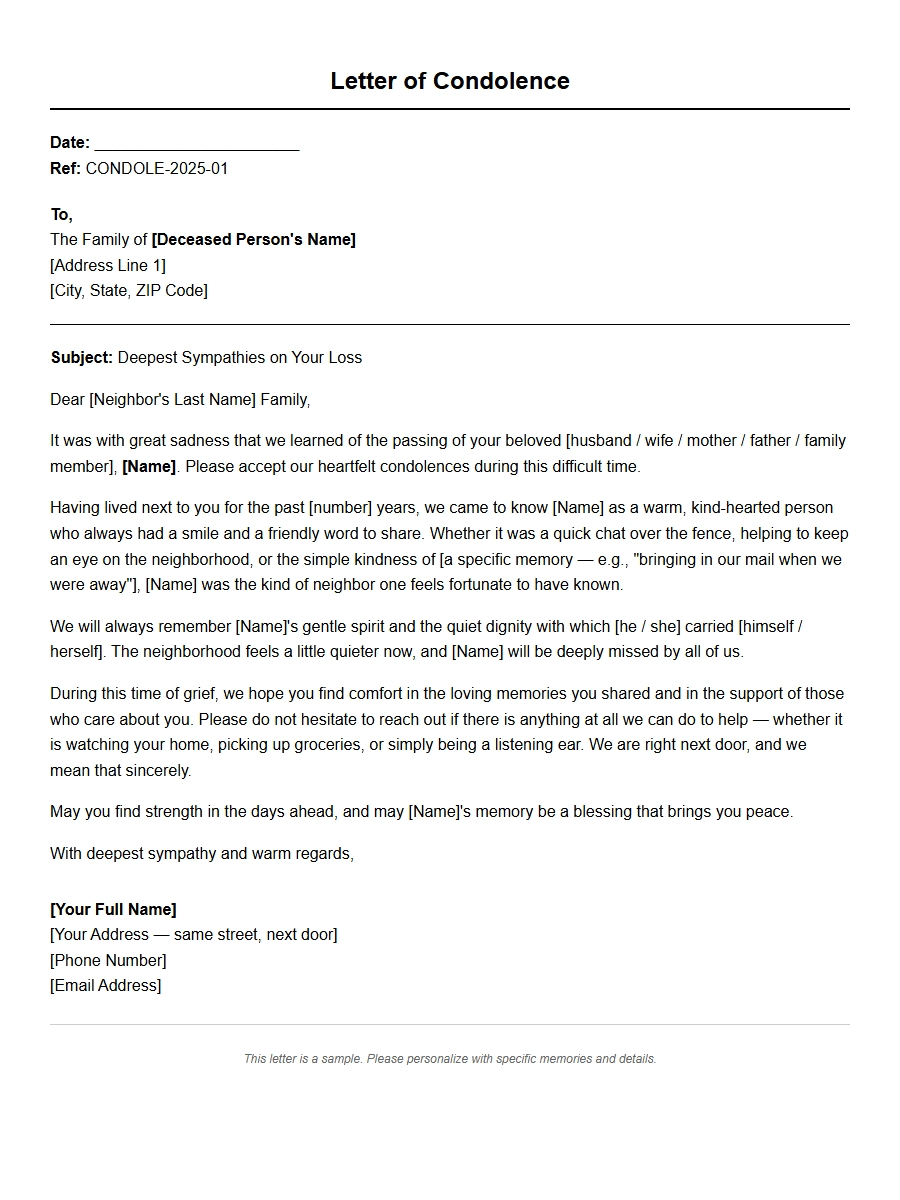 Condolence Letter Sample for a Neighbor
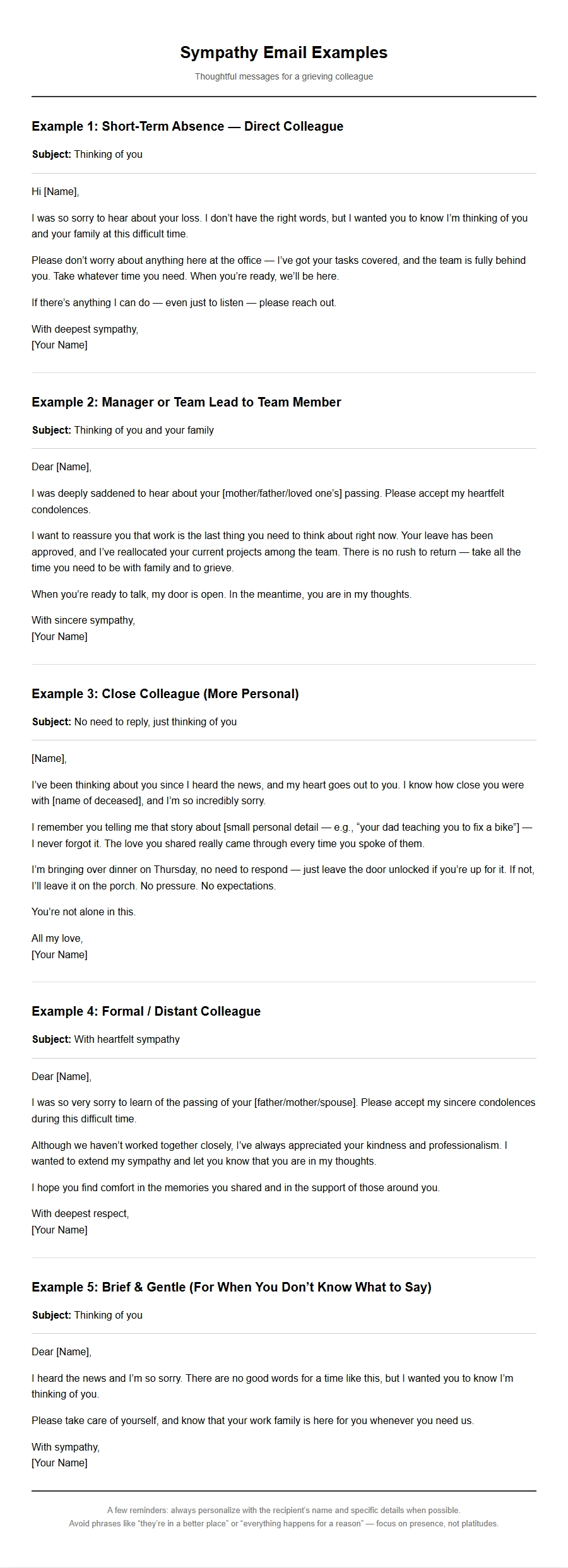 Sympathy Email Examples for a Grieving Colleague
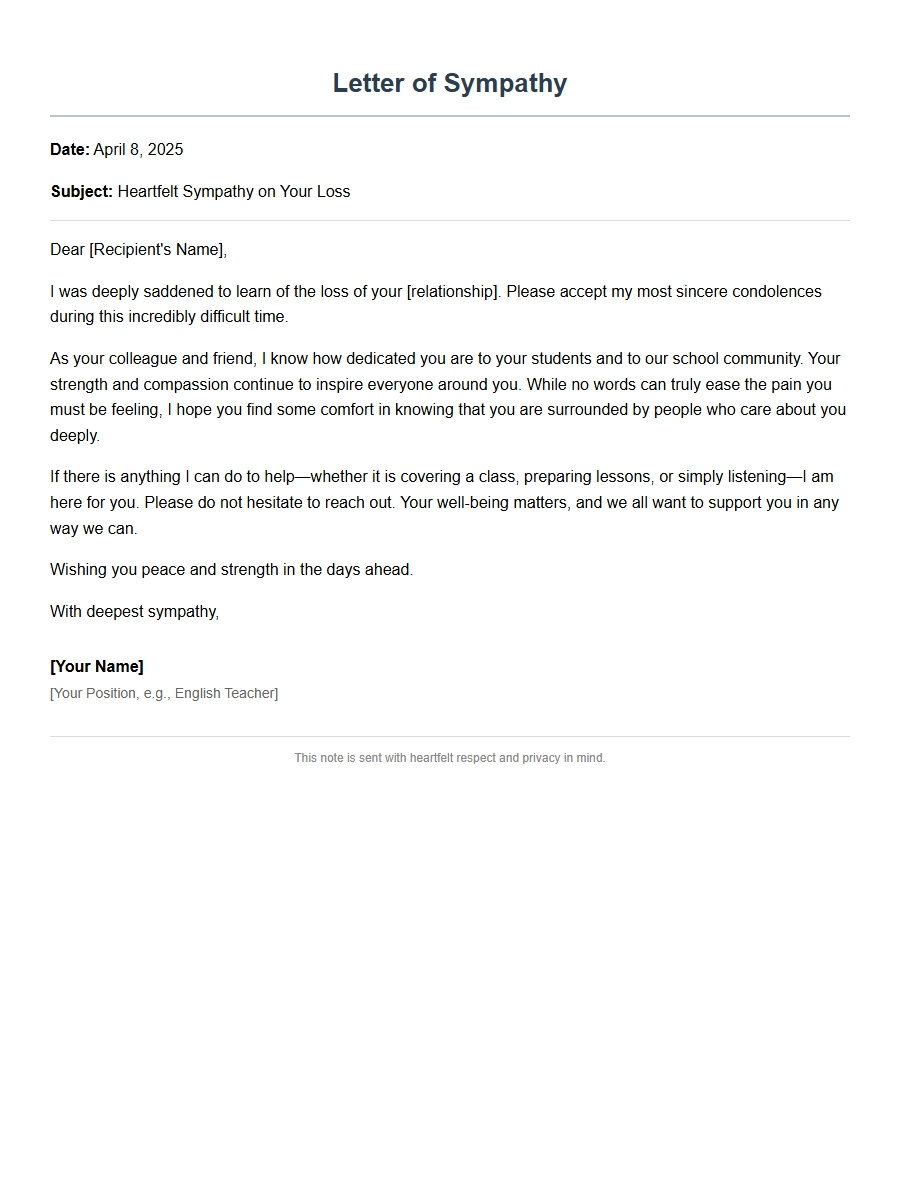 Condolence Words for a Teacher