When the Words Won't Come: Writing a Sympathy Message After a Second Loss
You’ve already written one condolence letter. Now you face another loss – and the words feel even harder to find. Maybe it’s a second death in the same family, or a friend who lost someone else after grieving a previous loved one. Staring at a blank page when you need to send a message can paralyze anyone. But a well-chosen sample turns that anxiety into a draft you can personalize without starting from zero.
Why Using Examples Isn’t Cheating – It’s Smart
Some people think using a letter template for sympathy feels impersonal. Actually, it’s the opposite. A good letter template gives you the structure and tone you need, then leaves room for your own words. It’s like having a trusted colleague whisper, “Start here.” You save time, avoid awkward phrasing, and still sound like yourself. Think of it as a scaffolding for professional correspondence – even though sympathy letters are personal, they follow letter writing etiquette that helps you avoid missteps.
How to Pick the Right Sample for a Second Loss
Not every example fits every situation. For a second loss in the same family, your message needs to acknowledge the cumulative grief without overwhelming the reader. Look for samples that use a warm but respectful tone in writing – not too stiff, not too casual. If you’re writing to a close friend, a semi-formal approach works. For a colleague or acquaintance, stick with a more traditional business letter format adapted for sympathy. The salutation and closing should match your relationship: “Dear Sarah” for a friend, “Dear Mr. and Mrs. Chen” for a more formal connection.
Three Ways to Adapt a Sample Without Losing Your Voice
First, change the opening line. Most templates start with “I was so sorry to hear...” That’s fine, but for a second loss you might add something specific: “After the loss of your mother last year, I can’t imagine how hard this news is.” That small tweak shows you remember their history.
Second, adjust the length. A long letter can feel heavy during repeated grief. Keep it short and sincere – three or four sentences often say more than a full page. The best examples of heartfelt sympathy messages respect the recipient’s emotional bandwidth.
Third, check the format. If you’re sending a digital message, digital letter format means no letterhead, but still use a proper greeting and closing. For a printed card, a simple letterhead design isn’t necessary – just your name at the end. And always proofreading letter before sending; a typo in a sympathy note can feel careless.
One big mistake: using outdated salutations like “To whom it may concern” in a personal letter. Another: ignoring the difference between email and printed mail. An email can be a bit shorter, but still needs a thoughtful subject line. Also, don’t over-apologize for writing so soon after a previous loss. A simple “I know this is a lot, but I wanted you to know I’m thinking of you” works better.
Some people try to write a letter of recommendation style – that is, listing the deceased’s achievements. Instead, focus on the living person’s grief and your support. Keep formal writing tips in mind: avoid clichés like “passed away” if it feels too distant – “died” is okay in a close relationship. And never use humor, even if you think it lightens the mood.
Make It Yours, Then Let It Go
Don’t aim for perfection. The best condolence letters feel both professional and personal. Use the sample as a springboard, not a crutch. Type or write a draft, read it aloud, and tweak anything that sounds stiff. Over time, writing these messages gets easier. And the person on the other end will appreciate your effort far more than your eloquence. So take a deep breath, choose a sample that fits, and start writing. You’ve got this.
Everyday Writing Examples
Messages for a Second Loss Condolence
For a Second Parent Loss
Dear Margaret,
Learning that your beloved mother has passed away, so soon after your father, has left me deeply shaken. I cannot imagine the weight of this back-to-back grief. Please know that I am holding you in my heart with the gentlest care.
When you lost your father last spring, you showed such strength. Now, to face this second loss—it is unimaginable. There are no right words, only a quiet promise: I am here. I will bring dinner on Tuesday, and the following Tuesday, for as long as you need.
Your mother spoke of you with such pride. Her love will walk beside you, just as your father’s does. In the days ahead, when sorrow doubles, may you also find moments of their doubled love. We are all here to help carry this.
With deepest sympathy, Caroline
To a Friend Who Lost Two Siblings
Dear Jordan,
I was heartbroken to learn of your sister Emma’s passing. So soon after losing your brother, this second blow is almost too much to bear. I am so, so sorry.
I remember how you held your family together during Alex’s illness, and how you celebrated Emma’s small victories. Your love for them was fierce and beautiful. Now that both are gone, I know the silence in your house must be deafening. Please do not suffer alone. My door is always open—for a coffee, a walk, or just to sit in silence together.
It is not fair to lose two siblings in a single year. But your siblings were lucky to have you. Their memories live on in your laughter, your stories, your tears. Let us honor them by holding each other close. I am bringing casserole tomorrow at 6 PM. No need to reply.
You are not alone, Alexis
For a Second Pet Loss
Dear Liam,
I am so sorry to hear that Buster has crossed the Rainbow Bridge, especially so soon after losing Daisy. The house must feel so quiet, and your heart must ache with a doubled emptiness.
I know how much those two dogs meant to you—they were your family. Daisy was your loyal shadow for 14 years, and Buster was the wild, joyful spirit who filled the silence after she left. Now both lights are gone, and it is okay to feel utterly devastated. Losing two beloved pets in such a short time is a profound grief that many do not understand, but I do.
Please be gentle with yourself. Let the tears come. Remember that you gave both of them a wonderful, loving home. If you’d like, I can help you plant a small garden in their memory—a sunny spot with daisies and a little buster statue. No rush. I’ll be over Saturday with takeout, and we can just remember them together.
With love, Samira
After Losing Both Parents in One Year
Dear Rebecca,
I am writing with a heavy heart after hearing that your mother has passed away. To lose both parents within twelve months is a sorrow that feels almost unmanageable. I am so deeply sorry.
Your father’s gentle humor and your mother’s steady warmth created a home I was lucky to visit. Now you are left to navigate a world without either of them. It is okay to feel unmoored. It is okay to not know what to do next. Grief doubled can feel like a hole with no bottom—but you do not have to face it alone. I am here for the late-night calls, the sudden tears at the grocery store, the moments when you need someone to just sit with you.
Please let me help with practical things—I am dropping off meals on Monday and Wednesday this week. No need to respond; just know that you are loved, and that your parents’ love remains woven into every part of you.
With all my heart, Patricia
For a Spouse Who Lost Two Close Friends
Dear Mark,
I was stunned to learn that your dear friend Carlos has passed away, so soon after losing David. Two of your closest companions in such a short span—I can only imagine the depth of your sorrow.
You and David built that treehouse together twenty years ago. Carlos was the one who taught you how to fish. Those memories are now double-edged—precious and painful. Please do not try to be strong for others. This is a time to be gentle with yourself, to allow the grief to come in waves, and to lean on those who love you (including me).
I will be at your place Saturday afternoon with a pot of chili and no agenda. We can look through old photos, or we can sit in silence. Whatever you need. You are not losing them alone; I will help you carry this.
With unwavering friendship, Elena
To a Colleague After a Second Family Loss
Dear Anita,
I was so sorry to hear about the passing of your uncle, so soon after your grandmother. This must be an incredibly painful time for you and your family. Please accept my deepest condolences.
I remember you telling me how your grandmother taught you to make her famous piecrust, and how your uncle cheered you on at every school play. To lose both anchors in a single season is unthinkable. I want you to know that your work family is here to support you. We have already arranged for extra coverage for your projects until you feel ready to return. There is absolutely no pressure.
When you are ready, maybe we can share a coffee and you can tell me one of your uncle’s bad jokes—I know you always rolled your eyes, but I suspect you’ll miss them. In the meantime, please take all the time you need. You are not alone.
Thinking of you, Michael
For a Second Miscarriage
Dear Sophie,
I am so devastated to learn of your second loss. After the hope you carried, the fear you managed, the appointments you attended—to have this happen again is a cruelty beyond words. I am so, so sorry.
Please know that this is not your fault, not even a little. You are not broken. Your body is not failing you. Babies are fragile, and sometimes, heartbreakingly, they cannot stay. But your love for them is real and eternal. The little one you lost last spring, and the one you lost now—they knew only warmth and hope, because that is what you gave them.
I am bringing over a care package later today: soft socks, tea, tissues, and no expectation to talk. We can just watch silly movies or stare at the wall. Whichever you prefer. I love you, and I am holding this grief with you.
Always here, Jenna
To a Neighbor Who Lost Two Relatives
Dear Mr. and Mrs. Chen,
We were so saddened to learn of your aunt’s passing, so soon after your cousin Wei. This repeated loss in your family must feel overwhelming. Please accept our heartfelt sympathy.
We have such fond memories of both of them—your aunt’s beautiful garden that she always shared, and Wei’s kindness to our children. The street is quieter now, and we know your home feels emptier. Please don’t hesitate to ask if you need anything; we are right next door. I am setting up a meal schedule with the neighbors; I’ll drop off dinner this evening. No need to respond.
In Chinese tradition, we often say that grief is like a river—it flows, it deepens, and eventually it finds a way to the sea of memory where our loved ones live forever. May your river find peace, and may you feel the warmth of so many who care.
With deepest sympathy, Anna and James
For a Second Grandparent Loss
Dear Chloe,
I was deeply sorry to hear of your grandfather’s passing, just months after your grandmother. Losing both grandparents in such a short time is a unique pain—losing two pillars of your childhood all at once.
I remember you telling me how your grandfather taught you to ride a bike, and how your grandmother always snuck you extra cookies. They shaped so much of who you are. Now, when you look in the mirror, you might see their smiles in your own—and for a while, that will hurt. But I hope, eventually, it will bring comfort. Their love is in your cells, in your laugh, in your gentle way with others.
Please let me know if you want company for the memorial, or just someone to sit with. I am free this weekend, and I can bring a photo album of our college days to make you smile. You are not alone in this sorrow.
With love, Riley
After a Second Child Loss
Dear Maria and David,
I am writing this with tears in my eyes, struggling to find words that can possibly offer comfort. To lose little Emily, so soon after your son Luke—the world has been unbearably cruel to you both. I am so, so sorry.
Luke’s bright smile and Emily’s curious eyes will never be forgotten. They were two beautiful souls, and you were the best parents they could have had. Please do not blame yourselves. Some storms are too big for any shelter. There is no timeline for this grief. Some days you will feel like you are drowning, and that is okay. Please reach out—I will always answer. Your family and friends are here to hold you up.
I have set up a meal train and a fund to help with expenses. I will also be cleaning your house every Saturday for the next two months, so you do not have to think about it. You only need to breathe. One breath at a time. We love you.
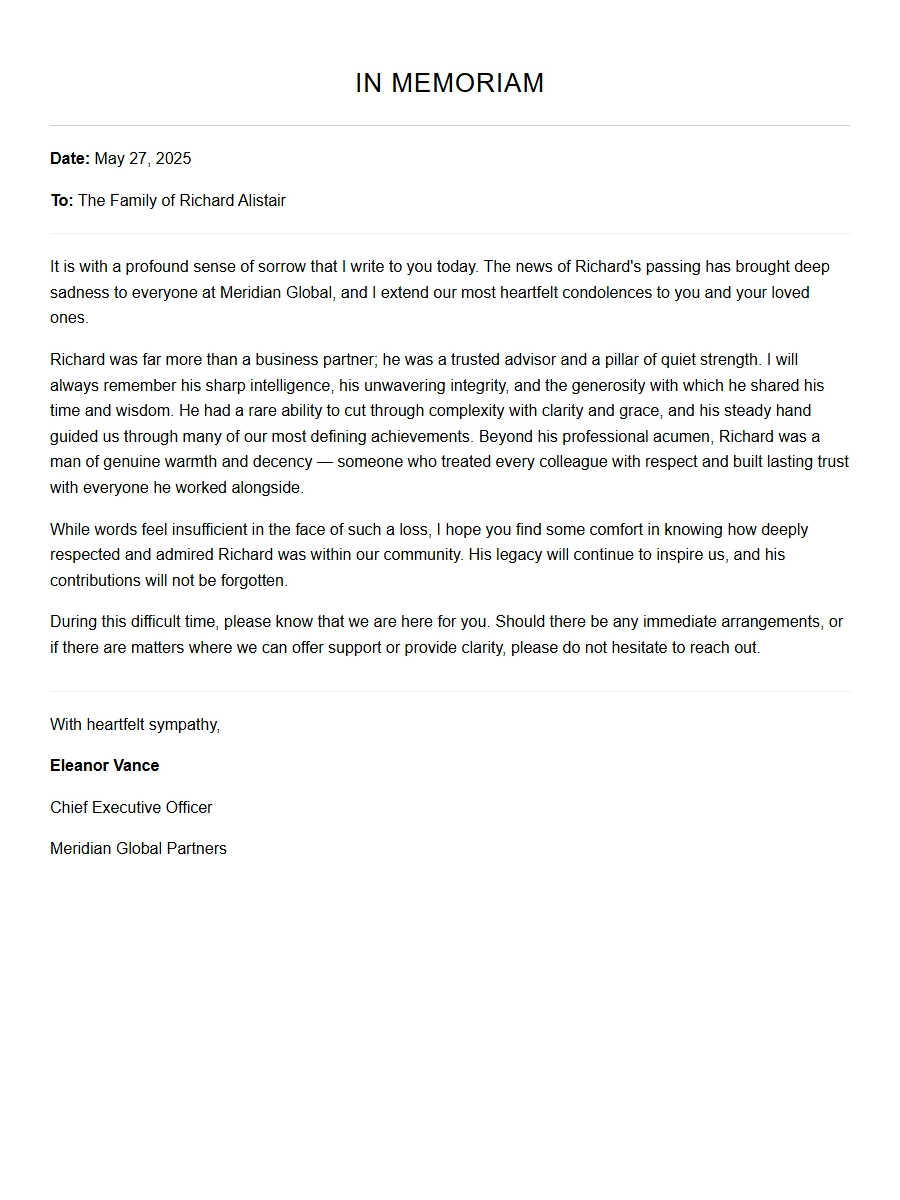 Formal Condolence Message for a Business Partner
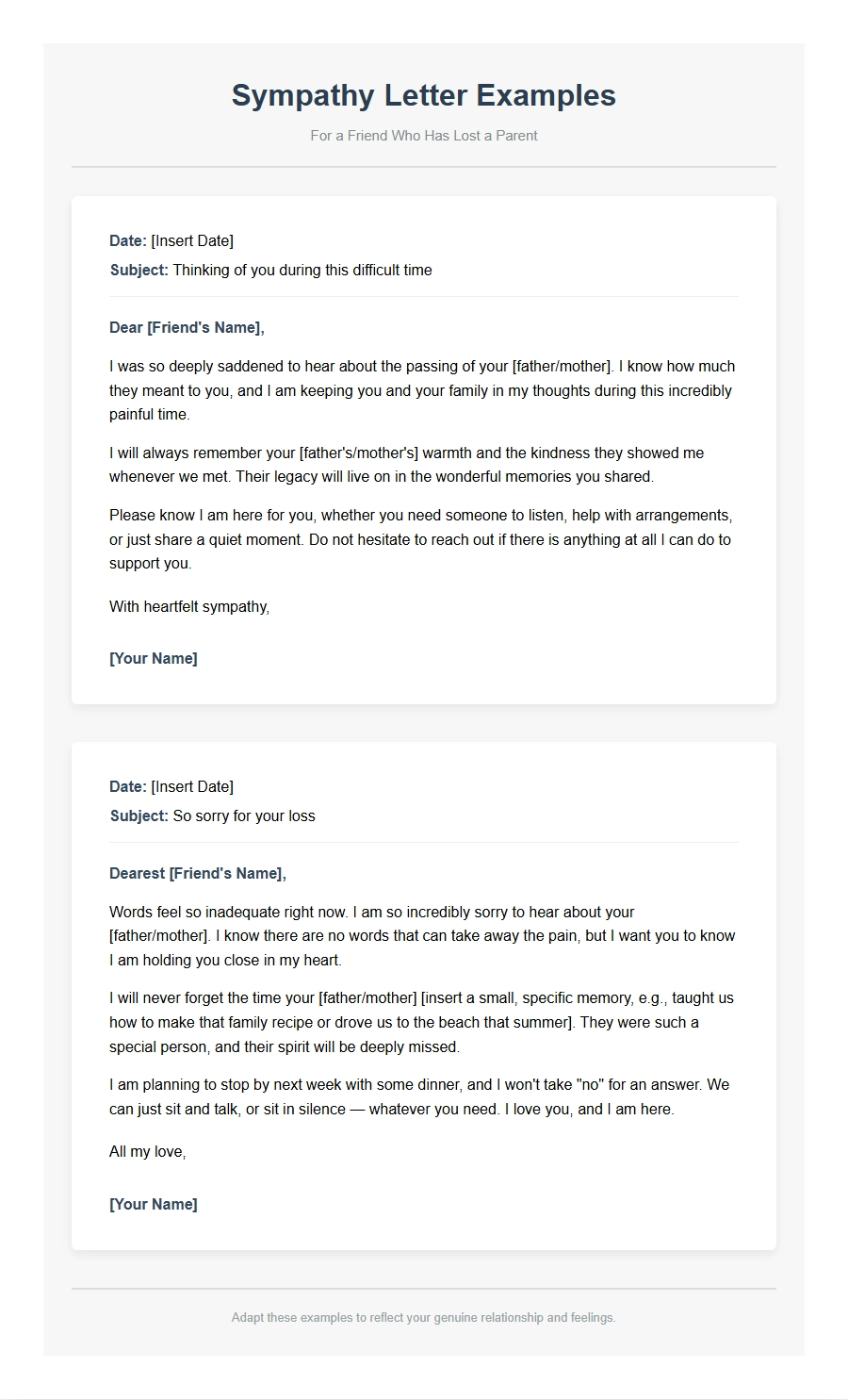 Sympathy Letter Examples for a Friend Who Lost a Parent
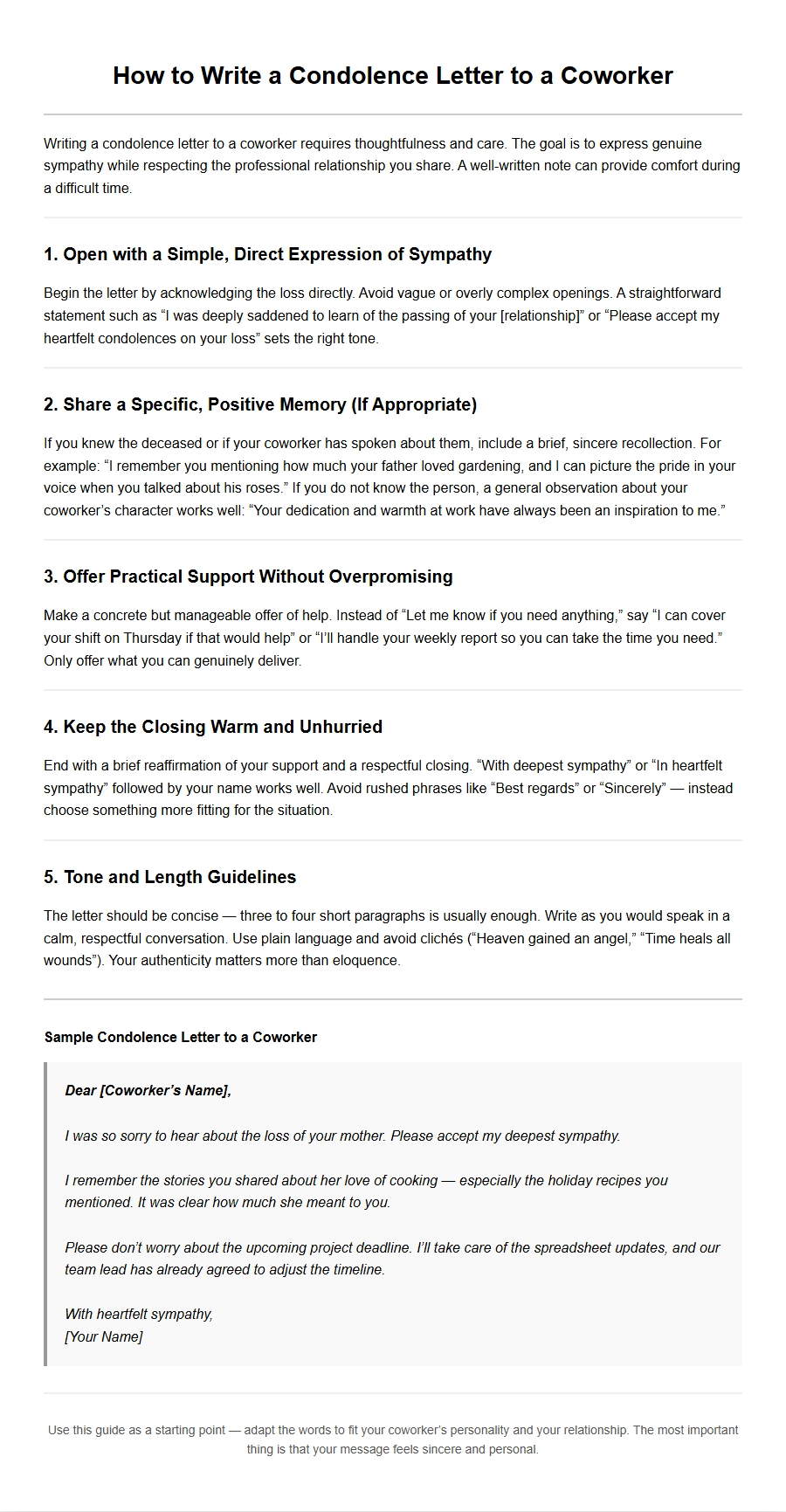 How to Write a Condolence Letter to a Coworker
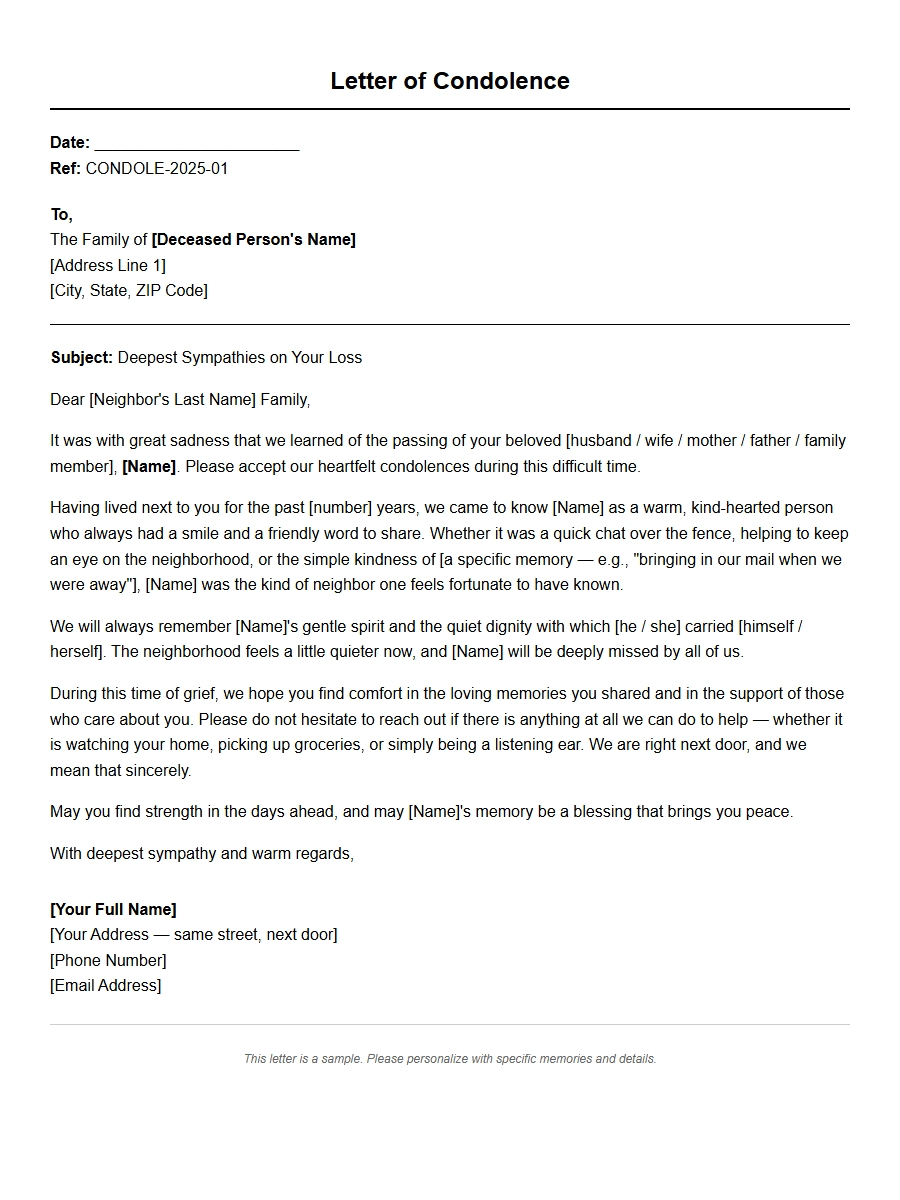 Condolence Letter Sample for a Neighbor
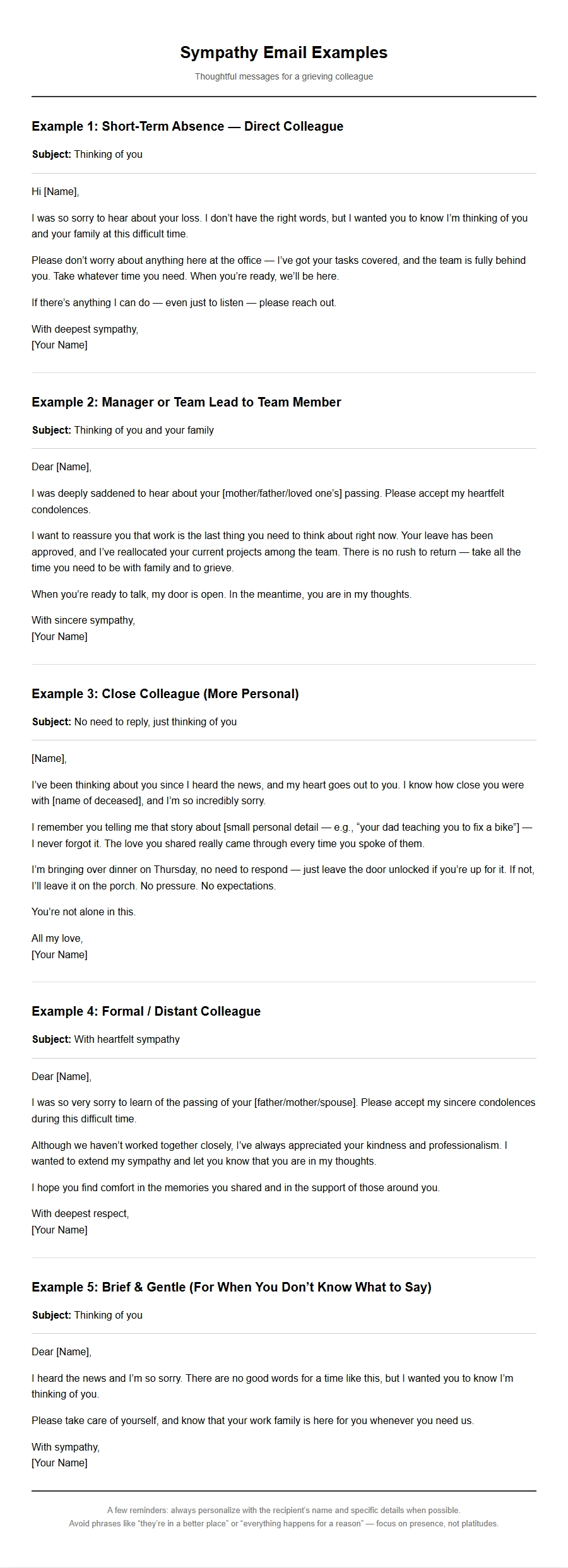 Sympathy Email Examples for a Grieving Colleague
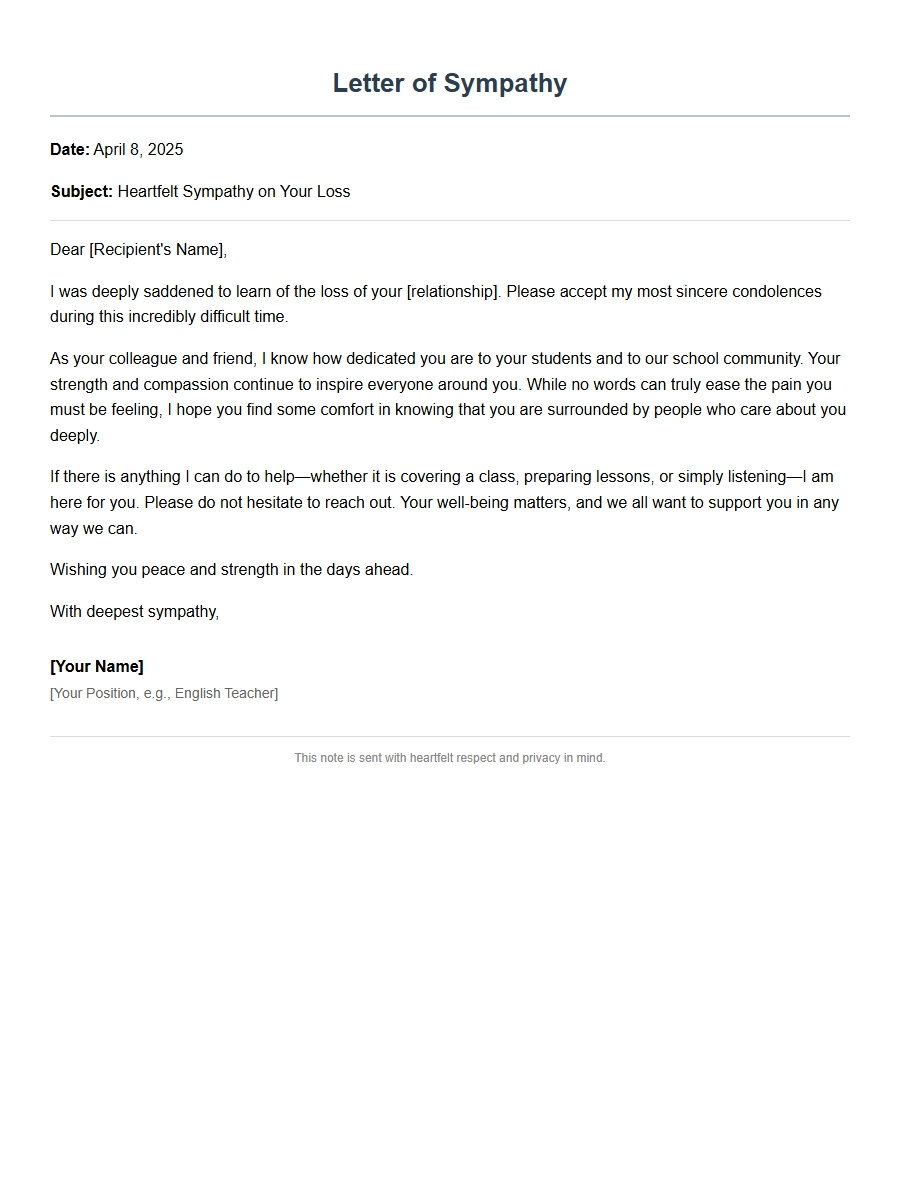 Condolence Words for a Teacher