You're tasked with writing a sympathy response for an email notification of death, and you're staring at a cursor that just won't blink. It's a heavy ask—finding the right words when someone's world has just shifted feels impossible. But here's the truth: using a thoughtful sample isn't cheating. It's giving yourself a starting point so you can focus on the genuine empathy you want to express, rather than wrestling with structure and tone from scratch.
Why a sample makes you sound better, not lazier
A good letter template does three things at once. It gives you the letter structure so you don't accidentally ramble or forget key components like the salutation and closing. It models the right tone in writing—warm but not casual, formal but not cold. And it provides those hard-to-phrase sentiments that feel inauthentic when you're forcing them on your own. Think of it as a framework you can customize to your voice, not a script you rigidly follow.
What makes a sympathy response for email notification of death different?
Writing a sympathy note for an email announcement has its own challenges. You're often responding in a semi-public format—a group email thread, a company announcement, or a shared mailing list. You want your response to feel personal without being intrusive. You're also up against the fact that email feels fleeting, but the words you choose carry real weight.
The key is to acknowledge the loss directly, express your condolences simply, and offer specific support if appropriate. Avoid generic phrases like "I'm sorry for your loss" as the only sentence. Instead, pair it with a brief, genuine memory or a concrete offer: "I'll always remember how Sam made everyone laugh during Monday meetings. I'm covering your inbox for the next week—please don't worry about a thing." This is where professional correspondence meets real human warmth.
How to adapt a sample without losing your voice
When you find a sample you like, grab its letter structure and key phrases, but swap out anything that doesn't feel like you. If the sample says "We were saddened to learn," and you'd say "I was so sorry to hear," use your version. Read your draft out loud. If it sounds like something a robot would write, rewrite it. The best cover letter examples and resignation letter samples work the same way—you borrow the bones, not the entire person.
One mistake people make is copying a formal sample verbatim for a close friend or colleague. If you were buddies with the person who passed, an email that sounds like a legal document will feel wrong. Match the formal writing tips you'd normally use for a letter of recommendation only when the relationship calls for it. For most sympathy response for email notification of death situations, a warm, direct, and slightly personal tone works best.
Practical steps to write your response
Start with a clear subject line. Something like "My deepest condolences" or "Thinking of you and your family" signals your intent without being vague. In the body, open with a direct acknowledgment: "I was so sorry to read about the passing of your mother." Then, offer one or two sentences about the person—a memory, a trait, or the impact they had. Close with a specific offer of help or a simple expression of ongoing support. End with a standard sign-off like "With heartfelt sympathy" or "In deepest sympathy," followed by your name.
Watch out for outdated letter writing etiquette. Avoid "Dear Sir or Madam" when you know the person's name. If you're responding to a digital letter format, skip the letterhead design and formal address block—email is cleaner without them. And please, proofreading letter is your friend. A typo in a sympathy message can come across as careless, even when you meant every word sincerely.
For more specific situations, you might want to see examples tailored to different relationships. If you're writing to a military family, our guide on condolences for military service member death offers the right respectful tone. For someone who's experienced pregnancy loss, the language needs to be particularly gentle and avoid certain clichés. And during holidays, the grief feels even heavier—acknowledging the season without minimizing the loss matters.
Some of the hardest notes to write are for suicide loss survivors, where simple presence is more important than trying to explain. For a widow or widower, a note that acknowledges the loneliness ahead—like our supportive messages for new widows—can mean more than any platitude.
One last thought
The sample is your springboard, not your crutch. Every time you write one of these notes, it gets a little easier. You'll find your rhythm, your go-to phrases, and your own version of warmth and professionalism. The most important thing is that you respond at all. Silence in the face of someone's grief is the only real mistake you can make.
Writing Examples
Sympathy Response for Death Notification Email
Formal Condolence to Colleague
Dear [Colleague Name],
I was deeply saddened to learn of the passing of your [relationship, e.g., father]. Please accept my heartfelt condolences during this difficult time. I remember you speaking fondly of him at the office gathering last year; his warmth and kindness clearly left a lasting impression on you.
While no words can ease the pain of losing a loved one, I hope you find comfort in the cherished memories you hold. Our team is here to support you in any way we can. If you need assistance with ongoing projects or simply wish to talk, please do not hesitate to reach out.
With sincere sympathy,
[Your Name]
Personal Sympathy to a Friend
Dearest [Friend’s Name],
My heart aches for you upon hearing the news of [deceased’s name] passing. I’m so sorry for your loss. I know how close you were, and the void they leave is immeasurable.
Please know I’m holding you in my thoughts and am here for you, whether you need someone to listen, a shoulder to cry on, or help with daily tasks. I’ve put together a small list of practical ways I can assist — just let me know what feels right.
Picking up groceries or meals
Walking your dog
Helping with childcare on weekends
Just sitting with you over tea
Take all the time you need. You don’t have to face this alone.
With love and deepest condolences,
[Your Name]
Brief Response to Group Notification
Dear [Name or ‘All’],
Thank you for sharing this difficult news. I am sorry to hear about the passing of [deceased’s name]. My thoughts are with [family member’s name] and the entire family during this time of grief.
I have contributed to the memorial fund set up in their honor via the link provided. Please let me know if there is an organized meal train or other coordinated support — I’d be happy to participate.
With respect and sympathy,
[Your Name]
Condolence with Offer of Help
Dear [Name],
I was so sorry to hear about the loss of your [relationship]. Please accept my deepest sympathy. I know how much they meant to you and how sudden this must feel.
During such a heavy time, even small tasks can feel overwhelming. I’d like to help in practical ways. Here are a few things I can do over the coming weeks:
Prepare and deliver dinner every Tuesday and Thursday
Drive [child’s name] to school or activities
Help sort through correspondence and manage notifications
Coordinate with other friends who want to help
No need to respond now; I’ll check in with you next week. Simply knowing you have support can be a comfort.
With heartfelt sympathy,
[Your Name]
Sympathy for Loss of a Parent
Dear [Name],
I was so saddened to hear about your mother’s passing. She was such a gracious and lively person — I’ll always remember her smile at the community events we attended together.
Losing a parent leaves a unique and profound emptiness. Please allow yourself time to grieve and remember the beautiful moments you shared. Your mother raised a wonderful family, and her legacy lives on through you.
If you ever want to talk or need a distraction, I’m only a phone call away. I’ve also included a few thoughts from others who have asked to pass along their condolences.
“She was a light in everyone’s life.” — [Friend]
“Thinking of you and your family with much love.” — [Neighbor]
“Her kindness will never be forgotten.” — [Cousin]
With deepest sympathy,
[Your Name]
Condolence to a Business Associate
Dear [Associate Name],
It was with great sadness that I learned of the passing of your [relationship, e.g., wife, Sarah]. On behalf of everyone at [Your Company], please accept our heartfelt condolences.
We understand that this is a deeply personal time, and we want to assure you that your professional commitments here are fully supported. We have arranged for [Colleague Name] to handle any urgent matters for the next month. Please do not worry about deadlines or meetings — your family comes first.
As a small gesture, we have made a donation in Sarah’s memory to [Charity Name], a cause she championed. A card is also on its way to your home.
With respect and sympathy,
[Your Name]
Message of Remembrance
Dear [Name],
I am so sorry to hear about [deceased’s name] passing. I had the privilege of working alongside them for several years, and I’ll never forget their dedication, humor, and the way they always made time to mentor junior staff.
One memory stands out: during a stressful project, they brought in homemade cookies for the whole team, insisting that “a full belly makes a clear mind.” That small act of kindness exemplifies who they were.
I’ve gathered a few colleagues who also wanted to share their favorite memories. We’ve compiled them into a small booklet, which I will send to you. I hope it brings a smile amid the tears.
Memory from [Colleague A]: “They always knew the best joke to lighten the mood.”
Memory from [Colleague B]: “They taught me how to negotiate calmly — a skill I use daily.”
Thinking of you.
[Your Name]
Sympathy with Religious Tone
Dear [Name],
Our hearts are heavy as we mourn the loss of your beloved [deceased’s name]. May you find comfort in the promise of eternal peace and the assurance that they are now in God’s loving care.
Scripture reminds us that “Blessed are those who mourn, for they shall be comforted” (Matthew 5:4). We are holding you close in prayer, asking for strength and peace to surround you and your family in the days ahead.
Please let us know if you would like us to arrange a prayer gathering or if there’s any other way we can support you spiritually or practically. The church community is here for you, and we will continue to pray for you daily.
With faith and sympathy,
[Your Name]
Condolence for Loss of a Child
My dear [Name],
I am at a loss for words upon hearing about the passing of your precious [child’s name]. No parent should ever have to endure such an unimaginable pain. My heart breaks for you and your family.
Please know that there is no right or wrong way to grieve. Take each moment as it comes. I want you to know that I am here for you, without any expectation — just to sit with you in silence, to cry with you, or to help with anything you need.
In their memory, I have planted a small garden of [flower type], which will bloom each year as a tribute to [child’s name]’s bright spirit. I would be honored to share a cutting with you if you ever wish.
With deepest, most sincere sympathy,
[Your Name]
Brief Acknowledgment of Death Notice
Dear [Name],
Thank you for informing me of [deceased’s name] passing. I am truly sorry for your loss. Please accept my heartfelt sympathy during this sorrowful time.
I note from the notification that the funeral service will be held on [date] at [time] at [location]. Unfortunately, I will be out of town and unable to attend, but I will be holding a moment of silence in their memory at that same hour.
If there is a memorial fund or a preferred charity for donations, please let me know — I would be glad to contribute. Thinking of you and your family.
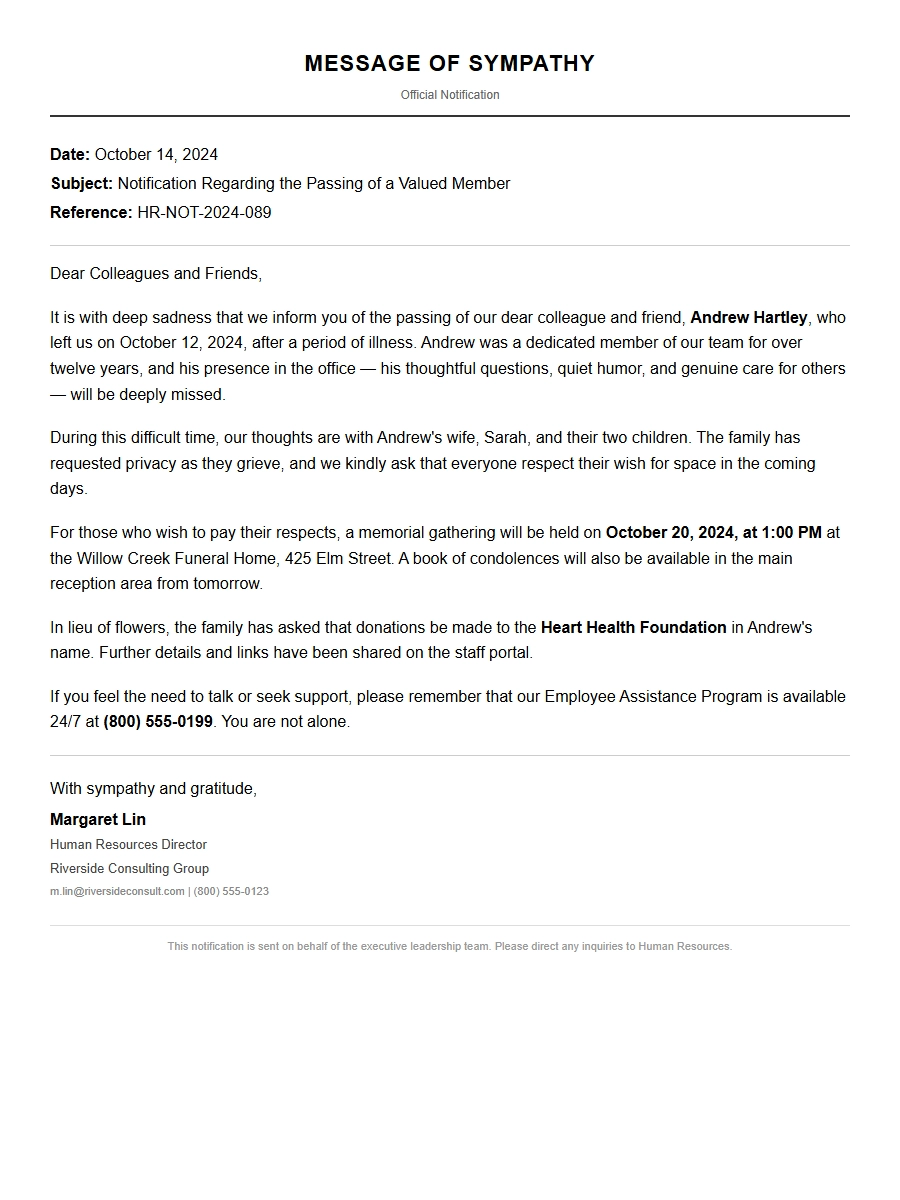
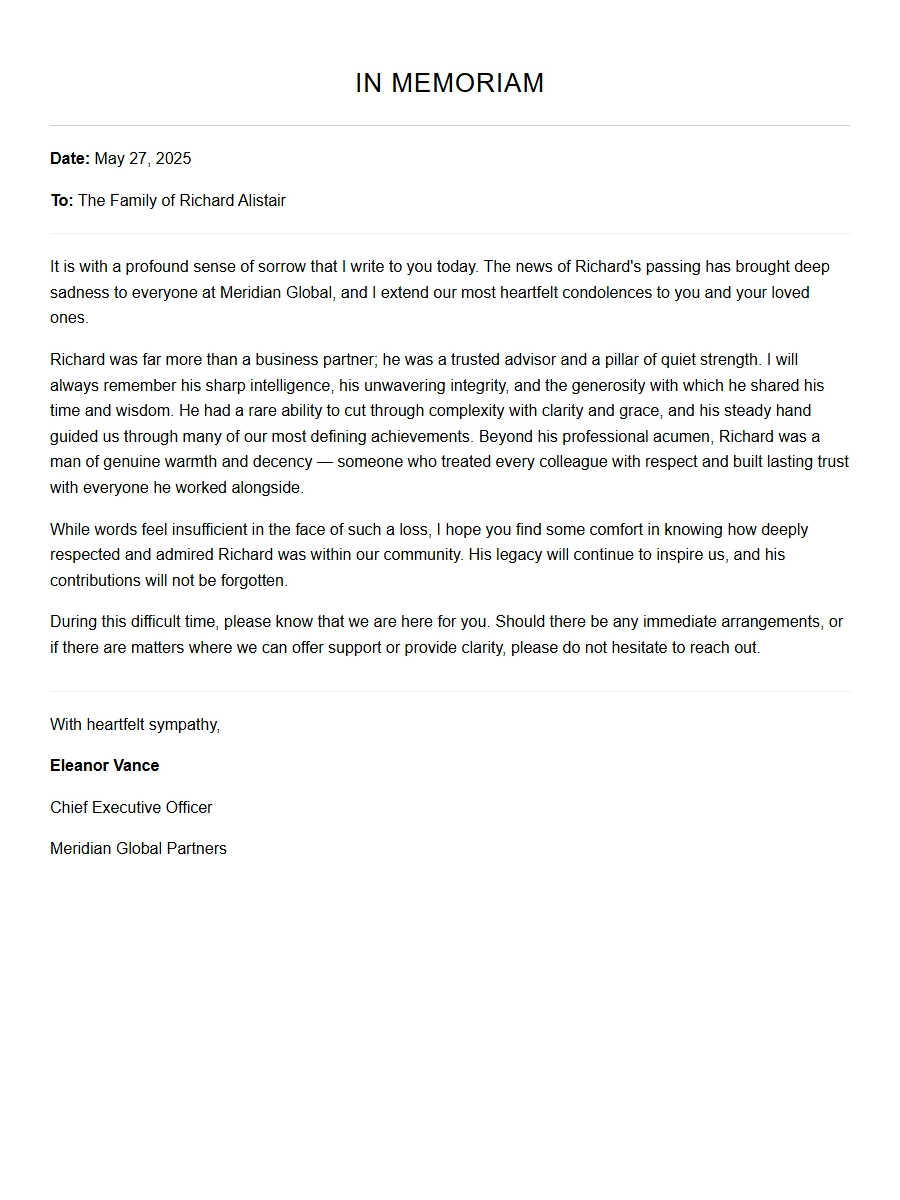 Formal Condolence Message for a Business Partner
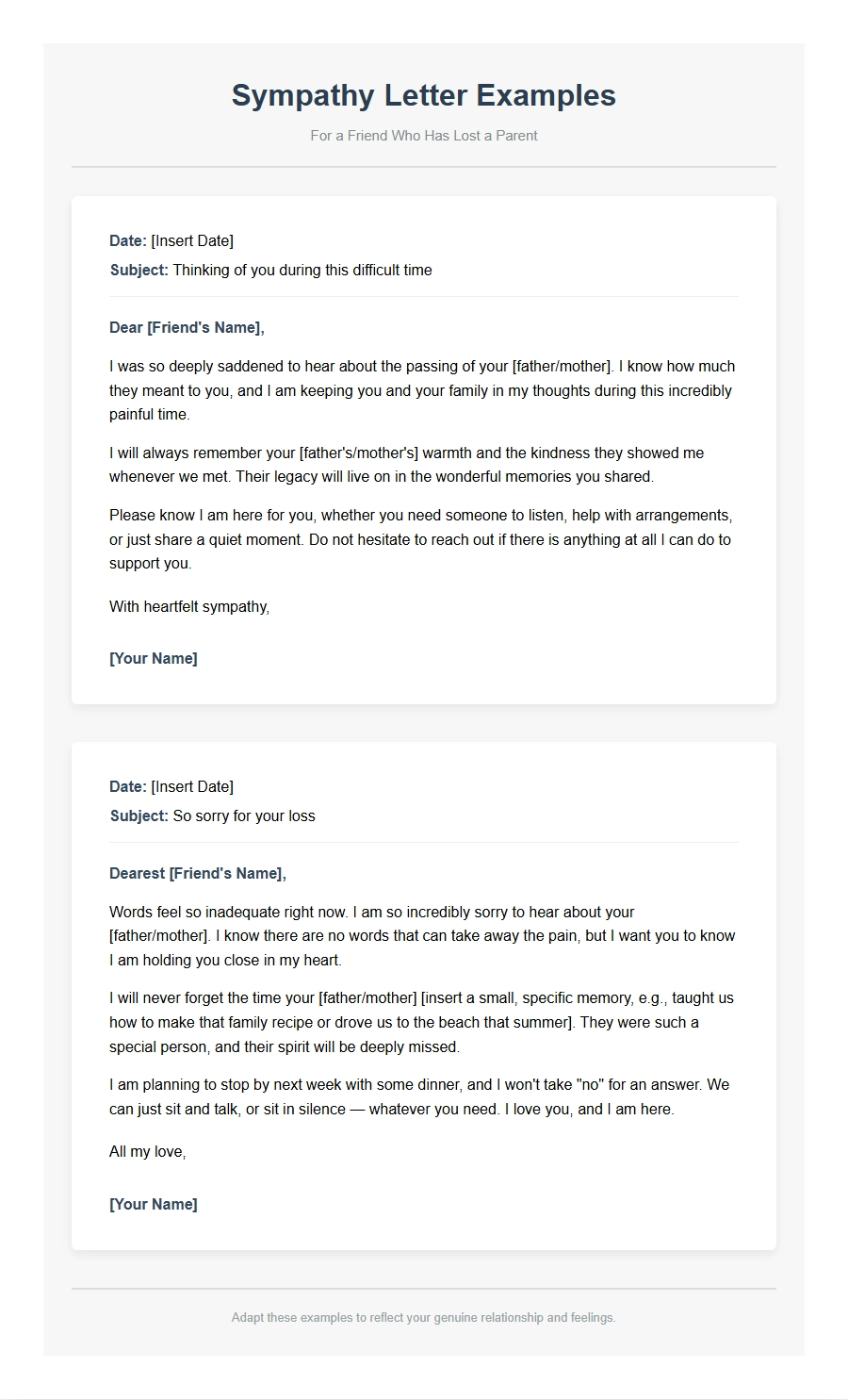 Sympathy Letter Examples for a Friend Who Lost a Parent
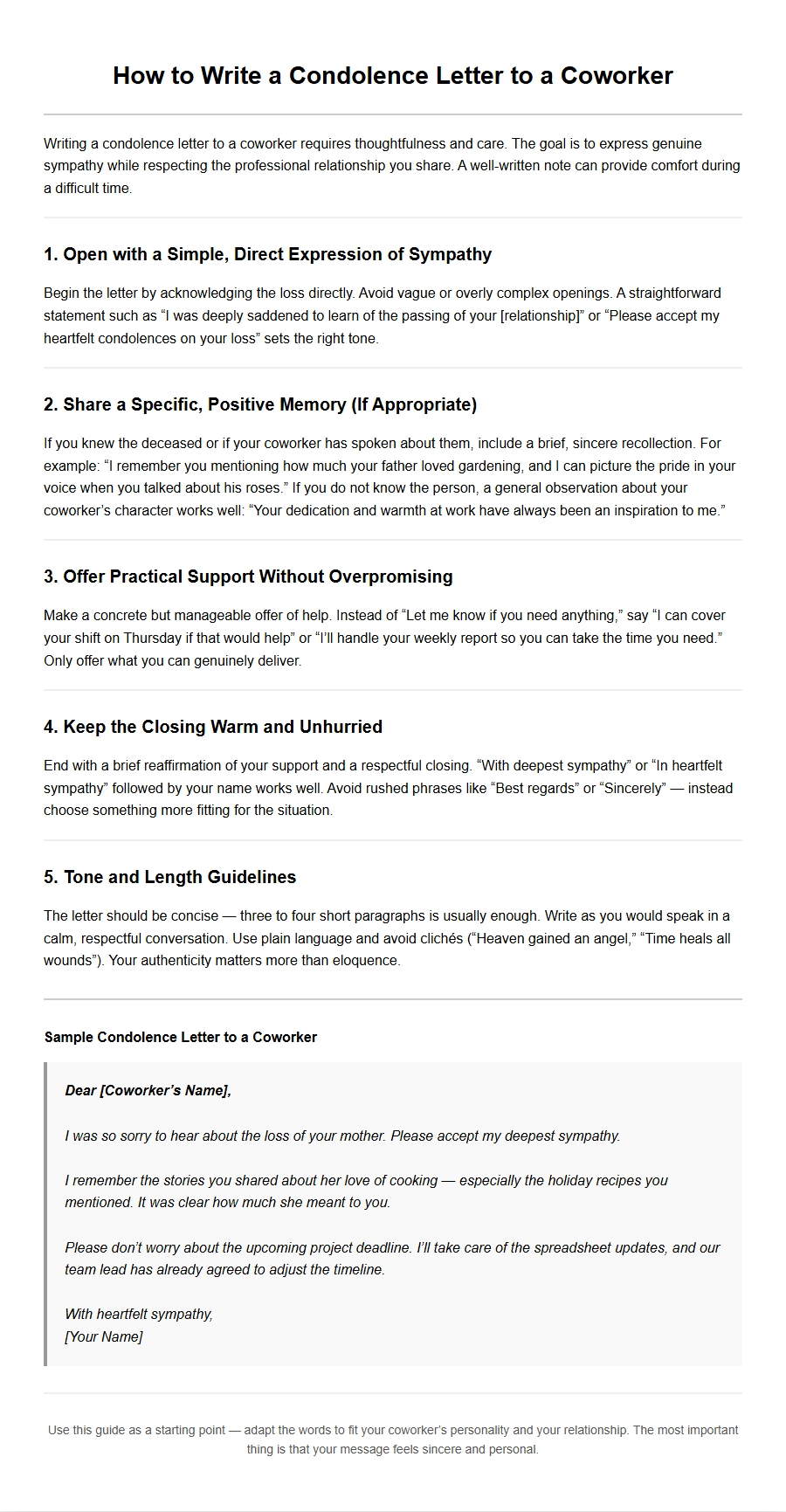 How to Write a Condolence Letter to a Coworker
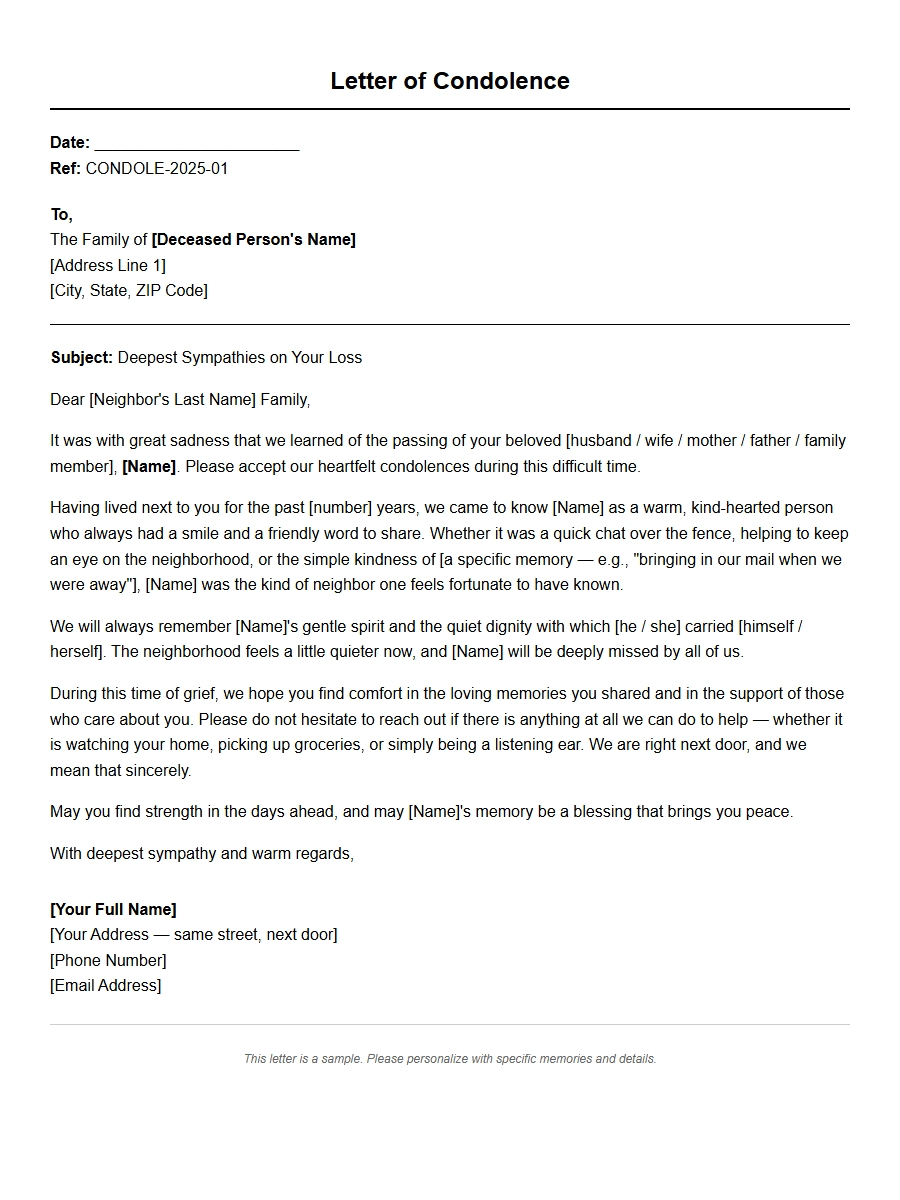 Condolence Letter Sample for a Neighbor
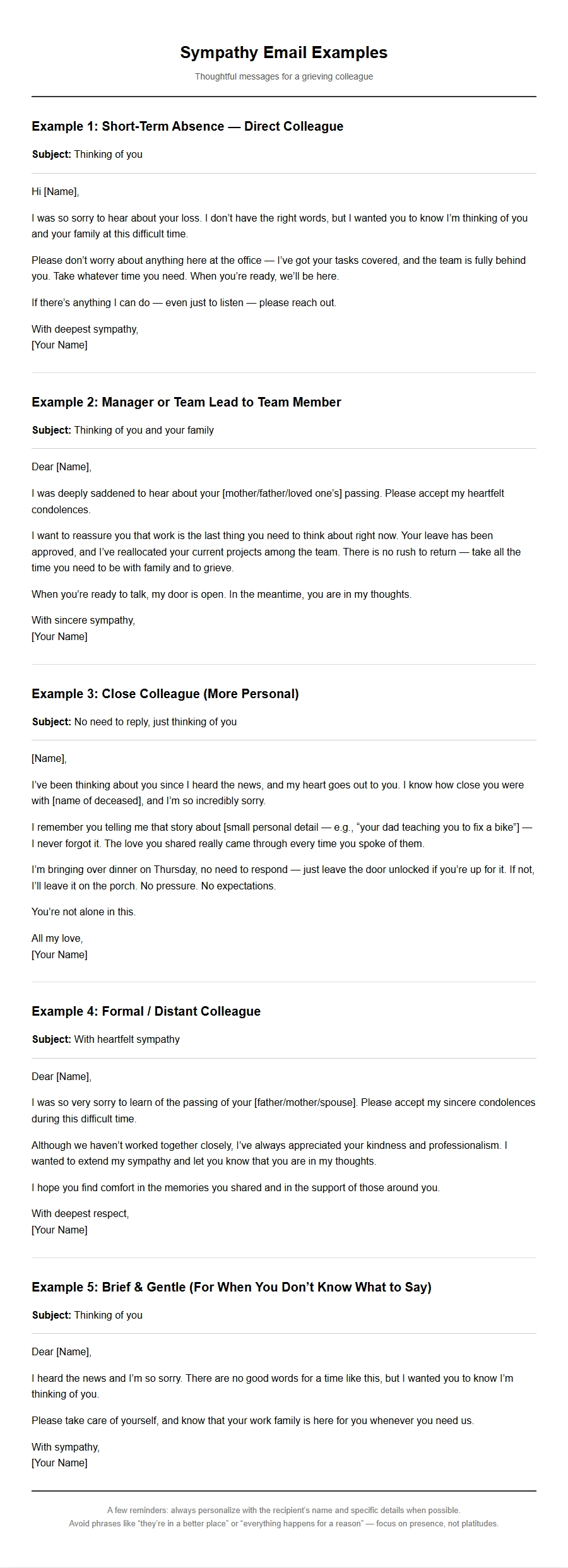 Sympathy Email Examples for a Grieving Colleague
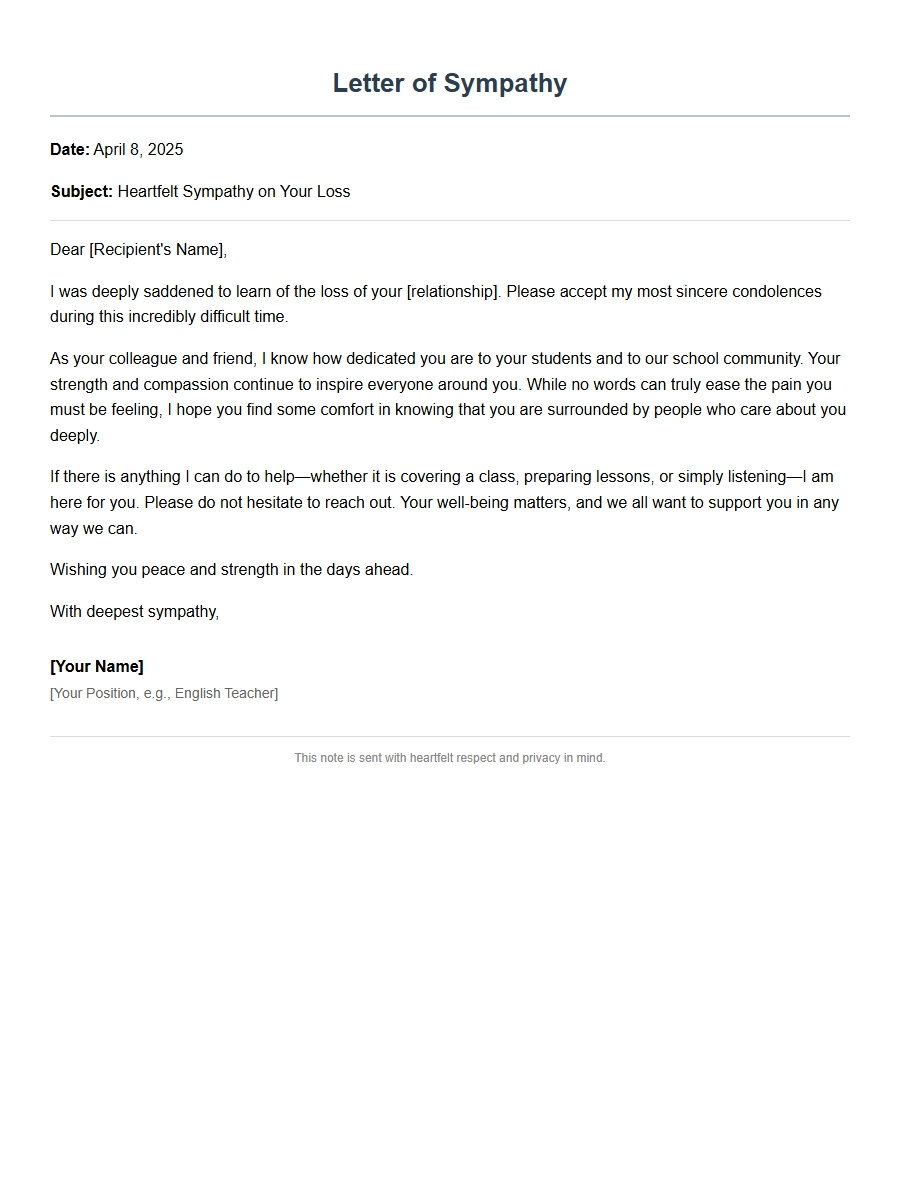 Condolence Words for a Teacher