You’re writing a letter for the family of a fallen service member. The weight of it stops you cold. You want to honor their sacrifice, comfort grieving loved ones, and not say the wrong thing. A well-chosen sample can guide your words, but only you can bring the genuine warmth that makes it real.
Why a sample helps (and isn’t cheating)
Writing from scratch when emotions run high is a recipe for staring at the screen. A letter template gives you a sturdy framework: the right salutation, paragraph flow, and a dignified closing. You skip the guesswork about structure and focus on the one part only you can write—the personal message. Think of a sample as a map, not a script. It respects your time and the gravity of the moment.
Some worry that used a sample feels impersonal. It doesn’t have to. The trick is to treat it like a starting point, not a cage. You adapt the tone, swap vague phrases for specific memories, and let your true voice show through. A sample that feels too stiff? Soften it. Too casual? Pull it back. That’s where the real help lives.
How to choose the right tone for a military condolence letter
The circumstances matter. A letter to a spouse who lost a soldier in combat reads differently than one for a family whose loved one died years after service. General condolences feel hollow. Ask yourself: Did you know the service member personally? Are you writing on behalf of a unit, a community group, or as an individual? Your relationship shapes the formality and the content.
For a formal, official letter (like from a commanding officer), stick to standard business letter format: your address, date, recipient’s name, a formal salutation, and a respectful closing. For a personal note to a family member, letter writing etiquette still applies, but you can skip the formality. Write more like you’d speak in a quiet conversation.
Step-by-step: Adapting a sample without losing your voice
First, read the sample aloud. Get a feel for its rhythm and its gaps. Where does it use generic phrases like “your loss” or “our deepest sympathy”? That’s where you step in. Replace those with something specific: “I’ll never forget the way Sergeant Torres taught me to tie a proper knot in freezing rain.” A concrete memory does more than a hundred perfect sentiments.
Next, adjust the tone in writing. Military communities often value directness and respect. Avoid overly flowery language. Short sentences carry weight. “He was a good soldier and a better friend. I miss him.” That lands harder than five paragraphs of abstractions.
Check the salutation and closing. “Dear Mrs. Garcia” is safe if you aren’t close. “To the family of Specialist Harris” works for collective letters. Close with something grounded: “With respect and gratitude,” or “Thinking of you all.” Avoid “Sincerely,” if it feels too transactional.
Common mistakes that weaken your message
The biggest one? Using outdated salutations like “To Whom It May Concern” in a condolence letter. It screams template. Another trap is ignoring format. A digital letter format (email) needs a clear subject line—“Thinking of you and your family”—and short paragraphs for screen reading. A printed letter benefits from simple letterhead design, even if it’s just your name and address at the top. It shows care.
Don’t overpromise. Avoid “I know how you feel” or “Time heals all wounds.” These phrases unintentionally dismiss grief. Stick to what you know: your own memory, your own respect, your own willingness to sit with their pain.
Proofreading is non-negotiable. A typo in a condolence letter can come across as neglect. Proofreading letter etiquette means reading it aloud, checking the name spelling, and confirming the date and unit details if you mention them. Ask someone else to glance at it if you’re unsure.
When to personalize further
If you’re writing to a family who lost multiple loved ones in the same incident, the grief compounds. The appropriate greetings for bereavement communication in that case need extra gentleness. Acknowledge the enormity without trying to summarize it: “We cannot imagine the weight of your loss. Please know your family remains in our thoughts.”
If you’re coordinating support—asking others to contribute to a fund or cover medical bills—the letter’s goal shifts slightly. You still write with care, but you also need to be clear about the ask. A separate letter template for support requests helps keep the tone respectful and the action clear.
For emails, timing matters. If you’re unsure whether to send a condolence via email or a physical card, err toward the format the family uses most. Email is immediate and allows others to reply. A handwritten note feels more permanent. Both are better than silence.
Your last check before sending
Read the letter once more as if you were the recipient. Does it sound like a real person wrote it? Would it comfort you, even a little? If a sentence feels hollow, cut it. If a memory feels right, keep it. Samples give you structure. You give it heart.
The next time you sit down to write, it’ll come faster. That first draft still feels heavy, but you know the path now. You start with empathy, use the sample as your scaffold, and fill the gaps with your own honest voice. That’s how a good letter becomes a meaningful one.
Practical Writing Samples
Condolence Letter for a Fallen Service Member
Commanding Officer’s Formal Condolence Letter
Subject: Deepest Sympathies for the Loss of Sergeant First Class Michael Torres
Date: October 15, 2024
To: Mrs. Elena Torres and Family
On behalf of the soldiers and officers of the 3rd Battalion, 187th Infantry Regiment, I extend our most heartfelt condolences on the death of your beloved husband and father, Sergeant First Class Michael Torres. He made the ultimate sacrifice while serving our nation in Afghanistan on October 7, 2024.
Sergeant Torres was an exemplary NCO whose courage and dedication inspired all who served with him. His leadership during Operation Enduring Freedom was nothing short of heroic. Below are the honors he received:
Bronze Star Medal with Valor
Purple Heart
Army Commendation Medal (3 awards)
Combat Infantryman Badge
We will forever remember his selfless service and the warmth he brought to our unit. A memorial ceremony will be held at Fort Campbell on October 30. Our Family Readiness Group stands ready to assist you. Please accept our deepest sympathy and gratitude for your family’s sacrifice.
With profound respect, Col. James H. Reeves Commanding Officer, 3/187th Infantry
Fellow Soldier’s Personal Letter to Family
Dear Mrs. Davis,
I was a squadmate of your son, Private First Class Kevin Davis, in Bravo Company. When I heard about his death, my heart broke. Kevin was more than a soldier—he was a brother. I’ll never forget the way he could make everyone laugh during the hardest days.
He told me so many stories about you, especially how you sent him care packages every month. He shared the cookies with the whole squad. In his last letter home (which I helped him mail), he wrote, “Tell Mom I’m okay. I’ll see her soon.”
I want you to know he died doing what he believed in. We were on patrol near Kandahar. He took the lead and shielded two other guys when the IED went off. His bravery saved their lives. The Army will give you the official report, but I wanted you to hear it from someone who was there.
If you ever want to talk, please call me. I’m stationed at Fort Bragg, but I can get leave. You are not alone.
With love, Sgt. Marcus Lee (910) 555‑0142
Military Chaplain’s Condolence Note
Grace and peace to you, family of Captain Laura Jenkins,
I write to you as the chaplain who served alongside your daughter at Joint Base Lewis‑McChord. Though words cannot fully comfort such a loss, I want to assure you that Captain Jenkins passed with faith and honor. She was a woman of deep conviction—she often asked me to pray with the unit before missions.
On November 5, 2024, during a humanitarian mission in the Philippines, her helicopter crashed. She was providing aid to earthquake victims. Her final act was to help a child evacuate the wreckage.
Please know that the chapel is open to you, always. I have included a list of resources that might help:
Resource
Contact
Survivor Outreach Services
1‑877‑272‑4472
Military OneSource
1‑800‑342‑9647
Chaplain (Maj.) David Kim
(253) 555‑0199
May the God of all comfort wrap you in His peace. You are in my prayers.
With deepest sympathy, Chaplain (Lt. Col.) Rebecca Torres
Veteran Family Friend’s Message of Support
Dear Johnson Family,
I am Frank’s old buddy from the Navy, but more importantly, I’ve been your neighbor for twenty years. When Sarah told me that Petty Officer Frank Johnson was killed in a training accident, I felt like I lost a brother.
Frank was the kind of guy who’d help you fix your car at midnight. He loved this country, but he loved his family more. I remember him saying, “My wife and kids are my real mission.”
I know the military will give you many honors, but let me offer something practical. Please find below some tasks my wife and I can handle immediately, so you can focus on grieving:
Mow your lawn every Saturday until further notice
Drive the kids to school on Mondays and Wednesdays
Prepare meals for two weeks (just tell us dietary restrictions)
You don’t have to respond. Just accept. We walk this road together.
With all my heart, Tom Stewart USN (Ret.)
Gold Star Family Letter to New Gold Star Family
To the family of Specialist Daniel O’Reilly,
I am a Gold Star mother. My son, Lance Corporal Ryan Moore, died in Iraq in 2018. When I heard about Daniel, I cried. I know you don’t know me, but I want to reach across that invisible bridge that only we walk.
I have collected a few things that helped me in the early weeks:
Item
Why it helped
Talking with a military grief counselor
They understand the unique pain of service loss.
Writing a letter to my son every day
It kept our conversation alive.
Joining a Gold Star support group
I found friends who never say “move on.”
I also want you to know that your hero’s name will be on the Wall. Volunteers polish it before Memorial Day. If you ever want to go to Washington together, my husband and I will take you. You are not alone.
With love and solidarity, Marilyn Moore Gold Star Mother
Condolence Note to Spouse from a Civilian Colleague
Dear Laura,
I was shocked and deeply saddened to learn about the death of your husband, Gunnery Sergeant Mark Rodriguez. I work in HR at the company where you used to be my assistant. Though we haven’t worked together in two years, I’ll never forget the day Mark came to pick you up after the office holiday party. He was so proud of you.
I cannot pretend to understand military life, but I can help with things here at home. Please let me know if any of the following would ease your burden:
I can arrange a meal train through our former coworkers.
I know a lawyer who handles survivor benefits pro bono.
I’ll take care of your pets while you travel for the funeral.
I am also enclosing a small check from a collection we took up at the office. No amount can fill the void, but we want you to feel supported. You and the boys are in my constant thoughts.
With deepest sympathy, Angela Perkins
Letter from a Battle Buddy to the Deceased’s Children
To Emily and Jake,
I know you’re hurting. I hurt too. Your dad, Staff Sergeant Paul Benson, was my battle buddy for three years. He talked about you all the time. He kept a picture of you two in his helmet liner.
I want to tell you something your dad did last month. During a field exercise, he found a hurt puppy. He carried it for three miles to get it medical care. That’s who he was—fierce in battle, gentle in life.
Your dad also made me promise that if anything happened, I’d teach you two things:
How to throw a perfect spiral (he said you’d both be football stars).
How to tell a joke that makes everyone groan.
I’m coming home for the funeral. I’ll bring my old jersey for you, and a book of dad jokes for Jake. I will always be your Uncle Mike. Call me anytime, day or night.
With all my love, Michael “Mike” Chen Former SGT, US Army
Community Leader’s Official Condolence to the Family
City of Oakwood, Office of the Mayor
Date: December 2, 2024
To: The Family of Private First Class Jasmine Rivera
On behalf of the citizens of Oakwood, I extend our deepest condolences for the loss of your daughter, Private First Class Jasmine Rivera, who died in a non‑combat incident while serving at Fort Hood. Jasmine was a proud Oakwood High graduate and a beloved member of our community.
In honor of her service, the City Council has approved the following:
Action
Date
Flying flags at half‑staff
Dec 2–5
Naming the community park baseball field “Rivera Field”
Spring 2025
Establishing a scholarship at Oakwood High in her name
2025–2026 school year
We invite you to a public memorial service on December 10 at the Oakwood Veterans Memorial. Please know that your family’s sacrifice will never be forgotten by this city.
With gratitude and sorrow, Mayor Cynthia Blake City of Oakwood
Official Unit Condolence with Military Honors Details
From: Headquarters, 2nd Marine Raider Battalion Subject: Condolences for the Death of Gunnery Sergeant Thomas “Tommy” Harris
It is with profound sadness that we inform you of the death of Gunnery Sergeant Thomas Harris, who was killed in action during a counter‑terrorism operation in Syria on January 12, 2025. He was a Raider through and through.
As you prepare for the funeral, we want to provide you with the honors that will be rendered:
Full military funeral honors: flag detail, rifle volley, taps
Presentation of the Purple Heart and Bronze Star to the next of kin
An escort from our unit, including eight pallbearers
We have also compiled a list of points of contact to help coordinate travel, lodging, and benefits:
Function
Contact
Phone
Funeral logistics (Casualty Assistance Officer)
Capt. Luke Andrews
910‑555‑0234
Financial & benefits (JAG)
Lt. Sarah Miller
910‑555‑0789
Emotional support (Chaplain)
Lt. Cmdr. James Park
910‑555‑0012
We will never forget Tommy’s courage. His legacy lives in every Raider who follows. Please accept our deepest sympathies.
Semper Fidelis, Col. Maria Torres Commanding Officer, 2nd MARDIV Raider Battalion
Letter from a Gold Star Child to the Deceased’s Parents
Dear Mr. and Mrs. Kowalski,
My name is Alex, and I’m 24. Seven years ago, my own father, a Marine, was killed in Afghanistan. When I read about the death of your son, Lance Corporal Derek Kowalski, I felt like I saw my own story mirrored. I wanted to reach out to you, not as a stranger, but as someone who knows the road ahead.
I remember the first year—the visits from casualty officers, the folded flag, the letters that never stopped. It was hard, but I want to share some things that helped me:
Keep a journal: I wrote to my dad every night. It helped me process the rage and the missing.
Find a peer group: I met other Gold Star kids through Tragedy Assistance Program for Survivors (TAPS). We understood each other.
Honor his memory actively: I started a small scholarship in his name at our local high school.
If you ever want to talk, I am here. I can send you a TAPS contact list or just listen. You raised a hero. He will never be forgotten.
With deepest respect and shared sorrow, Alex Nguyen
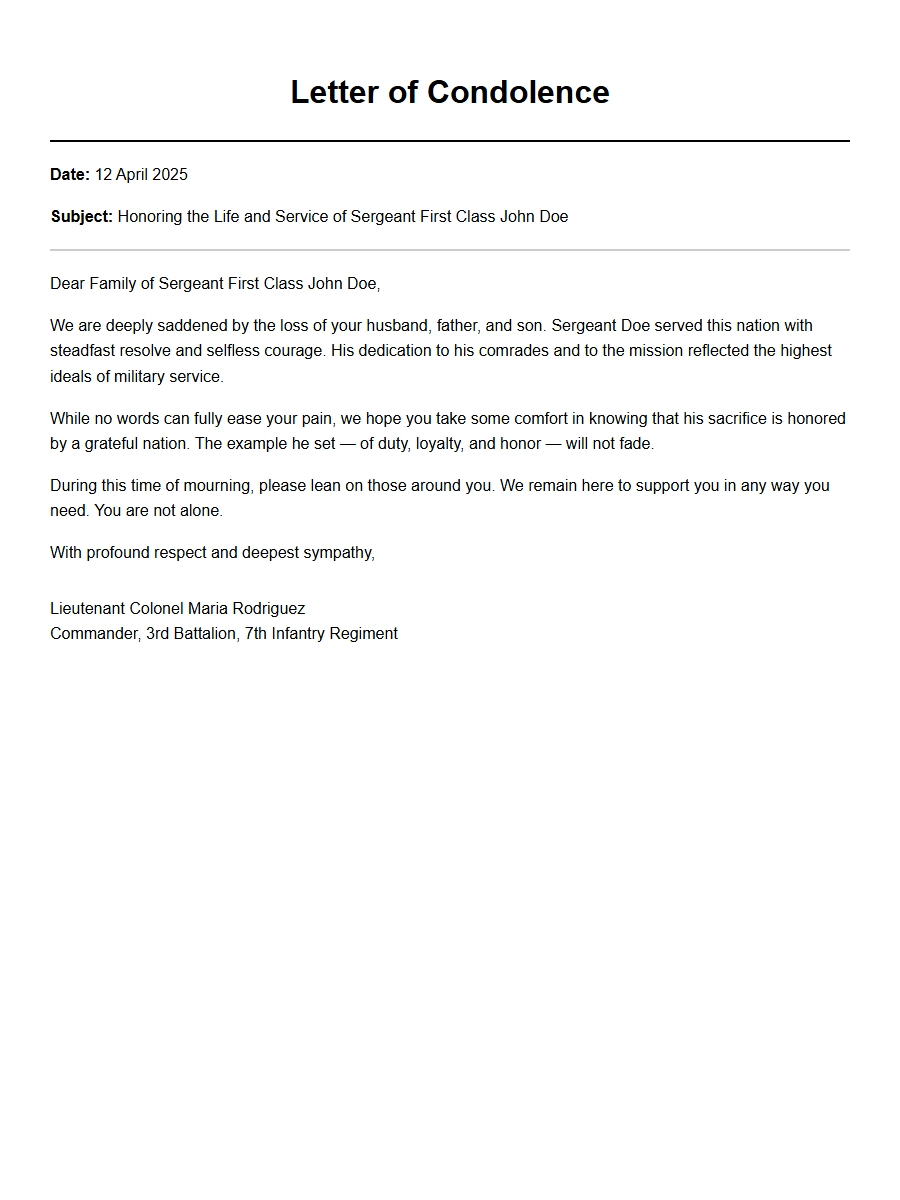
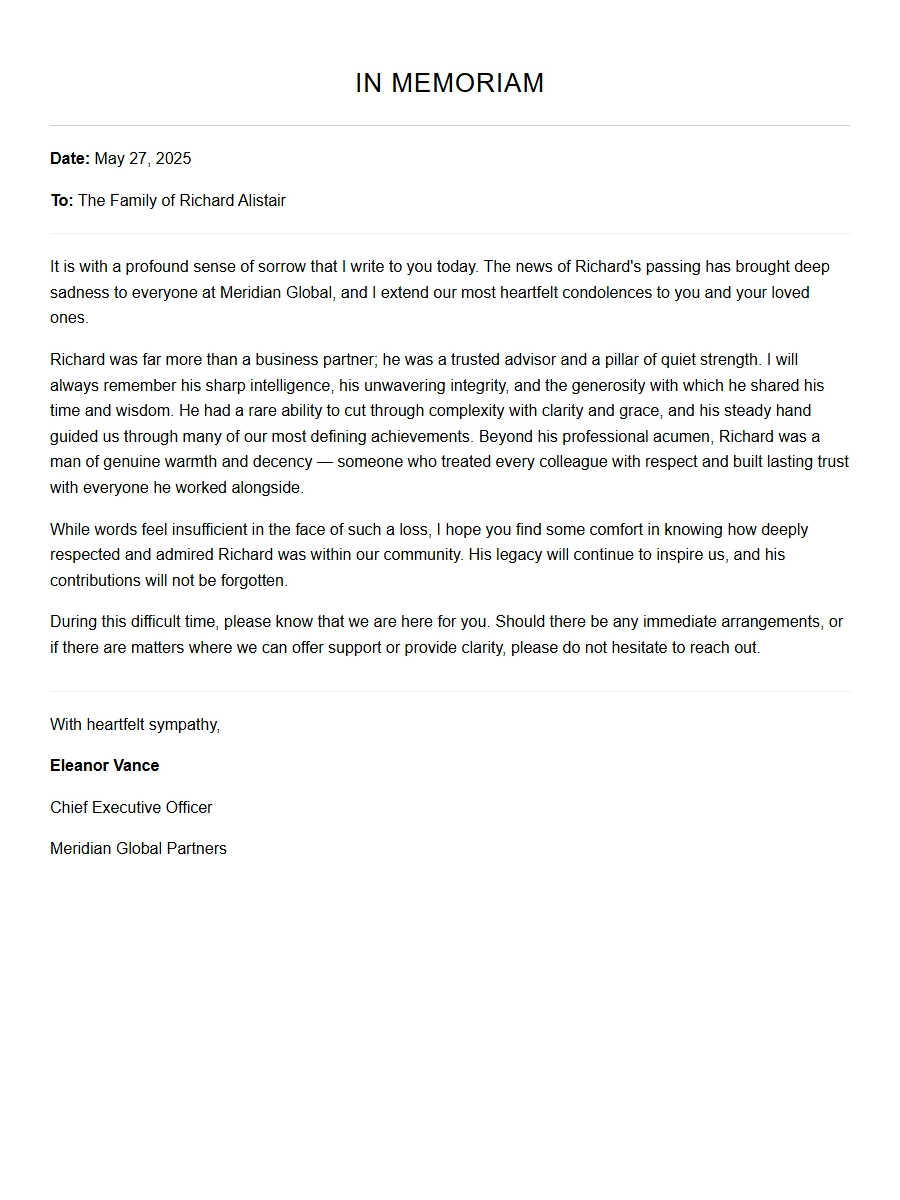 Formal Condolence Message for a Business Partner
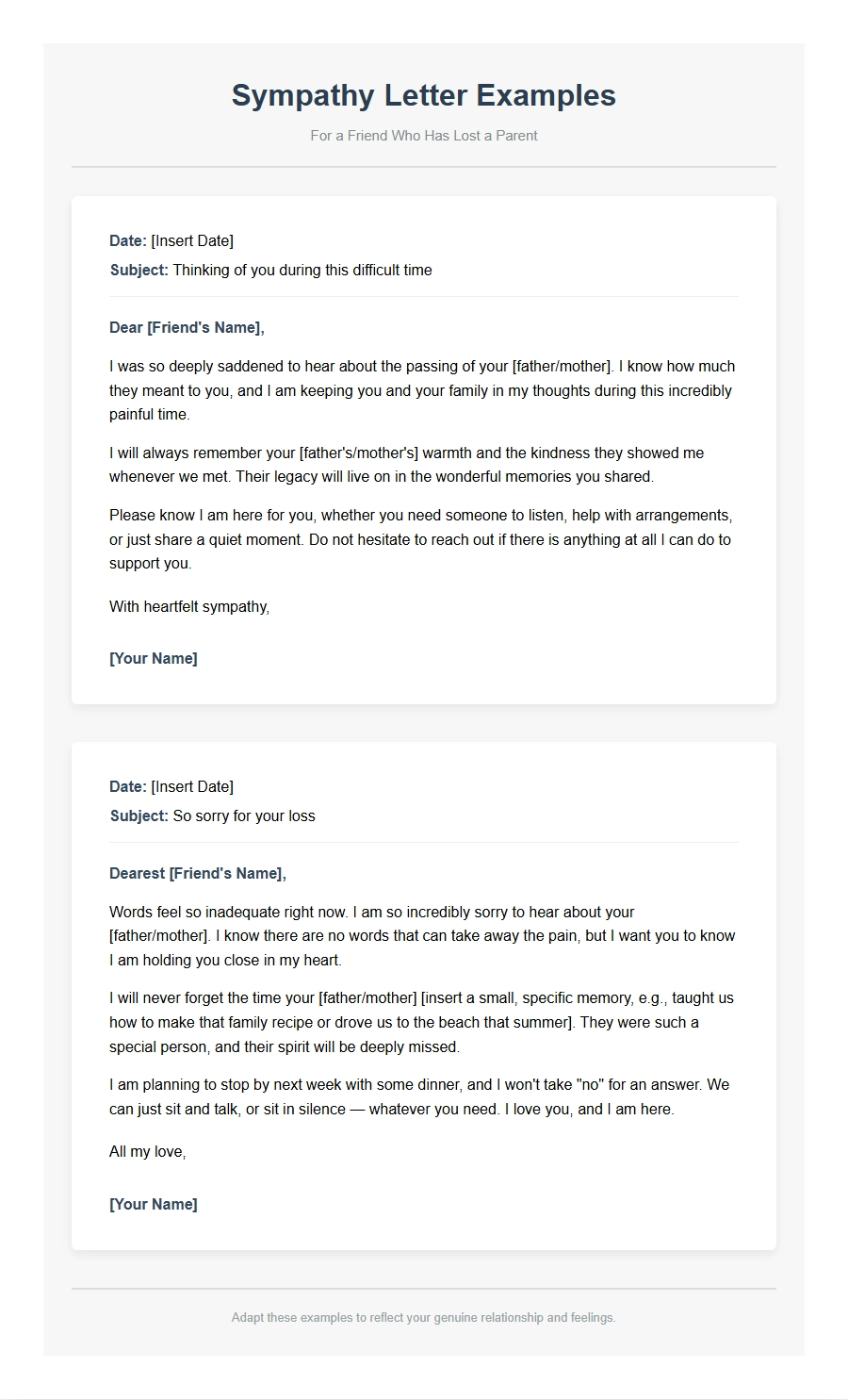 Sympathy Letter Examples for a Friend Who Lost a Parent
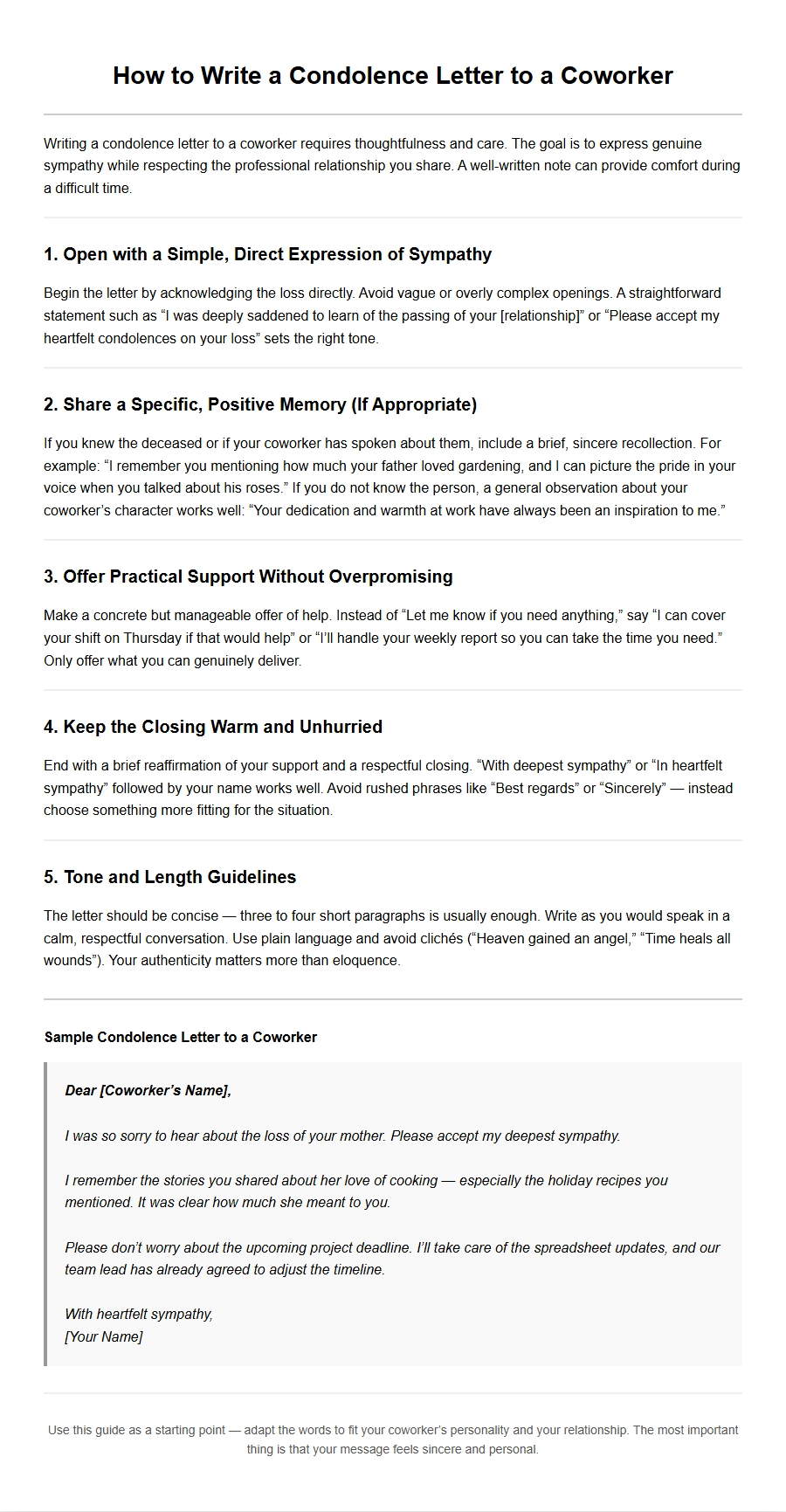 How to Write a Condolence Letter to a Coworker
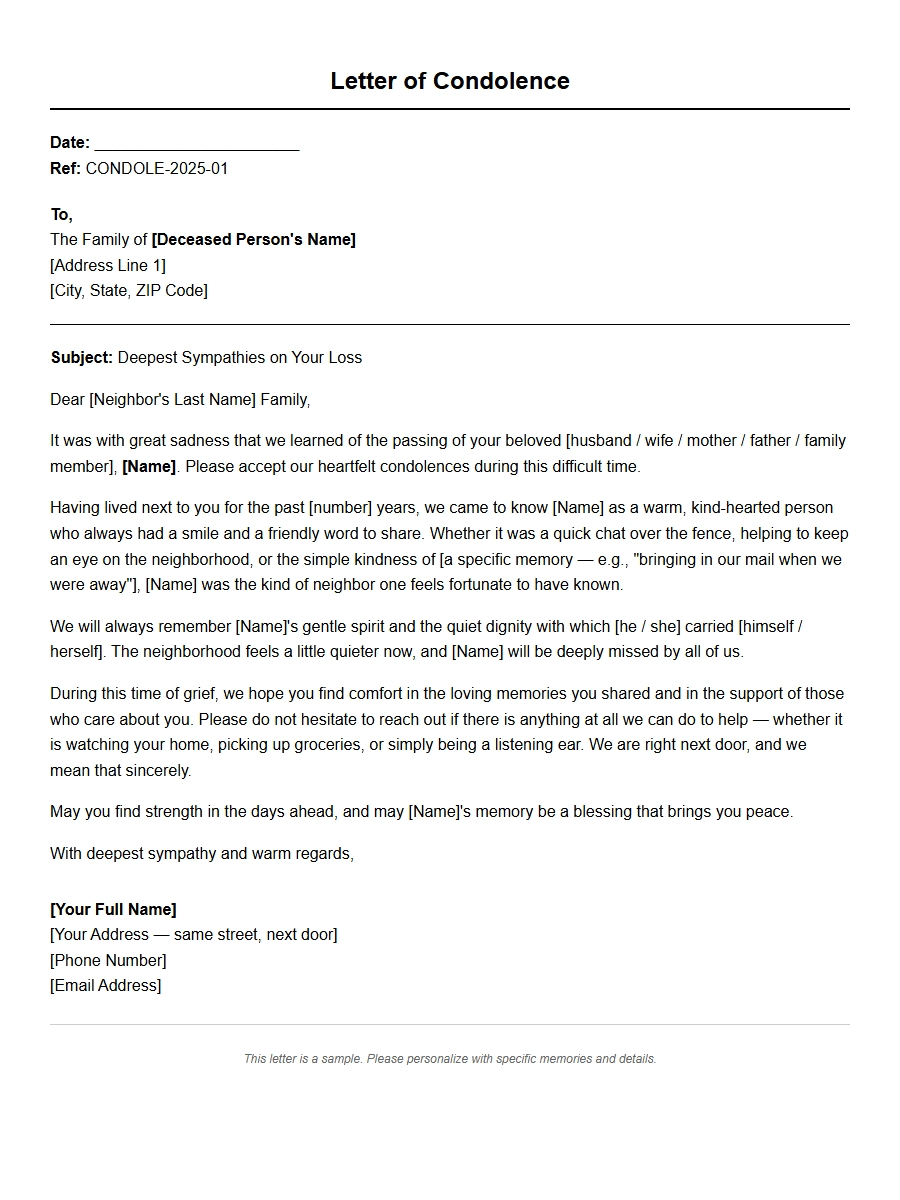 Condolence Letter Sample for a Neighbor
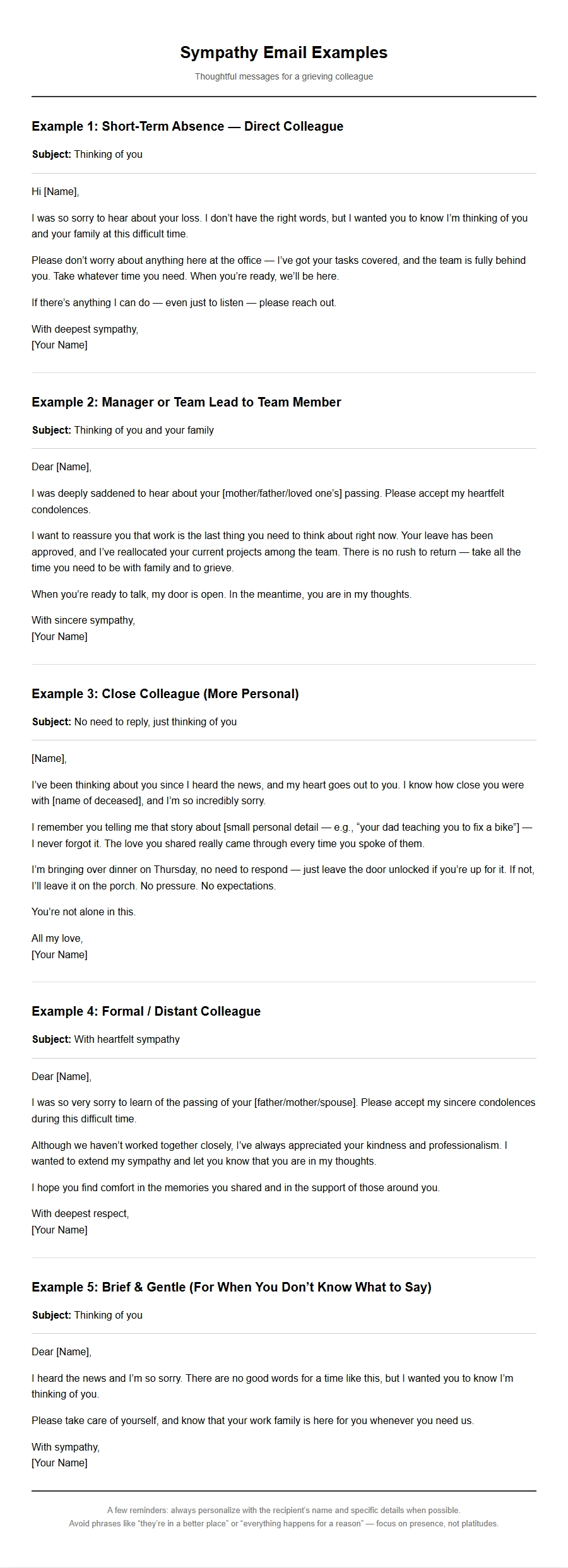 Sympathy Email Examples for a Grieving Colleague
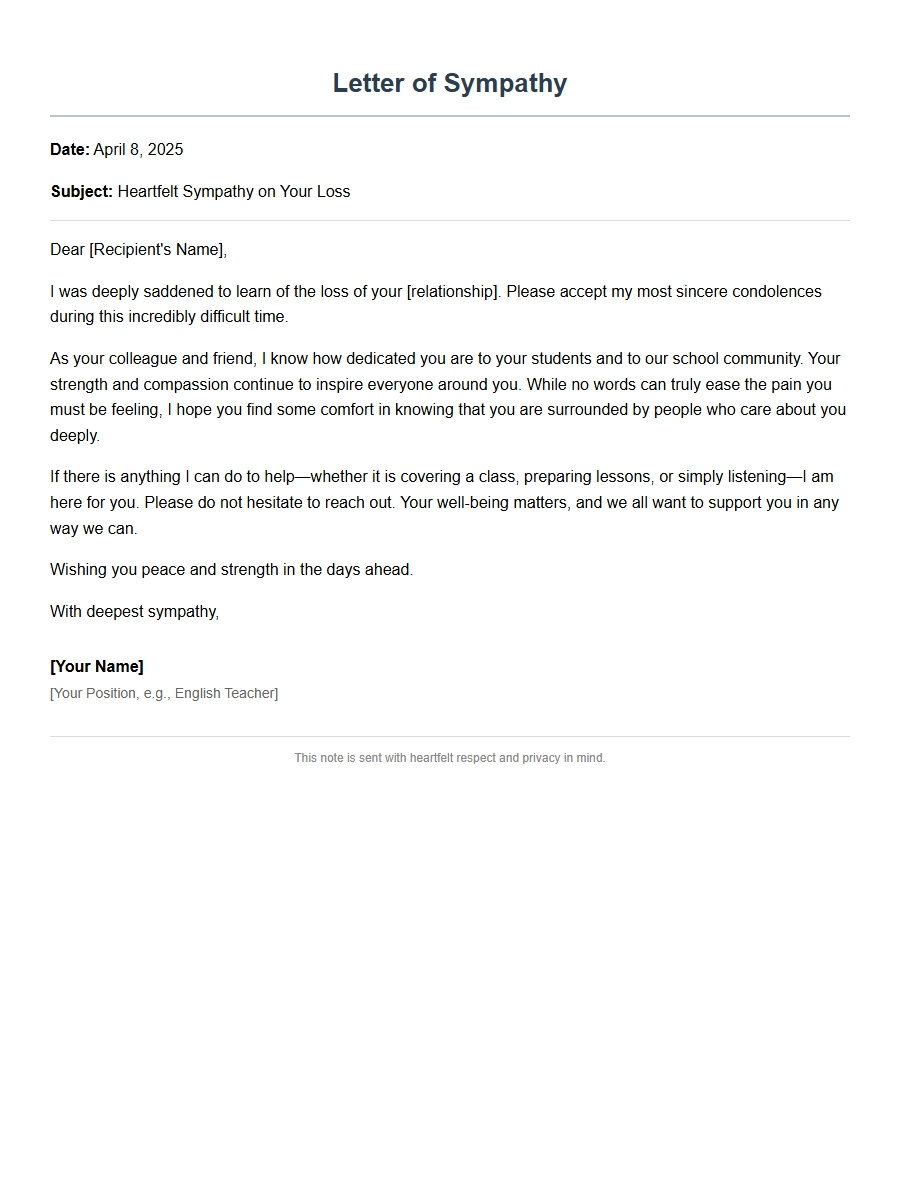 Condolence Words for a Teacher