Writing a condolence letter is hard. Writing one when the world is singing "Joy to the World" feels almost impossible. You want to reach out, but you're terrified of saying the wrong thing or adding to the burden. If you're staring at a blank page this holiday season, take a breath. You don't need to be a poet. You just need to show up.
A genuine condolence message for loss during holidays isn't about finding magic words to fix the grief. It's about offering quiet company in the sadness. That's why using a letter template isn't cold—it's smart. It gives you the professional correspondence skeleton, like the proper salutation and closing, so your brain can focus entirely on the personal part: the memory, the warmth, the specific way you care.
What makes a holiday condolence note different?
The main challenge here is tone in writing. You have to acknowledge the season without minimizing the loss. Ever received a card that felt too cheerful for the circumstances? It stings. Avoid phrases like "Merry Christmas! I know your dad would want you to be happy." Instead, try something quieter: "I'm thinking of you especially hard this season. I know the lights and carols must feel strange right now. I just wanted you to know I'm holding space for you." A good letter structure keeps you from accidentally falling back on awkward holiday clichés.
Choosing the right approach for your situation
Not all grief is the same, and not all relationships are either. The best customizable letter depends on who you're writing to.
If it's a colleague or a client, stick to a clear business letter format with a formal tone condolence letter for business. Acknowledge the loss professionally, offer practical support (like covering a shift or project), and keep the sentiment genuine but reserved.
If it's a close friend, you have more room. A personal touch sympathy letter for a close friend lets you mention specific, warm memories. When the loss follows a long illness, the specific phrasing found in a message for a family dealing with a cancer diagnosis can offer the right level of compassion. For very specific grief, like a parent or child, check a letter sample for a bereaved mother or daughter or a message example for loss of a father to get the tone just right.
Practical steps to write it without losing your voice
Okay, you have a sample. Now, how do you make it sound like you? Just like you wouldn't copy a cover letter example without tailoring it to the job, or use a resignation letter sample without adjusting the details, don't copy a condolence letter word-for-word.
Start with a simple structure:
The opening: Acknowledge the loss and the difficult timing. ("I was so saddened to hear about your mother.")
The memory: A specific, quiet observation. ("I always loved how she made everyone feel welcome. I know this table will feel emptier.")
The support: Offer something concrete. Instead of "Let me know if you need anything," try "I'd love to drop off dinner on Tuesday. Does that work?"
Close with warmth. "With deep sympathy" or "Thinking of you" are classic letter writing etiquette closings that never fail.
Common mistakes to avoid
The biggest trap during the holidays is forced cheer. Avoid "Everything happens for a reason" or "They're in a better place." Just sit in the sadness with them. Tone in writing is about restraint, not fixing.
Another mistake is ignoring the format. If you're sending an email, use a clear digital letter format with a simple subject line like "Thinking of you." If it's a printed card, take the time for neat handwriting. Adding a clean letterhead design on a printed note adds a layer of respect, but isn't necessary for most personal notes.
Proofreading for heart
Before you hit send or seal the envelope, read it out loud. Proofreading letter for tone is crucial here. If a sentence sounds like a generic greeting card, rewrite it. The recipient needs to feel you in the words, not a Hallmark robot. Does it sound natural? Does it sound like something you'd say if they were sitting across from you?
A sample gives you the skeleton. Your heart fills in the rest. This is a hard letter to write, but it's one of the most meaningful you'll ever send. Use the structure, trust your instincts, and know that your quiet presence—even in a few written lines—is a gift in a season that desperately needs it.
Writing Examples
Condolence Message for a Loss During the Holidays
Loss of a Parent at Christmas
Dear [Family Name],
We were deeply saddened to hear of your mother's passing during this Christmas season. The holidays are a time for family and togetherness, and losing a beloved parent at this time makes the pain even sharper. May the cherished memories of her warmth, laughter, and love bring you comfort in the days ahead.
We are holding a small gathering on December 26th at our home to share stories and light a candle in her memory. You are welcome to join us anytime.
Should you need assistance with meals or errands during this busy holiday week, please reach out:
Meal drop-off: Tuesday & Thursday, 5 PM
Grocery shopping: Contact us by 10 AM
Holiday meal delivery: Sign up via the link in our card
Our hearts are with you, and we hold you close in our thoughts and prayers.
Loss of a Spouse at New Year
Dear [Name],
Words cannot express how sorry we are to learn of your husband's passing as the new year begins. The ringing in of the new year must feel so hollow without him by your side. We remember how he used to laugh at our silly resolutions and always cheered for your dreams.
We would like to join you for a quiet New Year's Day brunch to honor his memory. Please let us know if you would like company.
For practical support during this season, here is a list of contacts and times:
Service
Contact
Hours
Grief support hotline
(555) 123-4567
24/7
Meal delivery
[Name], (555) 987-6543
11 AM – 7 PM
Childcare help
[Name], (555) 246-8101
By request
May you find moments of peace amidst the tears, and may his love carry you into the new year.
Loss of a Child During Hanukkah
Dear [Names],
Our hearts break with yours at the loss of your dear son during this Hanukkah season. The festival of lights feels dim without his bright smile and the light he brought into our lives. We hold your family close in our prayers during these eight nights of remembrance.
We will be lighting an extra candle on the fifth night of Hanukkah in his honor. If you wish, we can set aside a moment to share a story or sing a song he loved.
We have also prepared a small list of ways we can support your family over the holiday break:
Take the other children to the park for an hour while you rest
Drop off homemade latkes and applesauce on Friday evening
Drive your family to synagogue services if needed
Please know that you are not alone. We love you and are here for you in sorrow and in hope.
Loss of a Sibling at Thanksgiving
Dear [Name],
We were devastated to learn that your sister passed away just before Thanksgiving. This holiday of gratitude and gathering now carries a profound absence. We remember her so vividly — her laugh, her kindness, and the way she brought everyone together.
We have set aside Thursday, November 24 from 2 to 4 PM at our home for a quiet remembrance gathering. Please come if you feel up to it. No need to bring anything.
To ease the holiday burden, we offer these small gestures:
A cooked turkey and sides delivered to your door on Wednesday
Help setting up or cleaning up your own Thanksgiving meal
An ear to listen, any hour of the day or night
We are grateful for the time we had with her, and we are grateful for you. With deepest sympathy,
Loss of a Friend During Holiday Parties
Dear [Name],
I was so sorry to hear about the passing of our dear friend [Friend's Name] during this season of parties and celebrations. Amidst the joy, it feels so strange to grieve. I treasure the memories of the holiday parties she hosted — how she made sure everyone had a full glass and a warm laugh.
I am putting together a memory scrapbook for her family over the next two weeks. If you have any photos or notes you'd like to contribute, please let me know.
For those of us who want to support each other, here is a schedule for informal coffee meetups:
Date
Time
Location
December 18
10:30 AM
The Corner Café
December 22
3:00 PM
Lakeside Park (weather permitting)
December 26
7:00 PM
Virtual gathering (link to follow)
You are in my heart as we navigate this heavy holiday season. With love,
Bereavement During Kwanzaa
Dear [Name],
I was deeply saddened to hear of your grandmother's passing during Kwanzaa. As we celebrate the seven principles, her life embodied Umoja (unity) and Kujichagulia (self-determination). She was a pillar of wisdom and warmth. This Kwanzaa, her absence will be felt in every lighting of the kinara.
We are planning a virtual gathering on the third day of Kwanzaa (December 28) from 6 to 7 PM to share memories and light a candle in her honor. Please join us.
To help you during this time, here are some community offers:
Childcare for younger ones during the Kwanzaa feast preparation
Someone to help you set up your Kwanzaa table and decorations
May the lights of the seven candles guide you through this dark time. With heartfelt sympathy,
Loss of a Colleague During Year-End
Dear Team,
It is with heavy hearts that we share the news of our colleague [Name]'s passing during this holiday season. [He/She] was a beloved part of our team, always bringing energy and kindness to the office. The year-end celebrations feel muted without [him/her].
The company will hold a moment of silence and remembrance on the last working day (December 22) at 3 PM in the main conference room. All are welcome to attend.
We have arranged the following to support the family:
Item
Details
Condolence card
Please sign in HR by Dec 20
Family meal fund
Contribute via payroll link
Informal gathering
Friday, Dec 23, 6 PM at [Venue]
For any grief resources, our Employee Assistance Program is available 24/7 at (800) 555-0199. Let us support each other through this difficult time.
Pet Loss During the Holidays
Dear [Name],
We are so sorry to hear that your beloved dog [Pet's Name] passed away right before Christmas. Pets are family, and the empty spot by the fireplace and the missing jingle of his collar make the holidays feel incomplete. We know how much comfort he brought you all year round.
We want to create a small memory corner in our home over the next week. If you have a favorite photo or a toy of his, we would be honored to display it and light a candle.
For some practical care during this grief, here are a few things we can do:
Take your other animals for a walk so you can rest
Drop off a warm meal or hot cocoa this evening
Help you pack away his things if you're not ready to do it alone
You are not alone. The love you gave him will stay with you always, even through these chilly holiday days.
Funeral Delayed Due to the Holidays
Dear [Name],
I was so sorry to hear of your father's passing during this busy holiday season. I know the funeral has been postponed until after the New Year, which must add an extra layer of waiting grief. Please know that we are here to support you through this untimely stretch.
We have reserved Sunday, January 8 at 2 PM at the community center for an informal gathering to share memories, regardless of the official service date. You are welcome to come and simply be with us.
Until then, here is a list of practical help we can offer during the holiday week:
Accompaniment to the funeral home for arrangements if needed
Meals delivered on Dec 24, 25, and Jan 1
Childcare or pet sitting for a few hours
We carry your family in our hearts even as the calendar fills with festivities. With deepest sympathy,
Neighbor's Loss During the Holidays
Dear [Neighbor's Name],
We were so sorry to learn about the passing of your uncle during this holiday season. As neighbors, we have always appreciated the kindness your family shows, and this loss must feel especially heavy while the rest of the world is celebrating.
We are preparing a holiday meal and care package to drop off on the evening of December 20. No need to be home — we will leave it on your porch.
Our community has organized the following neighborly support:
Offer
Available Times
Snow shoveling / walkway clearing
Any morning after snowfall
Errands (grocery, pharmacy)
Daily 10 AM – 6 PM
Quiet company for tea or a walk
By arrangement
Please feel free to call or knock on our door anytime. Wishing you moments of peace amidst the sadness.
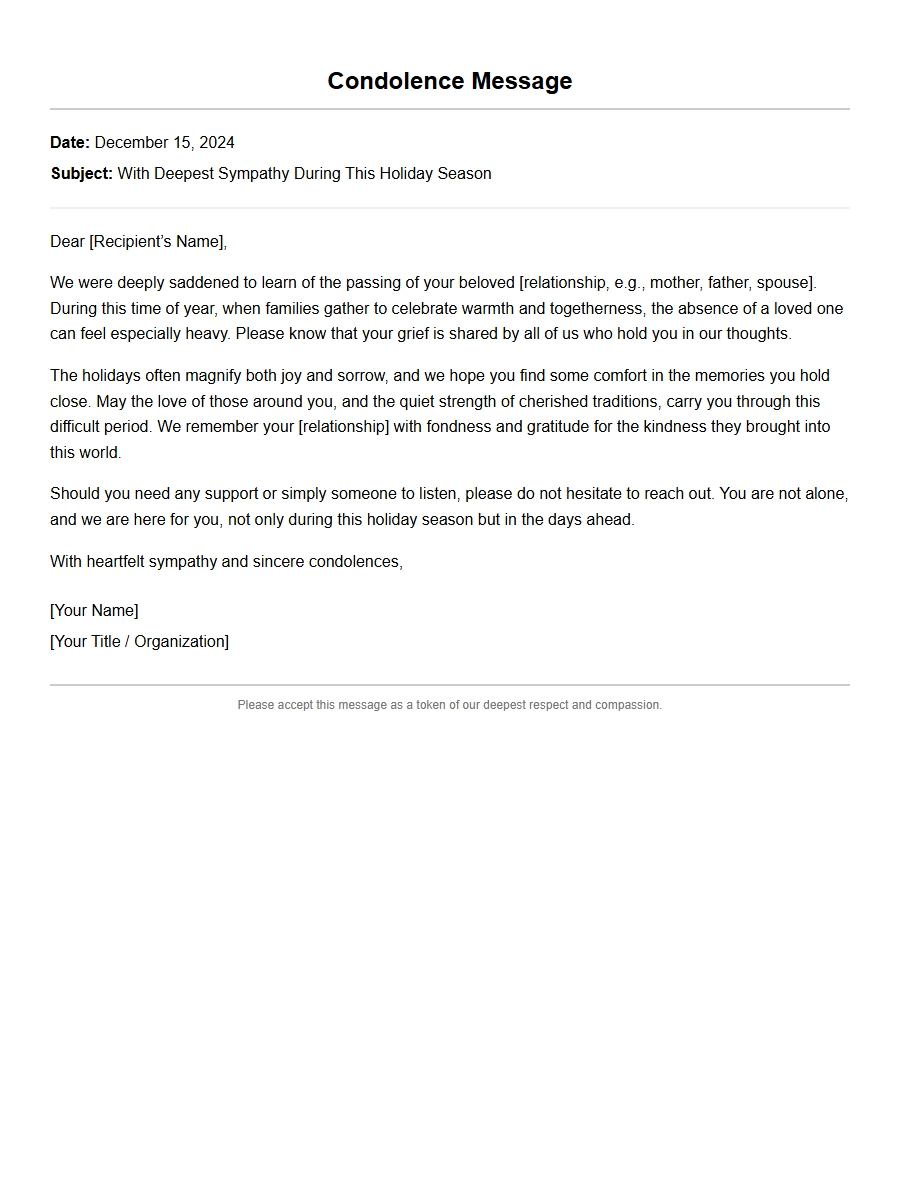
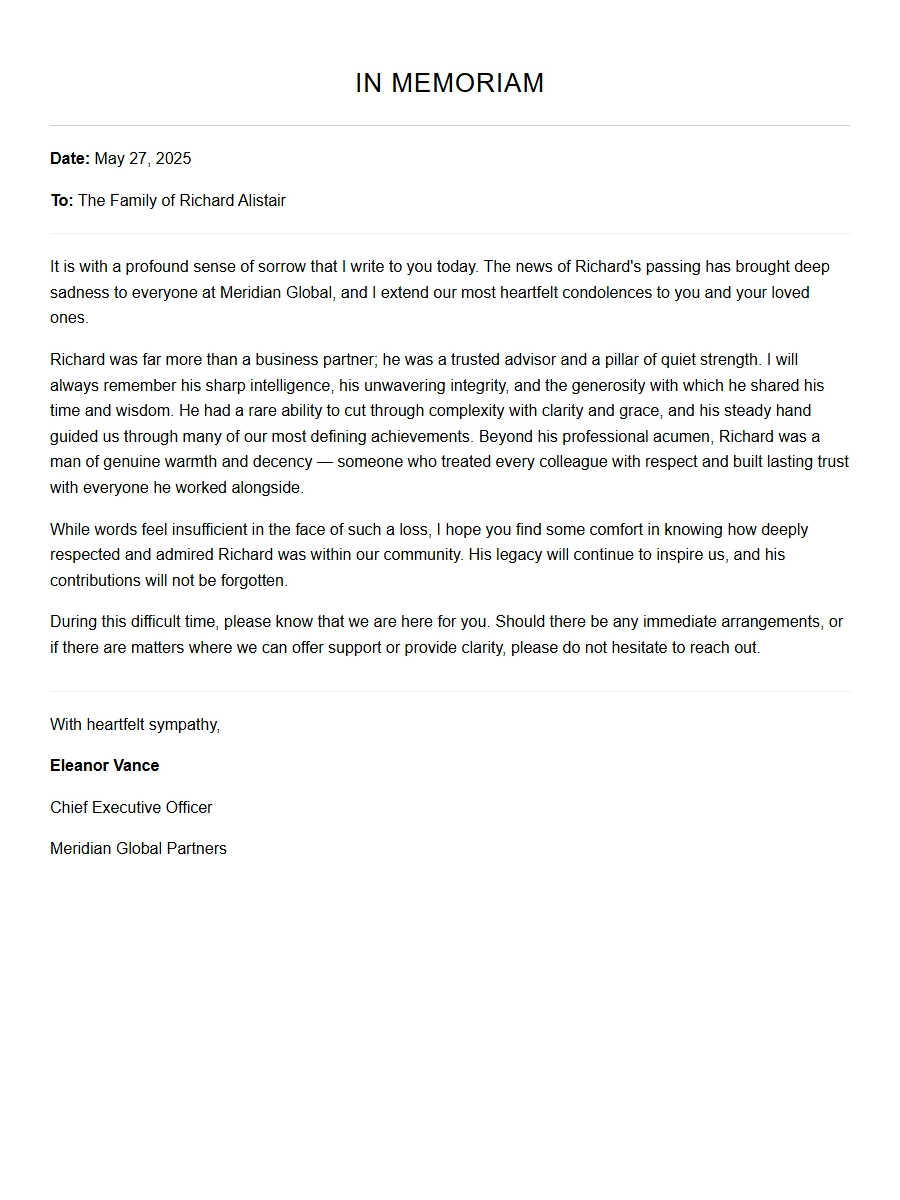 Formal Condolence Message for a Business Partner
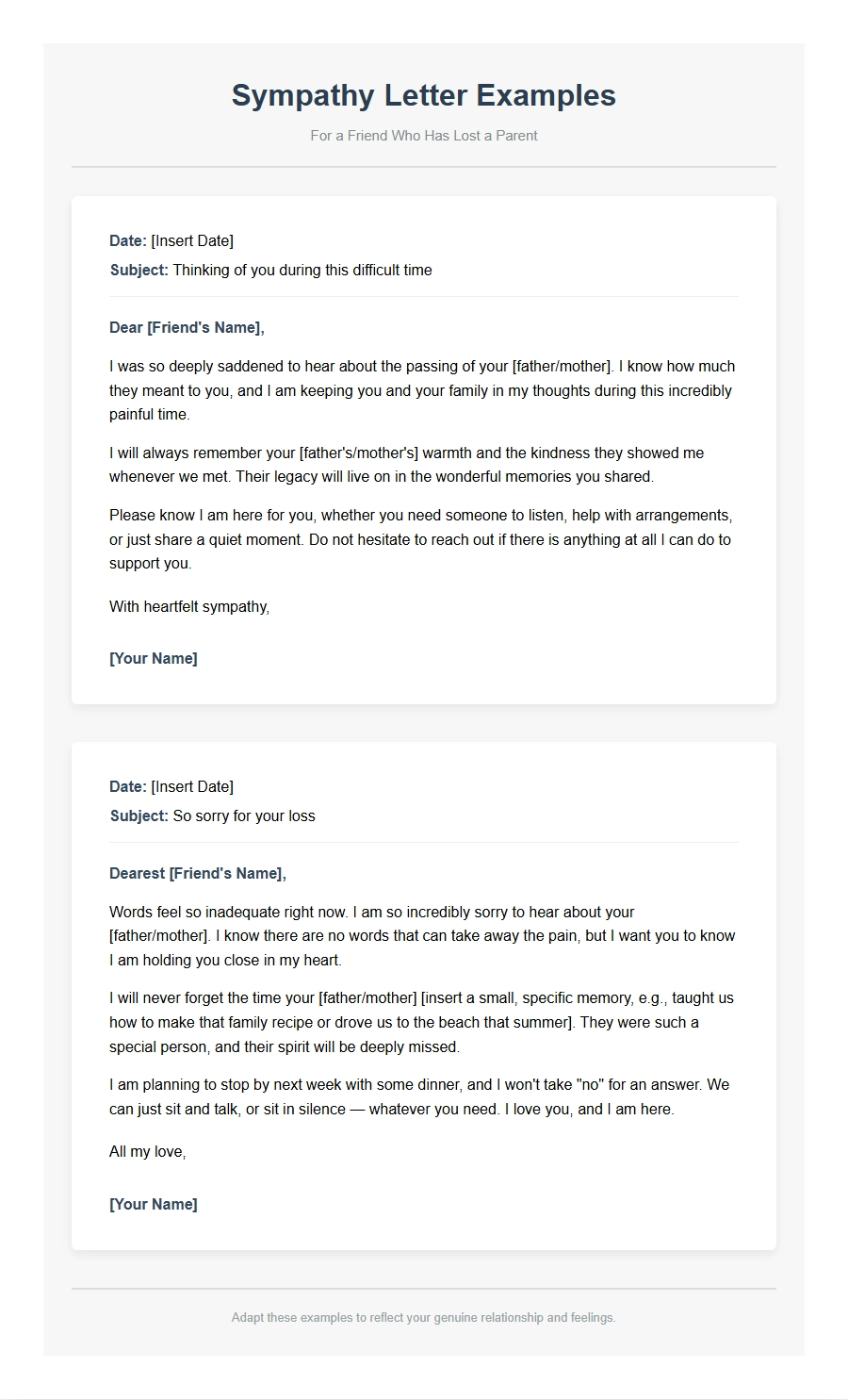 Sympathy Letter Examples for a Friend Who Lost a Parent
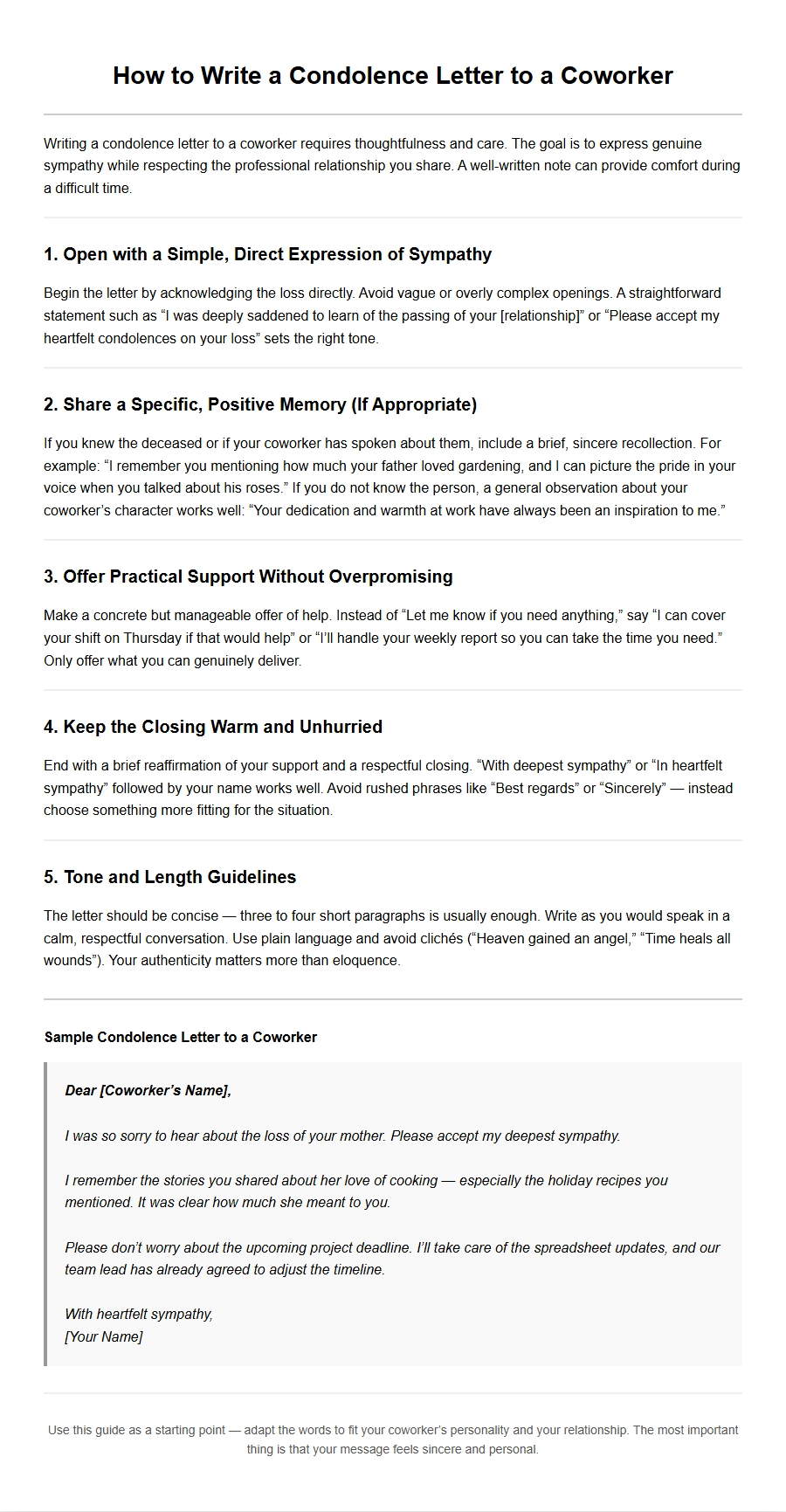 How to Write a Condolence Letter to a Coworker
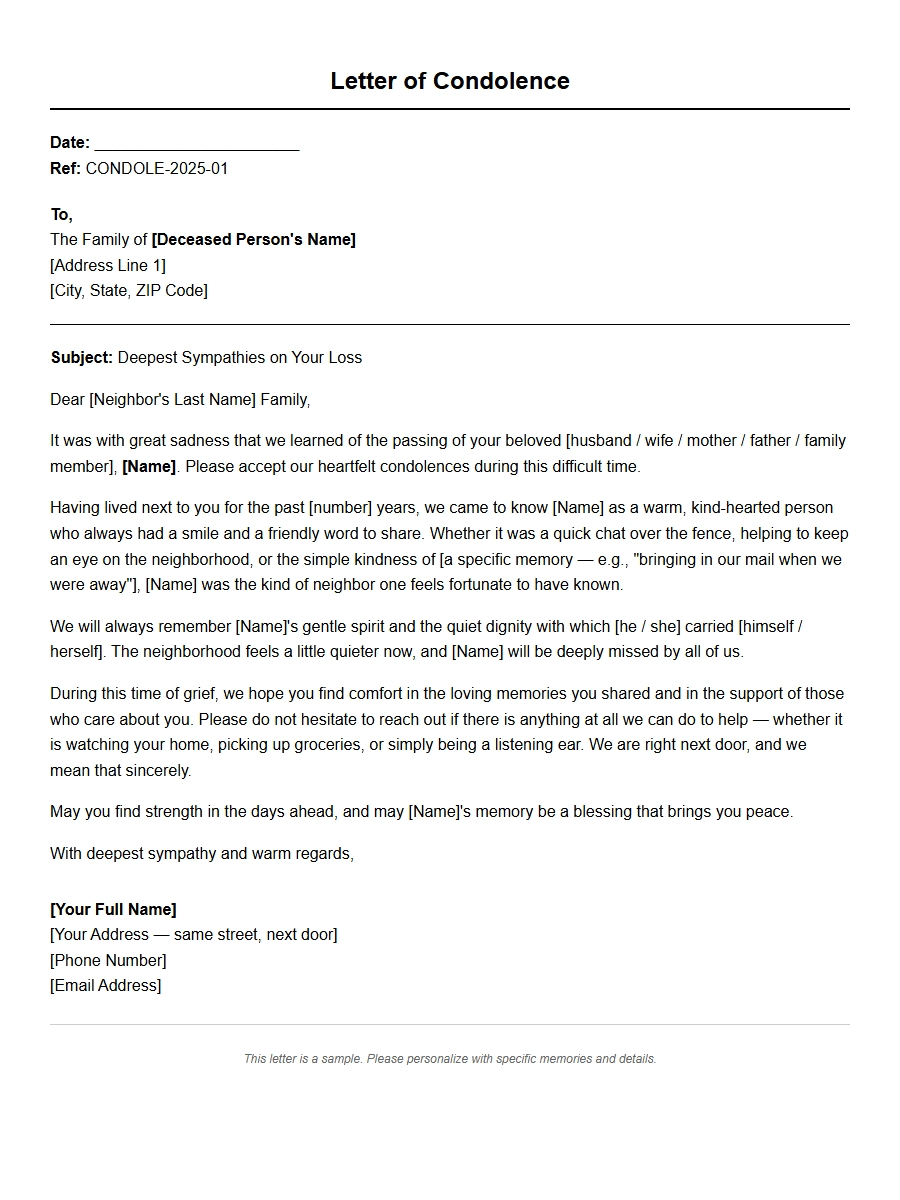 Condolence Letter Sample for a Neighbor
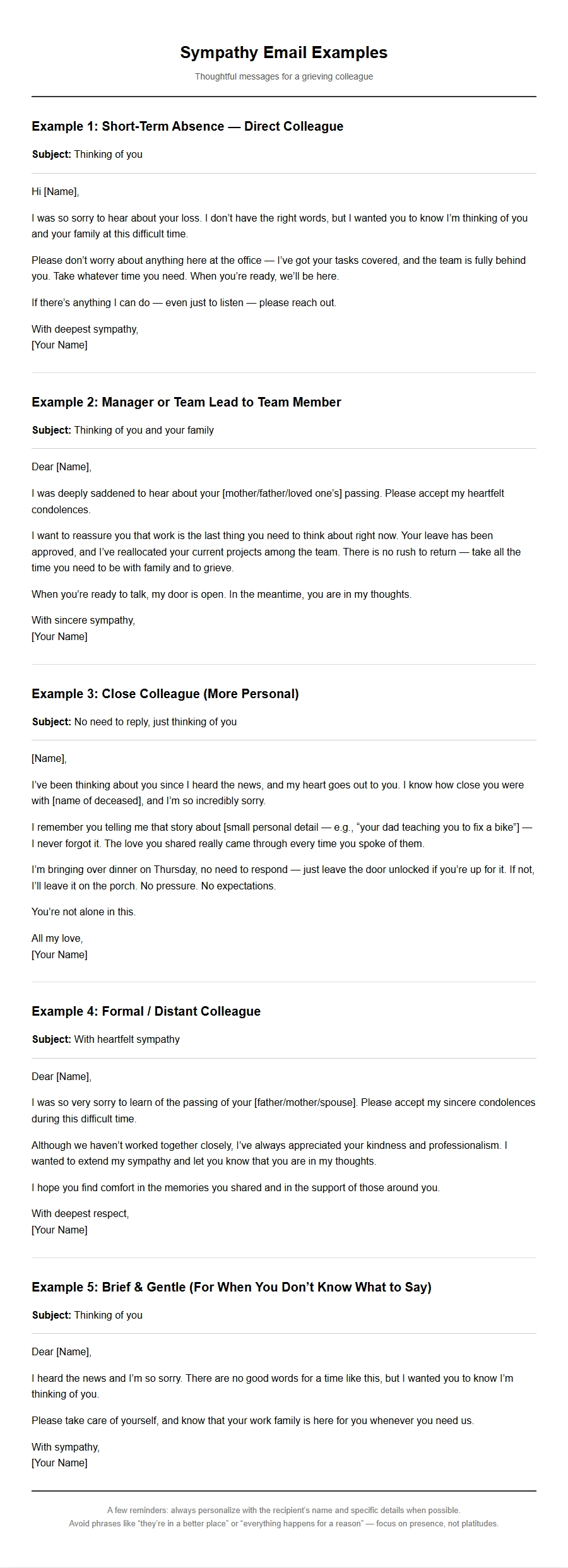 Sympathy Email Examples for a Grieving Colleague
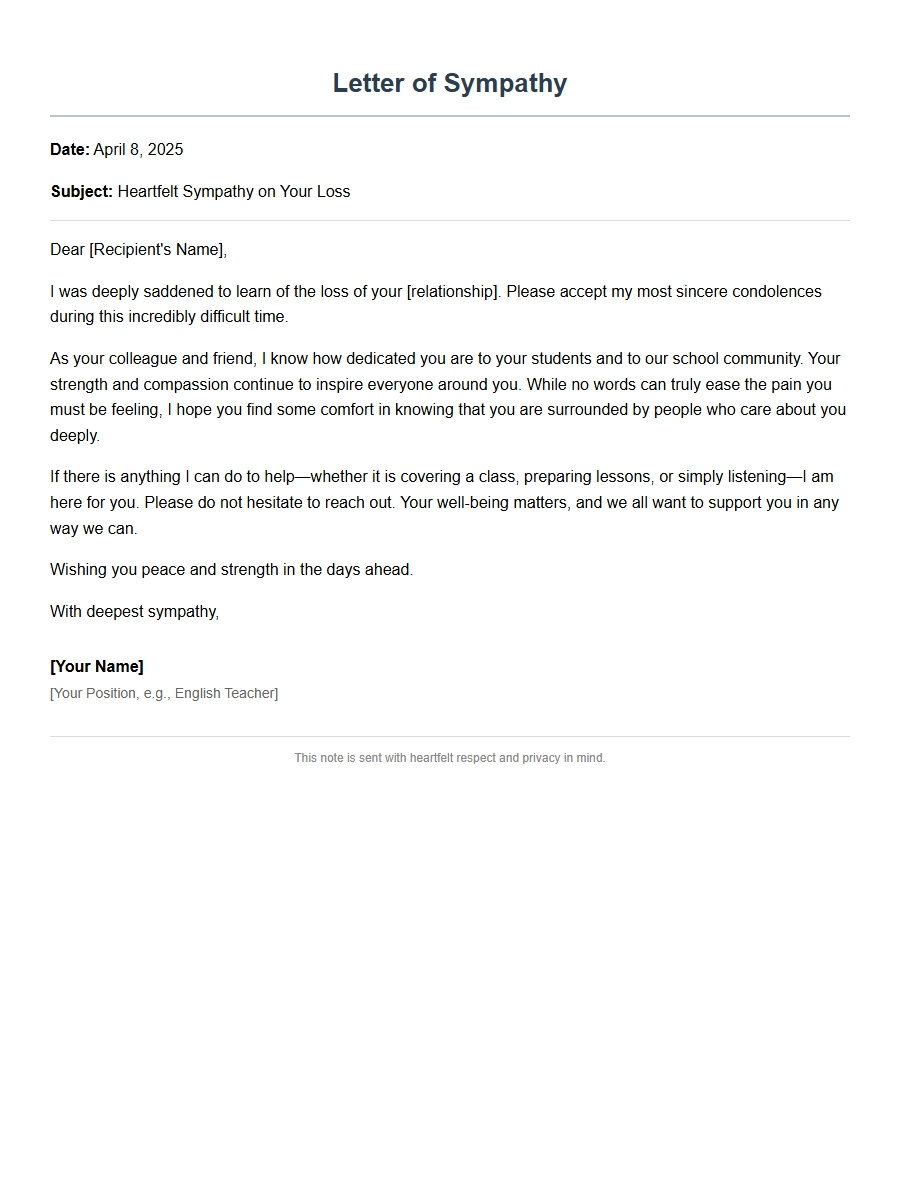 Condolence Words for a Teacher