sympathy message for suicide loss survivor - Condolence Letters
You’re staring at a blank screen or a blank card, and the words just won’t come. Someone you know has lost a loved one to suicide, and you want to say something—but you’re terrified of saying the wrong thing. That fear is normal. Suicide loss is different from other kinds of grief, and the right sympathy message can feel impossibly hard to write.
Here’s the truth: using a sample is not cheating. A well-crafted sample gives you a letter structure, a safe tone in writing, and key phrases you can personalize. It’s a smart shortcut that frees you from second-guessing every word. Think of it as a customizable letter where you fill in the specific memories and your genuine heart. The goal is not to copy—it’s to adapt without losing your authentic voice.
This article falls under the category of condolence letters for sensitive situations.
Why a sample helps when the loss is suicide
Most letter templates for sympathy assume a natural death. Suicide loss adds layers of stigma, guilt, and shock. Survivors often feel isolated. A generic “he’s in a better place” can hurt. A sympathy message for suicide loss survivor needs to acknowledge the pain without trying to explain it away. A solid sample gives you the right starting point—words that validate their grief and let them know they’re not alone.
When you choose a sample, look for one that matches the relationship you had with the person who died and with the survivor. Is this a close friend, a coworker, or a distant relative? The level of professional correspondence matters, but even a personal note benefits from clear letter writing etiquette. Avoid clichés like “everything happens for a reason.” Instead, focus on expressing care and remembering the person who died.
How to adapt a sample without sounding stiff
Start by reading the sample aloud. Does it feel like you? If not, change the salutation and closing to match your natural voice. For a suicide loss, a gentle opener like “I was so sorry to learn about [name]” works better than “I extend my deepest condolences.” Keep the body simple: share a specific memory if you have one, or simply say you’re thinking of them. You don’t need to have the perfect answer. Silence and presence are often more powerful than words.
One common mistake is making the message too long. Suicide loss survivors are already overwhelmed. A short, sincere note—even three sentences—can mean more than a page of platitudes. If you’re sending via email, use a clean digital letter format with a simple subject line like “Thinking of you.” For a printed letter, a basic letterhead design (just your name and address) is fine, but don’t overthink it. The content matters more than the paper.
Mistakes to avoid when writing a sympathy message
Never use outdated salutations like “To whom it may concern.” That’s for formal business letters, not for grief. Also, avoid offering unsolicited advice, like “You should feel grateful for the time you had.” Instead, let the survivor lead. If you’re unsure, a simple “I’m here if you want to talk” works.
Proofreading is essential. A typo in a sympathy note can come across as careless. Read it twice, and maybe have a friend glance at it. You don’t need to be a grammar expert, but respect the gravity of the situation. And remember: you don’t have to mention suicide directly. Phrases like “after [name]’s death” are fine. The survivor knows what happened. They don’t need a detailed reminder.
Putting it all together
Think of the sample as your scaffolding. You build your own message around it. Use a letter of recommendation approach in reverse—instead of praising someone’s skills, you’re honoring their life. The same principles of formal writing tips apply: be clear, be respectful, be brief. And just like cover letter examples vary by industry, your sympathy note varies by relationship. A note to a colleague may be more reserved than one to a sibling.
If you need extra guidance, you can look at how to express sympathy after a sudden death or find ideas for a short condolence text message for grief. For those supporting someone with anxiety during loss, a comforting email for a friend with anxiety during grief can also help you understand the emotional landscape.
Ultimately, the best sympathy message for suicide loss survivor is one that comes from a real place. It doesn’t have to be perfect. It just has to be honest. Use the sample as a springboard, not a crutch. With practice, you’ll get more comfortable—and your words will carry the warmth and care you meant them to.
Samples You Can Use
sympathy message for suicide loss survivor - Condolence Letters
Acknowledging the Pain
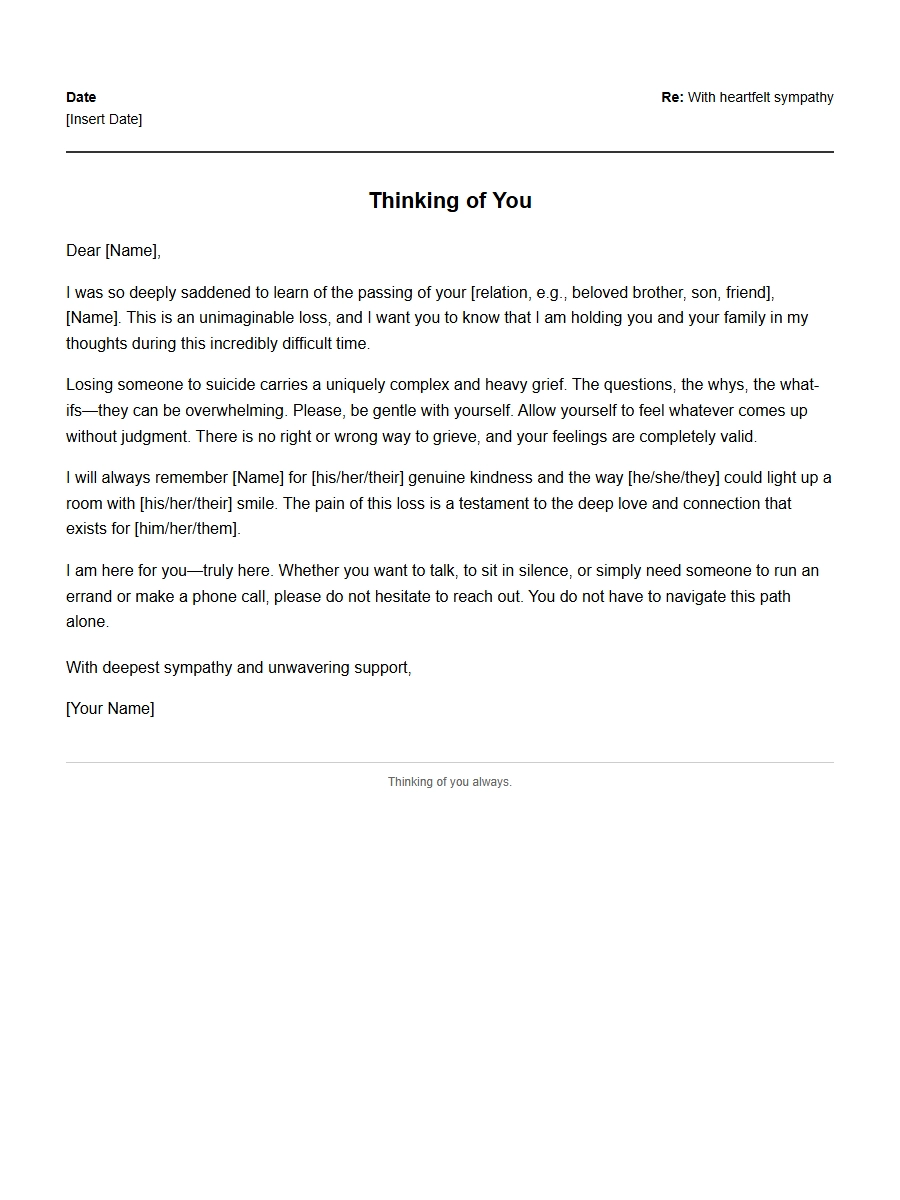
Dear [Name],
I am writing with a heavy heart, struggling to find words that can adequately acknowledge the depth of your loss. What you are going through is unimaginable, and I want you to know that I am here—not to offer empty platitudes, but simply to be a presence in your darkness. There is no timeline for grief like this, and no right way to feel. Some days may bring anger, others numbness, and some may feel unbearable. All of those feelings are valid.
Please know that you do not have to carry this weight alone. When you are ready, I would be honored to listen to stories about your loved one, or to sit in silence with you, whatever you need. I hold you in my thoughts with compassion and care.
Message of Unwavering Support
Dearest [Name],
I am so sorry for the terrible loss you are enduring. Losing someone to suicide brings a unique and complicated pain, and I cannot pretend to understand exactly how you feel, but I want you to know that my support for you is unconditional and steady.
In the coming weeks and months, please lean on me however you need. If you want to talk, I will listen without judgment. If you need a distraction, I am here for that too. I will check in on you gently, and I encourage you to be kind to yourself as you navigate this journey.
Below are some things I can offer:
Regular phone or video calls – you choose the frequency
Help with simple daily tasks like meals or errands
A safe space to express anger, sadness, or confusion
Respecting your silence when you need it
You are not alone. I am walking beside you.
Remembering Their Light
Dear [Name],
I was deeply saddened to hear about the passing of your [relationship, e.g., brother, friend, son]. I will always remember [Loved One's Name] as someone who brought so much warmth and laughter into every room. I think of the time we [specific positive memory, e.g., shared a meal, laughed until we cried] and how genuinely kind they were to everyone.
It feels so unfair that such a bright light has gone out, and I cannot imagine the hole this leaves in your life. Please do not feel pressured to respond to this note; just know that I am holding you and your family close in my heart.
When the world feels heavy, I hope you can hold onto the beautiful moments you shared. Their love remains a part of you. I am here for you, always.
Words for a Grieving Spouse
My dearest [Name],
I am writing this with tears streaming down my face because your pain is my pain. Losing a partner to suicide is a heartbreak that no one should ever have to face. You were a constant source of love and strength for [Spouse's Name], and I know you gave them so much joy during their life.
In the midst of this tragedy, I want to gently remind you: it is not your fault. Mental illness is a relentless battle, and you did everything you could. Right now, your only job is to survive each moment as it comes.
I will be bringing over meals on Mondays and Thursdays so you don't have to think about food. I've also compiled a list of local support groups and hotlines—I can send it to you when you're ready. Let me be your anchor when the waves feel too high. You are so loved.
Day
Meal
Notes
Monday
Chicken soup & bread
Will leave on porch if you prefer
Thursday
Pasta bake & salad
Can add extra if others visiting
For a Parent Who Lost a Child
Dear [Names],
There are no words that can possibly comfort a parent who has lost a child, especially in such a tragic way. Please know that I am thinking of you with profound sadness and empathy. [Child's Name] was a wonderful person—full of potential and kindness—and the world is dimmer without them.
I cannot imagine the depth of your grief. Please give yourself grace and allow all the emotions to come without judgment. If you ever feel like talking, sharing memories, or just being with someone who respects your pain, my door is always open.
I have gathered some resources that other bereaved parents have found helpful. They are listed below—please look at them only when you feel ready.
National Alliance for Grieving Children (local chapter)
Weekly support group for parents who lost a child to suicide
Books: "The Many Faces of Grief" and "No Time to Say Goodbye"
Private online forum for parent survivors
I am lighting a candle for [Child's Name] tonight. With all my love.
To a Friend in Deepest Loss
Hey [Name],
I don't even know where to begin. I am so, so sorry that you lost [Friend's Name]. I know how close you two were, and this is absolutely devastating. I've been walking around in a fog since I heard, and I can only imagine what you're feeling.
I want to be honest with you: I don't know what to say. But I know that showing up matters more than having the right words. So here I am, and I am not going anywhere. We can do whatever you need—we can sit in silence, we can watch a movie, we can go for a walk. Or we can just text and not talk at all.
Some practical things: I'll be at your house Saturday at noon to help with anything that's piling up—laundry, dishes, whatever. If you need space, just say the word and I'll leave. But I'll keep checking in.
Please remember to eat and hydrate, okay? I love you.
Professional Condolence (Workplace)
Dear [Employee/Colleague Name],
On behalf of the entire team at [Company Name], I extend our deepest condolences on the passing of your [relationship, e.g., father, partner]. We are deeply saddened by this news, and our hearts go out to you and your family during this incredibly difficult time.
We understand that grief from suicide loss is complex and that you may need time away from work to process everything. Please take all the time you require. We have arranged for your tasks to be covered and will do everything possible to reduce any work-related stress.
The following resources are available through our employee assistance program:
Resource
Contact
Details
Grief Counseling Hotline
1-800-555-0199
24/7, free, confidential
Bereavement Leave
HR Department
Up to 10 paid days, flexible
Peer Support Group
Meets Wednesdays
Virtual option available
Please reach out to me directly if there is anything you need. You are a valued member of our work family, and we are holding you in our thoughts.
With heartfelt sympathy,
[Your Name]
Honoring Their Memory with Simple Gestures
Dear [Name],
I am so sorry for your loss. I remember [Loved One's Name] with such fondness—their smile, their kindness, and the way they always knew how to make people feel seen. To honor them, I have planted a small tree in my garden as a living memorial. Every time I see it, I will think of the beautiful moments they brought into the world.
I know nothing can replace the hole left in your life, but I hope these small acts of remembrance bring you some comfort:
I will be making a donation to a mental health organization in their name.
I will set aside a quiet hour each month to reflect on their life and legacy.
I will share a happy memory of them with you, by letter, every few months—only if you want.
Please don't feel obligated to acknowledge this. I am simply finding my own way to carry their light forward. You are in my heart.
Offering Gentle Space for Grief
Dear [Name],
I am writing this with a quiet heart, knowing that words can feel hollow in the face of such profound loss. Please accept my deepest sympathy for the death of your [Loved One's Name]. I know that suicide loss comes with a heavy tangle of emotions—shock, guilt, anger, and deep sadness—and it can be hard to know where to turn.
I want you to know that there is no pressure to respond to this note, no expectation to be anything other than exactly how you are. I will be holding space for you in the following ways:
Weekly check-in texts that require no reply—just a heart emoji if you want acknowledgment.
A handwritten journal that I will leave in your mailbox, where you can write or draw anything you need.
An open invitation to coffee or tea—accept whenever, even months from now.
Your grief is valid, unique, and allowed. I will not rush you or try to fix anything. I am simply here.
Breaking the Silence Around Suicide
Dear [Name],
I want to start by saying how sorry I am that you are carrying this heavy loss. The silence and stigma around suicide often make grieving even harder, and I want to acknowledge that openly. It is okay to talk about what happened, and it is okay to say your loved one's name out loud. I am ready to hear it whenever you are.
I know that survivors of suicide loss often feel isolated, as if others don't understand or are uncomfortable with the topic. But I want you to know that you can talk to me—about the good times, the hard times, or anything in between. There is no shame in their passing, only sorrow for the pain they carried.
Here are some thoughts from organizations that support survivors:
You are not alone—AFSP (American Foundation for Suicide Prevention) has local walks and support groups.
It is common to ask "why"—there may never be a complete answer.
Healing happens at its own pace; allow yourself to feel without judgment.
Please reach out any time, day or night. You matter, and your loved one's life mattered. I am holding you in kindness.
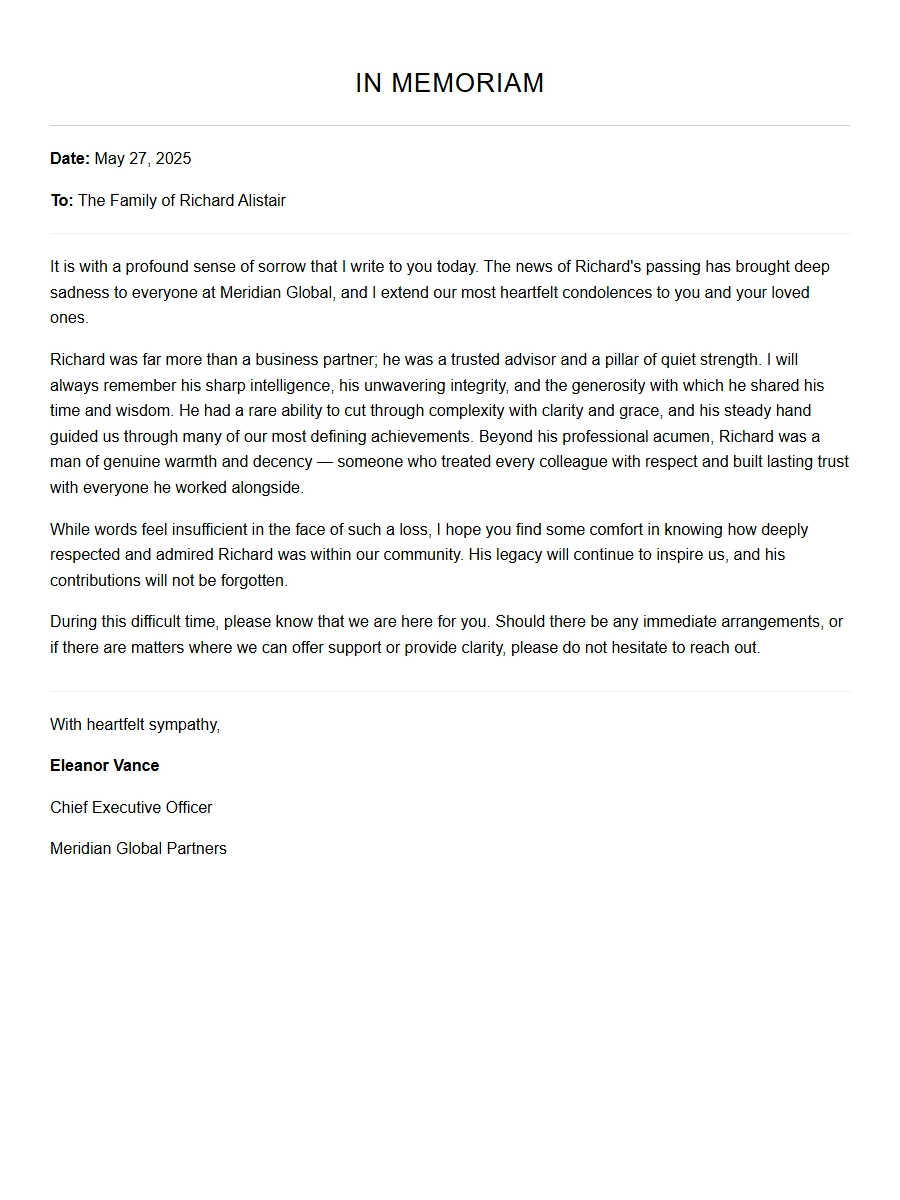 Formal Condolence Message for a Business Partner
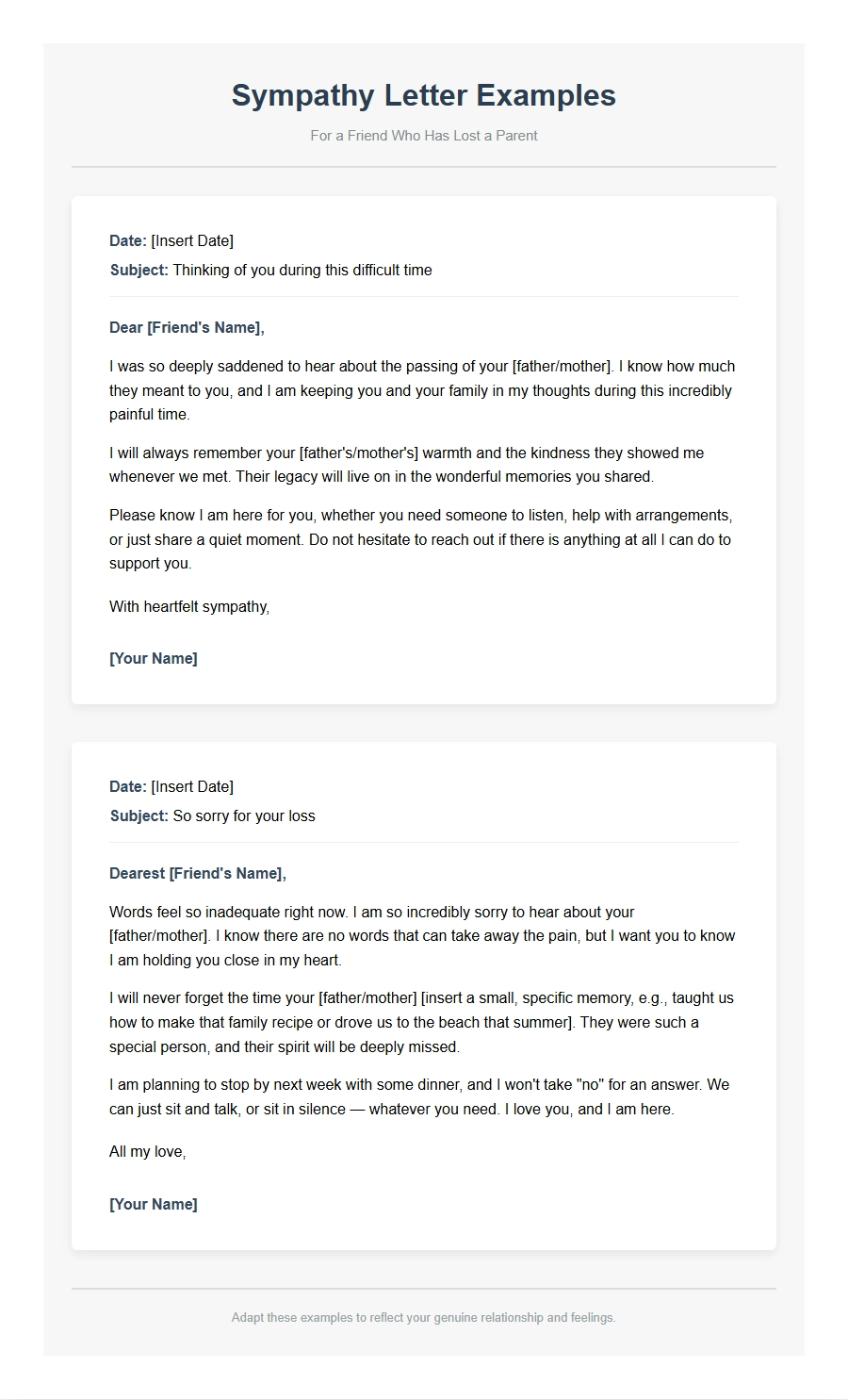 Sympathy Letter Examples for a Friend Who Lost a Parent
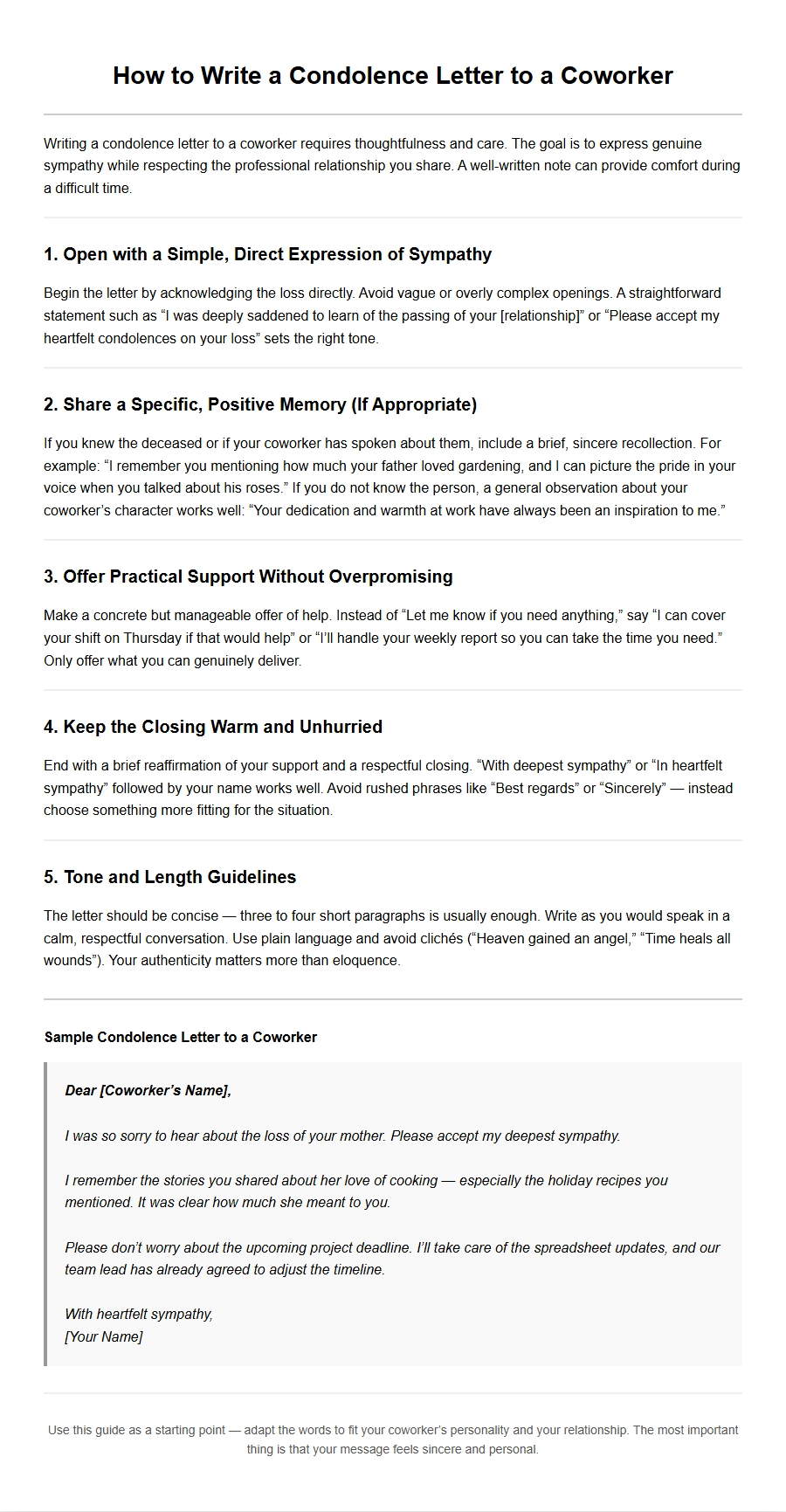 How to Write a Condolence Letter to a Coworker
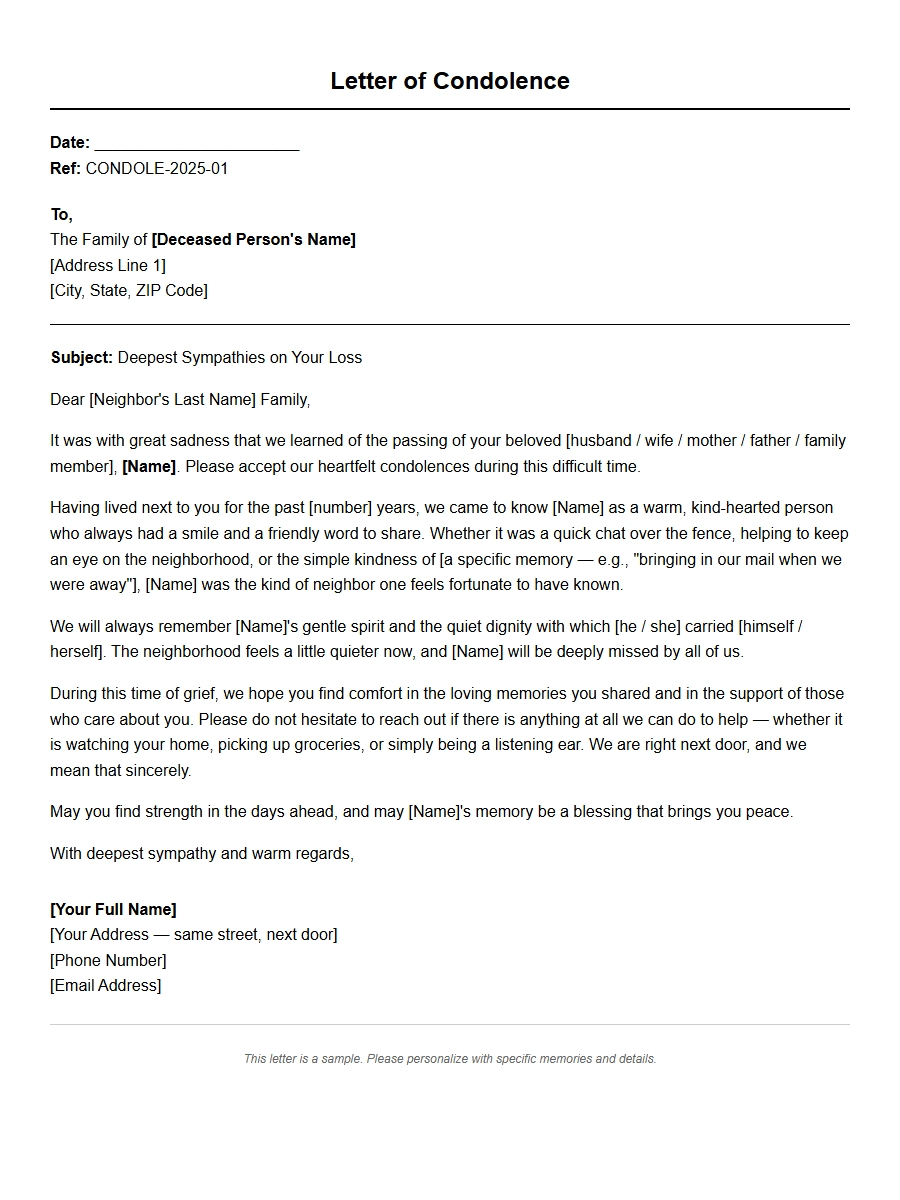 Condolence Letter Sample for a Neighbor
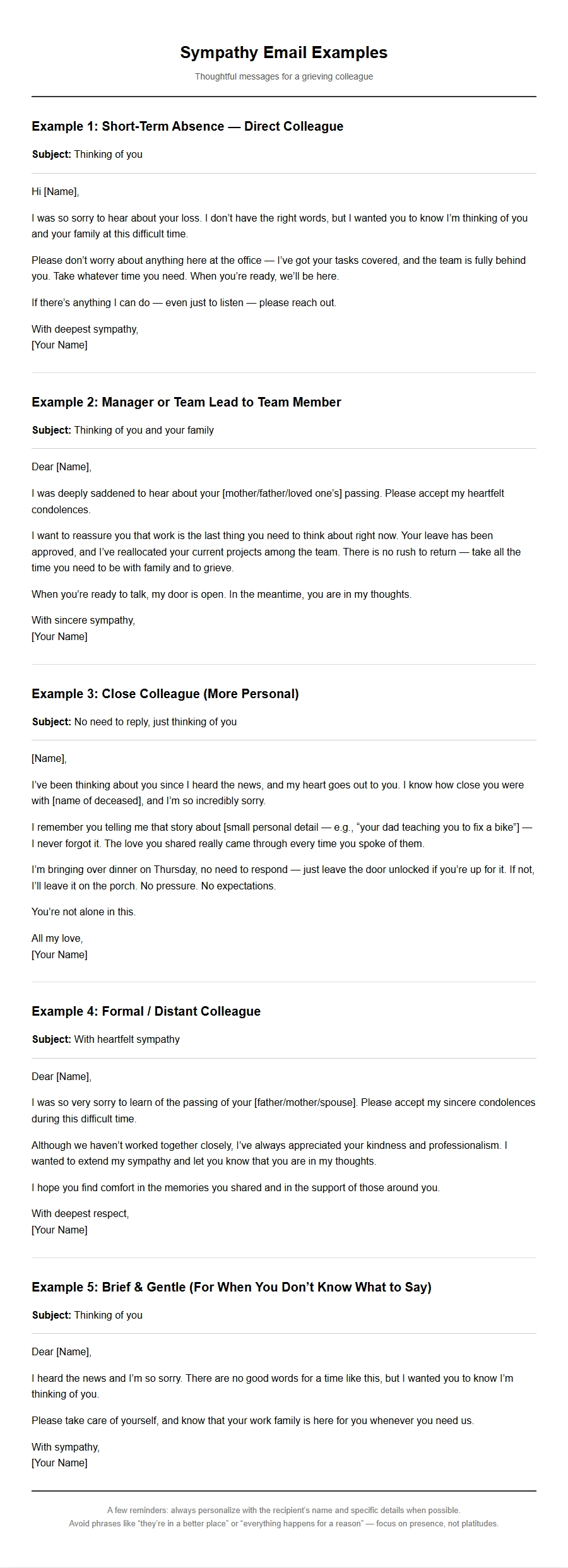 Sympathy Email Examples for a Grieving Colleague
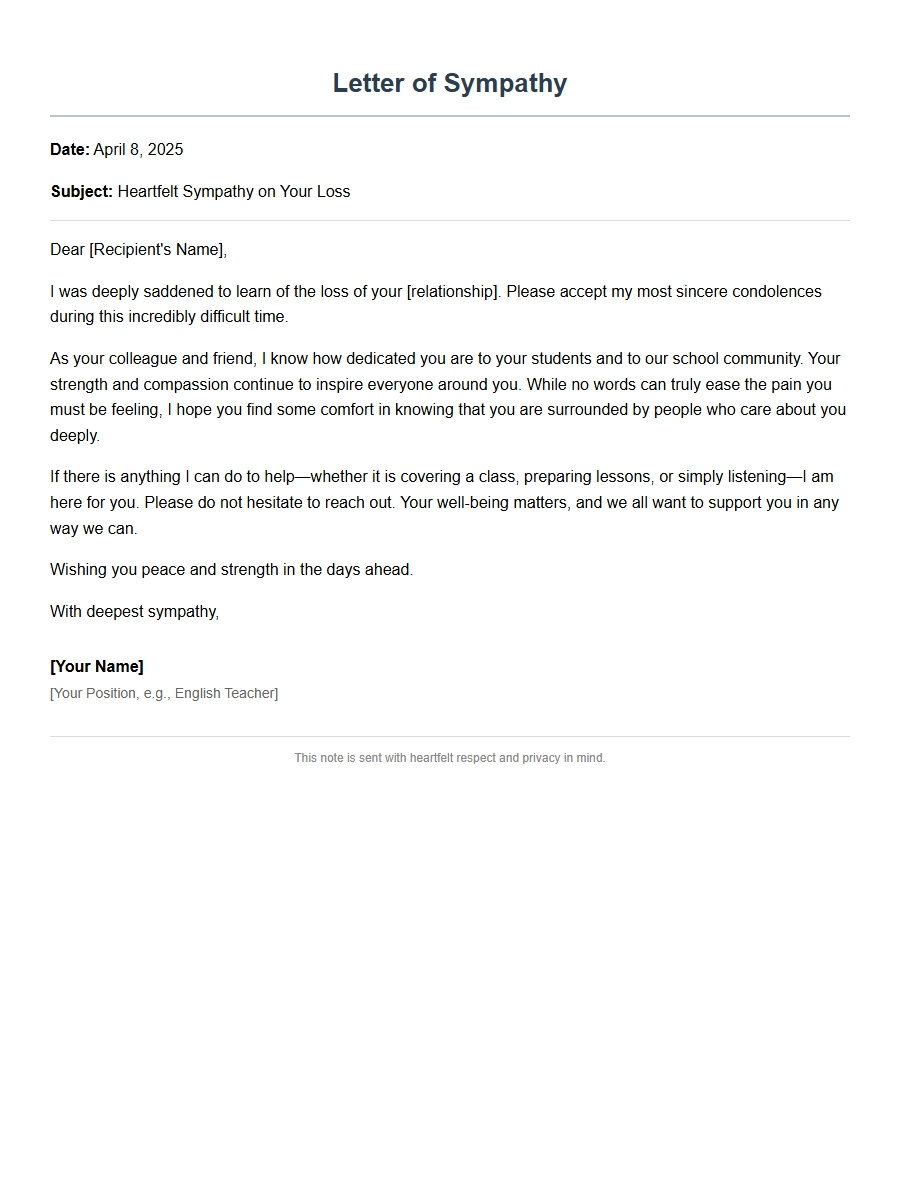 Condolence Words for a Teacher