You’re sitting down to write a sympathy letter after the loss of a child, and the words just won’t come. That blank page feels impossible—because how do you put grief into sentences that won’t hurt more? You’re not alone. Most people freeze at this moment. A good sample can turn that anxiety into something you can actually send.
Why using a sample is not cheating
Borrowing a structure doesn’t make your letter less heartfelt. It gives you a solid foundation so you can focus on what really matters: your own words of care. A sympathy letter template provides the right letter structure, a natural salutation and closing, and the kind of tone in writing that matches the situation. You don’t have to reinvent professional correspondence rules while you’re already emotionally stretched thin.
Think of a sample as a coach. It shows you where to start, what to say, and how to end—without stealing your authentic voice. The key is choosing the right one for the loss you’re addressing.
How to pick the right sample for a child loss
Not all condolence letters are the same. A note for a baby who never came home feels different from one for a teenager who died suddenly. Look for samples that mention the child’s age or the circumstances loosely—they’ll guide the letter writing etiquette that fits. For instance, a sympathy note for loss of a baby boy or girl uses simpler, softer language than one for an older child.
Also consider format. Will you send a printed card or an email? A digital letter format might skip letterhead design but still needs a clear subject line and respectful opening. For printed letters, a clean business letter format (with your address, date, and proper spacing) shows you took the time—even if the content is personal.
Adapting a sample without losing your voice
Once you have a good template, personalize it. Start by swapping generic phrases for specific memories. If you remember the child’s love for dinosaurs, mention it. If you recall a funny moment with the parent, add a quiet sentence about that. The structure stays, but the soul becomes yours.
Common mistake: copying the sample word for word. A customizable letter works only if you actually change it. Read the sample out loud and ask: “Would I say this?” If not, rephrase until it sounds like you. Also watch for outdated salutations. “Dear Sir” doesn’t fit a grieving parent. Use their name. “Dear Maria and Tom” is warmer.
Tone matters more than perfect grammar
You don’t need flowery language or perfect formal writing tips here. What matters is sincerity. Short sentences are fine. “I’m so sorry. This is unbearable. I wish I had the words.” That’s enough. Avoid clichés like “everything happens for a reason” or “at least they are in a better place.” Those can sting. Instead, offer simple presence: “I’m thinking of you every day.”
If you’re writing as part of a work or community context—like for a colleague—keep the tone respectful but not cold. Letter writing etiquette for sympathy allows empathy without overstepping. Mention the loss, express your sorrow, and offer concrete help if you can. For example, “I’ll bring dinner Thursday if that works.”
Proofreading before you send
Grief makes us rush, but a quick proofreading letter step prevents accidental hurt. Read it once for typos, then read it again imagining you’re the recipient. Does it feel comforting or awkward? If a sentence feels off, change it. Also check names and pronouns—getting the child’s name wrong would be devastating.
Let the sample be your springboard, not your crutch
Your letter doesn’t have to be perfect. The fact that you’re writing at all is a gift. Use a template to get started, then pour in your own memories and care. Over time, you’ll get faster and more confident. The families who receive these letters won’t judge your formatting—they’ll remember that you showed up.
So take a deep breath. Pick a sample that fits. Write a draft. Edit until it sounds like you. Then send it. You’ve got this.
Useful Writing Samples
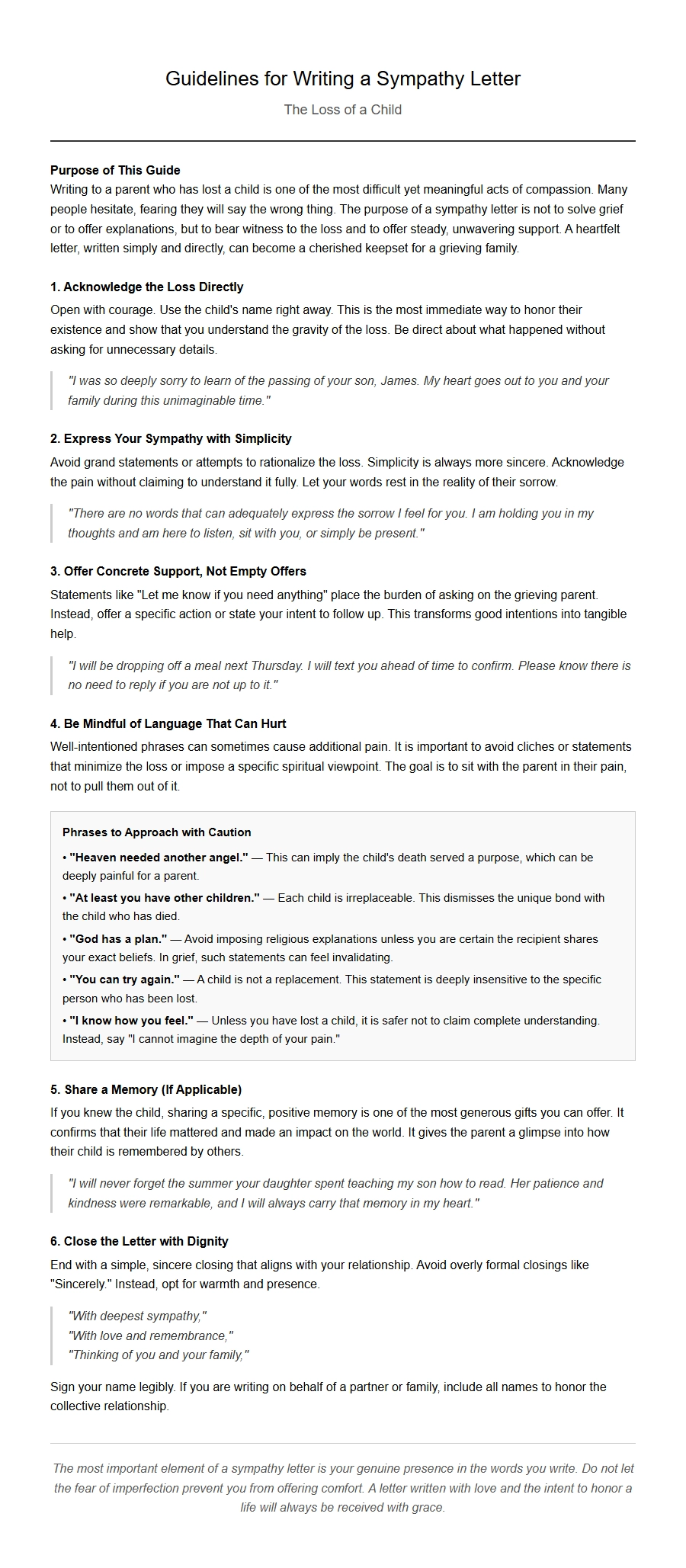
Sympathy Letter Guidelines for Losing a Child
Letter to a Grieving Parent from a Close Friend
To: Sarah and Michael From: Your friend, Laura Date: May 10, 2025
I am writing with the heaviest heart after hearing about Lily. There are no words that can truly express how sorry I am for your loss. I remember the joy she brought to every room — her laugh, her endless questions, and the way she hugged everyone like they were her best friend. Please know that I am holding you both in my thoughts every moment.
I would like to help in practical ways during this difficult time. Below are a few offers; please do not hesitate to ask for anything else.
Meals for the week — I can drop off dinners on Tuesday and Thursday.
Childcare for your other children anytime you need.
Running errands or picking up groceries.
You are not alone. I am here for you always, just a phone call away. With deepest sympathy, Laura.
Sympathy Letter from a Grandparent to Their Child
To: My dear daughter Emily From: Mom Date: May 12, 2025
My beautiful girl, I am writing this through tears. When I heard about little Ethan, my heart shattered for you. I know that no parent should ever outlive their child, and I cannot imagine the pain you are carrying. Please remember that I am here — not just as a grandmother, but as your mother who will hold you through this.
I want you to know that Ethan will always be part of our family. I treasure the memories we made together, like when we baked cookies last Christmas and he covered his face in flour on purpose. Those moments are precious and will stay with us forever.
I am arranging to come stay with you next week to help with meals, laundry, and anything else. I have also set up a small memory box with his favorite things — you can add to it whenever you want. Do not hesitate to lean on me. I love you more than words can say. Mom.
Condolence Note for a Sudden Child Loss
To: The Davis Family From: The Johnsons, your neighbors Date: May 15, 2025
We were devastated to learn about the sudden loss of your beloved son, Jake. There are simply no words to ease the shock and grief you must be feeling. Jake was such a vibrant, kind-hearted boy who always greeted us with a wave from your driveway. We will miss seeing him play basketball in the yard.
We would like to help in concrete ways. Please find below a list of what we have organized for the coming days:
Day
Meal
Time of Drop-off
Wednesday
Chicken casserole and salad
5:30 PM
Friday
Homemade soup and bread
6:00 PM
Sunday
Breakfast quiche and fruit
9:00 AM
Additionally, we can walk your dog, take care of mail, or sit with your younger daughter if needed. Please call us any time. With heartfelt sympathy, Karen and Mark.
Letter After a Long Illness – Offering Support
To: Rebecca and Tom From: Your cousin, Alex Date: May 18, 2025
I am so sorry to hear that sweet Mia has passed away after her courageous battle with leukemia. I know these past months have been incredibly hard, and you showed such strength while caring for her. Mia was a fighter, and her smile even during treatments taught everyone around her about resilience.
In memory of Mia, our family has made a donation to the Children’s Cancer Foundation in her name. We also want to support you in the coming weeks. I have put together a small plan to help ease daily burdens:
Three home-cooked meals delivered this week (Monday, Wednesday, Friday).
Grocery pickup service — just send me a list.
A “clean-up day” next Saturday where several cousins will tidy the garden and house.
Do not worry about replying. Know that we love you and are holding you close. With all my sympathy, Alex.
Sympathy Note for Loss of an Infant
To: Jessica and Brian From: Your friends at work, The Marketing Team Date: May 20, 2025
We were deeply saddened to learn about the loss of your precious baby girl, Ella. There are no words that can ease the ache of losing a child so soon after birth. Please know that we are thinking of you with love and compassion during this heartbreaking time.
We have collected a few small gestures from the team to show we care. Below is a summary of what we arranged:
Item
Description
Provider
Meal delivery
4 ready-to-heat meals from The Local Kitchen
Sara
Memory book
A beautiful journal for writing down memories of Ella
Mark and Lisa
Donation
$300 donated to Now I Lay Me Down to Sleep in Ella’s name
Work colleagues
You are in our hearts. Please take all the time you need, and know that we are here for you when you are ready. With deepest sympathy.
Letter from a Teacher to a Student Who Lost a Sibling
To: James, Grade 6 From: Mr. Harrison, your teacher Date: May 22, 2025
Dear James, I was so sorry to hear about the passing of your older brother, Max. He was a wonderful student and a kind person who often talked about how much he admired you. I know this is an incredibly difficult time, and I want you to know that I am here to support you in any way I can.
In class, we have set up a small space where you can go if you need a quiet moment — a corner with a soft chair and some books. You can use it anytime without asking. I also encourage you to talk to our school counselor, Mrs. Lee, who is ready to listen whenever you feel like talking.
Here are a few things that might help you feel connected to Max’s memory:
A memory jar: Write down a happy memory on a slip of paper each day and put it in the jar.
Drawing: You could draw a picture of something you loved doing together.
Reading: I left a book called “The Invisible String” on your desk — it helps explain how love stays even when someone is gone.
Take your time, James. You are not alone. With care, Mr. Harrison.
Colleague Sympathy Letter for Coworker’s Child Loss
To: Maria From: Your colleagues at Acme Corp Date: May 25, 2025
Dear Maria, we were heartbroken to learn about the tragic loss of your daughter, Sofia. There are no words to convey our sorrow. Sofia was such a bright young lady; we remember the photos you shared of her dance recitals and her love for painting. Please accept our deepest condolences.
We know that work is the last thing on your mind, but we want to assure you that your responsibilities are fully covered. Here is a summary of what the team has arranged to support you:
Support Type
Details
Leave
Full paid leave for the next 4 weeks, approved by HR
Meal deliveries
Two weeks of meals from a local service, starting tomorrow
Errand help
Team members signed up for grocery runs, dog walking, and pharmacy pickups
Memory fund
Office collection raised $1,200 for the Sofia Garcia Memorial Art Scholarship
We are all thinking of you. Do not worry about replying. Take all the time you need. With love from your work family.
Letter from a Religious Leader to Bereaved Parents
To: The Miller Family From: Pastor Thompson, Grace Community Church Date: May 28, 2025
Dear David and Rachel, I am writing to express my deepest sympathy for the loss of your son, Noah. As your pastor, I have watched Noah grow in faith and kindness — he was truly a light in our youth group. My heart aches with yours, and I want you to know that our church community is surrounding you with prayers and practical support.
We believe that Noah is now at peace in the loving arms of our Savior. Yet we know that your grief is heavy and real. In the coming days, our prayer team will be meeting daily for you. Below are some ways we are walking alongside you:
Pastoral visits: I will come to your home every Tuesday and Thursday if you wish.
Meal ministry: A schedule for hot dinners for the next two weeks is ready; simply call the church office to confirm.
Grief support group: A special session for parents who have lost a child will meet every Saturday at 10 AM. You are welcome anytime.
Memorial service: The church will host a service on June 10th at 2 PM; you can help plan the details when you are ready.
You are not alone. The Lord is near to the brokenhearted. With love and prayers, Pastor Tom.
Sympathy Letter from a Sibling to Their Brother or Sister
To: My dear sister Nicole From: Your brother, Jake Date: May 30, 2025
Nicole, I don’t know how to begin. When Mom told me about little Liam, I felt like the world stopped. I know how much you loved him — every finger painting on the fridge, every lullaby at bedtime, every story you read to him. He was such a joyful little boy, and he had your eyes.
I’m so sorry I live far away. But I want you to know I’m flying in next week to stay with you for at least a month. I’ll help with anything — cleaning, cooking, taking care of the dog, or just sitting with you in silence. I’ve also set up a few things on your end:
Task
Who is helping
Notes
Groceries
Your neighbor Karen
She will pick up your list every Monday
Lawn care
Our cousin Dave
He will come every Saturday until you say stop
Meals
Our aunt Susan
She is dropping off freezer meals this Friday
I love you, sis. Liam will never be forgotten. I’m here forever. Your brother, Jake.
Checklist for Writing a Sympathy Letter for Child Loss
Use this guide to structure a heartfelt message that honors a child and supports the family. The following checklist outlines key elements to include. Adjust tone based on your relationship with the bereaved.
Acknowledgment of loss — Start with the child’s name and express direct, honest sympathy. Example: “I was so sorry to learn about the death of your precious daughter, Emma.”
Personal memory or positive trait — Share a short, specific memory or quality. Helps show you truly knew the child. Avoid clichés like “He is in a better place” unless you know the family’s beliefs.
Offer practical help — List concrete actions (meals, errands, childcare). Use a table or bullet list to make it easy to see. Example: “I can drop off dinner on Tuesday and Thursday.”
Expression of continued support — Reassure them you will be present in the coming weeks and months. Avoid “let me know if you need anything” — instead, offer specific times.
Closing with love or faith — Sign off with a warm phrase. For religious families, add a short prayer or blessing. For others, simply “With deepest sympathy.”
Tip: Handwrite the letter if possible. Keep it to one page. Never compare losses or suggest the parent will “get over it.” Your goal is to validate their pain and show you care.
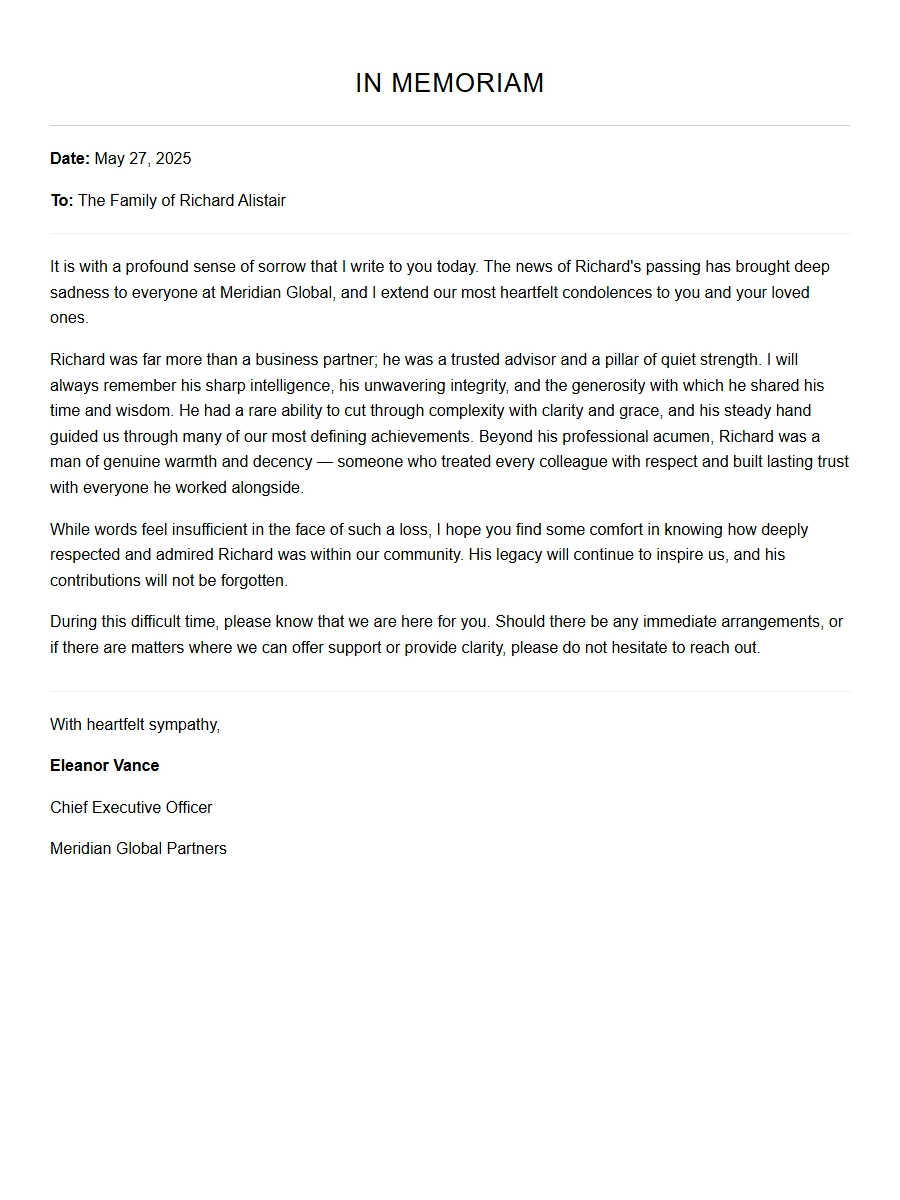 Formal Condolence Message for a Business Partner
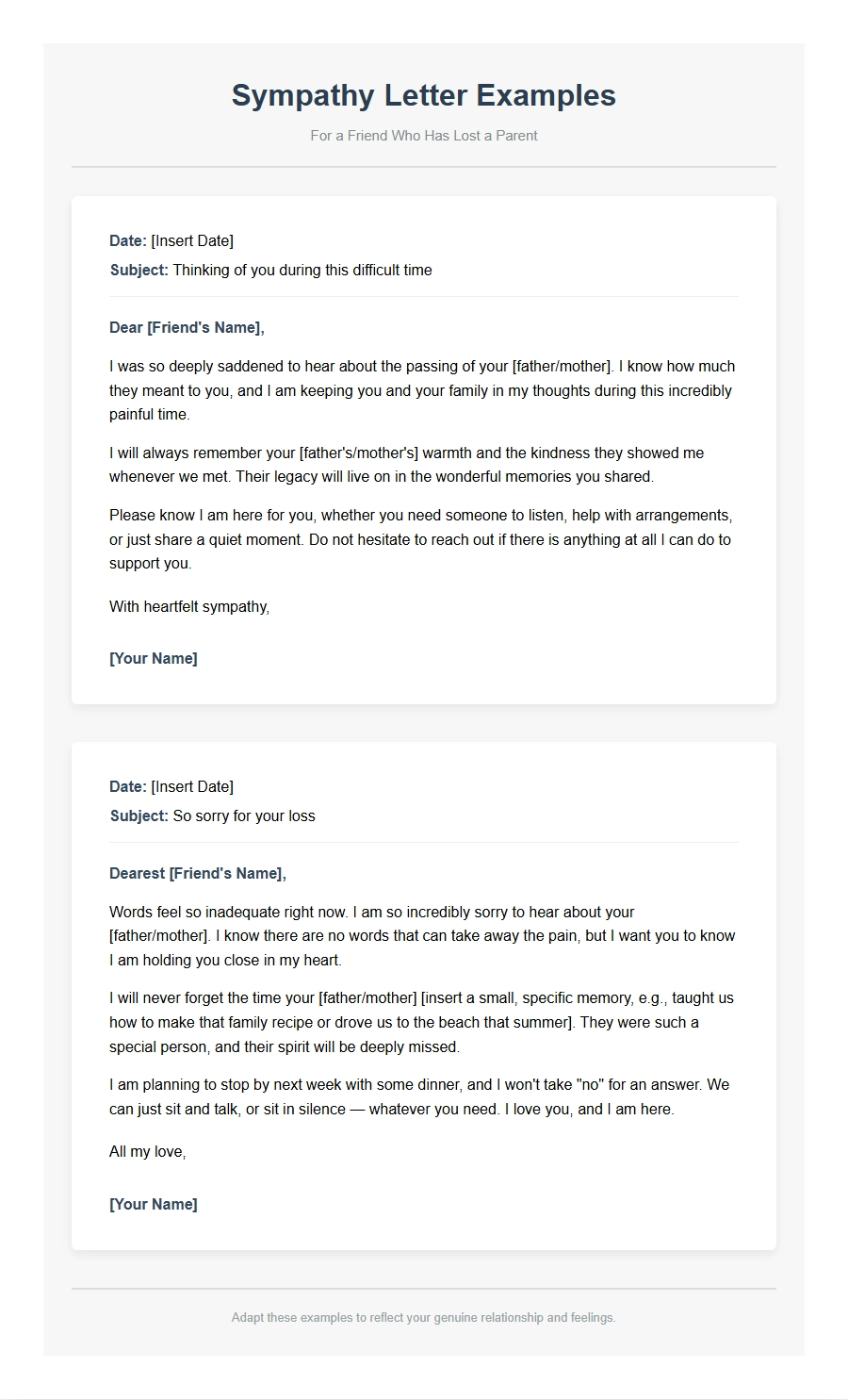 Sympathy Letter Examples for a Friend Who Lost a Parent
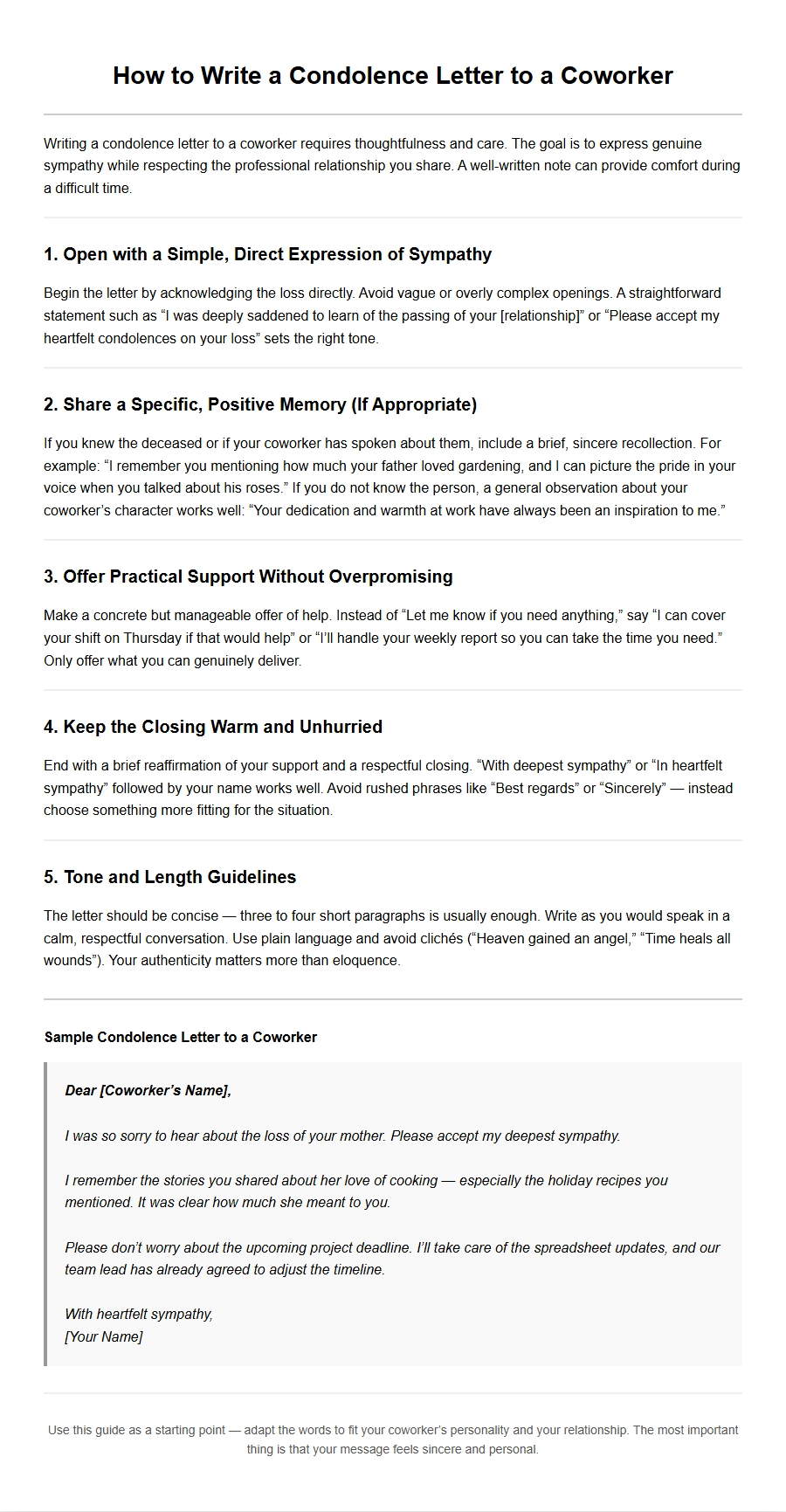 How to Write a Condolence Letter to a Coworker
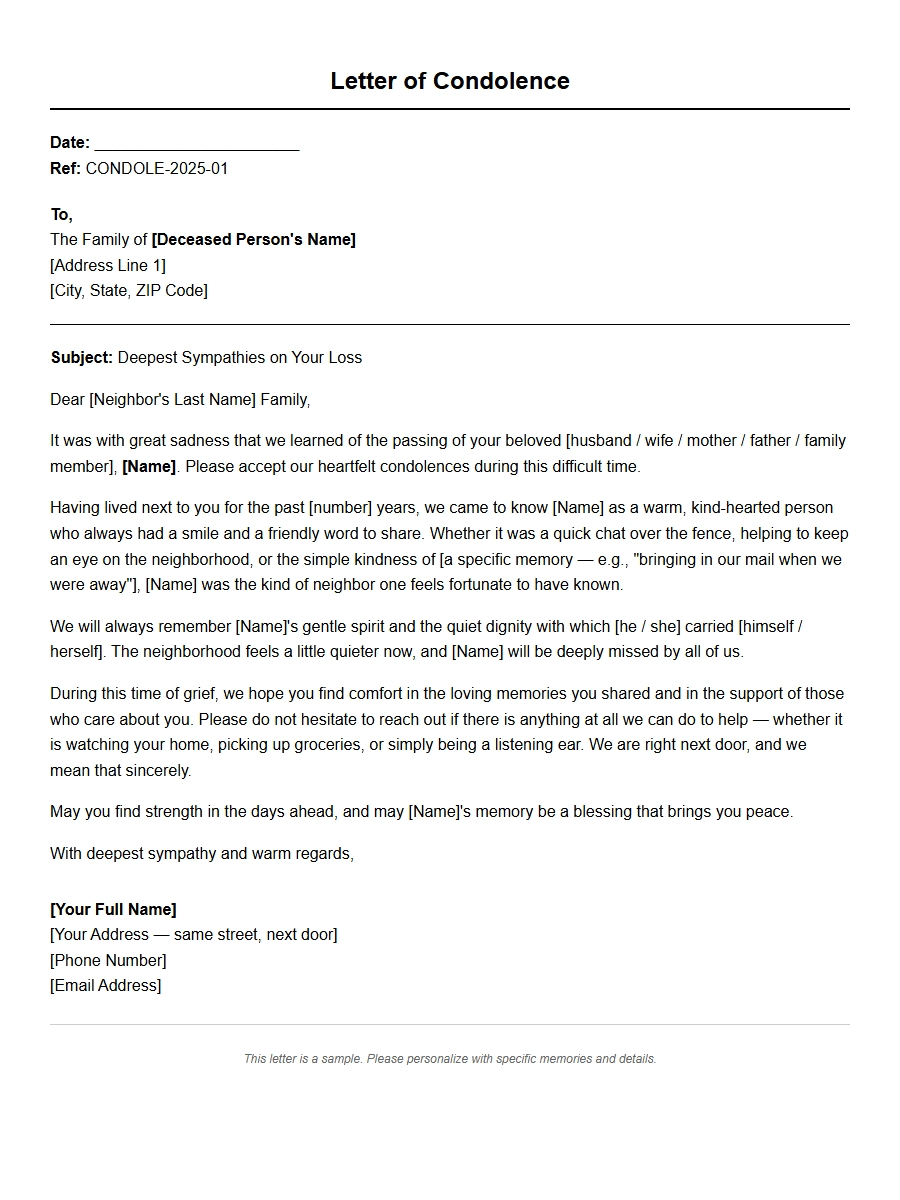 Condolence Letter Sample for a Neighbor
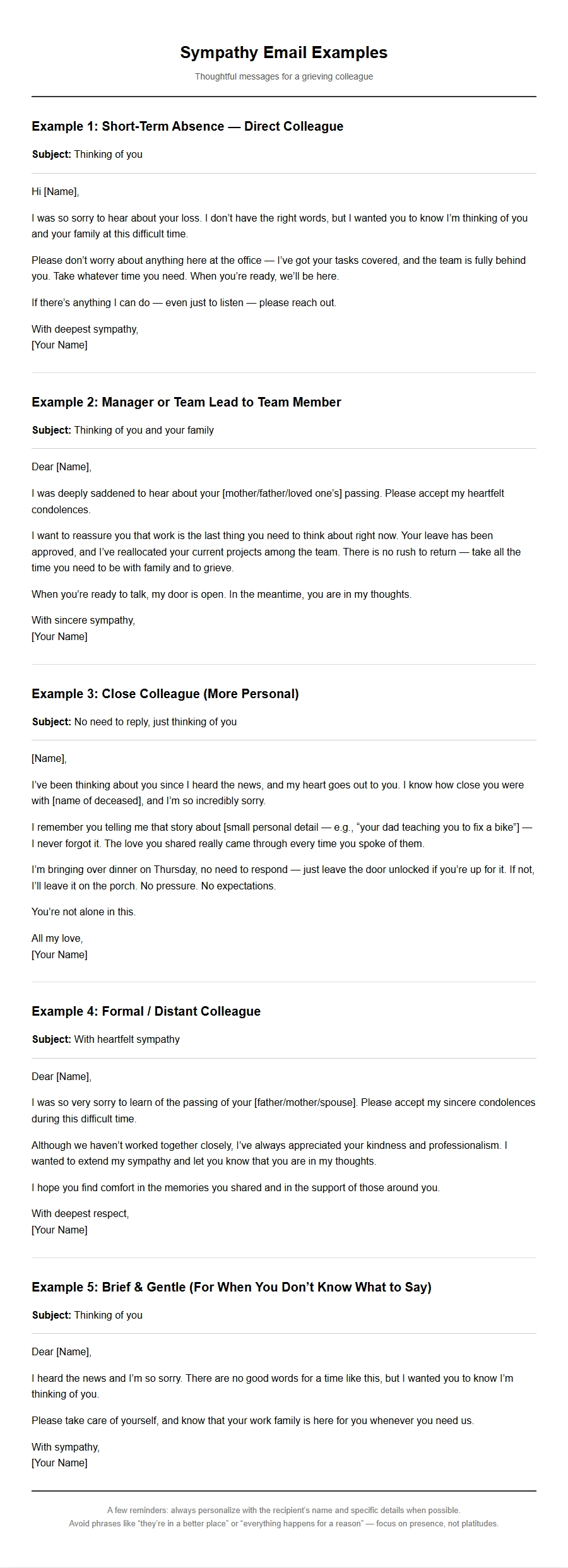 Sympathy Email Examples for a Grieving Colleague
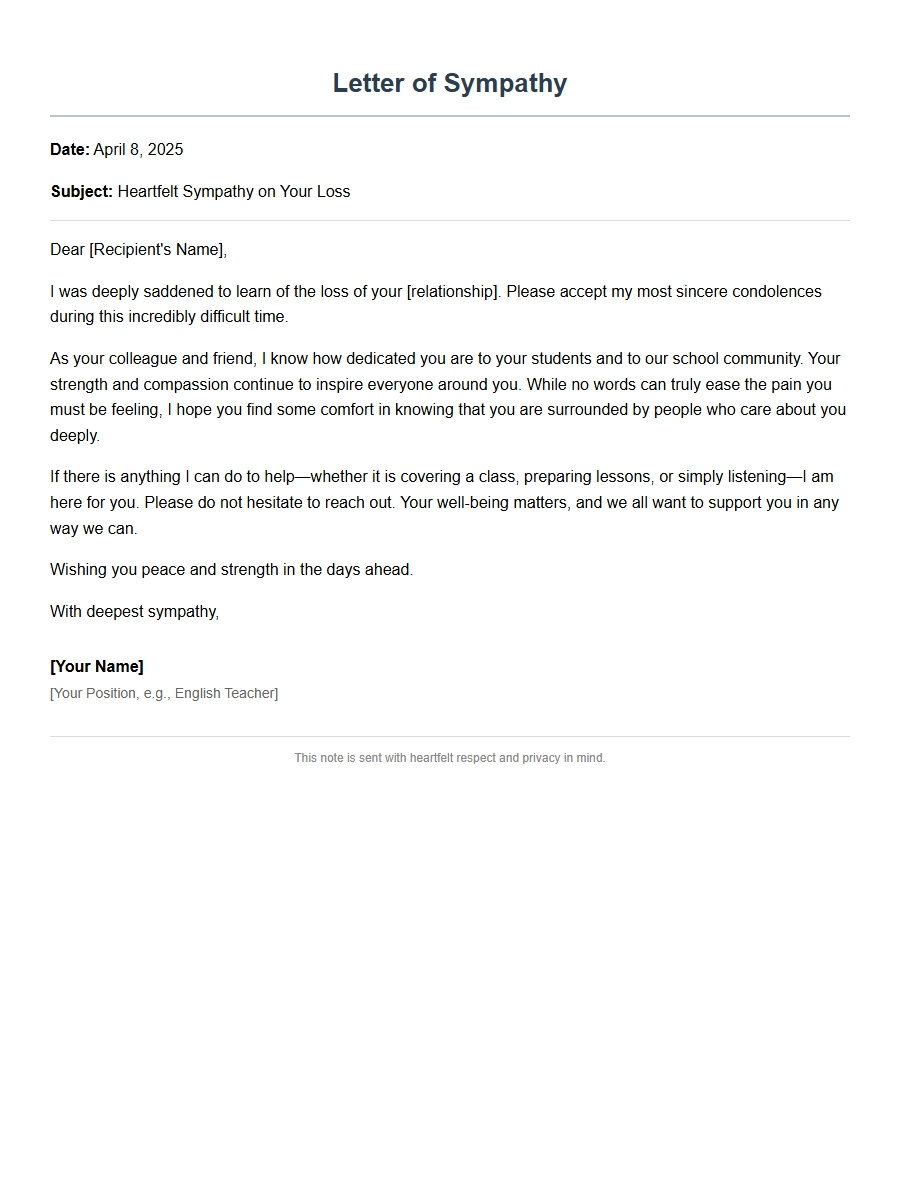 Condolence Words for a Teacher