You’ve reset the modem, checked every coax cable, and spent another evening buffering through a show that should have streamed perfectly. When your cable internet drops out for the third time this week, you don’t just want a fix—you want the company to know this isn’t acceptable. Writing a letter about recurring outages might feel like shouting into the void, but a clear, professional notification can actually get you a credit on your bill and a technician who takes the issue seriously.
Why writing a letter works better than a phone call
Phone support is built to handle simple problems. Recurring outages are not simple. When you call, you often start from scratch with each agent. A written letter—sent via email or customer portal—creates a record. It shows you’ve documented the problem. And a well-structured complaint letter, adapted from a solid template, forces you to include the details a technician actually needs: dates, times, what you’ve already tried, and what the company promised but didn’t deliver.
Using a sample isn’t cheating. It’s smart professional correspondence. A good sample gives you the right business letter format, a proper salutation and closing, and the kind of tone in writing that gets read instead of ignored. You just adapt it with your specific outage log and the frustration you’re feeling. That’s the difference between a form email and a real request for action.
Choosing the right letter structure for your situation
Start by deciding how formal you need to be. If you’re dealing with a regional provider you’ve had good service with for years, a semi-formal note works fine. If your cable company is a national giant and you’ve been bounced between departments, go with a more structured complaint. The key is to match your letter structure to the severity of the problem.
Most outage complaints follow this flow:
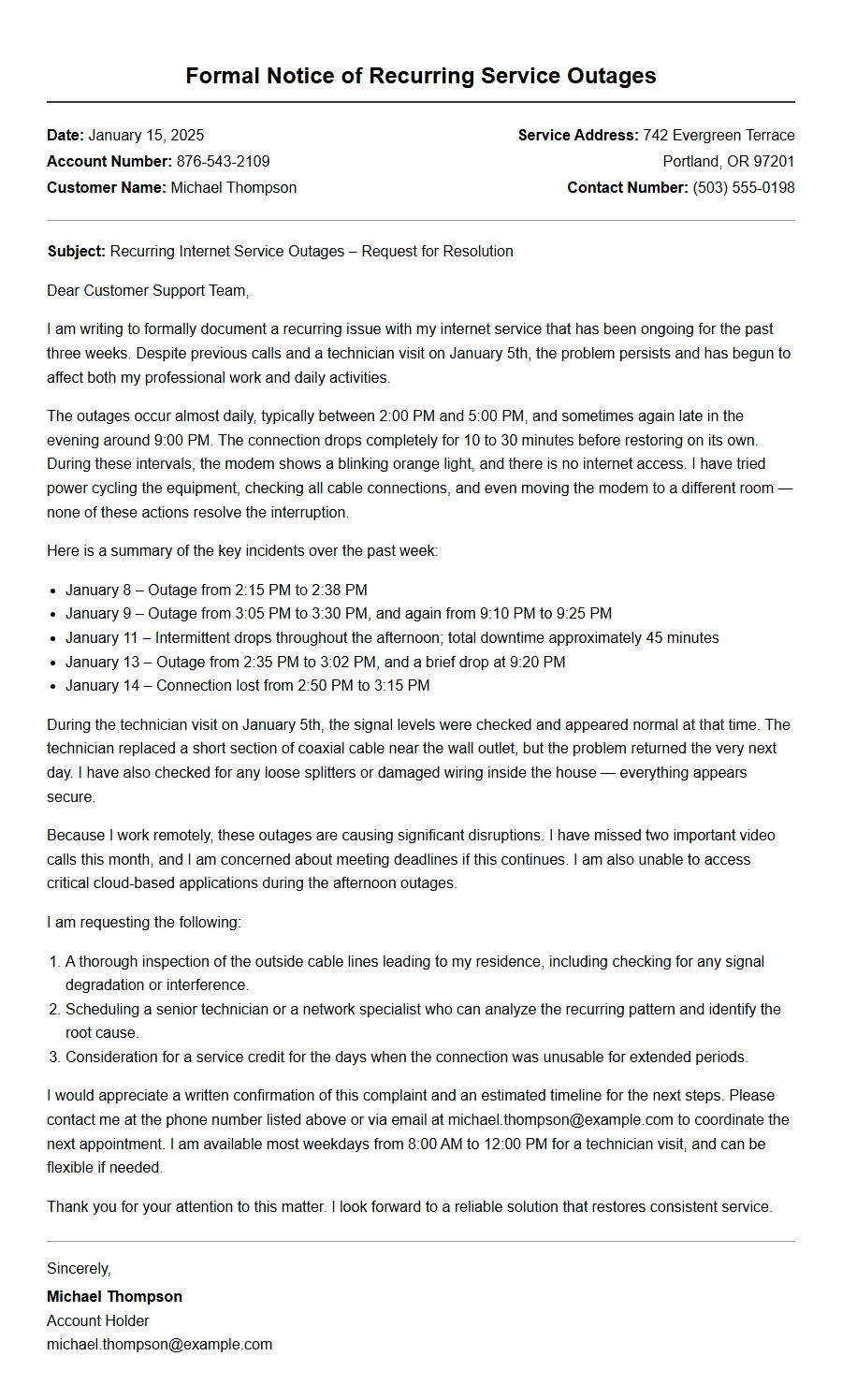
State the purpose clearly in the first sentence. “I’m writing to document repeated service outages at my address.”
List specific dates and times of outages. Include how long each lasted.
Mention what troubleshooting you’ve done (restarted modem, checked connections, ran a speed test).
Reference any previous contact with support, including case numbers or names of reps you spoke to.
State what you want: a bill credit, a technician visit, or a follow-up plan.
End with a clear request for a response by a certain date.
Don’t forget the basics of digital letter format. Use a subject line like “Recurring Service Outages – [Your Account Number] – Request for Credit.” Keep paragraphs short. Proofread your letter before sending—typos make your complaint look less serious.
Adapting a sample without sounding like a robot
This is where most people get stuck. You find a great letter template online, but when you fill in the blanks it sounds stiff. Fix that by reading your draft out loud. If you wouldn’t say it that way in a calm conversation with a customer service manager, rewrite it.
For example, a generic template might say, “I respectfully request a full credit for the period of service disruption.” That’s fine, but you could say, “I’d like a credit for the days my internet was down—I’ve been paying for speeds I’m not getting.” Both are professional. The second one sounds like you wrote it.
Pay attention to your salutation and closing. “To Whom It May Concern” is outdated. Use “Dear Customer Service Manager” or “Dear [Company Name] Billing Department.” Close with “Sincerely” or “Best regards,” plus your full name, account number, and phone number. This follows proper letter writing etiquette and makes it easy for them to find your account.
Common mistakes that weaken your complaint
The biggest mistake is being too vague. “My internet goes out all the time” doesn’t give them anything to work with. “My internet dropped at 8:15 PM on October 12 and didn’t return until 9:42 PM—this is the fifth outage in two weeks” gives them a pattern to investigate.
Another mistake is ignoring formatting. If you’re sending a printed letter, use a simple letterhead design with your name and address at the top. If you’re emailing, skip the letterhead and put a clear subject line. A wall of text in either format will get skimmed, not read.
Also avoid emotional language. You’re frustrated—that’s understandable. But a letter that says “Your service is terrible and your company is useless” will get a defensive response. Stick to facts. “The outages are affecting my ability to work from home” is more effective than “I’m so sick of this garbage service.” The facts speak for themselves.
If your provider keeps giving you the runaround, you might want to look at examples of other types of formal complaints to see how a firm but fair tone works. For example, a complaint letter about landlord repairs follows a similar structure—list the problem, reference past conversations, and clearly state what resolution you expect. The same approach applies here.
Dealing with billing errors from your cable company can also feel like a dead end. A grievance letter for a medical billing error shows how detailed documentation and a calm request for correction gets results. That same strategy works when you’re asking for a service credit.
What to do after you send the letter
Give them a reasonable time to respond—usually five to seven business days. If you don’t hear back, send a follow-up referencing your original letter. Keep copies of everything. If the problem persists and the company won’t help, you have a documented trail that makes it easier to escalate to your state’s public utilities commission or the FCC.
In some cases, the issue isn’t just equipment but the provider’s infrastructure. If you’ve done everything right and the outages continue, you might need to consider switching providers. But a well-written letter can often get you a technician who actually looks at the lines feeding your house, not just the modem in your living room.
Writing this kind of letter gets easier the more you do it. Think of the sample as your starting point—something that handles the structure so you can focus on the facts. After a couple of times, you’ll know exactly what to include and how to phrase it. A diplomatic approach to vendor issues often gets you further than aggressive demands, and this is no exception.
Next time your screen freezes mid-stream, you won’t have to stare at a blank page. You’ll know what to write, how to say it, and where to send it. That’s the whole point of using a sample the right way—it turns frustration into action.
Useful Formats
Sample Letter for Recurring Cable Outages
Formal Request for Service Credit
Dear Cable Provider Customer Service,
I am writing to formally request a service credit due to recurring outages that have severely disrupted my service over the past month. My account number is 987654321 and my service address is 123 Oak Street, Anytown.
Below is a log of the outages I have experienced:
Date
Start Time
Duration
Service Affected
Feb 3
7:15 PM
3 hours
Internet & TV
Feb 8
10:30 AM
1.5 hours
Internet
Feb 12
6:00 PM
4 hours
All services
Feb 18
8:45 AM
2 hours
Internet & phone
I expect a credit of at least $50 for the total downtime of over 10 hours. Please confirm receipt of this request and the adjustment to my next bill.
Sincerely, John Smith john.smith@email.com | (555) 123-4567
Urgent Notice of Repeated Disruptions
Attention: Customer Relations Department,
This is an urgent notice regarding repeated service outages at my residence (account # 456789012). Over the last two weeks, my internet has cut out daily between 5 PM and 9 PM, each time lasting 30 to 90 minutes. This pattern has made it impossible for me to work remotely or attend online classes.
Please escalate this issue immediately. I have already called three times and was told it would be fixed, but nothing has changed.
Outage recurrence: Every evening since Feb 10
Typical duration: 45–90 minutes
Impact: Work, school, streaming
I need a technician to inspect the line and a firm timeline for resolution. If this is not addressed within 48 hours, I will file a complaint with the state utility commission.
Regards, Maria Gomez (555) 987-6543
Detailed Outage Log and Compensation Request
To Whom It May Concern,
I am documenting the recurring outages affecting my cable and internet service (account # 789012345) over the past three weeks. Despite several calls to support, the issue persists. I request compensation equivalent to the total downtime.
Outage details are listed below:
Date
Duration
Loss of Internet
Loss of TV
Feb 19
2h 15m
Yes
Yes
Feb 21
1h 45m
Yes
No
Feb 22
3h 00m
Yes
Yes
Feb 25
2h 30m
Yes
Yes
Feb 27
0h 50m
Yes
No
Total downtime: over 10 hours. According to your service guarantee, I am entitled to a credit of $5 per hour for downtime exceeding 2 hours per month. Please apply this to my account and notify me of the adjustment.
Thank you, David Chen
Follow-Up After Unresolved Outages
Dear Support Team,
I am following up on my previous complaint (reference # CR45678) about recurrent outages that have continued since my initial call on February 10. I was assured a senior technician would visit, but no appointment was made.
Since then, I have experienced:
February 20: full outage from 6 PM to 11 PM
February 22: intermittent dropouts every 15 minutes from 2 PM to 8 PM
February 24: no service from 9 AM to noon
This is unacceptable. I have a home-based business and have lost income. I need immediate, permanent resolution. Please send a technician this week and confirm the date. Additionally, I expect a credit of $75 for the accumulated disruptions.
Please respond by end of business tomorrow with a concrete action plan.
Best, Sarah Williams (555) 111-2222
Request for Technician Visit Due to Recurring Issues
Customer Service,
I am requesting an urgent technician visit to diagnose and fix the recurring outages affecting my cable and internet service (account # 321654987). The outages have occurred at least twice a week for the past month, always in the afternoon and often lasting several hours.
I have already performed basic troubleshooting (reset modem, checked cables) but the problem persists. My suspicion is a faulty drop line or neighborhood node issue. I want a full line test and, if needed, replacement of the modem or cabling.
Available time slots for the technician: Monday–Friday, 9 AM to 5 PM. Please schedule the earliest possible appointment and send a confirmation. If the issue is due to external factors, please provide an estimated resolution date.
Additionally, please note my account for a credit once the issue is resolved, as I have lost service for over 15 aggregate hours in the last 30 days.
Thank you, James King (555) 333-4444
Complaint About Lack of Communication
To the Manager,
I am writing to express my frustration not only with the recurring outages but also with the lack of communication from your company. My account # 654321789 has suffered outages every 2–3 days since the start of February. I have called four times and was promised updates that never came.
Here is a summary of my calls and responses:
Date of Call
Promise Made
Outcome
Feb 5
“Check within 24h”
No contact
Feb 12
“Escalated to engineering”
No reply
Feb 19
“Technician will call”
No call
Feb 26
“Credit applied”
Not on bill
I demand a clear, written explanation of the root cause, a timeline for permanent repair, and immediate application of a service credit for all outages. I also expect proactive notifications going forward. Please treat this as a formal complaint.
Sincerely, Laura Banks (555) 777-8888
Notice of Intent to Cancel Service
Dear Retention Department,
I am writing to notify you that due to persistent and unresolved service outages, I intend to cancel my account (# 876543210) effective 14 days from today, unless the issues are resolved satisfactorily.
In the past 30 days, I have logged the following outages:
Internet down: 8 separate occurrences, total ~18 hours
TV service interruptions: 4 occurrences, total ~6 hours
Phone service unreliable: 3 occurrences
I have repeatedly reported these problems (calls on Feb 2, 9, 16, 23) but received no lasting fix. I cannot continue paying for unreliable service. My options are to switch to competitor X or use mobile hotspot.
If you wish to retain me as a customer, I require: - A visit from a senior technician within 3 days - Full account credit for the past month’s service - A written guarantee of 99% uptime going forward
Failure to meet these conditions will result in cancellation. Please send a representative to discuss.
Regards, Robert Liu (555) 555-1212
Billing Dispute Due to Unreliable Service
Accounts Department,
I am disputing my current bill (invoice # INV-2024-0315) for the amount of $129.99 for the period February 1–29, 2024. I refuse to pay full price for service that was unavailable for a significant portion of that month due to recurring outages.
My account # is 246813579. The outages experienced are as follows:
Date
Duration
Service
Feb 5
3h
Internet
Feb 7
1h
TV
Feb 10
4h 30m
All
Feb 14
2h
Internet
Feb 18
5h
All
Feb 22
2h 15m
Internet
Feb 26
3h
All
Total downtime: nearly 21 hours. According to your policy, I am owed a credit of $42 (based on $2/hour for internet + $1/hour for TV). I request that the bill be adjusted to $87.99. Please reverse any late fees and confirm the correction.
Thank you, Anna Martinez
Request for Equipment Replacement
Technical Support,
I am contacting you about account # 159357246 to request replacement of my cable modem and router due to ongoing, daily dropouts. For the past two weeks, my connection drops for 10–15 minutes every hour, beginning around 3 PM and lasting until midnight. I have run speed tests and captured logs showing the modem resets repeatedly.
I have already tried:
Power cycling the modem (multiple times)
Checking for loose coaxial connections
Using a different power outlet
Connecting directly via Ethernet (still drops)
The equipment I have is a manufacturer A modem (model X1) and a standard wireless router. It is likely faulty or outdated. Please authorize a free replacement of both units, or send a technician to install a new modem and test the signal strength from the tap.
If the equipment is not the issue, I need a full line test and resolution of the recurring outages. Please schedule a technician visit at your earliest convenience.
Best regards, Kevin Johnson (555) 222-3333
Summary of Outages Over Past Month
Dear Customer Relations,
As a long‑time customer (account # 741852963), I am deeply disappointed by the recurring outages I have endured over the past month. I have compiled a comprehensive summary of every service interruption in February 2024 to demonstrate the severity of the problem.
Date
Start
End
Type
Impact
Feb 2
4:00 PM
6:45 PM
Internet
Work
Feb 4
8:15 PM
10:30 PM
TV
Entertainment
Feb 7
11:00 AM
12:20 PM
All
Home office
Feb 9
3:30 PM
5:00 PM
Internet
Online class
Feb 11
6:00 AM
8:00 AM
All
Morning news
Feb 13
9:45 PM
11:15 PM
Internet
Streaming
Feb 15
2:00 PM
3:30 PM
TV+Internet
Kids’ shows
Feb 18
7:30 PM
9:00 PM
All
Evening use
Feb 22
12:00 PM
2:00 PM
Internet
Work
Feb 26
5:15 PM
7:45 PM
All
Dinner time
I request a full investigation and long‑term fix, plus a 50% credit on my next bill. Please contact me to discuss the resolution.
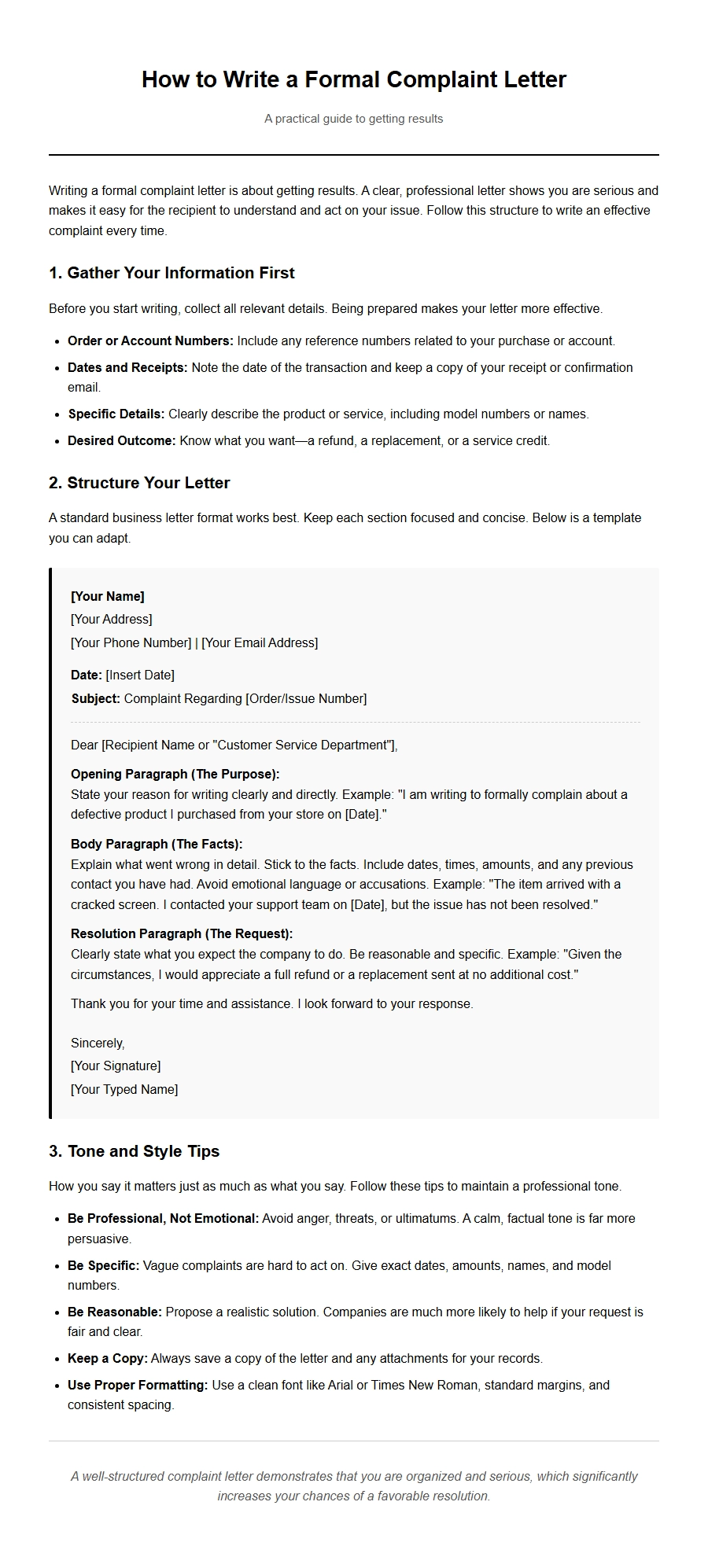 How to Write a Formal Complaint Letter
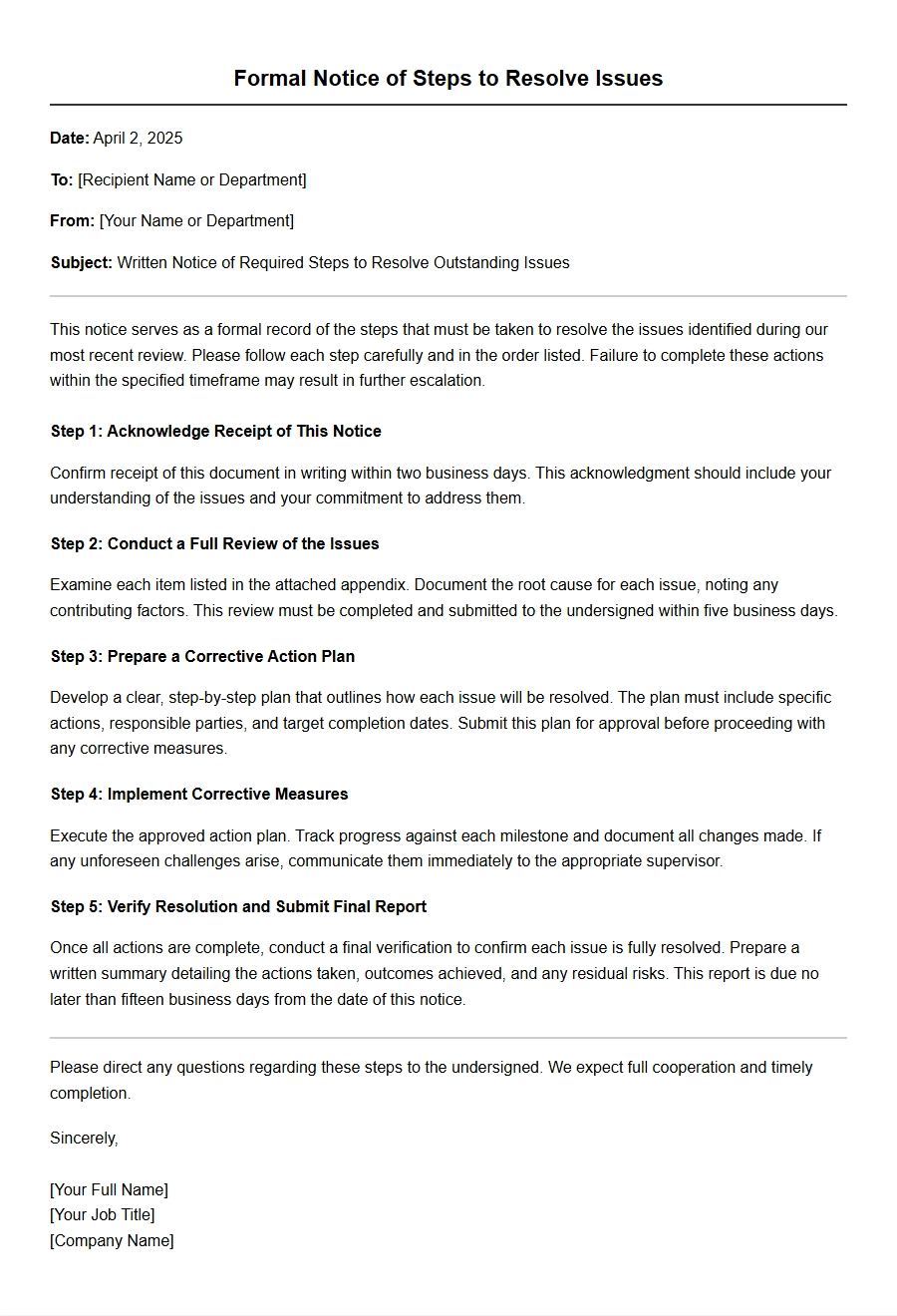 Steps to Resolve Issues via Written Notice
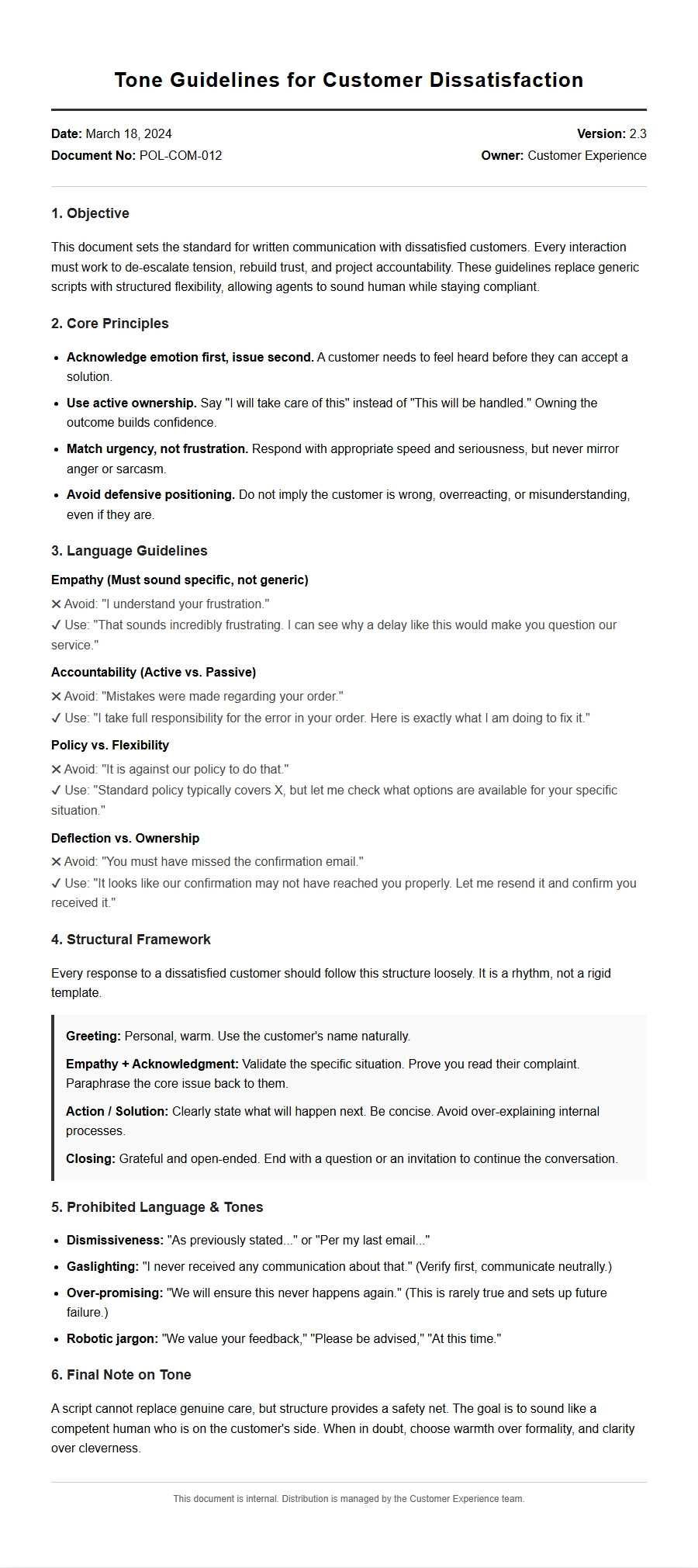 Tone Guidelines for Dissatisfied Customer Letters
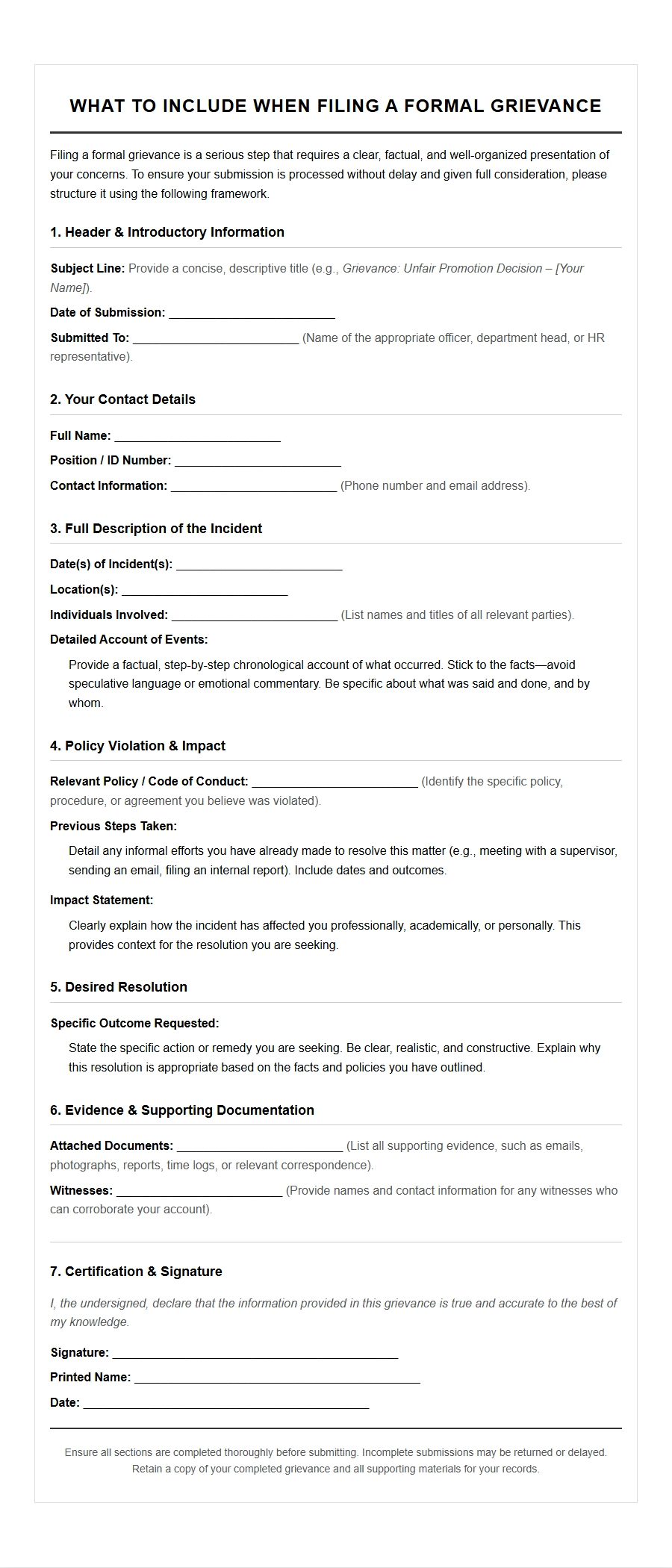 What to Include in a Formal Grievance Letter
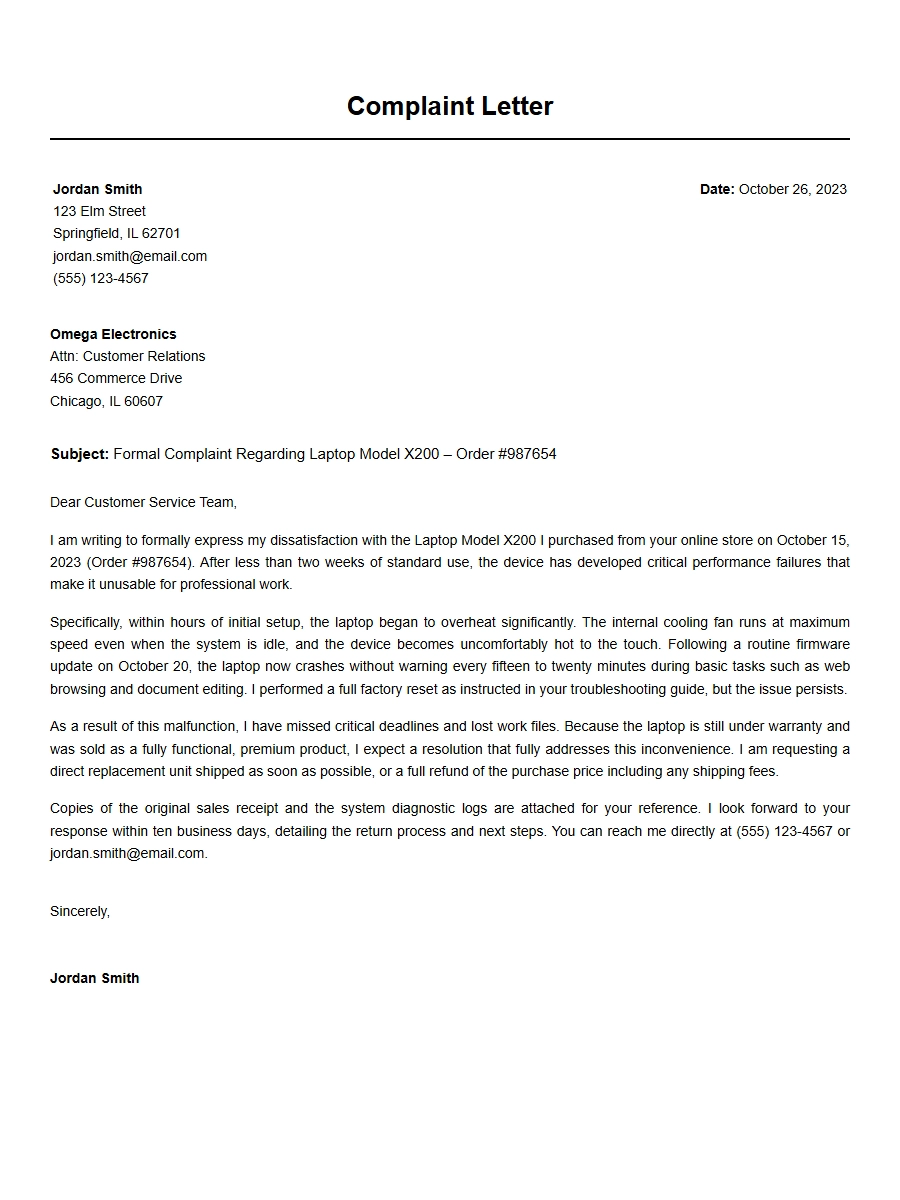 Structure of an Effective Complaint Letter
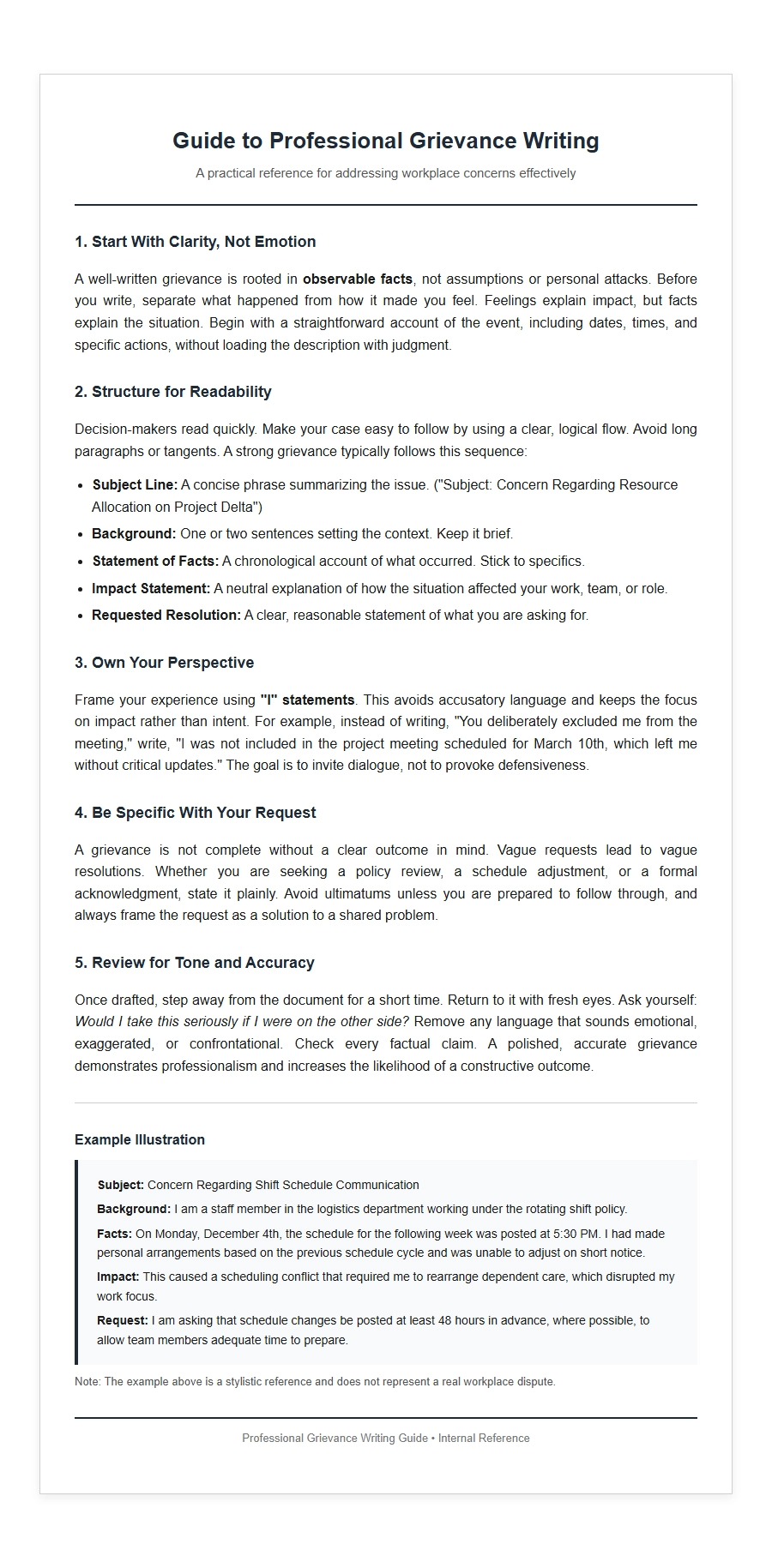 Best Practices for Writing Professional Grievance Letters