You've asked for that broken heater to be fixed three times. Now it's cold, you're frustrated, and the thought of writing one more email makes you want to scream. Staring at a blank page when you need to write a professional complaint letter about landlord repairs can feel paralyzing—but the right template turns that anxiety into a confident, polished draft in minutes.
Using a sample isn't cheating. It's a smart strategy. A good complaint letter template gives you the structure, tone, and key phrases you need while leaving plenty of room for your specific details. You don't have to reinvent professional correspondence every time. And when you're already angry or stressed, having a starting point keeps you from saying something you'll regret.
Category: Renters' Rights & Documentation
Why a template works for landlord repair requests
A repair request letter is a formal piece of business correspondence. It sets the tone for how seriously your landlord takes the issue. If you write something too casual, they might brush it off. If you write something overly legal, you could damage the relationship unnecessarily. A well-designed complaint letter template helps you strike the right balance: clear, firm, and professional without being hostile.
Formal writing tips like keeping a respectful salutation and closing matter here. Avoid outdated greetings like "To Whom It May Concern" unless you have no name. Instead, use "Dear [Landlord Name]" or "Dear [Property Manager]." The right letter writing etiquette shows you're serious but reasonable.
How to pick the right sample for your situation
Not all templates are created equal. For a landlord repair letter, you want something that includes space for the date, address, description of the issue, prior attempts to contact, and a clear request for action. Avoid templates that are too generic—like those meant for general customer complaints. Your letter should feel specific to housing, not a retail complaint.
Consider the tone. If you've had a good relationship until now, a semi-formal tone is fine. If the landlord has ignored you for weeks, you might need a firmer, more structured document. A customizable letter template lets you adjust the voice. You can start polite and escalate in later follow-ups.
Adapting a template without losing your voice
Once you have a sample, don't just copy it word for word. Read it through once. Then rewrite it in your own words while keeping the letter structure intact. The opening paragraph should grab attention—mention the specific repair, how long it's been pending, and the impact (e.g., "The heating has been broken for 10 days, and the indoor temperature is below 55°F"). That immediate detail shows you're not exaggerating.
A common mistake is ignoring the format for digital delivery. If you're sending an email, you don't need a full letterhead design—just a clear subject line ("Urgent: Repair needed at [address] – [issue]"). If you're printing and mailing, use a simple letterhead with your name and address at the top. For digital letter format, keep paragraphs short and avoid attachments unless requested; paste the letter into the email body so it's easy to read.
Tone in writing: firm but not aggressive
You want to sound authoritative without being rude. Phrases like "I require this repair to be completed within 14 days as per our lease" work better than "Fix this now or else." Use "request" or "expect" instead of "demand." Keep the focus on the problem, not the person. If you need to reference local housing laws, do it calmly—link to a resource like pre-litigation complaint notice requirements if you're ready to take a legal step.
Proofreading is essential. Read your letter out loud. Check for typos, especially in dates and addresses. A sloppy letter undermines your message. Have someone else look it over if you can.
Examples of when to use other complaint letter structures
The best complaint letters feel both professional and personal. A template gives you a skeleton. You fill in the flesh with your facts, your voice, and your specific situation. Don't be afraid to revise it. The more you write these letters, the faster the process becomes. And one day you'll look at a blank page and know exactly where to start.
Everyday Writing Examples
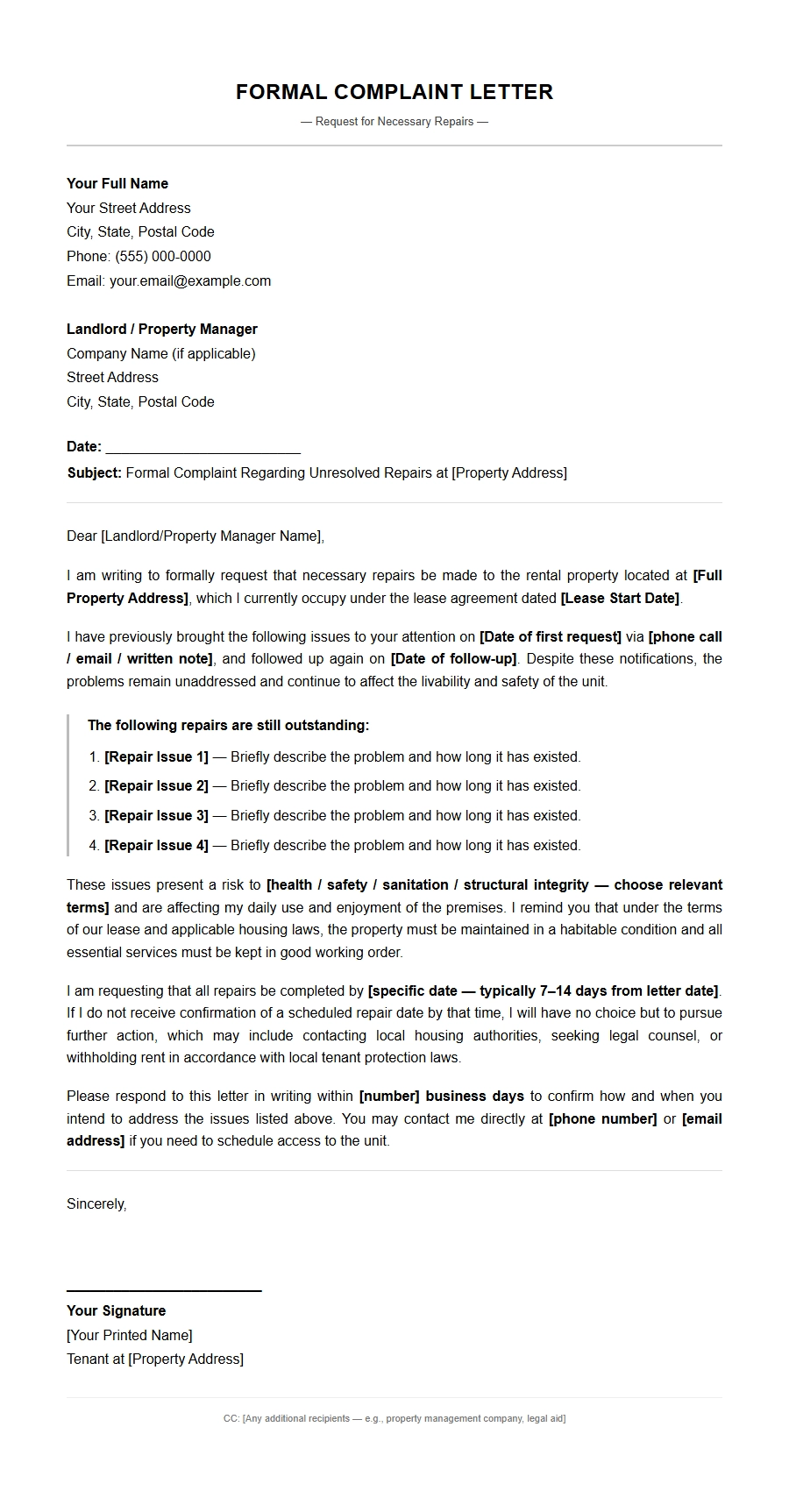
Complaint Letter Template for Landlord Repairs
Standard Repair Request Letter
[Your Name] [Your Address] [City, State, ZIP]
[Date]
[Landlord Name] [Landlord Address]
Dear [Landlord Name],
I am writing to formally request repairs at [Your Address], unit number [Unit Number]. The following issues have persisted despite my previous verbal requests on [Date of First Request]:
Leaking faucet in the kitchen
Broken window latch in the living room
Non‑functional heating in the master bedroom
These problems affect my daily living and the habitability of the unit. I kindly ask that you arrange for repairs within [Number] days as required by [State/City] landlord‑tenant law.
Please contact me at [Your Phone Number] or [Your Email] to schedule a convenient time for the contractor to enter. I look forward to your prompt response.
Sincerely, [Your Name]
Urgent Complaint for Emergency Repair
[Your Name] [Your Address] [City, State, ZIP]
[Date]
[Landlord Name] [Landlord Address]
Dear [Landlord Name],
This is an urgent complaint regarding a complete loss of heat in my apartment, [Apartment Number], at [Your Address]. The outside temperature has dropped below freezing, and the indoor temperature is currently [Temperature] degrees Fahrenheit. This situation poses a serious health risk, especially to my young child and elderly parent living here.
I have attempted to contact you by phone multiple times today but have received no response. Under [State/City] law, emergency repairs must be addressed within 24 hours. I am asking that you dispatch a licensed HVAC technician immediately.
If I do not hear from you by [Time] today, I will have no choice but to contact the local housing authority and arrange for an emergency repair myself, with costs deducted from next month’s rent.
Please call me at [Your Phone Number] as soon as possible.
Thank you, [Your Name]
Follow-Up Complaint After Ignored Request
[Your Name] [Your Address] [City, State, ZIP]
[Date]
[Landlord Name] [Landlord Address]
Dear [Landlord Name],
I am writing to follow up on my repair request sent on [Previous Date]. To date, no action has been taken. The unresolved issues include:
Mold growth in the bathroom ceiling
Dripping shower head that will not stop
Rodent droppings found in the kitchen
These conditions are worsening and are affecting my health and safety. I asked for repairs to be completed by [Deadline Date], and that deadline has passed.
Pursuant to [State] Civil Code [Section], I am providing you with an additional [Number] days to begin the work. If repairs are not started by [New Deadline], I will deduct the cost from rent or pursue legal remedies, including contacting code enforcement.
I expect a written response confirming when a contractor will be sent.
Sincerely, [Your Name]
Complaint with Detailed Repair Table
[Your Name] [Your Address] [City, State, ZIP]
[Date]
[Landlord Name] [Landlord Address]
Dear [Landlord Name],
Please address the following repair items in my unit at [Your Address], apartment [Unit Number]. I request that all work be completed within [Number] days.
Item
Location
Issue
Priority
1
Kitchen
Garbage disposal jammed
High
2
Bathroom
Toilet runs continuously
Medium
3
Living room
Ceiling crack from water leak
High
4
Bedroom
Outlet sparks when used
High
I have previously notified you by email and phone. A timely response is expected. You may contact me at [Your Phone Number] to arrange access.
Regards, [Your Name]
Complaint Regarding Mold and Health Hazard
[Your Name] [Your Address] [City, State, ZIP]
[Date]
[Landlord Name] [Landlord Address]
Dear [Landlord Name],
I am writing to notify you of a serious mold infestation in my unit, [Apartment Number], at [Your Address]. Black mold has been growing in the bathroom and closet for at least [Number] weeks. My family and I are experiencing allergy symptoms, and my asthma has worsened since the mold appeared.
I previously reported the leak behind the toilet on [Date], and the leak was fixed, but the resulting moisture was never properly remediated. I have attached photos and a physician’s note confirming the health impact (if applicable).
Under [State] law, mold that threatens health constitutes a failure to maintain habitability. I request that you hire a licensed mold remediation company within [Number] days to assess and remove the contamination.
If this is not addressed swiftly, I will seek assistance from the local health department.
Please reply with your plan by [Date].
Sincerely, [Your Name]
Complaint with Rent Withholding Notice
[Your Name] [Your Address] [City, State, ZIP]
[Date]
[Landlord Name] [Landlord Address]
Dear [Landlord Name],
This letter serves as official notice that I am exercising my right to withhold rent due to your failure to make needed repairs at [Your Address]. The following conditions remain unresolved since my request on [Date of Original Request]:
No hot water for [Number] days
Broken refrigerator causing food spoilage
Multiple broken locks on exterior doors
These conditions significantly reduce the habitability of the unit. In accordance with [State] law, I will place the full rent amount of [Rent Amount] into an escrow account starting [Date]. The funds will be released once all listed repairs are completed and inspected by the housing authority.
You are required to complete the repairs within [Number] days. After that, I may terminate the lease or take further legal action.
Please respond in writing acknowledging receipt of this notice.
Respectfully, [Your Name]
Complaint for Major Appliance Repairs
[Your Name] [Your Address] [City, State, ZIP]
[Date]
[Landlord Name] [Landlord Address]
Dear [Landlord Name],
I am writing about the failure of two major appliances in my apartment, [Unit Number], at [Your Address]. The following appliances are included in my lease as provided amenities and are not functioning:
Appliance
Model
Issue
Reported On
Refrigerator
[Brand/Model]
Not cooling; temperature is [temp]
[Date]
Stove/Oven
[Brand/Model]
Burner and oven do not ignite
[Date]
I have been without a working refrigerator for [Number] days, causing loss of groceries. The malfunctioning stove prevents me from cooking meals. These appliances are essential for daily living.
I request that you arrange for repair or replacement within 48 hours. If you cannot complete the repair yourself, please authorize a professional technician to enter my unit after coordinating with me at [Phone Number].
Thank you for your prompt attention.
Sincerely, [Your Name]
Complaint for Pest Infestation
[Your Name] [Your Address] [City, State, ZIP]
[Date]
[Landlord Name] [Landlord Address]
Dear [Landlord Name],
I am writing because my apartment, [Unit Number] at [Your Address], has a severe pest infestation. Over the past week I have seen:
Cockroaches in the kitchen and bathroom
Mice droppings in cabinets and near baseboards
Ant trails along the living room wall
I have kept the unit clean and sealed food, yet the problem continues. This violates the warranty of habitability and puts my family at risk for disease.
I request that you hire a licensed pest control company to treat the unit and perform exclusion work. I also ask that adjacent units be inspected, as the infestation likely originates from common areas.
Please schedule treatment within [Number] days and confirm the date by [Date]. I will be available to allow access after [Time].
Failure to act will result in a complaint to the health department.
Regards, [Your Name]
Complaint for Structural Issues (Leaking Roof)
[Your Name] [Your Address] [City, State, ZIP]
[Date]
[Landlord Name] [Landlord Address]
Dear [Landlord Name],
I am writing to report a leaking roof in my unit, [Unit Number], at [Your Address]. During the recent rain on [Date], water entered through the ceiling above the living room. The damage includes:
Water stains covering approximately [Area] sq. ft.
Peeling paint and bulging plaster
A musty smell consistent with ongoing moisture
This is a structural issue that may worsen and could lead to mold or electrical hazards. I reported this to your maintenance office on [Date] but no action was taken.
I request that a licensed roofer inspect and patch the leak within [Number] days. Additionally, the interior ceiling must be dried, treated for mold, and repaired. I expect written confirmation of the scheduled work.
If you fail to respond, I will consider this a breach of habitability and will exercise my legal remedies, including repair‑and‑deduct.
Sincerely, [Your Name]
Complaint for Lack of Essential Services (Elevator/Security)
[Your Name] [Your Address] [City, State, ZIP]
[Date]
[Landlord Name] [Landlord Address]
Dear [Landlord Name],
I am writing concerning two essential services that are not functioning in my building, [Building Name/Address], apartment [Unit Number].
Service
Issue
Duration
Elevator
Out of service
[Number] days
Intercom / Security door
Buzzer not working; front door does not lock
[Number] days
As a tenant on the [Floor Number] floor, I cannot easily carry groceries or laundry up the stairs. The broken security door leaves the building vulnerable to unauthorized entry, posing a safety risk for residents.
I request that you schedule repairs immediately. If the elevator repair requires parts that are on order, please provide a written timeline. For the security door, please assign an emergency repair.
I look forward to your response by [Date]. Thank you.
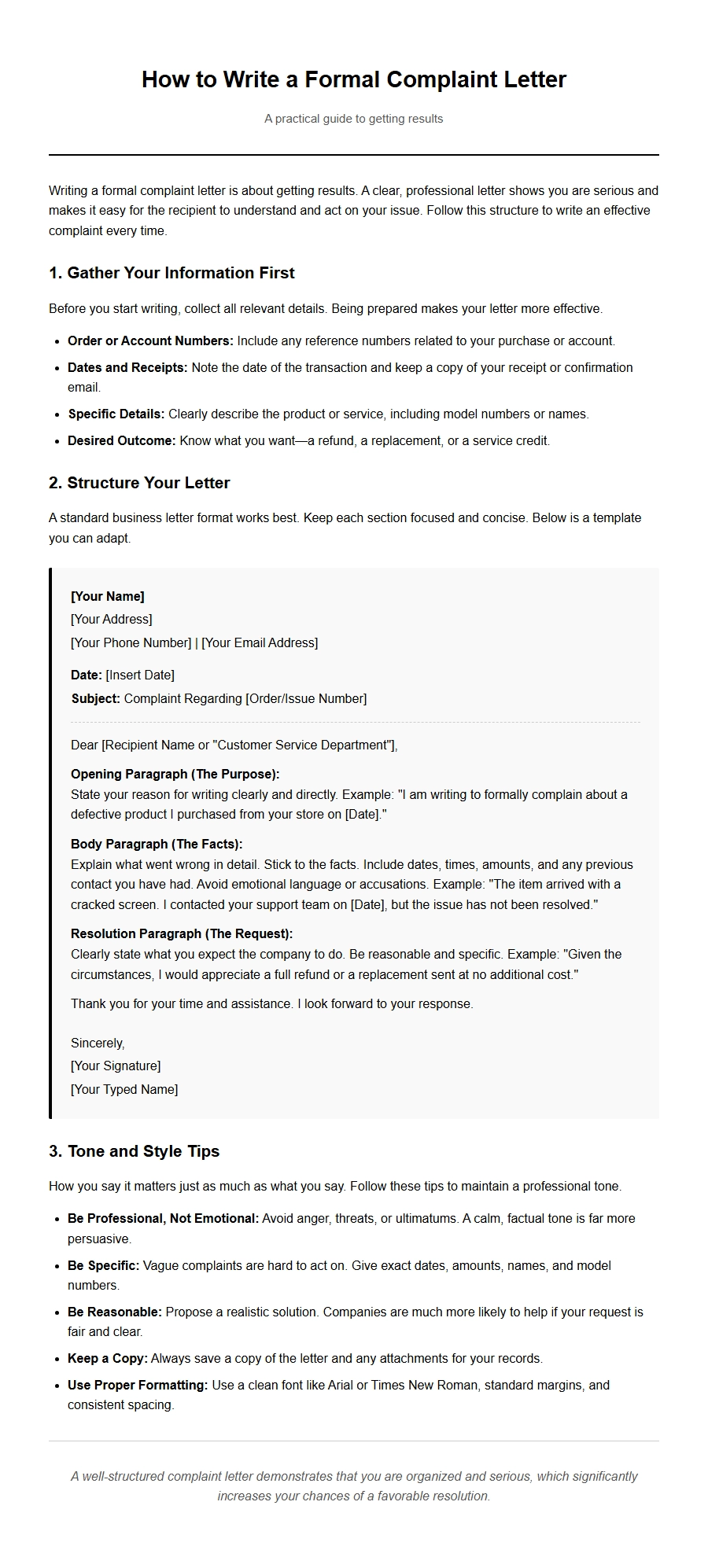 How to Write a Formal Complaint Letter
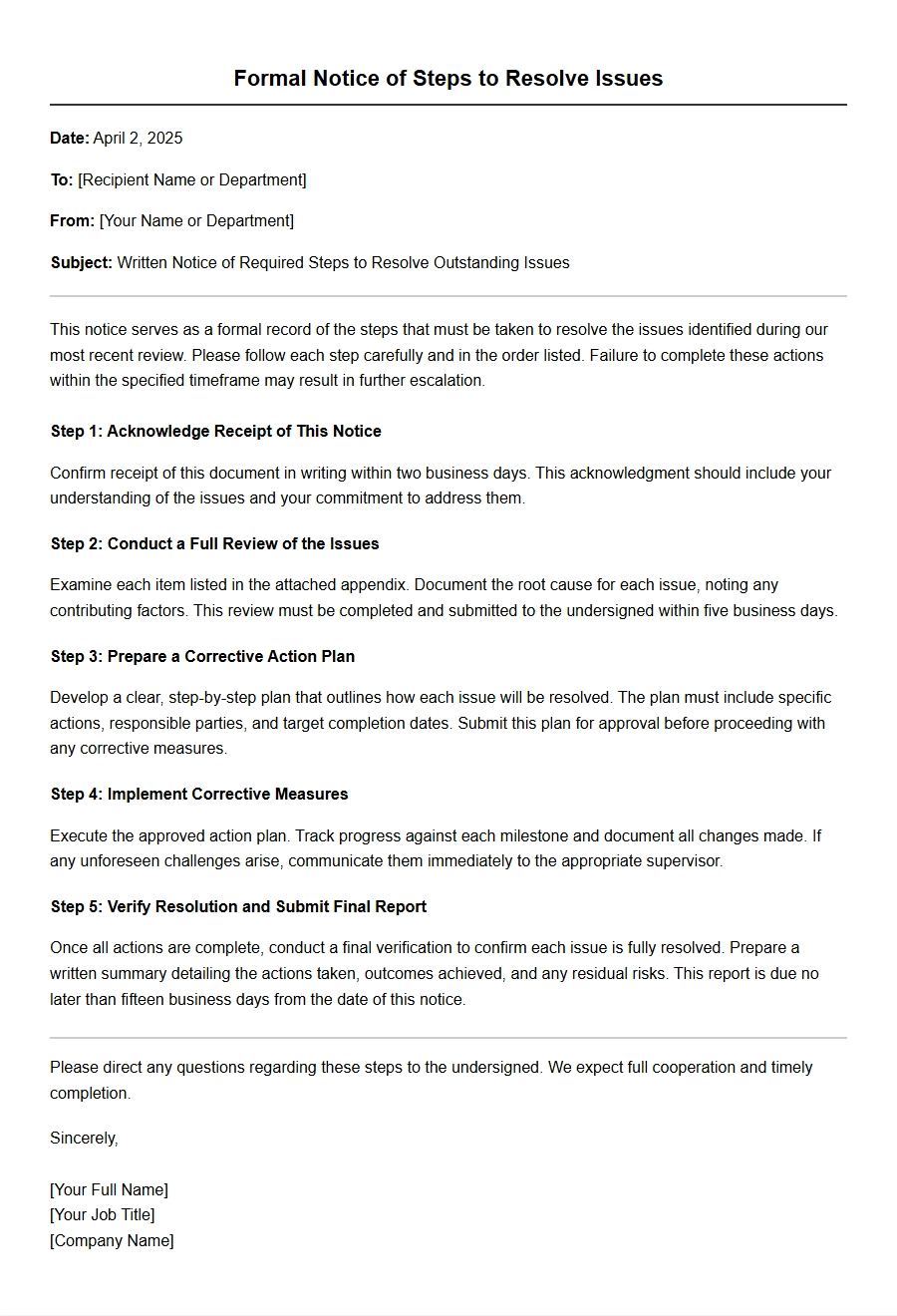 Steps to Resolve Issues via Written Notice
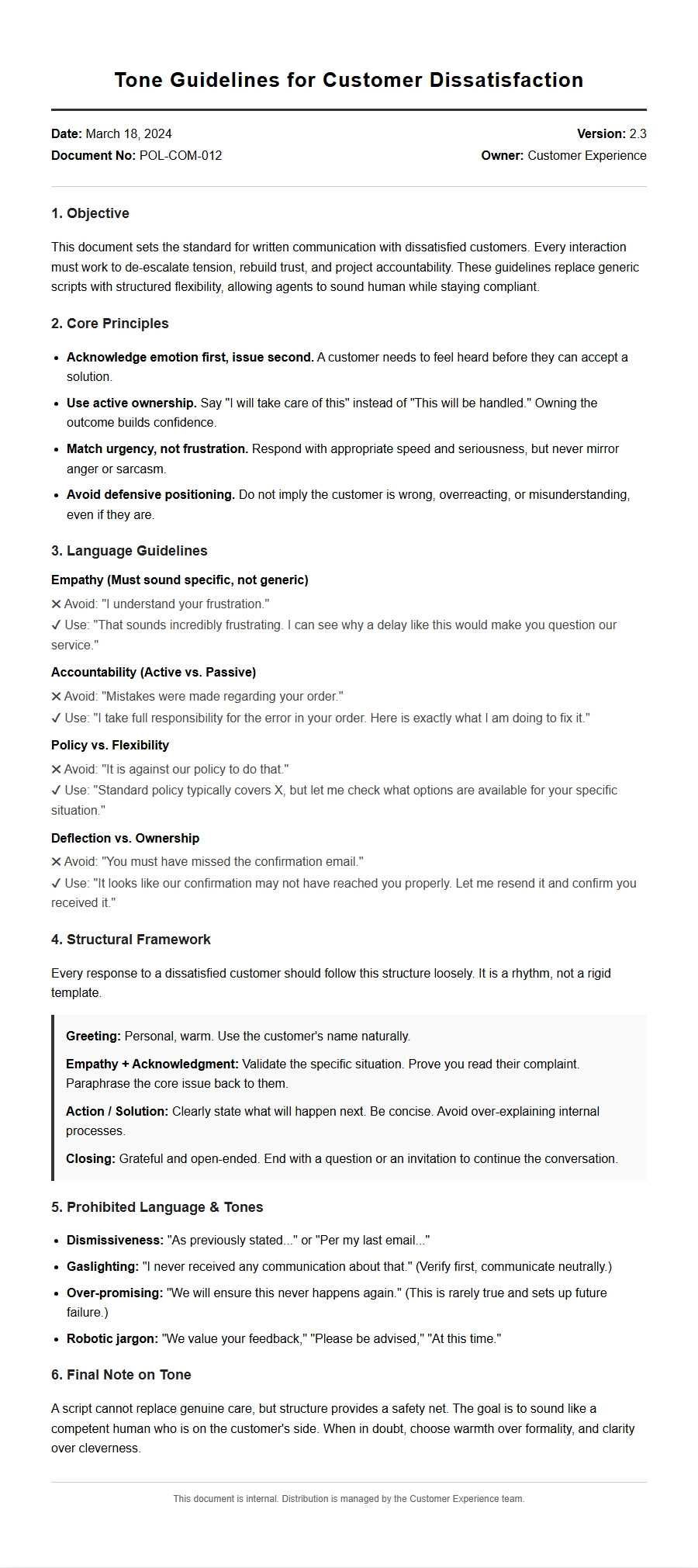 Tone Guidelines for Dissatisfied Customer Letters
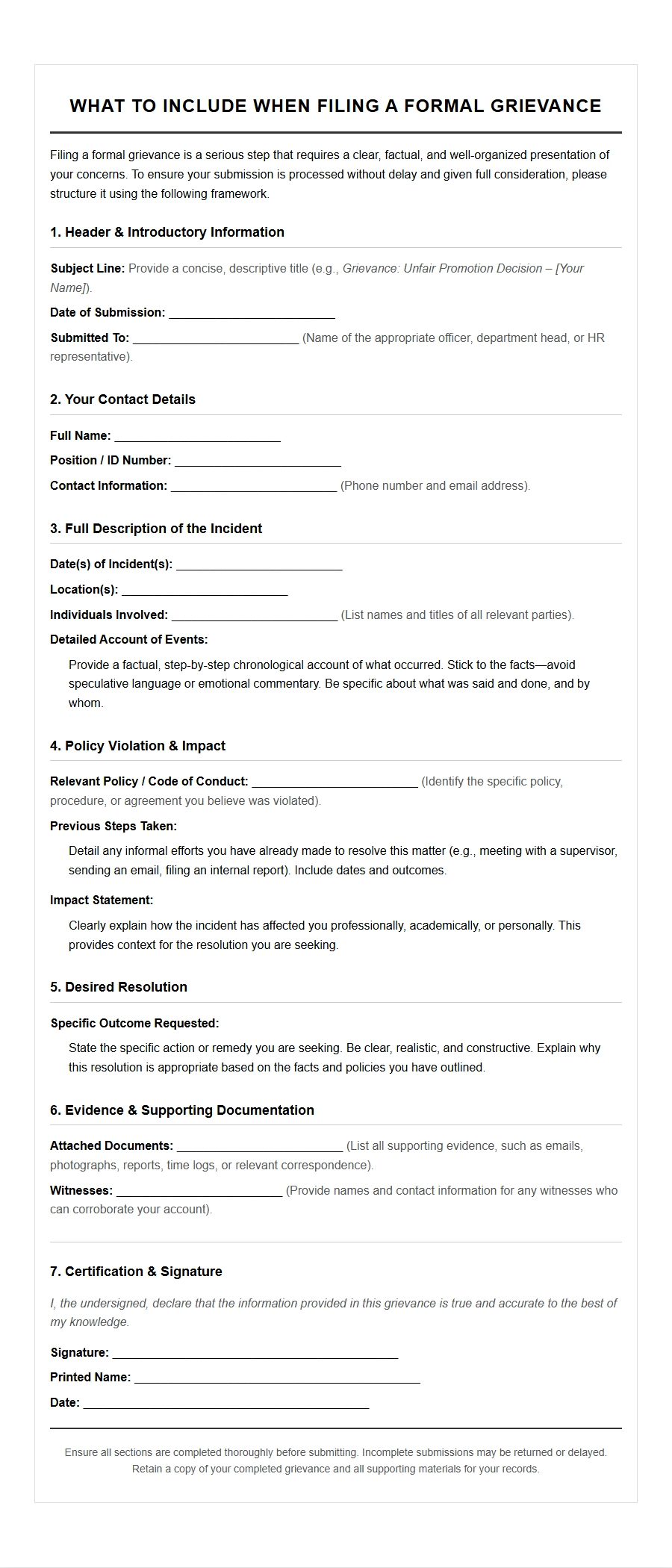 What to Include in a Formal Grievance Letter
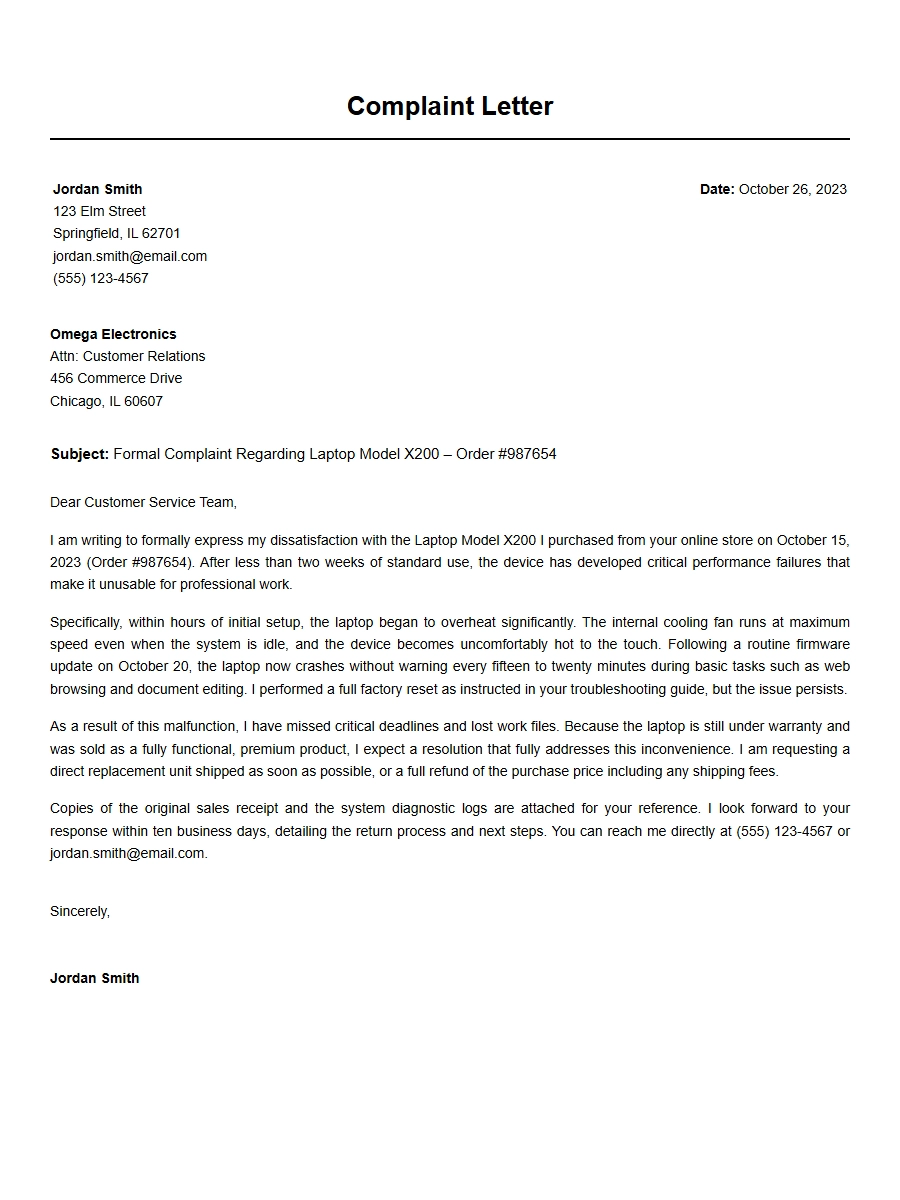 Structure of an Effective Complaint Letter
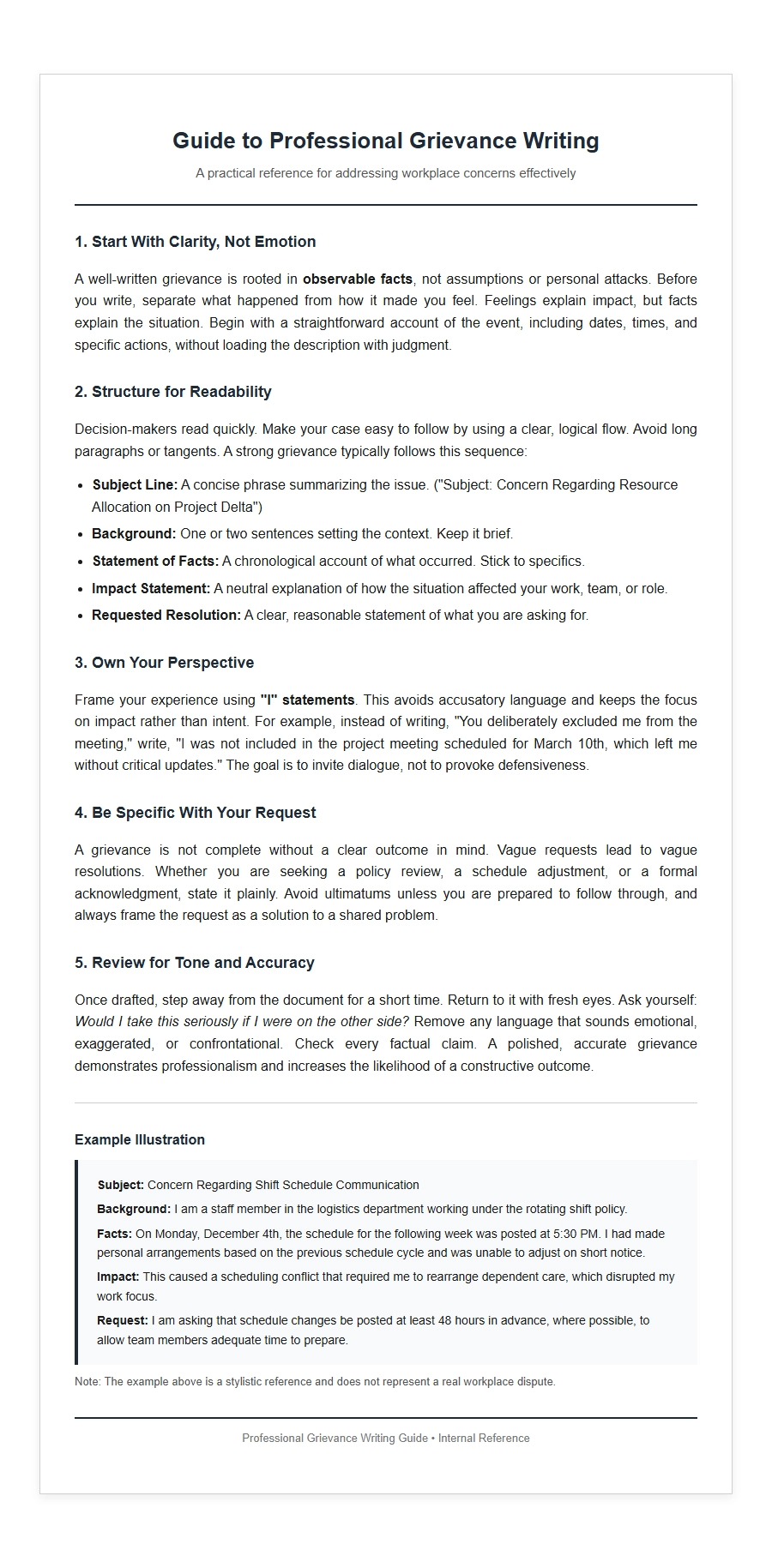 Best Practices for Writing Professional Grievance Letters