How to Dispute a Performance Review Evaluation Letter
You got a performance review that doesn’t match what you actually did. Maybe it’s full of vague criticism, factual errors, or worse—it just feels unfair. You’re frustrated, and you’re not sure how to push back without looking defensive. That’s normal. Writing a disputing performance review evaluation letter is one of those tasks where your emotions run high, but the response needs to stay calm and professional. It’s a tricky line to walk.
Here’s the good news: you don’t need to start from scratch. A solid letter template gives you the structure and tone you need while leaving space for your specific situation. Using a sample isn’t cheating. It’s smart. It prevents you from writing something reactive that you might regret later.
Category: Formal complaint letters.
What a disputing performance review letter actually does
This isn’t just about venting. You’re creating a record. A clear, written disagreement shows your manager or HR that you take the process seriously and that you have evidence to back your side. It’s professional correspondence that sets the stage for a fair follow-up conversation.
The goal isn’t to attack anyone. It’s to point out specific inaccuracies in the review and offer your perspective. Done right, this letter can lead to a corrected review, a better plan moving forward, or at least a fair hearing.
How to pick the right approach for your situation
Not all performance reviews are equally serious. A minor misunderstanding about a project timeline needs a lighter touch than a review that accuses you of poor performance or misconduct. Match your tone to the stakes.
If the review contains clear factual errors—like dates, metrics, or completed tasks—stick to those facts. List them out calmly. If the problem is more about biased language or unrealistic expectations, your tone should still be professional, but you’ll need to frame it as a request for clarity or reconsideration.
Step-by-step: turning a sample into your own letter
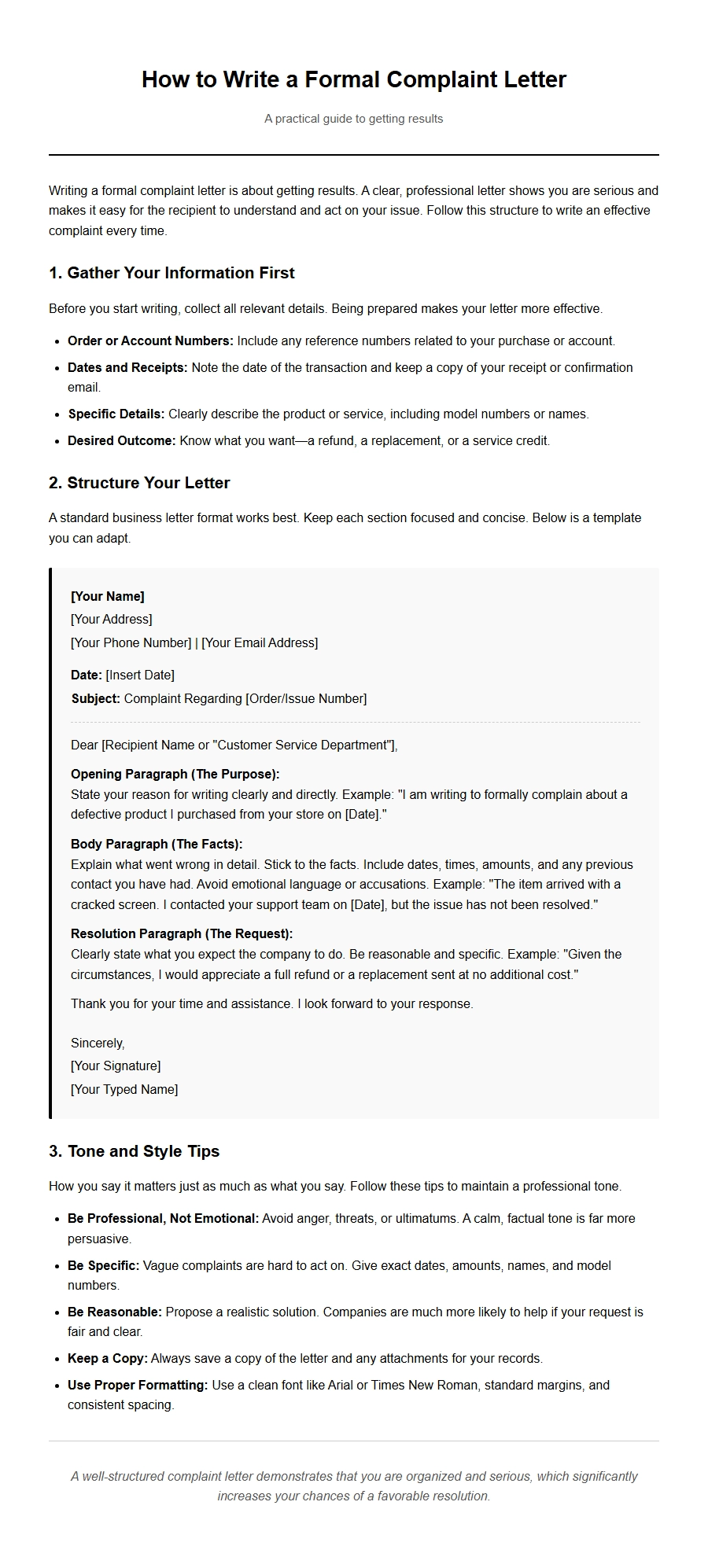
First, grab a simple business letter format. Use your regular letterhead with your name, date, and the recipient’s contact info. This keeps it formal and easy to file.
Start with a standard salutation like “Dear [Manager’s Name].” Avoid “To Whom It May Concern” unless you really don’t know who will read it.
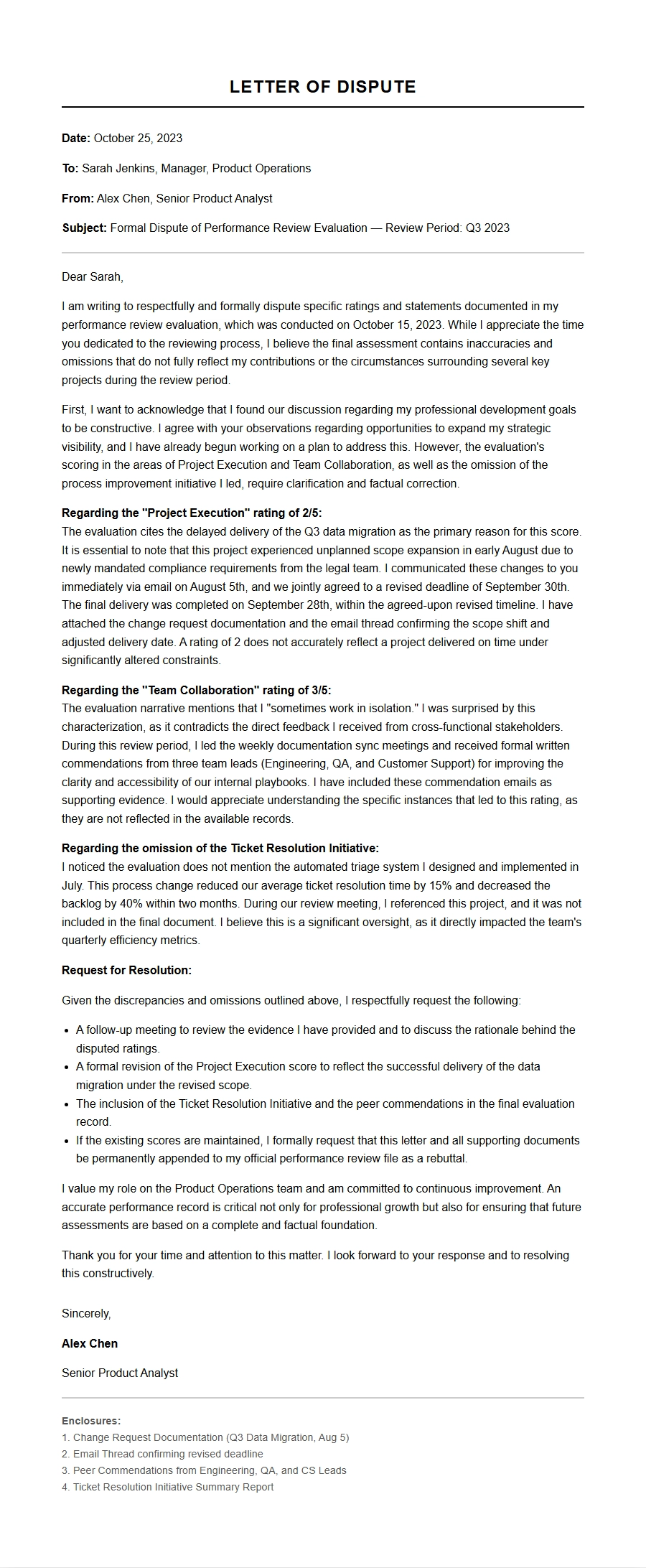
In the opening paragraph, mention the review you’re disputing. Be specific: “I am writing to discuss my performance review dated January 15, 2025. I have a few concerns about the accuracy of the feedback in the ‘Project Leadership’ section.” This immediately shows you’re not rejecting the entire review—just the parts that are wrong.
Then, in the body paragraphs, calmly explain each point you want to dispute. For example: “The review states that the marketing campaign fell short of its Q3 targets. However, internal reports show we exceeded the target by 12%. I’ve attached the quarterly summary for reference.” Include evidence wherever possible.
End with a clear request. Do you want a corrected appraisal? A follow-up meeting? An updated performance improvement plan? Say it directly but politely. A good closing line is: “I would appreciate the opportunity to discuss these points with you and reach a fair resolution.” Then close with “Sincerely” and your name.
Common mistakes to avoid in your letter
Writing a dispute letter can feel like walking through a minefield. Here are a few traps to sidestep:
Getting emotional. Avoid words like “unfair,” “wrong,” or “ridiculous.” Stick to facts. Instead of “This is completely incorrect,” say “This does not align with the project data from October.”
Ignoring formal writing tips. Keep paragraphs short. Use professional vocabulary. Don’t write like you’re texting a friend.
Forgetting the digital format. If you’re sending this by email, adjust the subject line clearly—something like “Dispute of Performance Review – [Your Name].” Keep the letter inside the email body and attach a PDF if needed.
Skipping proofreading. One typo can make your otherwise solid argument look sloppy. Read it out loud. Better yet, ask a trusted colleague to glance at it.
Making the letter feel like you
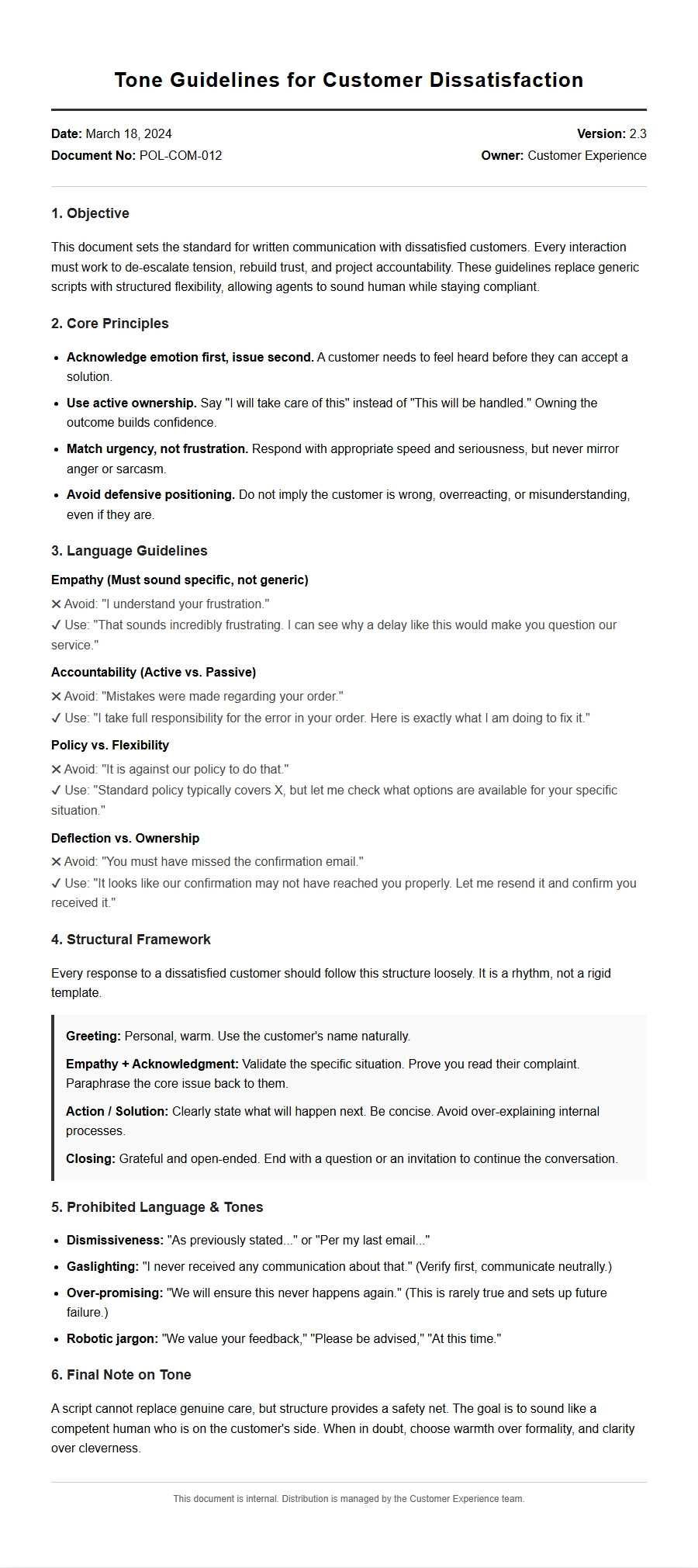
A template gives you the bones, but your voice makes it believable. Don’t copy a sample word for word. Rewrite the opening to reflect how you naturally talk—within reason. If you’d normally say, “I think there’s been a misunderstanding about the timeline,” put that in. A stiff, overly formal letter can feel insincere.
Also think about tone. For a first dispute, a respectful and curious tone works best: “I want to make sure we’re on the same page about my contributions last quarter.” If you’ve already discussed it informally and nothing changed, you can be more direct: “I am formally disagreeing with the evaluation due to the factual errors listed below.” Both are professional, but one is firmer.
If you’re dealing with a situation that involves broader workplace issues—like misconduct or ongoing bias—a letter like a formal request for investigation into conduct complaint might be worth reviewing for structure and tone.
What to do after you send the letter
Once you’ve hit send or handed over the printed page, wait. Give your manager or HR time to read it carefully. You don’t need to follow up immediately. If you don’t hear back within a week, send a short, polite email asking if they’ve had a chance to review your concerns.
Be prepared for a meeting. Your letter is a strong start, but a conversation is usually where things get resolved. Bring your notes, stay calm, and keep referencing the facts you already laid out in writing.
Sometimes a dispute leads to a corrected review. Sometimes it leads to a clearer understanding of expectations. Either way, you’ve done the right thing by documenting your side. And over time, writing these letters gets easier—you’ll learn what works and how to phrase things cleanly.
Remember: the sample is a springboard, not a crutch. Adapt it, make it honest, and you’ll send something that gets read and taken seriously.
Samples for Inspiration
How to Dispute a Performance Review Evaluation Letter
Disputing Low Performance Rating Due to Missing Context
Date: March 10, 2025
To: Human Resources Manager
From: Jane Doe, Senior Analyst
Subject: Formal Dispute of Performance Review Rating (Q4 2024)
I am writing to formally dispute the overall rating of “Needs Improvement” assigned in my recent performance review. The evaluation fails to account for critical contextual factors that significantly impacted my output during the review period.
Key factors omitted from the review:
Team restructuring in October reduced headcount by 40%, increasing my workload disproportionately.
Two major system outages (Nov 5–7 & Dec 12–14) required round-the-clock remediation, delaying project deliverables.
I received no formal mentoring or guidance despite multiple requests to my supervisor.
Below is a comparison of my self‑assessment versus the manager’s evaluation:
Criterion
Manager Rating
Self‑Rating
Supporting Evidence
Project Completion Rate
2/5
4/5
3 of 5 projects delivered on time; 2 delayed due to outages documented in IT tickets
Quality of Work
2/5
4/5
No defects logged post‑release; client satisfaction score 4.6/5
I request a re‑evaluation of my performance with the full context included. I am happy to discuss further at your earliest convenience.
Sincerely, Jane Doe
Formal Appeal of Unfair Performance Evaluation
Date: March 12, 2025
To: Performance Review Committee
From: Mark Smith, Lead Engineer
Subject: Appeal of Annual Performance Evaluation – Unfair Process
I am filing a formal appeal regarding my 2024 annual performance evaluation. I believe the evaluation was conducted in a manner that violates our company’s stated review principles of fairness, objectivity, and transparency.
Procedural concerns:
The review was completed without a scheduled calibration meeting with my direct supervisor. I was only shown the final rating during a brief 10‑minute conversation.
I was not given an opportunity to provide a self‑assessment before the rating was finalized.
The manager cited incidents that occurred more than six months ago without any prior coaching or written warnings.
Summary of disputed ratings vs. actual achievements:
Category
Given Rating
My Achievement
Innovation
3/5
Developed a patent‑pending algorithm (disclosure filed Feb 2025)
Leadership
2/5
Mentored two junior engineers, both promoted to mid‑level
Reliability
3/5
Missed zero workdays; delivered all sprint commitments
I respectfully request the committee to review the attached evidence and schedule an independent hearing. The process itself must align with the Employee Handbook Section 7.3.
Sincerely, Mark Smith
Challenge of Subjective Performance Assessment
Date: March 15, 2025
To: Director of Operations
From: Lisa Chen, Customer Success Manager
Subject: Challenge of Performance Rating Based on Subjective Criteria
I am challenging the “Exceeds Expectations” downgrade to “Meets Expectations” in my Q1 2025 performance review. The stated reason— “communication style could be more assertive” — is a subjective personality observation rather than an objective performance metric.
My concerns with the evaluation:
No specific examples of ineffective communication were provided.
Client feedback consistently praises my “clear, patient explanations” (see attached satisfaction surveys).
My manager admitted in the review meeting that the comment came from a single peer who had a personality conflict with me.
Comparison of objective performance indicators:
Metric
Q1 Target
Q1 Actual
Notes
Client Retention Rate
95%
98%
Above goal
Case Resolution Time
<24 hrs
18 hrs avg
Improved
Net Promoter Score
70
85
Highest in team
I request removal of the subjective communication rating and restoration of my original “Exceeds Expectations” rating. Performance evaluations should be based on measurable outcomes, not personal preferences.
Thank you for your prompt attention. Lisa Chen
Request for Correction of Evaluation Errors
Date: March 18, 2025
To: Human Resources Department
From: David Kim, Financial Analyst
Subject: Request to Correct Factual Errors in Performance Evaluation
I am writing to dispute the accuracy of my performance evaluation for the period January–December 2024. The review contains several demonstrable factual errors that, if uncorrected, will unfairly impact my career progression and bonus calculation.
List of errors identified:
Error 1: The evaluation states I missed the Q3 budget deadline. In fact, my deliverable was submitted two days early (attachment: email timestamp proof).
Error 2: It claims I had two unexcused absences. I have copies of approved leave requests for those dates.
Error 3: The rating for “Attention to Detail” is 2/5, yet I received a “Zero Defect” award from Compliance in November 2024.
Correction table:
Disputed Item
What Review Says
What Actually Happened
Evidence
Q3 Budget Deadline
Missed
Submitted early
Attachment A
Unexcused Absences
2
0 – all approved
Attachment B
Attention to Detail
2/5
Zero Defect Award
Attachment C
I request that HR formally correct these errors in my personnel file and issue a revised evaluation within 10 business days. Please let me know if any additional documentation is needed.
Regards, David Kim
Disagreement with Performance Review Based on New Evidence
Date: March 20, 2025
To: Reviewing Manager, Sarah Jones
From: Emily Tran, Product Designer
Subject: Disagreement with Performance Rating – New Evidence Provided
I am writing to formally disagree with the “Developing” rating I received for the “User Empathy” competency in my performance review. Since the review was finalized, I have uncovered new evidence that contradicts the assessment.
Summary of new evidence:
During the review period, I led three user research sessions that resulted in major design changes for the onboarding flow. The product manager sent an email on Oct 15 praising those insights.
My manager was on leave for six of the twelve months and may not have been aware of these contributions.
I have compiled a log of 12 user feedback quotes that directly reflect empathy and deep understanding of pain points.
Comparison of evidence vs. current rating:
Competency
Current Rating
Evidence Rating
User Empathy
Developing
Accomplished
Prototyping
Meets
Exceeds
Cross‑functional Communication
Meets
Exceeds
I request that you review the attached documentation and update my evaluation accordingly. The new evidence demonstrates that my performance exceeded expectations in multiple areas.
Thank you for your reconsideration.
Sincerely, Emily Tran
Complaint About Retaliatory Performance Evaluation
I am filing this complaint because I believe my most recent performance evaluation (dated 02/28/2025) is a direct act of retaliation. In November 2024, I reported a data privacy violation by my supervisor to the HR whistleblower hotline. My rating dropped from “Exceeds Expectations” to “Below Expectations” without any valid performance justification.
Timeline of events:
Nov 10, 2024: Filed anonymous report regarding improper sharing of PII.
Nov 15, 2024: My supervisor confronted me about the report (I refused to confirm involvement).
Dec–Feb: I received unwarranted criticism in team meetings, but no formal performance improvement plan was issued.
Feb 28, 2025: Evaluation delivered with rating “Below Expectations” citing “frequent late submissions” – all of my deadlines were met.
Evidence of retaliation:
Period
Previous Rating
Current Rating
Comments
Before report (Q3 2024)
Exceeds
–
All targets met or exceeded
After report (Q4 2024 – Q1 2025)
–
Below Expectations
Same work output, no performance decline
I request an independent investigation and a stay of any employment actions pending the outcome. Retaliation is prohibited under company policy and federal law.
Sincerely, Robert Nguyen
Dispute Over Inconsistent Performance Standards
Date: March 25, 2025
To: VP of Sales
From: Amanda Garcia, Regional Sales Manager
Subject: Dispute of Performance Evaluation – Inconsistent Standards Across Regions
I am formally disputing my 2024 performance rating because the evaluation criteria were applied inconsistently compared to other regional managers. My rating of “Meets Expectations” does not reflect my actual performance relative to peers.
Evidence of inconsistency:
My region (Northwest) has a 35% smaller budget than others but achieved 110% of revenue target.
A peer in the Northeast missed quota by 15% yet received “Exceeds Expectations”.
I was penalized for “low team engagement scores” even though my region’s score (78) was above company average (72).
Comparison of key metrics (2024):
Metric
My Region
Peer Region (Northeast)
My Rating
Peer Rating
Revenue vs. Target
110%
85%
Meets
Exceeds
Customer Retention
92%
80%
Meets
Exceeds
Team Engagement Score
78
65
Meets
Exceeds
I request that my evaluation be recalibrated against consistent standards or that the criteria for “Exceeds Expectations” be clearly defined and applied equally to all regions.
I look forward to a fair resolution.
Amanda Garcia
Appeal of Evaluation Based on Outdated Criteria
Date: March 28, 2025
To: Performance Management Team
From: James Lee, Software Developer
Subject: Appeal of Performance Evaluation – Criteria No Longer Relevant
I am appealing my performance evaluation for the period January–December 2024 on the grounds that the criteria used are outdated and do not reflect my current role responsibilities, which changed substantively in Q2 2024.
Changes in my role:
In April 2024, I was reassigned from front‑end development to a full‑stack team, with 60% of my time now spent on backend and infrastructure tasks.
Despite this, the evaluation rubric still emphasized front‑end KPIs (page load times, UI consistency) that I no longer directly control.
The manager did not adjust the weighting or add relevant backend metrics (e.g., API response times, uptime).
Impact on rating:
Criterion
Weight in Review
Relevance to My Role
Front‑end performance
30%
Minimal (focused only 15% of time)
Backend reliability
0%
Critical (85% of time)
Code reviews (front‑end)
20%
Low – rarely assigned
I request that the evaluation be redone using criteria that match my actual responsibilities during the review period. Alternatively, the rating should be marked as “Not Applicable” pending a role‑adjusted review.
Sincerely, James Lee
Response to Unsubstantiated Performance Criticism
Date: March 30, 2025
To: Line Manager, Patricia Wong
From: Olivia Brown, Marketing Coordinator
Subject: Response to Performance Evaluation – Unsubstantiated Criticism
I have received my 2025 Q1 performance evaluation and must dispute the criticism regarding my “proactive communication” competency, which was rated 1/5. The evaluation states I “fail to keep stakeholders informed,” but no concrete examples are provided. I find this assessment unsubstantiated and inconsistent with documented evidence.
Evidence of proactive communication:
I send weekly status reports every Friday (archive attached – 12 reports for Q1).
I set up a shared Slack channel for the campaign project, with daily updates posted without fail.
Three stakeholders (see list below) confirmed in feedback that they were “always informed and never surprised.”
Average response time 1.2 hours (measured by Slack analytics)
“Rarely volunteers information”
Volunteered to create the dashboard; presented findings at team meeting
I request that the rating be revised to reflect the documented evidence. If the manager can provide specific instances of failure, I am willing to discuss them, but without examples the criticism is baseless.
Thank you for your fairness.
Olivia Brown
Formal Grievance Regarding Performance Review Process
Date: April 2, 2025
To: Chief Human Resources Officer
From: Michael Davis, Project Manager
Subject: Formal Grievance – Flawed Performance Review Process
I am filing a formal grievance concerning the 2024 performance review process as applied to me. I believe the process itself was so flawed that the resulting evaluation cannot be considered valid. I request that the evaluation be voided and a new review conducted under proper procedures.
Process violations identified:
Lack of 360° feedback: My evaluation included only the manager’s input, despite company policy requiring peer, subordinate, and client feedback.
No calibration session: Ratings were not discussed with other managers who know my work, contrary to Section 4.2 of the Review Guidelines.
Delayed delivery: The review was given 45 days late, after the promotion deadline had passed, effectively denying me consideration.
Summary of grievances:
Issue
Requirement (Policy)
Actual
360° feedback collection
Mandatory
Not done
Calibration with other managers
Required if cross‑functional
Not held
Delivery deadline
Within 30 days of period end
45 days late
I request an immediate investigation and that a new evaluation be conducted with full adherence to policy. Please confirm next steps within five business days.
 How to Write a Formal Complaint Letter
 Steps to Resolve Issues via Written Notice
 Tone Guidelines for Dissatisfied Customer Letters
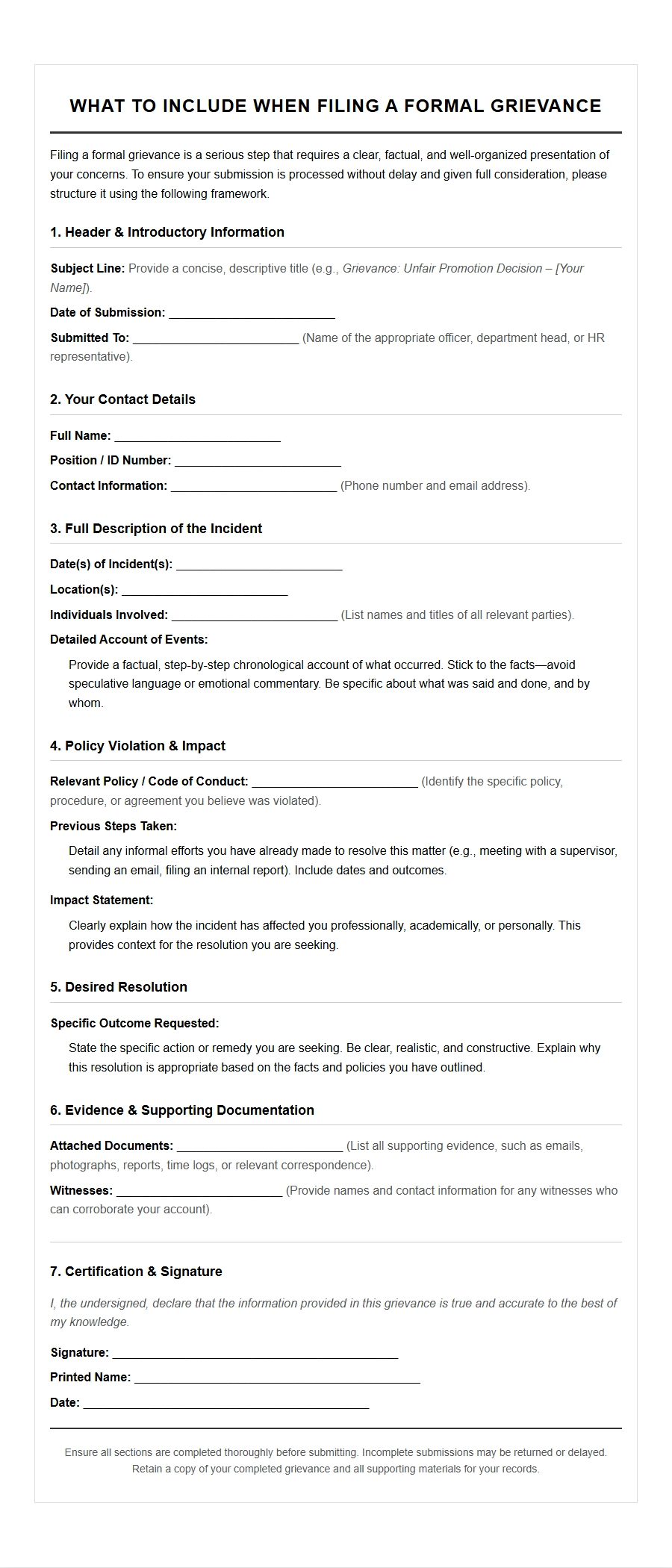 What to Include in a Formal Grievance Letter
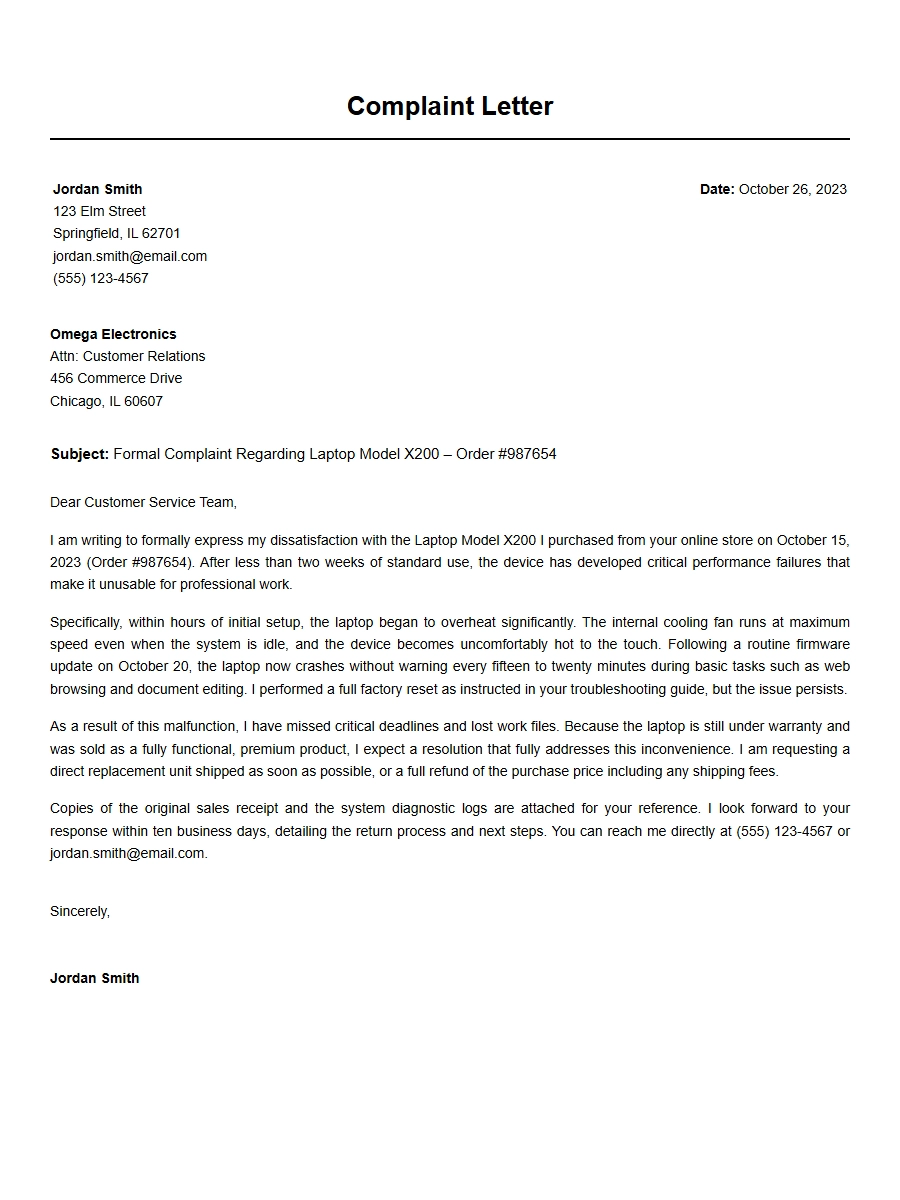 Structure of an Effective Complaint Letter
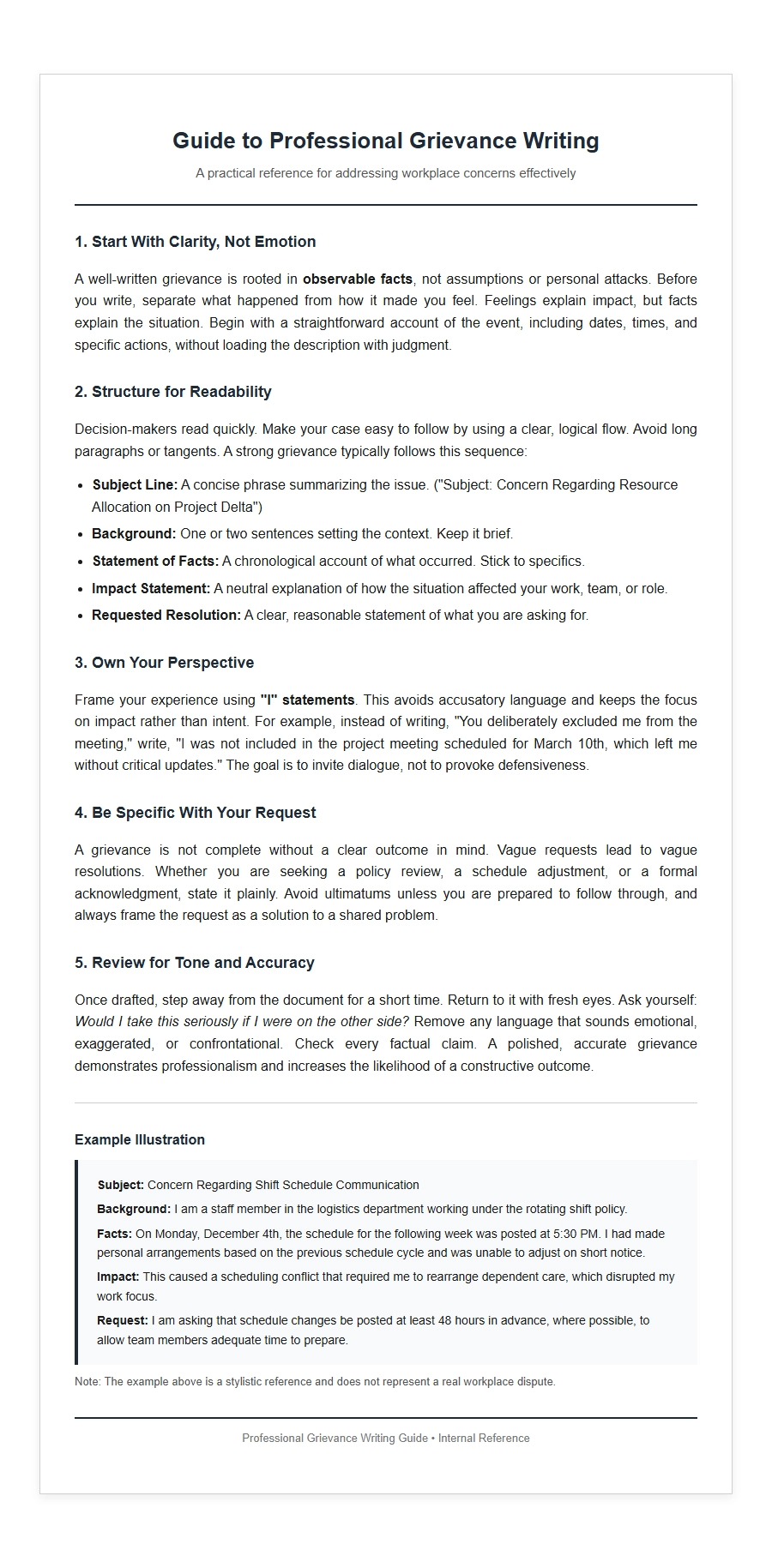 Best Practices for Writing Professional Grievance Letters