You open your mail or log into your patient portal and see a charge that doesn’t make sense. Maybe you were billed for a more expensive procedure than what was done, or a diagnosis code doesn’t match your visit. Medical bill coding errors are frustrating, and they’re more common than you’d think. The urge to call and argue is strong, but a written grievance letter gives you a paper trail and a clear path to resolution. If you’re not a professional writer, staring at a blank page can feel like another headache. That’s where a good sample comes in.
Using a grievance letter for medical bill coding error isn’t cheating. It’s a smart way to start with a proven structure so you can focus on your specific details. A well-designed letter template gives you the right tone, the proper business letter format, and the key phrases that show you’re serious. You’ll save time and avoid missing important elements like policy numbers, dates of service, and the exact code you’re disputing. The best part? You customize it to sound like you.
Category: Complaint Letters – Medical Billing
What exactly is a medical bill coding error grievance letter?
It’s a formal written request to a healthcare provider or insurance company asking them to review and correct a mistake in how a medical service was coded. Codes determine what you owe. A wrong Current Procedural Terminology (CPT) code, an incorrect diagnosis code, or unbundling (charging separately for services that should be bundled) can inflate your bill. Your letter should clearly state the error, reference the specific code, and attach supporting evidence like your Explanation of Benefits (EOB) or itemized bill. You’re not just complaining; you’re requesting a correction under your insurer’s grievance process.
When should you write this letter?
Send a grievance letter after you’ve tried a quick phone call and gotten nowhere, or if you need a formal record. Many insurance plans require a written grievance before they’ll reopen a claim. Also write one if the error involves a large amount or if you suspect a pattern of incorrect coding. Don’t wait too long – most policies have a deadline, often 60 to 180 days from the date of service.
How to choose the right sample and adapt it
Look for a customizable letter that follows standard professional correspondence rules. The best samples include a clear subject line, a polite but firm opening, a section for details, and a request for action. Avoid templates that sound overly aggressive or too casual – you want the tone in writing to be firm but respectful. Check the letter structure: it should have your contact info, date, recipient’s name and address, a proper salutation (e.g., “Dear Customer Service Manager”), and a closing like “Sincerely.”
When adapting, don’t copy the sample verbatim. Read it, then rewrite the opening paragraph in your own words. For example, instead of “I am writing to dispute a billing error,” try “I received my explanation of benefits for my visit on March 3 and noticed that Procedure XYZ was coded incorrectly.” This grabs attention because it’s specific. Use the sample as a scaffold, not a cage.
Common mistakes to avoid
One big error is neglecting to include your policy number, claim number, and the date of service. Without those, your letter might sit in a pile. Another mistake is using an outdated salutation like “To Whom It May Concern” when you can find a specific name on your bill or insurance website. If you’re sending the letter via email, remember digital letter format – use a clear subject line like “Grievance: Incorrect Coding on Claim #[number]” and paste the letter in the body or attach a PDF with proper letterhead design. Always proofread your letter before sending; a typo can make you look less credible. And keep a copy for your records – you’ll need it if you escalate to a state insurance regulator.
You might also be tempted to write a long emotional story about the inconvenience. Stick to the facts: what code was used, what code should have been used, and the dollar amount in dispute. If you’re unsure about coding, you can request a coding review by the provider’s billing department. Many errors are simple typos that get fixed quickly once pointed out in writing.
Making your letter stand out (in a good way)
Start with the most important fact: the error. Then explain why you believe it’s wrong. For example, “The claim shows Evaluation and Management code 99214, but my visit was a brief follow-up that should be coded 99212. The documentation in my medical record supports this.” If you have supporting documents, mention them and attach copies (never originals). Close with a clear request: “Please reprocess the claim with the corrected coding and send me an updated EOB.” Keep the tone professional – you’re looking for a solution, not a fight.
After you send the letter, give the recipient about 30 days to respond. Follow up by phone if you don’t hear back. Most billing errors are resolved quickly once you put everything in writing. Don’t let a small coding mistake turn into a bigger headache. Use a sample, make it your own, and send it off. The first time you do this, it might take an hour. The next time, you’ll zip through it in fifteen minutes. That’s the power of a good template and a little practice.
Browse Sample Ideas
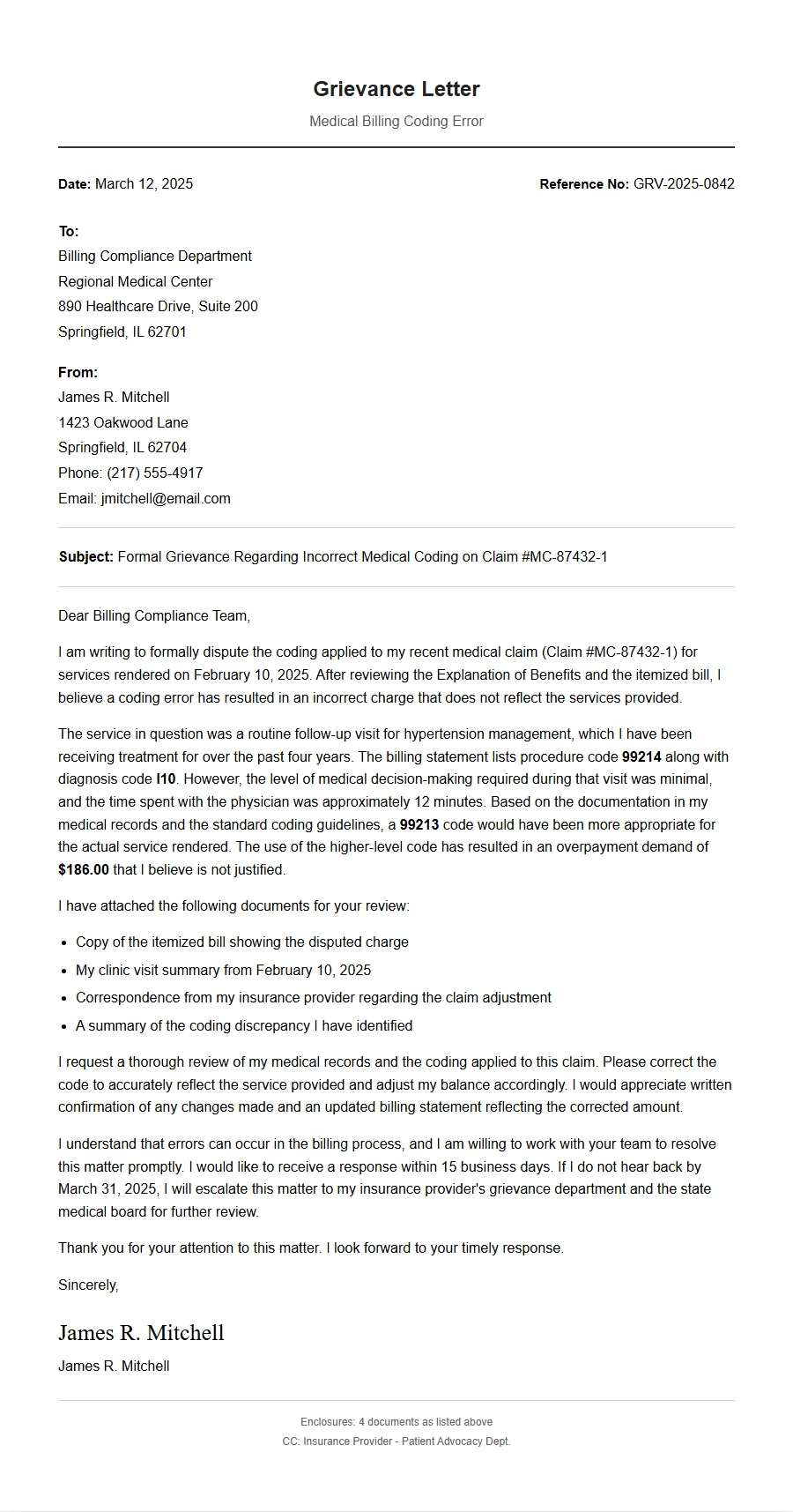
Grievance Letter for Medical Bill Coding Error
Coding Error Grievance – Upcoded Office Visit
Date: June 10, 2025
To: Billing Disputes Department, HealthChoice Insurance Co.
Re: Grievance for Claim #HC-88432 – Upcoding Error
I am writing to formally dispute the claim for an office visit on May 22, 2025 (visit code 99204), which was billed as a level 4 new patient visit. I was in the office for only 15 minutes with a straightforward complaint (sinus congestion). Standard coding guidelines support a level 2 visit (99202).
Details of the error:
Service date: May 22, 2025
Billed code: 99204 (Level 4 new patient visit, $280)
Correct code: 99202 (Level 2 new patient visit, $110)
Difference: $170 overcharge attributed to upcoding
I request a reprocessing of this claim using the corrected code. Please adjust my responsibility accordingly. Enclosed is my visit summary showing the brief duration and minimal medical decision-making.
Thank you for your prompt attention to this matter. I expect a written response within 30 days as per state regulations.
Sincerely, Janet Miller Policy #: HC-123456
Grievance for Unbundled Lab Codes on EOB
Date: July 1, 2025
To: Complaints Department, MedCare Health Plans
Re: Unbundled Lab Codes – Claim #MCP-4523
I received my Explanation of Benefits for a routine blood draw on June 10, 2025, and noticed that the lab billed separate codes (80061, 82465, 83721) for a standard lipid panel, which should be billed as a single panel code 80061 alone. This unbundling increased my out-of-pocket by $45.
Billed codes vs. Correct code:
Service
Billed Code
Allowed Amount
Lipid panel component
80061
$35
Additional component
82465
$20
Additional component
83721
$25
Total billed
$80
Correct single panel (80061)
80061
$40
Under CPT bundling rules, these tests are part of a panel and must not be separately reported. I request that MedCare deny the unbundled charges, reprocess the claim with code 80061, and refund any extra cost share paid.
Please send a corrected EOB and adjust my deductible and out-of-pocket accordingly.
Sincerely, Robert Torres Member ID: MCP-7890
Duplicate Procedure Code Complaint to Provider
Date: August 15, 2025
To: Physician Billing, Northside Medical Group
Re: Duplicate Billing of EKG (93005) on June 30, 2025
I am writing to dispute two identical charges for an EKG performed during my annual physical on June 30, 2025. My explanation of benefits shows two lines with code 93005 on the same date, same provider, with a combined charge of $180.
Billing errors:
Claim line 1: 93005 – $90 – EKG, tracing only
Claim line 2: 93005 – $90 – EKG, tracing only (duplicate)
Only one EKG was performed. Please remove line 2 and submit a corrected claim to my insurer. If the duplicate was already paid, issue a refund to me directly. I have attached the medical record excerpt confirming a single EKG.
I trust this oversight will be corrected promptly. Please send confirmation once resolved.
Sincerely, Linda Chang Patient Account #: NMG-45678
Incorrect Modifier Leading to Denial – Appeal Letter
Date: September 5, 2025
To: Appeals Department, BlueCross BlueShield of X
Re: Appeal of Denied Claim #BCBS-7761 – Modifier 25 Error
My claim for a preventive visit with treatment of acute pharyngitis on August 1, 2025 was denied because modifier 25 was appended incorrectly to the evaluation and management code 99213. The preventive visit code 99396 was billed without a modifier, and the office used modifier 25 on 99213.
Billing details:
Code
Modifier
Charge
Status
99396
(none)
$200
Paid
99213
25
$150
Denied
The denial reason stated “modifier 25 requires documentation of separate service.” The physician’s note clearly documents the acute problem and treatment separate from the preventive exam. I request a redetermination: modifier 25 was appropriate. I am providing the clinical note and a modifier 25 justification form.
Please overturn the denial and process payment consistent with my benefits.
Sincerely, David Park Member ID: BCBS-998877
Wrong Diagnosis Code on Surgery Claim
Date: October 20, 2025
To: Coding Compliance Officer, St. Anthony’s Hospital
Re: Incorrect Diagnosis Code on Claim #SAH-2025-4321 (Knee Arthroscopy)
I am writing to grieve a coding error on my knee surgery claim from September 10, 2025. The hospital billed diagnosis code M23.231 (derangement of medial meniscus, right knee) but my pre-op diagnosis was actually M23.211 (bucket-handle tear of medial meniscus, right knee). This mistake caused my insurance to deny the procedure as not medically necessary based on the wrong code.
I have attached my operative report and pre-op MRI findings that clearly document a bucket-handle tear. Please submit a corrected claim to my insurer with the appropriate diagnosis code. I also request that you reprocess any denial and ensure I am not held responsible for charges that should have been covered.
Thank you for correcting this coding error promptly.
Sincerely, Michael Greene Account #: SAH-9901
Coding Error Resulting in Incorrect Patient Responsibility
Date: November 12, 2025
To: Customer Service, Aetna Health Inc.
Re: Grievance for Overpayment Due to Coding Mistake – Claim #AE-677889
I received a bill for $320 as my patient responsibility for an emergency room visit on October 5, 2025. However, the ER coded the visit as 99285 (Level 5) when the actual care was simple and brief, fitting 99283 (Level 3). Because of this upcoding, my copay and coinsurance were miscalculated.
Comparison of charges:
Code
Description
Provider Charge
My Responsibility (based on plan)
99285 (billed)
Level 5 ER visit
$1,200
$320
99283 (correct)
Level 3 ER visit
$600
$150
I request that you request the provider to correct the code to 99283, recalculate my cost share, and refund the overpayment of $170. I have the ER clinical summary confirming the lower level of care.
Please contact me at (555) 123-4567 with a case number.
I visited your clinic on November 15, 2025 for a laceration repair and a separate wound check. Your billing used modifier 59 (distinct procedural service) on code 12001 for the repair, but the wound check was performed during the same session and is inherently part of the aftercare. Using modifier 58 would be more appropriate if needed, but modifier 59 is incorrect here.
G0463 (wound check) – without modifier – allowed $50
The wound check (G0463) should not have been separately billed because it is included in the global surgical package for the repair. Additionally, modifier 59 on the repair code is inappropriate as there was no distinct anatomical site or session.
I ask that you remove G0463 and modifier 59, resubmit the claim with correct codes (12001 without modifier), and refund any overpayment already made. Let me know the corrected amount.
Sincerely, James O’Brien Patient ID: PUC-7722
Dispute Over Billing Inpatient Stay as Outpatient Due to Wrong Status Code
Date: January 8, 2026
To: Patient Accounts, Lakeview Regional Medical Center
Re: Incorrect Outpatient Status on Claim #LRMC-112233
I was admitted to your hospital on December 20, 2025 for overnight observation and stayed two midnights. However, your billing coded the stay as outpatient observation (status code 22) instead of inpatient admission (status code 21). As a result, my Medicare Part A denied coverage, and I received a bill for $8,500.
Details of stay:
Date
Admission Time
Discharge Time
Type of Stay
Dec 20
10:00 AM
–
Overnight
Dec 21
–
11:00 AM
Discharged
Two midnights rule qualifies this as an inpatient stay. Please rebill with correct patient status (inpatient) and diagnosis codes. I have my discharge summary and physician orders confirming inpatient admission.
If the code is not corrected, I will file a formal complaint with the state insurance department. I expect a corrected claim within 15 days.
Sincerely, Eleanor Wright Acct #: 3301-LRMC
Billing Error – Wrong CPT Code for Vaccination Administration
Date: February 20, 2026
To: Billing Errors Division, Central Health Systems
I received an immunization (influenza vaccine) on January 25, 2026. Your billing used CPT code 90471 (immunization administration, one vaccine) but I also received a second vaccine (Tdap) at the same visit, which requires code 90472 for the additional vaccine. Instead, you billed two units of 90471, which is incorrect per CPT guidelines.
Billed codes:
90471 x 2 – Immunization administration (each additional should be 90472)
90658 – Influenza vaccine
90715 – Tdap vaccine
Correct coding:
90471 – First vaccine administration
90472 – Each additional vaccine administration (Tdap)
This error caused my insurance to deny the second administration as a duplicate. Please correct the claim, resubmit to my payer (Cigna), and notify me of the outcome. I have attached my vaccine record.
I also request that you verify no balance billing occurs for the incorrectly coded service.
Sincerely, Priya Singh Policy #: CIG-776655
Formal Grievance for Billing Services Not Rendered (Phantom Code)
I attended a follow-up appointment on February 28, 2026 for my right ankle sprain. During that visit, only a manual exam and discussion occurred. However, your practice billed CPT code 97110 (therapeutic exercises) for 30 minutes, and code 97112 (neuromuscular reeducation) for 30 minutes. No such therapy was performed or ordered. This appears to be phantom billing or upcoding of services not rendered.
Details of the disputed charges:
Date
Code
Units
Description
Charge
02/28/26
97110
2
Therapeutic exercises, 30 min
$120
02/28/26
97112
1
Neuromuscular reeducation, 30 min
$85
I require that these codes be removed from my claim immediately. Please issue a corrected EOB to my insurance (UnitedHealthcare) and ensure I am not billed for these services. If you continue to bill inaccurately, I will report this to the state medical board and the Office of the Inspector General.
I expect a written confirmation of the correction within 10 business days.
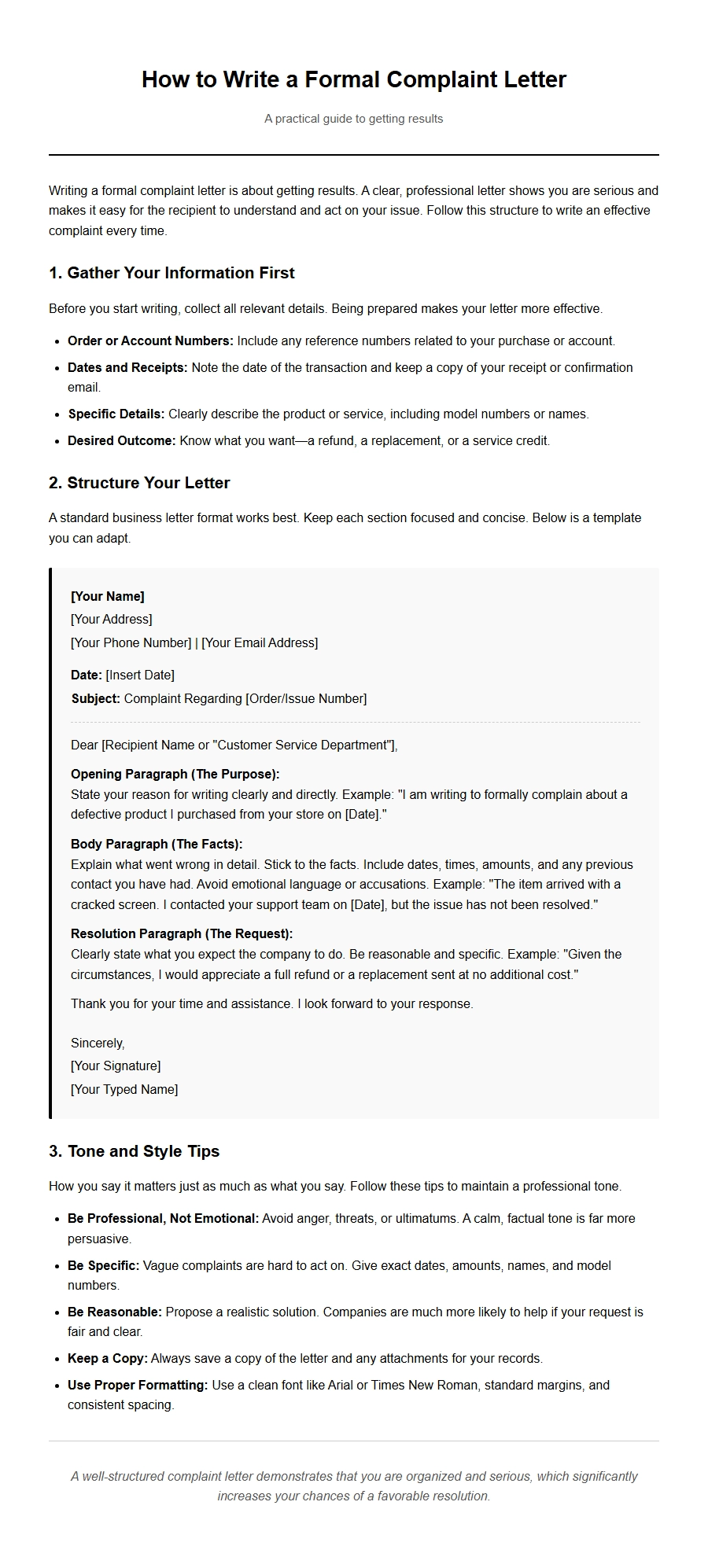 How to Write a Formal Complaint Letter
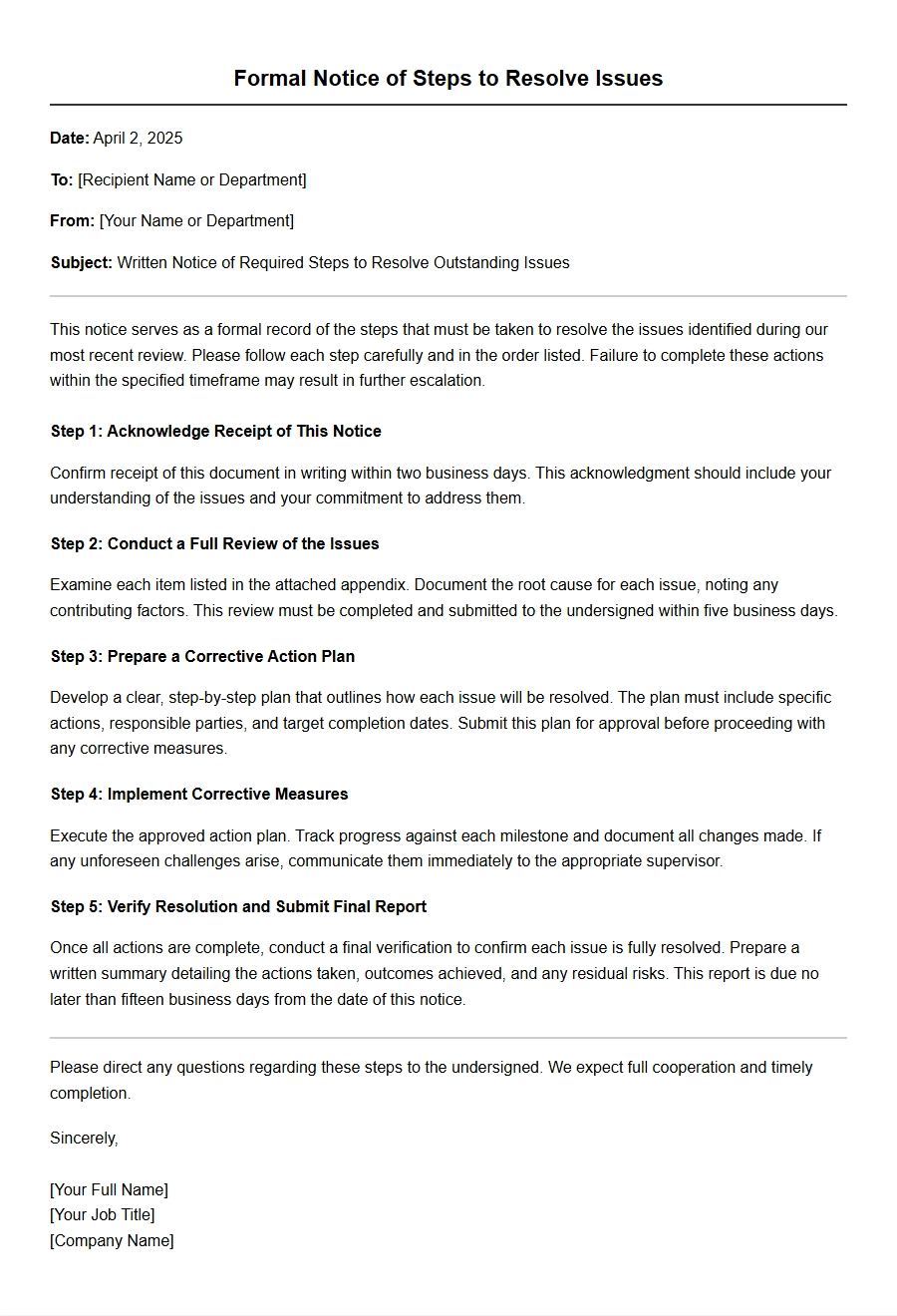 Steps to Resolve Issues via Written Notice
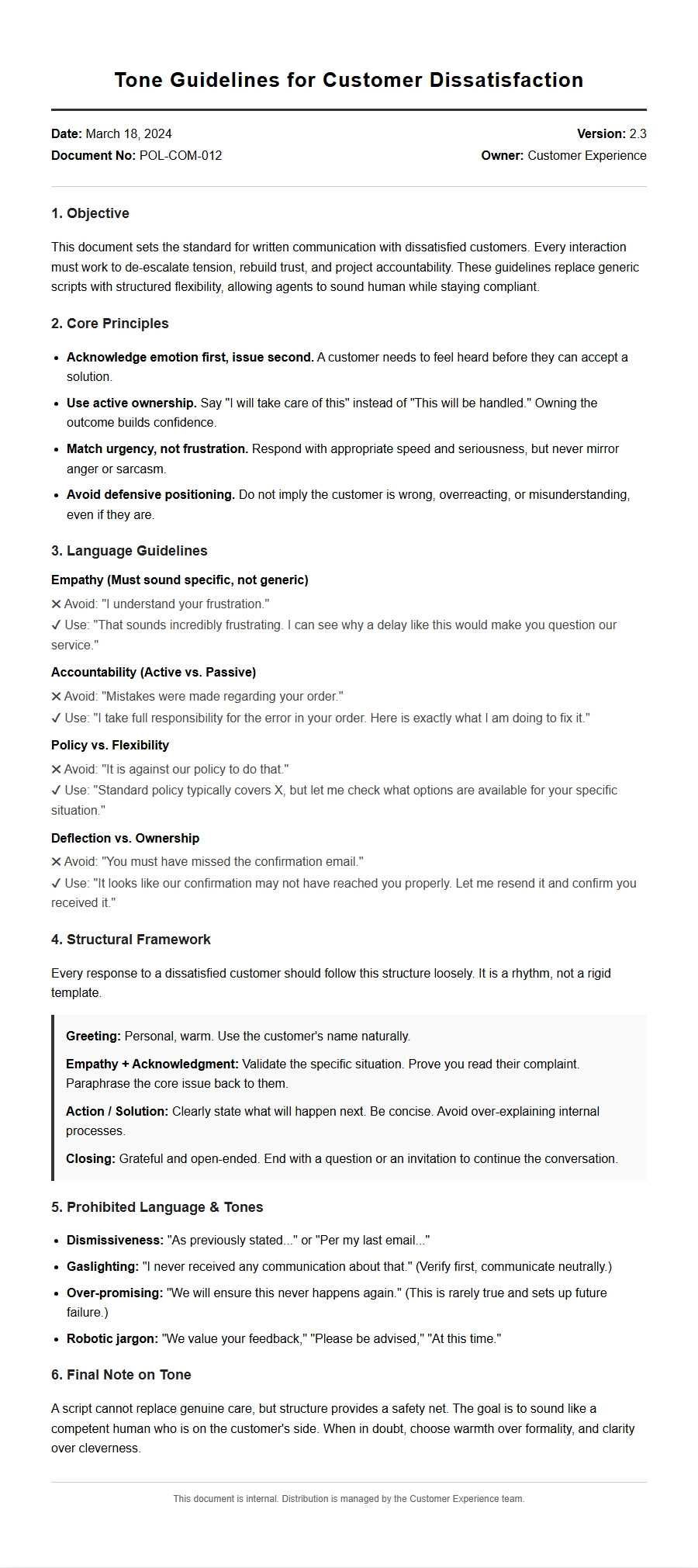 Tone Guidelines for Dissatisfied Customer Letters
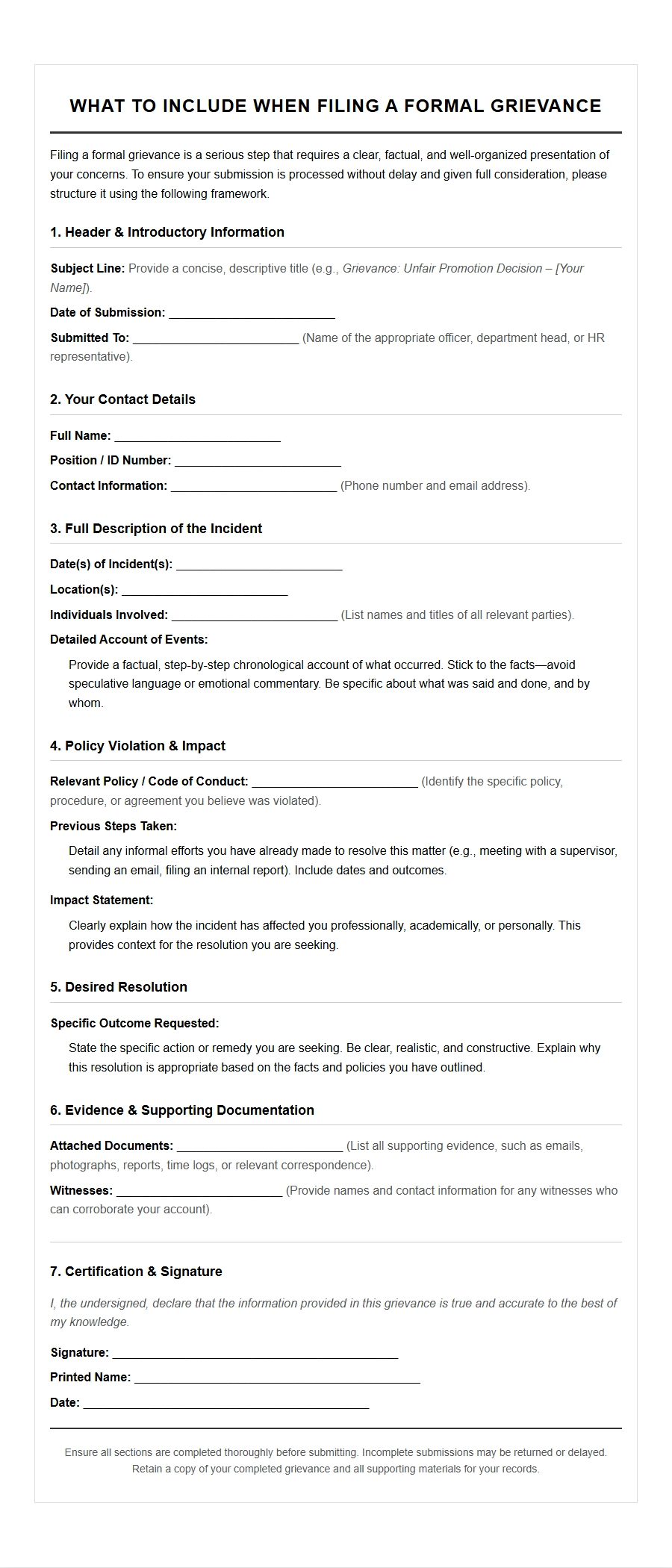 What to Include in a Formal Grievance Letter
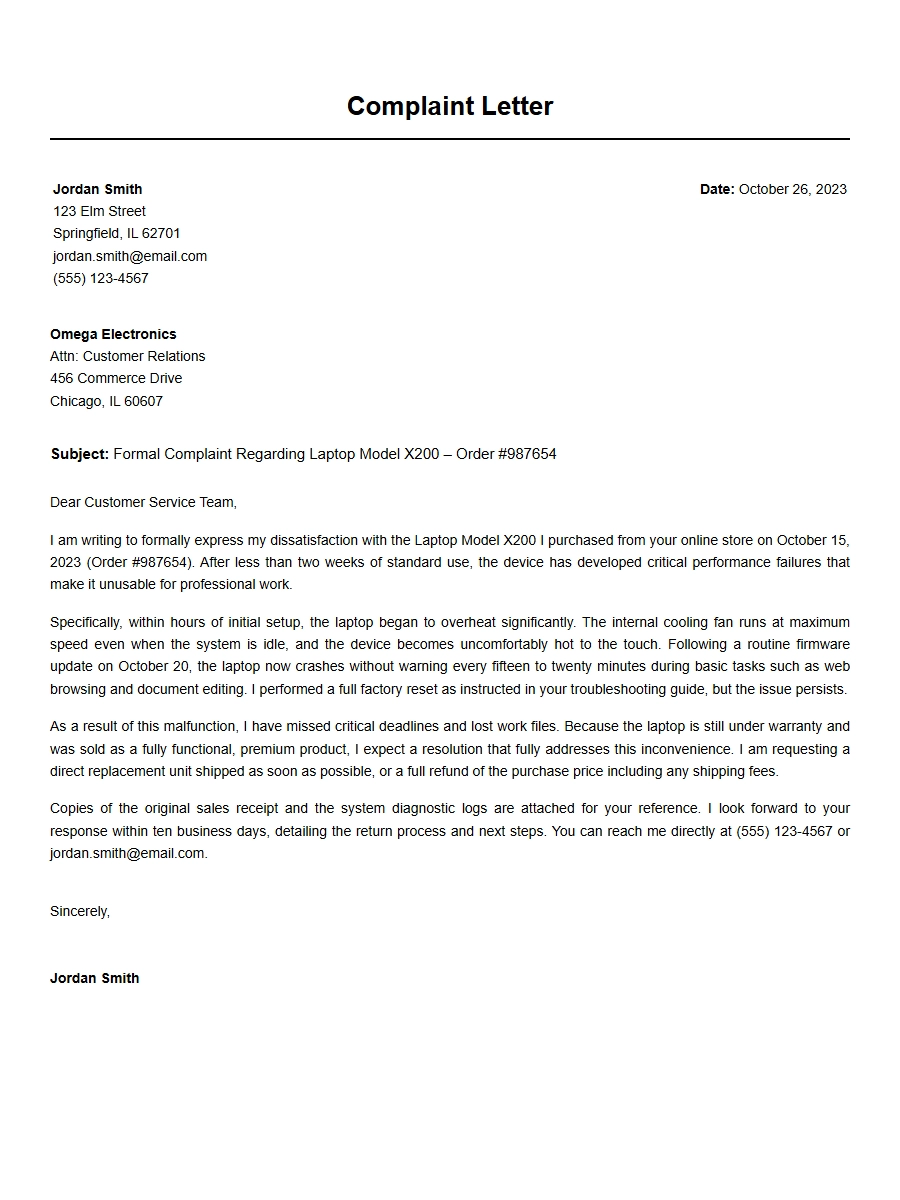 Structure of an Effective Complaint Letter
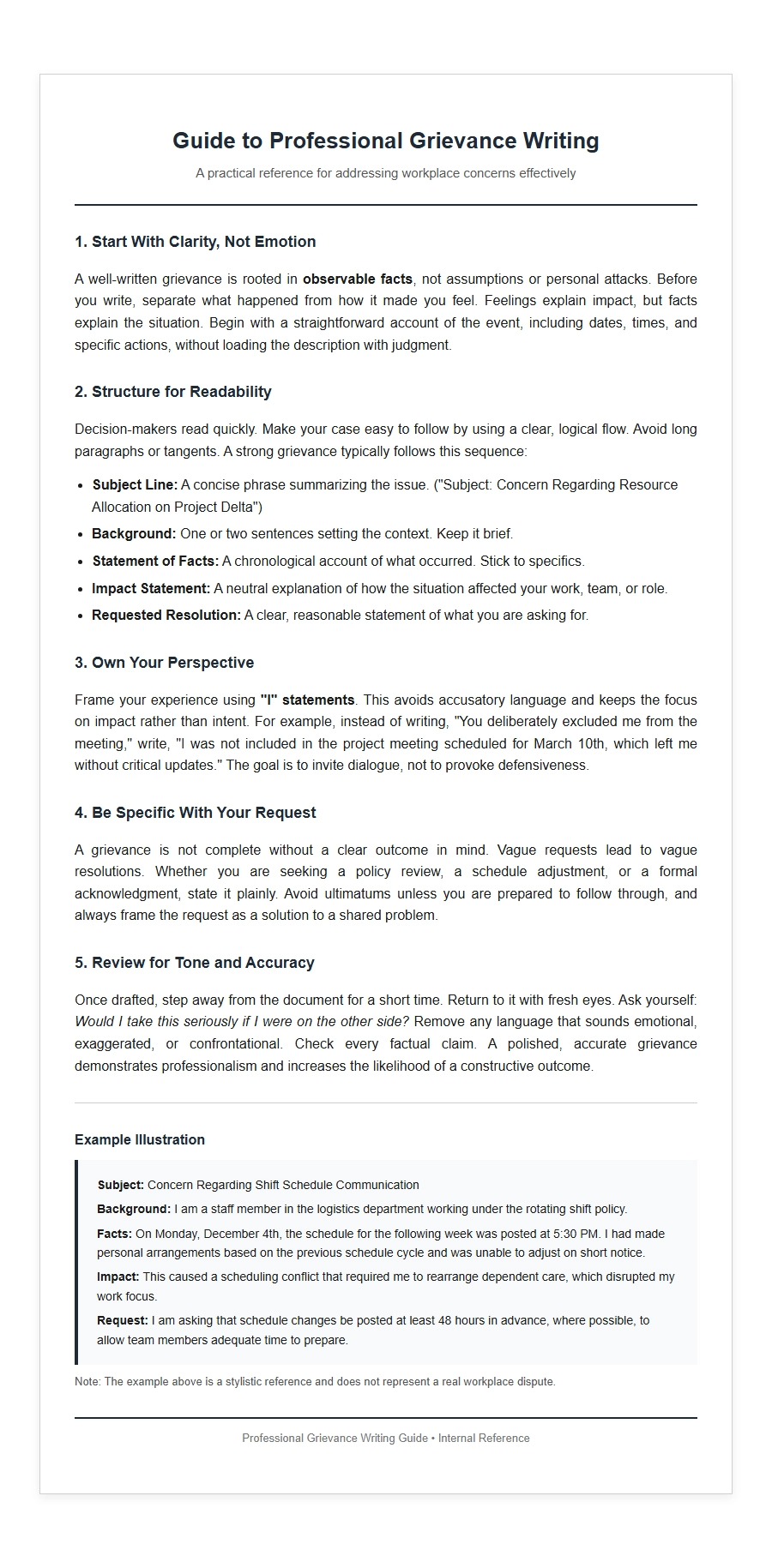 Best Practices for Writing Professional Grievance Letters