You need to send a letter addressing a vendor relationship issue, but you’re stuck between sounding too aggressive and coming across as a pushover. It’s a tightrope walk. One wrong word can damage a partnership you’ve spent months building. The good news is that a thoughtful, diplomatic approach—backed by a solid letter template—can turn that anxiety into a clear, professional message that actually fixes the problem.
That blank page is intimidating, but it doesn’t have to be. Using a sample letter isn’t cheating. It gives you a reliable structure for professional correspondence, so you don’t have to invent the wheel while you’re already stressed. A good template provides the right tone, a logical flow, and the key phrases you need to stay respectful yet firm. You just add your specific details and your authentic voice.
Category: Complaint Letters
Why a Diplomatic Approach Matters in Vendor Relations
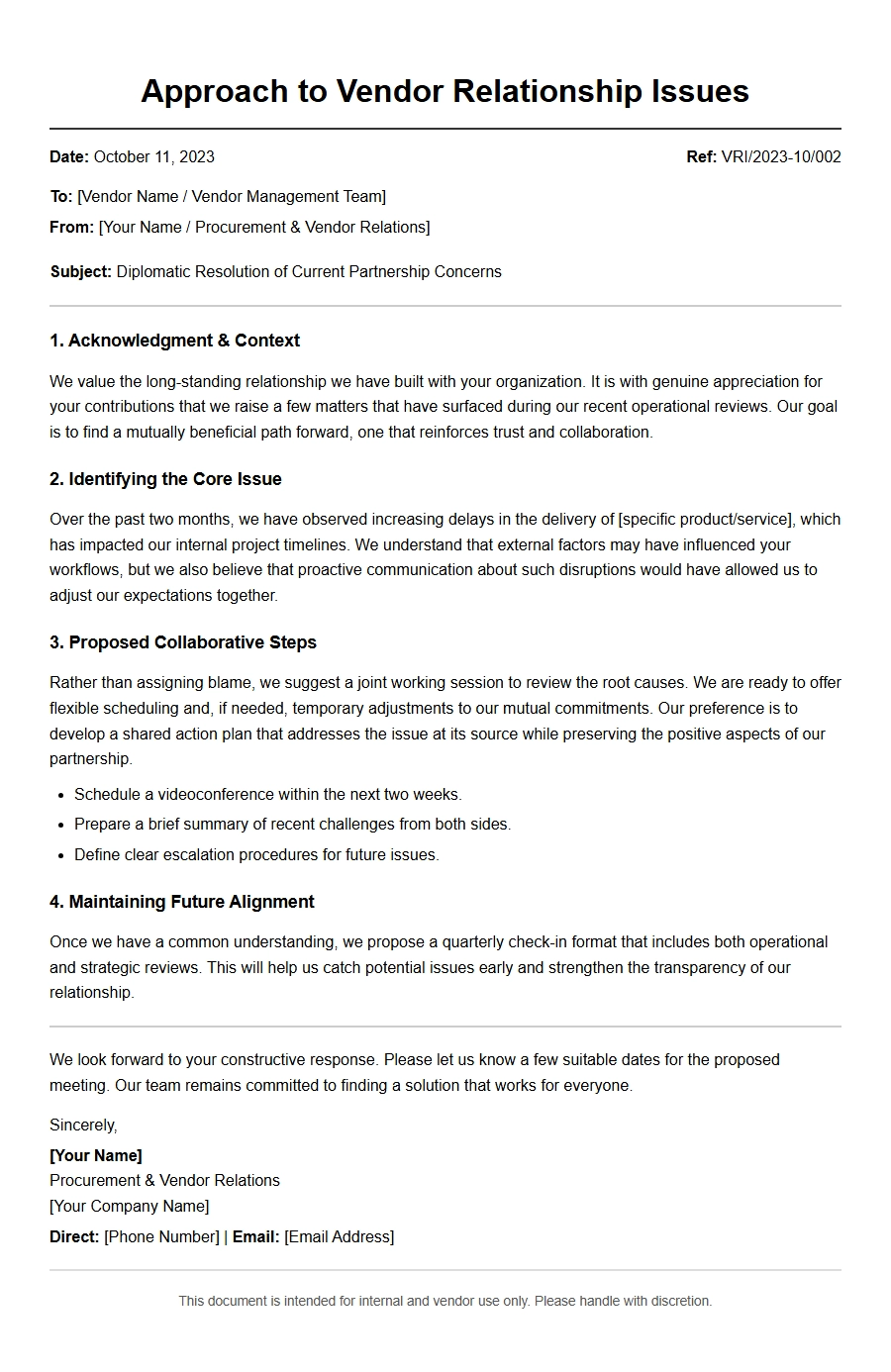
A vendor relationship is a partnership. When something goes wrong—a missed deadline, a quality issue, or a billing mistake—your goal isn’t just to complain. You want a resolution that keeps the relationship intact. A formal writing tip here is to state the problem clearly, but frame it as a shared challenge. For example, instead of “You failed to deliver on time,” try “The recent delay in delivery created challenges on our end. Can we discuss how to prevent this going forward?” That small shift in tone preserves trust while still holding them accountable.
How to Choose the Right Letter Sample
Not every business letter format works for every situation. If you’re dealing with a long-term strategic partner, you’ll need a more collaborative tone. For a transactional vendor you’ve used once, a more direct approach is fine. Look for a sample that matches the severity of the issue. A cover letter example won’t help here—you need something built for conflict resolution. Pay attention to the salutation and closing in the sample. “Dear [Name]” and “Sincerely” are standard, but if the relationship is informal, “Hi [Name]” and “Best regards” might feel more human.
Adapting the Sample Without Losing Your Voice
Once you find a good sample, read it, then put it aside. Write your first draft from memory using the structure you absorbed. That keeps the skeleton but forces your own words to fill it. If you copy-paste and just swap names, the letter will feel robotic. You want the reader to hear you, not a robot. A useful practice is to read your draft out loud. If you stumble over a phrase or it sounds stiff, rephrase it. Tone in writing is everything here. You’re aiming for calm, direct, and solution-oriented.
Common Mistakes to Avoid
The biggest mistake people make is using outdated formal language like “Please be advised” or “This is to inform you.” That stuff makes the letter feel cold and accusatory. Instead, open with something simple like “I’m writing to discuss the issue we experienced with…” Another mistake is ignoring the format. If you’re sending a printed letter, a proper letterhead design adds professionalism. But if it’s an email, a digital letter format with a clear subject line and short paragraphs works better. Long blocks of text in an email get ignored. Also, never send a letter without proofreading the letter for typos. A typo in a complaint about attention to detail undermines your credibility.
Tailoring the Opening Paragraph to Grab Attention
The first paragraph sets the tone. Don’t start with a history lesson or a list of grievances. Lead with the shared goal. For example: “I appreciate our partnership over the past year, and I’d like to address a recent issue before it affects our upcoming projects.” This makes the reader see you as a collaborator, not an adversary. You can also reference the specific project or order number early so they know exactly what you’re talking about. This is where a good resignation letter sample approach can be tweaked—you’re announcing a problem, not leaving, but the clarity is the same.
Writing the Body: Facts, Impact, and Request
In the body, state the facts neutrally. Describe what happened, the impact on your work, and what you need to fix it. Use “I” statements to avoid sounding accusatory: “I noticed that the shipment arrived without the final packaging specification. This caused a delay in our quality check. Could we review the process to ensure this doesn’t recur?” This is a direct application of letter writing etiquette—you state the problem without attacking the person. End the body with a clear, reasonable request. That could be a refund, a replacement, or simply a meeting to discuss improvements.
Before you send it, step away for an hour. Then read it again. Does it sound like you? Would you be comfortable saying these words out loud to the vendor’s face? If yes, you’re ready. Close the letter by affirming your interest in continuing the relationship and inviting their response. Something like “I’m confident we can resolve this together. Please let me know a good time to discuss next steps.” That leaves the door open and shows you’re not just venting—you’re solving.
Think of the sample as scaffolding. It holds you up while you build something solid. The more you write these letters, the less you’ll need the scaffold. Eventually, you’ll just write from instinct. But for now, grab a good template, make it your own, and send that letter with confidence.
Samples for Inspiration
Diplomatic Complaint Letter for Vendor Issues
[
{
"title"
"Late Delivery – Polite Follow-Up",
"body"
"
Date: March 10, 2025
To: Vendor Relations Team, Alpha Supplies Inc.
Re: Order #ORD-7841 – Late Shipment
I hope this message finds you well. We have been long-standing partners, and your service has always been reliable. However, our recent order (details below) was due on March 5, 2025, and has not yet arrived. We understand that delays can occur, and we are writing to kindly request an update on the expected delivery date.
Item
Qty
Order Date
Promised Delivery
Widget A (SKU-101)
500
Feb 25
Mar 5
Widget B (SKU-202)
200
Feb 25
Mar 5
This order is critical for our upcoming production cycle. Please let us know the revised shipping date and any steps being taken to expedite. We value our partnership and prefer to resolve this amicably. Thank you for your prompt attention.
"
},
{
"title"
"Defective Product – Request for Replacement",
"body"
"
Date: March 12, 2025
To: Quality Assurance, GreenTech Components
Re: Invoice #INV-9021 – Defective Shipment
I am writing to bring to your attention a quality issue with the last shipment we received (Invoice #INV-9021, dated March 1). Upon inspection, we found that 45 out of 300 units of the EcoSensor-2 have faulty connectors, rendering them unusable. Our team has documented the defects with photographs (available upon request).
We understand that occasional defects can happen, but we value the consistency we have seen from your company. To maintain our trust, we kindly ask for a full replacement of the defective units at no additional cost, along with a prepaid return label for the faulty items. We would also appreciate a brief root-cause analysis to prevent recurrence.
Defective items: 45 units of EcoSensor-2 (Lot #LT-4321)
Replacement requested: 45 new units, shipped standard
Return: Prepaid label needed
Please let us know how you would like to proceed. We are confident we can resolve this in a positive manner.
"
},
{
"title"
"Overcharge – Billing Discrepancy",
"body"
"
Date: March 14, 2025
To: Billing Department, CloudServ Solutions
Re: Invoice #INV-2304 – Disputed Amount
Good morning. I am writing to discuss a discrepancy in the invoice we received for last month’s services (Invoice #INV-2304, total $4,250). According to our contract, the monthly fee for the Premium Support Package is $3,500, but you have billed an additional $750 for “expedited escalation.” Our team did not request any escalated service; we followed the standard support channel.
I have attached a copy of our Master Service Agreement (Section 5.3) which states that any additional fees require written approval from both parties. As no such approval was given, I kindly request a credit of $750 to be applied to the next invoice. Alternatively, if you can provide documentation of our request, we are happy to reconsider.
Item
Amount Billed
Expected
Premium Support
$3,500
$3,500
Expedited Escalation
$750
$0
Thank you for your understanding. We value our partnership and hope to resolve this quickly.
"
},
{
"title"
"Poor Communication – Seeking Better Updates",
"body"
"
Date: March 16, 2025
To: Account Management, DataFlow Logistics
Re: Project Phoenix – Update Request
I hope you are doing well. I am writing to gently express some concern about the frequency of project updates regarding the integration of our inventory system. We are two weeks into the implementation, and while the initial kick‑off was excellent, our team has received only one status report since then. Several email inquiries have gone unanswered for more than three days.
To keep our internal stakeholders aligned, we would appreciate a regular weekly update – even a brief email with bullet points would suffice. Specifically, please include:
Progress against milestones
Any blockers or risks
Action items for our team
We understand your team is busy, but transparent communication is key to the success of this project. I am confident that with a small adjustment we can get back on track without any friction. Please let me know if you would like to schedule a quick call to discuss.
"
},
{
"title"
"Contract Violation – Gentle Reminder of Terms",
"body"
"
Date: March 18, 2025
To: Legal & Contracts, Precision Tools Ltd.
Re: SLA Non‑Compliance – Response Time
I trust this message finds you well. As per our Master Services Agreement (signed July 2024), your service level commitment for critical incident response is 2 hours during business hours. On March 14 and March 16, we submitted two critical tickets (#CT-112 and #CT-113) regarding a production outage. In both instances, the initial response came after 5 hours, exceeding the agreed threshold.
I understand that unforeseen circumstances may affect response times, but we would like to bring this to your attention to prevent a pattern. Our operations depend on timely support, and we value the reliability you have shown historically. We kindly request:
A formal acknowledgment of the two SLA breaches
An action plan to ensure future compliance
A credit of 10% on this month’s invoice as per Section 12.4 of the MSA (optional, but recommended)
I am happy to discuss this further. Our goal is to maintain a healthy, long‑term partnership.
"
},
{
"title"
"Service Level Not Met – Performance Discussion",
"body"
"
Date: March 20, 2025
To: Operations Manager, SecureHost Networks
Re: Monthly Uptime Report – February 2025
I am writing to share our concerns regarding the uptime performance of your cloud hosting services during February 2025. According to your own monthly report, availability was 99.2% – below the guaranteed 99.9% in our contract. This resulted in approximately 5 hours of unplanned downtime across two separate incidents (Feb 12 and Feb 27).
We have always appreciated your technical expertise and responsive support. However, this level of downtime affected our e‑commerce platform, causing lost revenue and customer frustration. To address this, we propose a few constructive steps:
Investigation: Please share a root cause analysis for each incident.
Compensation: According to the SLA, we are entitled to a 5% service credit for any month below 99.9%. We request this credit on the next invoice.
Prevention: Provide a timeline for implementing additional redundancy measures.
We believe that working together we can restore the high reliability we have come to expect.
"
},
{
"title"
"Unresponsive Support – Request for Escalation",
"body"
"
Date: March 22, 2025
To: Customer Experience Director, HelpDesk Pro
Re: Ticket #HD-4892 – No Response Since 3 Days
I hope you are doing well. I am writing concerning support ticket #HD-4892, opened on March 19 regarding a critical system error that prevents our team from accessing the client portal. Despite several follow‑ups, we have not received any acknowledgment or update from your support team.
I understand that ticket volume can be high, but a 3‑day silence on a critical issue is unusual for your service. Could you kindly escalate this to a senior engineer or the on‑call manager? We need at least an initial diagnosis within the next 24 hours to allow us to plan workarounds.
We have been loyal customers for two years and truly value your solution. A prompt response would greatly reassure us. Please let me know the best way to proceed. I am also available for a call at any time.
"
},
{
"title"
"Inconsistent Quality – Examples and Improvement Request",
"body"
"
Date: March 24, 2025
To: Quality Manager, PrecisionParts Co.
Re: Batch #B-2201 – Quality Variation
I am reaching out to discuss a quality inconsistency we have observed over the past three deliveries. While we have always appreciated the high standards of your components, the last two batches (B-2201 and B-2200) show noticeable variation in surface finish and dimensional tolerance. For example, the thickness of the metal brackets in batch B-2201 ranges from 4.2 mm to 4.8 mm, whereas the specification requires 4.5 mm ±0.1 mm.
We have attached measurement data for your review (see table below). Our production line has experienced a 12% rework rate because of these variations.
Batch
Item
Spec (mm)
Actual Range (mm)
B-2201
Bracket MK-3
4.5 ±0.1
4.2 – 4.8
B-2200
Bracket MK-3
4.5 ±0.1
4.3 – 4.7
We would like to work together to understand what changed in your process
and request an updated quality control plan for the next shipment. We are confident you can return to the excellent tole
},
{
"title"
"Payment Terms Confusion – Clarifying Agreement",
"body"
"
Date: March 26, 2025
To: Accounts Receivable, Global Office Supplies
Re: Invoice #GOS-5512 – Net 30 vs Net 60
Good afternoon. I am writing to clarify the payment terms applied to invoice #GOS-5512, dated March 1, 2025, for $12,300. Our purchase order (PO-2025-038) clearly states “Net 60 days” as agreed in the contract signed on January 15, 2025. However, the invoice shows “Net 30 days” and a late fee warning was sent to us on March 20.
We always honor our payment commitments and prefer to keep our relationship smooth. Could you please confirm the correct terms and adjust the invoice accordingly? For your reference, here are the relevant details:
Contract Clause 4.2: Payment shall be made within 60 days from invoice date.
PO Number: PO-2025-038
Invoice Amount: $12,300
Once the terms are corrected, we will process payment within the agreed window. Please let us know if you need any further documentation. Thank you for your cooperation.
I am writing to share some feedback regarding a recent interaction with one of your consultants, John Smith. During the video call on March 23, Mr. Smith made several comments that were dismissive of our team’s technical suggestions and used a tone that we found unprofessional. Specifically, he interrupted our engineers multiple times and stated that our proposed solution was “not worth discussing.”
I want to emphasize that we have great respect for your company’s expertise and have enjoyed a productive partnership. However, such interactions can hinder collaboration. I would prefer to address this directly and constructively. Could we schedule a brief meeting with Mr. Smith and you to reset communication expectations? Our goal is to ensure that all team members feel respected and valued.
I believe a simple conversation can restore the positive rapport we have built. Thank you for your attention to this matter.
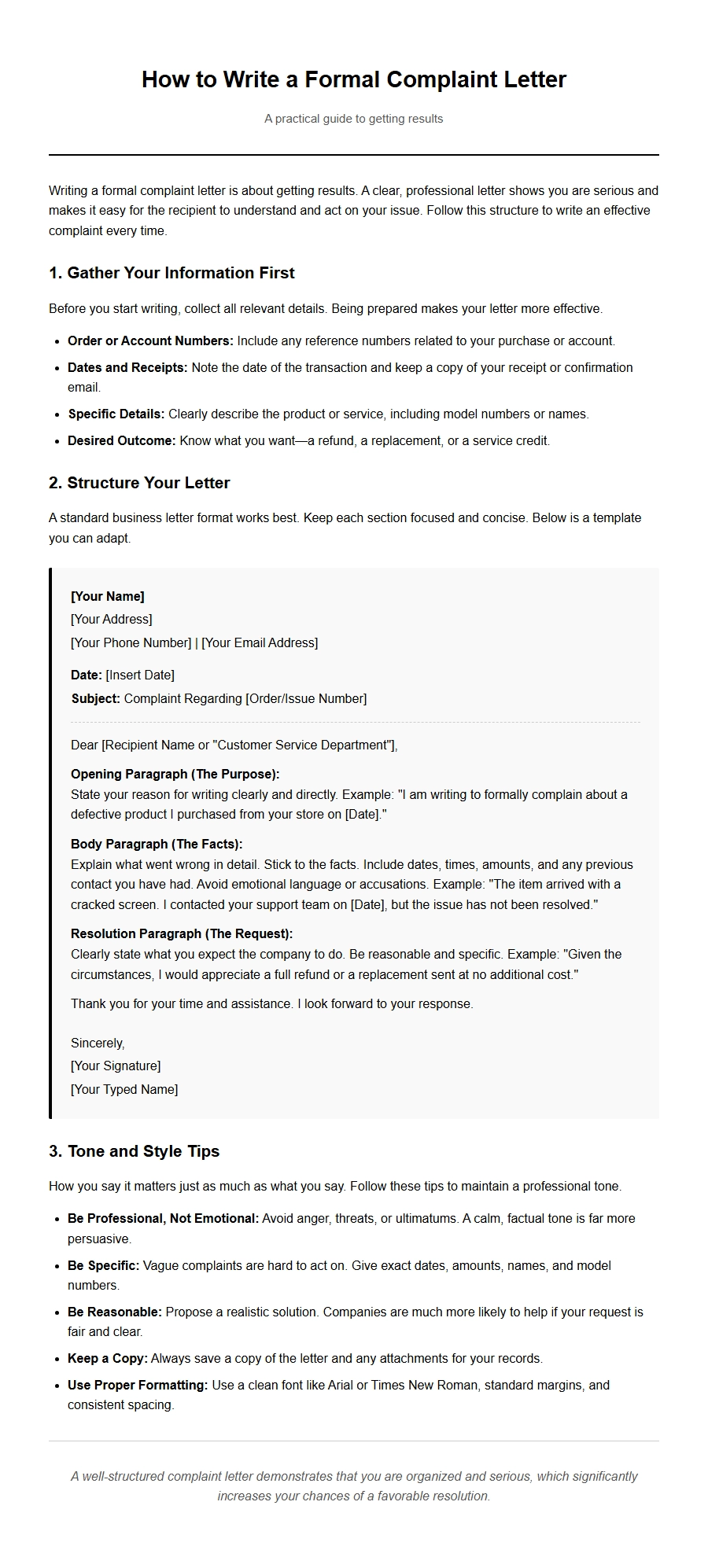 How to Write a Formal Complaint Letter
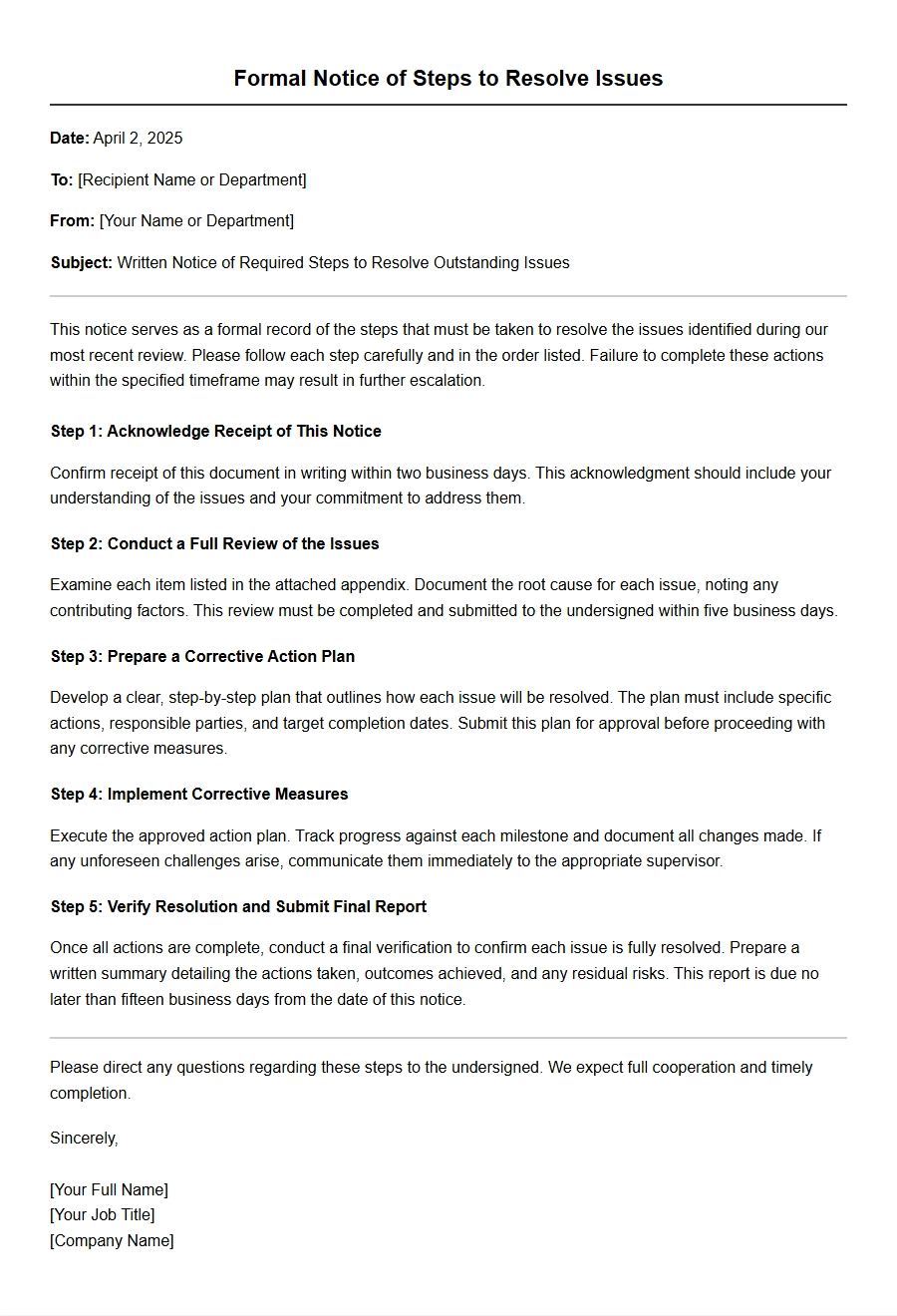 Steps to Resolve Issues via Written Notice
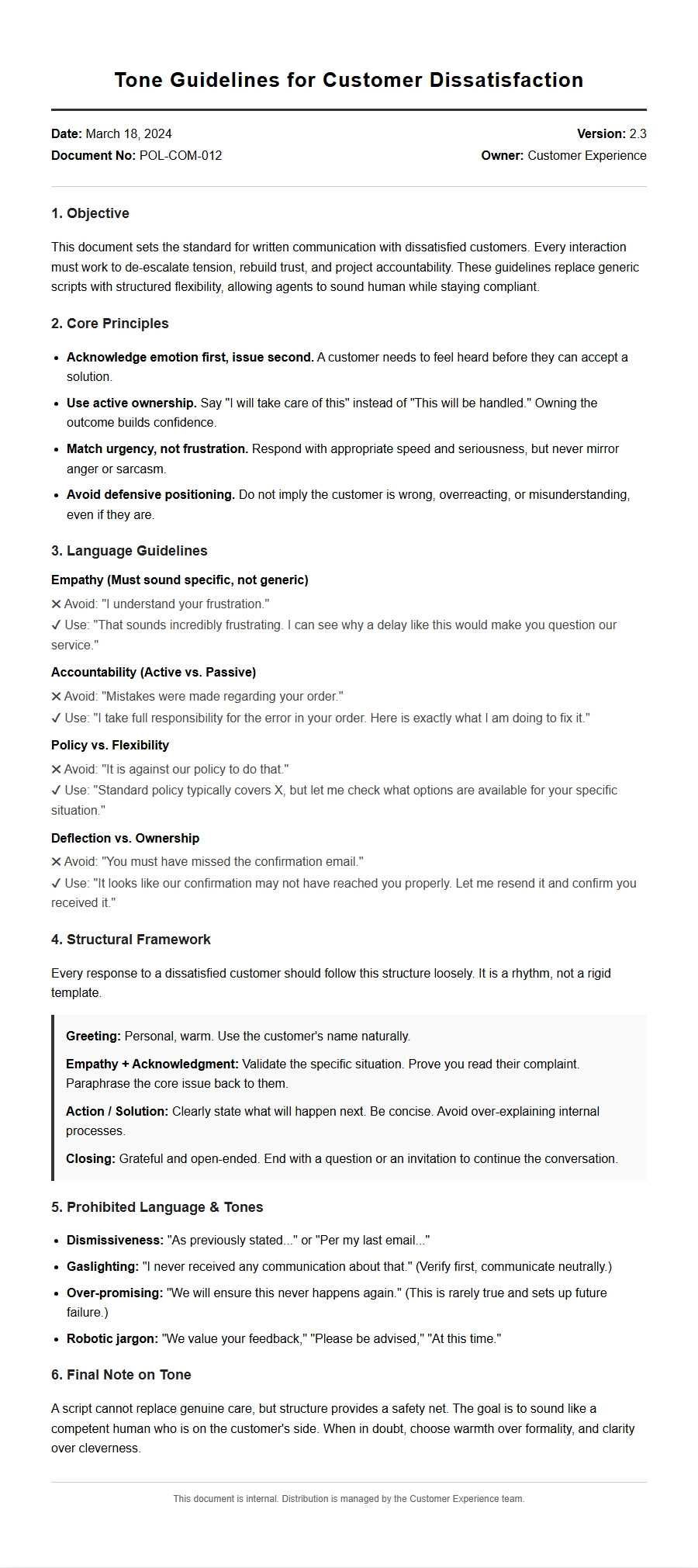 Tone Guidelines for Dissatisfied Customer Letters
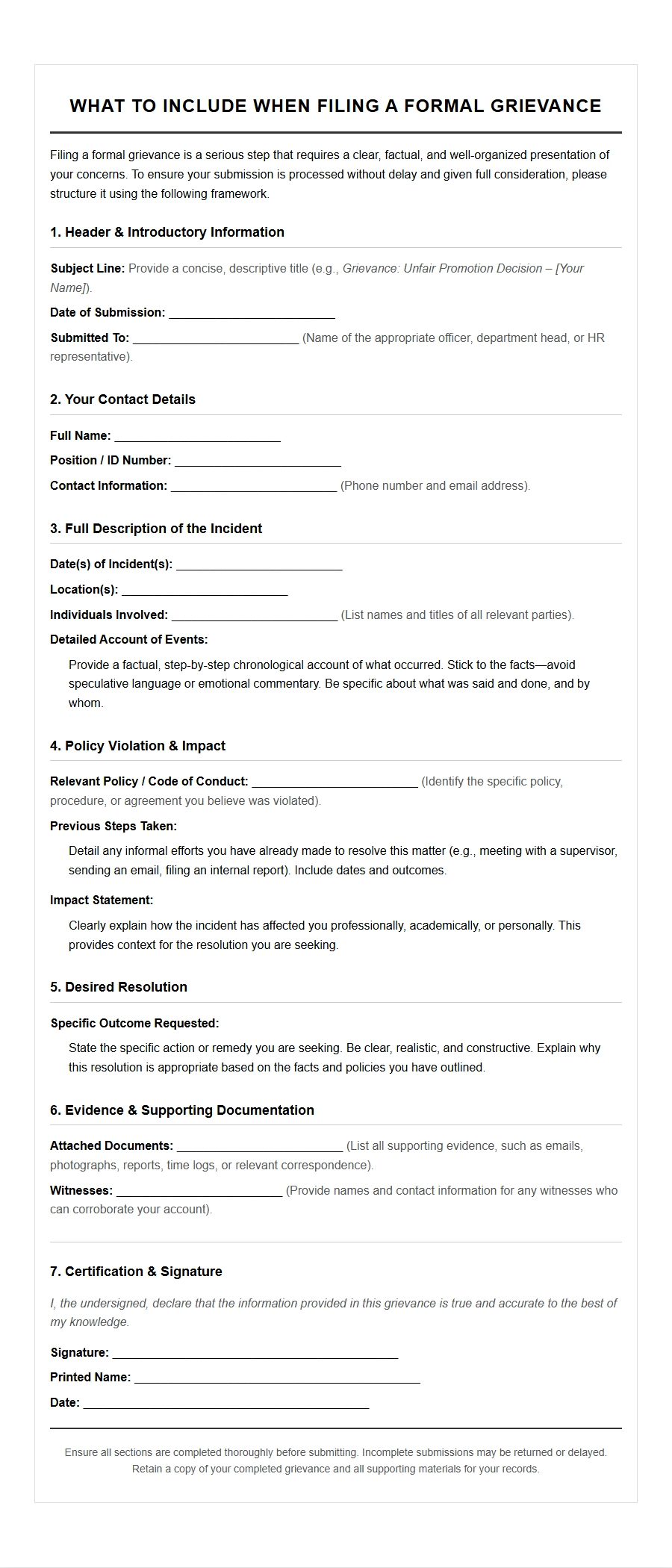 What to Include in a Formal Grievance Letter
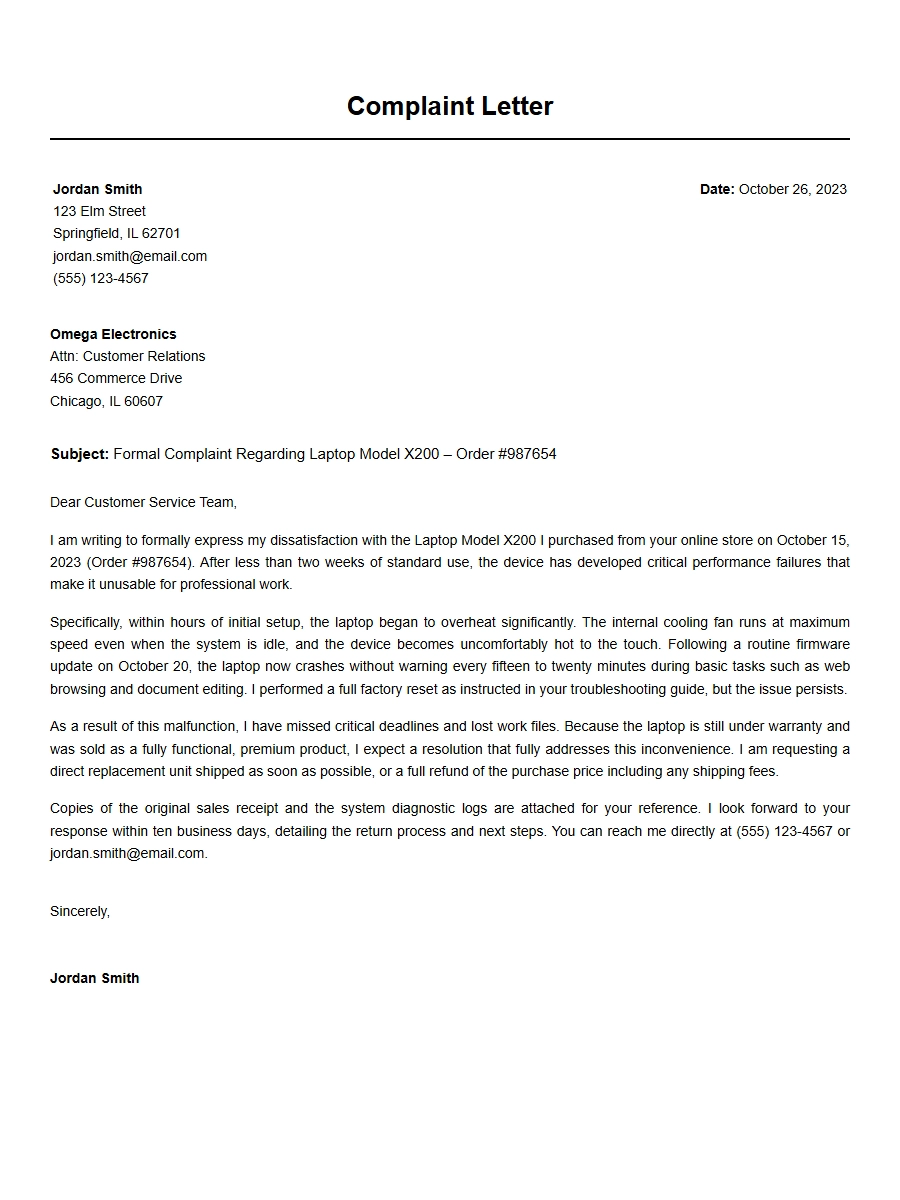 Structure of an Effective Complaint Letter
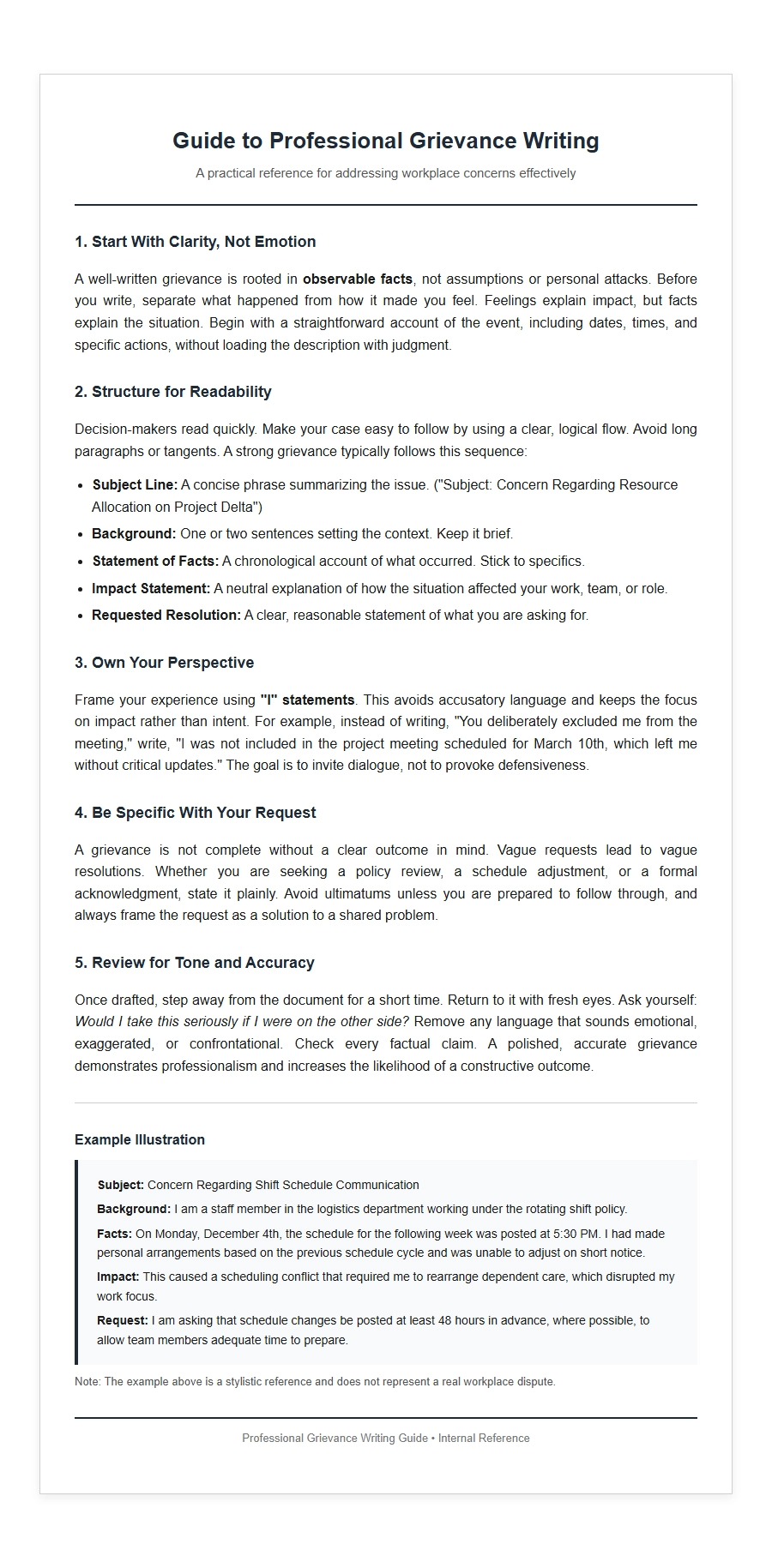 Best Practices for Writing Professional Grievance Letters