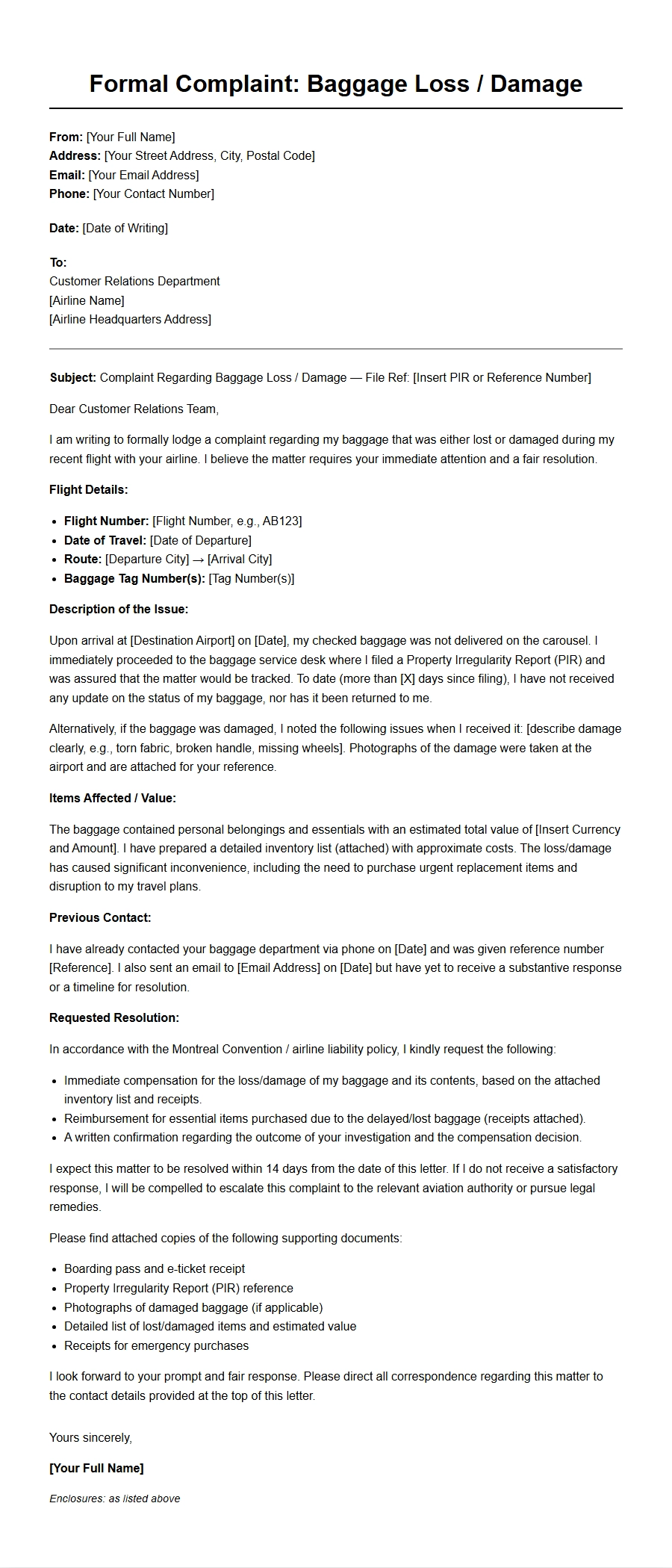
Complaint Letter for Lost or Damaged Airline Baggage
You’ve just dragged yourself home from the airport. The suitcase that didn’t show up on the belt held everything you needed for that conference. Or maybe it arrived, but the handle is snapped and there’s a tear in the fabric. Filing a complaint is the last thing you want to do, but it’s the only way to get the airline to make things right. Staring at a blank email draft makes the frustration boil over again.
This is where a solid letter template becomes your best travel companion. Using one isn’t cheating or lazy. It’s a smart way to make sure you include every critical detail without letting your anger take over your tone in writing. A good template gives you the bones—the right business letter format, the place for your baggage report number, and the specific legal language that airlines respect. It turns your anxiety into a confident draft in minutes.
Before you start typing, decide how you’re going to send this. A physical printed letter using your own letterhead design (or a clean digital one) often carries more weight than a message through a website contact form. If you’re sending an email, keep the salutation and closing professional but direct. “Dear Customer Service Team” is fine, but if you have a specific agent’s name, use it. The structure of your professional correspondence should always include your booking reference, the PIR (Property Irregularity Report) number, and a reference to the Montreal Convention Article 17 or 22.
A sample letter works best when you make it your own. Don’t just swap in your name and call it done. Describe your bag in detail—the brand, the color, the scuff on the back wheel. Explain exactly what was inside and how the loss or damage impacted your trip. Letter writing etiquette means being firm but fair. Avoid accusations. State facts: “The bag was checked in good condition at 6:00 AM and arrived damaged at 8:00 PM.” Proofreading letter details is crucial here. A typo in your address or flight number can slow down the whole process.
Many airlines use automated phone systems designed to filter complaints. If you are stuck in one of these loops and can’t reach a human, sending a clear, formal letter can bypass the whole mess. It works much like a complaint about an automated phone system failure, forcing the company to treat your issue as a formal record rather than a casual phone note.
Think of your letter as a formal request for restitution. You need to be as clear about the outcome you want as you are about the problem. Structuring your claim like a billing error correction notice to a utility provider adds a layer of seriousness to your request. If the airline’s negligence caused you specific financial loss—like ruined work equipment or missed event fees—your letter should read like a formal request for compensation for professional negligence damages. Mastering an assertive yet professional tone is a key part of service recovery, and you can see exactly how that works in examples of an assertive tone complaint letter for service recovery.
In some ways, protecting your property claim isn’t unlike protecting your identity—it requires clear, documented action. A well-structured problem notification creates a paper trail that holds the airline accountable, much like notifying social security of identity theft concerns protects your personal records.
So, grab that sample letter. Use it as a springboard. Fill it with your specific, personal details, and send it off. The goal isn’t to write a perfect letter. The goal is to write an effective one that gets your bag back or gets you paid. Do it once, do it right, and you’ll have the confidence to handle it quickly if it ever happens again.
Templates and Samples
Complaint Letter for Lost or Damaged Airline Baggage
Lost Checked Baggage - Request for Compensation
Dear Customer Service,
I am writing to formally file a claim for lost baggage on flight AA1234 from New York (JFK) to London (LHR) on June 15, 2025. My black hard-shell Samsonite suitcase with a red ribbon handle (tag #XYZ789) was checked in but never arrived at baggage claim.
Despite filing a PIR report at the airport (reference #LHR-4567), I have not received any update after 21 days. According to Montreal Convention rules, the airline is liable for the full value of the lost baggage.
Item Description
Value (USD)
Suitcase (Samsonite)
$250
Clothing and personal items
$1,200
Laptop (Dell XPS)
$1,500
Books and documents
$200
Total Claim
$3,150
Please process my compensation immediately. I have attached copies of my boarding pass, baggage tag, and itemized receipts. I expect a response within 10 business days.
Sincerely, Jane Doe Phone: +1-555-1234 Email: jane.doe@email.com
Delayed Baggage - Reimbursement for Essential Items
Dear Claims Department,
I am seeking reimbursement for essential items purchased due to a 48-hour baggage delay on flight BA5678 from Dubai (DXB) to Manchester (MAN) on July 2, 2025. My bag (blue North Face duffel, tag #MAN-8901) did not arrive with me.
As per your policy, I am entitled to recover reasonable expenses incurred during the delay. Below is a list of items I purchased, with receipts attached.
Change of clothes (shirt, trousers, underwear) - $85
Toiletries (toothbrush, shampoo, etc.) - $25
Charger and adapter - $30
One night accommodation (hotel near airport) - $150
Meals (dinner, breakfast, lunch) - $60
Total claimed: $350
My bag was delivered to my hotel on July 4 at 9:00 PM. I request reimbursement via bank transfer to the account details attached. Thank you for your prompt attention.
Yours faithfully, John Smith Booking Reference: BA-67890
Damaged Suitcase - Repair or Replacement Claim
To the Baggage Service Office,
I am filing a claim for a damaged suitcase after flight DL9012 from Atlanta (ATL) to San Francisco (SFO) on August 10, 2025. My black Travelpro spinner suitcase (serial #TP-456) arrived with two broken wheels and a torn handle.
The damage was noted by the baggage agent at SFO who issued a Property Irregularity Report (PIR #SFO-3344). The bag is only one year old and was in perfect condition before check-in.
Damage Type
Estimated Repair Cost
Replacement Cost
Two broken wheels
$50
N/A
Torn telescopic handle
$75
N/A
Total repair (quote from luggage shop)
$125
$280 (new equivalent)
I prefer repair as it is more economical. Please authorize repair at the quoted amount or provide a new suitcase of similar value. I have attached photos and the PIR form.
Regards, Emily Wang Flight: DL9012 Seat: 14A
Missing Valuables from Checked Baggage
Dear Baggage Claims,
I am writing to report missing valuables from my checked baggage after flight EK7777 from Dubai (DXB) to Mumbai (BOM) on August 5, 2025. My silver hardcase American Tourister (tag #BOM-1122) arrived with the lock cut open and several items missing.
I immediately reported this to the baggage desk at BOM and was given PIR #BOM-5566. The missing items include:
This is a complaint regarding mishandling of my baggage during a connecting flight on June 28, 2025. My itinerary was: Frankfurt (FRA) to Toronto (YYZ) via London (LHR) on Air Canada flight AC8456. My bag was checked through FRA but failed to connect at LHR.
I arrived in Toronto at 22:00 without my bag. The baggage office issued PIR #YYZ-7890 and promised delivery within 24 hours. However, my bag was delivered only after 72 hours, and when it arrived, the zipper was broken and the contents were damp.
Issue
Details
Delay duration
72 hours (June 28 - July 1)
Damage
Broken zipper (repair needed)
Personal inconvenience
Missed business meetings, had to purchase clothes
Expenses incurred
USD 210 (receipts enclosed)
I request compensation for the damage (estimated repair $60) plus reimbursement of delay expenses ($210), totaling $270. Please let me know your decision within 14 days.
Thank you, Michael Chen Reference: AC-8456-PIR
Claim for Full Replacement Value of Lost Luggage
Dear Customer Relations,
I am submitting a claim for the full replacement value of luggage lost on flight UA3456 from Chicago (ORD) to Tokyo (NRT) on July 20, 2025. My bag (green Eagle Creek duffle, tag #NRT-2345) was never located after 30 days.
Under the Montreal Convention, the maximum liability for lost baggage is approximately 1,288 SDR (about $1,700). However, my actual losses exceed this, and I request the maximum allowable compensation.
I understand the Montreal Convention cap, but please consider the exceptional circumstances – these were irreplaceable items for a 3-week trip. I have filed police report #ORD-6543 and attached all documentation.
I expect a settlement within 30 days.
Yours, Lisa Brown Phone: +1-312-555-7890
Damaged Fragile Items Inside Suitcase
To the Baggage Claims Unit,
I am writing to report damage to fragile items inside my checked suitcase after flight AF5678 from Paris (CDG) to New York (JFK) on September 2, 2025. My red Delsey suitcase (tag #JFK-9988) appeared undamaged externally, but upon opening, I found two porcelain figurines and a glass perfume bottle shattered.
I had carefully wrapped these items in clothing and bubble wrap. The bag was labeled "fragile" by the check-in agent. Despite this, the contents were destroyed.
Item
Value (EUR)
Limoges porcelain figurine (pair)
€400
Chanel perfume bottle (limited edition)
€150
Damaged clothing (stained by perfume)
€200
Total claim (EUR)
€750
I request compensation of €750 plus shipping costs for replacements (if applicable). I have photos of the damaged items and the packaging. Please process this claim promptly.
Best regards, Sophie Lambert Booking: AF-5678-JFK
Baggage Destroyed During Ground Handling
Dear Baggage Services,
I am filing a complaint regarding the destruction of my checked baggage during ground handling on flight LH6789 from Munich (MUC) to Los Angeles (LAX) on August 22, 2025. My suitcase (brown Rimowa aluminum, tag #LAX-3456) was handed to me at LAX with the entire shell cracked and one side caved in.
The baggage agent confirmed the damage was likely caused by heavy equipment during unloading. The bag is now unusable.
Bag brand/model: Rimowa Classic Cabin (original cost $1,200)
Purchase date: January 2024
Damage: Cracked shell, bent frame, scratched surface
Contents: All clothes and electronics damaged by pressure? No, but bag is total loss.
I request either a replacement bag of equal value (Rimowa Classic Cabin retails at $1,300) or cash compensation of $1,000 (depreciated value). I have photos, PIR #LAX-7777, and original receipt.
Please advise on next steps.
Regards, David Kim Email: dkim@travel.com Phone: +1-323-555-9012
Request for Interim Expenses Due to Baggage Delay
To the Claims Department,
I am requesting reimbursement for interim expenses caused by a baggage delay on flight QF1234 from Sydney (SYD) to Los Angeles (LAX) on July 30, 2025. My bag (blue Victorinox backpack, tag #LAX-2233) did not arrive with me.
I waited 3 days for delivery. During this time I had to purchase essential items. Please see the list below:
Toiletries (toothbrush, deodorant, razor) - $20
Two changes of clothing (shirt, pants, socks, underwear) - $120
Phone charger and power bank - $50
Prescription medication (not in carry-on) - $40
Taxi to pharmacy and hotel - $30
Total interim expenses: $260
My bag arrived on August 2 at 6 PM. I have attached all receipts and the PIR #LAX-2233. Please transfer the reimbursement to my bank account (details in attached form). I expect payment within 15 business days.
Thank you for your cooperation.
Sincerely, Olivia Taylor Flight: QF1234 Seat: 22A
Final Notice - Unresolved Baggage Damage Claim
Dear Customer Service Manager,
This is my third and final notice regarding baggage damage claim #DAM-2025-4567, filed on August 1, 2025, for flight TK7890 from Istanbul (IST) to Miami (MIA). My silver hardcase (tag #MIA-7890) was returned with a large dent and the lock mechanism broken.
I submitted all required documents (PIR #MIA-4567, photos, repair estimate) on August 5. Despite multiple follow-ups on August 20, September 1, and today, I have received no response from your claims team.
Claim Summary
Details
Date of incident
July 28, 2025
Claim filed
August 1, 2025
Amount claimed
$350 (repair cost $150 + inconvenience $200)
Response received
None
I demand a response within 7 days. If I do not receive a satisfactory resolution, I will escalate this to the Department of Transportation and pursue legal action. I also expect compensation for my time and frustration.
Awaiting your urgent reply.
Regards, Carlos Rivera Reference: TK-7890-DAM Phone: +1-305-555-1234
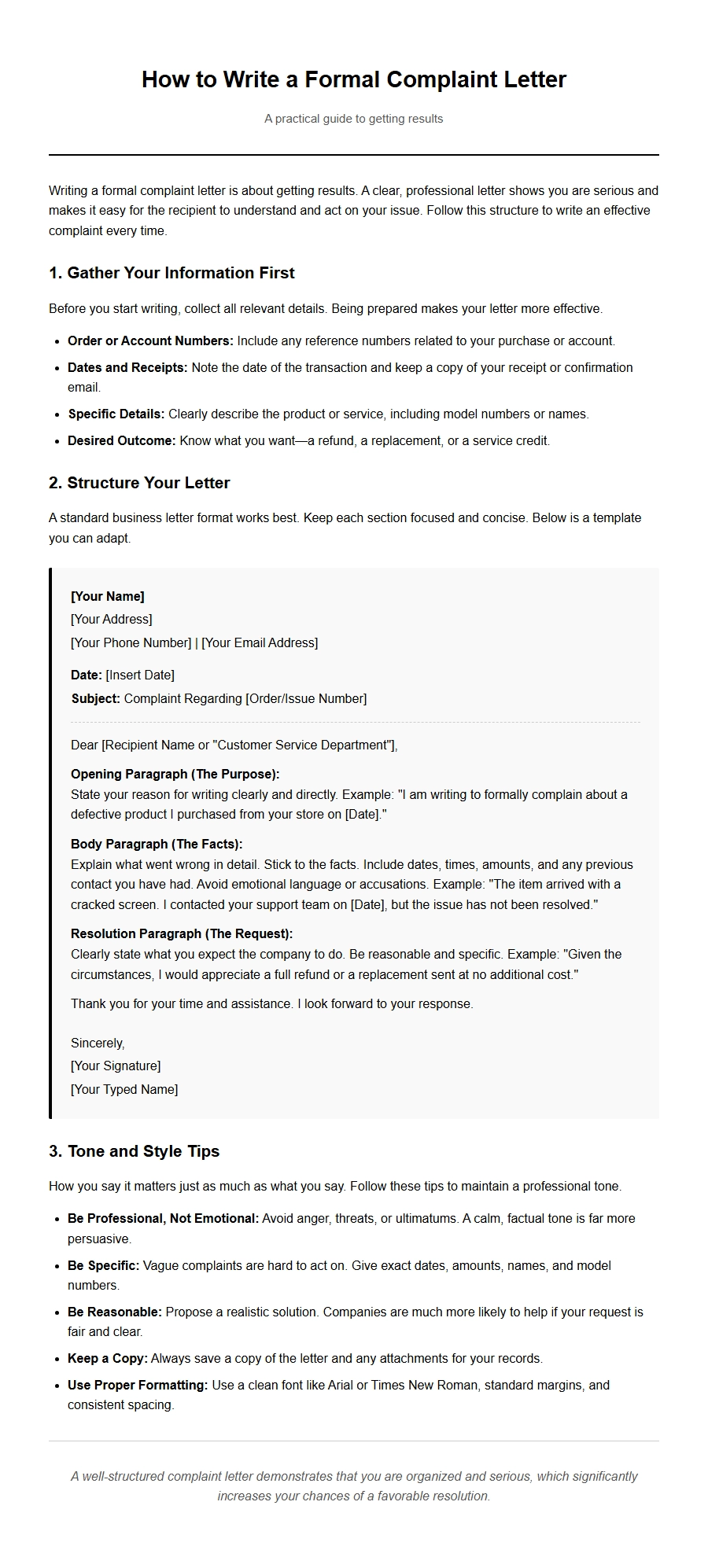 How to Write a Formal Complaint Letter
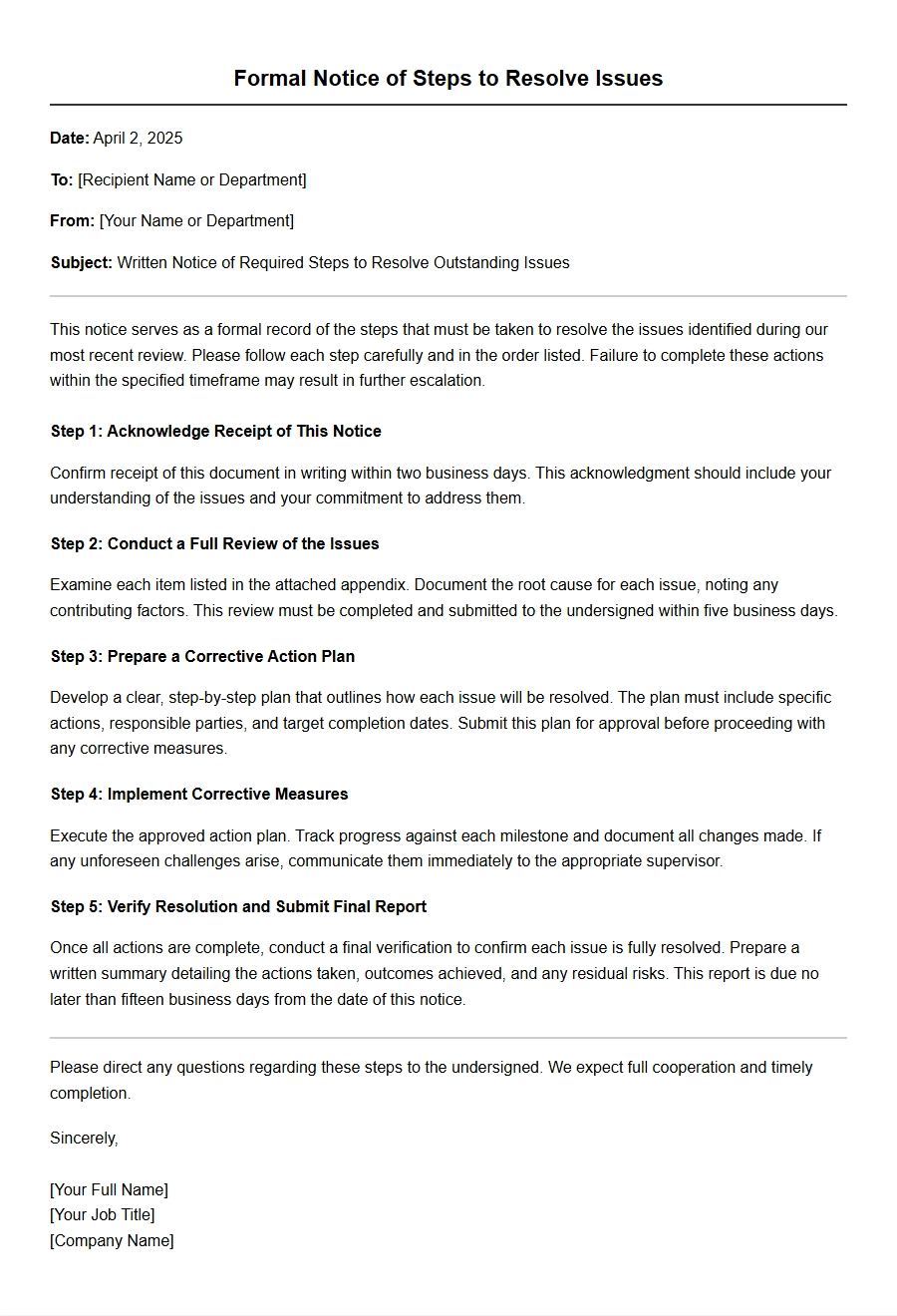 Steps to Resolve Issues via Written Notice
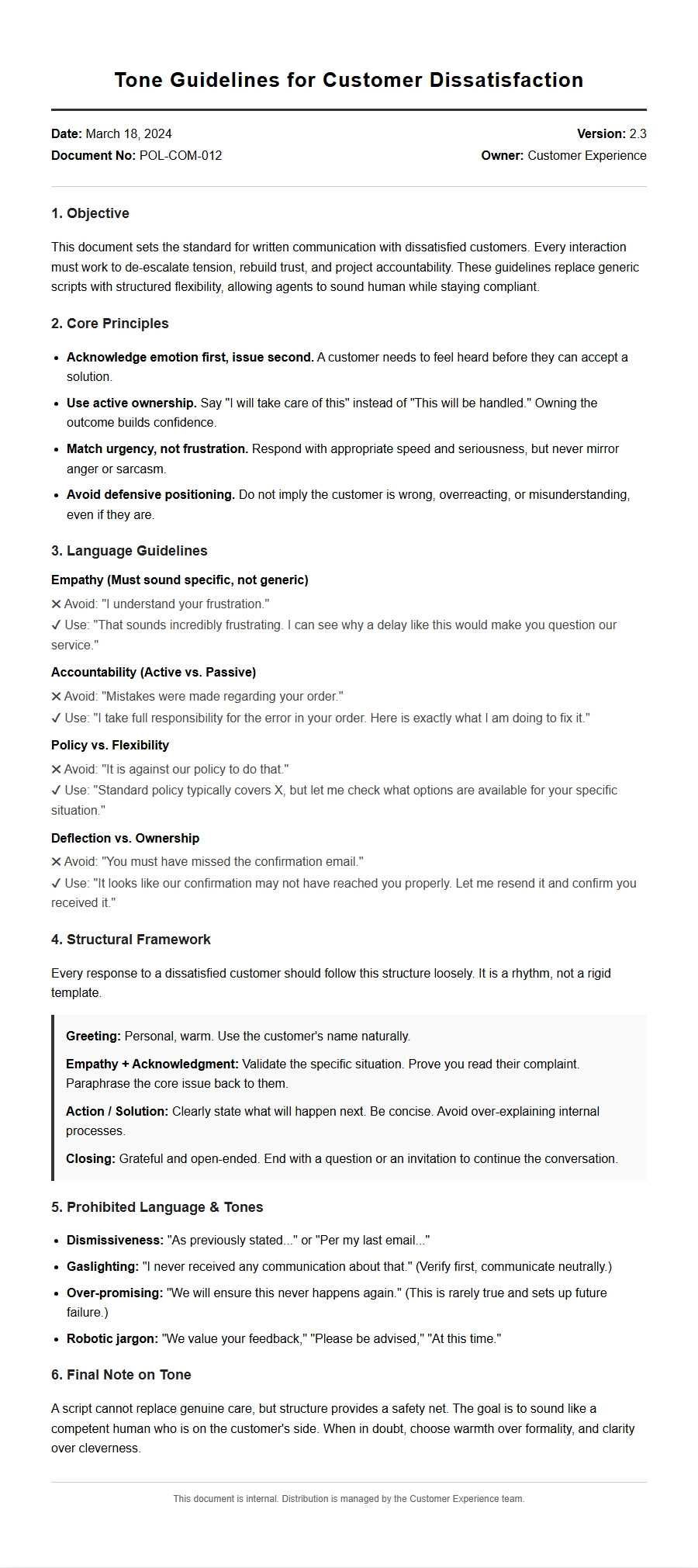 Tone Guidelines for Dissatisfied Customer Letters
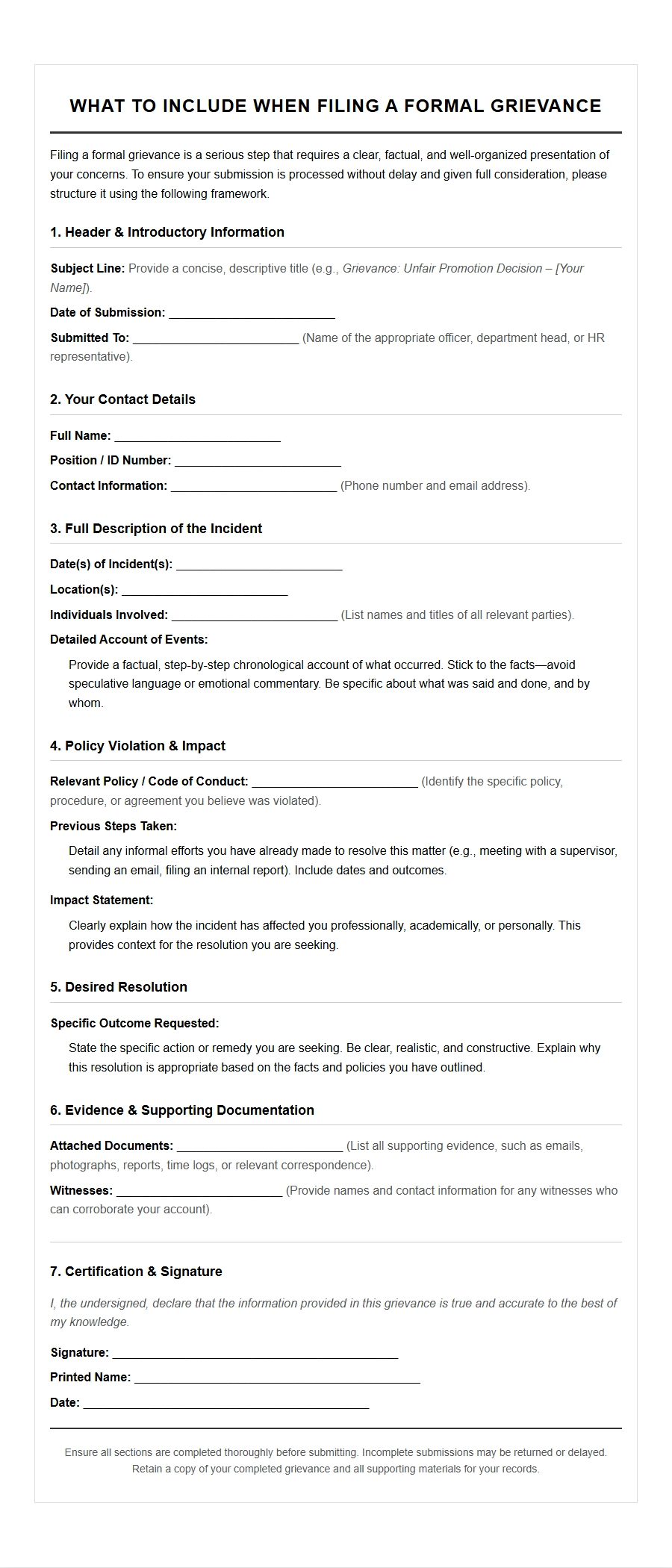 What to Include in a Formal Grievance Letter
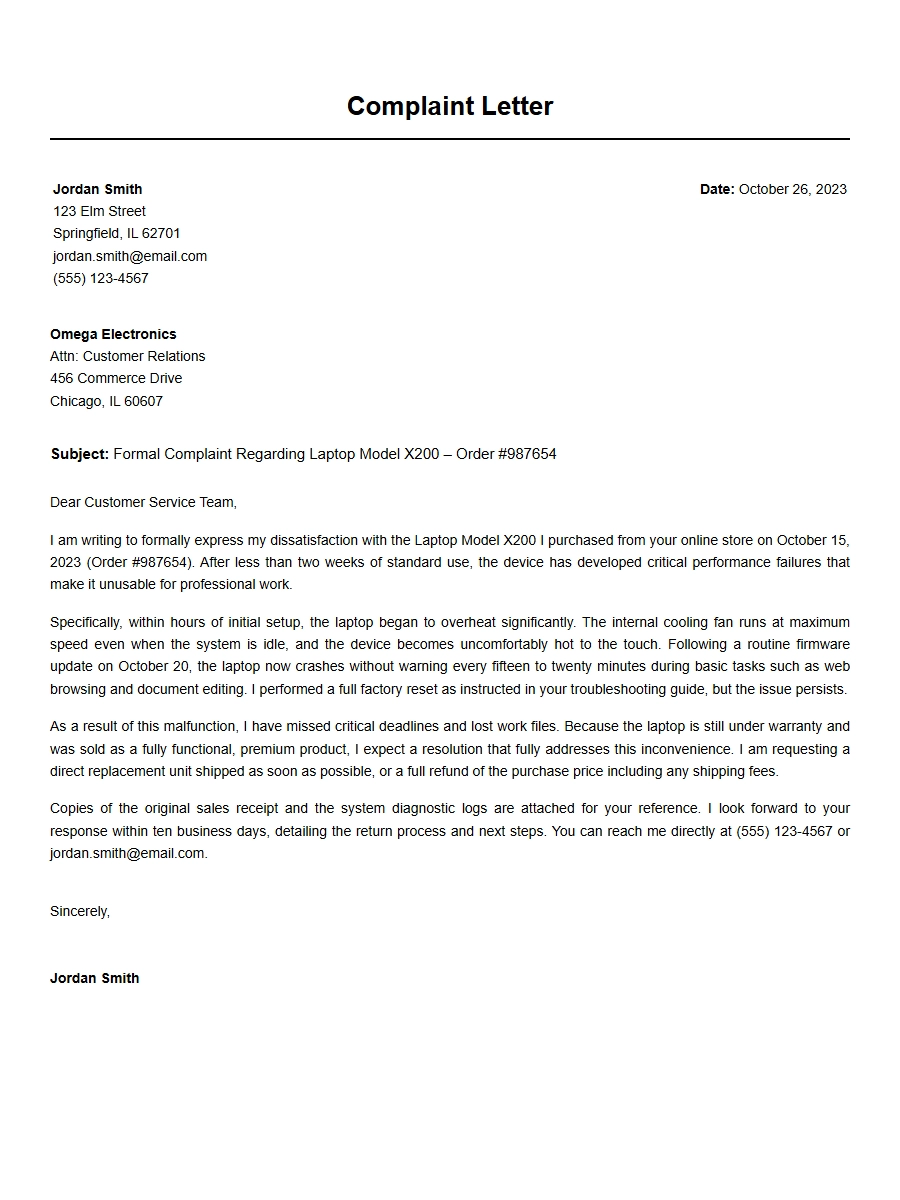 Structure of an Effective Complaint Letter
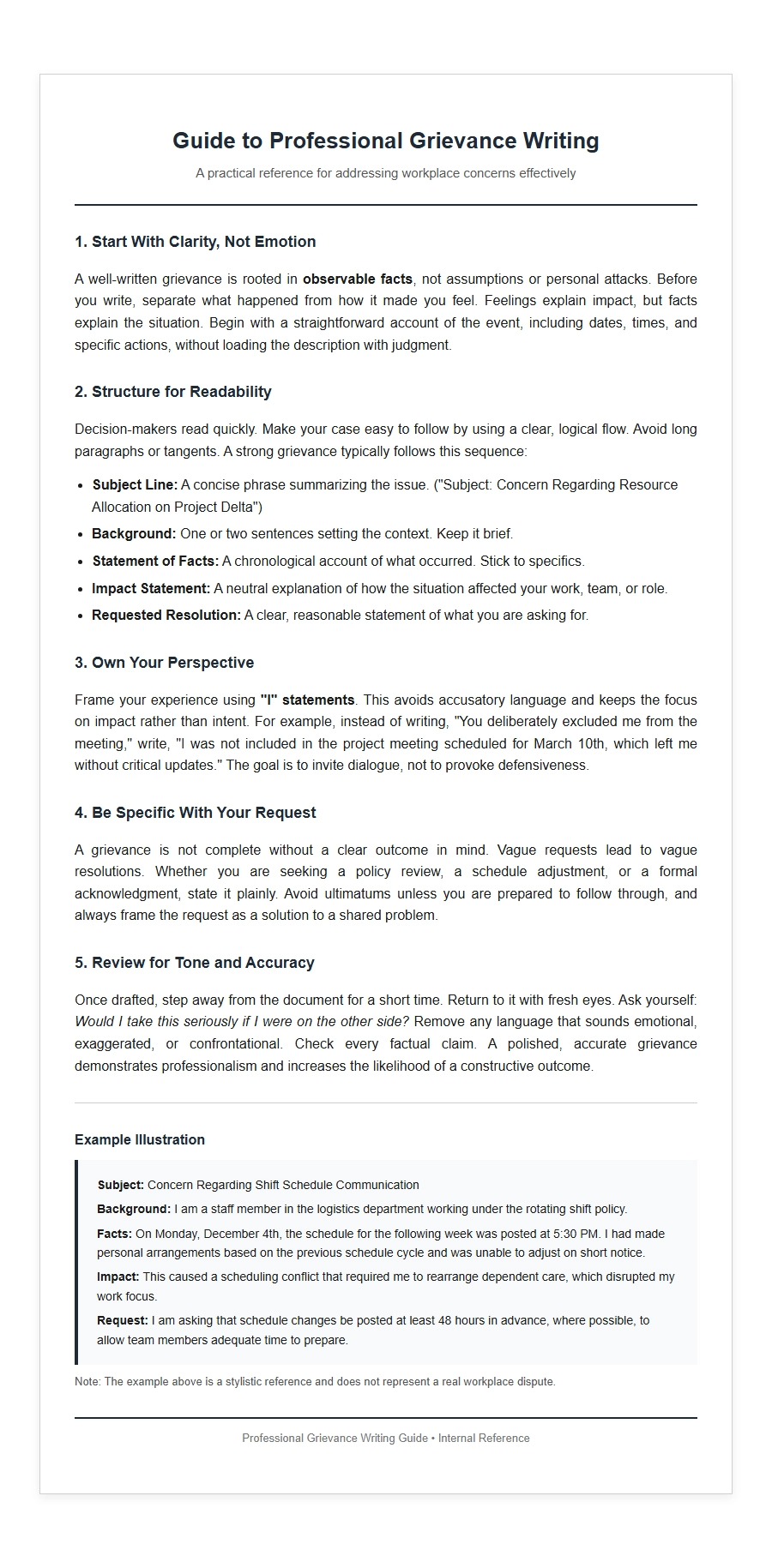 Best Practices for Writing Professional Grievance Letters