Write an Assertive Complaint Letter for Service Recovery
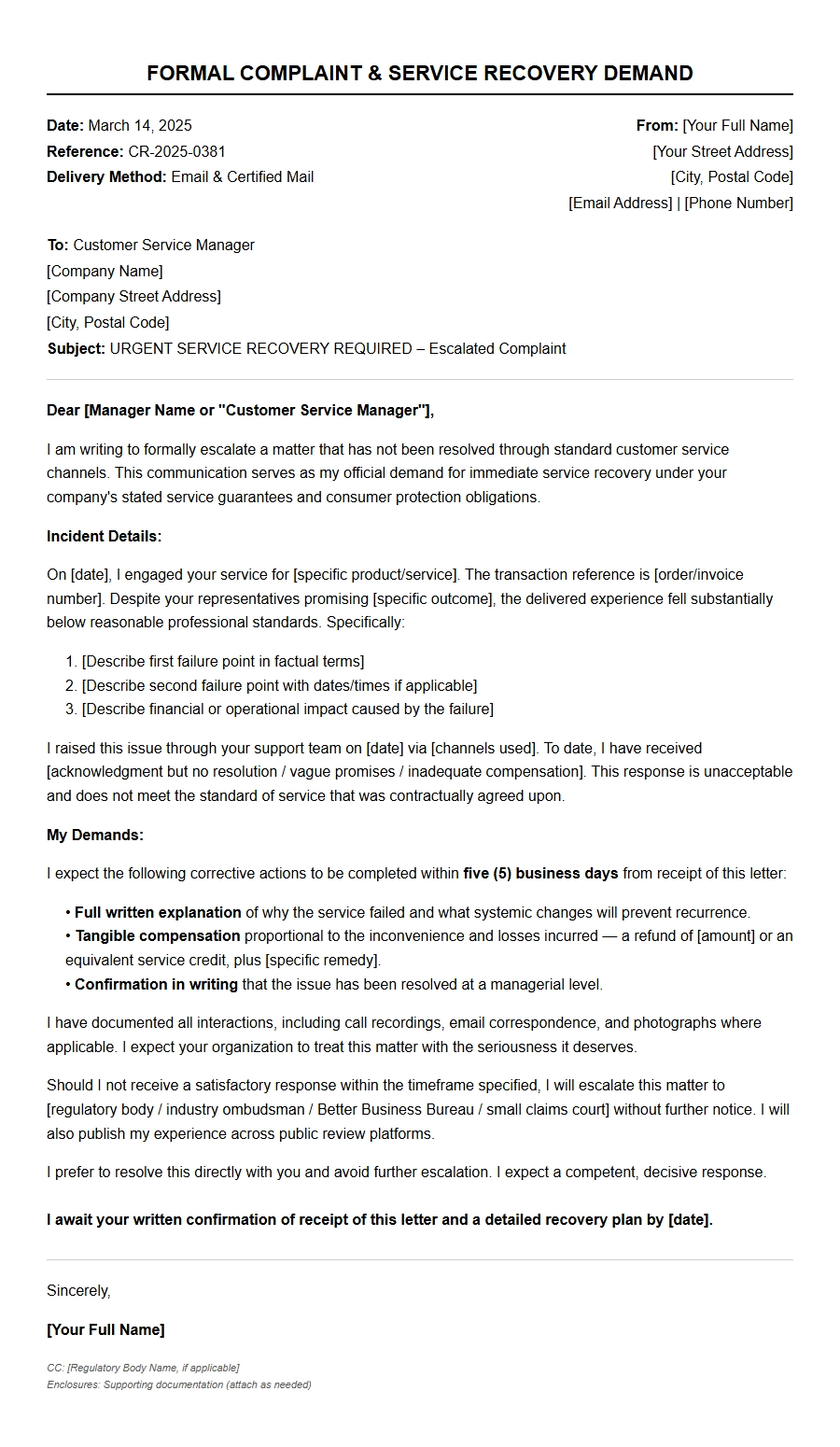
You’ve been let down by a service you paid for. Maybe a hotel double-booked your room, a repair wasn’t fixed right, or an online order arrived damaged. Now you need to write a complaint letter that gets results — not one that gets ignored. That blank page can feel like a wall. But an assertive tone complaint letter for service recovery isn’t about being angry; it’s about being clear, firm, and fair. A good sample gives you the backbone of that letter, so you can focus on your specific facts.
Why using a sample isn’t cheating
Writing professional correspondence from scratch takes time you may not have. A letter template provides structure — the right salutation, a logical flow, and a closing that leaves the door open for resolution. It also shows you the business letter format expected in formal complaints. The trick is to treat the sample as a starting point, not a script. You’ll adapt the tone, replace details, and make it sound like you. That’s smart, not lazy.
Category: Complaint Letters
Choosing the right sample for your situation
Not every complaint letter is the same. If you’re dealing with a small local business, a semi-formal tone often works better. For a bank or insurance company, stick to full formal writing tips — include your account number, dates, and reference numbers. Look for a sample that matches the industry and the gravity of the problem. For example, a pre-litigation complaint notice demands stricter language than a simple refund request. Don’t use a pre-legal template when a polite nudge will do.
How to adapt a sample without losing your voice
Start by reading the sample aloud. If it sounds too stiff or too casual, adjust. Replace phrases like “I am writing to express my dissatisfaction” with something more natural: “I’m writing because your team didn’t resolve the issue we discussed on March 3.” Keep the letter structure — introduction, chronology of events, what you want, deadline — but let your personality show. A good letter feels professional and personal at the same time.
Tailoring the opening paragraph
The first sentence should grab attention. Instead of “I am writing to complain,” try “After our conversation with your support team on Tuesday, I expected the refund to be processed — it wasn’t.” That immediately tells the reader the context and the gap. Avoid generic openings like “I hope this letter finds you well.” It’s a complaint, not a holiday card.
Common mistakes to avoid
Using outdated salutations — “To Whom It May Concern” feels lazy when you can find a name. If you don’t know who handles complaints, call and ask. Another mistake: forgetting that digital letter format matters. A complaint sent by email should have a clear subject line (e.g., “Complaint – Order #1029 – Damaged Item”) and the same professionalism as a printed page. If you mail a physical letter, include your letterhead design (just your name and address) at the top. And please, proofread. A typo in a complaint can make you look careless when you’re asking someone else to be careful.
Service recovery works best when you state facts and expectations calmly. Compare: “You ruined my vacation!” vs. “The room was not as booked, and I spent two hours relocating.” The second is factual and harder to dismiss. Assertive tone uses “I need” or “I expect” rather than “You failed.” It also sets a deadline — “Please confirm by Friday how you will resolve this.” That gives the recipient a clear action. If they don’t respond, you have documented proof of your attempt, which helps with steps to resolve issues via written notice.
Adapting your sample for email versus printed letter
In an email, keep paragraphs short. Use bold for the subject line but not for full sentences. If you’re mailing a printed letter, use standard business format: your address, date, inside address, salutation, body, closing, and signature block. Both need salutation and closing that match the tone — “Dear [Name]” and “Sincerely” are safe. Avoid “Yours truly” if you’ve never met them. Also, don’t skip the proofreading letter step; reading it aloud catches awkward phrasing.
When to be more formal
If you’re dealing with a large corporation or a legal matter, follow letter writing etiquette strictly. Use their complaint process, reference prior case numbers, and avoid emotional language. Sometimes the best letter of recommendation for your own cause is a calm, well-documented complaint. That’s why samples with a serious tone work well for complaint regarding timeshare sales commission fees or other high-stakes issues.
Use the sample as a springboard, not a crutch
The most effective complaint letters are those that sound like a real person wrote them. A sample gives you the map, but you drive the car. Fill in your specific dates, names, and desired outcome. Be honest about what happened and what you want — repair, refund, replacement, or an apology. After you send it, give the company a fair window to respond. Many will fix the problem quickly when they see you’re organized and reasonable.
For everyday issues, like notifying school district of transportation scheduling errors, a simple adapted template works fine. Over time, you’ll get faster at writing these letters. Practice makes the process almost automatic. And when you get that positive resolution — a refund, a replacement, or an apology — you’ll know the few minutes spent on the letter were worth it.
Examples You Can Adapt
Write an Assertive Complaint Letter for Service Recovery
Complaint Regarding Delayed Furniture Delivery with Missing Parts
Date: 2025-02-18 Reference: ORD-8847 To: Customer Service Manager, HomeStyle Furnishings
I am writing to formally escalate my dissatisfaction with the delivery of my dining set (Order #8847). The shipment arrived three weeks late, and after inspecting the package, I discovered that two table legs and four screws are missing. This has left me with an unusable product and a disrupted home schedule.
I expect immediate action to rectify this situation. Below is a summary of the issues:
Issue
Detail
Expected delivery
January 25, 2025
Actual delivery
February 15, 2025
Missing parts
2 table legs, 4 screws (item code: DINE-LEG-SET)
I demand that you ship the missing parts via expedited delivery at no cost to me, and additionally issue a 20% refund for the delay. You must confirm this resolution within 48 hours. If not, I will take my business elsewhere and report this to the Better Business Bureau.
I look forward to your prompt and assertive response.
Complaint for Incomplete Laptop Repair Service
Date: 2025-02-17 Reference: REP-2391 To: Service Manager, TechFix Solutions
I sent my laptop (Model: XPS 15, Service Tag: 1ABC23) for keyboard replacement on February 5. Your technician returned it on February 14, but the space bar still sticks, and the trackpad is now unresponsive. This is unacceptable.
I have lost critical workdays due to your incomplete service. Below is a timeline of my interactions:
Feb 5: Laptop dropped off, promised 3-day turnaround
Feb 12: Called twice, told “still in diagnostics”
Feb 14: Received device with new defects
I insist that you either fully repair the laptop to working condition within 72 hours or provide me with a replacement unit of equal value. A partial refund for the wasted time is also expected. I will not accept another slipshod attempt. Please contact me by end of business tomorrow with a concrete plan.
Complaint Regarding Rude Staff at Restaurant
Date: 2025-02-16 Reference: DINE-4451 To: General Manager, The Golden Spoon
I visited your establishment on February 14 with my family for a Valentine’s dinner. The hostess was dismissive, the server rolled her eyes when we asked for a menu change, and the manager ignored my complaint about a long wait. This experience was entirely unacceptable for a $200 meal.
I have been a loyal customer for five years, but this incident forces me to reconsider. I require the following to restore my confidence:
A written apology from the manager and the server.
A full refund for the meal (receipt attached).
A gift certificate for two complimentary dinners.
You must respond within one week. Failing that, I will post my experience on social media and file a complaint with the local health department regarding the hygiene issues I also observed.
Dispute Over Incorrect Billing for Subscription
Date: 2025-02-15 Reference: BILL-3345 To: Billing Department, StreamCloud Inc.
My monthly subscription ($12.99) was charged $49.99 on February 1 under invoice #INV-2025-02-112. I contacted support twice, but the overcharge remains. This is a clear billing error that you must correct immediately.
Here is the breakdown of my account:
Item
Expected
Charged
Basic Plan (due Feb 1)
$12.99
$49.99
Previous plan (Jan)
$12.99
$12.99
I demand:
A refund of the $37.00 overcharge to my original payment method.
Confirmation that my plan will revert to $12.99/month.
A $25.00 credit for the time and inconvenience caused.
You have 48 hours to resolve this. If not, I will file a dispute with my credit card company.
Complaint for Damaged Product Received from Online Store
Date: 2025-02-14 Reference: DLV-9901 To: Customer Service, GadgetZone.com
I ordered a Bluetooth speaker (Model: SoundBoom Pro, Order #89012) on February 10. The package arrived today with the outer box crushed and the speaker casing cracked. The unit does not power on.
This is a clear case of inadequate packaging or mishandling. I have photographic evidence of the damage. I expect immediate replacement or full refund, including any return shipping costs. Additionally, you must expedite a replacement so I receive it within three business days.
To be clear:
I will not accept a refurbished unit as a replacement.
I will not pay any restocking fee.
You must also credit me $15 for the inconvenience.
I expect a resolution by end of day tomorrow. Otherwise, I will escalate to my credit card’s purchase protection program.
Failure to Honor Warranty on Appliance
Date: 2025-02-13 Reference: WAR-4467 To: Warranty Department, CoolBreeze Appliances
My refrigerator (Model: CB-4000, Serial: 2023-5567) stopped cooling three days ago. The unit is still under the two-year warranty (purchased March 2024). When I called your service line, I was told the warranty does not cover “compressor issues”—which contradicts your written terms.
I have enclosed a copy of the warranty document and the receipt. The compressor is explicitly covered under section 3.1.a. I demand that you schedule a technician visit within 48 hours, perform repairs at no charge, and provide a loaner unit until the fridge is fixed.
If you fail to honor the warranty, I will file a complaint with the Consumer Protection Agency and post my experience on review sites. I insist on a written confirmation of the service appointment by noon tomorrow.
Complaint for Misleading Advertisement of Service
Date: 2025-02-12 Reference: ADV-7712 To: Marketing Director, CleanSweep Carpet Care
Your advertisement promised “complete deep cleaning of up to 5 rooms for $99” with no hidden fees. I booked an appointment on February 10, but the technician charged an extra $40 for “heavy traffic treatment” and left a large wet spot that caused damage. The ad was misleading, and the service was subpar.
I require the following immediate remedies:
Full refund of the $139 charged, plus $40 as compensation for the carpet damage.
Removal of any misleading claims from your advertising.
A written apology from the technician and manager.
I have taken screenshots of your ad. If you do not respond within 72 hours, I will report this false advertising to the Federal Trade Commission and share my experience on Nextdoor.
Poor Quality of Catering Service Caused Event Disruption
Date: 2025-02-11 Reference: CAT-5598 To: Operations Manager, Elite Event Catering
Your team catered my daughter’s birthday party on February 8. The food was delivered an hour late, the chicken was undercooked, and the dessert tray had only 10 portions instead of the 30 we ordered. Several guests fell ill after eating.
Below is a summary of the shortcomings:
Issue
Agreed
Delivered
Delivery time
1:00 PM
2:15 PM
Chicken entrée (30 pax)
Fully cooked
Undercooked, 20 portions
Dessert tray
30 pieces
10 pieces
I demand a full refund of $1,500, plus $500 to cover medical expenses for two guests. You must also issue a public apology on your social media. This is a serious breach of trust. I expect a response within 48 hours or I will pursue legal action.
Non-Responsive Tech Support for Critical Software Issue
Date: 2025-02-10 Reference: TKT-6674 To: Support Manager, CloudSync Software
I submitted ticket #6674 on January 28 regarding a sync error that deleted 200 client files. I have called five times and sent three emails, but nobody has provided a solution or even an estimated resolution time. This negligence has cost my business hours of work.
I need the following immediately:
Restoration of all lost files from your backups.
A detailed root-cause analysis within five days.
A 50% discount on my next six months of subscription for the disruption.
I will not tolerate further delays. If I do not receive a concrete action plan within 24 hours, I will migrate to a competitor and expose this poor support on professional networks. You must treat this with the urgency it deserves.
Overcharged for Hotel Stay with No Resolution
Date: 2025-02-09 Reference: HTL-3321 To: General Manager, Grand Vista Hotel
I stayed at your hotel from February 5–7 (Reservation #GWH-1122). At check-in I was quoted $180 per night, but my final bill shows $280 per night plus a $50 “resort fee” that was never disclosed. The front desk manager refused to adjust the charges, saying it was “system policy.”
Here is the discrepancy:
Item
Agreed Rate
Charged
Room rate (2 nights)
$360
$560
Resort fee
$0
$50
Total
$360
$610
I demand a refund of $250 immediately, as well as a written apology. You must also provide documentation showing the correct rate was programmed into your system. If I do not receive confirmation of the refund by February 12, I will report this to the state attorney general and post my experience on TripAdvisor.
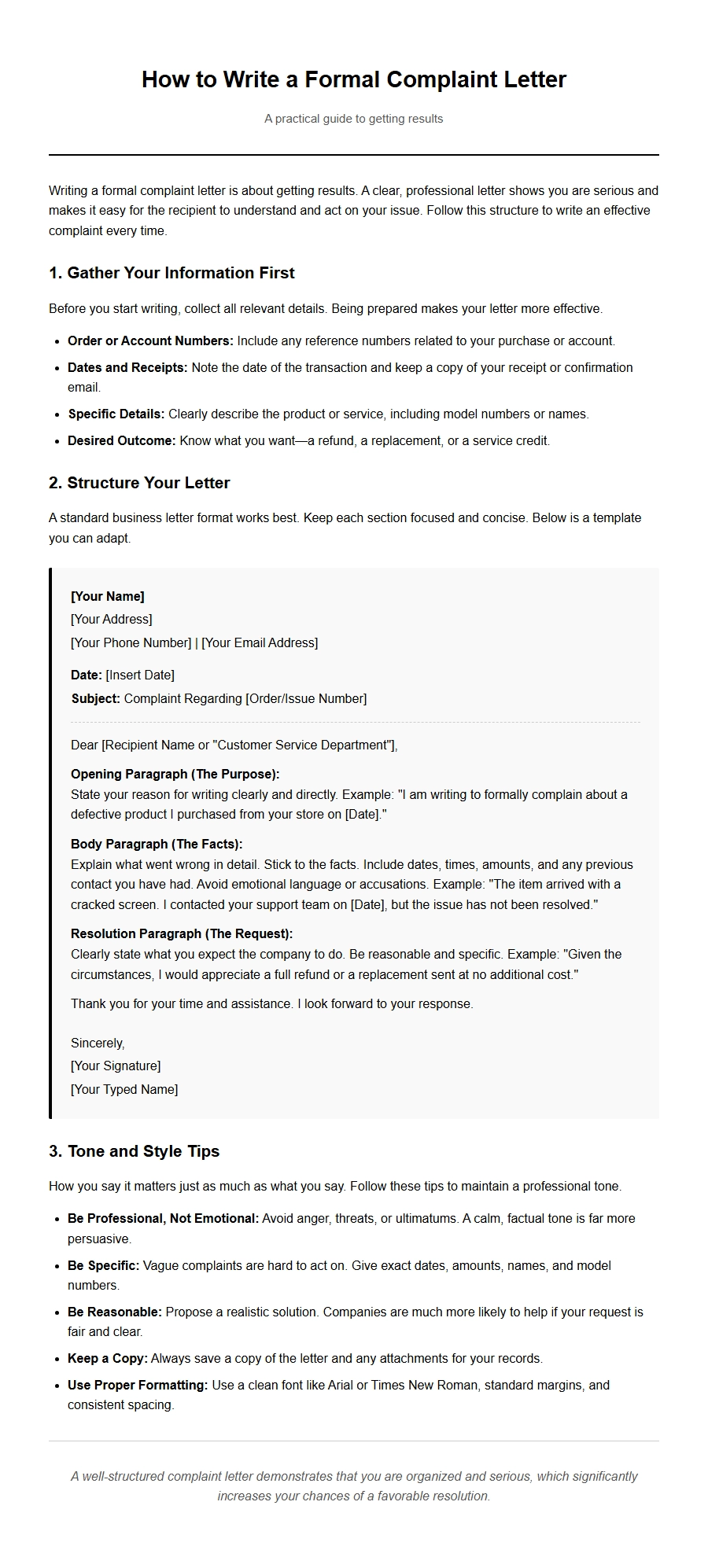 How to Write a Formal Complaint Letter
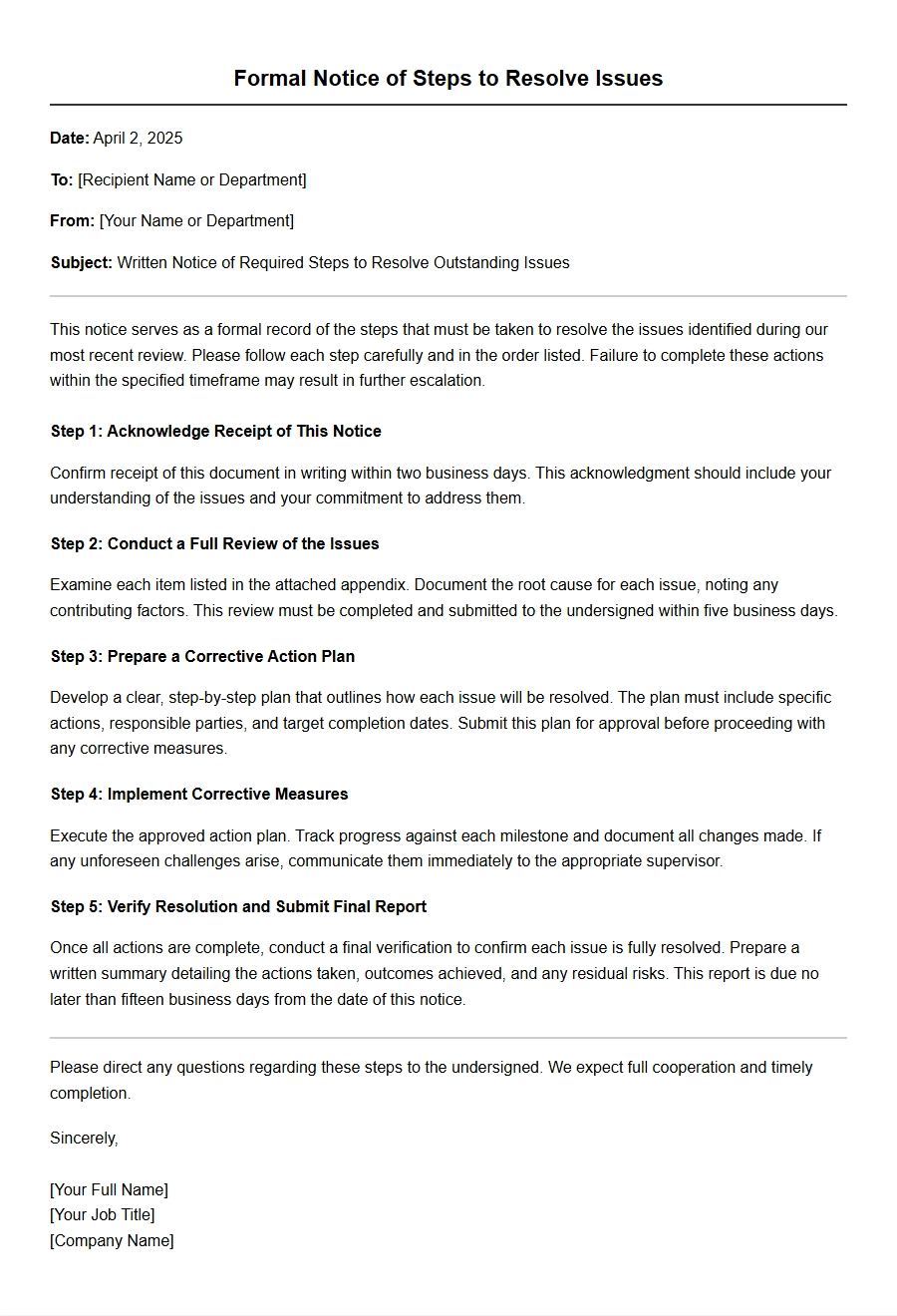 Steps to Resolve Issues via Written Notice
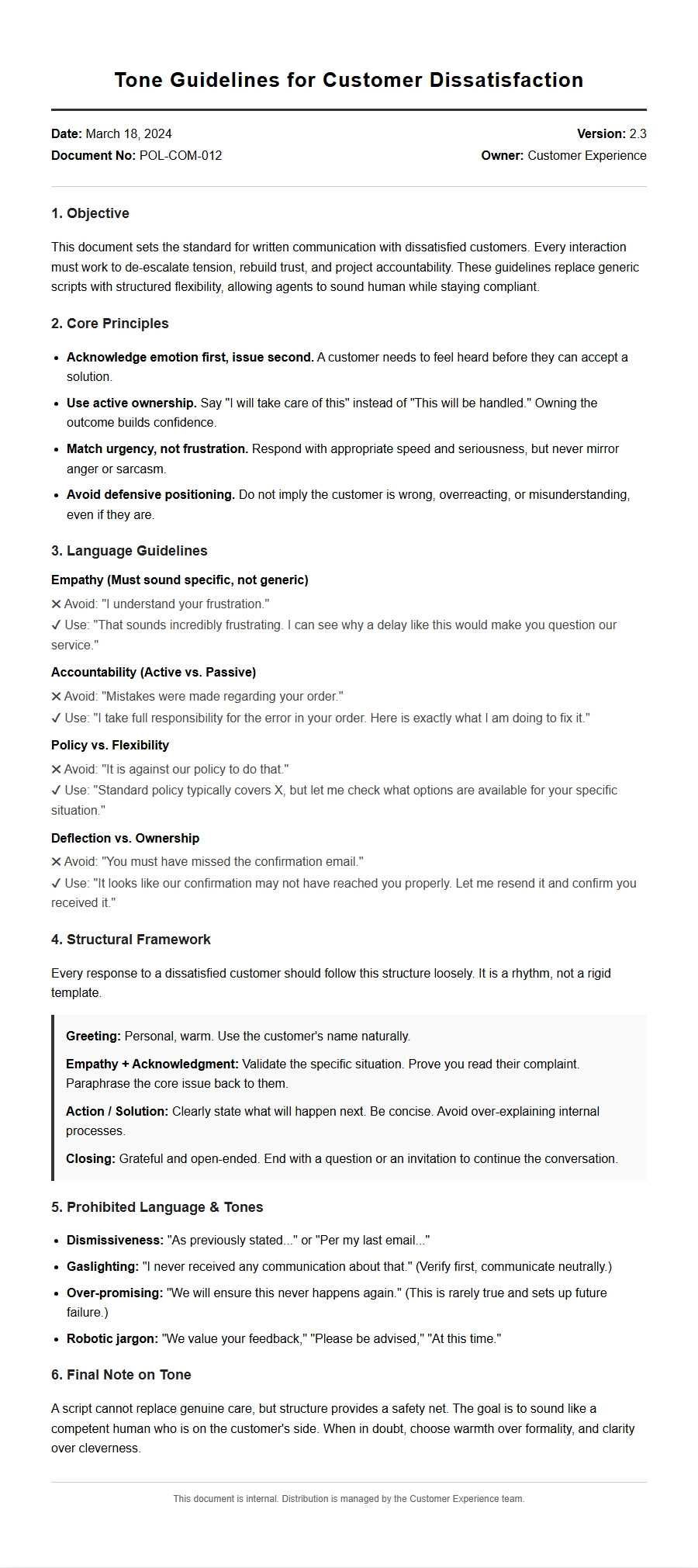 Tone Guidelines for Dissatisfied Customer Letters
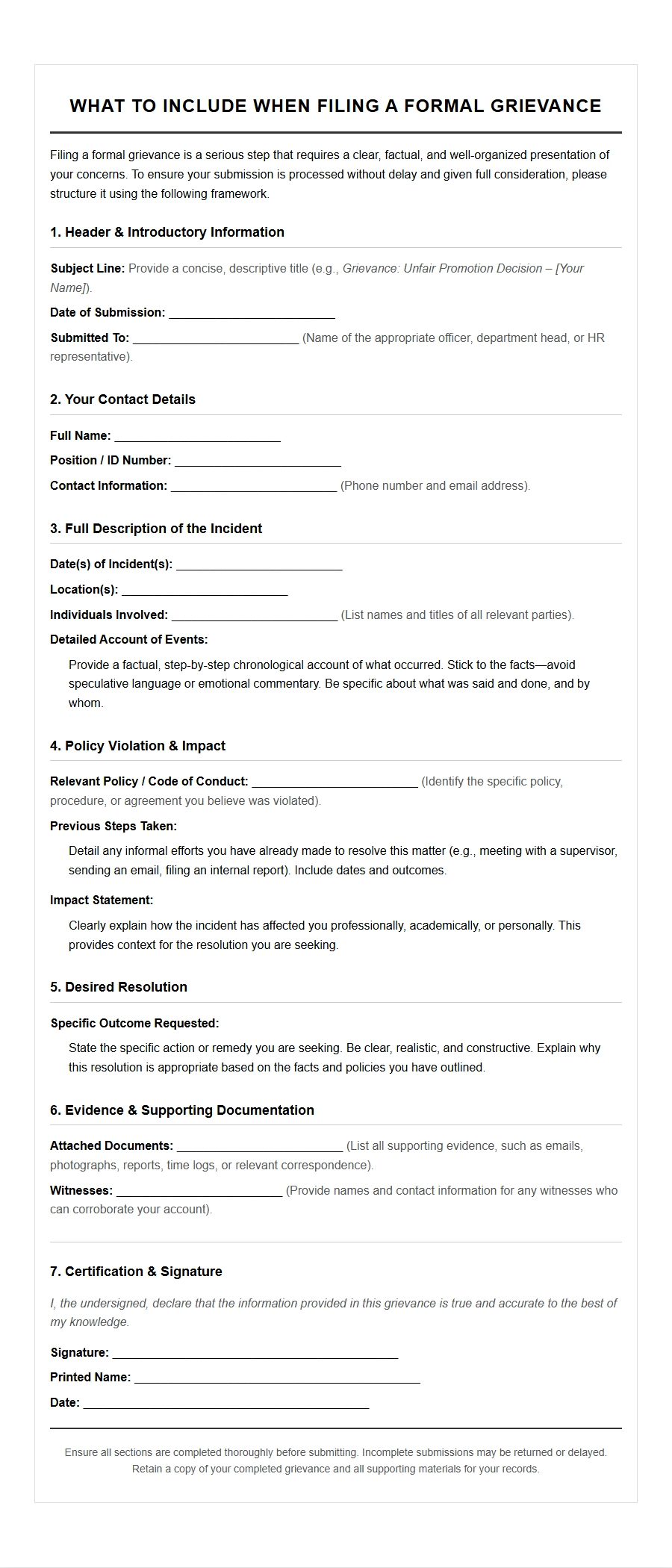 What to Include in a Formal Grievance Letter
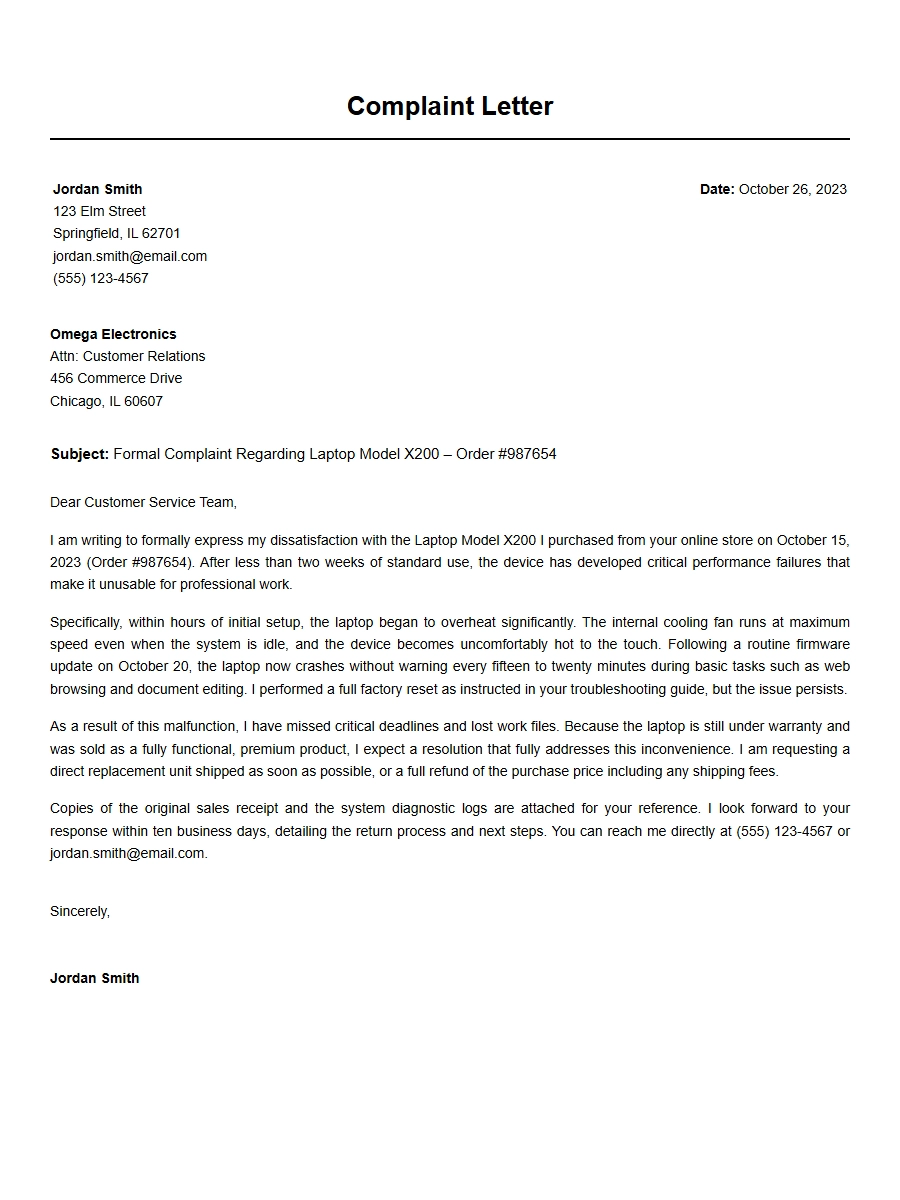 Structure of an Effective Complaint Letter
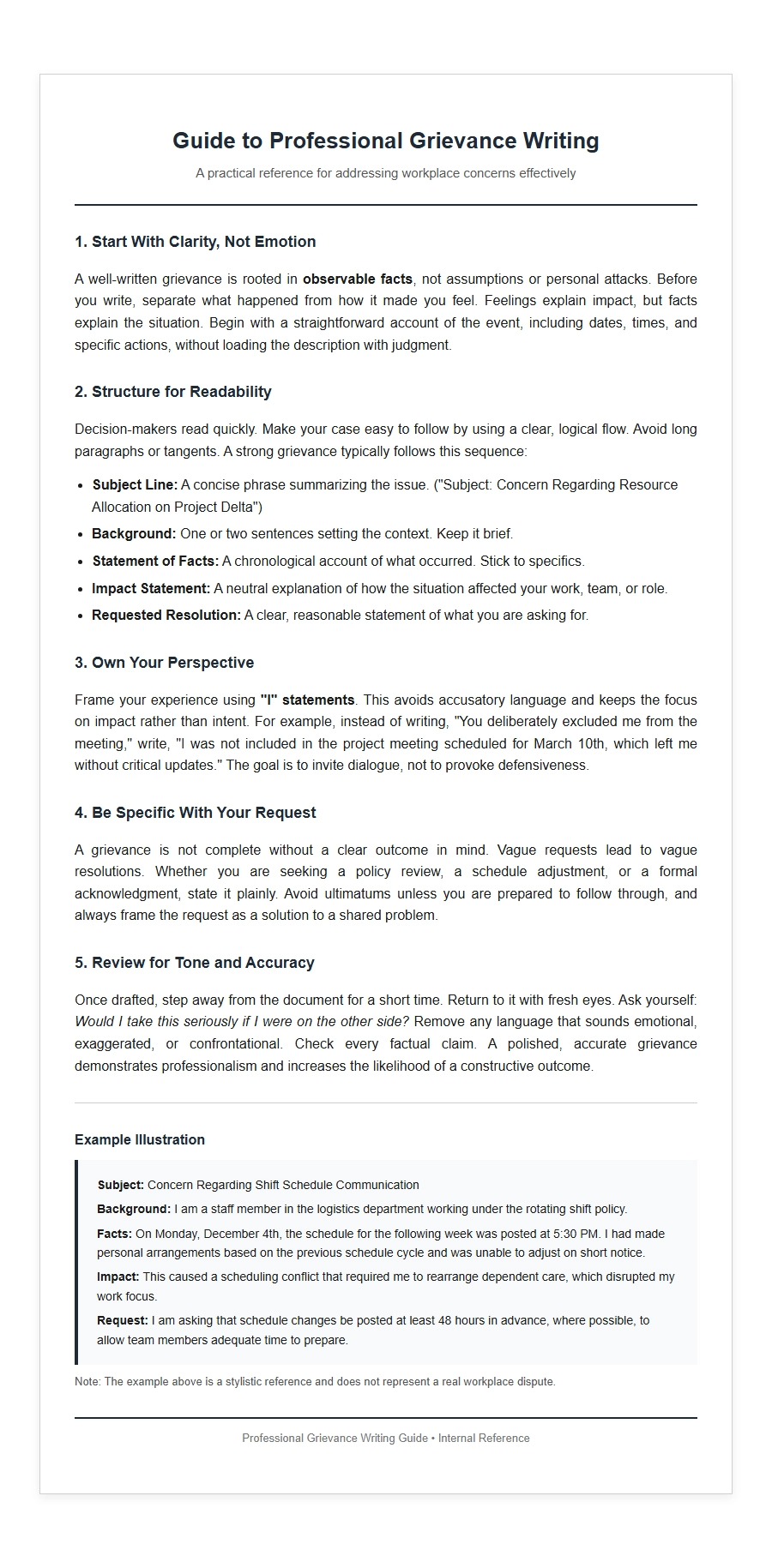 Best Practices for Writing Professional Grievance Letters