You open the blank card, pen in hand, and suddenly the right words disappear. Writing what goes inside a sympathy card should be simple—but grief makes everything harder, including finding the right phrasing. Whether you're facing your first condolence note or your twentieth, that hesitation is completely normal.
Using a sample for sympathy card wording isn't taking shortcuts. It's using a time-tested structure so you can focus on what matters: saying something genuine. A good example gives you the tone, the opening line, and the closing—then leaves room for your own voice. Think of it as a starting point, not a script.
Why the right wording matters in a sympathy card
A sympathy card message is more than words on paper. It's a quiet acknowledgment that someone's loss matters to you. People remember the card that arrived at the right moment, the note that didn't dodge the hard truth, the sentence that made them feel seen. The words you choose carry weight—but they don't need to be perfect. They need to be real.
When you're unsure, it helps to look at different approaches. For instance, if you're writing to a coworker, you might find useful phrasing in these examples of sympathy emails for a grieving colleague. The same care applies whether the message goes in an email or a physical card.
Finding the right tone for your sympathy message
The biggest mistake people make is trying to sound formal when they'd normally be casual, or too loose when the situation calls for restraint. Your relationship with the person grieving should guide your tone. A formal letter of condolence to an executive works well for a professional superior. For a close friend, something warmer and less structured fits better.
Here's a simple way to decide: If you'd normally hug this person, your note can be more personal. If your relationship is more distant, keep it respectful and brief. Both approaches are valid—the key is matching the tone to the person.
How to structure the message inside a sympathy card
Most condolence notes follow a straightforward pattern. Open with a direct acknowledgment of the loss. Say something specific about the person who died, if you knew them. Offer a simple gesture of support. Close with warmth.
For example: "I was so sad to hear about your mother's passing. I'll never forget how she always made everyone laugh at the family gatherings. Thinking of you and your family during this difficult time."
If you're struggling with brevity, take a look at these examples of brief condolence statements—sometimes a few honest sentences carry more meaning than a long message.
Common mistakes to avoid in sympathy card wording
A few pitfalls can make a well-meaning note fall flat. Avoid vague phrases like "I know how you feel"—everyone's grief is different. Don't offer unsolicited advice or religious language unless you're certain the recipient shares your beliefs. And steer clear of lengthy personal stories that shift focus away from the person grieving.
Also, don't worry about making it perfect. A handwritten sentence with a small smudge is still more meaningful than a typed paragraph that sounds hollow. If you missed the funeral due to distance or circumstance, you can still send a note later—here's how to apologize for missing a funeral via letter gracefully.
Adapting a sample without losing your voice
When you start with a sample, read it through once. Then rewrite it in your own words. Swap out generic phrases for something personal. Instead of "They will be missed," say what you'll specifically miss—their laugh, their advice, the way they made coffee for everyone.
Category: Sympathy card messages and condolence letter wording.
If the person you're writing to is a neighbor, keep the tone warm but not overly intimate. A condolence letter sample for a neighbor can give you the right balance of kindness and distance.
Making your message feel natural and personal
People often worry that using a sample makes their note feel generic. That only happens if you copy it word for word without adding anything of your own. The sample gives you the skeleton—you add the heartbeat. A single specific memory, a short observation, or even just saying "I don't have the right words, but I'm thinking of you" can make the message feel true.
Pay attention to the salutation and closing. "Dear [Name]" and "With deepest sympathy" work for most situations. For a closer relationship, you might open with "Dearest [Name]" and close with "With love." These small choices set the tone from the first word to the last.
Treat the sample as a springboard
The best sympathy messages are both professional in structure and personal in feeling. Use a sample to get started, then trust yourself to make it your own. The more you write, the faster it gets. Next time you face a blank card, you'll know exactly where to begin.
Simple Examples
Sympathy Card Inside Message Wording
To a Dear Friend
I was so deeply saddened to hear of your loss. I know words cannot take away the pain you are feeling, but I hope you find some comfort in knowing that others care. Your friend was a truly wonderful person, and the memories you hold will always be a treasure.
Please know that I am here for you, whether you need a listening ear, a quiet cup of tea, or simply a hand to hold. Do not hesitate to reach out anytime.
With heartfelt sympathy, [Your Name]
For a Colleague
Dear [Name],
Our team was deeply saddened to learn about your loss. While no words can ease this difficult time, we want you to know that you are in our thoughts. Please accept our sincerest condolences on the passing of your [mother/father/loved one].
During this time, we encourage you to take the space you need. We are covering your tasks and look forward to your return when you are ready. Your strength and resilience inspire us.
You have our full support.
We remember your loved one with fondness.
Do not worry about anything work-related.
With sympathy, [Your Name] and the team
To a Neighbor
Dear [Neighbor's Name],
We were so sorry to hear about the passing of your dear [husband/wife/family member]. In times like these, we realize how precious community and kind connections are. Your family has always been a bright spot on our street, and we share in your sorrow.
If you need anything at all—a ride to the store, help with yard work, or just someone to sit with—please call. We are just next door, and we mean it.
May the love of family and friends carry you through this difficult time.
With deepest sympathy, [Your Name]
Loss of a Parent
Dear [Name],
I cannot imagine the depth of your grief losing a parent. A mother’s/father’s love leaves an indelible mark on our hearts, and the void they leave is immense. Please know that I am thinking of you and your family with the deepest compassion.
I remember your [mother/father] as someone full of warmth and wisdom. The stories you shared always made me smile.
Cherish the memories—they are a light in the darkness.
Allow yourself to grieve in your own way.
Know that you are surrounded by love.
I am here for you, always.
With love and sympathy, [Your Name]
Loss of a Spouse
My dear [Name],
Words feel so inadequate at a time like this. Losing a life partner is a sorrow like no other. Your [spouse's name] was a remarkable person, and your love was a beautiful example to all who knew you. I hold you close in my heart.
I wish I could take away your pain, but I promise to stand by you in the days ahead. When you need to talk, or when you need silence, I will be there.
May the cherished memories of your life together bring you some comfort.
With all my love and deepest sympathy, [Your Name]
Loss of a Child
Dear [Name],
I am utterly heartbroken to learn of your loss. No parent should ever have to say goodbye to their child. There are no words that can ease this unimaginable pain, but please know that I am holding you in my heart with the most tender care.
Your [son/daughter] brought so much joy to this world, and their spirit will live on in the love you gave them. I remember their laughter, kindness, and the beautiful person they were.
Allow yourself to feel every emotion—there is no right or wrong way to grieve.
Lean on those who love you; you do not have to be strong alone.
I will keep you in my thoughts and prayers.
With deepest sympathy and love, [Your Name]
Short & Simple Message
Dear [Name],
Thinking of you during this difficult time. Please accept my heartfelt condolences on your loss.
I hope that the love of those around you brings some peace and comfort. You are in my thoughts.
With sympathy, [Your Name]
Religious / Faith-Based
Dear [Name],
May the grace of God surround you and bring you peace that passes all understanding. “Blessed are those who mourn, for they shall be comforted.” (Matthew 5:4) We take comfort in knowing that your beloved [name] is now in the loving arms of our Lord.
I am praying for strength, hope, and healing for you and your family. May your faith be a rock during this storm.
Scripture reading can bring solace.
Trust that God’s plan is one of love.
You are not alone; the church community surrounds you.
With prayers and deepest sympathy, [Your Name]
For a Distant Relative
Dear [Name],
Even though miles separate us, my heart aches for you and our family. Losing [loved one's name] is a profound loss for us all. The memories of times spent together—the laughter, the stories, the quiet moments—will forever be a part of who we are.
I wish I could be there to give you a hug. Please know that I am sending my love across the distance, and I will call soon to check in.
Take gentle care of yourself and hold your loved ones close.
With love and sympathy, [Your Name]
To a Close Friend After a Sudden Loss
My dearest [Name],
I am so incredibly sorry. I still can't believe it. Your [loved one's name] was taken far too soon, and I know the shock and pain are overwhelming. I am here, and I am not going anywhere.
Let me help with the little things—meals, errands, anything. You don't have to figure it all out alone. I will sit with you in the silence, or we can just watch a movie if that's easier.
No need to respond; just know I love you.
I will help plan the memorial if you'd like.
You are strong, but you are allowed to fall apart.
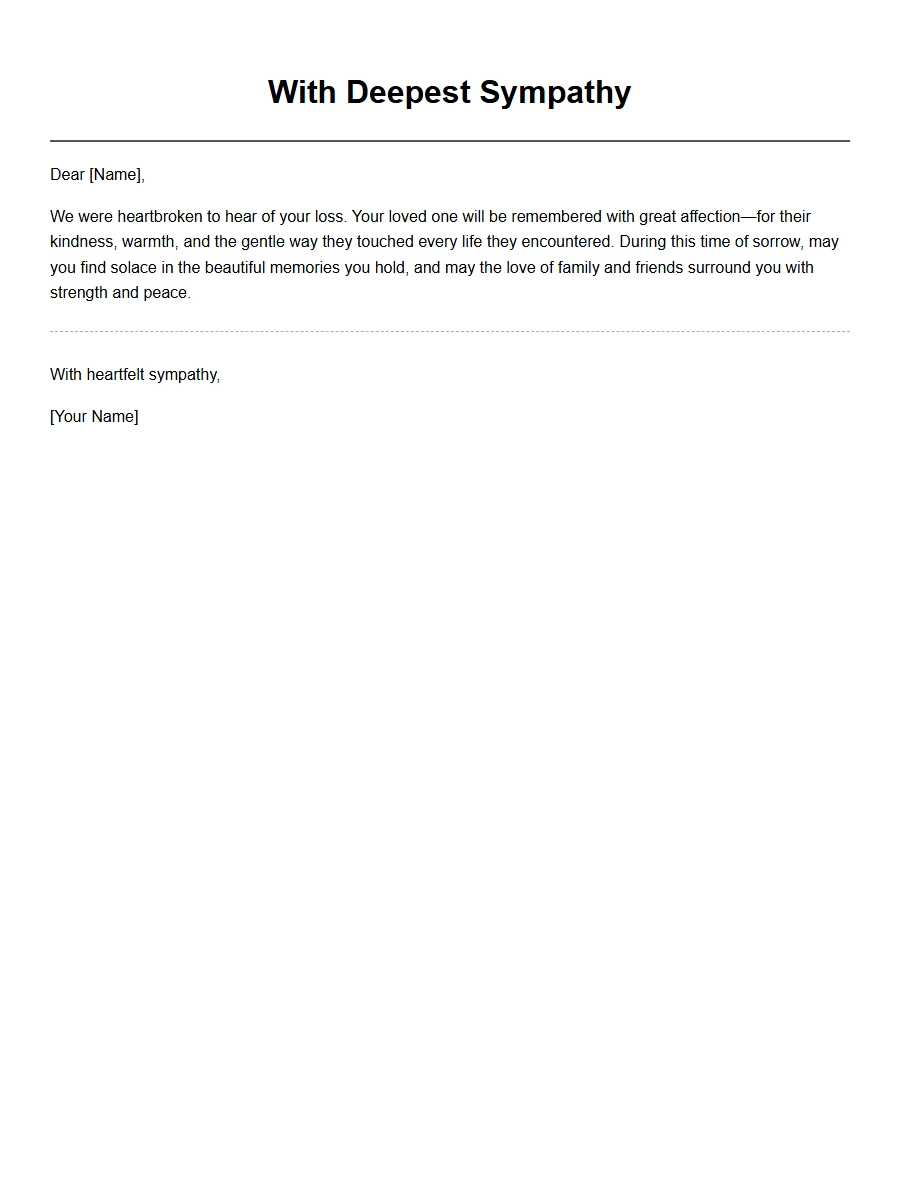
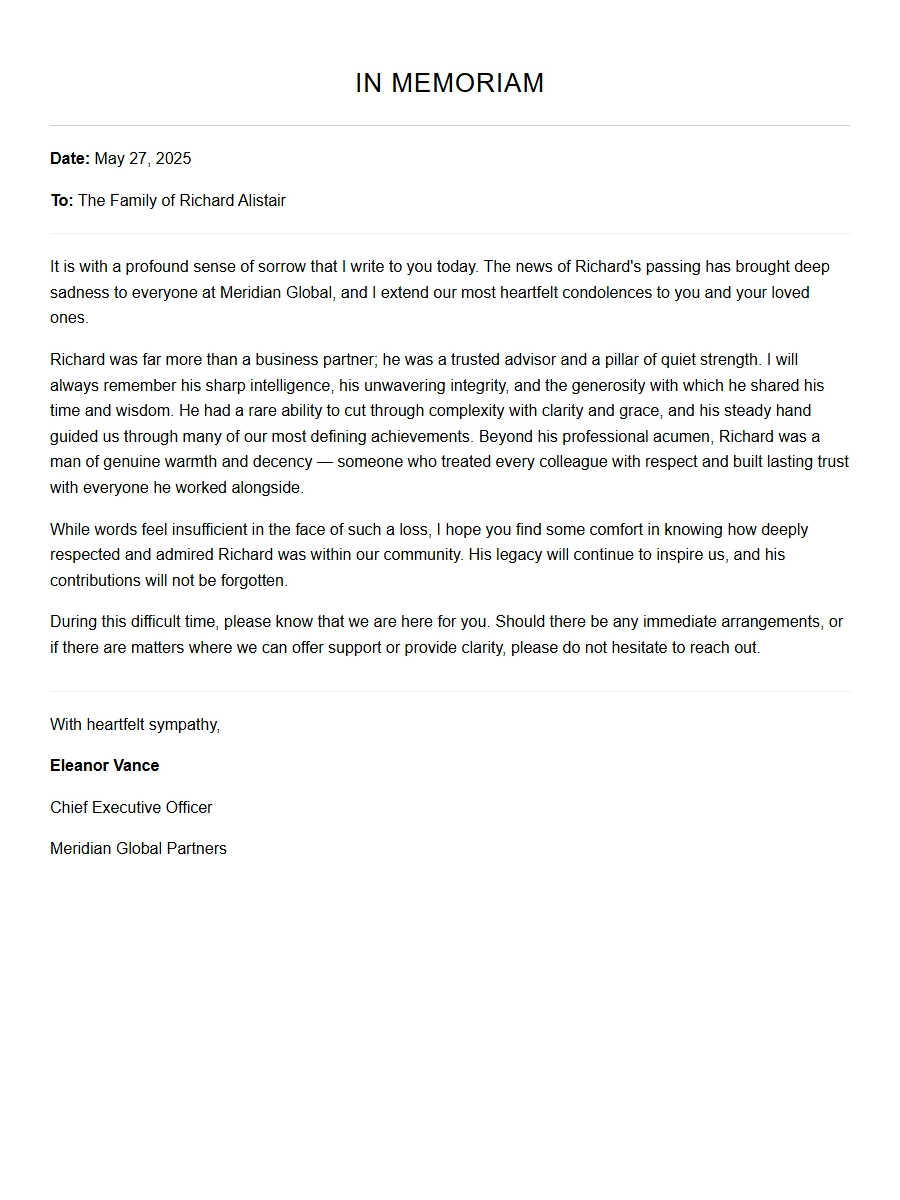 Formal Condolence Message for a Business Partner
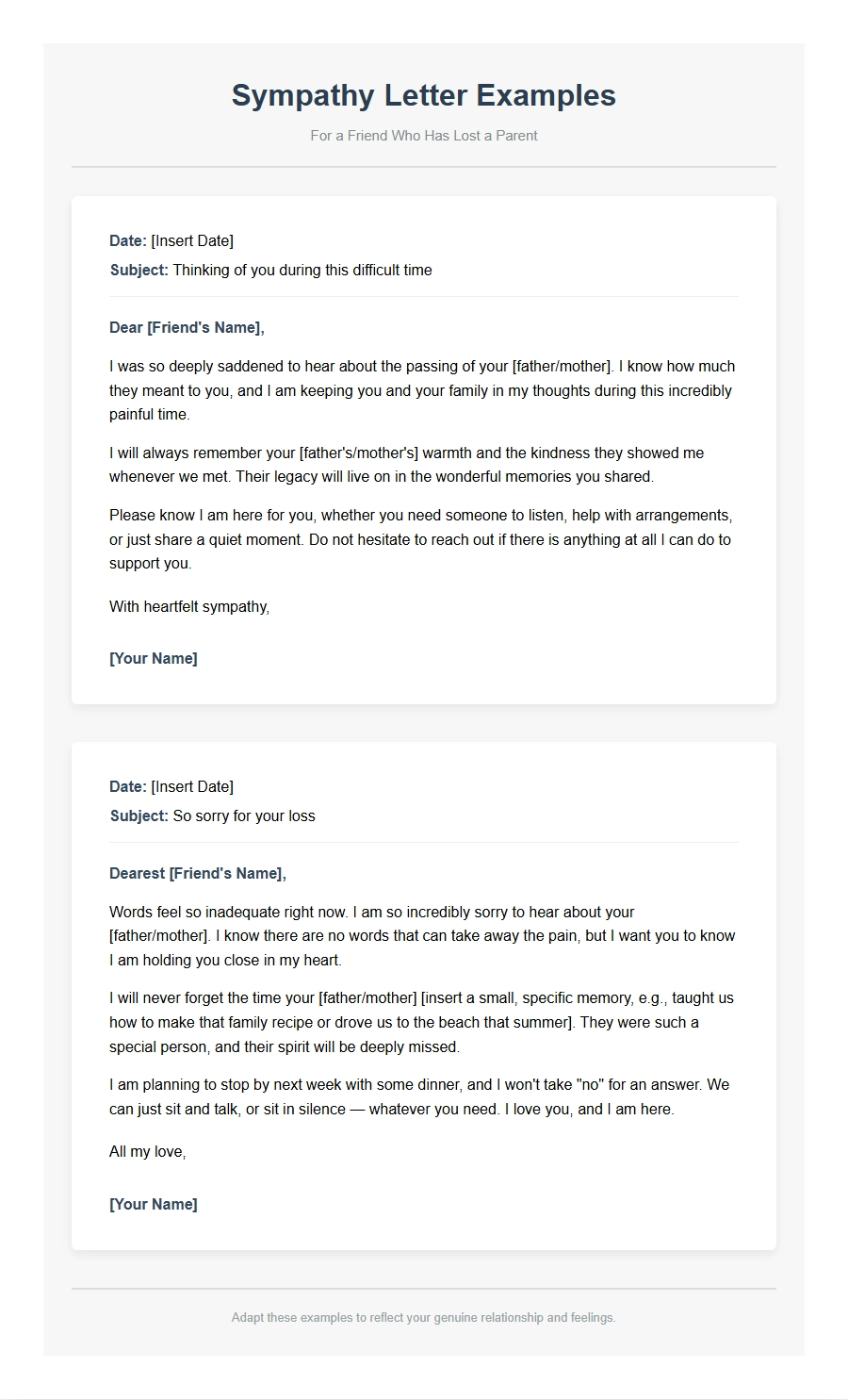 Sympathy Letter Examples for a Friend Who Lost a Parent
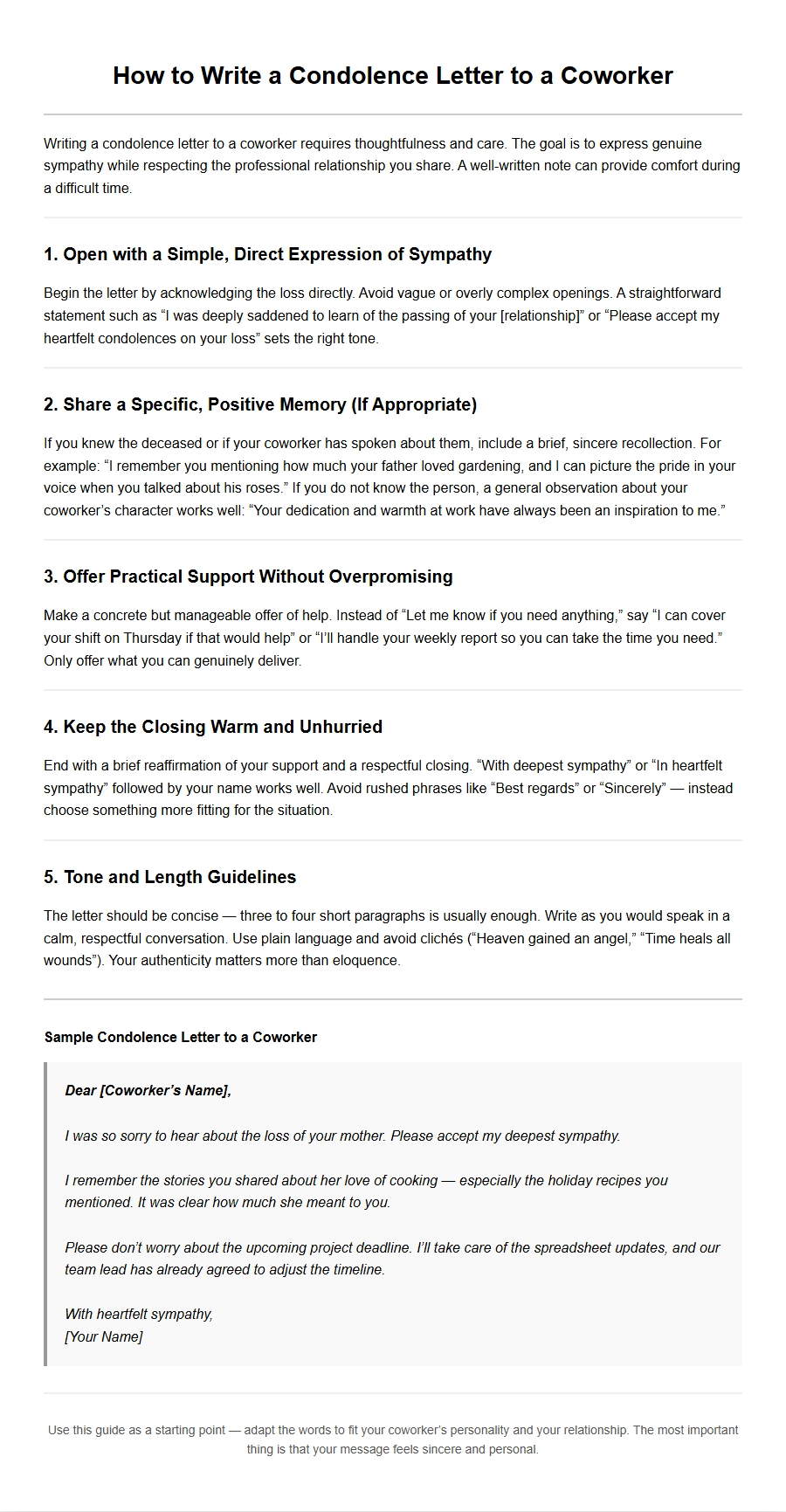 How to Write a Condolence Letter to a Coworker
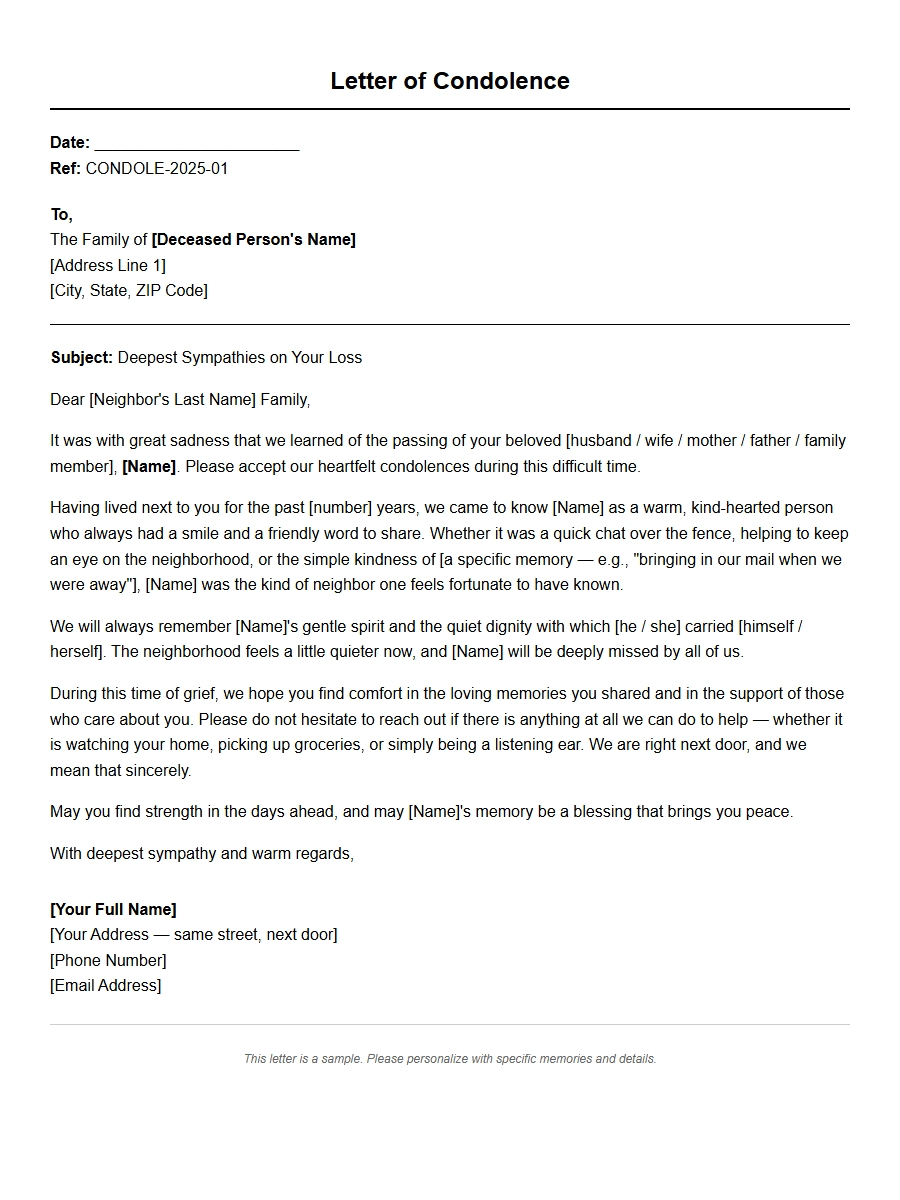 Condolence Letter Sample for a Neighbor
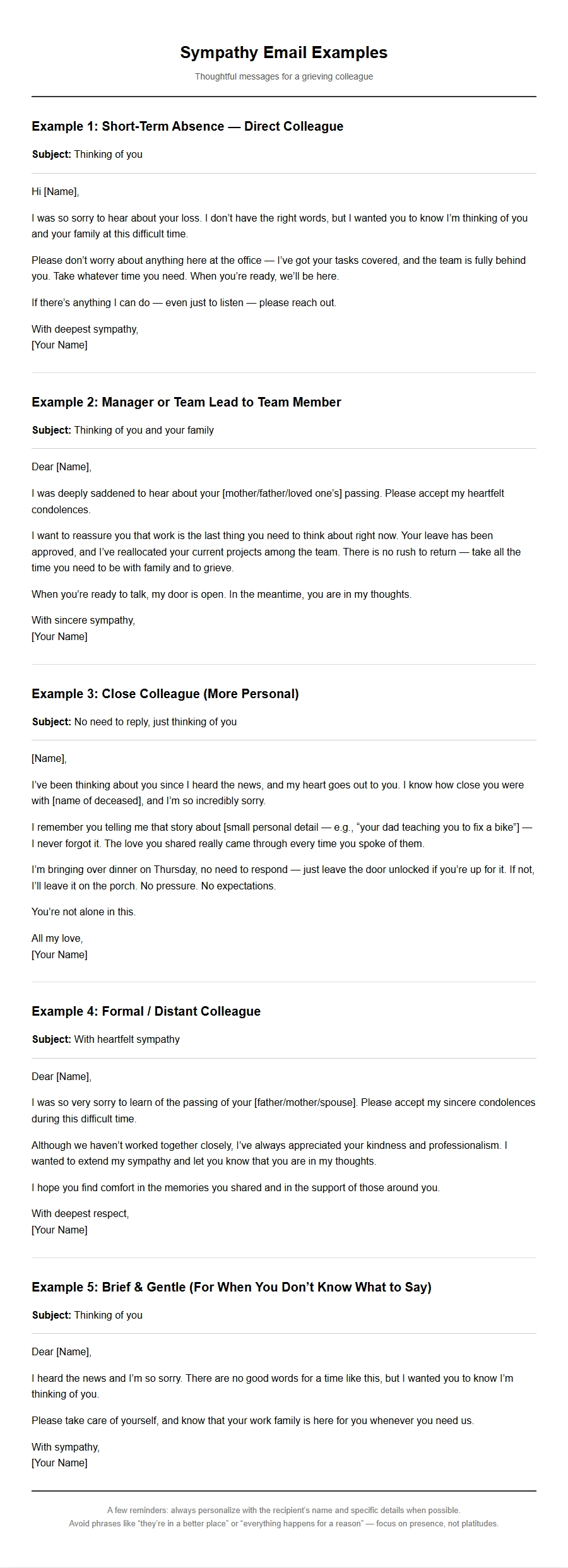 Sympathy Email Examples for a Grieving Colleague
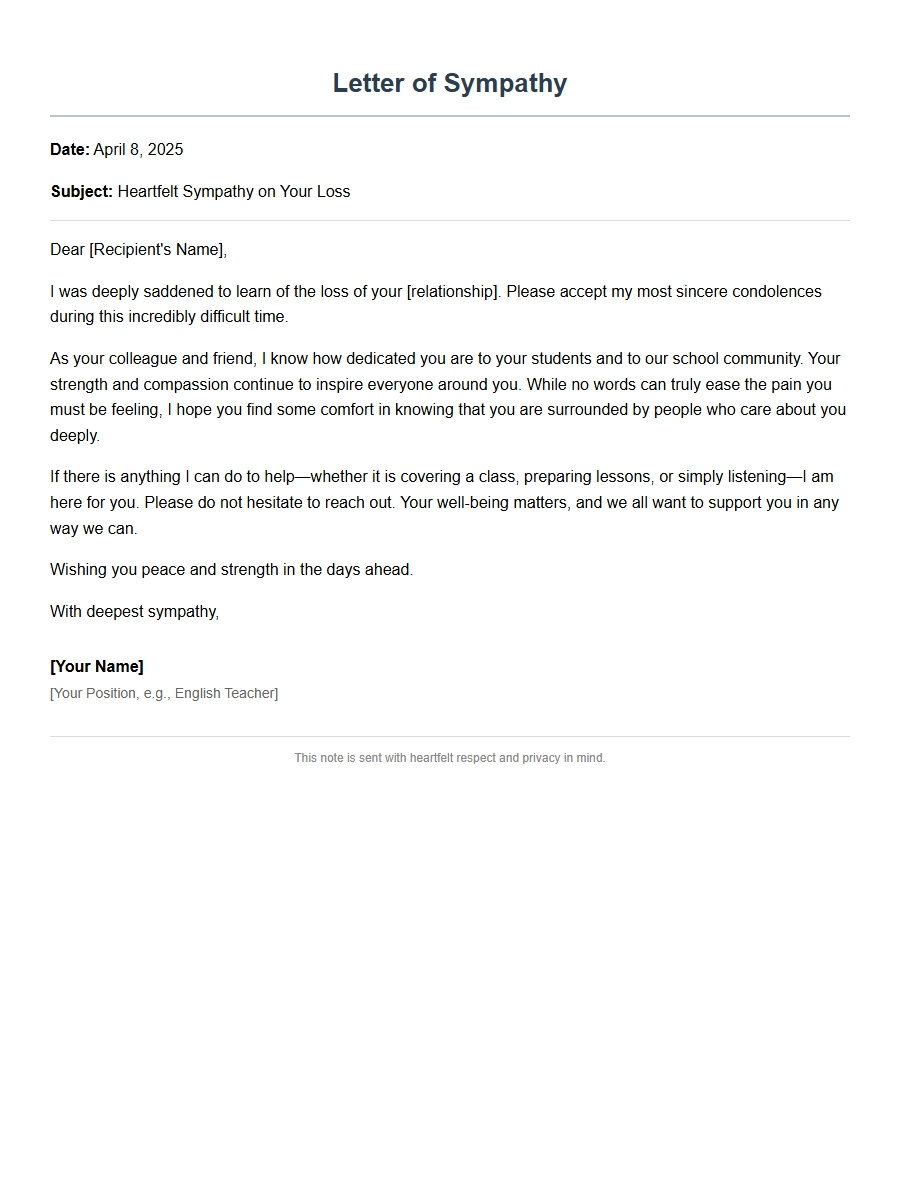 Condolence Words for a Teacher