You need to write a formal letter of condolence to an executive—maybe your boss, a CEO, or a senior leader you respect—and the pressure to get it exactly right feels overwhelming. Staring at a blank page can be paralyzing. But the right sample turns that anxiety into a confident, polished draft in minutes.
Using a letter template isn’t cheating. It’s a smart, time-saving strategy that gives you a solid structure, an appropriate tone, and key phrases you can build on. A good sample leaves room for your own words while making sure you don’t miss the etiquette that matters in professional correspondence. Think of it as a starting point, not a crutch.
What makes a condolence letter to an executive different?
When you’re writing to an executive, the relationship is often more formal than a personal note to a friend or colleague. The letter structure needs to respect the hierarchy while still feeling human. You’re balancing professionalism with genuine sympathy. A letter of condolence in this context should acknowledge the loss, offer support, and remain respectful of the executive’s role and privacy.
The tone in writing here is crucial. Too stiff, and it sounds like a form letter. Too casual, and it may come across as disrespectful. The sweet spot is warm but polished, using formal writing tips like avoiding contractions in the most sensitive parts, but letting your authentic voice show in the personal details.
How to choose the right sample for your situation
Not all condolence letters are the same. If the executive lost a parent, you might reference a specific memory of them mentioning their family. If it’s a sudden death, the phrasing should be more restrained. Look for a sample that matches the closeness of your working relationship—a close mentor deserves a more personal note than a distant department head. Industry culture also matters. A creative agency might accept a slightly warmer tone than a law firm.
Once you have a sample, adapt it to fit your authentic voice. Change the salutation and closing to match your typical email style, but keep the core empathy intact. For example, if the sample starts with “Dear Mr. Johnson,” but you always call them “Alex,” it’s fine to use the first name if your workplace culture allows. The key is to be consistent with how you normally address that person, but err on the side of formality when in doubt.
Common mistakes to avoid
One big mistake is using outdated salutations like “To whom it may concern” in a condolence letter. That feels impersonal and cold. Another is ignoring the medium. If you’re sending a printed letter, letterhead design matters—keep it clean and professional. If it’s a digital letter format, avoid decorative fonts and keep the layout simple for easy reading on screen.
Also, don’t forget to proofread the letter. A typo in a condolence note can feel careless. Read it aloud to catch awkward phrasing. And if you’re including a memory or specific compliment, make sure it’s accurate. A vague “You were a great leader” is weaker than “I’ll never forget how you handled that quarterly crisis with such calm.”
Tailoring the opening paragraph
The opening is where you grab attention and show you care. Instead of “I was sorry to hear about your loss,” try something more specific: “It was with deep sadness that I learned of your father’s passing. I remember you mentioning his love for gardening during our team retreat.” That small personal touch makes the letter feel genuine, not formulaic.
For wording ideas, you might look at resources on sympathy card messages to find phrases that feel natural to you. If the executive is a public figure in your industry, check guidelines on phrasing for public figure deaths to strike the right tone of respect without presuming intimacy.
Signing off with confidence
The closing of a formal condolence letter should reflect the relationship. “With deepest sympathy” works for most situations. “Sincerely” is safe. If you were close, “With warm regards” can feel more personal. For specific guidance on endings, see how to sign off a formal sympathy letter without sounding robotic.
If the loss involves a parent, you may find help in writing a note to someone who lost their mother, especially if that applies to the executive’s situation. And if the death is after cremation services, there are nuances about timing and wording that a good sample can address.
Make it yours, then move on
The best condolence letters feel both professional and personal. Use a sample to get the skeleton right—the salutation, the structure, the closing. Then pour your own empathy into the body. One specific sentence about how the executive impacted your work or a kind gesture they made can mean more than a paragraph of generic sympathy.
Practice makes this process faster. Next time you need to write a formal letter of condolence to an executive, you’ll know exactly where to start. Grab a sample, tailor it to your voice, and send it with confidence. The recipient will appreciate the thought—and that’s what matters most.
Helpful Reference Samples
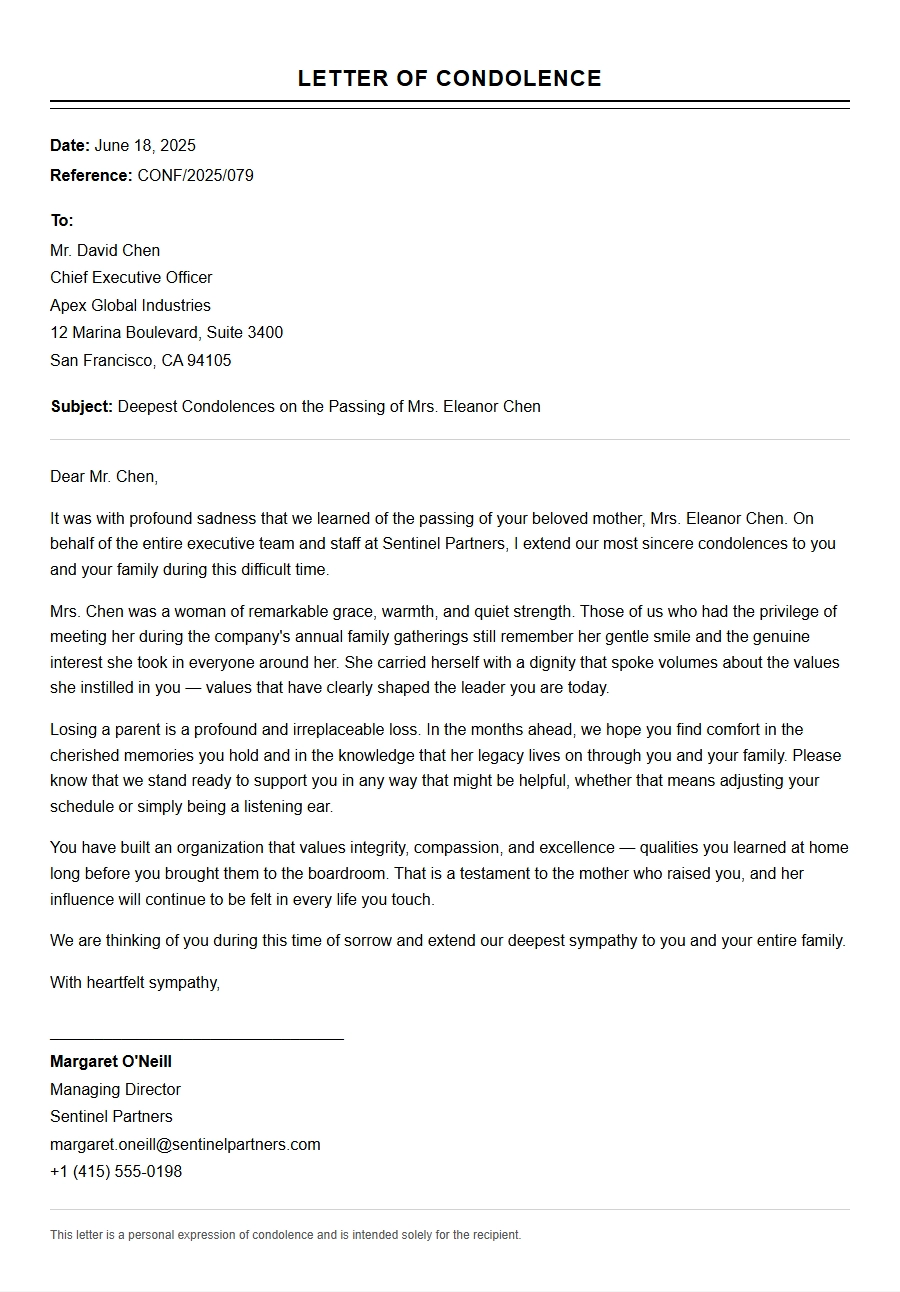
Formal Condolence Letter to an Executive
Condolence Letter to CEO on Loss of Spouse
Dear Mr. Thompson,
On behalf of the entire executive team, please accept our deepest condolences on the passing of your beloved wife, Eleanor. We were deeply saddened to learn of your loss, and we want you to know that you are in our thoughts during this difficult time.
Eleanor was a remarkable person whose warmth and grace touched everyone who knew her. Her contributions to the community and the support she provided to you personally and professionally will never be forgotten.
During the coming weeks, please do not hesitate to delegate any responsibilities. We have arranged for the following team members to cover your immediate commitments:
Client meetings: Sarah Jenkins will take the lead until further notice.
Board reports: Michael Chen will prepare and submit them on schedule.
Operational decisions: The Directors will coordinate with your assistant for approvals.
We hope that knowing you have a reliable team behind you brings some measure of comfort. Please take all the time you need to be with your family. You are not alone in this grief.
With heartfelt sympathy, John Roberts Chief Operating Officer
Letter to CFO After Passing of a Parent
Dear David,
I was deeply saddened to hear the news of your mother’s passing. Please accept my sincere condolences. Losing a parent is one of life’s most profound losses, and I can only imagine what you are going through.
Your mother’s legacy lives on in the wonderful person you have become—your integrity, diligence, and compassion are reflections of the values she instilled. I hope that these memories bring you some peace.
As you navigate this time, please know that your responsibilities here are fully covered. The finance team has been briefed and will handle all routine matters. Specifically:
Weekly reports will be submitted by Linda.
Quarterly audit preparation is on hold until you return.
All vendor payments requiring your signature have been postponed.
If there is anything—no matter how small—that I can do to support you or your family, please do not hesitate to ask. Take the time you need, and come back when you feel ready.
With deepest sympathy, Alan Grant Vice President, Finance
Condolence to Board Chair Regarding Executive's Death
Dear Chairwoman Henderson,
It is with profound sadness that we write to express our condolences on the sudden passing of our esteemed colleague and your close friend, Richard Lancaster. The entire organization is in shock and mourns together with you and the board.
Richard was a pillar of integrity and innovation. His leadership over the past 12 years shaped this company into what it is today. We will honor his memory by continuing the work he was so passionate about.
In light of this loss, we suggest the following actions to be considered at the next board meeting:
Item
Proposed Action
Timeline
Memorial tribute
Establishment of a scholarship in Richard's name
Within 30 days
Interim leadership
Appointment of Sarah Mitchell as acting SVP
Effective immediately
Support for family
Donation to a charity of the family's choice
This week
We are ready to support you and the board in any way needed. Please let us know how we can assist during this transition. May Richard rest in peace.
Respectfully yours, Emily Carter Chief Strategy Officer On behalf of the Senior Leadership Team
Letter from Junior Executive to Senior Executive on Loss of Child
Dear Ms. Whitmore,
I was deeply heartbroken to hear about the passing of your son, James. Words cannot express how sorry I am for your unimaginable loss. No parent should ever have to endure such pain.
I have always admired your strength and grace, but I know that this is a pain that goes beyond any professional skill. Please know that you have the full support of the entire team. We are all keeping you and your family in our thoughts.
To help ease the burden during this time, I and a few colleagues have coordinated the following support:
Meal delivery: We have arranged home-cooked meals three times a week for the next month.
Errands: I can personally handle any grocery or pharmacy runs you might need.
Office coverage: All your current projects are being managed by senior staff.
Please do not worry about anything at work. Your only job now is to take care of yourself and your loved ones. If there is anything, even just to talk, I am here for you.
With deepest sympathy and respect, Jordan Lee Junior Analyst, Marketing
Formal Condolence to Executive Director from Peer Organization
Dear Dr. Patel,
On behalf of the board and staff of the Coastal Environmental Alliance, please accept our heartfelt condolences on the untimely passing of your colleague and Deputy Director, Mark Sullivan. We were stunned and saddened by the news.
Mark was a dedicated environmental advocate whose collaborations with our organization on the coastal restoration project were invaluable. His expertise and passion will be deeply missed across the entire sector.
As a gesture of our respect and support, we would like to offer the following:
Offer
Details
Project assistance
Our team can take over the quarterly reporting for the shared grant until you are back to full strength.
Staff counseling
We have arranged free sessions with a grief counselor for your entire department through our EAP.
Memorial contribution
We will donate $2,500 to the charity of Mark's family's choice.
Please let us know if there is any other way we can be of help. We stand with you in this difficult time.
With sincere sympathy, Rebecca Torres Executive Director Coastal Environmental Alliance
Letter to VP of Operations on Loss of Sibling
Dear Robert,
I was so sorry to learn of the passing of your brother, David. Losing a sibling is a unique and painful loss, and I offer you my deepest condolences.
The memories you shared—growing up together, the trips, the laughter—will be a treasure that no one can take away. May those memories bring you comfort in the days ahead.
In your absence, the operations team is running smoothly. Here is an update on critical areas:
Shipping & logistics: All schedules are on track under Eric’s supervision.
Warehouse management: Stock levels are sufficient, and no urgent issues.
Staffing: Overtime has been minimized, and we have temporary coverage.
Please take as much time as you need to be with your family. You have built a strong team here, and we are ready to support you. If you need anything at all, do not hesitate to call me directly.
Thinking of you and your family, Maria Gonzalez Director of Operations
Condolence to Executive Vice President from HR Department
Dear Ms. Chen,
The entire Human Resources team extends our deepest sympathy to you and your family on the passing of your father. We were deeply saddened by the news, and we want you to know that you are in our hearts.
Your father raised a remarkable woman—one who leads with both strength and kindness. We see his influence in your dedication to our people and culture.
To support you during this time, we have arranged the following:
Bereavement leave: In addition to the standard policy, the company has authorized up to four weeks of paid leave for you.
Flexible return: You may return part-time initially or work remotely as you adjust.
Family support: A meal train has been organized by your team; we can also arrange transportation for any family members visiting.
Please do not think about work. We have reassigned your current projects to senior HR Business Partners who will keep everything on track. Take all the time you need to heal, and let us know if there is anything else we can do.
With heartfelt condolences, Lisa Wang Chief Human Resources Officer
Letter to COO from Company Founder on Family Loss
Dear Karen,
I was absolutely devastated to hear about the loss of your mother. She was an extraordinary woman, and I know how close you were to her. Please accept my most sincere condolences.
I remember meeting her at our company anniversary last year—she was so proud of you and full of warmth. Her spirit will continue to inspire everyone who knew her.
As the founder of this company, I want you to know that you are family. Take whatever time you need—there are no deadlines, no meetings, no expectations beyond your own well-being. I have personally taken over oversight of the new product launch so that you can be fully present with your family.
Here is what we have arranged:
Coverage: I am acting COO until you return.
Family travel: The company will cover flights for any family members coming to be with you.
Memorial: If you wish, we can host a small gathering at the office to honor your mother’s memory later.
We are here for you. With love and respect, Steve Cooper Founder & Chairman
Condolence to Chief Marketing Officer from Agency Partner
Dear Michelle,
I was deeply saddened to learn of the passing of your grandmother. On behalf of the entire creative team at BrightIdeas Agency, please accept our heartfelt condolences. She was clearly a cherished part of your life, and we share in your sorrow.
Your grandmother’s wisdom and love shaped the incredible person you are—your creativity, your resilience, your warmth. Those qualities shine through in every campaign we collaborate on, and we are grateful for the gift she gave the world through you.
To support you during this time, we have made the following adjustments to our joint projects:
Project
Status
Next Steps
Spring launch campaign
Paused
Resume upon your return; deadline extended by 2 weeks
Brand guidelines refresh
On hold
Internal review completed; no action needed from you until March
Weekly status calls
Cancelled
Will be replaced by email summaries you can read at your convenience
No rush on any decision. We are here to carry the load. Please take all the time you need, and know that you are surrounded by people who care.
With deepest sympathy, Tom Henderson Partner, BrightIdeas Agency
Condolence from Direct Report to Executive on Loss of Parent
Dear Mr. Patel,
I was so sorry to hear about the passing of your father. Please accept my deepest condolences. Losing a parent is a profound loss, and I cannot imagine what you are going through.
Your father must have been an amazing person to have raised such a compassionate and brilliant leader. The way you treat your team with respect and encouragement reflects his teachings, and for that, I am forever grateful.
While you are away, I wanted to reassure you that everything is under control. I have taken the lead on the following tasks to ensure a smooth operation:
Weekly status reports: I will compile and send them to you only when you request.
Client calls: I have rescheduled any non-urgent ones; urgent items will be handled by Sarah.
Team morale: I organized a card that everyone signed, along with a small donation to a cancer charity in your father’s name.
Please do not worry about work. Your only focus now should be your family and yourself. If you need anything—even just someone to talk to—I am here.
With sincere sympathy and respect, Alex Rivera Senior Analyst
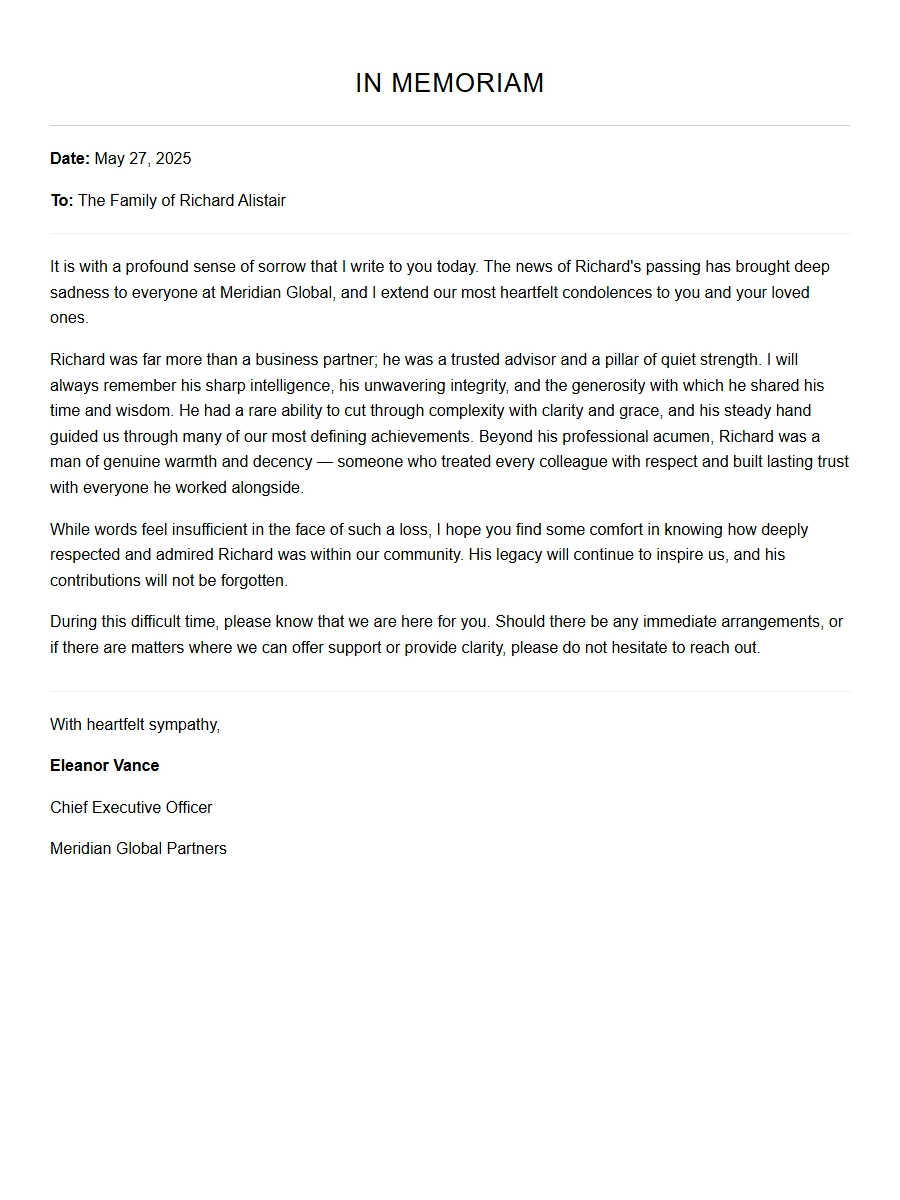 Formal Condolence Message for a Business Partner
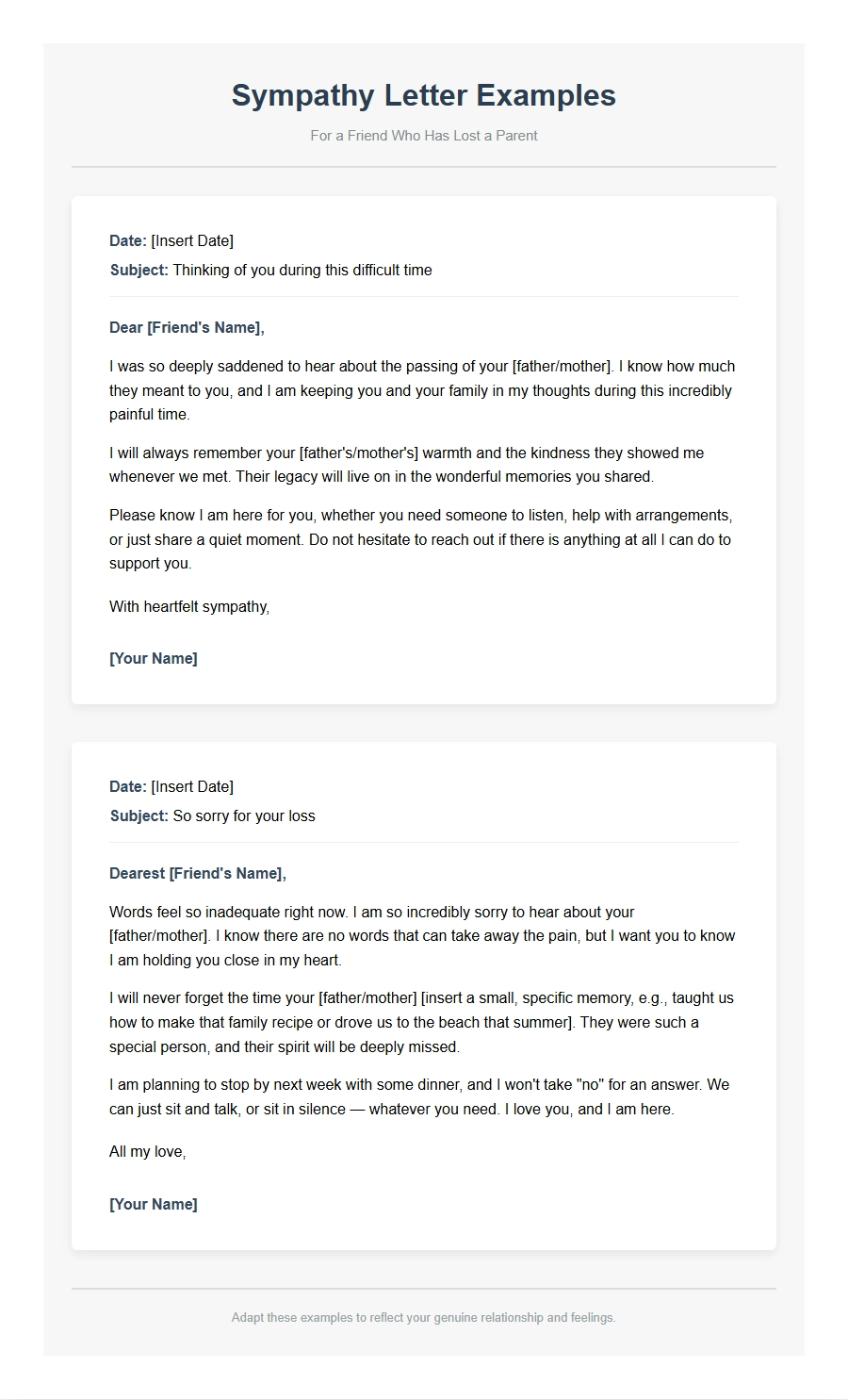 Sympathy Letter Examples for a Friend Who Lost a Parent
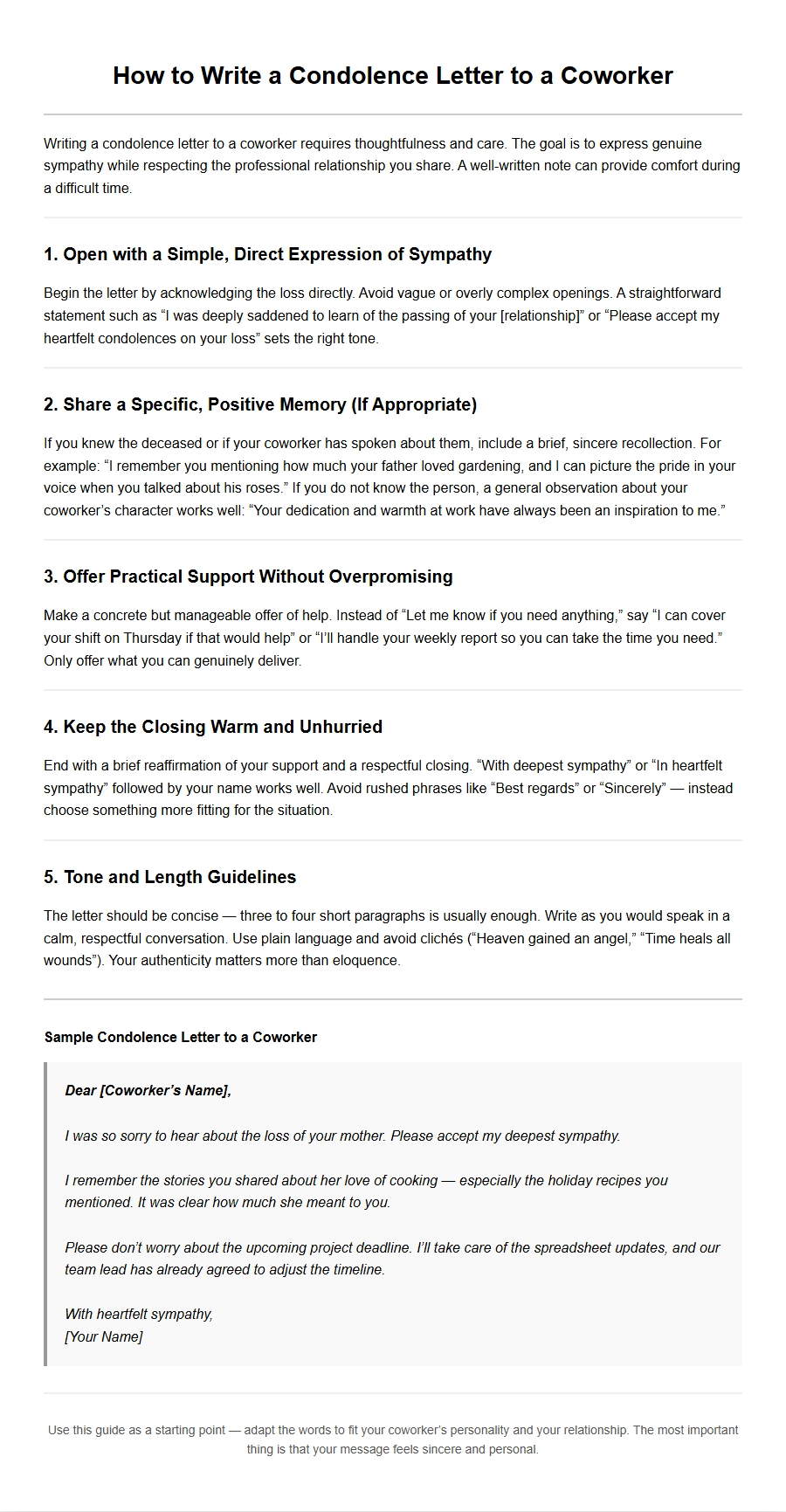 How to Write a Condolence Letter to a Coworker
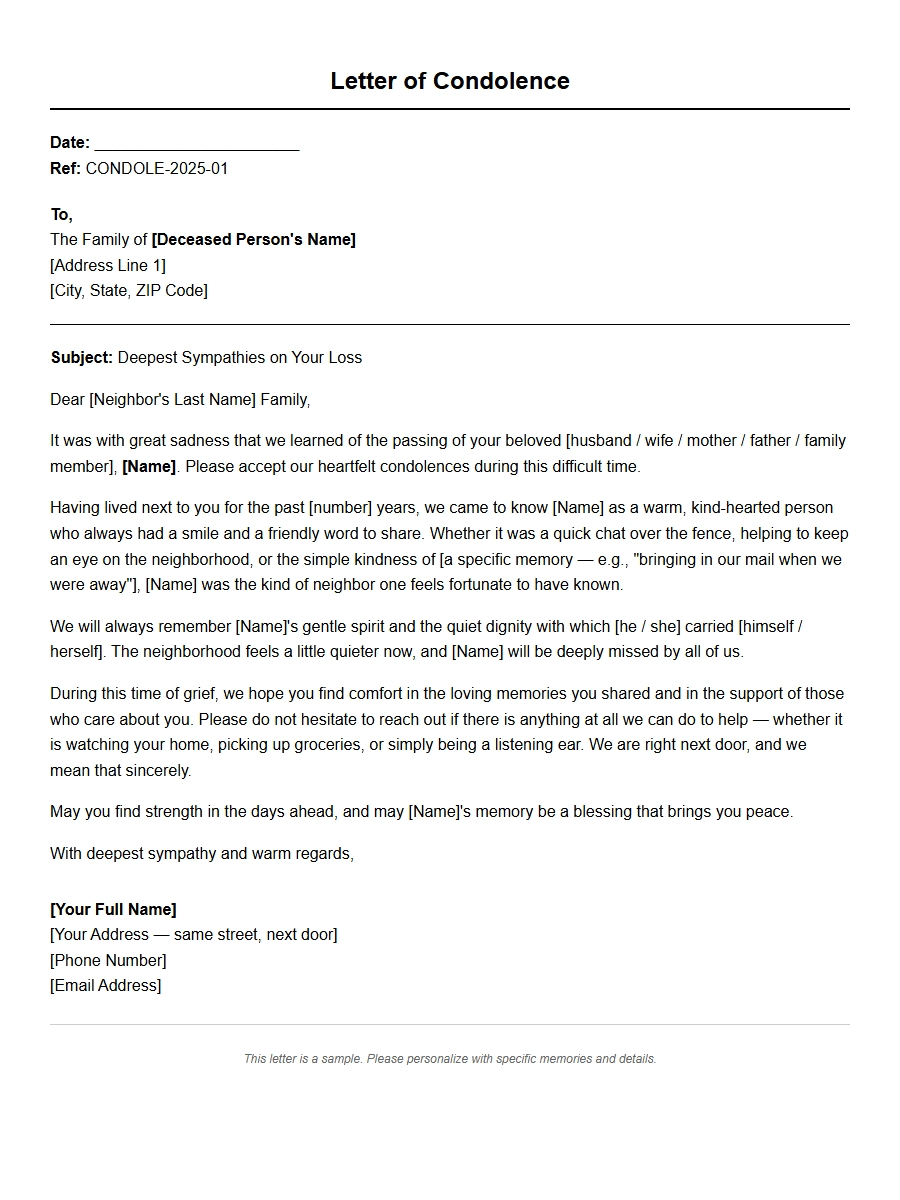 Condolence Letter Sample for a Neighbor
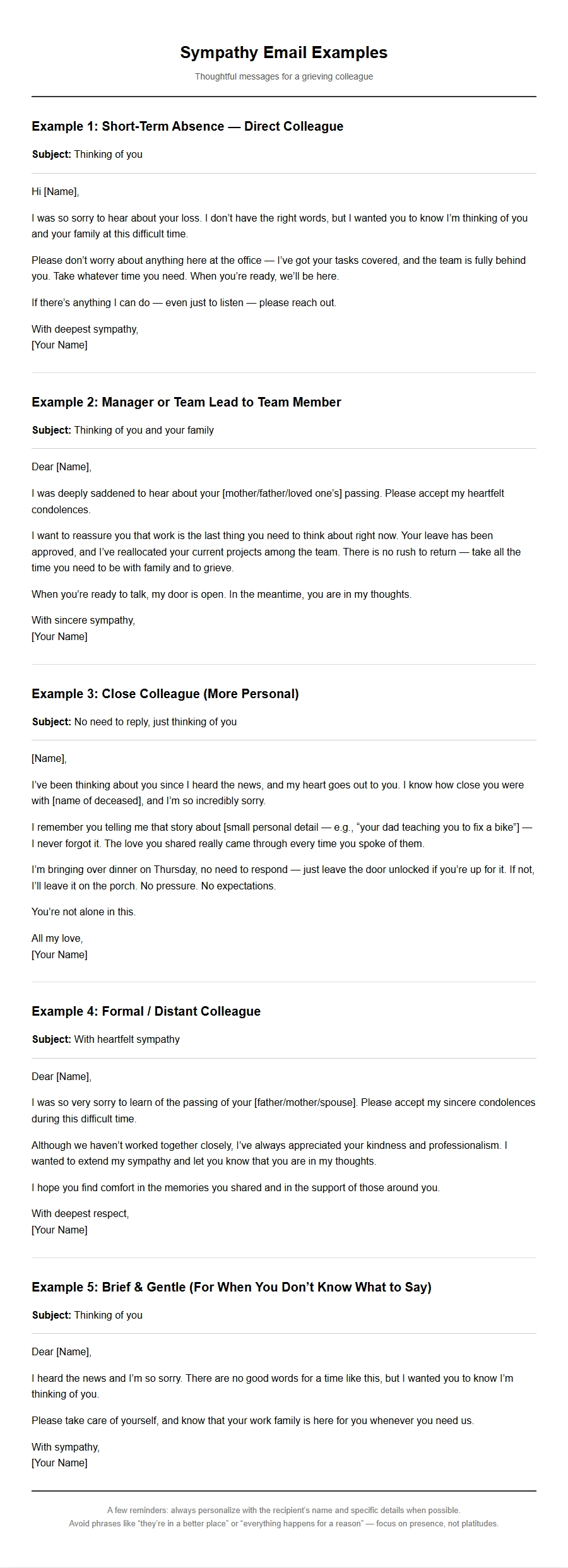 Sympathy Email Examples for a Grieving Colleague
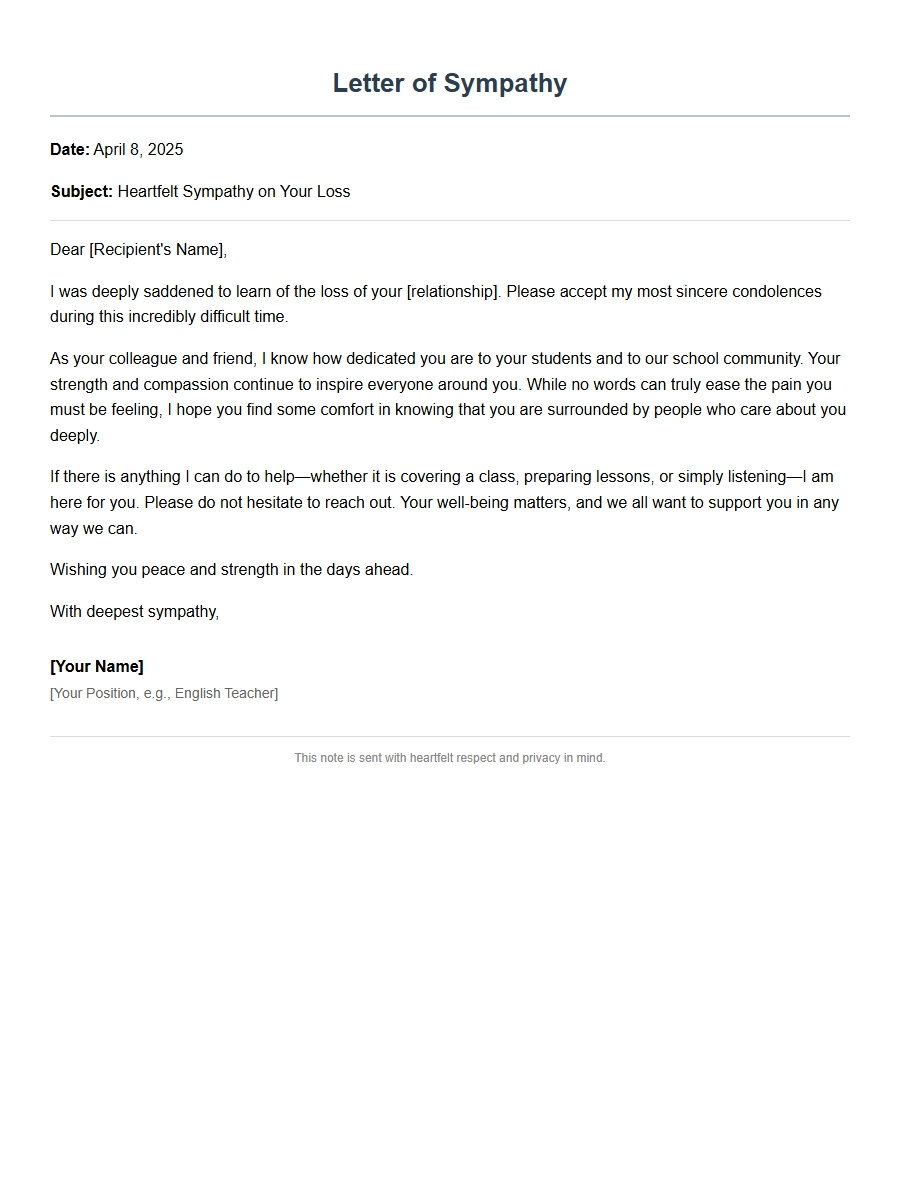 Condolence Words for a Teacher