You want to write a letter to a mother who has lost her daughter, but the words feel stuck. That blank page can make you question everything—tone, length, even whether to send anything at all. A good letter sample for a bereaved mother daughter gives you a starting point. It’s not about copying. It’s about having a structure so you can focus on the real message.
Why using a letter sample is a smart move
Nobody expects you to invent the perfect condolence letter from scratch. A sample provides the right vocabulary and pacing. It shows you how to open, what to say in the middle, and how to close without sounding scripted. Think of it as a template that respects letter writing etiquette while leaving room for your own words. You adjust the details, add a memory, change the salutation—and suddenly you have a genuine message.
Professional correspondence for grief is different from a business letter. The format matters less than the heart. But having a solid structure keeps you from rambling or saying something unintended. Samples for bereaved mothers often include phrases like “I am so sorry for your loss” and gentle offers of support. They avoid clichés like “she’s in a better place” unless you know the family’s beliefs.
How to choose the right sample for your situation
Are you writing a formal condolence letter to a colleague who lost her daughter? Or a personal note to a close friend? The relationship decides the tone. A formal letter uses “Dear Mrs. Smith” and a full closing like “With deepest sympathy.” A personal note can start with the mother’s first name. Look for a sample that matches your distance from the family. If you didn’t know the daughter well, keep it simple. If you did, include a brief, specific memory.
Consider the delivery method. An email or digital letter format should still feel thoughtful—avoid all caps, slang, or emojis. A printed letter on proper letterhead or nice stationery shows extra care. Check the salutation and closing section of any sample. For a bereaved mother, “With love and sympathy” or “Thinking of you” work better than “Sincerely.”
Adapting a sample without losing your voice
Take the sample and rewrite the opening paragraph. Instead of “I was saddened to hear of your loss,” try “I keep thinking about you and your family since I heard the news.” That small shift makes it feel like you, not a form letter. Keep the middle section that acknowledges her pain and offers help, but change vague offers like “let me know if you need anything” to something concrete: “I’ll bring dinner on Wednesday if that works.” Specificity shows you mean it.
Common mistake: using outdated salutations like “To whom it may concern” in a personal letter. Another: ignoring formatting for printed versus digital. For a printed letter, include your address and date. For email, a clear subject line such as “Thinking of you” helps. Proofreading letter is non-negotiable—read it aloud to catch awkward phrasing. A typo in a condolence note can feel careless, even if unintentional.
Category: Condolence Letters
Adding a personal touch without overdoing it
A brief memory of the daughter—her laugh, a kindness she showed—can mean more than any formal writing tip. Keep it short and genuine. If you never met the daughter, acknowledge that: “I wish I had known her, because you clearly raised someone wonderful.” That respects both mother and child.
Don’t try to explain grief. Phrases like “time heals all wounds” can hurt more than help. Instead, affirm her strength: “I don’t know how you’re doing this, but I am here for you.” That’s honest and supportive. The sample you use should leave room for that authenticity. If a sample feels too stiff or too casual, tweak it until it sounds like you talking to a real person.
Avoiding pitfalls in sympathy letter writing
Never dictate how the mother should feel. Avoid “you must be devastated” or “I know how you feel.” You don’t. Stick to how you feel: “I feel so helpless and sad for you.” That’s safe and true. Also avoid comparing losses. Saying “I lost my own mother last year” changes the focus to you. The letter is about her and her daughter.
Keep the letter concise. Two short paragraphs are enough. A handwritten note on a nice card often works better than a long typed letter. The sample can show you the right length—usually 100–200 words for personal condolence. Respect that gently.
Let the sample guide, not control
Once you have your draft, read it as if you were the mother. Does it comfort or confuse? If a line feels hollow, change it. The best letter weaves professional structure with personal voice. You don’t have to write a masterpiece. You just have to show up on the page. Over time, writing these letters gets easier. Each one teaches you a little more about tone and kindness.
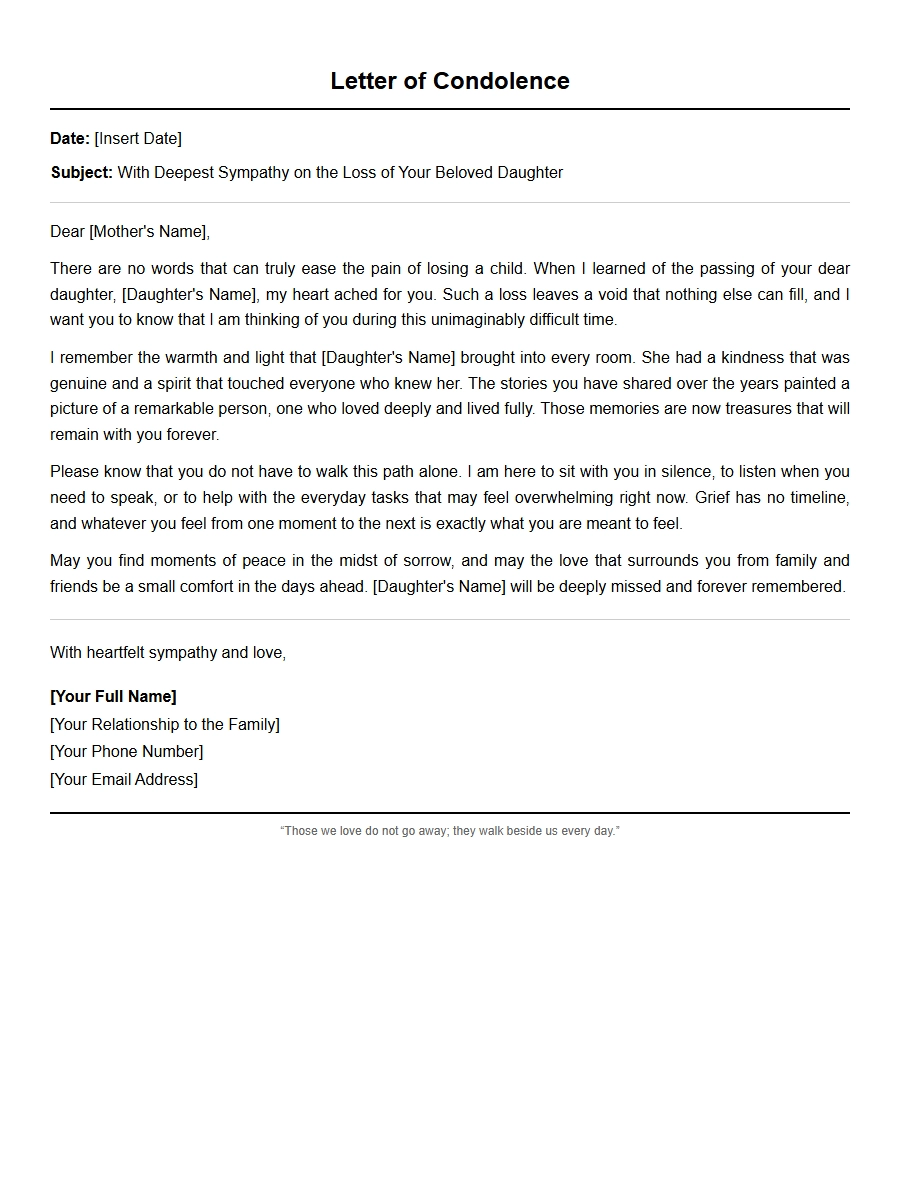
I was heartbroken to hear the news of [Daughter's Name]'s passing. There are no words to ease the pain you must be feeling right now. I will always cherish the memories of her laughter and kindness.
Please know that I am here for you in any way you need—whether it's a quiet cup of tea, a listening ear, or help with daily tasks. Do not hesitate to reach out.
With deepest sympathy, [Your Name]
Condolence Letter from a Colleague
Dear [Mother's Name],
On behalf of the entire team at [Company Name], I extend our heartfelt condolences on the loss of your beloved daughter, [Daughter's Name]. She was a remarkable person who brought joy to everyone around her.
We understand this is a difficult time, and we want to support you. Please let us know if there is anything we can do to help, whether it's arranging time off or coordinating meal deliveries.
You are in our thoughts and prayers.
Sincerely, [Your Name]
Short Note of Comfort
Dearest [Mother's Name],
My heart aches for you. [Daughter's Name] was a beautiful soul, and her light will never fade.
I'm holding you close in my thoughts. Sending you strength and peace during this unimaginable time.
With love, [Your Name]
Letter from a Religious Leader
Dear [Mother's Name],
I was deeply saddened to learn of the passing of your dear daughter, [Daughter's Name]. May you find comfort in the promise of eternal peace and the loving embrace of [Faith/God].
Our congregation is praying for you. We have arranged a prayer gathering in her memory:
Date
Time
Location
[Date]
[Time]
[Church/Mosque/Temple Address]
You are welcome to attend, or I can visit you privately. Please reach out if you need spiritual guidance or just someone to talk to.
May God bless you and give you strength.
In faith, [Your Name]
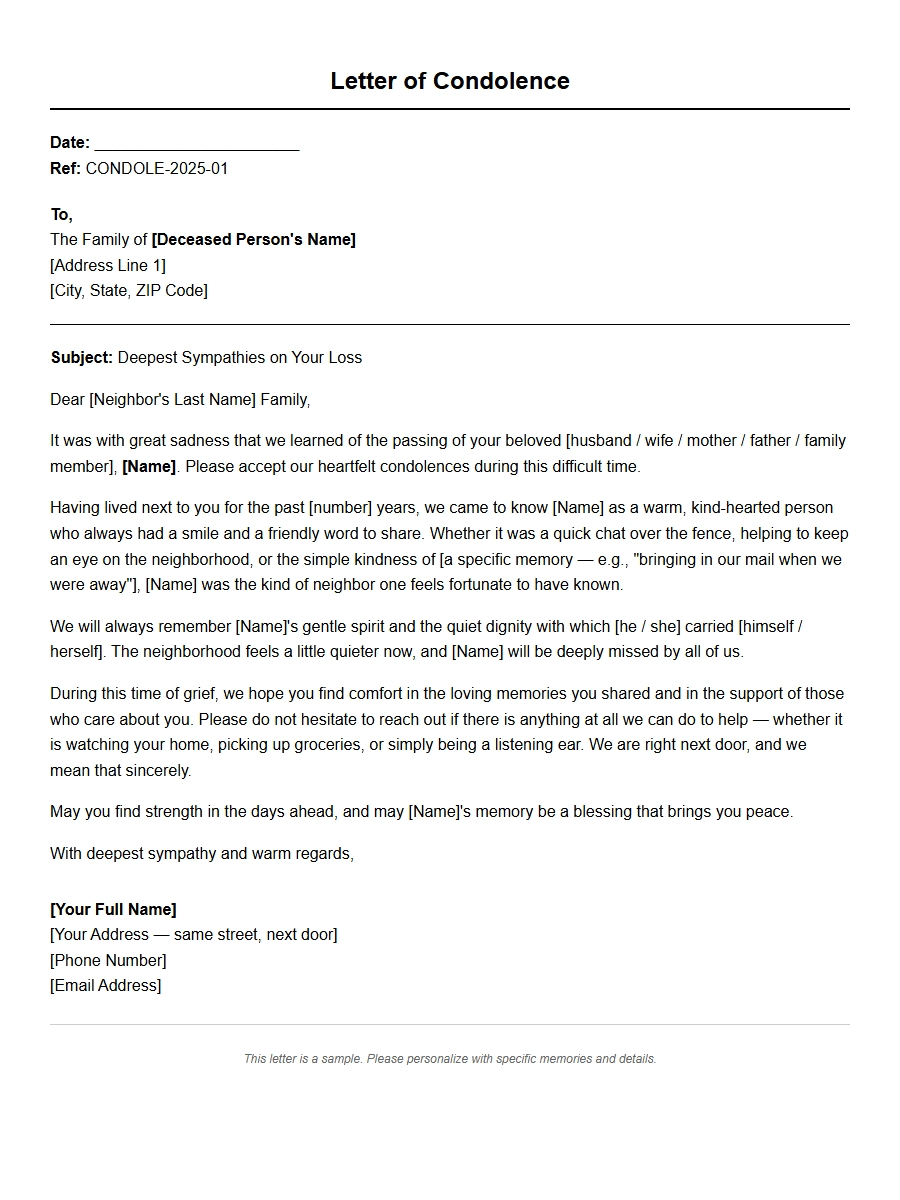
Condolence Letter to a Mother from a Neighbor
Dear [Mother's Name],
We are so sorry to hear about your daughter. She was such a dear neighbor, always smiling and helping others. Our street feels emptier without her.
We have organized a small support network for you:
Meal drop-offs: Monday, Wednesday, Friday at 6 PM
Grocery runs: Contact [Neighbor's Name] at [Phone]
Pet care if needed: [Other Neighbor's Name]
Don't hesitate to ask for anything. You are not alone.
With heartfelt sympathy, [Your Name]
Letter from a Support Group for Bereaved Mothers
Dear [Mother's Name],
We, at [Support Group Name], understand the profound loss you are experiencing. Losing a daughter is a journey no mother should have to walk alone. We invite you to join our group of mothers who have also lost daughters.
Our meetings include:
Monthly group sharing sessions
One-on-one peer support
Resources on grief counseling
We will hold a special remembrance circle on [Date] at [Time] at [Location]. You are welcome to come as you are. We will light a candle for [Daughter's Name].
You are in our hearts.
With compassion, The [Group Name] Team
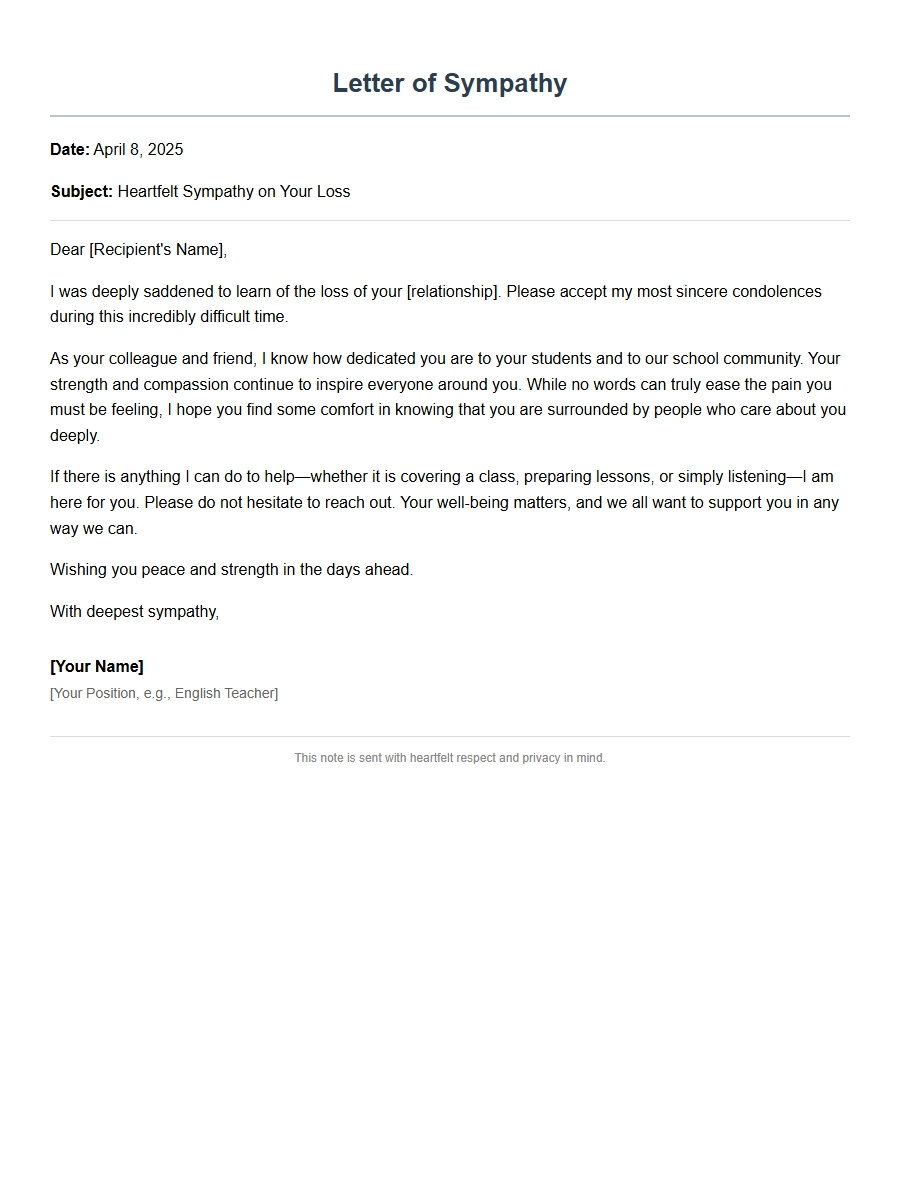
Condolence Letter from a Former Teacher
Dear [Mother's Name],
I was deeply saddened to hear of [Daughter's Name]'s passing. I had the privilege of teaching her in [Year/Class], and she was one of the brightest, most compassionate students I ever had. She inspired her classmates and left a mark on our school.
In her memory, the school is establishing a small scholarship fund. If you would like, we can provide details on how to contribute or support it.
Please accept my heartfelt condolences. I will always remember her with great fondness.
Respectfully, [Your Name]
Formal Letter of Condolence from an Organization
Dear [Mother's Name],
On behalf of [Organization Name], I extend our deepest sympathies on the passing of your daughter, [Daughter's Name]. She was a valued member of our community, and her contributions will not be forgotten.
We have arranged the following in her honor:
Tribute
Details
Donation to charity
$[Amount] donated to [Charity Name]
Memorial bench
To be placed in [Park/Location]
Tree planting
Ceremony on [Date] at [Time]
We hope this brings you some comfort. Please let us know if you would like to participate in any of these tributes.
With sincere condolences, [Your Name], [Title]
Handwritten-Style Letter from a Family Member
My dearest [Mother's Name],
I am writing this through tears. [Daughter's Name] was like a sister to me, and I cannot imagine the depth of your pain. I keep thinking of all those summers we spent together—the laughter, the secrets, the silly arguments that always ended in hugs.
I want you to know that I will always be here for you. I'm planning to visit next week and bring some comfort food. I'll call before I come. If there's anything specific you need, just whisper it to me.
You are the strongest woman I know, but you don't have to be strong right now. Let us carry you.
All my love, [Your Name]
Brief Condolence Email Template
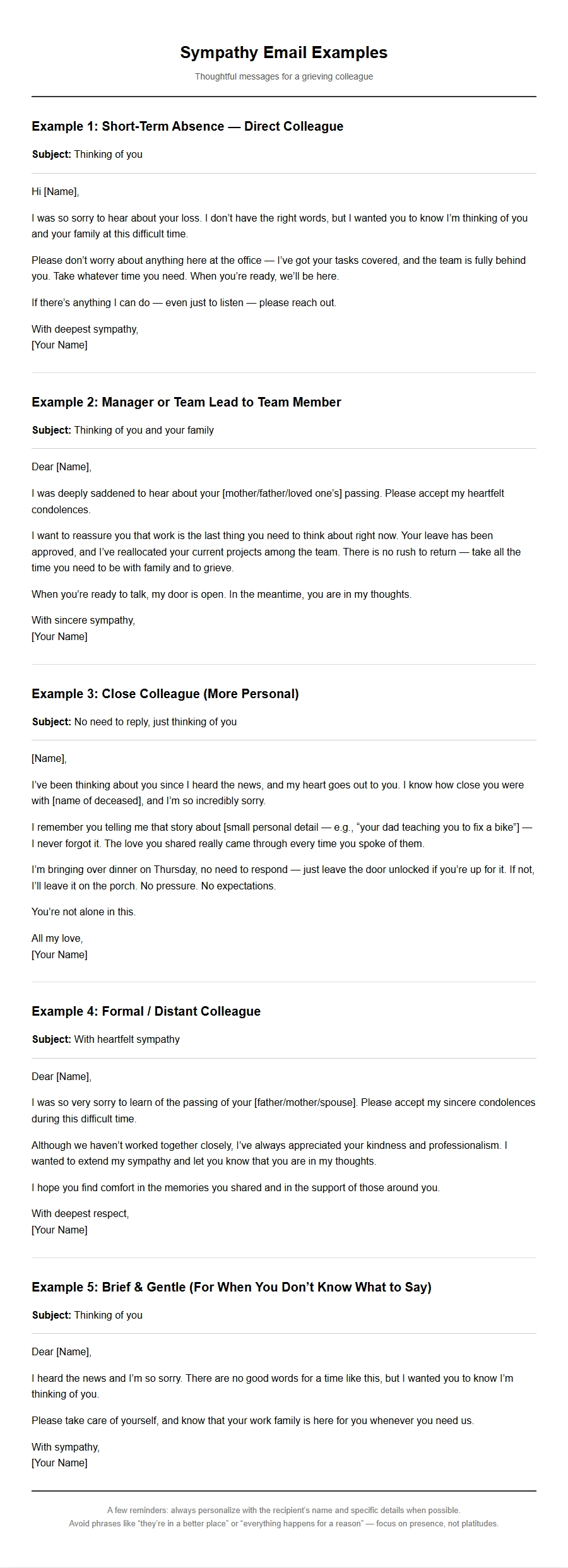
Subject: Thinking of you
Dear [Mother's Name],
I just heard about [Daughter's Name] and I am so sorry. Words fail, but please know I am thinking of you and sending love.
I would like to help in a practical way. Please check the options below that you'd appreciate:
Meal delivery on [day of week]
Errand running
Just a phone call to chat
Company for a walk
Reply to this email or text me at [Phone]. You don't have to face this alone.
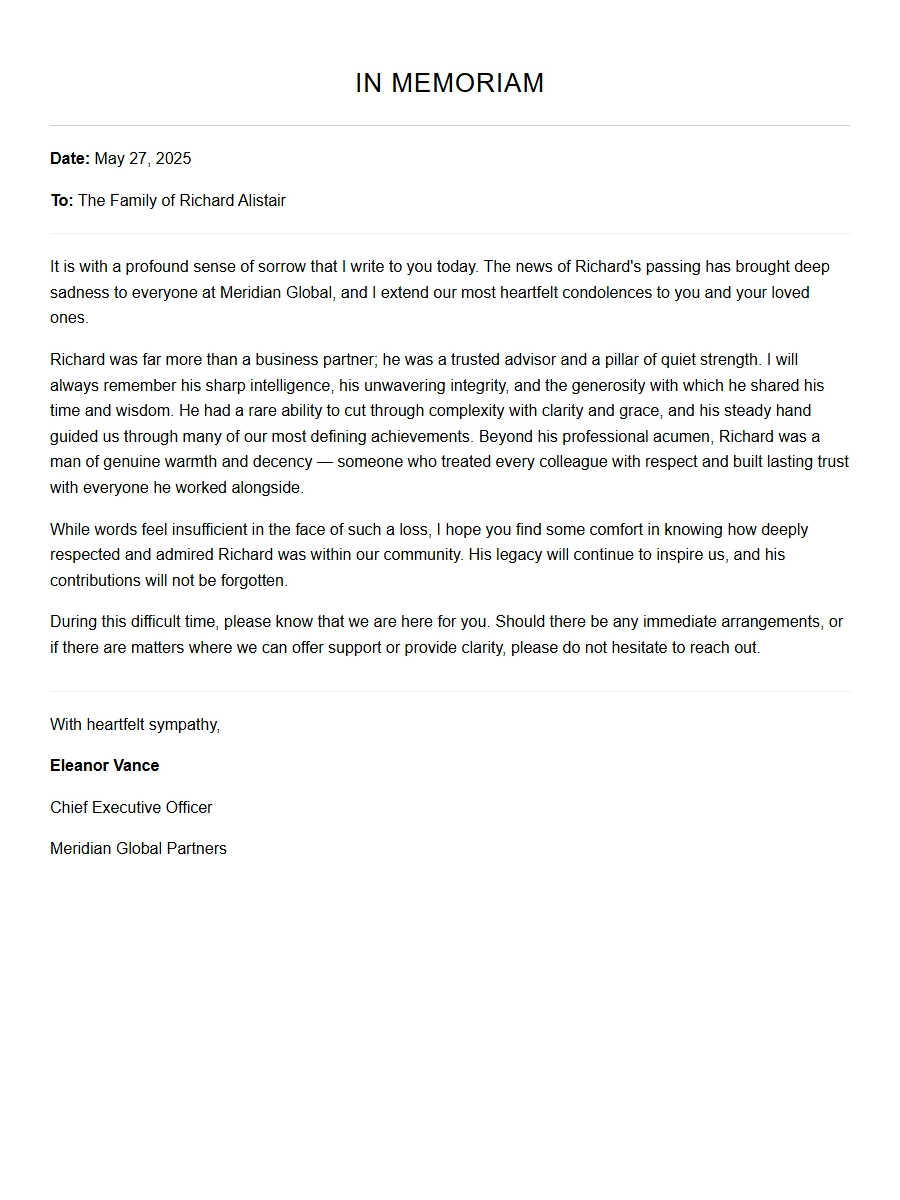 Formal Condolence Message for a Business Partner
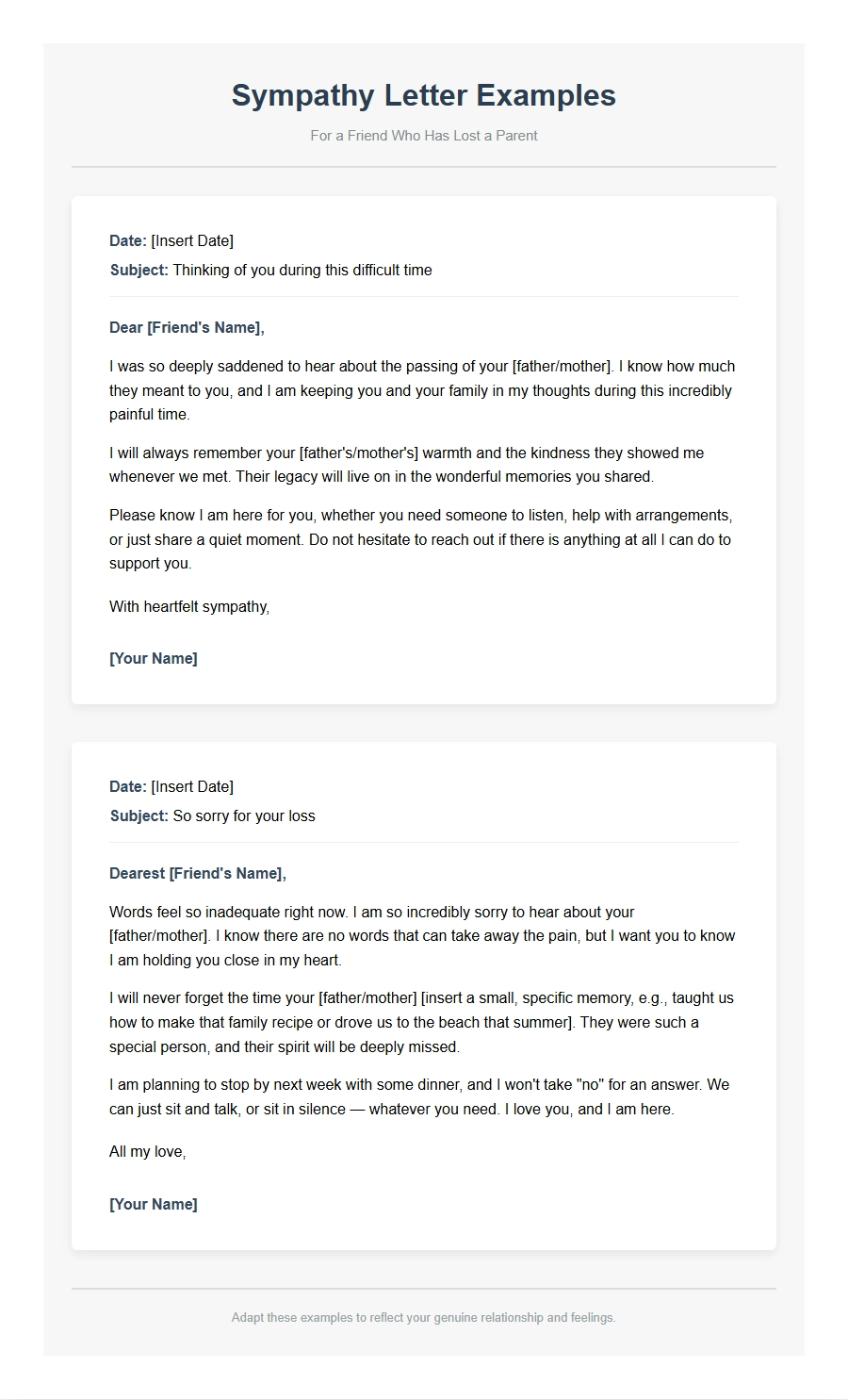 Sympathy Letter Examples for a Friend Who Lost a Parent
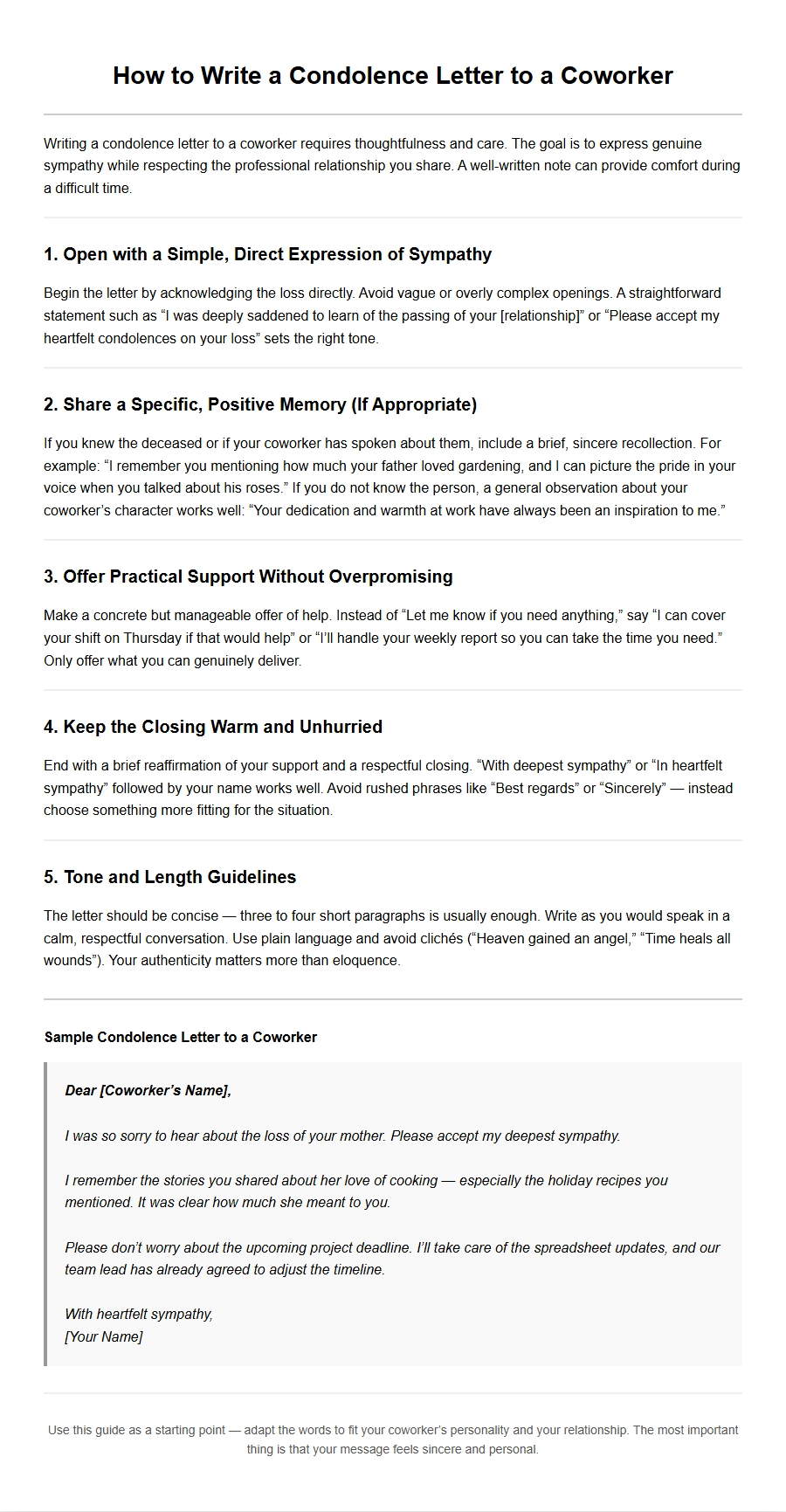 How to Write a Condolence Letter to a Coworker
 Condolence Letter Sample for a Neighbor
 Sympathy Email Examples for a Grieving Colleague
 Condolence Words for a Teacher