How to Write a Sympathy Letter for a Church Member
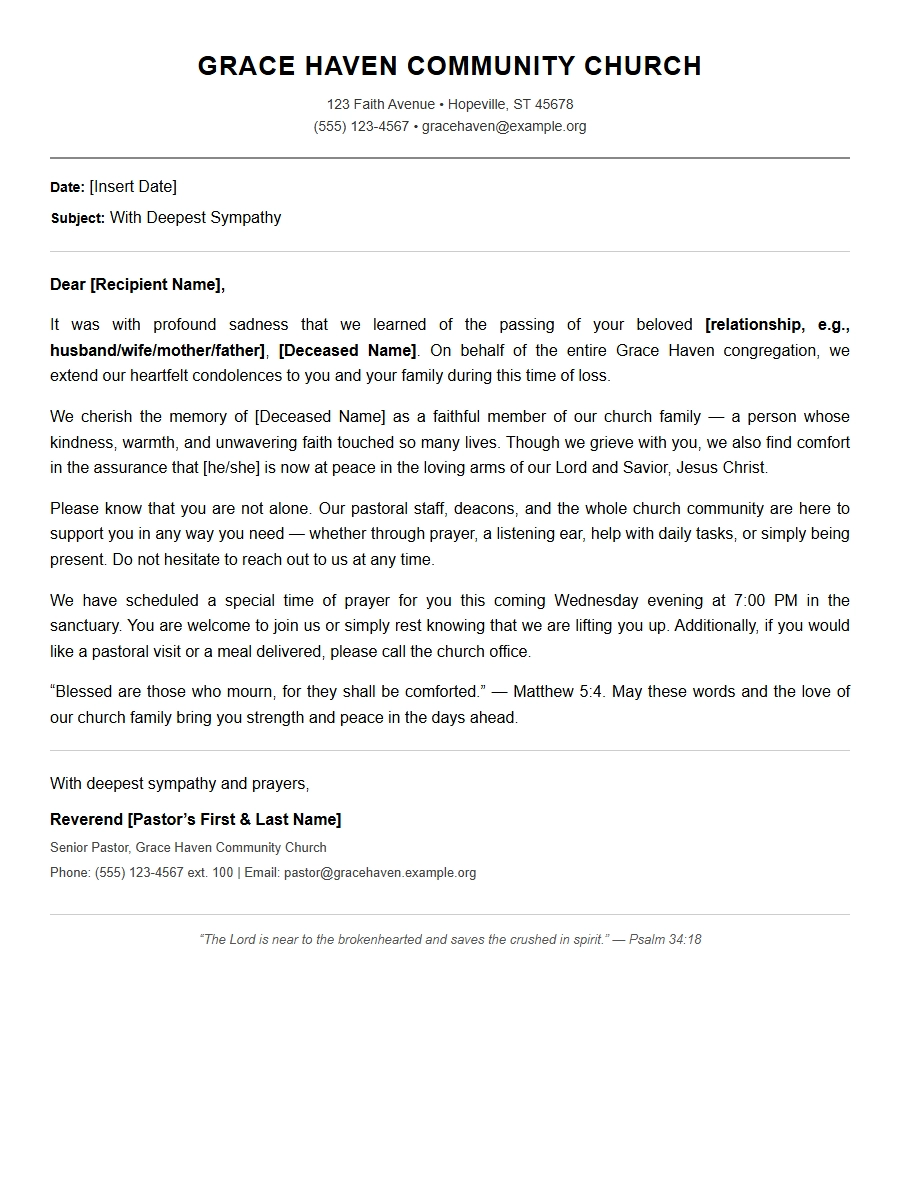
Staring at a blank page when you need to write a sympathy letter for a church member can feel paralyzing. You want to say the right thing, honor their faith, and offer real comfort—but the words just won’t come. The good news? A solid sympathy letter format for church member can turn that anxiety into a confident, polished draft in minutes. It’s not cheating. It’s working smarter.
Category: Sympathy Letters
Using a letter template for these situations gives you a clear structure—where to start, how to acknowledge the loss, and how to close with hope. It also provides the right tone. Church sympathy letters lean warmer and more faith-filled than standard business correspondence, but they still need to feel sincere, not stiff. A sample helps you strike that balance.
When you’re writing to a grieving church family member, start by choosing a format that fits your relationship. Are you the pastor, a Sunday school teacher, or a fellow congregant? Your role affects how formal the letter should be. For a pastor, a slightly more polished professional correspondence style works. For a close friend in the pew, a personal note with a gentle tone is better.
Once you pick a sample, adapt it without losing your authentic voice. Read the opening paragraph of the template. Does it match how you’d naturally speak? If a sentence feels too formal, rewrite it in your own words. The best customizable letter samples leave room for you to fill in specific memories, Scripture verses, or details about the person who passed away. For example, instead of “We are sorry for your loss,” try “We will miss how Uncle Joe always handed out peppermints after service.” That small touch makes the letter feel real.
Structure matters. Most sympathy letters for church members follow a simple flow: salutation, statement of sorrow, a personal memory or acknowledgment of faith, an offer of support, and a closing with a prayer or blessing. Stick to that letter structure and you won’t forget anything important.
Pay attention to salutation and closing. Avoid outdated phrases like “To whom it may concern.” Use the person’s name—even if you don’t know them well, a simple “Dear Mrs. Green” is respectful. For the closing, phrases like “With deepest sympathy in Christ” or “Holding you in prayer” fit well. The tone in writing should be compassionate but not dramatic.
One common mistake is ignoring whether the letter will be printed or sent digitally. For a printed letter, use a clean letterhead design and leave room for a handwritten signature. For email or a church website, keep paragraphs short and use a standard digital letter format with a clear subject line like “With sympathy for your family.”
After you write the first draft, proofread the letter reading it aloud—you’ll catch awkward phrases and hear if the tone sounds like you. Also double-check names, dates, and any Scripture references. One typo can distract from your message.
Remember, the sample is a springboard, not a crutch. The best sympathy letters feel both professional and personal. They show you took time to care. And the more you practice, the faster the process gets. Next time you face that blank page, you’ll already have a framework—and the confidence to fill it with words that truly comfort.
Templates and Samples
How to Write a Sympathy Letter for a Church Member
Pastor's Sympathy Letter to Bereaved Family
Date: June 10, 2025
To: The Johnson Family
Dear Martha, David, and Emily,
It was with a heavy heart that I learned of the passing of your beloved husband and father, Robert. On behalf of the entire congregation of Grace Community Church, I extend our deepest condolences to you all. Robert was a pillar of faith, a man whose gentle spirit and unwavering service touched so many lives. His presence in the choir and on the usher board will be greatly missed.
Please know that you are not alone in this time of grief. Our church family is holding you in prayer, and we are here to support you in any way we can. As Scripture reminds us in 2 Corinthians 1:3-4, God is the Father of mercies and the God of all comfort, who comforts us in all our affliction.
We have arranged for a meal train to provide dinners for your family over the next two weeks. A sign-up sheet will be in the church foyer. Visitation is set for Thursday at 2 PM, followed by the funeral service at 3 PM in the sanctuary.
May the peace that surpasses all understanding guard your hearts and minds in Christ Jesus.
With deepest sympathy,
Pastor Michael Thompson
Congregational Sympathy Note (Signed by Members)
To: The Wilkerson Family
From: The Women’s Ministry and Adult Bible Class of New Hope Church
Dear Phyllis, Andy, and Rachel,
We were deeply saddened to hear about the homegoing of your dear wife and mother, Gloria. Her warm smile and encouraging words were a blessing to everyone who knew her. Gloria served faithfully in the nursery for over twenty years, and her legacy of love will continue in the hearts of the children she cared for.
As a token of our love, we have compiled a memory book of messages from class members. We would like to present it to you after the memorial service. Please let us know if there is anything practical we can assist with — from yard work to grocery runs, we are ready to help.
We are also collecting a special offering in Gloria’s memory for the church’s children’s ministry, as she would have wanted. Details are available at the welcome desk.
You are constantly in our prayers. Trust in the Lord, for He will sustain you.
With love and sympathy,
The Women’s Ministry Coordinator, Sarah Jenkins (on behalf of the class)
Sympathy Letter from Church Board of Elders
Date: June 12, 2025
To: Brother Thomas Carter’s Family
Dear Mrs. Carter and children,
On behalf of the Board of Elders of Riverdale Bible Church, we extend our heartfelt sympathy to you in the loss of Thomas. He served as an elder for twelve years, and his wisdom and dedication to sound doctrine were invaluable. Thomas led the men’s discipleship group and was a faithful steward of God’s Word.
We know that words cannot fully express the comfort we wish to offer, but we trust in the promises of God. Jesus said, “I am the resurrection and the life. Whoever believes in me, though he die, yet shall he live.” (John 11:25)
The elders have arranged for a memorial service at the church on Saturday, June 21, at 11:00 AM. Lunch will be provided afterward in the fellowship hall. We kindly request that you let us know if you need transportation or any other assistance.
We are praying that the Lord will wrap you in His peace and give you strength for the days ahead. You are loved.
In Christian love,
The Board of Elders
Sunday School Class Sympathy Note
To: The Martinez Family
From: The Faith Seekers Sunday School Class, Crossroads Church
Dear Mr. and Mrs. Martinez and family,
We were so sorry to learn of the passing of your beloved son, Joshua. He was a vibrant member of our youth Sunday school class, always eager to participate in discussions and help set up chairs. His laughter and kindness will not be forgotten.
As a class, we have put together a small memorial: a photo collage from our class trips and a memory journal filled with notes from his peers. We will deliver it to your home on Wednesday evening. We would also like to invite you to join us for a special prayer gathering this Friday at 7 PM in the youth room, where we will honor Joshua’s life and lift your family in prayer.
We know that this is a difficult time. Please remember that God is close to the brokenhearted. Your class is here to support you — whether it means mowing the lawn or just sitting with you in silence.
With tender sympathy,
Mrs. Clara Bennett, Sunday School Teacher
Letter from Church Youth Group to a Grieving Teen
To: Emily Ross
From: The Edge Youth Group, First Baptist Church
Dear Emily,
We were heartbroken to hear about your dad. He was such an awesome guy — always cheering at our basketball games and bringing donuts for Sunday morning breakfast. We know that nothing can replace him, and we are so sorry you have to go through this.
We want you to know that you’re not alone. Our youth group has set up a special prayer chain, and we are meeting at the church this Saturday at 2 PM to pray for you and your family. We also made a video with messages from all of us — it’s not much, but we hope it makes you smile.
We’ve collected some Scriptures that have helped us during hard times:
Psalm 34:18 — “The Lord is near to the brokenhearted.”
Matthew 5:4 — “Blessed are those who mourn, for they shall be comforted.”
Romans 8:38-39 — Nothing can separate us from God’s love.
We hope you can join us for pizza after the prayer meeting. If you need anything at all, just text any one of us. We love you, Em.
Your friends in Christ,
The Youth Group
Sympathy Letter with Practical Assistance Offer
To: The Okafor Family
From: The Deacon Board and Care Team, Zion Church
Dear Mrs. Okafor and children,
We extend our sincere condolences on the passing of your dear husband, Chinedu. He was a devoted husband, father, and deacon who served our church with humility and joy. We share in your sorrow and want to help you practically during this time.
Our Care Team has put together a list of available support. Please do not hesitate to let us know what you need:
Service
Coordinator
Contact
Meal delivery (2 weeks)
Sarah Adeyemi
555-0123
Childcare pick-up / homework help
James & Lucy Kim
555-0456
Transportation to appointments
David Brown
555-0789
House cleaning / yard work
Maria Torres
555-0321
Also, we have arranged a memorial service for Saturday, June 28, at 10 AM. Following the service, a reception will be held in the fellowship hall. We will also be live-streaming the service for relatives who cannot attend in person.
May God’s unfailing love be your refuge. We are praying for you daily.
With heartfelt sympathy,
Deacon Thomas Lee on behalf of the Deacon Board
Sympathy Letter Focused on Scripture Comfort
To: The Nakamura Family
Dear Mr. and Mrs. Nakamura,
We were deeply saddened to hear about the loss of your dear mother, Haruko. She was a woman of deep faith who loved the Lord and her church family. Her gentle presence in the ladies’ prayer group will be greatly missed.
During this time, we cling to the promises of God’s Word. Please find comfort in these passages:
Psalm 23: “Even though I walk through the darkest valley, I will fear no evil, for you are with me.”
Isaiah 41:10: “Fear not, for I am with you; be not dismayed, for I am your God; I will strengthen you, I will help you.”
Revelation 21:4: “He will wipe away every tear from their eyes, and death shall be no more.”
We have placed these verses on a framed card for you, which we will drop off this week. We are also organizing a prayer vigil at the church on Thursday evening at 7 PM, specifically lifting up your family. All are welcome.
May the Lord fill your hearts with peace that surpasses understanding, and may you know that your mother is now in the arms of her Savior.
With deepest sympathy,
The Caring Committee
Sympathy Letter Acknowledging Church Member’s Service
To: The Mitchell Family
From: The Trustees and Staff, Grace Chapel
Dear Mrs. Mitchell and family,
We join you in mourning the loss of Brother George Mitchell, a faithful member of our church for forty years. George was instrumental in building our community outreach program and served as head of the maintenance team. His dedication to keeping our church facilities welcoming was a labor of love.
To honor his memory, the church trustees have established a memorial fund, the “George Mitchell Service Scholarship,” to support young adults pursuing vocational ministry. Donations may be made at the church office or through our website.
Funeral arrangements:
Visitation: Friday, July 5, from 6-8 PM at the church
Funeral: Saturday, July 6, at 11 AM
Burial: Oakwood Cemetery immediately following
A reception meal will be provided by the Women’s Ministry. If you have dietary needs, please contact Helen Green at 555-0111.
We are praying that you will feel the Lord’s presence and the support of your church family. Thank you for sharing George with us for so many years.
With sincere sympathy,
The Trustees
Bereavement Letter from Church to Non-Member Family
To: The Davis Family
Dear Mr. and Mrs. Davis,
Though we did not have the privilege of knowing your father, William, personally, we understand that he was a cherished member of our community and the beloved father of your family. As a church, we extend our deepest sympathy to you in this time of loss.
We understand that your family is not part of our congregation, but we want you to know that God’s love and ours reach beyond these walls. Please accept the enclosed meal gift certificate as a small gesture of care. Additionally, we offer the use of our church facilities for the funeral service if you have not yet made arrangements. Our pastor, Reverend Adams, is available to officiate or provide grief counseling at no cost.
Below are some local resources that may assist you during this time:
GriefShare Support Group: Meets Tuesdays at 7 PM in our fellowship hall. All are welcome.
Meal Assistance: Contact our Care Coordinator, Linda, at (555) 0199.
Transportation: We can arrange rides to and from the service. Call the church office.
We are praying for God’s comfort to surround you. Please know that you are not forgotten.
With heartfelt sympathy,
Pastor John Adams
First Community Church
Generic Sympathy Letter Format for Multiple Church Members to Sign
To: The Bereaved Family of ______________
Dear Brothers and Sisters in Christ,
We, the undersigned members of Hilltop Christian Church, join together to express our deepest sympathy to you on the loss of your loved one. Though we may not all know each name, we are united in Christ’s body, and when one member suffers, we all suffer together.
We pray that you will find strength in the Lord and in the fellowship of believers. We have prepared a list of specific ways our church family can come alongside you. Please check any that apply:
Offered Support
Coordinated By
Status
Meal delivery (list dates)
Susan Park
Available
Prayer visits
Elder Robert
Can arrange
Childcare during service
Youth group
Will assist
Transportation
Deacon Mike
Ready
Errands/shopping
Women’s ministry
On call
Please feel free to call the church office at 555-1000 to connect with any of these teams. We are holding you in prayer and will continue to do so. “Blessed are those who mourn, for they shall be comforted.” (Matthew 5:4)
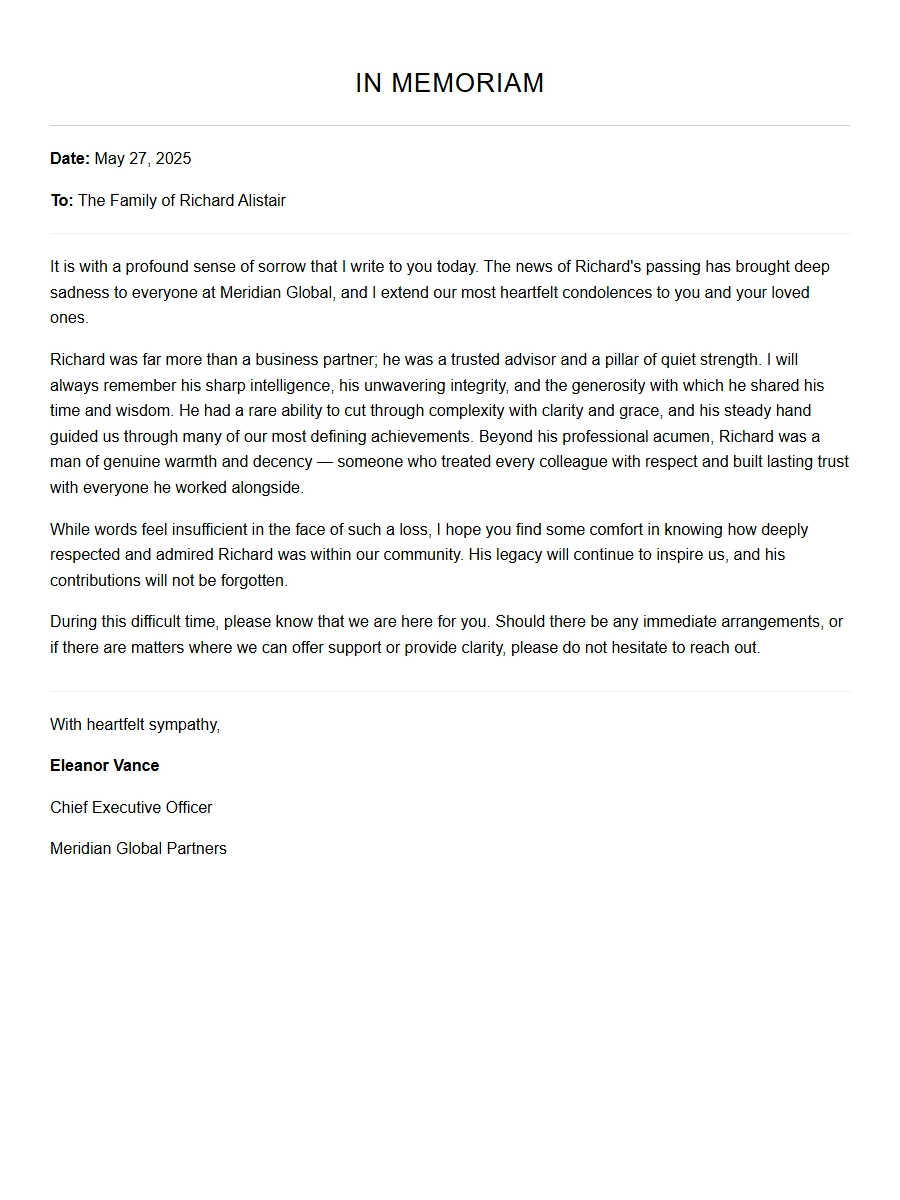 Formal Condolence Message for a Business Partner
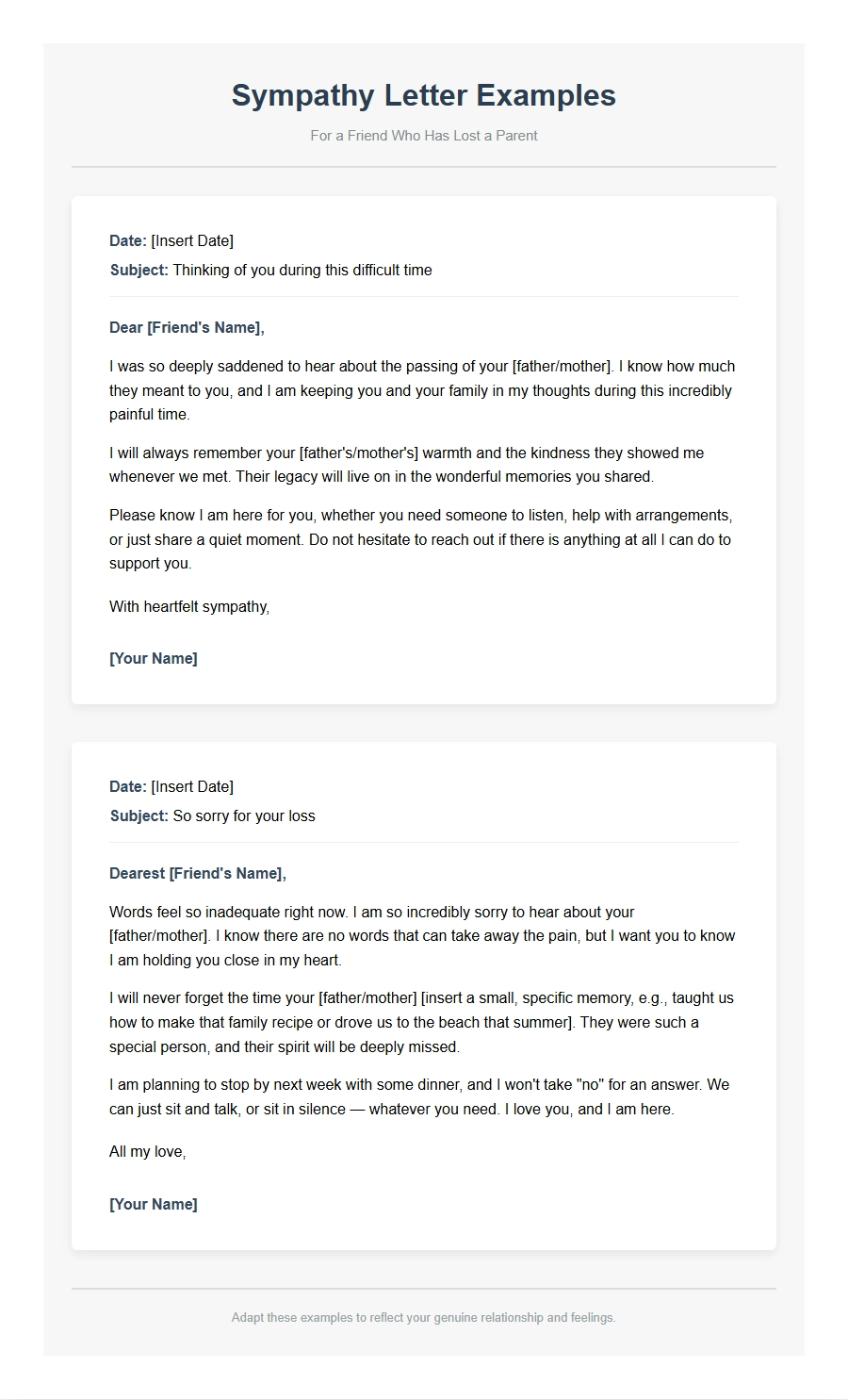 Sympathy Letter Examples for a Friend Who Lost a Parent
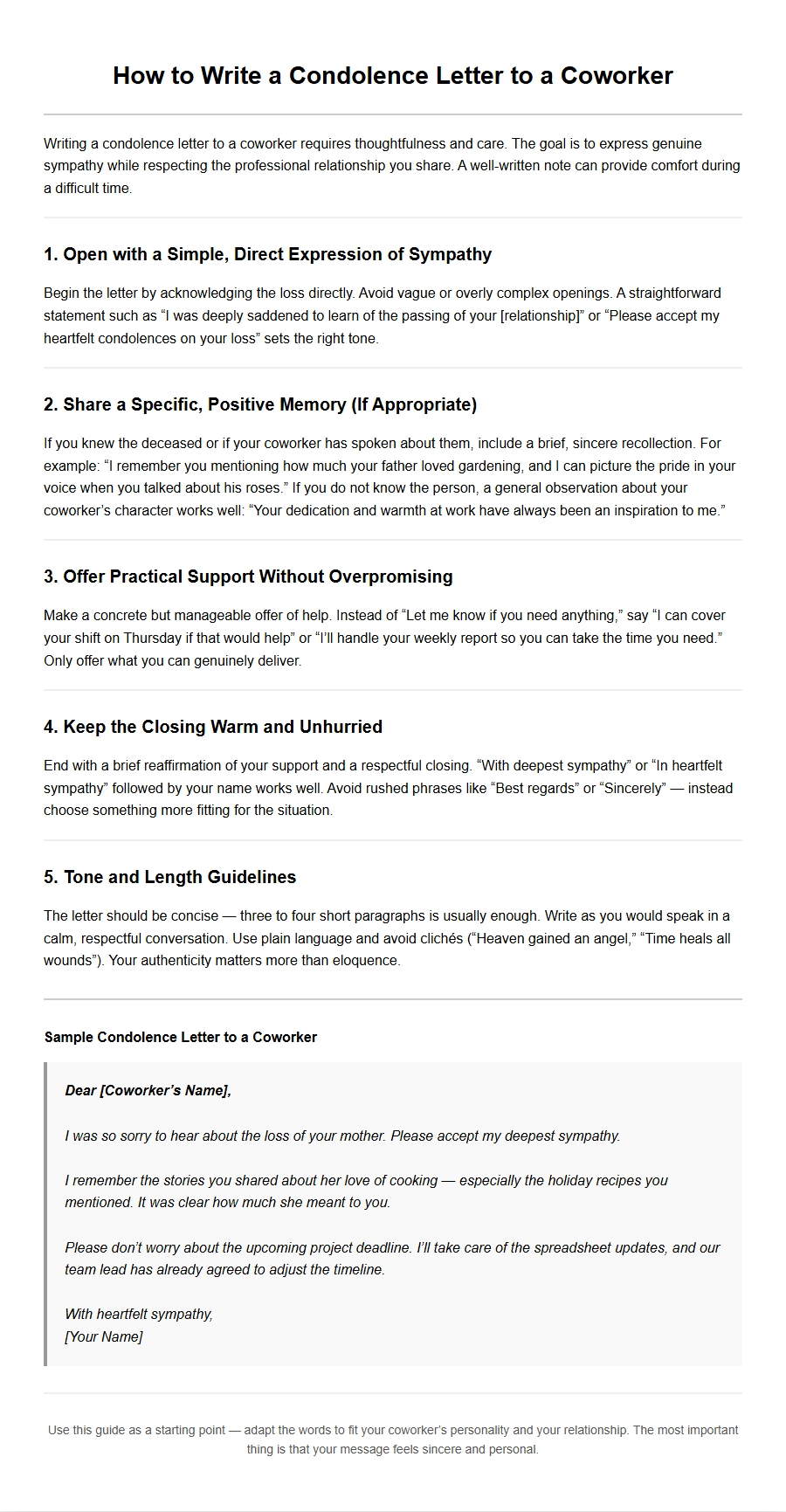 How to Write a Condolence Letter to a Coworker
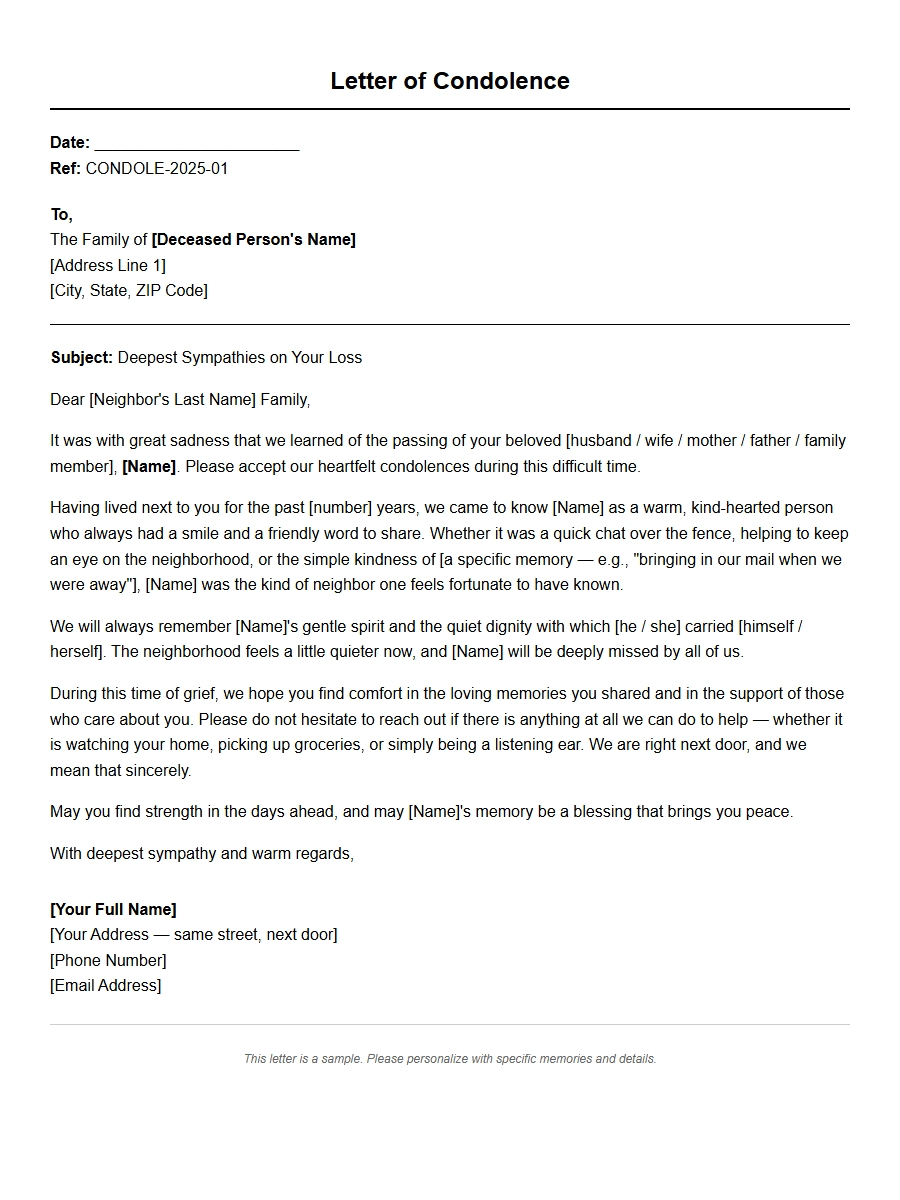 Condolence Letter Sample for a Neighbor
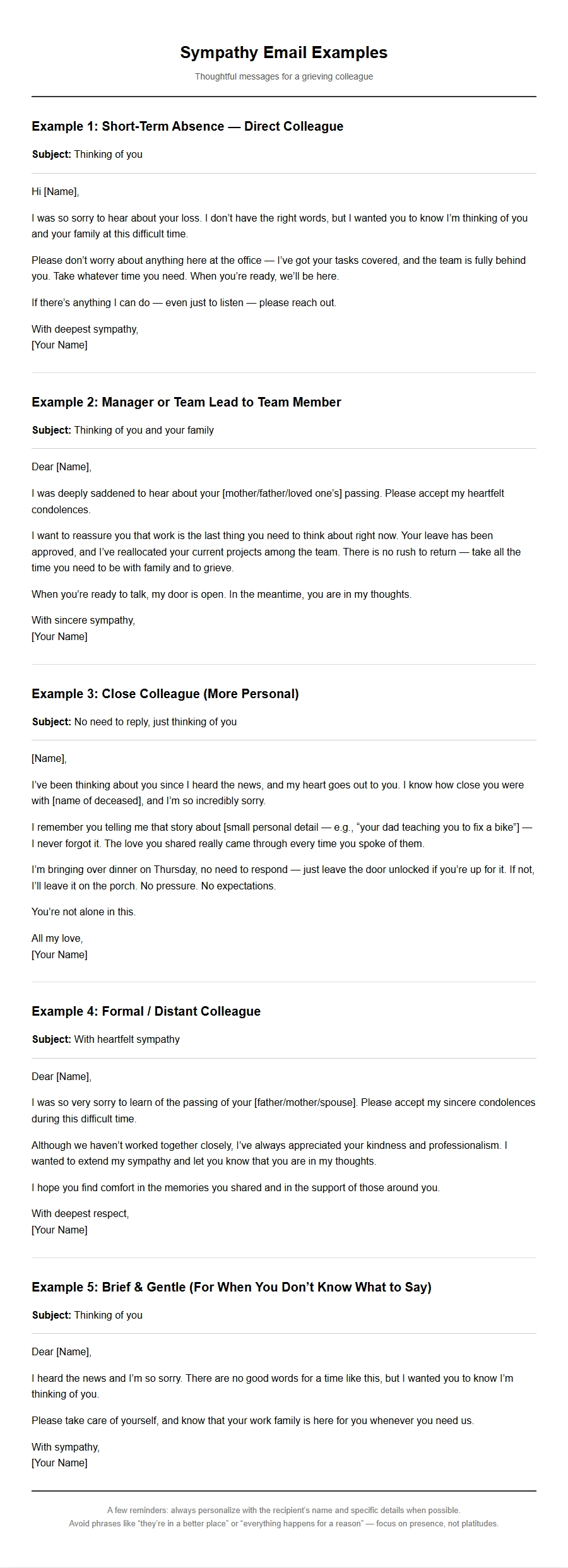 Sympathy Email Examples for a Grieving Colleague
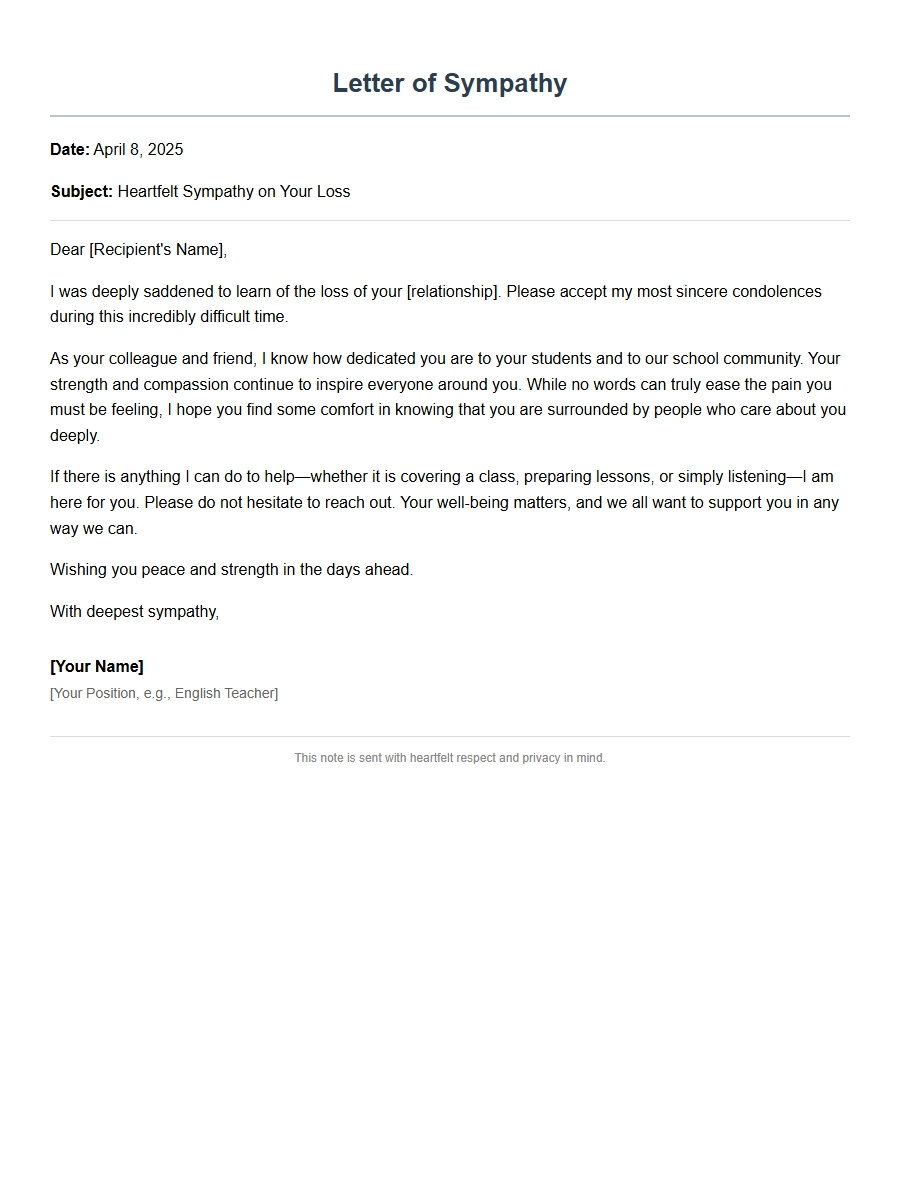 Condolence Words for a Teacher