non religious sympathy message template - Condolence Letters
You’re staring at a blank card or email, and every word feels either too stiff or too sentimental. You want to offer comfort, but you don’t want to assume someone shares your faith—or any faith at all. That’s where a non religious sympathy message template becomes your best tool. It’s not about copying someone else’s words; it’s about having a solid structure so you can focus on what really matters: genuine warmth and support.
Why a template isn’t cheating (it’s smart)
A template gives you a ready-made framework—opening, middle, closing—so you don’t have to invent every line from scratch. It also helps you avoid common pitfalls like accidentally defaulting to religious phrases (“they’re in a better place,” “God’s plan”) when that may not fit the recipient. Think of it as training wheels: once you’ve used a few templates, you’ll start to internalize the rhythm and tone, and writing your own will feel much easier.
Category: Condolence Writing Resources
What makes a sympathy message feel right without religion?
The key is focusing on shared human experiences: sorrow, memory, and presence. Instead of referencing an afterlife or divine comfort, you can acknowledge the pain, celebrate the person’s life, and offer your own support. A good non religious template includes phrases like “I’m so sorry for your loss,” “I’ll always remember [name] for [specific quality],” and “I’m here if you need anything—even just to sit quietly.”
For example, a simple but effective opening might be: “I was saddened to hear about [name]’s passing. I’m thinking of you during this difficult time.” That sentence works for anyone, regardless of belief system. From there, you can personalize with a memory or a simple offer of help. Avoid empty platitudes like “time heals all wounds” because they can feel dismissive. Instead, try something like “There are no right words, but please know I’m holding you in my thoughts.”
How to choose and adapt a non religious sympathy template
Start by considering your relationship to the bereaved. A close friend will allow a warmer, more personal tone than a colleague you barely know. Look for templates that match that level of formality. For a semi-formal situation—like a coworker or distant relative—you might use a more structured letter format with a standard salutation (“Dear [Name]”) and closing (“With deepest sympathy”). For a close friend, feel free to drop the formalities and write as you speak.
When adapting a template, always replace generic details with specifics. Instead of “I’ll miss them,” say “I’ll miss how they always made everyone laugh in the breakroom.” Specifics show you truly knew the person, and that’s more comforting than any generic phrase. Also, pay attention to the closing. “With love” might be too intimate for a professional relationship; “Warmly” or “Thinking of you” are safer bets.
Common mistakes to avoid
One mistake is using outdated salutations like “Dear Sir” for a condolence letter—it feels cold. Another is ignoring the format. If you’re sending a digital letter, keep the font clean and avoid excessive formatting like colorful backgrounds that can look unprofessional. For a printed card, consider the quality of the paper or the letterhead design if you’re writing on behalf of an organization. Also, proofread your message carefully: a typo in a sympathy note can distract from your intention. Read it aloud to check the tone in writing—does it sound like you, or like a robot? Adjust until it feels natural.
When a longer letter is needed
Sometimes a few lines aren’t enough. If you’re writing a letter of recommendation for a memorial tribute or a formal condolence for a loss during holidays, you may need a full-page structure. A non religious template for a longer note might include an opening acknowledgment, a specific memory, an expression of support, and a closing reaffirmation of your care. For example, you can link to articles about condolence messages during the holidays or what to say to a spouse for more tailored guidance.
If you’re writing on behalf of a group, like a team at work, use a neutral tone that respects everyone’s beliefs. A line like “We’re all thinking of you and grateful for the time we shared with [name]” works well. Avoid assuming collective grief or beliefs.
Let the template be a springboard
The best non religious sympathy messages feel both professional and deeply personal. A template gives you the skeleton, but your own voice fills in the heart. The more you practice, the faster it becomes. Next time you face that blank page, you’ll have a mental library of openers, closings, and phrases that sound like you—without the guesswork. And if you need more examples, explore resources on messages for loss of a father or tribute letters for a late boss. Write from a place of honesty, and your words will bring real comfort.
Useful Writing Samples
non religious sympathy message template - Condolence Letters
General Sympathy Message
Dear [Name],
I was deeply saddened to learn of the passing of your loved one. Please accept my heartfelt condolences during this difficult time. I know that no words can truly ease the pain you are feeling, but I hope you find some comfort in knowing that many people care about you and are here to support you.
If there is anything I can do—whether it's running errands, preparing a meal, or just listening—please don't hesitate to reach out. You are not alone.
With sincere sympathy, [Your Name]
Sympathy for Loss of a Parent
Dear [Name],
I am so sorry to hear about the passing of your [mother/father]. Losing a parent is a profound loss, and I can only imagine the depth of your sorrow. Your [mother/father] was a remarkable person who touched many lives with kindness and grace.
I will always remember [her/his] warmth and the way [she/he] made everyone feel welcome. Please know that I am thinking of you and your family during this painful time.
If you would like to talk or need a hand with anything at all, I am just a phone call away.
With deepest sympathy, [Your Name]
Sympathy for Loss of a Spouse
Dear [Name],
There are no words that can adequately express the sadness I feel for you upon the loss of your beloved husband/wife. The bond you shared was a testament to true love and partnership, and I know the void left behind feels immeasurable.
I fondly recall the joy and laughter you both brought to every gathering. Your loved one will be deeply missed by all who knew [him/her].
Please allow yourself the time and space to grieve. I am here to support you in any way you need—whether it's a quiet coffee, help with daily tasks, or simply someone to sit with you in silence.
With heartfelt condolences, [Your Name]
Sympathy for Loss of a Child
Dear [Name],
I am heartbroken to hear about the passing of your precious child. The pain of losing a child is beyond words, and I cannot imagine what you are going through. Please know that you are in my thoughts every moment.
Your child brought so much light and joy into the world, and the memories of [his/her] smile will forever remain in our hearts. I remember how proud you were of [him/her], and that love will never fade.
There is no timeline for grief, and no right way to feel. I am here to support you without any expectations—just to be present whenever you need me.
With deepest sympathy and love, [Your Name]
Sympathy for Loss of a Friend
Dear [Name],
I was so sorry to learn that your dear friend [Name] has passed away. The friendship you two shared was truly special, and I know how much [he/she] meant to you. [He/She] was a loyal, kind, and wonderful person who enriched the lives of everyone fortunate enough to know [him/her].
I will miss [his/her] infectious laugh and the way [he/she] could light up a room. In this time of sorrow, I hope you can find comfort in the cherished memories you hold dear.
If you need someone to talk to or just want a distraction, I am here for you. Please take care of yourself.
With sympathy and enduring friendship, [Your Name]
Sympathy for Loss of a Colleague
Dear Team,
It is with great sadness that we share the news of our colleague [Name]'s passing. [Name] was a dedicated professional and a warm-hearted individual who made our workplace brighter. [He/She] always offered a helping hand and approached every challenge with grace.
We will remember [Name] for [his/her] contributions, but even more for the compassion [he/she] showed to each of us. During this difficult time, let us support one another and keep [Name]'s family in our thoughts.
Details regarding memorial services and ways to offer condolences are listed below:
Service
Date & Time
Location
Visitation
April 12, 2–4 PM
Harper Funeral Home
Memorial Service
April 13, 11 AM
Oakwood Reception Hall
Please reach out if you need any support.
With deep sympathy, Management
Sympathy for Loss of a Pet
Dear [Name],
I was so sad to hear that your beloved [pet type], [pet name], has passed away. I know how much [he/she] meant to you—the loyal companion who greeted you every day, the one who brought endless joy and unconditional love. The bond you shared was a beautiful part of your life.
Losing a pet is losing a family member, and it hurts deeply. Please allow yourself to grieve and remember all the wonderful times you had together—the walks, the cuddles, the playful moments. Those memories will always be with you.
If you want to share stories about [pet name] or just need a hug, I am right here.
With heartfelt understanding, [Your Name]
Sympathy for Miscarriage or Infant Loss
Dear [Name],
I am so incredibly sorry for your loss. The passing of a baby, whether at the beginning of life or after birth, is a heartbreak that no one should have to endure. Please know that I am holding you close in my thoughts during this unimaginable time.
Your baby was so loved, and that love will always remain. The brief time you had together—those hopes, dreams, and precious moments—will never be forgotten. It is okay to feel every emotion that comes, and it is okay to take all the time you need to heal.
I am here to support you in whatever way you need—whether that's a listening ear, help with meals, or just sitting together in silence.
With all my love and sympathy, [Your Name]
Sympathy for Sudden Loss
Dear [Name],
I was utterly shocked and deeply saddened to hear the sudden news of [Name]'s passing. When life ends so unexpectedly, the world feels turned upside down, and words feel inadequate. Please accept my most sincere condolences.
[Name] lived fully and brightly, and the suddenness of this loss only underscores how precious every moment was. I will always treasure the memories of [his/her] spirit and laughter.
In the coming days and weeks, as you navigate this difficult journey, please lean on those who care about you. I am here to help with practical matters or simply to be present. Do not hesitate to ask.
With shock and profound sympathy, [Your Name]
Sympathy for Loss After Long Illness
Dear [Name],
I was saddened but not surprised to learn that [Name] has passed away after such a long and courageous battle with illness. Though we knew this day might come, the reality of the loss is still heavy. Please accept my heartfelt sympathy.
Throughout [his/her] illness, [Name] showed incredible strength and grace. You and your family provided such loving care, and I hope that brings you some peace. [He/She] is no longer in pain, and that is a comfort, but your loss is still profound.
I will remember [Name] for [his/her] resilience and the warmth [he/she] always shared. Now is the time to rest and let others support you. I am here for anything you need.
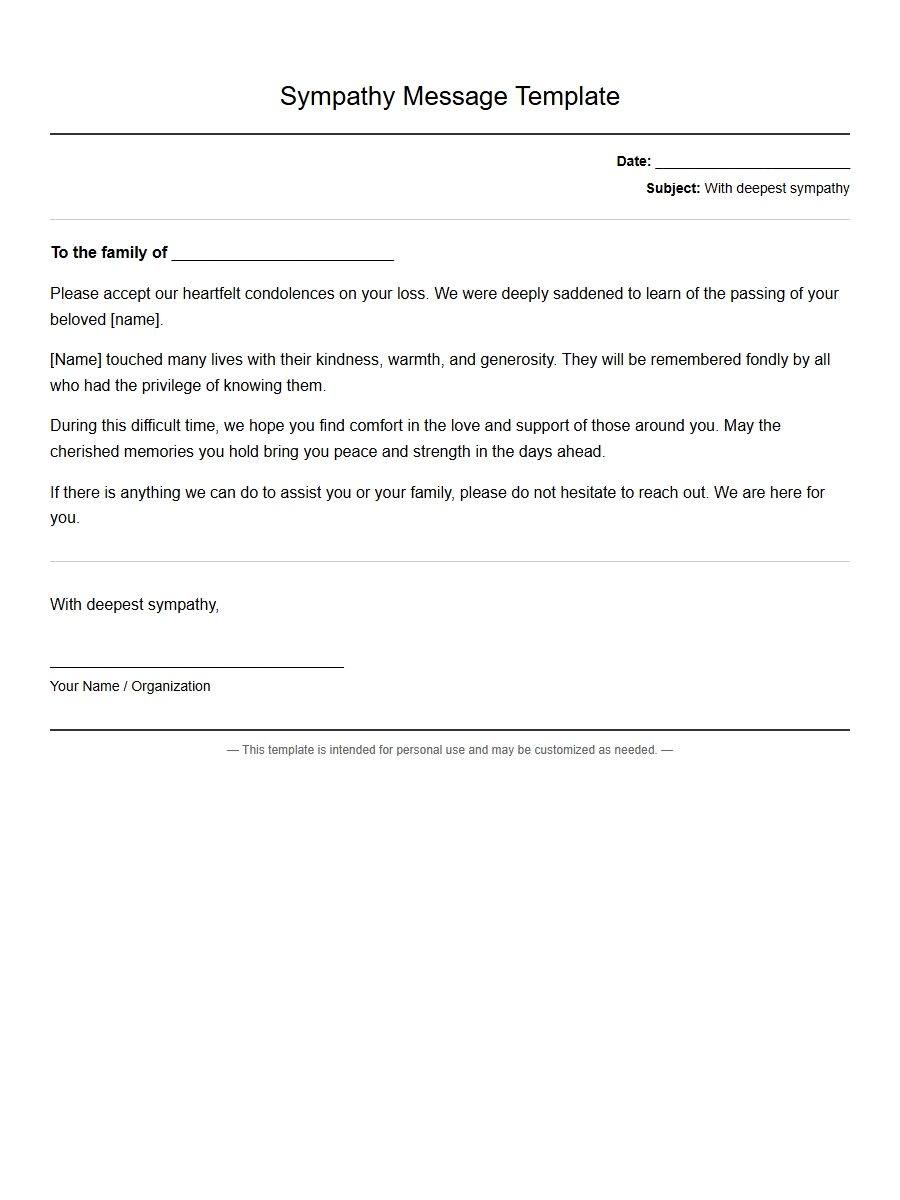
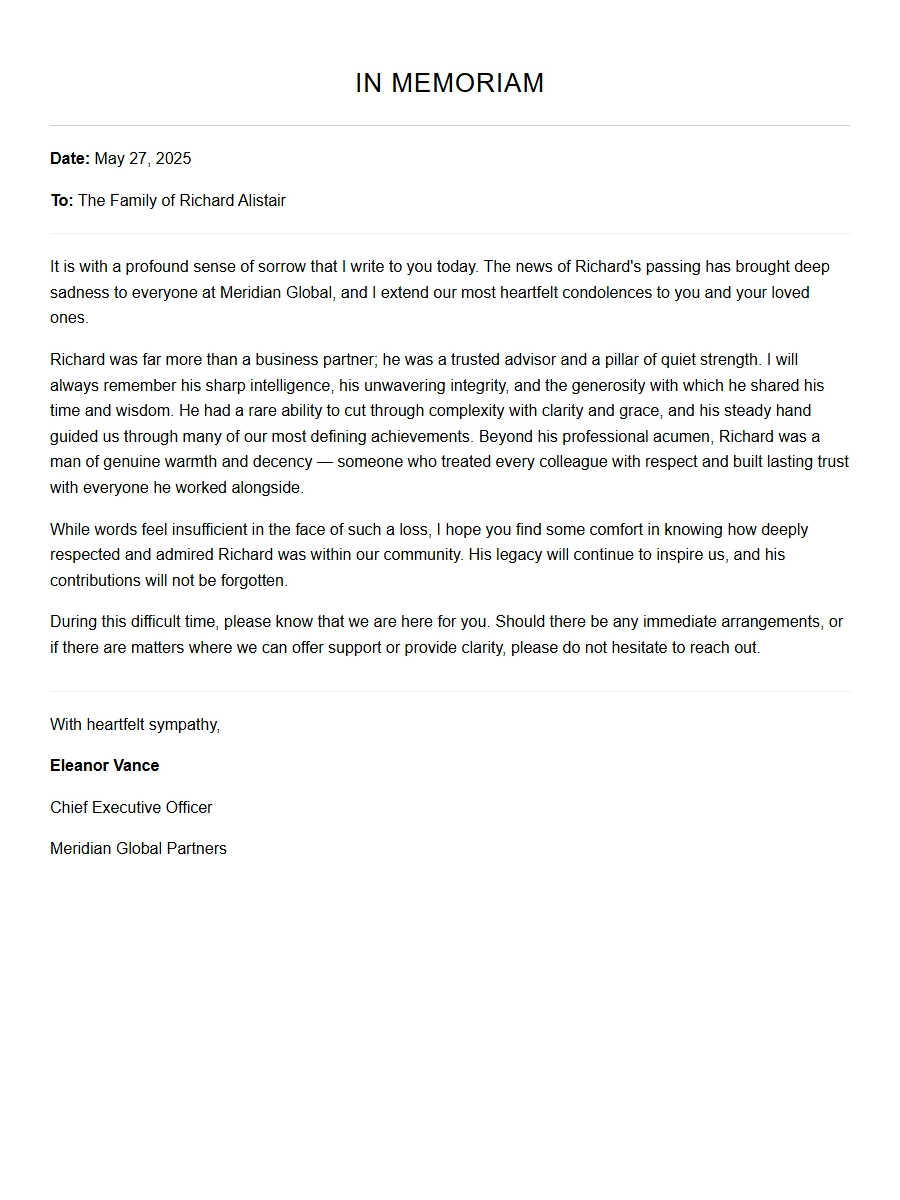 Formal Condolence Message for a Business Partner
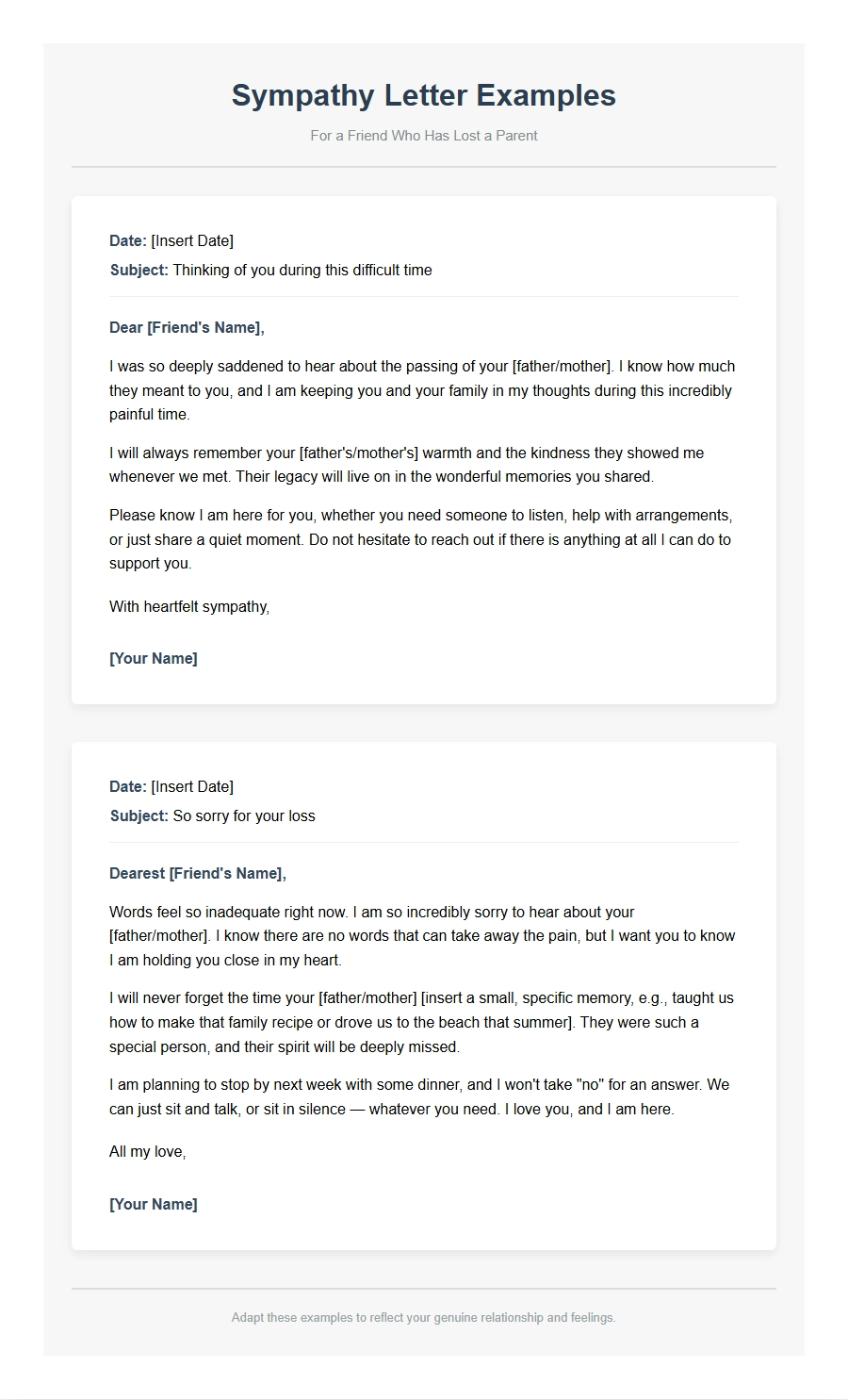 Sympathy Letter Examples for a Friend Who Lost a Parent
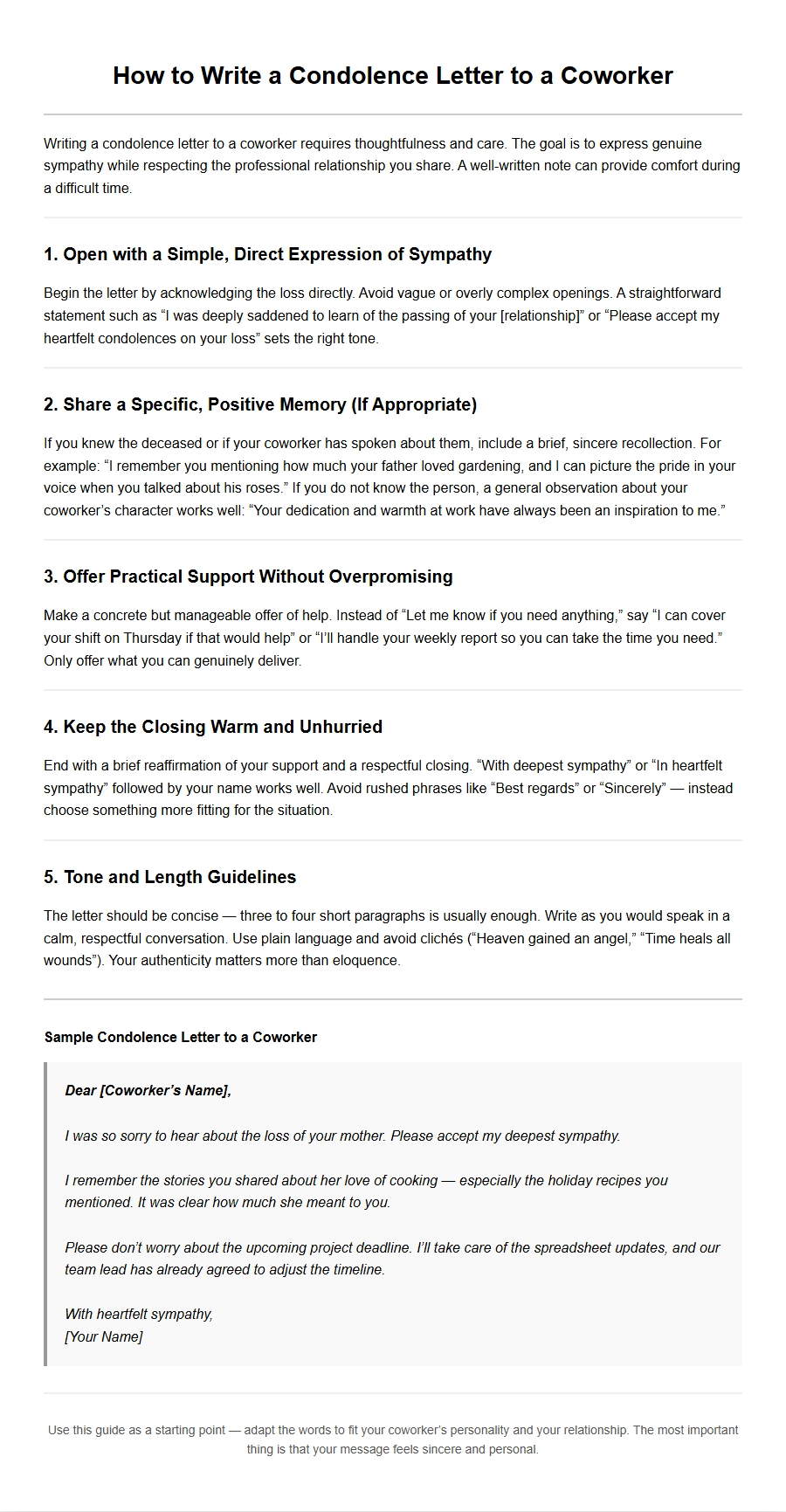 How to Write a Condolence Letter to a Coworker
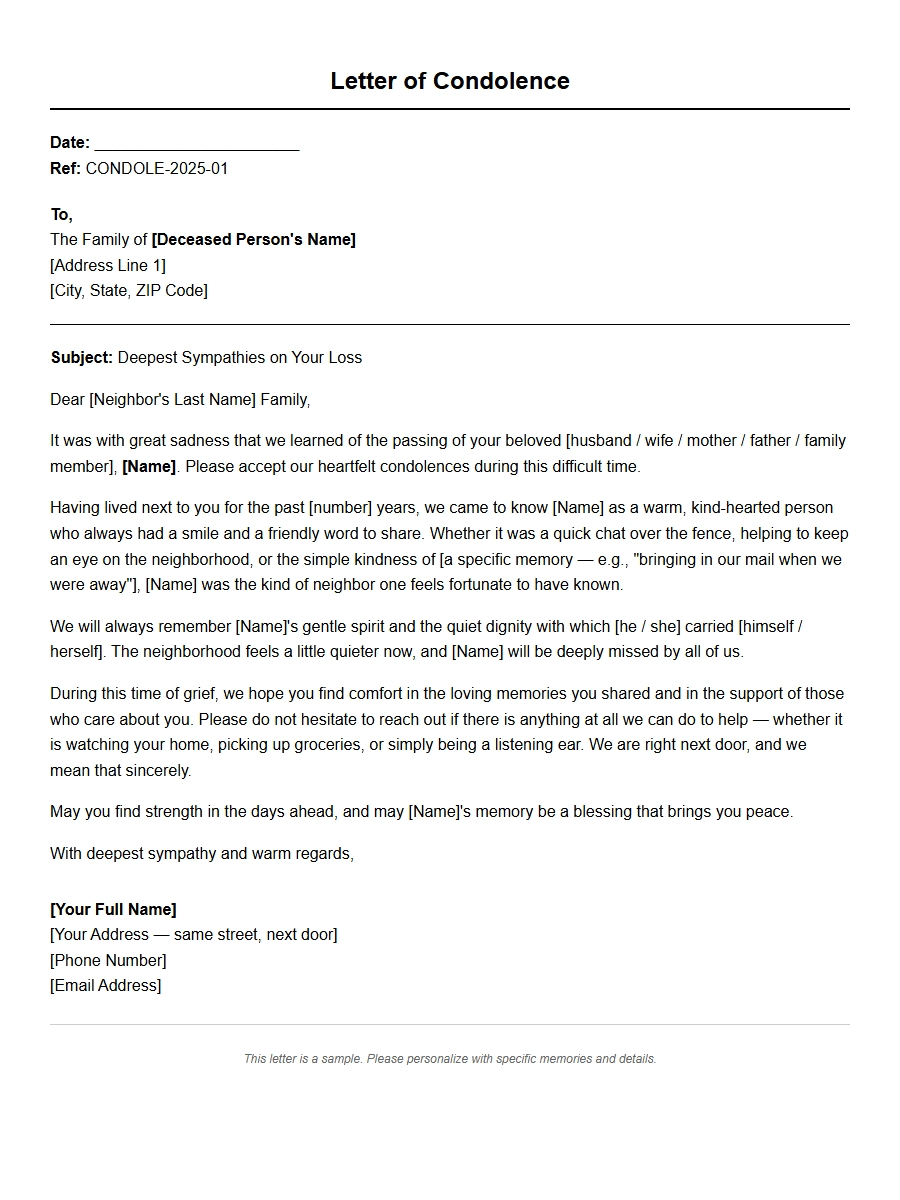 Condolence Letter Sample for a Neighbor
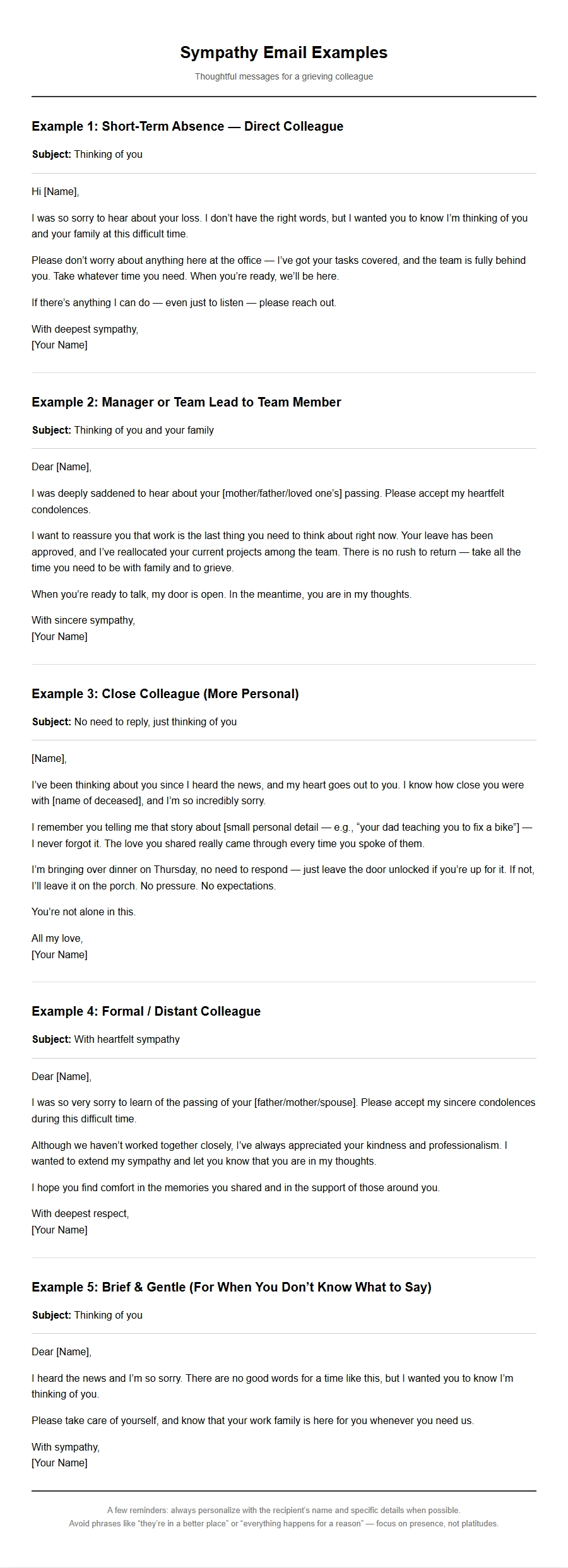 Sympathy Email Examples for a Grieving Colleague
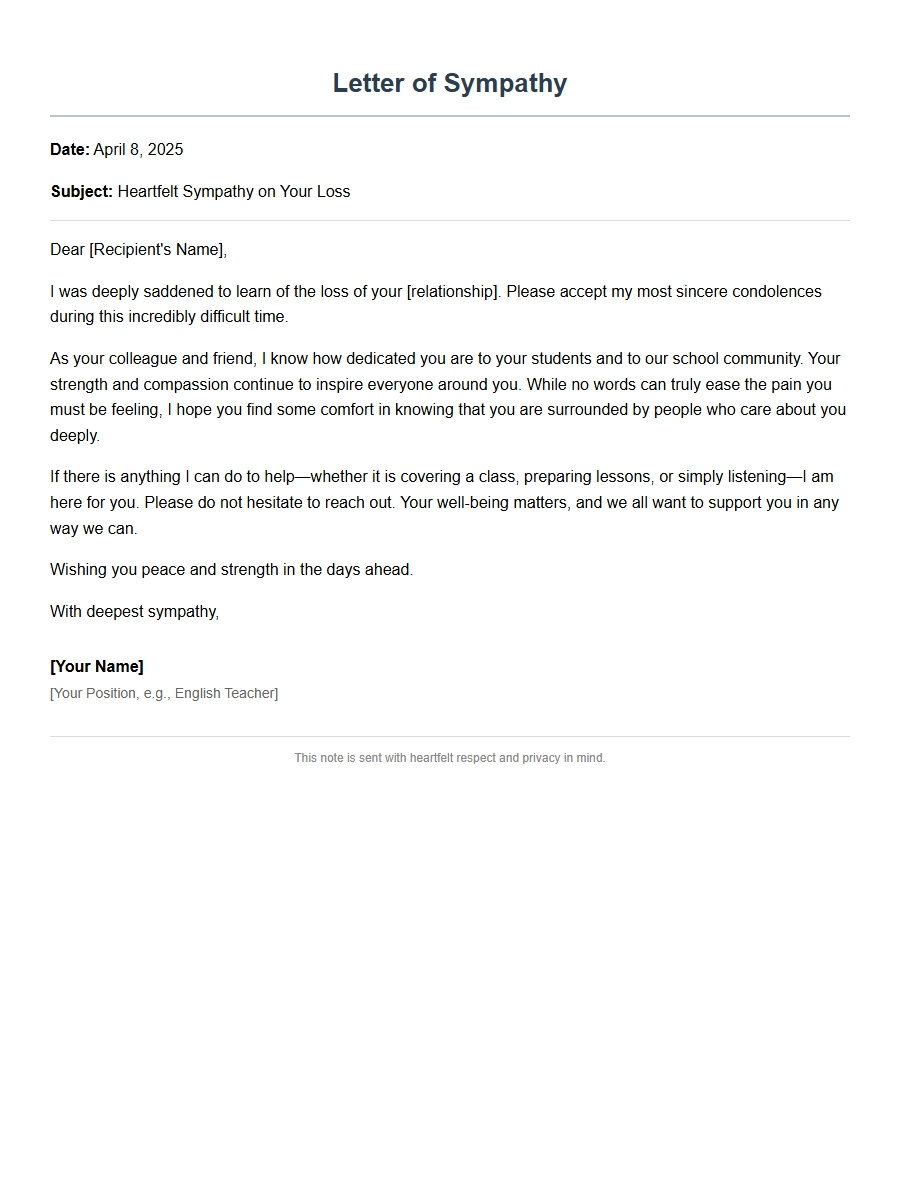 Condolence Words for a Teacher