You're staring at a blank screen, trying to find the right words to honor a boss who shaped your career. The grief is fresh, and the pressure to get it right feels heavy. That's normal. A tribute letter to a late boss isn't just a letter—it's a way to say thank you, acknowledge their impact, and bring a little comfort to their family. But when you're already emotionally drained, starting from scratch can feel impossible.
Using a tribute letter sample isn't cheating. It's a smart, time-saving strategy. A good sample gives you a reliable structure for professional correspondence, ensures proper business letter format, and sets the right tone. You then personalize it with your own memories and feelings. Think of it as a sturdy frame for your portrait—you fill in the colors.
How do you choose the right tribute letter sample for your situation?
Not all letter templates fit the same situation. For a late boss, you need a sample that balances formal respect with personal warmth. If you worked closely in a small company, a semi-formal tone works well. In a large corporate environment, stick to more formal writing tips—save the personal anecdotes for later in the letter. The key is to match the relationship and the culture of the workplace.
Look for a customizable letter that includes space for specific memories. Avoid templates that are too generic or stiff. A good sample will have a flexible letter structure: a warm salutation, an opening that expresses sympathy, a middle section where you share a story or highlight the boss's qualities, and a closing that offers condolence.
How to adapt the sample without losing your authentic voice
Start by reading the sample all the way through. Notice how it handles salutation and closing. Replace the placeholder phrases with your own words. For the opening, skip the formulaic "I am sorry for your loss" and instead say something like, "I was heartbroken to hear of your husband's passing. He was more than a boss to me—he was a mentor." That small shift makes it personal.
Don't copy the whole thing verbatim. Pick out the parts that feel right for you. If the sample uses language that sounds too formal or too casual, adjust the tone in writing to match your natural voice. A tribute letter should feel like you wrote it, not a robot. Ever received a letter that felt too stiff? It misses the point. Your boss's family will appreciate authenticity over perfection.
Common mistakes to avoid in a tribute letter
One big mistake is using outdated salutations like "To Whom It May Concern." Always address the letter to a specific recipient—usually the spouse or family. If you don't know the names, "Dear [Name] family" is acceptable. Another pitfall is ignoring whether you're sending it via email or printed letter. For digital letter format, include a clear subject line (e.g., "In memory of [Boss's Name]") and keep the closing simpler. Printed letters benefit from a proper letterhead design—your name, title, and company.
Also, watch the language around death. You don't have to use the word "dead." Phrases like "passed away" or "left us too soon" are gentler. If you're unsure, you can check our tips on how to write a letter without using the word dead. Sensitive wording makes a difference.
Making your tribute stand out
A great tribute letter to a late boss includes a specific memory. Share a moment when they gave you advice, taught you something new, or showed kindness. That small story is worth more than a dozen generic compliments. Keep the letter to a page or less—respect the family's time. After you finish, give it a careful round of proofreading letter. A typo can distract from the sincerity.
If you're also thinking of writing a separate note to a coworker who is grieving, you might find our guide on how to write a condolence letter to a coworker helpful. For a shorter tribute inside a card, you could adapt wording from a sympathy card inside message. And if the boss's family includes a bereaved mother or daughter, a separate letter sample for bereaved mother daughter might provide structure for a different note.
Use the sample as a springboard, not a crutch
The best tribute letters feel both professional and personal. Your sample gives you the road map—your memories and feelings are the fuel. Don't worry if the first draft isn't perfect. Practice makes the process faster, and each letter you write will come more naturally. Start with the structure, fill in your heart, and you'll create something that honors your boss and comforts those left behind.
Common Sample Formats
How to Write a Tribute Letter for Your Late Boss
Essential Structure of a Tribute Letter
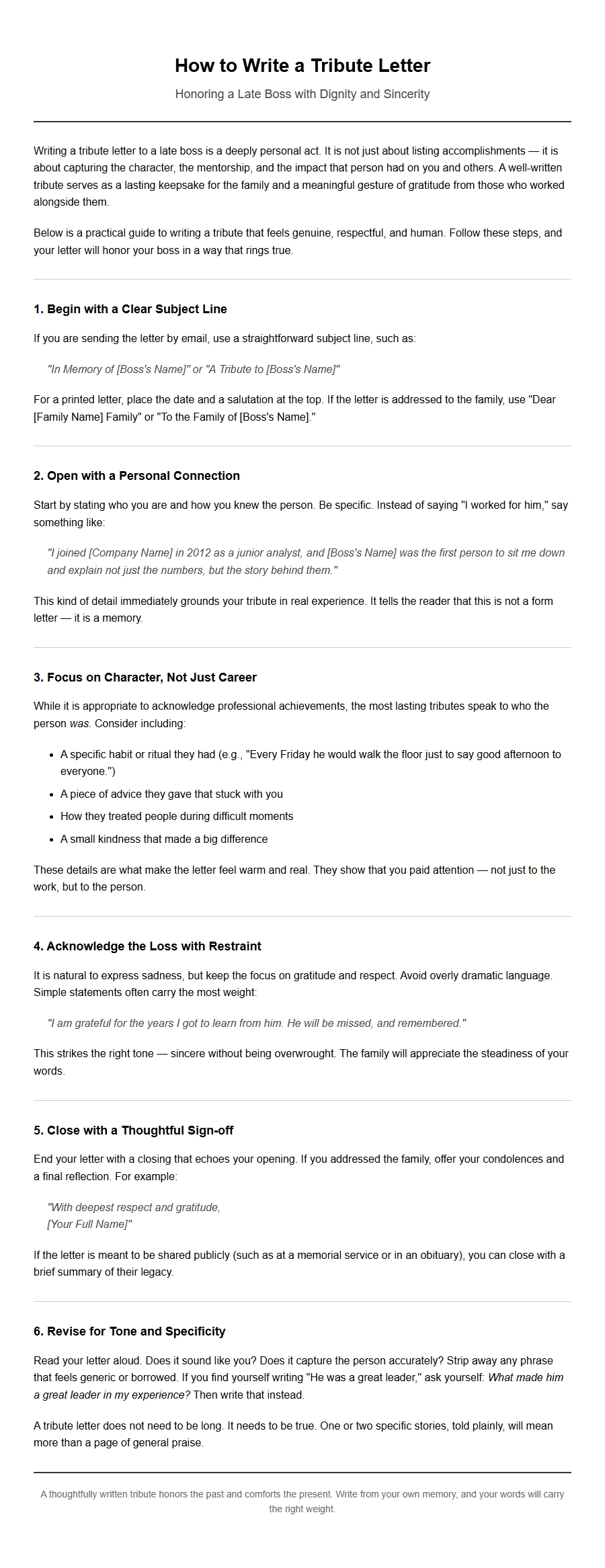
A tribute letter to your late boss should follow a clear structure to convey respect and gratitude. Begin with the date and your contact information (optional), then directly address the family or close colleagues. The opening paragraph should state your purpose—to honor his or her memory and express condolences. The body should contain two main sections: personal memories and professional contributions. Use a small table to outline key elements:
Section
Content Guidelines
Introduction
Express sympathy, state your relationship with the deceased.
Personal Memories
Share a specific anecdote that shows his/her character.
Professional Legacy
Highlight achievements, leadership style, impact on you.
Closing
Offer continued support, sign off warmly.
Keep the tone sincere and professional. Avoid exaggeration or overly emotional language. Conclude with a simple signature line.
Heartfelt Anecdote Template
When writing a tribute, one powerful anecdote can make the letter memorable. Use this template to craft yours:
Opening: "Dear [Family name], I am writing to share my deepest condolences and to honor the memory of [Boss's name], my mentor and friend."
Anecdote paragraph: "I will never forget the afternoon when [he/she] called me into [his/her] office. I had made a costly error on a project, and I expected a reprimand. Instead, [he/she] calmly said, 'We all learn from mistakes. The question is what did you learn?' Then [he/she] patiently walked me through a solution. That moment taught me more about leadership than any textbook."
Transition: "That compassion extended beyond work. [He/She] always asked about my family and celebrated our small victories."
End with a promise to carry forward his/her lessons and sincere sympathy for the family.
Professional Achievement Focus
If your boss was known for remarkable professional contributions, structure your tribute around those accomplishments. Include a list of key achievements that influenced your career:
Mentorship: [Boss's name] personally guided me through three major promotions by assigning challenging projects.
Innovation: Under [his/her] leadership, our department introduced a new client management system that increased efficiency by 20%.
Team Building: [He/She] created a culture of collaboration, holding weekly roundtables that gave every voice a platform.
Follow with a paragraph linking these achievements to your gratitude: "The skills I gained from [his/her] coaching have shaped every success I have had since." Then offer condolences to the family, acknowledging that behind every great leader was a supportive family.
Step-by-Step Writing Guide
Follow these five steps to write a sincere tribute letter:
Gather memories. Jot down specific moments: a kind word, a tough lesson, a shared success.
Choose a format. Decide whether to address the family or a broader audience (e.g., company newsletter).
Write the opening. Express sympathy and your relationship to the boss (e.g., "I worked with [Name] for 10 years").
Develop the body. Alternate between personal stories and professional respect. Use two short paragraphs or a bullet list.
Close with warmth. Offer to help the family or simply say, "[Name] will be deeply missed."
After writing, read aloud to check tone. Ask a trusted friend to review for clarity and sincerity.
Sample Opening Paragraph Variants
Choose an opening that fits your relationship with your late boss:
Situation
Sample Opening
Long-time subordinate
"Dear Mrs. [Last Name], I am writing with a heavy heart to express my deepest condolences on the passing of your husband, my boss and mentor for over two decades."
Recent employee
"To the family of [Boss's name], though I only worked with [him/her] for two years, the impact [he/she] had on my professional growth was immeasurable."
Former employee
"Even years after leaving the company, I still carry lessons from [Boss's name]. I am so sorry for your loss."
Peer colleague
"Dear [Boss's first name], you were more than a boss—you were a partner in building something great. I will miss your wisdom."
Adapt the tone to be genuine and specific. Always include the deceased's name early in the letter.
Checklist: What to Include in a Tribute Letter
Use this checklist to ensure your tribute letter covers all essential elements:
Salutation addressed to family or a specific person (e.g., "Dear Smith family").
Condolence expression in the first sentence.
Your relationship to the deceased (job title, years worked together).
Personal memory (a story that shows character, kindness, or guidance).
Professional impact (how he/she influenced your career or the company).
Specific qualities you admired (e.g., patience, vision, integrity).
Acknowledgement of family (recognize the loss beyond work).
Offer of support (e.g., "Please let me know if I can help with anything").
Closing sentiment (e.g., "He will never be forgotten").
Signature with your full name and optionally your contact information.
Review each point after writing to confirm nothing is missing.
Tone and Language Dos & Don'ts
Maintain the right tone with these guidelines:
DOs:
Use respectful language (e.g., "I had the privilege of working under his guidance").
Keep sentences straightforward; avoid flowery or overly poetic phrases.
DON'Ts:
Do not criticize or mention negative traits, even as a contrast.
Avoid clichés like "heaven gained an angel" unless the family uses that language.
Do not make the letter about yourself—keep the focus on the boss.
Never mention salary, bonuses, or workplace disputes.
Read the letter aloud. If it sounds stiff or insincere, revise until it feels like a natural, warm tribute.
Example: Letter to the Family
Dear Mrs. [Last Name] and family,
I was deeply saddened to learn of [Boss's first name]'s passing. Please accept my heartfelt condolences during this difficult time.
I worked for [Boss] for seven years at [Company Name], first as a junior analyst and later as a department lead. [He/She] was the kind of boss who believed in second chances—and third ones if you showed determination. I remember once when I missed an important deadline, [he/she] sat beside me and helped me reorganize the workflow rather than assigning blame. That lesson in patience and problem-solving has stayed with me ever since.
Professionally, [Boss] transformed our sales division from a struggling unit into the company's top performer, all while maintaining a team atmosphere where everyone felt valued. [He/She] often said, "A leader's job is to make others successful."
I know [he/she] loved nothing more than spending weekends with you all at the lake house. My thoughts are with you every day.
With deepest sympathy, [Your Full Name]
Tailoring the Tribute for a Public Memorial
If the tribute letter will be read at a memorial service or published in a company newsletter, use a slightly more formal tone and include statements that reflect collective gratitude. Structure it as follows:
Opening:"On behalf of the [Department Name] team, we extend our heartfelt condolences to the family of [Boss's name]."
Body paragraph: "[Boss] was not only our manager but our mentor. Under [his/her] leadership, we launched the [Project Name] initiative that increased our market share by 15%. Yet [he/she] was most proud of the way we worked together—'teamwork is our superpower,' [he/she] would say."
List of collective memories:
The annual team retreats where [he/she] roasted marshmallows and told stories.
Every Friday coffee chats where [he/she] asked about our weekend plans.
The way [he/she] remembered each person's birthday with a personal note.
Closing: "We will strive to continue [his/her] legacy of kindness and excellence."
Short Condolence Tribute with Key Points
For a brief yet meaningful tribute, use this compact format:
Dear [Family Name],
I am writing to honor [Boss's first name] and to express my sorrow at your loss. [He/She] was my boss from 2018 to 2023, and those years shaped my career.
Key qualities I will always remember:
Quality
Example I Witnessed
Integrity
Refused a lucrative deal because it violated ethics.
Generosity
Used his own bonus to fund team training.
Humility
Always credited others for successes.
These examples show the person [he/she] was. I feel privileged to have known [him/her]. Please know that my thoughts are with you, and I am happy to help with anything you need, from organizing files to running errands.
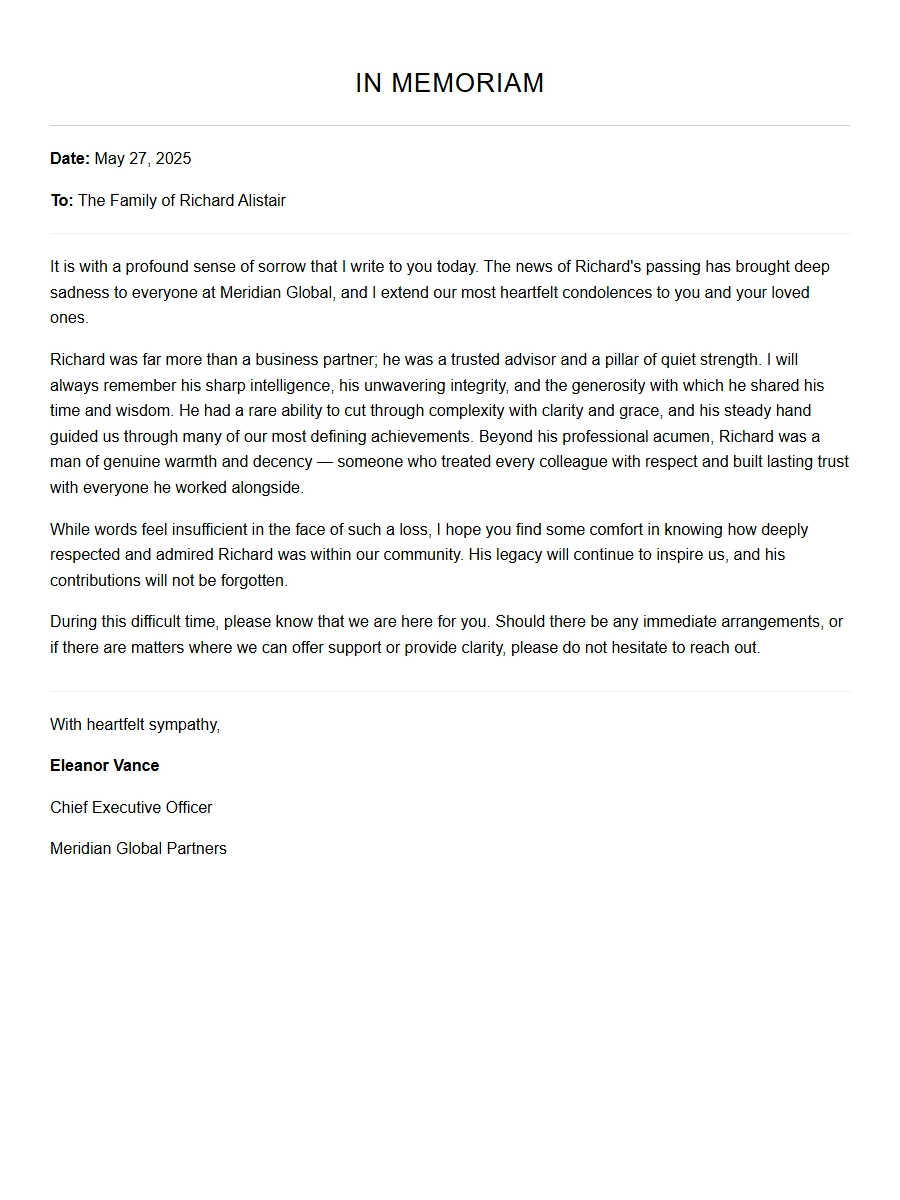 Formal Condolence Message for a Business Partner
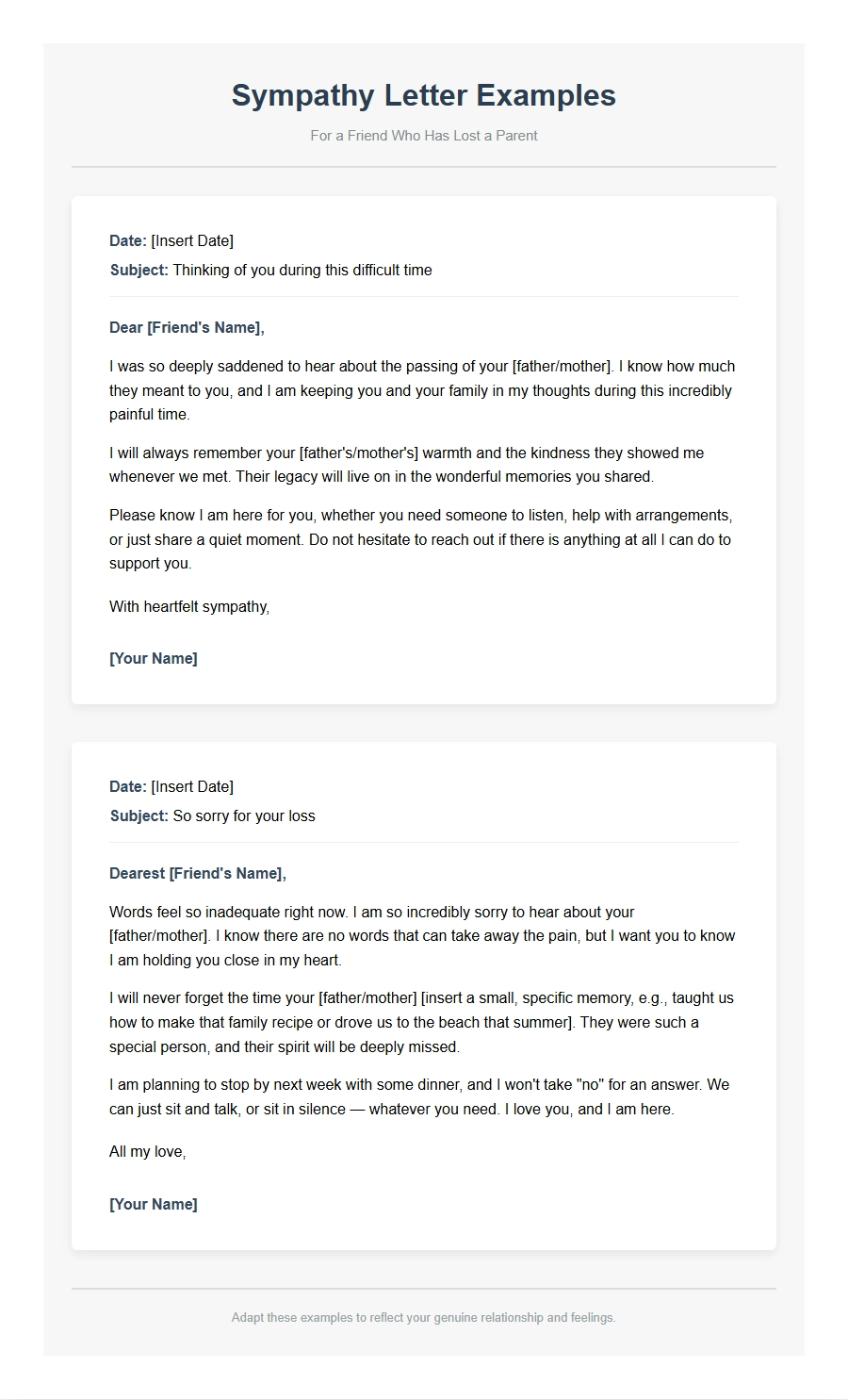 Sympathy Letter Examples for a Friend Who Lost a Parent
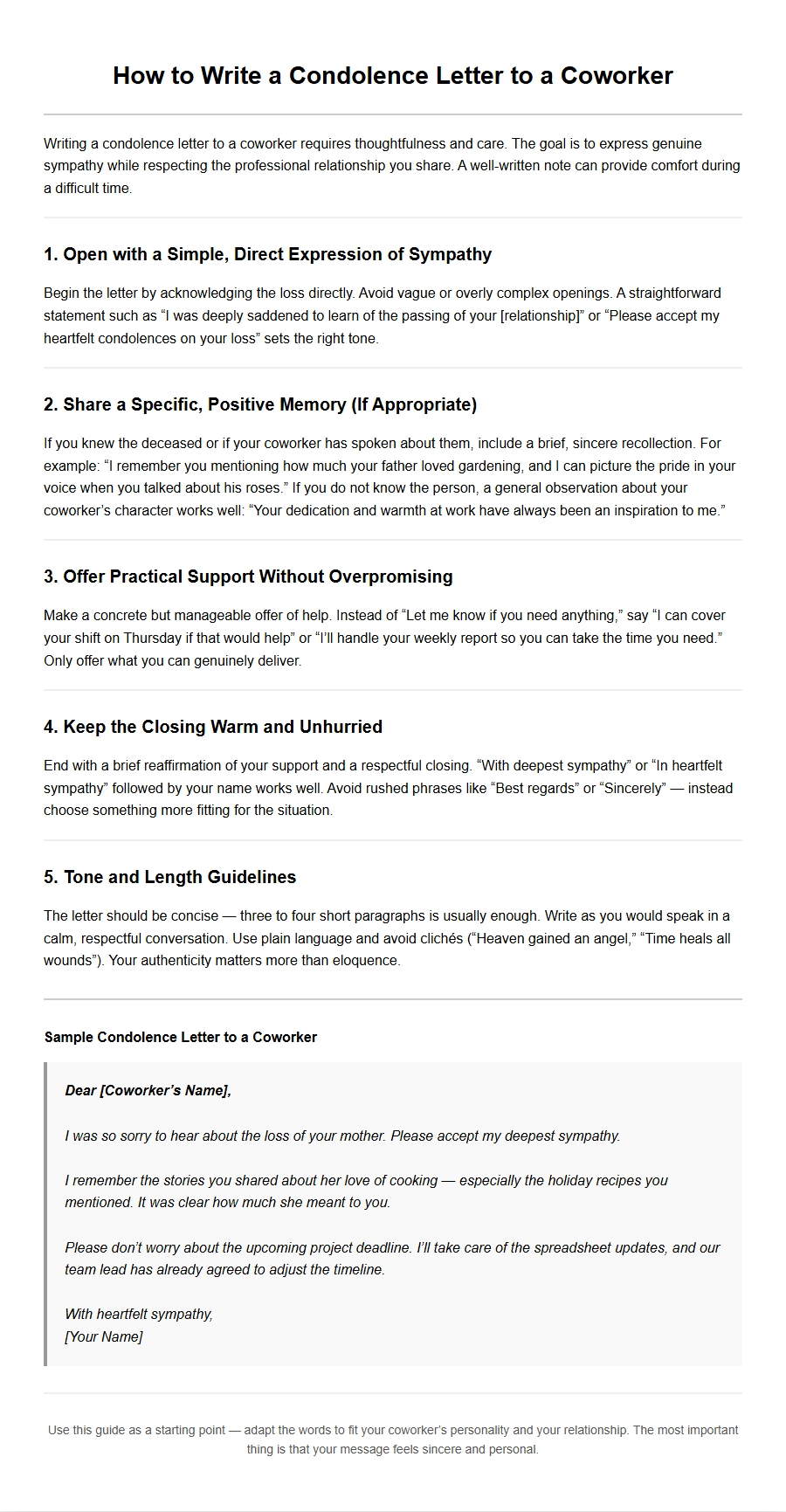 How to Write a Condolence Letter to a Coworker
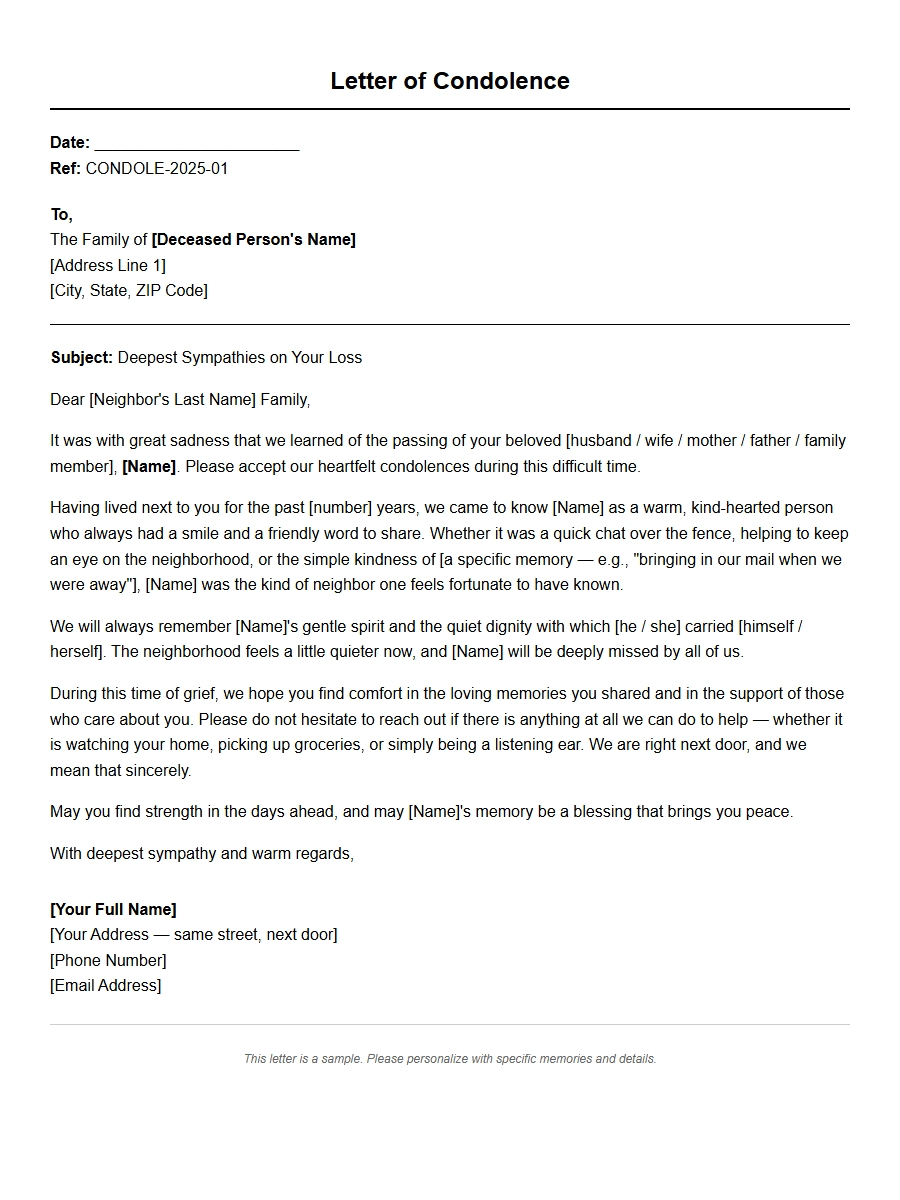 Condolence Letter Sample for a Neighbor
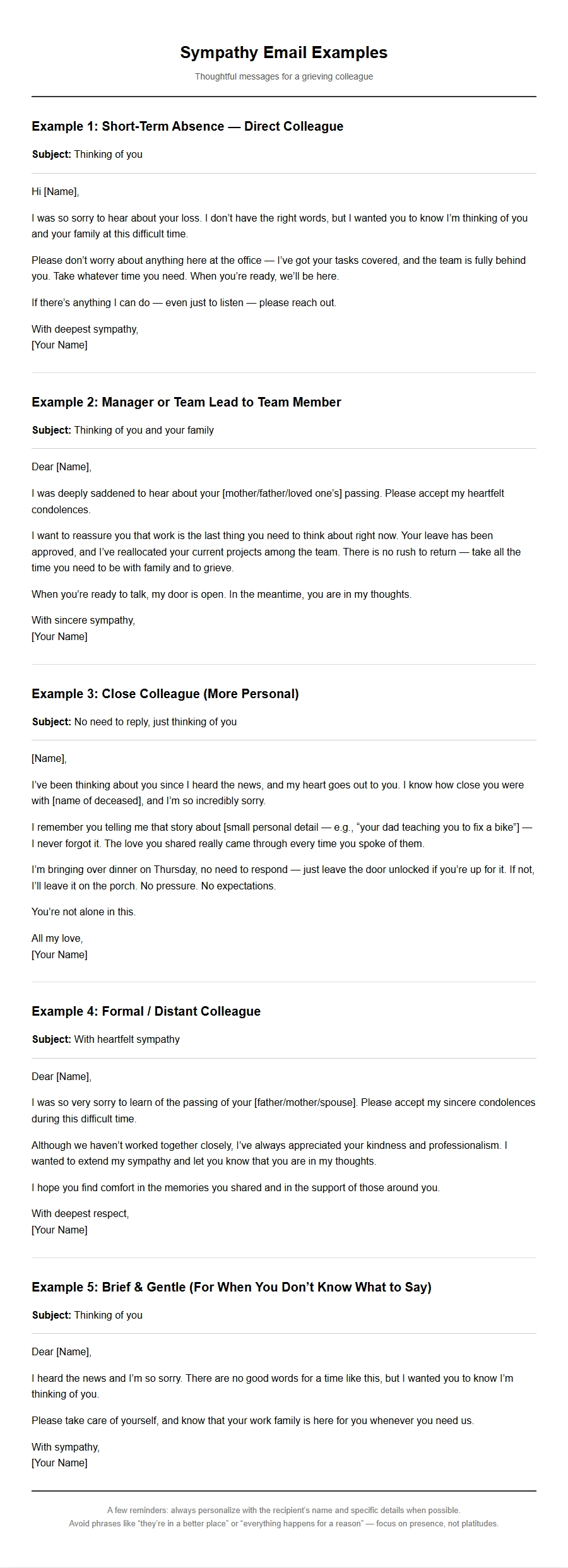 Sympathy Email Examples for a Grieving Colleague
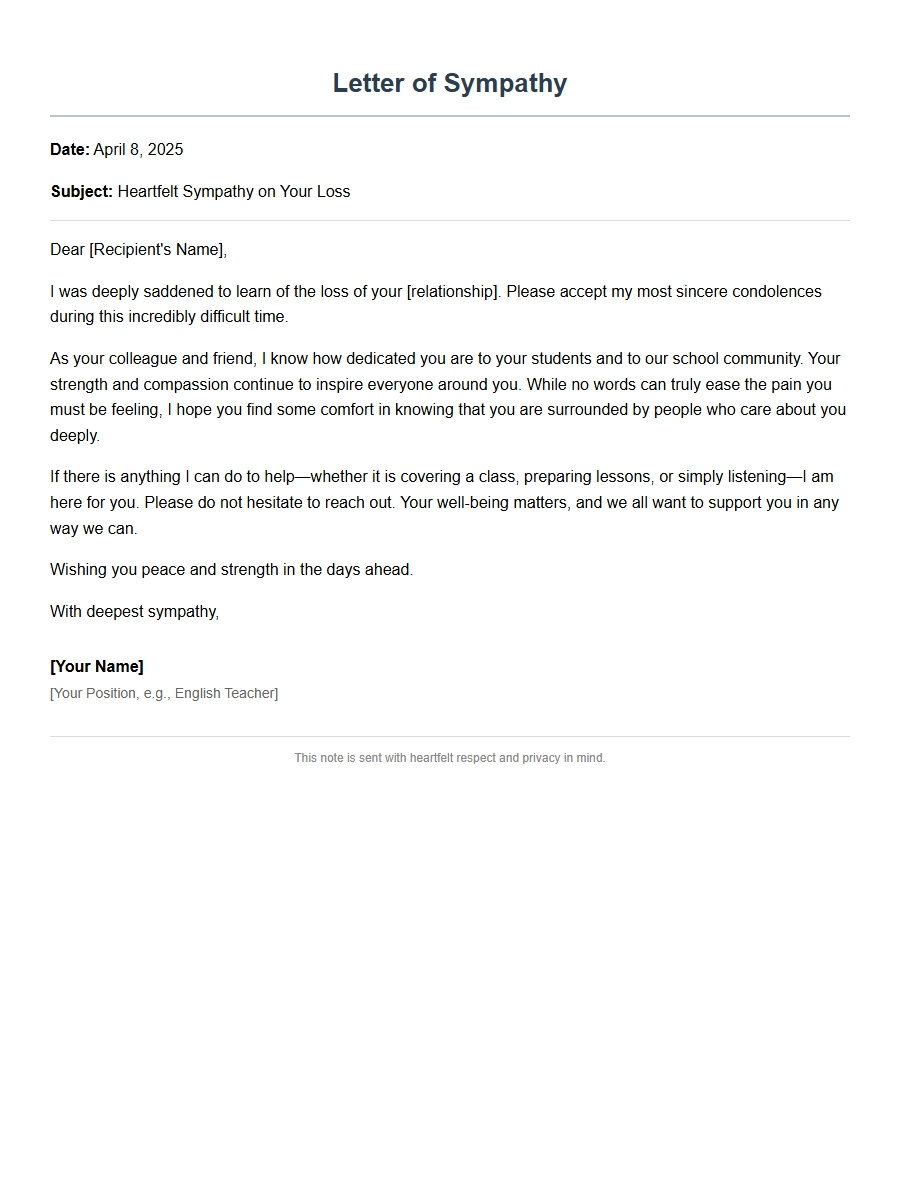 Condolence Words for a Teacher