You checked the grade portal, and the number just seems wrong. Maybe it was a miscalculation, a missed assignment, or a misunderstanding with the TA. Either way, you need to write a grade dispute appeal letter to administration, and you're not sure where to start. That's okay. A good sample letter can cut through the anxiety and give you a clear path forward.
Why using a letter template isn't cheating
It's not about copying. It's about having a solid foundation. A well-written sample shows you the right letter structure for academic appeals: the proper salutation and closing, the logical flow from explanation to request, and the respectful tone in writing that administrators expect. When you adapt a template, you're learning by example. You save time and avoid mistakes that weaken your case.
Category: Academic & Student Affairs
Picking the right sample for your situation
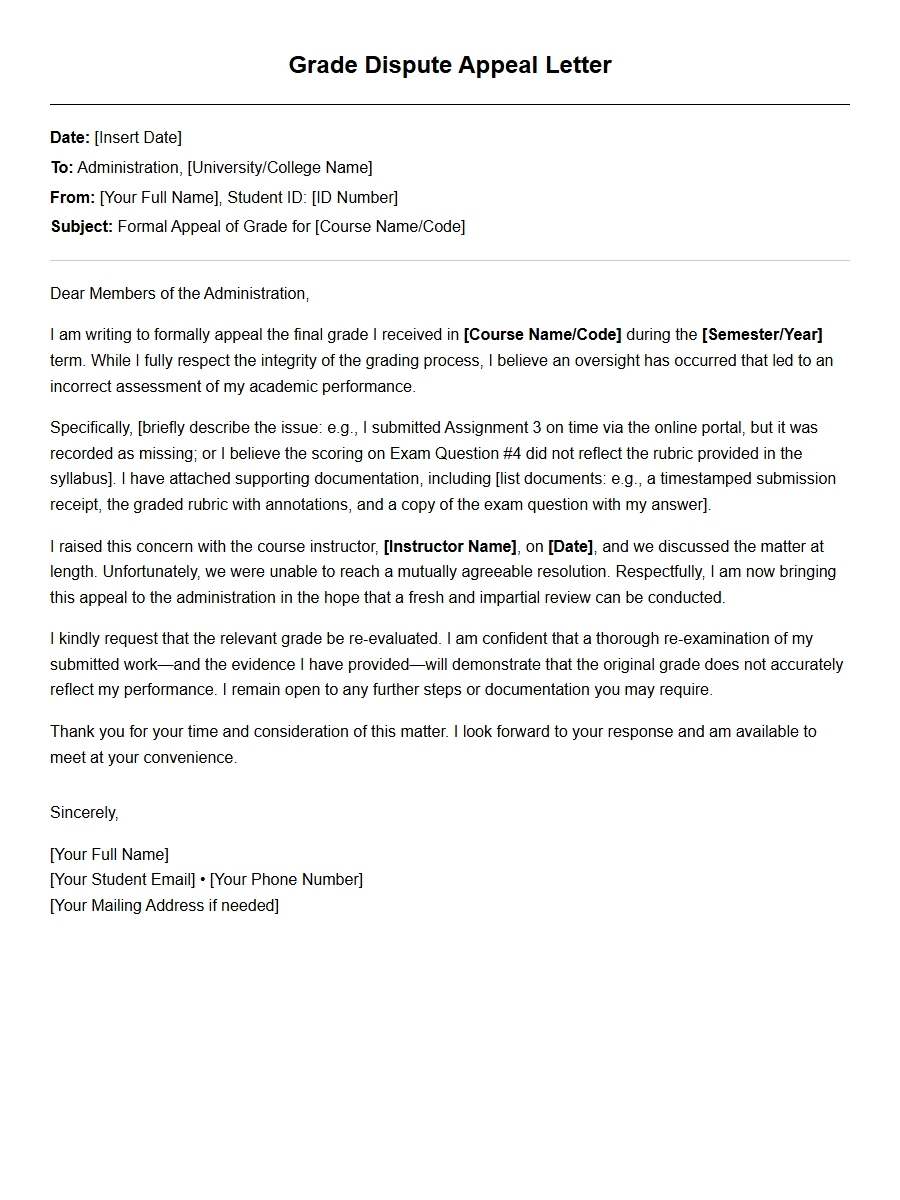
Not all grade dispute appeals are the same. If your professor is approachable, a semi-formal email may work. If you're going directly to the dean's office, stick with a formal business letter format. Look for a customizable letter that matches your specific scenario—one that allows you to plug in your course name, the disputed grade, and the reason for appeal. Avoid samples that sound too stiff or too casual. You want something that feels like professional correspondence, not a rant.
Adapting the sample without losing your voice
Once you have a template, read it through. Underline the parts that explain your situation generically. Replace those with your own details. For example, if the sample says "I believe there was an error in grading," you might write "I compared my answers to the rubric and found that question 3 was marked incorrectly." That's more specific and credible. Keep your language polite but direct. Don't worry about letterhead design if you're sending this digitally—just use a clear subject line like "Grade Appeal – [Course Code]."
Common mistakes to avoid
One frequent error is using an outdated salutation and closing. "To whom it may concern" feels impersonal. Instead, address the recipient by name if you know it. If not, "Dear Academic Appeals Committee" works. Also, don't ignore proofreading letter rules—one typo can make you seem careless. Read aloud, use spell-check, and have a friend glance at it. Another mistake is choosing the wrong format. If you email it, keep it as plain text or a simple PDF. If you're mailing a physical copy, follow business letter format with your address, date, and signature block.
The first paragraph should state who you are, what course, and what grade you're disputing. Then briefly say why you believe it's wrong. Don't bury the lead. For example: "I am writing to appeal the final grade of C+ I received in BIOL 101 (Fall 2024). I believe my exam score was incorrectly recorded based on attendance records I can provide." That's clear and direct. Avoid long stories about how hard you studied—stick to facts and evidence.
Handling email vs. printed letter
Most grade disputes start as emails. That's fine. But remember digital letter format matters too. Use a professional email address, include a concise subject line, and attach any supporting documents (graded assignments, emails from the professor). If you're sending a printed letter, use plain white paper, a standard font, and a simple layout. No need for fancy letterhead design unless it's provided by the school.
For more on how to state your case calmly, you can look at a refund request for defective software—the tone is similar: explain the problem, provide proof, and ask for a solution.
The closing and next steps
End with a polite request for review and a specific outcome. For instance: "I respectfully request that my final exam be re-graded by another instructor. Thank you for your time." Then sign off with "Sincerely" or "Respectfully." Include your contact information.
Use the sample, then move past it
A grade dispute appeal letter is just the first step. Once you've sent it, follow up in a week if you don't hear back. Remember, the sample is a springboard, not a crutch. The best letters feel both professional and human. They show you care about fairness, not just a higher grade. Over time, writing these letters becomes easier. You'll learn the rhythm of formal writing tips and letter writing etiquette naturally. Until then, let a solid template guide you—and don't be afraid to tweak it until it sounds like you.
If you're ever dealing with a similar complaint about institutional fairness, reading a request for disciplinary action against a staff member can also help you understand how to keep your language objective and solution-focused. And for broader practice with professional correspondence, a cruise ship cabin cleanliness complaint is another example of stating a problem clearly without over-explaining.
Samples You Can Use
Grade Dispute Appeal Letter to Administration
Formal Appeal for Final Grade Discrepancy
Dear Dean of Academic Affairs,
I am writing to formally appeal my final grade in Calculus II (MATH 202) for the Fall 2024 semester. My instructor, Professor Lee, assigned me a grade of C+, but my calculations indicate I should have received at least a B- based on the syllabus grading breakdown.
Below is a table comparing my recorded scores versus the actual scores on my returned assignments:
Component
Weight
My Score
Recorded Score
Midterm Exam
30%
78
78
Final Exam
40%
82
82
Homework (Best 10 of 12)
20%
89 average
81 average
Lab Reports (5)
10%
92 average
92 average
As shown, the homework average is incorrectly recorded as 81 instead of 89. I have attached copies of all graded homework for verification. I respectfully request a grade review and correction. Thank you for your attention.
Medical Hardship Grade Appeal
To the Grade Appeals Committee,
I am appealing my final grade of D in Organic Chemistry I (CHEM 301) due to an unforeseen medical emergency that affected my performance during the last three weeks of the semester.
From November 10 to December 5, 2024, I was hospitalized for pneumonia and submitted documentation to the Dean of Students office. Despite this, I completed the final exam while still recovering, which resulted in a poor score. I had maintained a B average on all prior exams and assignments.
Key evidence provided:
Doctor’s note covering the illness period
Dean of Students verification of excused absences
Instructor email acknowledging my late submission of labs
I am not requesting a full change without basis; I propose either an incomplete (grade I) to retake the final exam or a retroactive withdrawal. I believe these options are equitable given my academic record before the illness. Please advise on the next steps. Sincerely, Jane Doe, ID #45678.
Clerical Error in Grade Recording
Dear Office of the Registrar,
This letter is an appeal regarding a clerical error in the recording of my final grade for Introduction to Psychology (PSY 101), section 3, taught by Dr. Adams. My unofficial transcript shows a grade of C, but my calculated average based on the syllabus is a solid B.
After reviewing my returned work, I found that my final research paper (worth 25% of the grade) was graded as 70 by the instructor. However, I received a score of 88 on my paper. I contacted Dr. Adams, who confirmed that the grade entry in the system was a typo—the correct score is 88. He sent an email (attached) to the registrar requesting the change, but it has not been reflected for over two weeks.
I have summarized the discrepancy below:
Item
Recorded
Actual
Final Paper Score
70
88
Calculated Grade
C
B
Please update my transcript accordingly. I appreciate your prompt assistance.
Appeal Based on Unclear Grading Rubric
Dear Academic Appeals Board,
I am appealing the final grade of B- I received in Digital Media Design (ART 230) because the grading rubric for the final project was not provided until after submissions. The project is worth 40% of the grade, and without clear criteria, I could not tailor my work to meet expectations.
My instructor, Professor Kim, only gave a one-sentence description of the assignment: “Create a multimedia portfolio.” No rubric, no point breakdown. When I requested feedback, she said my project lacked “visual cohesion,” a term never listed in the syllabus or discussed in class.
I have the following concerns:
The syllabus states that rubrics will be provided for all major assignments.
Other students also expressed confusion; two received similar vague feedback.
I invested over 30 hours and followed all technical requirements.
I request that the committee review my project holistically or require the instructor to apply a retroactive rubric. I am confident my work would merit at least a B+ under fair assessment. Thank you for your consideration.
Request for Retroactive Incomplete Grade
To the Dean of Students,
I respectfully request approval to change my grade in Advanced Statistics (STAT 405) from a D to an Incomplete (I) due to circumstances beyond my control. I was unable to complete the final project because of a family emergency that required me to travel out of state during the last two weeks of the semester.
I had completed 85% of the coursework with a B average. The final project (worth 30% of the grade) was left unfinished. I contacted Professor Reynolds before the deadline, explaining the situation, but he did not respond until after grades were posted. He then entered a grade based only on completed work.
Supporting documentation:
Airline itinerary and hotel receipts showing travel dates
Email correspondence with Professor Reynolds
Hospital note regarding my mother’s surgery
I am prepared to complete the project within the first three weeks of the next term. Granting an incomplete would reflect my true academic standing and prevent unjust academic penalty. I look forward to a favorable decision.
Borderline Grade Round-Up Appeal
Dear Grade Appeal Committee,
I am writing to appeal my final grade of 89.3% (B+) in Financial Accounting (ACCT 301). The cutoff for an A- is 90.0%. I believe that due to my consistent performance and one extra-credit opportunity that was not factored in, a rounding to 90.0% is justified.
According to the syllabus, the instructor may round up at her discretion. My grade breakdown is as follows:
Component
Weight
Score
Exams (three)
60%
91, 88, 85
Quizzes (best 8 of 10)
20%
94 average
Homework
10%
100 average
Participation
10%
90
I also completed an optional extra-credit project worth 2 points that was graded as 1.5, but those points were never added to my final average. If included, my grade would be 89.6%, still 0.4% short. I respectfully ask the committee to consider my consistent high performance and grant the round-up. I have attached grade verification.
Appeal for Denied Extra Credit Opportunity
Dear Academic Appeal Committee,
I am appealing the final grade of C in Introduction to Philosophy (PHIL 101). The instructor, Dr. Brown, offered an extra-credit assignment to the entire class but later disqualified me without explanation, claiming I was “ineligible” because of a previous missed deadline unrelated to the extra credit.
The extra credit was announced in class and on the LMS: “Watch a philosophical film and write a 500-word reflection, worth up to 5 points added to the final exam.” I submitted it on time (November 20, 2024), but Dr. Brown returned it with a note saying “no credit—policy.” When I asked for clarification, he refused to elaborate.
Key points:
The syllabus does not mention any prerequisites for extra credit.
I had no unexcused absences or late penalties that would disqualify me.
Other students submitted the same assignment and received credit.
Without the 5 points, my final exam score was 68, giving a C. With the extra credit, my exam would be 73, raising my overall grade to a B-. I request a review of the policy and reinstatement of the extra credit.
Bias and Discrimination in Grading Appeal
Dear Dean of Equity and Inclusion,
I am filing a formal grade appeal for American Literature (ENGL 250) based on what I believe is biased grading by Professor Hughes. I am a Latino student, and I received a D on my final essay, while my White peers who wrote similar analyses received B or higher. My prior work in the class consistently earned Bs and B+s.
Specifics:
My essay argued the cultural importance of Latinx authors; professor criticized it as “too personal” and “subjective.”
Two classmates used personal family histories and received praise.
Professor Hughes has a history of complaints from minority students (I have documented three others).
I requested a regrade with a different instructor, but my request was denied. My final grade is a C-, which prevents me from enrolling in the major. I have attached:
My graded essay with comments
A peer’s similar essay that received a B+
Emails from other students reporting similar treatment
I ask for an independent review of my essay and removal of any bias from the process. Justice in grading is essential.
Group Project Grade Dispute
To the Grade Grievance Committee,
I am appealing my grade of 70 (C) on the group project in Business Strategy (MGMT 410), which constitutes 30% of my final course grade. My individual contribution was substantially higher than that of my teammates, yet the group received a single grade.
The project involved a 20-page report and a presentation. The professor allowed teams to split work equally, but two members, John and Mary, submitted incomplete sections and did not attend the final rehearsal. I ended up writing 60% of the report and leading the entire presentation.
I wish to propose a grade adjustment that reflects individual effort. Below is a breakdown of contributions:
Team Member
Report Section
Presentation Contribution
Quality (1-5)
Me (Alex)
Intro, Analysis, Conclusion
Full slide design and oral delivery
5
John
Literature Review (incomplete)
None
2
Mary
Financial Data (wrong figures)
Attended but did not speak
1
Susan
Case Example (good)
Contributed slides
4
I request that the committee assign me a grade of at least B+ for the project and adjust the others accordingly. I have emails and Google Docs history as evidence.
Follow-Up Appeal After Initial Denial
Dear Academic Appeals Board,
This is a follow-up to my grade appeal submitted on December 12, 2024, regarding Physics I (PHYS 110). The initial review denied my request to change my grade from D+ to C based on a miscalculation of lab scores. I am providing additional evidence that I believe was overlooked.
In my original appeal, I pointed out that Lab 4 (grade: 95) was omitted from the average. The committee’s response claimed that Lab 4 was excluded because it was an “optional makeup.” However, the syllabus lists six required labs, and Lab 4 was mandatory. I have attached the syllabus showing that labs 1 through 6 are all compulsory.
Updated calculations:
Without Lab 4: Lab average = 76 → final grade D+
With Lab 4 included: Lab average = 82 → final grade C
I also note that my lab partner, who completed the same set, received a C because his Lab 4 was counted. This inconsistency violates the grading policy. I respectfully ask the board to re-examine the evidence and correct the error. I trust in the fairness of this process.
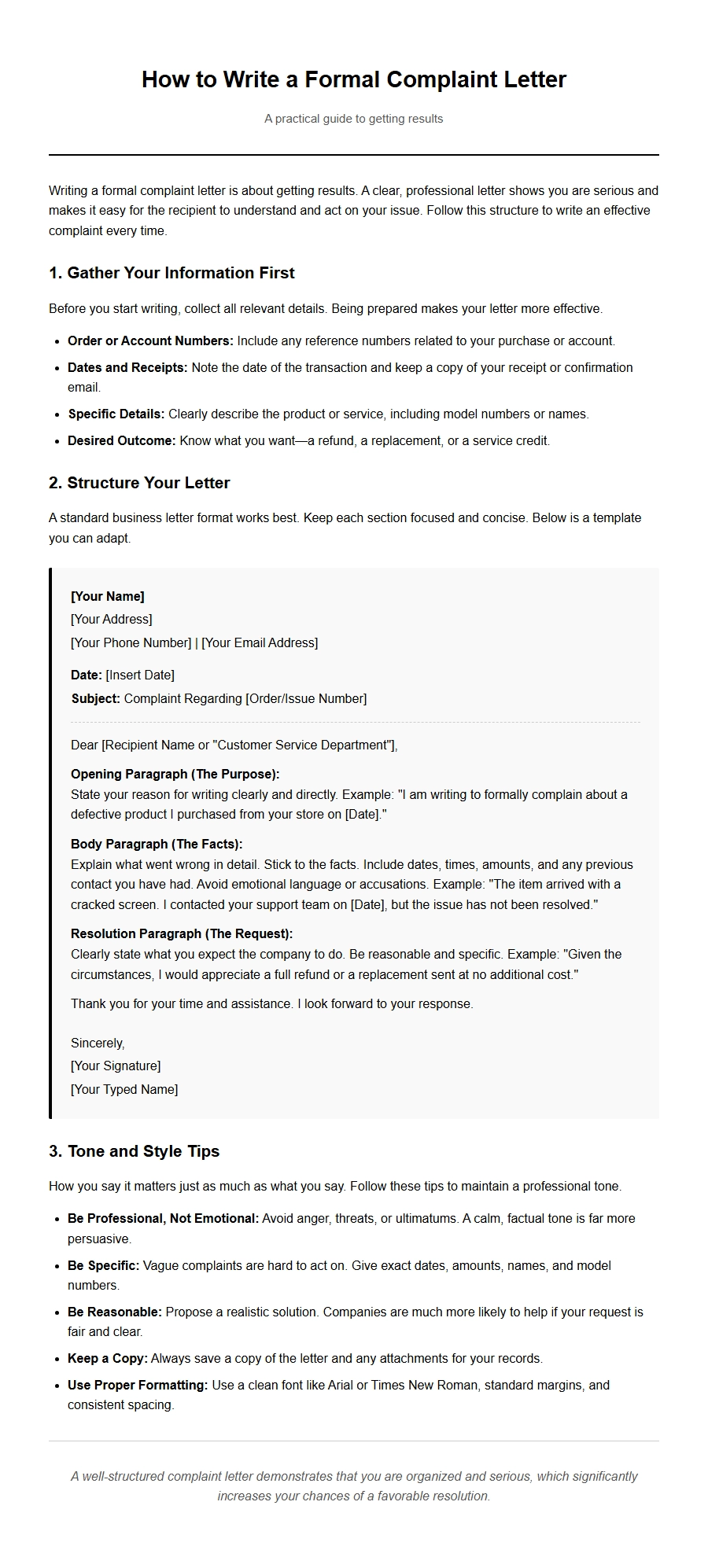 How to Write a Formal Complaint Letter
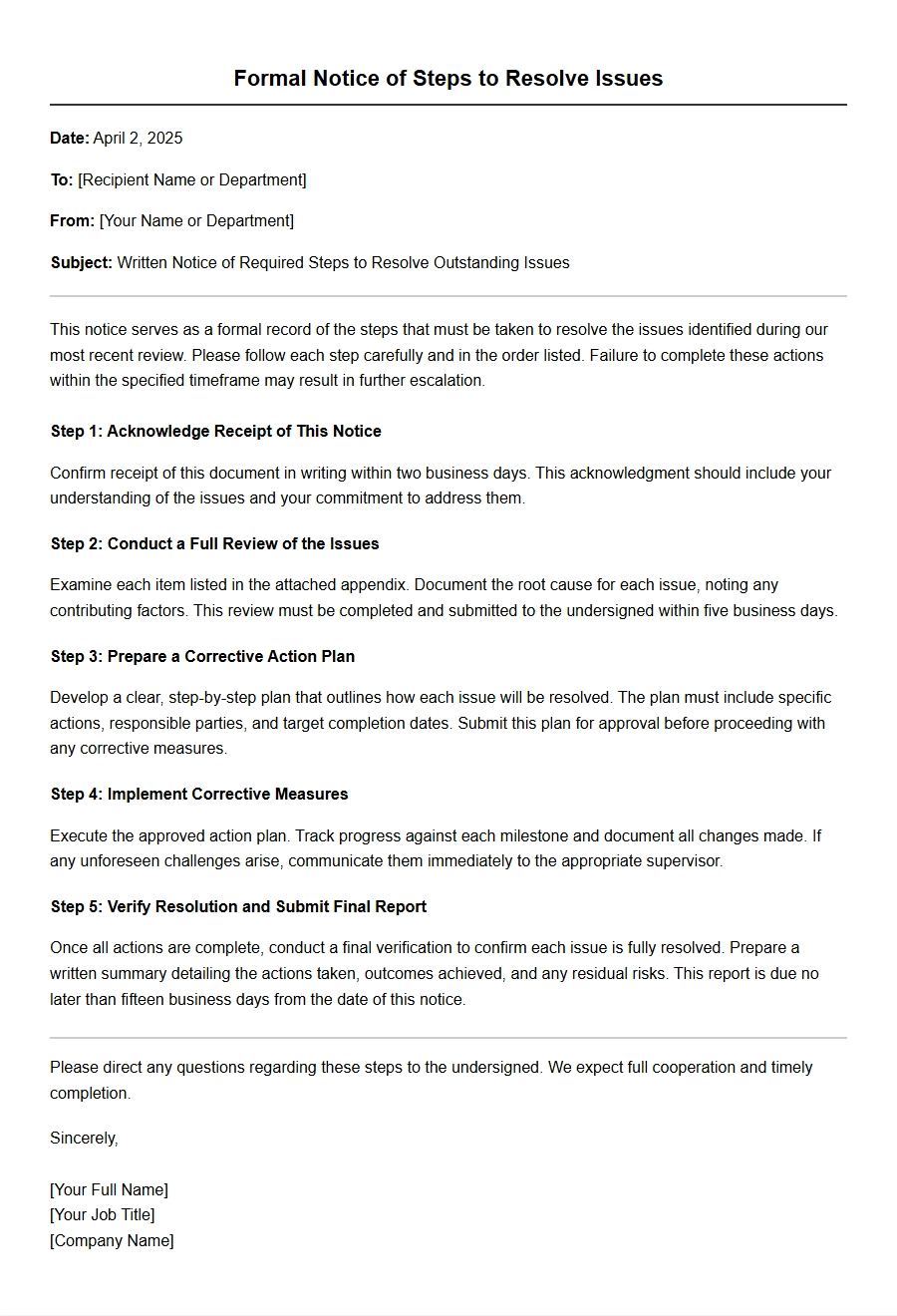 Steps to Resolve Issues via Written Notice
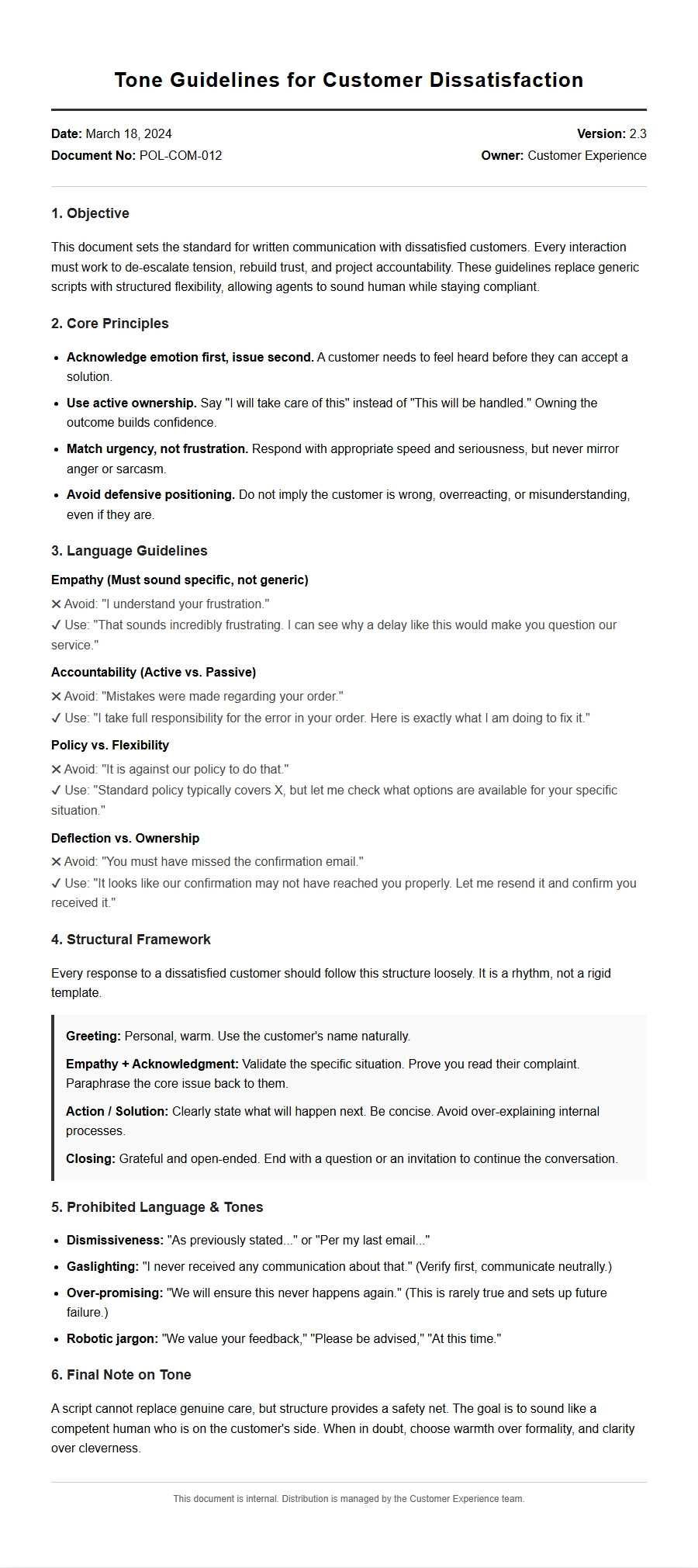 Tone Guidelines for Dissatisfied Customer Letters
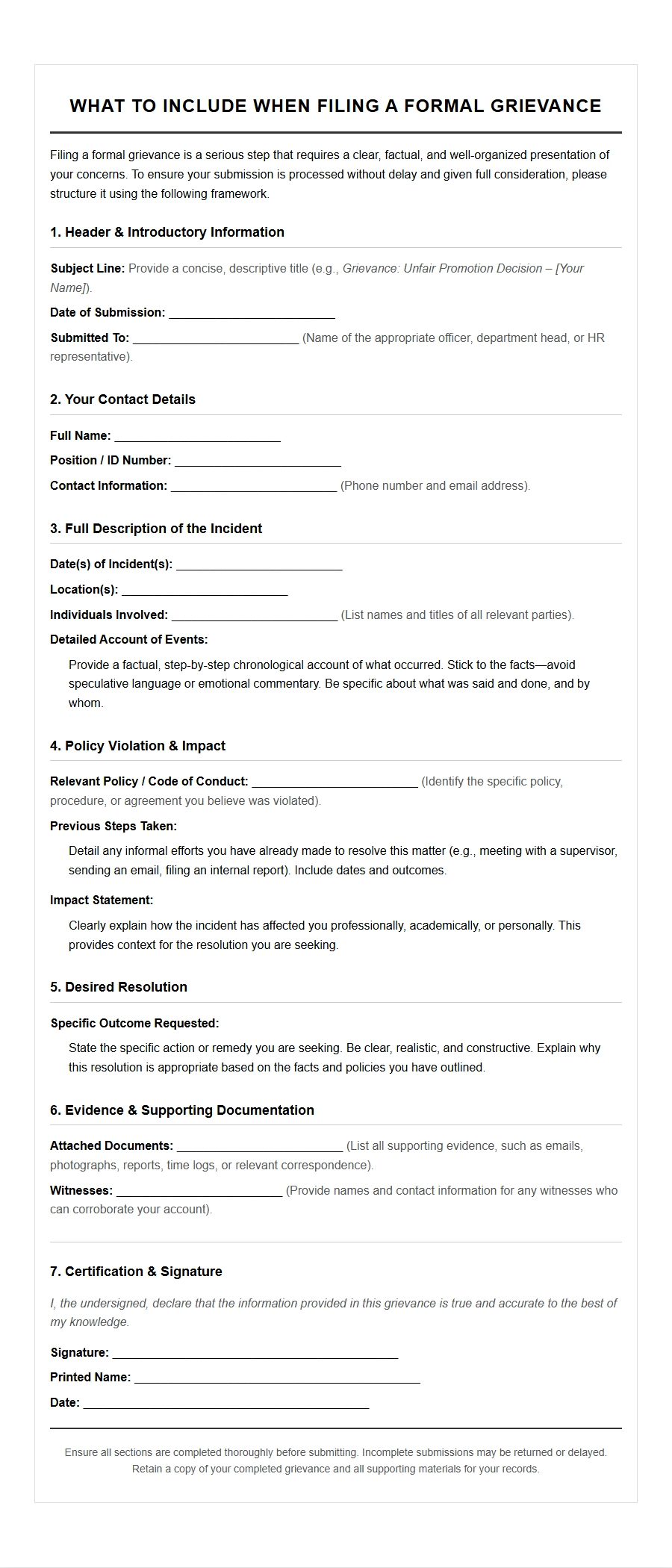 What to Include in a Formal Grievance Letter
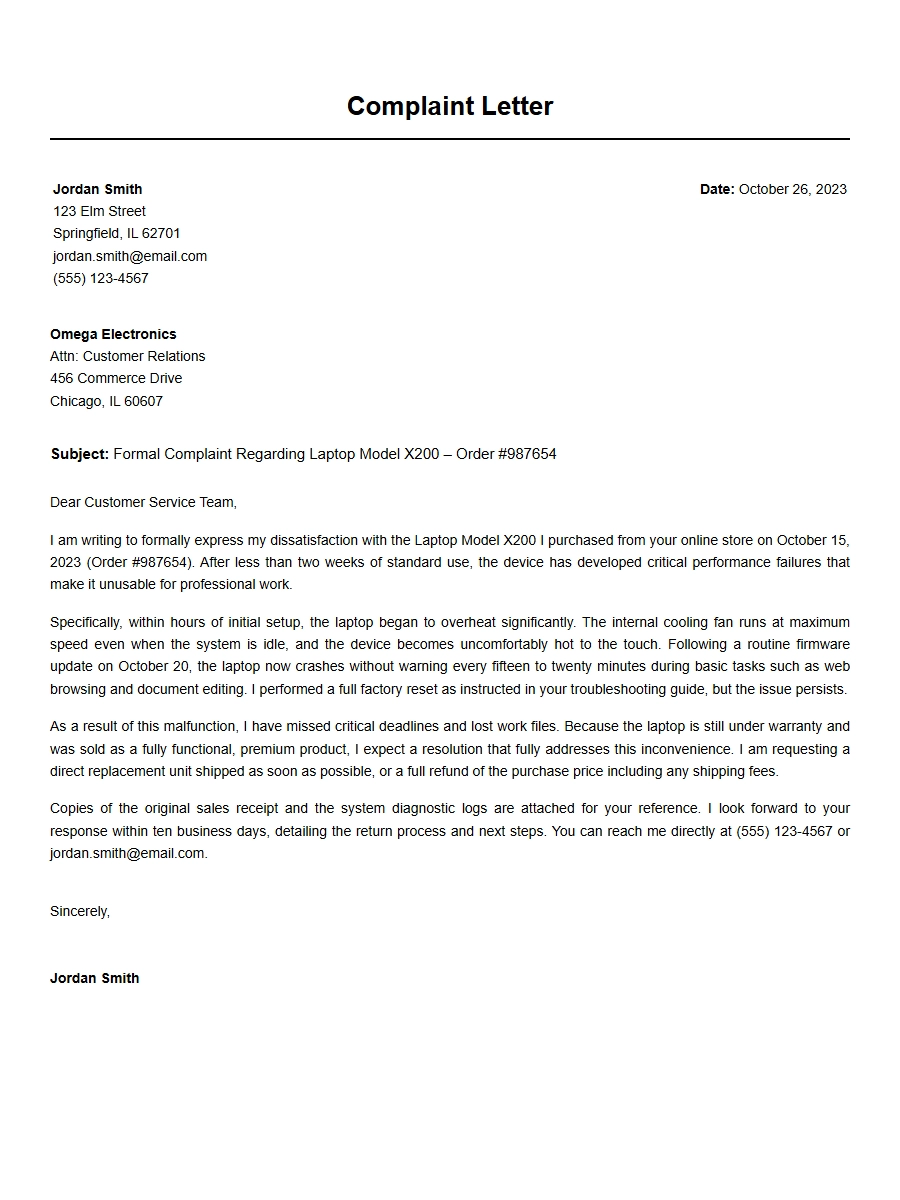 Structure of an Effective Complaint Letter
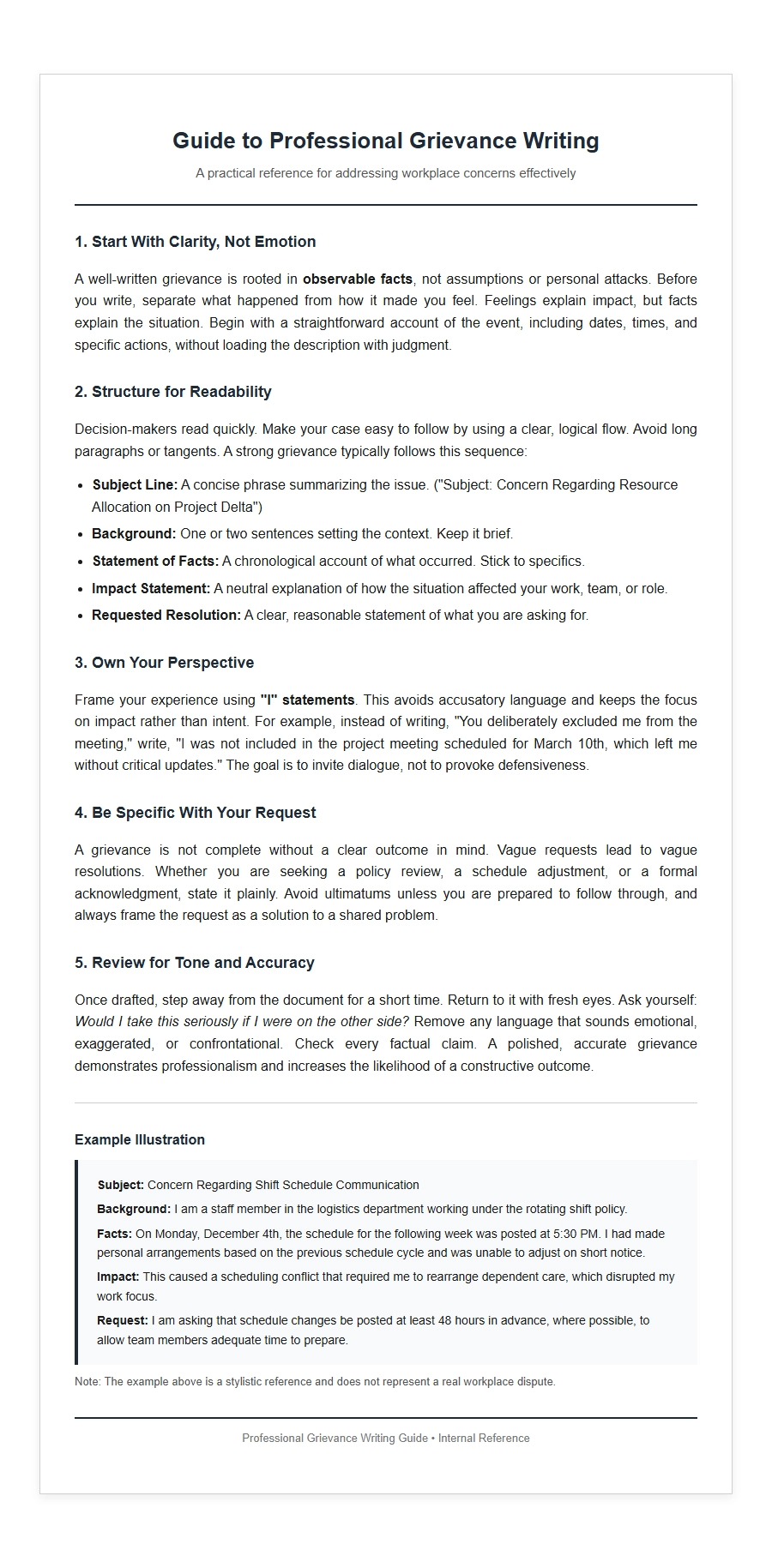 Best Practices for Writing Professional Grievance Letters