You open your inbox, cursor blinking in the message body, and realize you have to write an email expressing sympathy for someone’s loss. The words won't come. You type a sentence, delete it, try again. It feels too formal, too casual, or just wrong. That blank page can make even a simple message feel impossible. But a well-chosen sample—a real, human example of a condolence email—can turn that hesitation into a thoughtful message in minutes.
Why using a condolence email sample isn't cheating
Some people worry that using a letter template for condolences feels impersonal. The truth is, a good sample gives you a structure and a respectful tone to start from. It saves you from stumbling over the opening line or forgetting a key element like the proper salutation and closing. You don't copy it word for word. You adapt it. You make it your own. That’s smart letter writing etiquette, not a shortcut.
What makes a condolence email different from other professional correspondence
Condolence messages sit in a unique zone of professional correspondence. They aren’t as rigid as a business letter, but they shouldn’t be as casual as a text. The tone in writing needs to strike a balance: warm, sincere, and respectful of the recipient’s grief. A good digital letter format for condolences usually includes a clear subject line, a direct opening that mentions the person who passed, a brief personal memory or kind thought, an offer of support (only if you mean it), and a simple closing.
For example, you might start with “I was so sad to hear about the loss of your father.” That’s direct and honest. Then you can add a sentence about what you admired in the person you’re writing about. That’s the customizable letter part—the part where your voice matters.
Common mistakes people make when sending condolence emails
Ever received a condolence message that felt like a form letter? It usually happens because the writer used an outdated phrase like “he passed away peacefully” when you know the death was sudden. Or they ignored the letter structure and wrote a long, rambling paragraph with no clear point. Another frequent error: using the wrong salutation. If you know the person well, “Dear John” is fine. If it’s a colleague’s spouse you’ve never met, “Dear Mrs. Smith” is safer.
Also, people often forget to check the email format. Condolences sent via email don’t need a letterhead design. Just use a clean, simple style. No fancy fonts or graphics. You want the focus on your words, not the design.
How to adapt a sample without losing your authentic voice
When you find a resignation letter sample or a cover letter example, you usually change the job titles and skills. With a condolence sample, you change the relationship details and the personal memory. Read the sample out loud. Does it sound like you? If not, tweak the sentences. Replace “I will always remember his kindness” with something specific, like “I still think about the time he brought cookies to the whole team on a Monday morning.”
Don’t bury the main message. Say “I am so sorry for your loss” or “My heart goes out to you” early in the email. Then you can expand. This isn’t a suspenseful story. The recipient wants to know immediately that you are aware of their loss and that you care. It’s also a good place to include a formal writing tip: avoid clichés like “he is in a better place” unless you are very sure that’s what the person believes.
Proofreading matters more than you think
Before you hit send, read your email aloud. Check for typos, missing words, and awkward phrasing. Proofreading letter is not about perfection—it’s about respect. A typo in a condolence message can feel careless. Also, double-check the name of the deceased and their loved ones. Getting a name wrong can undo all the warmth you tried to build.
If you need help starting, our eulogy letter sample offers a longer, more reflective tone that you can adapt for email. And if you knew the person very well, our guide for close relationships will give you more specific phrases.
Category: Condolence Email Samples
Think of a condolence email sample as a springboard, not a crutch. You don’t need to reinvent the wheel every time you write one. The more you practice, the easier it gets. Start with a basic structure, fill in your specifics, and let your genuine care for the person show through. That combination of business letter format structure and personal warmth is what makes a condolence email feel right.
And if you’re writing to a bereaved mother or daughter, you’ll want extra care in the language. Our sample for a bereaved mother or daughter can guide you toward a tone that’s gentle without being overwhelming.
Now, the next time that blinking cursor stares back at you, you’ll have a place to start. Write the email, read it once, and send it. The person on the other end will appreciate the effort—not the perfection.
Common Sample Formats
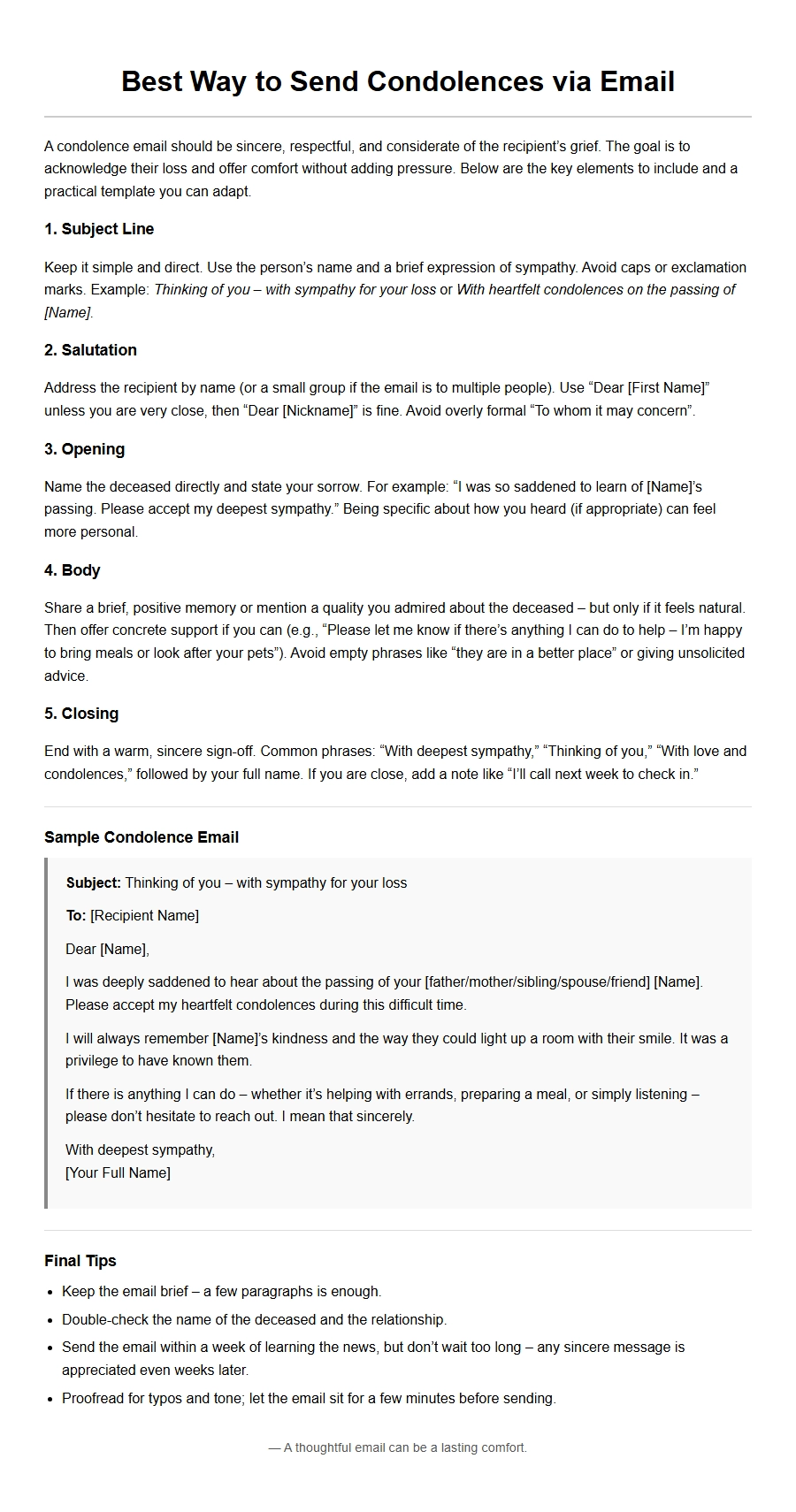
Best Way to Send Condolences via Email
Brief and Sincere Condolence Email
Subject: With Deepest Sympathy
Dear [Recipient's Name],
I was profoundly saddened to learn of the passing of your [relationship, e.g., beloved mother]. Please accept my most heartfelt condolences during this incredibly difficult time.
I remember [name] as a person of immense kindness and warmth. Their gentle spirit and [positive trait, e.g., infectious laugh] brought joy to everyone fortunate enough to know them. May the cherished memories you hold bring you some comfort in the days ahead.
While no words can truly ease your pain, I want you to know that I am holding you and your family in my thoughts. If you need someone to talk to or require any practical assistance, please do not hesitate to reach out. I would be honored to help in any way I can.
With deepest sympathy, [Your Name]
Condolence Email to a Colleague
Subject: Thinking of You During This Loss
Dear [Colleague's Name],
I was so sorry to hear about your [relationship, e.g., father's passing]. Please know that my thoughts are with you and your family.
I have always admired your strength and professionalism at work, and I can only imagine how difficult this must be. Take all the time you need to be with your loved ones—we are all thinking of you and sending our deepest sympathy.
If there is anything we can do to support you during this time, whether it is covering a project or simply having a coffee, please let me know. You are not alone.
Warm regards, [Your Name]
Condolence Email with a Personal Anecdote
Subject: Remembering [Name] with Love
Dear [Recipient's Name],
I was heartbroken to learn of [name]'s passing. I will always treasure the memory of the time [mention a specific warm memory, e.g., when we all laughed together at the family picnic]. Their [quality, e.g., generosity] was truly a gift.
May you find solace in the many happy memories you shared. I am thinking of you and sending all my love.
With deepest sympathy, [Your Name]
Condolence Email Offering Practical Support
Subject: With Sympathy and a Helping Hand
Dear [Recipient's Name],
I was so sorry to hear of your loss. During this challenging time, I want to help in a practical way. Please see below some ways I can assist:
Meals: I can bring dinner on Tuesday or Wednesday—just tell me your preference.
Errands: I can pick up groceries or run other errands for you.
Childcare: I can watch the kids for a few hours if needed.
No need to respond now. Simply text or call me when you are ready. My heartfelt condolences to you and your family.
With care, [Your Name]
Condolence Email for a Sudden Passing
Subject: Shocked and Deeply Saddened
Dear [Recipient's Name],
I am utterly shocked and saddened to hear about the sudden passing of [name]. My heart aches for you and your family as you navigate this incredibly difficult time.
Please know that I am holding you close in my thoughts. I cannot imagine the pain you must be feeling, but I want you to know that I am here for you—whether you need to talk, cry, or simply sit in silence.
With deepest condolences, [Your Name]
Condolence Email with a Poem or Quote
Subject: In Loving Memory
Dear [Recipient's Name],
I was so sorry to hear of your loss. I came across a quote that reminded me of [name]: "Those we love don't go away, they walk beside us every day."
May these words bring you a small measure of comfort. Thinking of you and sending strength.
With love and sympathy, [Your Name]
Condolence Email to a Friend’s Family
Subject: Sympathy for Your Loss
Dear [Family Name] Family,
I was deeply saddened to learn of [name]'s passing. [Name] was a wonderful friend to me, and I am forever grateful for the time we shared.
During this time of grieving, I hope you can find peace in the beautiful memories of [name]. Please accept my heartfelt sympathy and know that I am thinking of you all.
With sincere condolences, [Your Name]
Condolence Email from a Business or Organization
Subject: Our Deepest Sympathies
Dear [Recipient's Name],
On behalf of [Company/Organization Name], we extend our most sincere condolences to you and your family on the passing of [name].
We remember [name] as a valued [position/role] who contributed so much to our team. Their [qualities, e.g., dedication and warmth] will be deeply missed.
Please find below some information that may be helpful during this time:
We have arranged for a floral tribute from the team.
In lieu of flowers, we have made a donation to [charity] in [name]'s honor.
You can reach [Contact Person] at [email/phone] for any assistance.
You are in our thoughts and prayers.
With deepest sympathy, [Your Name] on behalf of [Organization]
Condolence Email with a Shared Memory Table
Subject: Remembering [Name] Together
Dear [Recipient's Name],
I was so sorry to hear about [name]'s passing. I have many fond memories of [name], and I wanted to share a few standout moments that capture their spirit:
Memory
Year
Why It Matters
Helped me move apartments without complaint
2018
Showed incredible generosity
Organized the office holiday party
2019
Brought everyone together
Took me for coffee after a tough day
2020
Was a true listener
I hope these small recollections bring a smile to your face. Please know I am thinking of you.
With sympathy, [Your Name]
Condolence Email for a Pet Loss
Subject: Thinking of You and Your [Pet's Name]
Dear [Recipient's Name],
I was so sorry to learn of the passing of your beloved [pet's name]. They were such a cherished part of your life, and I know how much they meant to you.
I have many happy memories of [pet's name]—from [mention a fond memory, e.g., their excited greeting at the door] to [another memory, e.g., their love of belly rubs]. Their joy and loyalty were truly a gift.
Please take comfort in the wonderful life you shared with them. They were lucky to have such a devoted friend.
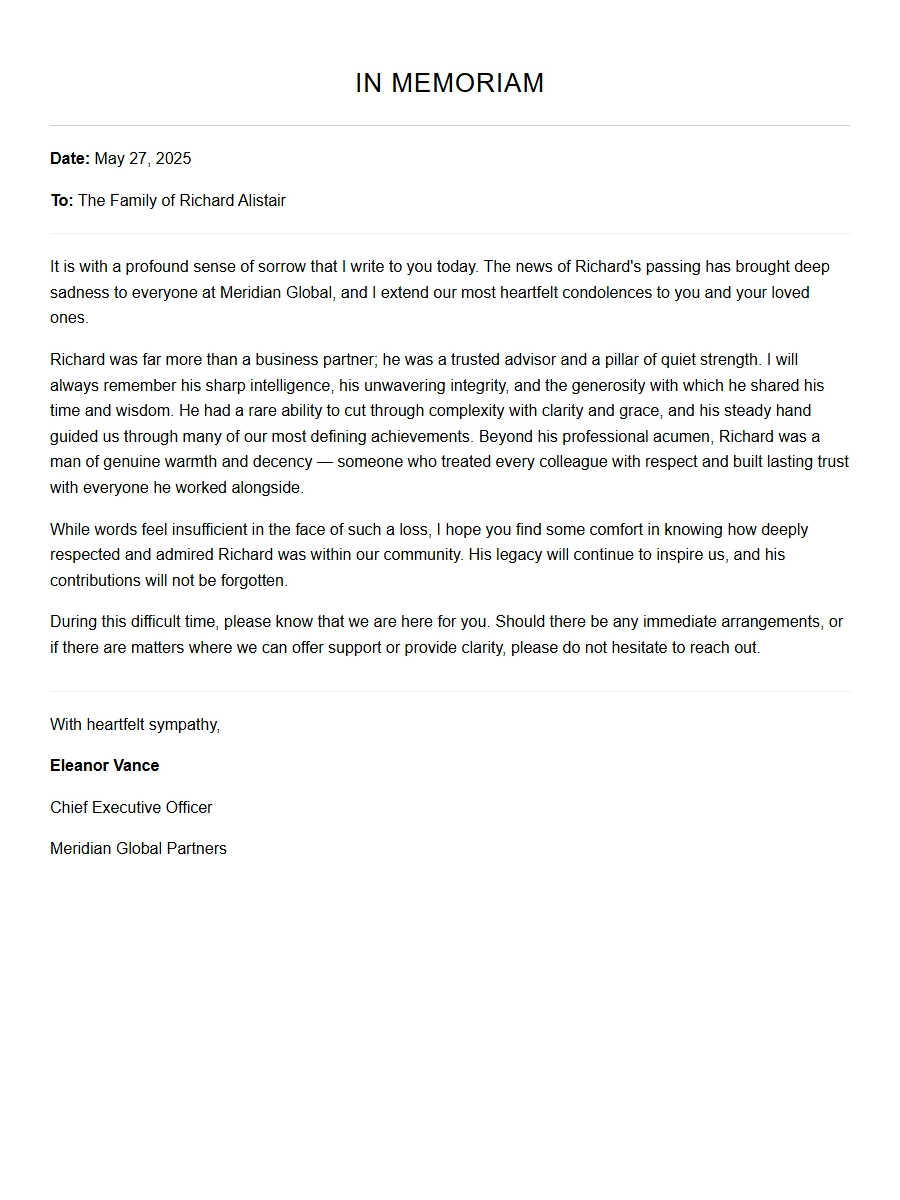 Formal Condolence Message for a Business Partner
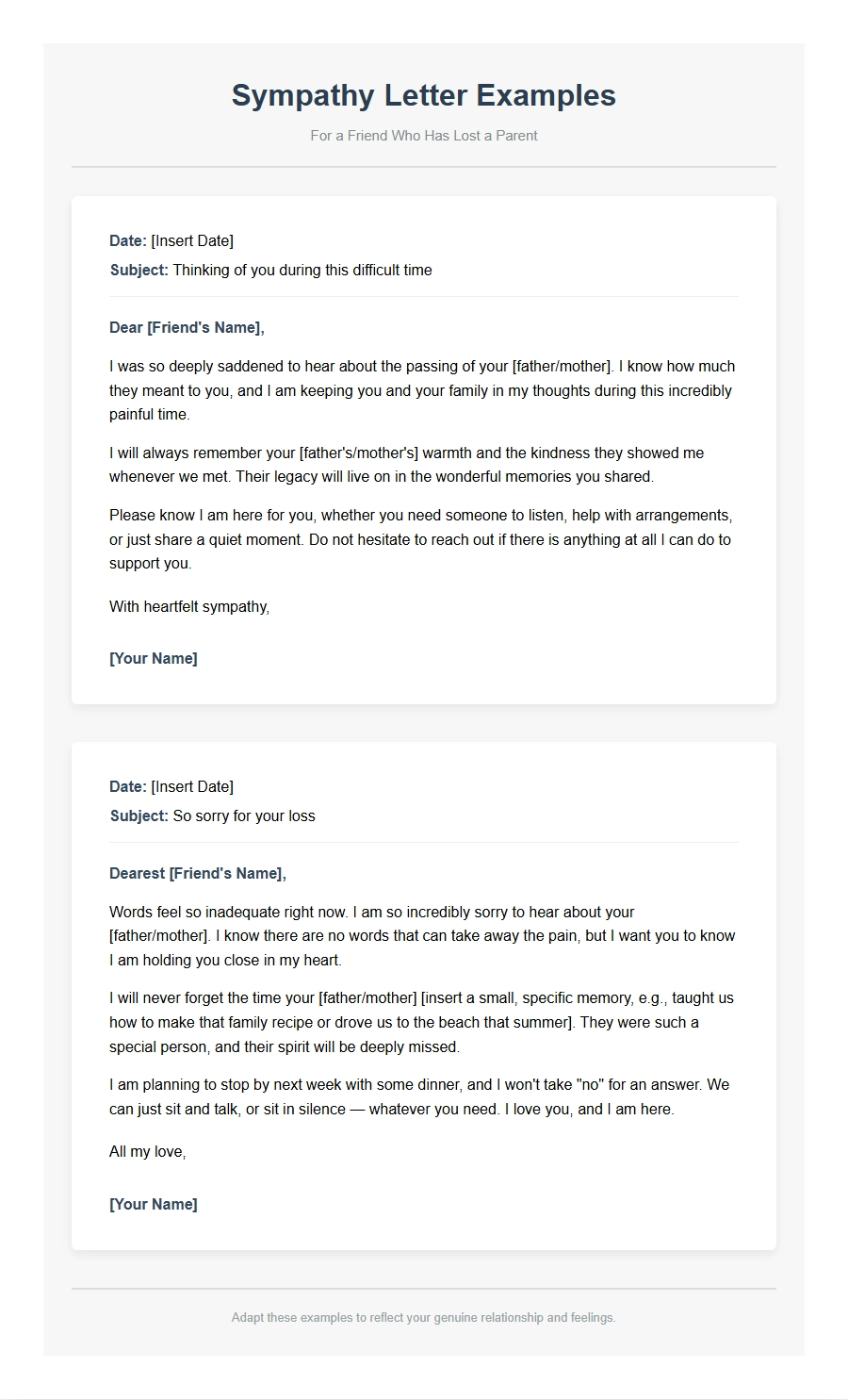 Sympathy Letter Examples for a Friend Who Lost a Parent
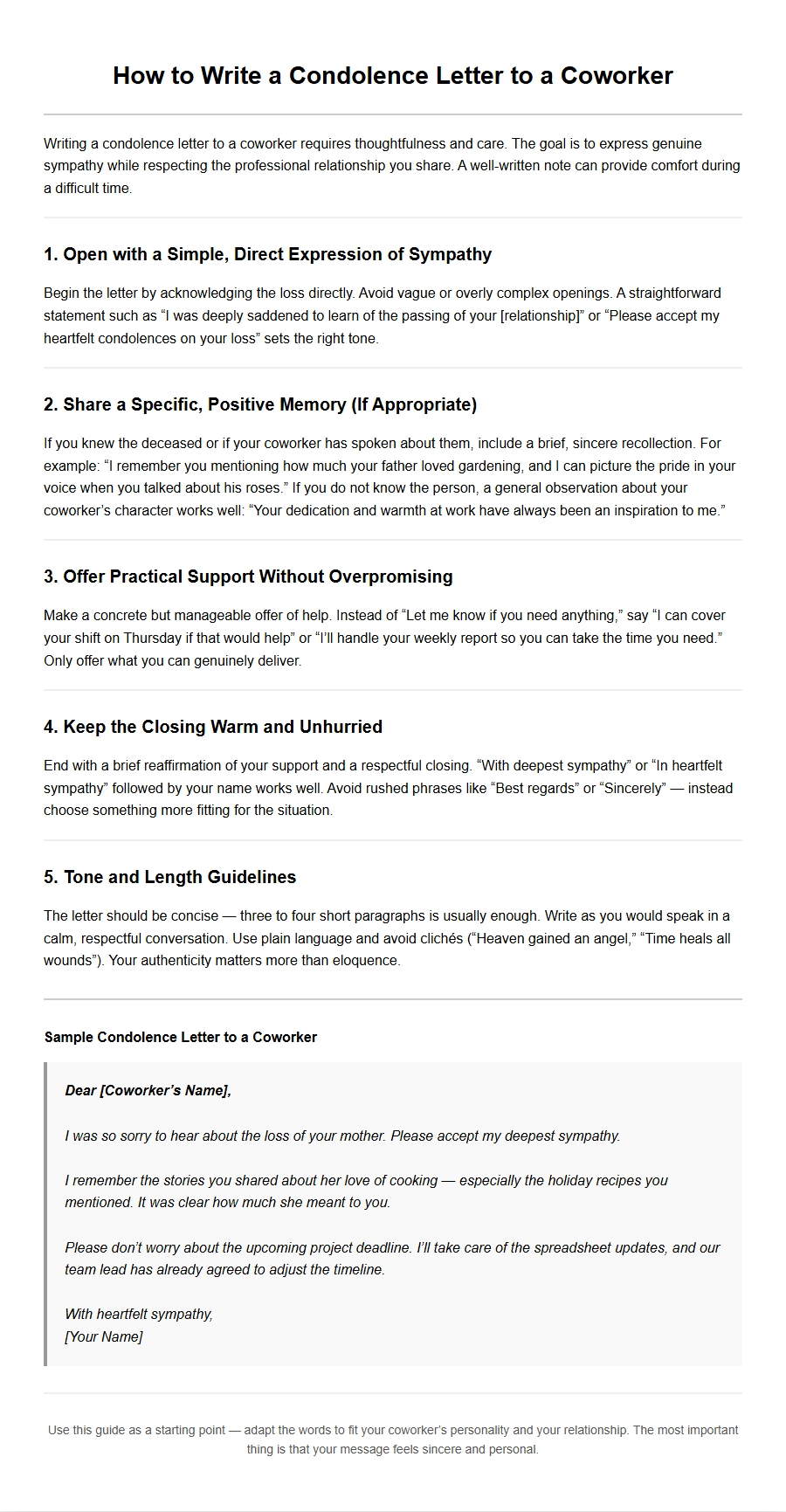 How to Write a Condolence Letter to a Coworker
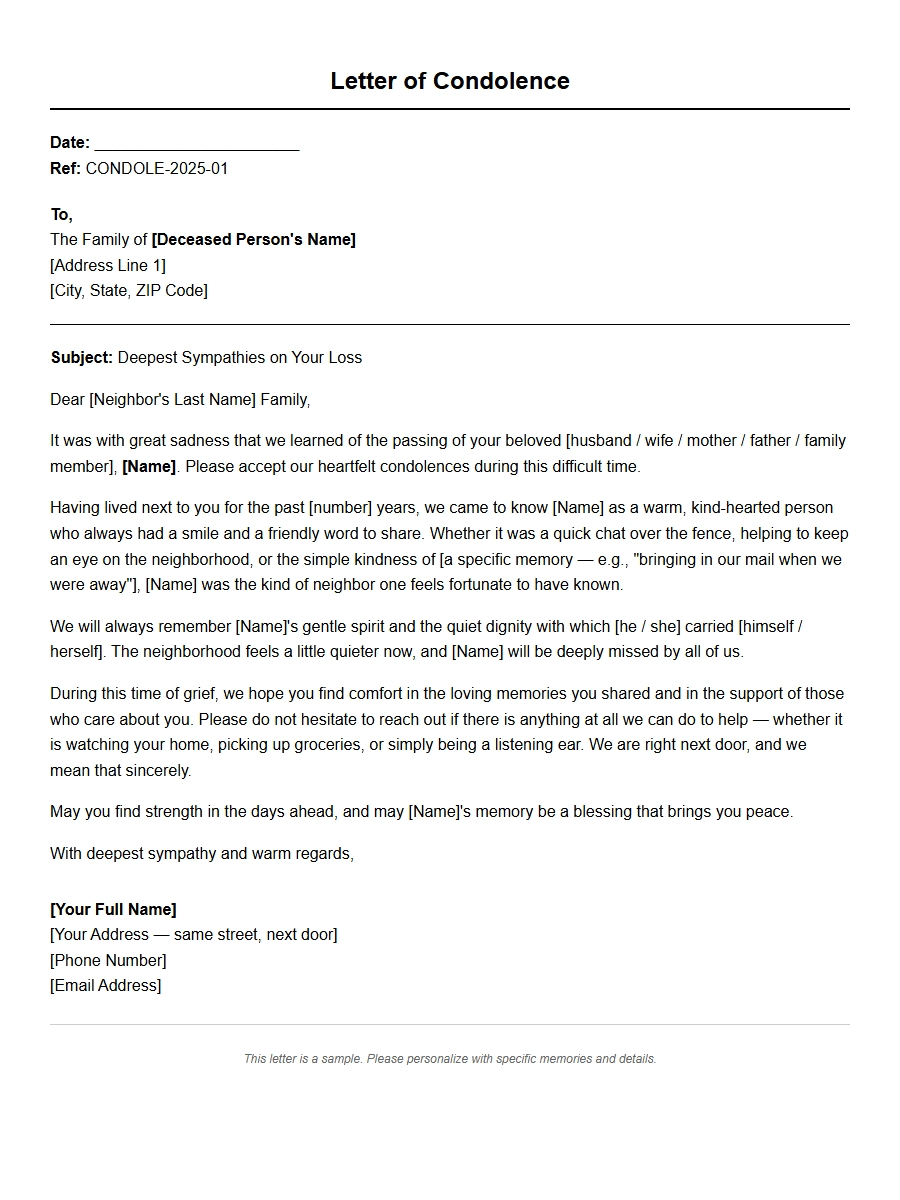 Condolence Letter Sample for a Neighbor
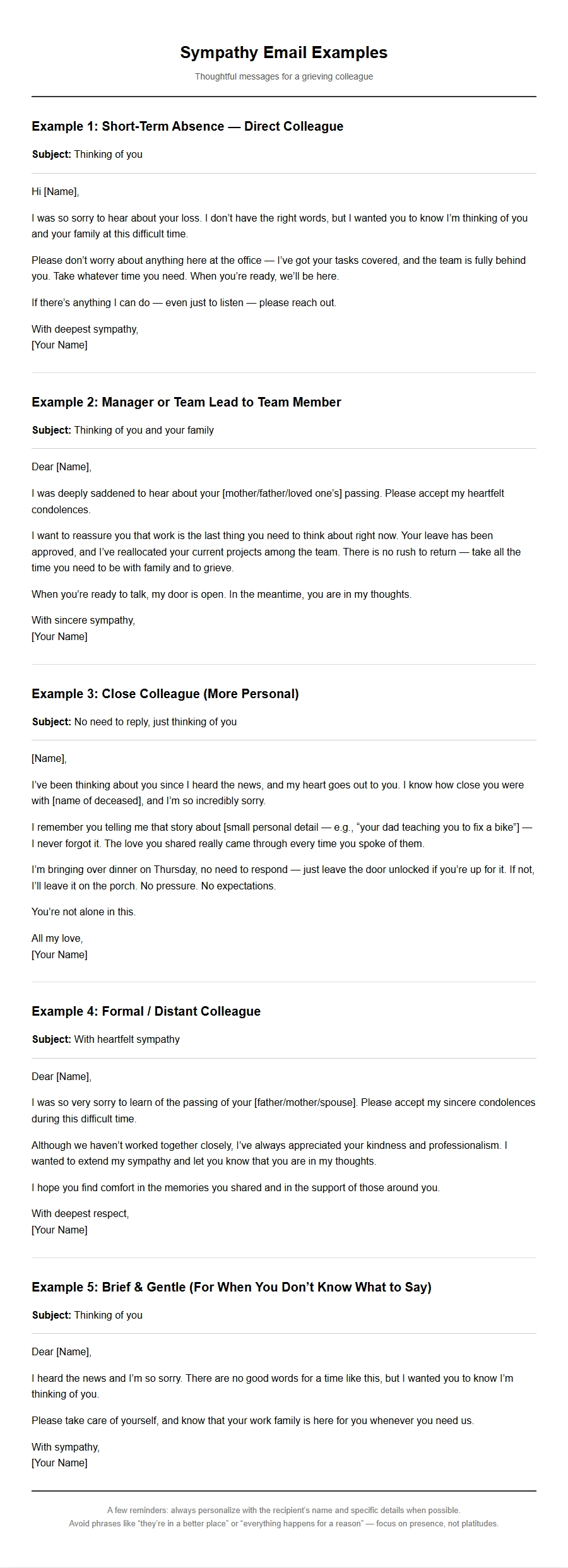 Sympathy Email Examples for a Grieving Colleague
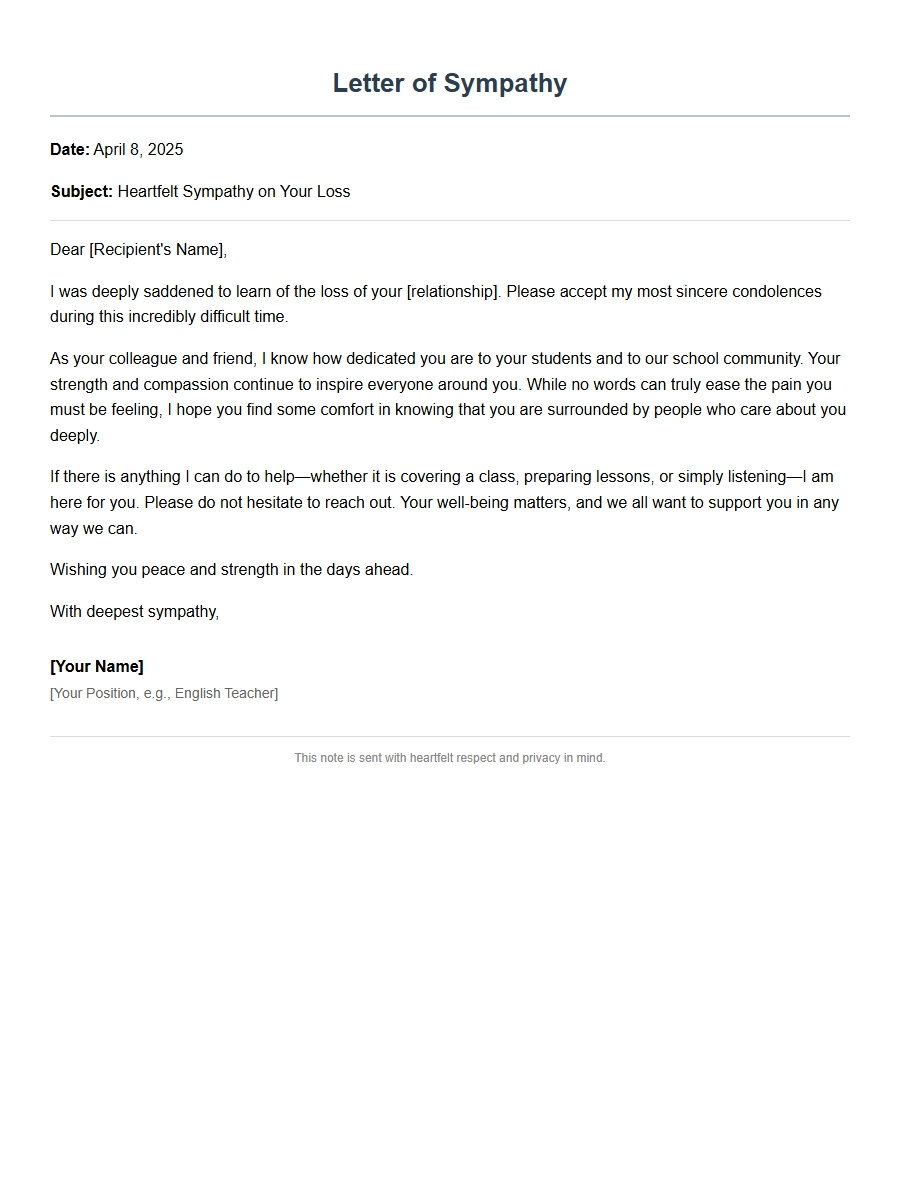 Condolence Words for a Teacher