examples of sympathy messages for husband wife - Condolence Letters
You’re facing one of the hardest things anyone has to do—writing a sympathy message for a friend or family member who just lost their husband or wife. It’s easy to freeze up. You want to say the right thing, but words feel inadequate. That blank page can feel like a wall. Let me help you get past it.
Why using a sample isn’t a shortcut—it’s a starting point
Some people worry that using a letter template or sample means they’re being insincere. That’s not true. A good sample gives you structure, tone, and key phrases so you don’t have to invent everything from scratch. It shows you what a respectful salutation and closing look like. It helps you avoid awkward gaps in your message. Think of it as professional correspondence training wheels—you still write in your own voice, but you don’t fall over.
The best condolence letters feel warm and personal, not like a form letter. A sample hands you a framework. You bring the heart.
How to pick the right tone for a spouse’s loss
Not every sympathy message for a husband or wife should sound the same. The tone depends on your relationship to the person grieving. Are you a close friend, a coworker, a neighbor, a distant relative? Let that guide you.
For a close friend or family member, you can be more direct and emotional. You might say something like, “I don’t have the right words, but I’m here. I’ll never forget how Mike lit up a room. I’ll miss him with you.” That’s honest and specific. It doesn’t try to fix anything—it just shows up.
For a coworker or acquaintance, aim for respectful warmth without overstepping. Something like, “I was so sorry to learn about your husband’s passing. Please know I’m thinking of you during this difficult time.” That’s polite, kind, and leaves space for them to respond however they need to. For more guidance on office-appropriate messages, read about using appropriate language for death in an office setting.
Adapting a sample without losing your authentic voice
The trick to using any customizable letter sample is to read it, then set it aside. Don’t copy it word for word. Take the structure—a brief opening, a memory or quality about the person who died, an offer of support, a kind closing—and fill in your own details.
For example, if a sample says, “I have such fond memories of your wife,” change it to something true for you. “I’ll always remember how your wife made me laugh at the office holiday party. She had a way of making everyone feel included.” That’s concrete. That’s you. That’s the kind of detail that helps a grieving person feel seen.
If you’re writing to someone who isn’t religious, check out secular sympathy message options that focus on shared humanity rather than faith.
Common mistakes to avoid
One of the biggest missteps is using outdated phrases like “He is in a better place” or “It was God’s plan” unless you know the recipient shares that belief. When in doubt, stick to simple, heartfelt statements. Another mistake is ignoring the format. If you’re sending a printed letter, use proper letterhead design or at least clean stationery. If it’s an email, keep the subject line clear: “Thinking of you” works. Don’t use all caps or bright colors in a digital letter format. Keep it quiet and respectful.
Also, proofread. A typo in a sympathy note can feel careless. Read it aloud before you send it. That one extra pass catches awkward phrasing and shows you care enough to check.
Short condolence messages that work
Sometimes you don’t need a full page. A short, direct message can be just as meaningful. For a husband’s loss, you might say: “I’m so sorry for your loss. Your husband was a good man, and I’m thinking of you.” For a wife’s loss: “There are no words. I’m holding you in my heart.” For short condolence text messages, keep it even simpler: “Thinking of you. I’m so sorry.”
If you’re writing to a church community, there are specific conventions that help. Read sympathy letter format for church members for guidance on phrasing that fits that context.
How to structure your letter from start to finish
Here’s a simple letter structure that works for nearly any situation:
Salutation: “Dear [Name],” or “Dear [First Name],” depending on closeness.
Opening sentence: Express sympathy directly. “I was devastated to learn about the passing of your wife.”
Body: Share a specific memory or quality. “I’ll always remember how she volunteered at the school bake sales.”
Offer of support: “If you need anything—a meal, someone to watch the kids, or just a coffee—I’m here.”
Closing: Warm and simple. “With deepest sympathy, [Your Name].”
This format works for formal and informal notes alike. You just adjust the tone in writing based on who you’re addressing.
The best sympathy messages leave the door open. You’re not trying to wrap everything up in a neat package. You’re saying, “I see you, I’m here, and I’ll still be here next week.” Use the sample as a springboard—get the structure down, then pour in your own memories and care. Over time, writing these notes gets easier. You learn what lands and what doesn’t.
For now, just start. Pick a sample, personalize it, read it once out loud, and send it. You’ll be glad you did—and so will the person who receives it.
Helpful Examples
examples of sympathy messages for husband wife - Condolence Letters
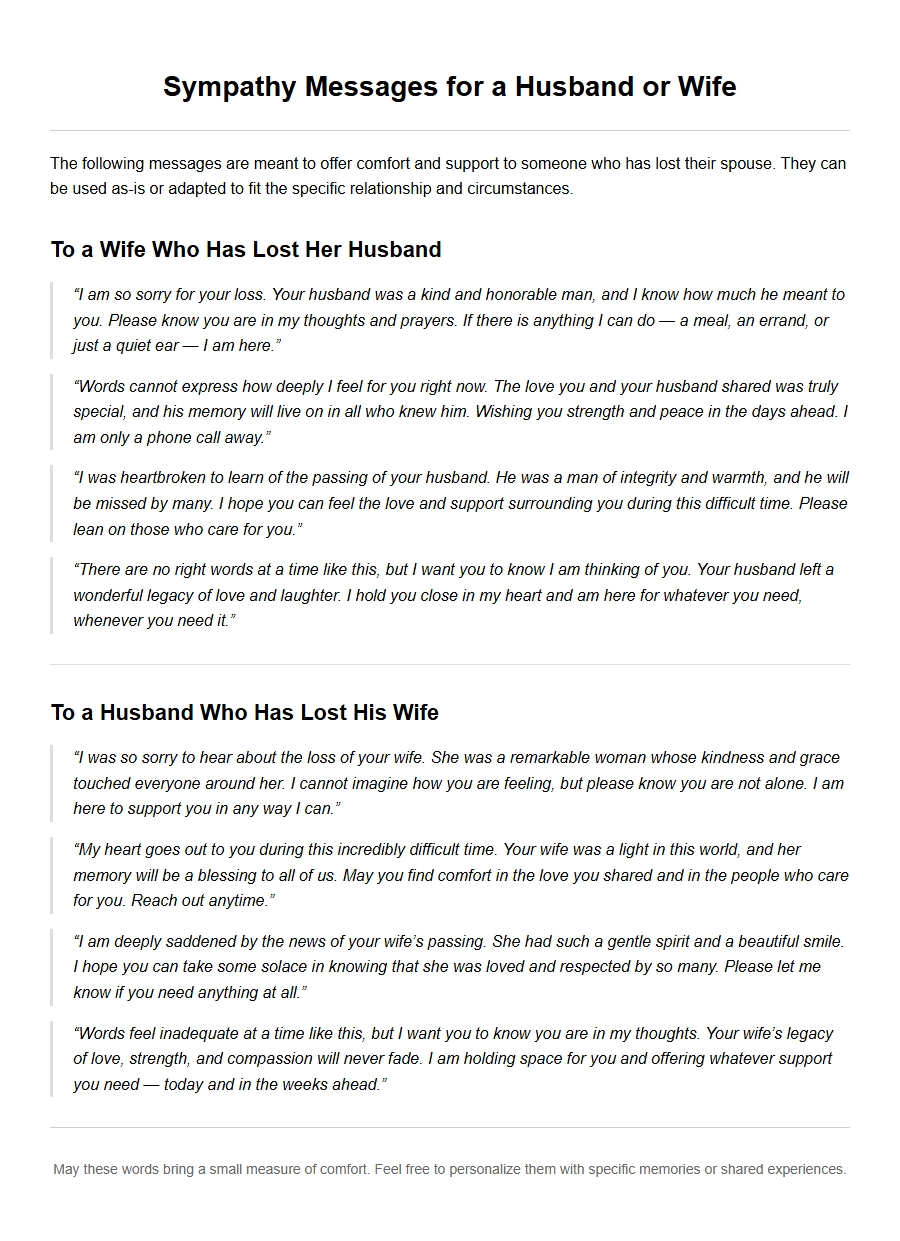
For the Loss of a Beloved Husband
Dear [Recipient's Name],
We were heartbroken to hear about the passing of your dear husband, [Name]. He was a man of great kindness, strength, and warmth, and his presence will be deeply missed by everyone who knew him.
During this difficult time, we hope you find comfort in the love and support of family and friends. Please remember that we are here for you, whether you need a listening ear, a helping hand, or simply a quiet moment together.
With heartfelt sympathy, [Your Name]
For the Loss of a Cherished Wife
My dearest [Recipient's Name],
I am so sorry to learn of the passing of your beloved wife, [Name]. She was a remarkable woman whose grace, intelligence, and compassion touched so many lives. The bond you shared was truly special.
May the memories of your life together bring you some peace in the days ahead. I know that words cannot fully ease your pain, but please take comfort in knowing that I am thinking of you and am here to support you in any way I can.
With deepest sympathy, [Your Name]
Short and Simple Sympathy
Dear [Name],
I was deeply saddened to hear about the loss of your [husband/wife]. Please accept my heartfelt condolences. [He/She] will be remembered with great affection.
Thinking of you during this painful time.
With sympathy, [Your Name]
Sympathy with Memories
Dear [Recipient's Name],
I will always treasure the memories I have of your wonderful [husband/wife], [Name]. From our shared laughter at family gatherings to the quiet, wise advice [he/she] offered, [Name] left an indelible mark on my heart.
Some of my favorite memories include:
The way [he/she] always remembered everyone's birthday with a thoughtful card.
How [he/she] would tell stories with such warmth and humor.
The countless hours [he/she] spent volunteering in our community.
May these and all your precious memories bring you comfort. You are in my thoughts and prayers.
With love and sympathy, [Your Name]
Offering Practical Support
Dear [Recipient's Name],
I was so sorry to hear about the loss of your [husband/wife]. During such a difficult time, it can be hard to manage day-to-day tasks. Please know that I want to help in any way that works for you.
Here are a few things I can do over the next week, if it would ease your burden:
Task
Available Times
Bring homemade meals
Monday, Wednesday, or Friday
Pick up groceries or errands
Any afternoon
Watch the children for a few hours
Saturday afternoon
Help with correspondence or calls
Anytime, just let me know
There is no need to respond immediately—simply call or text when you are ready. I am thinking of you.
With deepest sympathy, [Your Name]
Sympathy from a Colleague
Dear [Recipient's Name],
On behalf of everyone at [Company Name], I want to express our deepest condolences on the passing of your [husband/wife], [Name]. We know how much [he/she] meant to you, and we share in your sorrow.
We have arranged for a small collection of flowers to be sent to the service, and we are also organizing a meal train for the coming weeks. Please let us know if there is anything else we can do to support you during this time.
You have our heartfelt sympathy.
Sincerely, [Your Name] [Your Position]
Religious Sympathy Message
Dear [Recipient's Name],
I was so sad to learn of the passing of your dear [husband/wife]. May God wrap you in His loving arms and grant you peace that surpasses all understanding. [Name]'s faith was a shining example to all of us, and I find comfort knowing [he/she] is now in the presence of the Lord.
I am praying for you daily, asking for strength, comfort, and hope. Please lean on your faith and the community that loves you.
With prayers and sympathy, [Your Name]
Sympathy for a Long Marriage
Dear [Recipient's Name],
I was deeply moved to hear about the loss of your beloved [husband/wife]. After [number] years of marriage, your bond was truly extraordinary. I know that the depth of your love also means the depth of your grief.
Please remember that you are not alone. Your children and grandchildren, and all of us who have watched your beautiful partnership over the years, are here to support you. [Name]'s legacy of love will live on through your family.
Holding you close in my heart.
With love and sympathy, [Your Name]
Sympathy When You Cannot Attend the Service
Dear [Recipient's Name],
I was so sorry to hear the news about your [husband/wife]. I deeply regret that I will be unable to attend the funeral service due to [brief reason, e.g., being out of town], but please know that I am thinking of you and holding you in my heart.
I have arranged for a donation to be made in [Name]'s memory to [Charity Name], which was a cause [he/she] cared about deeply. A card is also on its way with a small keepsake to remind you of my love and support.
With heartfelt sympathy, [Your Name]
Sympathy for the Loss of a Spouse Who Suffered Long Illness
Dear [Recipient's Name],
After such a long and courageous battle with illness, your [husband/wife] [Name] is finally at peace. I know that does not make the loss any easier—you have been through so much as a caregiver and partner. Please accept my deepest sympathy.
Now it is time for you to rest and to allow others to care for you. I hope you find comfort in the knowledge that [Name] is free from pain, and that your devotion made [his/her] final journey lighter. You are in my constant thoughts.
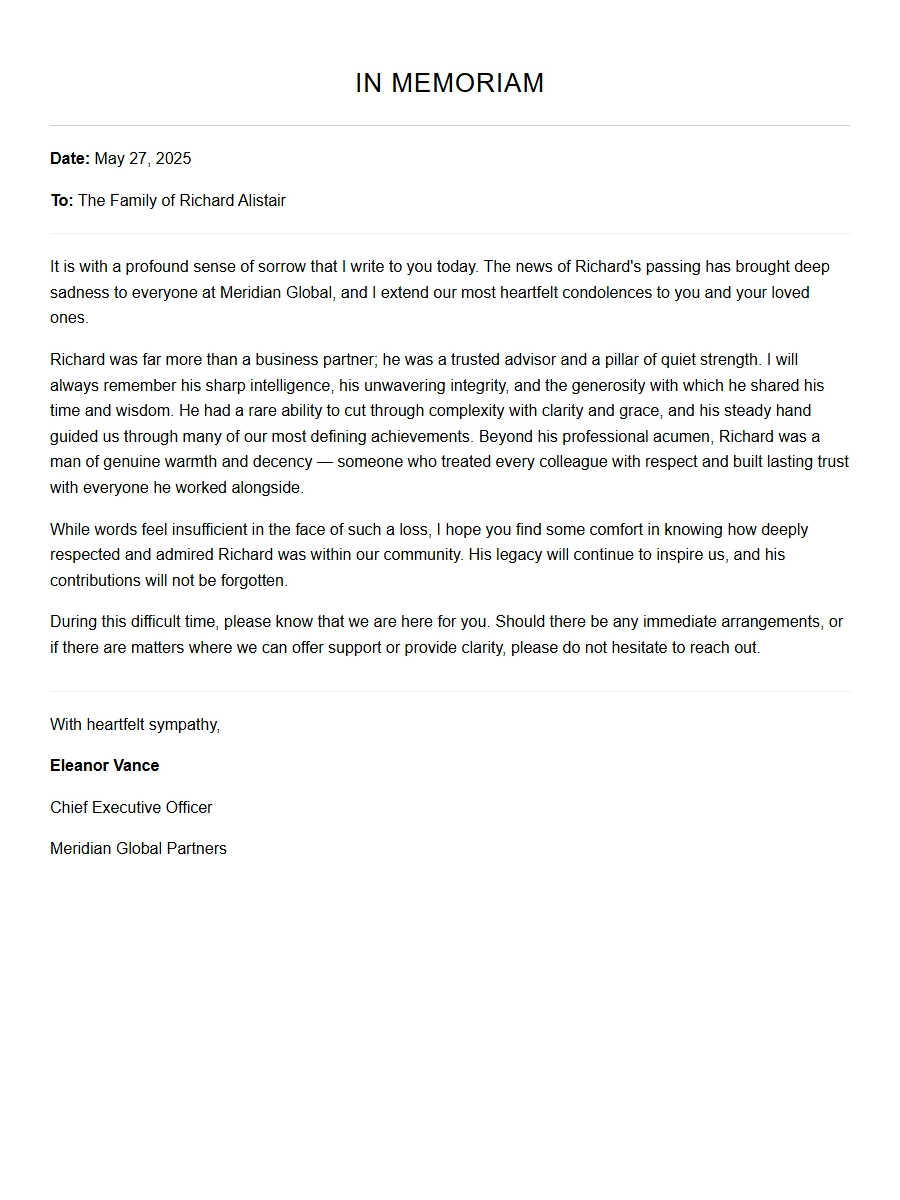 Formal Condolence Message for a Business Partner
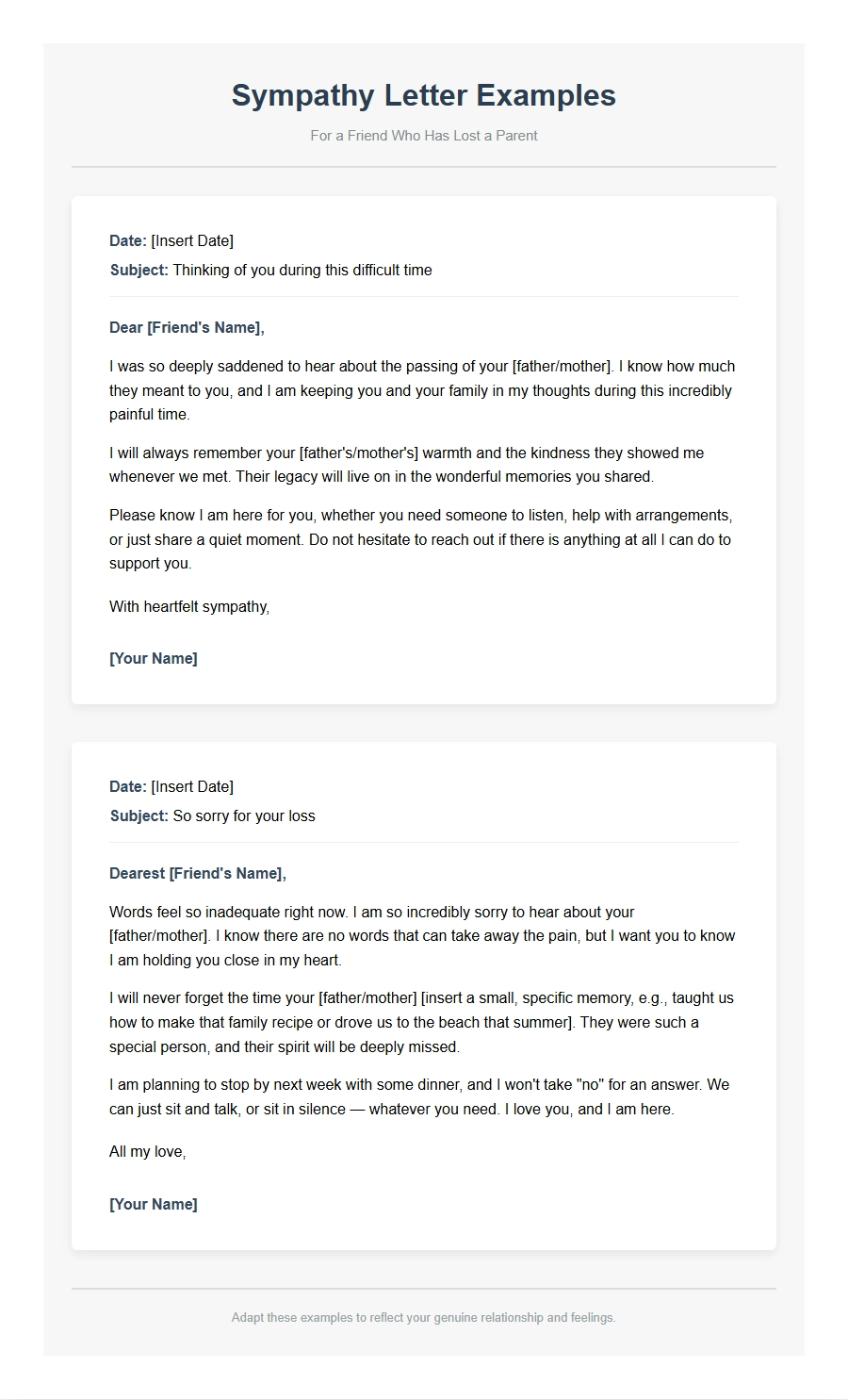 Sympathy Letter Examples for a Friend Who Lost a Parent
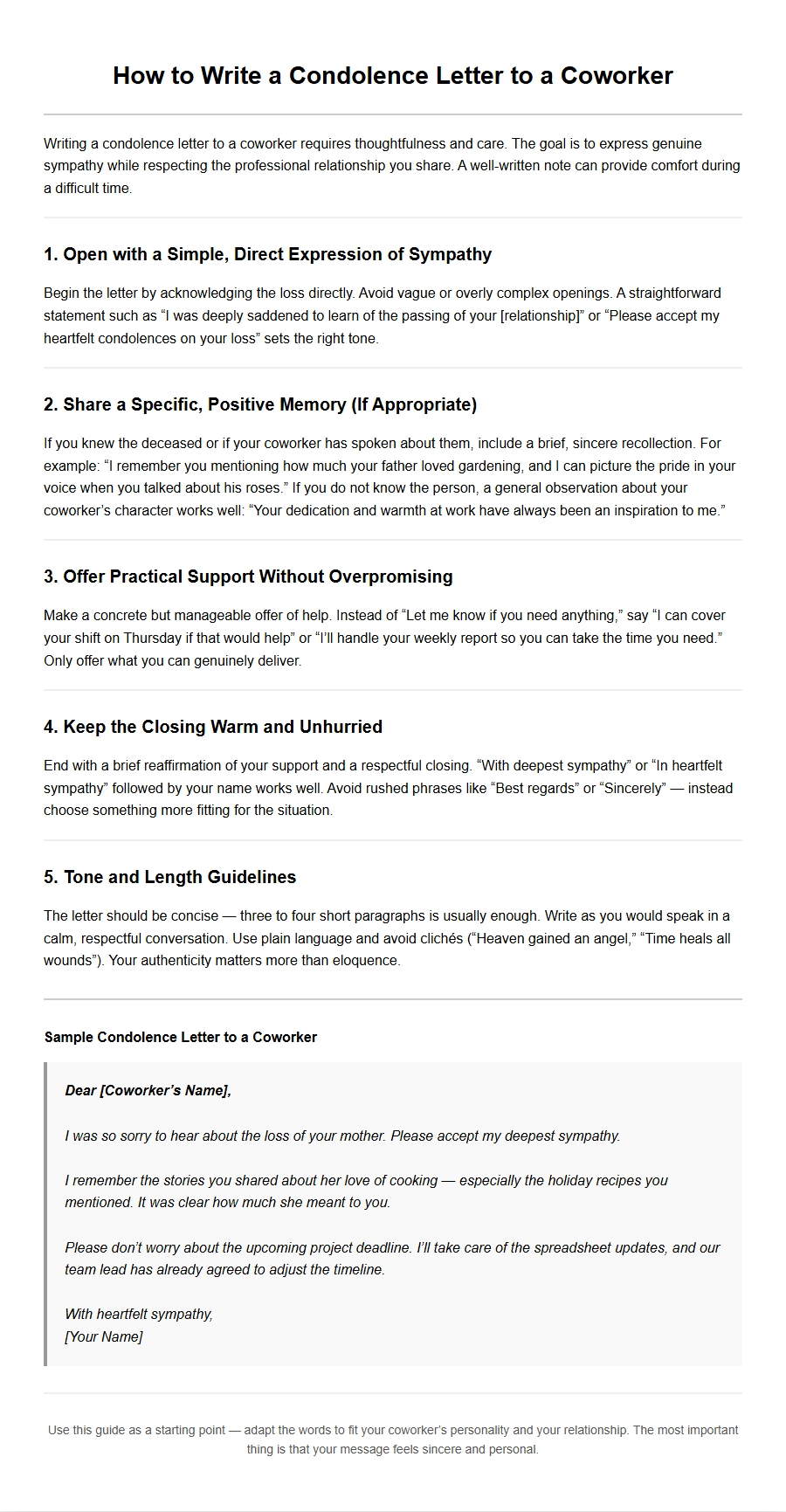 How to Write a Condolence Letter to a Coworker
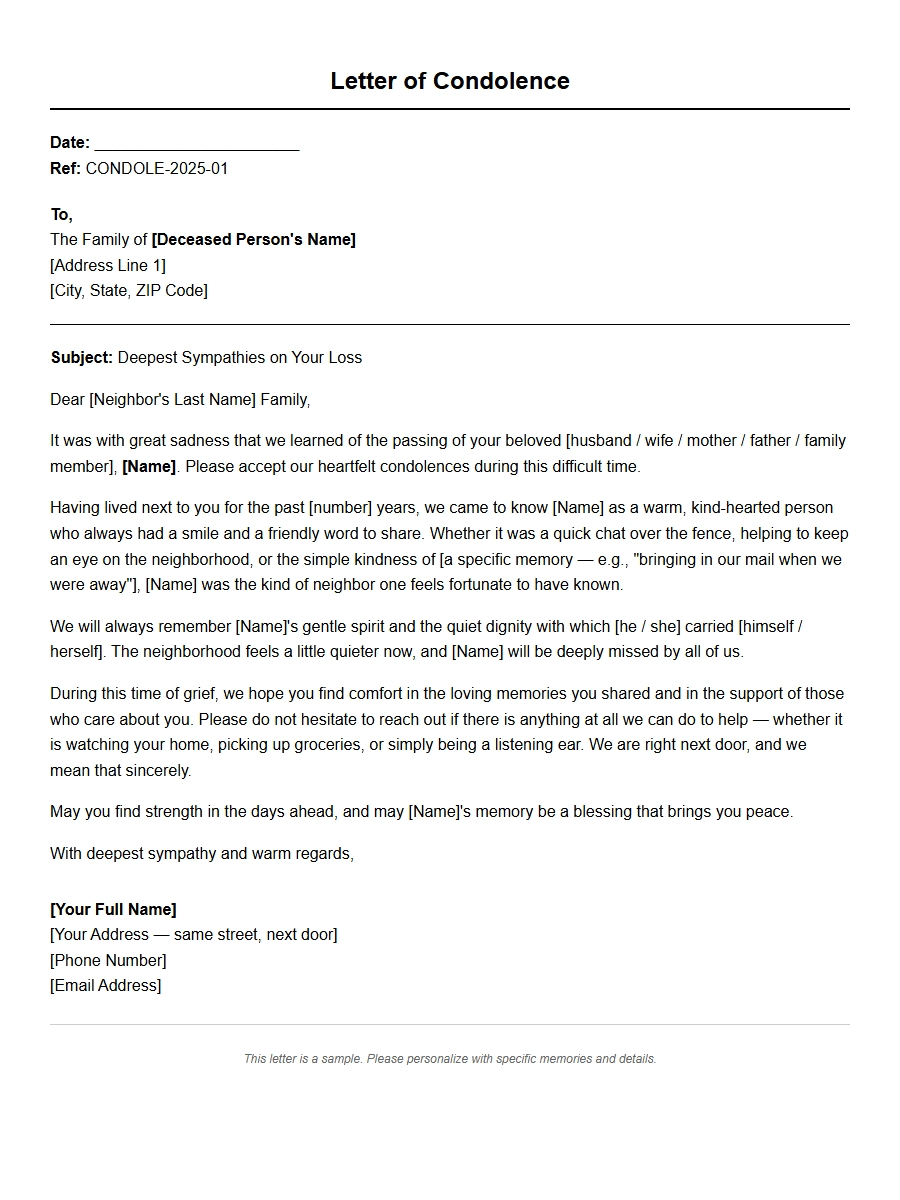 Condolence Letter Sample for a Neighbor
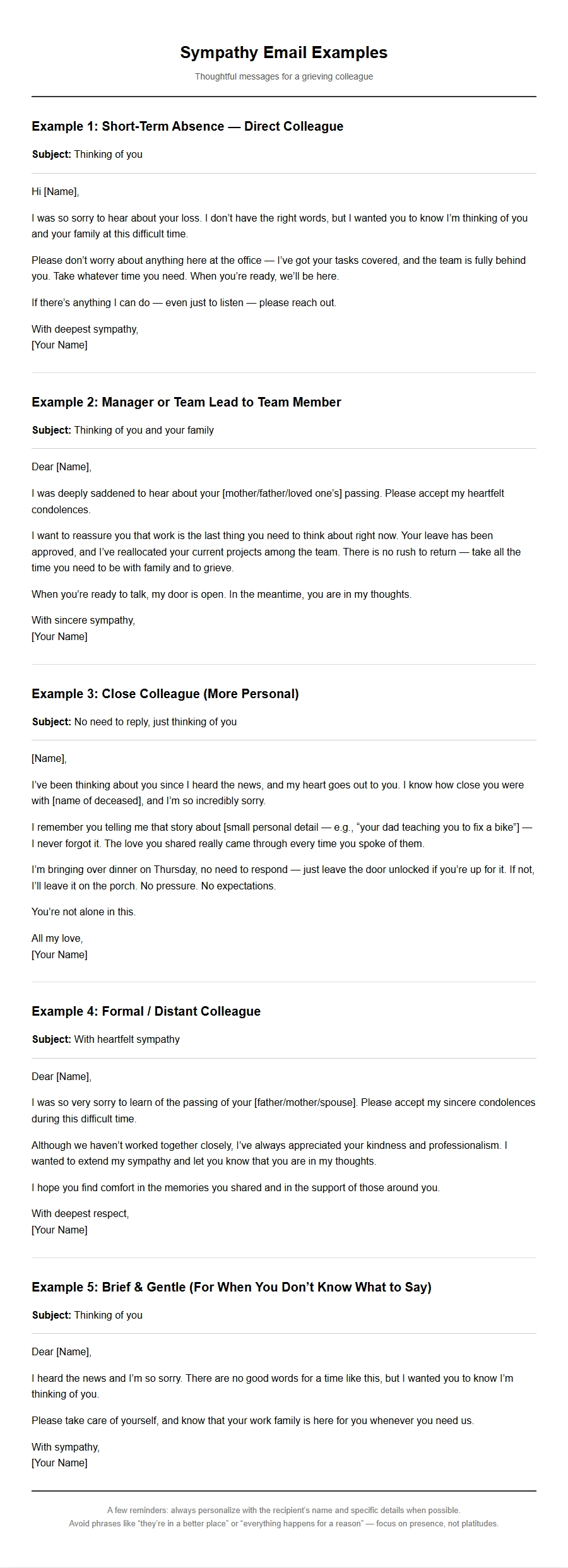 Sympathy Email Examples for a Grieving Colleague
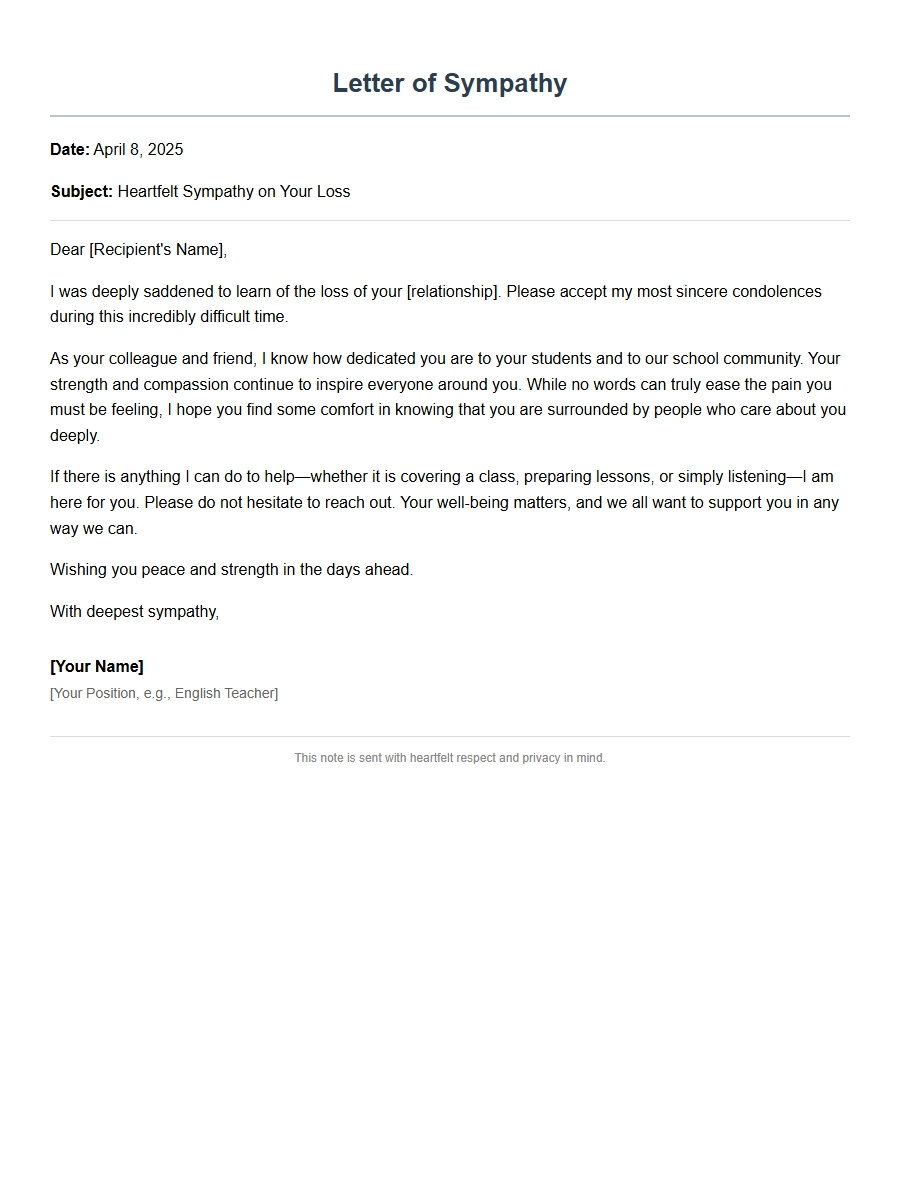 Condolence Words for a Teacher