Comforting Email for a Grieving Friend with Anxiety
You want to say something, but every draft sounds either too cold or too heavy. Your friend is grieving and also struggling with anxiety, so you're worried that a wrong word might sting or that silence might feel worse. That knot in your chest is real. You're not alone in feeling stuck.
Using a sample email as your starting point isn't cheating. It's a smart way to borrow structure and tone while keeping your authentic voice. A good template gives you a framework: a warm salutation, a clear opening that names the grief without forcing it, a few sentences that acknowledge the anxiety, and a closing that leaves the door open. You fill in the rest with your specific memories and the kind of support only you can offer.
Category: Grief & Anxiety Support
What makes this email different from a standard condolence note?
Your friend's anxiety means they might overthink every line. They could read your message and wonder, "Does she really mean that?" or "Am I a burden?" So the tone in writing matters more than ever. You want to sound warm but not pushy, supportive but not prescriptive. Avoid phrases like "you should" or "at least." Instead, use "I've been thinking of you" or "I'm here whenever you feel like talking, even if it's just a silly meme."
Choosing the right structure for your email
Email format matters. A clogged subject line or a stiff salutation can feel off before your friend even reads the body. For a comforting email, keep the subject short and gentle: "Thinking of you," "No need to reply," or just their name. Use a salutation you'd use in person: "Dear [Name]," or "Hey [Name]," depending on your relationship. The closing should match too: "With love," "All my care," or simply "Your friend."
The body of the email should have a natural flow. First, acknowledge their grief and the anxiety separately. You might say, "I know this loss is incredibly painful, and I can only imagine how much your mind must be racing right now." Then offer a specific memory or a gentle question that doesn't demand an answer: "Remember that time we laughed until we cried at your mom's kitchen table? I'm holding that memory close." Finally, offer a concrete but low-pressure way to help: "I'm free on Tuesday afternoon if you want company, or I can drop off groceries and leave them at the door. No need to decide now."
Avoiding common mistakes
One trap is using a letter structure that feels too formal. This is not a business letter format. Skip the "To Whom It May Concern" and the formal business letter format entirely. Another mistake is writing too long. A friend with anxiety may feel overwhelmed by a wall of text. Keep paragraphs short, maybe two or three sentences each. Proofreading your email before sending is worth the extra minute—typos or awkward phrasing can distract from your genuine care.
Adapting a sample without losing your voice
Start with a customizable letter template you trust. Maybe you find one that says, "I am so sorry for your loss. Please know I am thinking of you." That's fine, but then add your own spin. Swap "I am sorry" for "My heart aches for you." Add a specific memory or a shared joke. If your friend uses humor to cope, a light reference can be comforting—but only if you're sure they'll receive it well. The best letters feel both professional and personal, even in a casual email to a friend.
If you need more inspiration, look at our collection of heartfelt sympathy messages for different approaches. For a situation where you're writing to honor a mentor, this example letter might help you understand how to balance respect and warmth. And if you're unsure how to talk about death without using the word "dead," this guide offers alternatives that feel more gentle.
Offering help without pressure
Anxiety often makes people feel like they should handle everything alone. Your email can gently push back against that. Instead of "Let me know if you need anything," try something specific: "I'm picking up flowers this weekend—can I bring you a bunch?" or "I ordered takeout and have extra—can I drop some off tomorrow?" For more ideas on offering help gracefully, this page covers practical approaches. And if you're considering sending flowers instead of cash, this guide explains how to phrase that.
A final thought
A sample email is a springboard, not a crutch. Once you've written a few drafts, you'll find your own rhythm. The more you practice writing to a friend in pain, the more naturally the words come. And even if your first attempt isn't perfect, your friend will remember that you reached out. That act of reaching out is the most important part.
Extra Samples
Comforting Email for a Grieving Friend with Anxiety
A Gentle Check-In
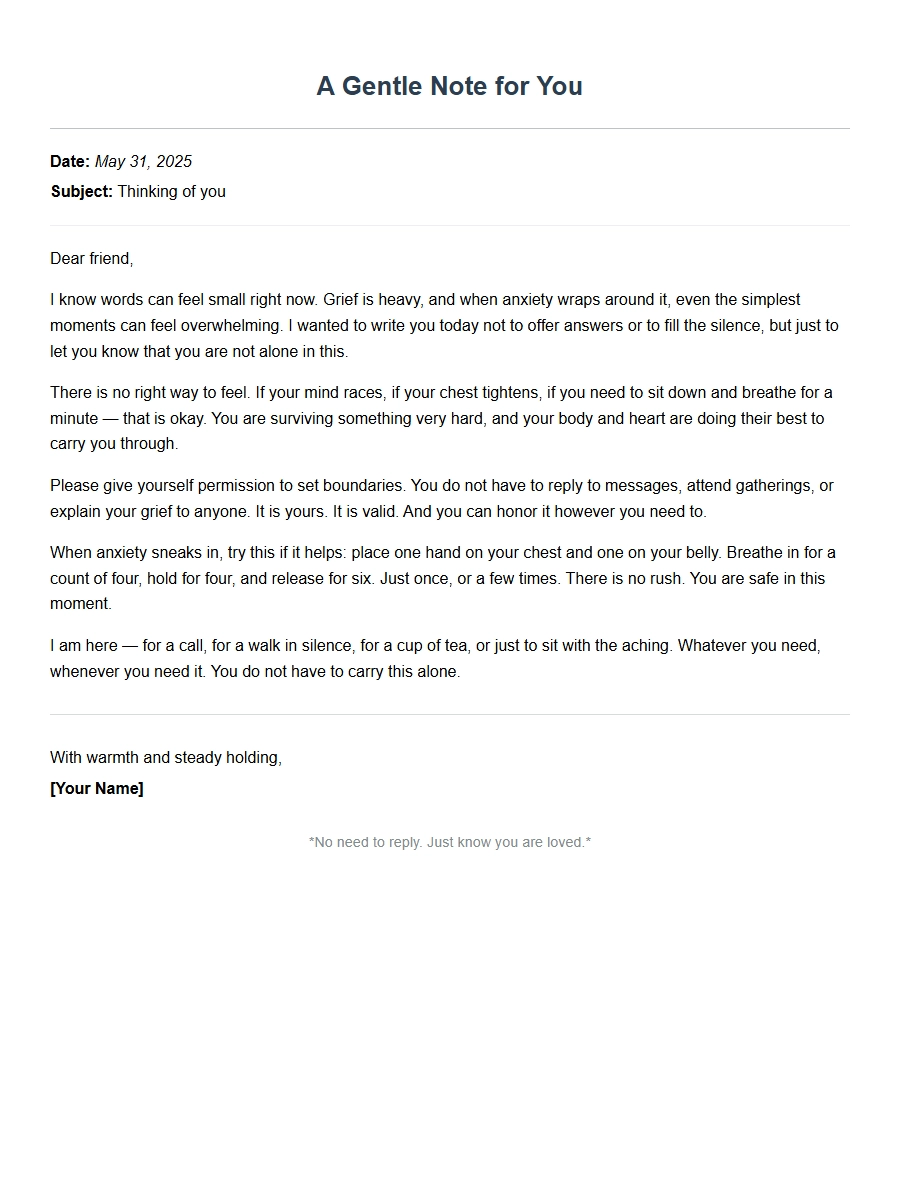
Dear [Friend's Name],
I hope this email finds you in a moment of quiet. I know you're carrying so much right now, and it's completely okay if today is one of those days where everything feels heavy. There's no need to respond at all.
Grief and anxiety often walk hand in hand. Please remember that your feelings are valid—every single wave of sadness, fear, or numbness. I'm holding space for you, exactly as you are.
If you'd like, we could just sit together sometime, no words needed. A walk, a cup of tea, or a quiet video call. Whatever feels most manageable for you.
You are not alone in this. I'm here whenever you're ready, even if that's next week or next month.
With warmth, [Your Name]
Permission to Rest
Hello [Friend's Name],
I've been thinking of you. Please know it's more than okay to say no to things right now. You have full permission to rest, to cry, to stare at the wall, or to distract yourself. There are no rules.
When anxiety creeps in alongside grief, it can feel like your mind is running a marathon. Try these gentle reminders when it gets loud:
Breathe slowly: in for 4 counts, hold for 4, out for 6.
Name one thing you can see, one sound you hear, and one texture you feel.
Remember that this moment will pass, even if it feels endless.
I'm not going anywhere. You can reach out at 3 AM or ignore me for weeks—either is fine. I care about you, no matter what.
Yours, [Your Name]
Little Steps Forward
Hi [Friend's Name],
I wanted to share something small that helped me when I felt overwhelmed by grief and anxiety. It's okay if it doesn't work for you—we all handle things differently.
Sometimes, setting just one tiny intention for the day can ease the pressure. Here's a simple list you might try:
Time of Day
Possible Small Step
Morning
Drink a glass of water and stretch for 30 seconds
Afternoon
Step outside for 5 minutes or open a window
Evening
Write down one thing you're grateful for, even if it's small
There's no pressure to do any of this. Just knowing you have options can sometimes quiet the noise. I'm proud of you for getting through today, moment by moment.
Thinking of you, [Your Name]
Sharing the Load
Dearest [Friend's Name],
I know grief can feel isolating, especially when your anxiety whispers that no one truly understands. But I want you to know I'm here, and I want to help carry some of the weight, if you'll let me.
Here are a few practical things I can do for you this week, no questions asked:
Pick up groceries or a meal and leave it at your door.
Help with errands you've been putting off.
Just listen on the phone without offering advice.
You don't have to figure everything out alone. Lean on me when you need to. Grief is heavy, but we can share the load.
With all my love, [Your Name]
Remembering the Light
Dear [Friend's Name],
In the midst of your grief and anxiety, I wanted to remind you of a few things you might have forgotten today. You are stronger than you feel, braver than you believe, and loved more than you know.
It's okay to feel torn—wanting to hold onto memories yet hurting because of the loss. Both can exist at once. Let yourself feel everything without judgment.
Whenever you're ready, I'd love to hear a favorite story about your loved one if you'd like to share. No pressure. We can laugh or cry together, whichever comes first.
You are cherished. Don't ever doubt that.
Always, [Your Name]
When Night Feels Longest
Hello [Friend's Name],
I know nighttime can be especially hard when grief and anxiety settle in. The quiet amplifies everything. If you find yourself awake and struggling, here are a few things that might help:
Try a calming tea or warm water with lemon.
Listen to a gentle playlist or a familiar audiobook.
Place a hand on your chest and take slow breaths.
Write down whatever is racing in your mind—even if it doesn't make sense.
You can always text me, even if it's 2 AM. I might not reply instantly, but I will when I wake up. You don't have to face the dark alone.
Rest well, [Your Name]
A Quiet Space for You
Dear [Friend's Name],
I've been thinking about how overwhelming it must feel to navigate grief while managing anxiety. Please know that there is a quiet space here for you—no expectations, no timelines, no pressure to be okay.
You might find comfort in simple routines. Here's a suggestion for a gentle day if you're feeling lost:
Activity
How It Might Help
Take a warm shower
Grounding and soothing
Read a few pages of a light book
Gentle distraction
Pet an animal or soft fabric
Calming the nervous system
There's no rush. Take whatever time you need. I'll be right here when you're ready to reach out.
With care, [Your Name]
Honoring Your Feelings
Hi [Friend's Name],
I wanted to send you this note to say: your feelings are allowed. Every tear, every worry, every moment of disbelief. Grief doesn't follow a schedule, and anxiety often makes it more intense.
Please don't apologize for how you're coping. Whether you're crying, laughing at a memory, or feeling numb—it's all part of your unique journey. You don't have to perform strength for anyone, least of all me.
If you need to vent, I'm here to listen. If you need silence, I can sit with you in that too. Whatever you need, I'm ready.
You are not too much. You are exactly enough.
Forever your friend, [Your Name]
A Gentle Reminder for Tomorrow
Dear [Friend's Name],
As you prepare for another day, I wanted to leave you with a few grounding thoughts. Grief and anxiety can make tomorrow feel terrifying, but you've survived every hard day so far.
Remember these three things for tomorrow morning:
Breathe before you move. Pause for three deep breaths before getting out of bed.
Set a tiny goal. Even just brushing your teeth or making toast counts as a win.
Give yourself grace. If you can't do everything, that's okay.
I'll check in with you tomorrow afternoon, just to say hello. No pressure to reply. Rest tonight, and know you are loved.
Sleep well, [Your Name]
An Offer of Company
Hello [Friend's Name],
I know grief can make you want to hide away, and anxiety can make social contact feel impossible. But I wanted to offer a gentle invitation, with no strings attached.
Sometimes, just being in the same room with someone, doing your own thing, can ease the loneliness. Here are some options:
Activity
Why It Works
Parallel reading or working
Company without conversation
Watching a simple, comforting show
Shared focus, less pressure to talk
Taking a short, quiet walk together
Fresh air and movement
We can stay in, go out, or simply be silent together. Whatever feels safe. Just say the word, and I'll be there.
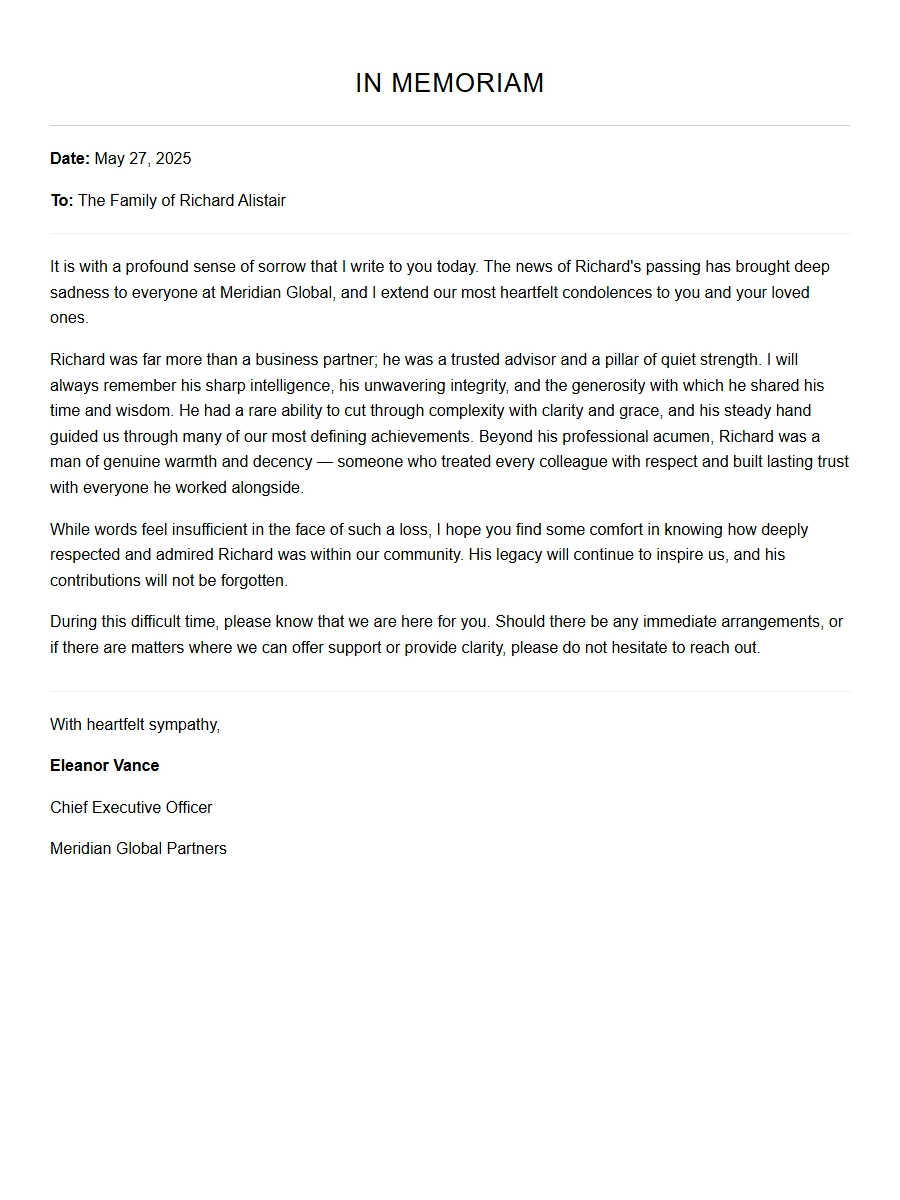 Formal Condolence Message for a Business Partner
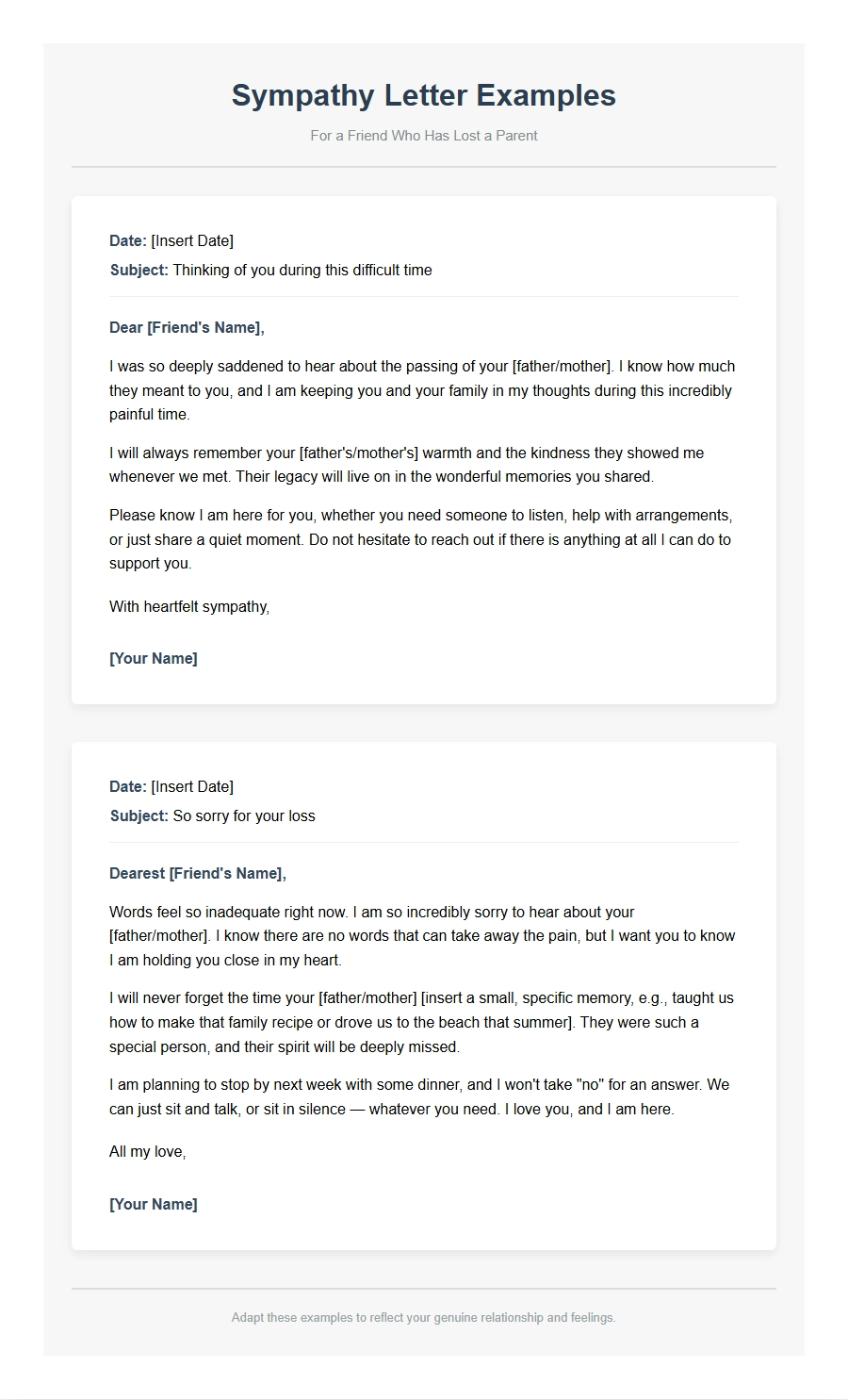 Sympathy Letter Examples for a Friend Who Lost a Parent
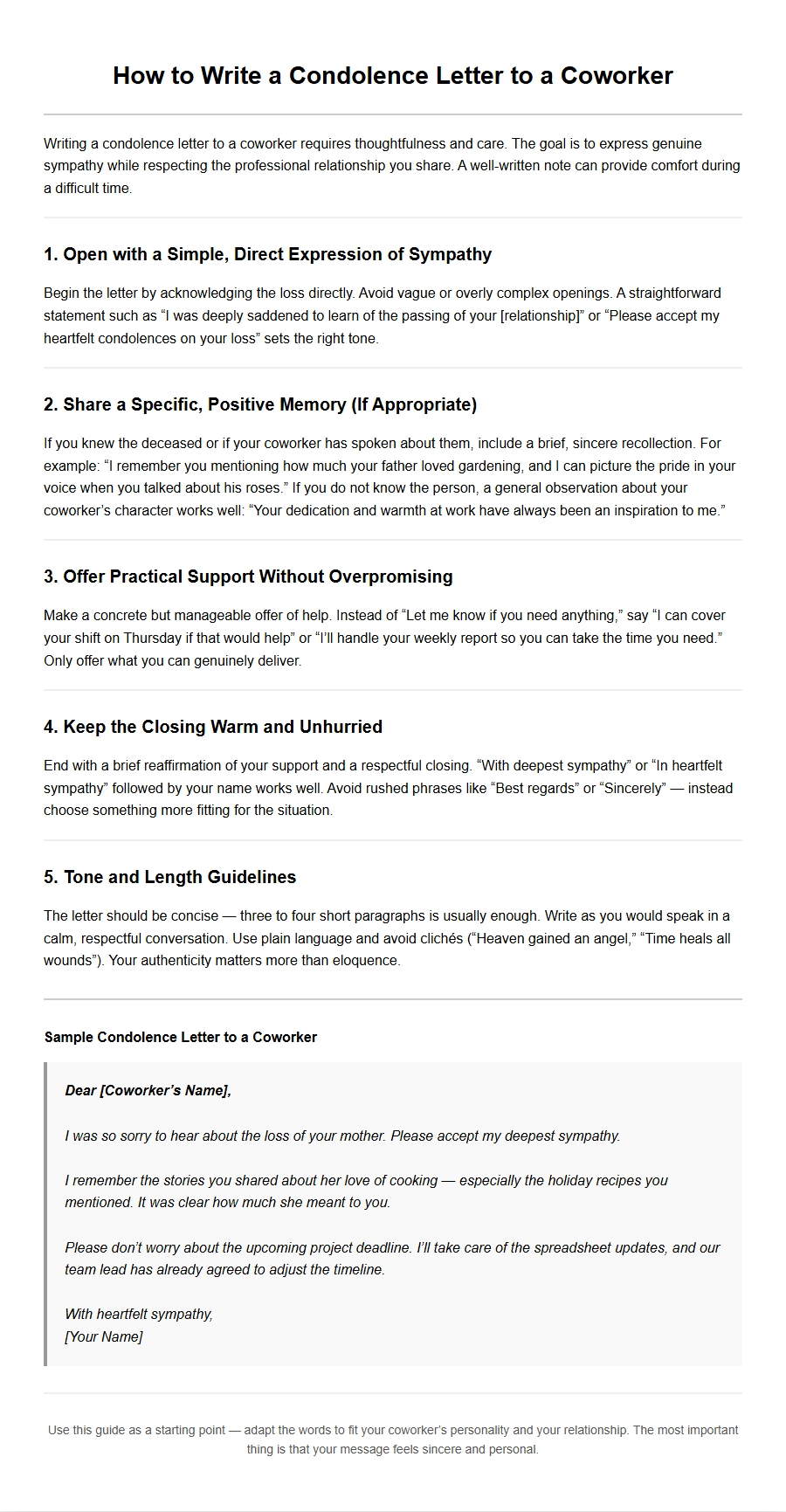 How to Write a Condolence Letter to a Coworker
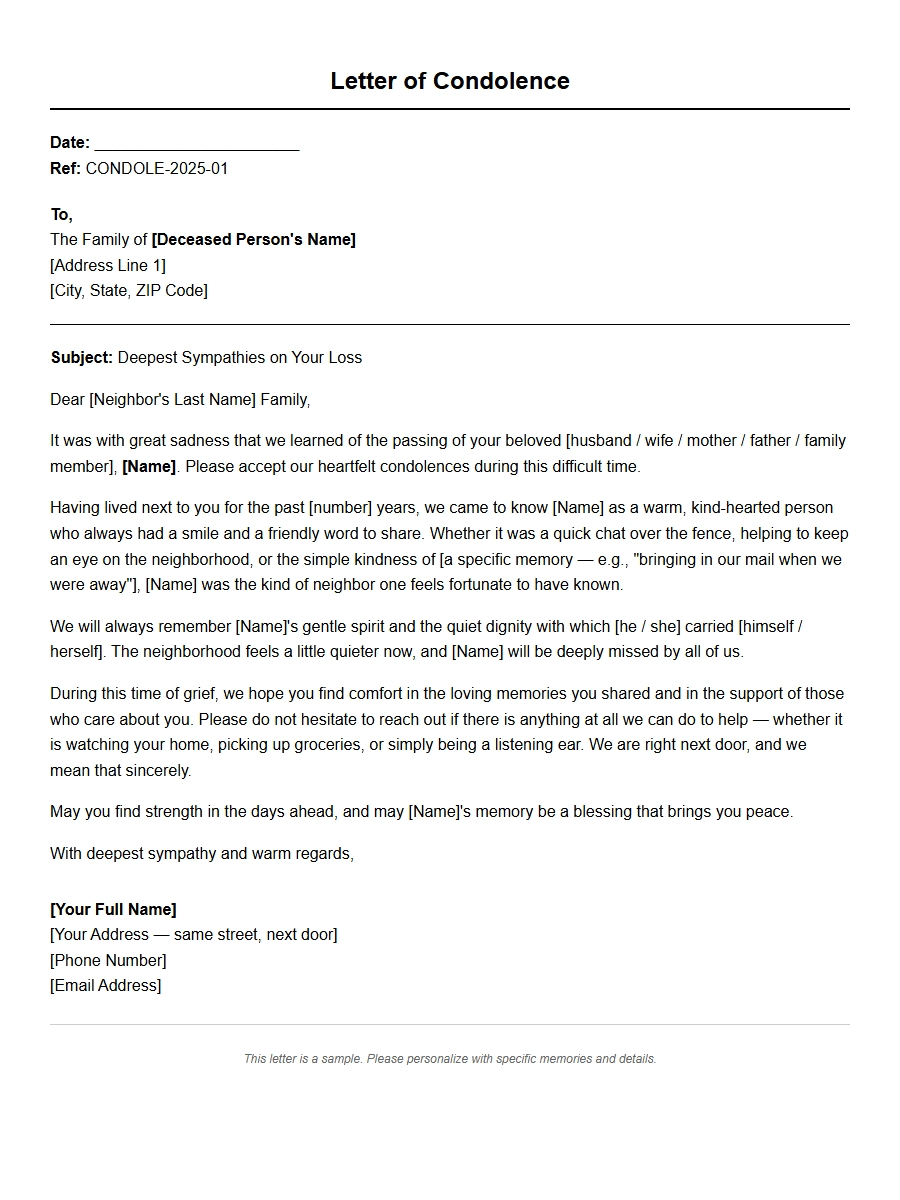 Condolence Letter Sample for a Neighbor
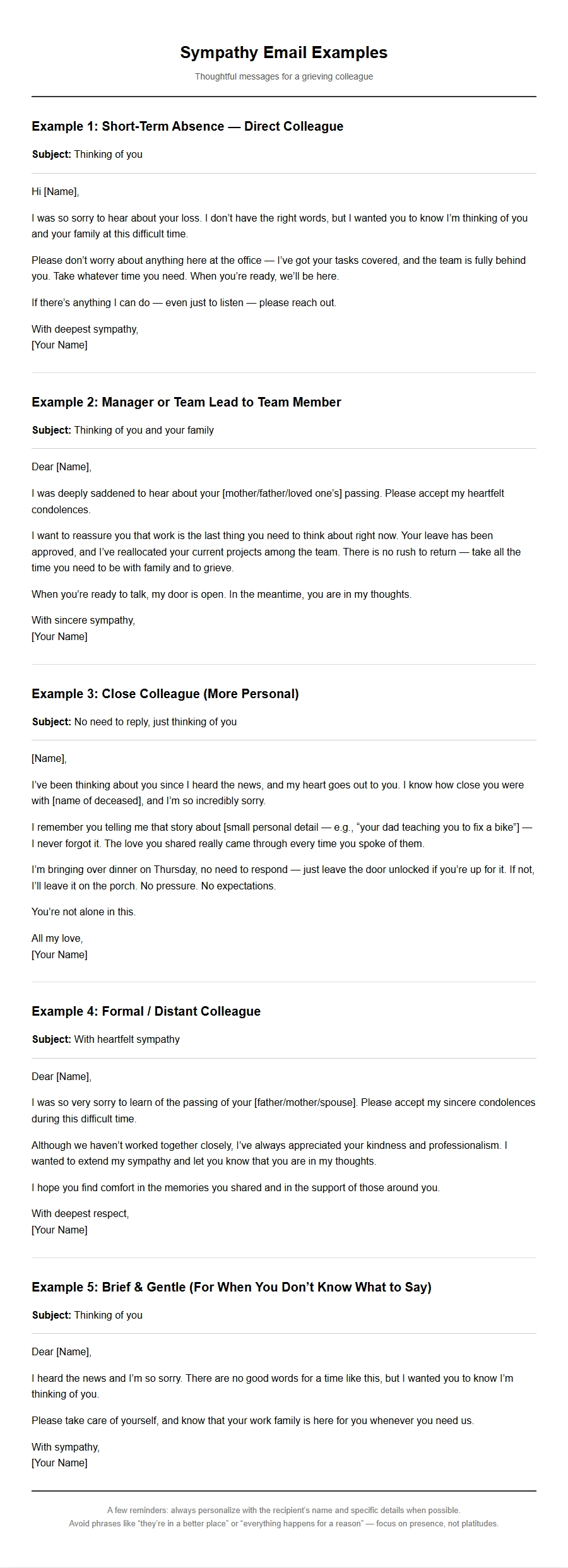 Sympathy Email Examples for a Grieving Colleague
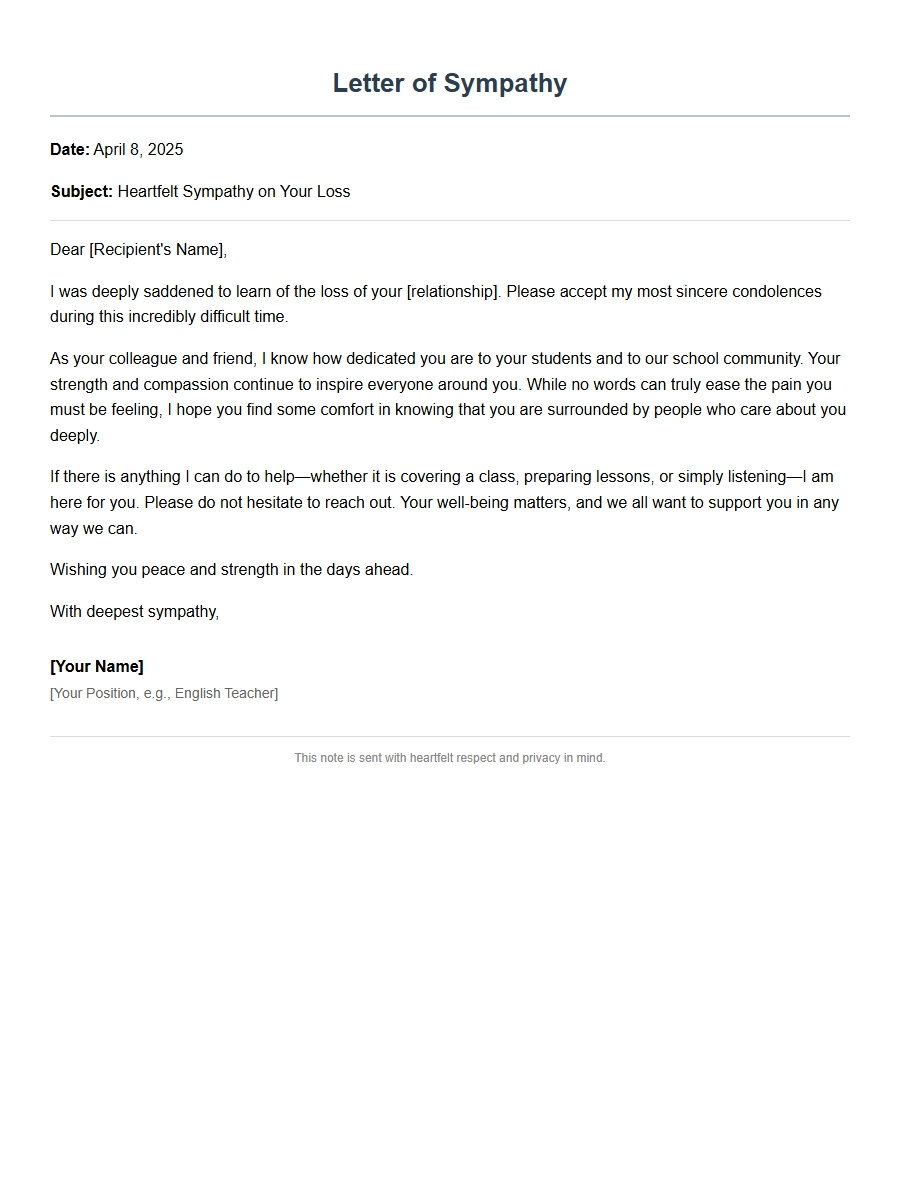 Condolence Words for a Teacher