Staring at a blank page when you need to write a letter about the loss of an ex-spouse can feel uniquely difficult. You're navigating grief that others might not fully understand, and finding the right words—especially when children, mutual friends, or legal ties are still in the picture—can stop you cold. But a solid sample letter gives you a starting point that turns that anxiety into a draft you can actually send.
Using a letter template isn't cheating. It's a smart way to handle a sensitive situation without getting stuck on structure or tone. A good sample gives you the format, the salutation, and the pacing, so you can focus on what you actually want to say. You're still writing in your own voice—you just have a roadmap.
But not every sample fits every situation. The letter you send to your ex-spouse's parents will sound different from one you write to a mutual friend or a lawyer handling estate matters. The key is choosing the right starting point and then adapting it so it feels like you, not a form letter.
When you'd need a sample letter for loss of an ex-spouse
You might write this kind of letter to express sympathy to the family, to acknowledge the loss for your children's school or activities, or to communicate formally with an executor or attorney. Sometimes you just need to send a brief, respectful note to people who knew you both, and a sample helps you strike the right balance between personal and appropriate.
Choosing the right tone for your situation
Tone matters more here than with almost any other letter. You and your ex-spouse may have parted amicably, or the split may have been painful. The letter should reflect your actual relationship—not a forced version of it. If you remained close friends, a warmer, more personal tone works. If the relationship was distant or difficult, a simple, respectful acknowledgment is better.
For example, if you're writing to your ex's parents, you might say something like, "We shared a lot of years together, and I will always remember the good times." That's honest and kind without pretending the relationship was something it wasn't. If you're writing to your adult children about their other parent, the tone shifts again—it's more about supporting them than about your own feelings.
What to include in the letter
Most condolences or connection letters follow a similar structure, and a sample gives you that framework. You'll typically include an opening that acknowledges the loss, a sentence or two about your connection to the person who died, and a closing that offers support or simply expresses sympathy. The best letters are short—three or four sentences usually do the job.
One common mistake is overwriting. People try to explain the relationship or justify why they're writing, and the letter becomes awkward. Instead, trust that the recipient understands the context. A simple line like, "I'm sorry to hear about your son. Even though we weren't married anymore, I'll always remember his kindness" is enough.
Adapting a sample without losing your voice
When you find a sample you like, read it through once, then set it aside. Write the key points you want to make in your own words. Then check the sample to see if you missed anything important—like a proper salutation or a closing line. The sample should guide you, not dictate every word.
If the sample uses formal language and you're not a formal person, change it. "Dear Mr. and Mrs. Smith" can become "Dear Sarah and Tom" if that's your relationship. The point is to sound like yourself, but with the structure a sample provides.
Formatting and delivery—digital vs. printed
Whether you send a printed letter or an email depends on the relationship and the situation. A formal letter to an executor or estate attorney should follow standard business letter format, with a clear subject line, salutation, and closing. A note to a mutual friend can be an email or even a handwritten card, as long as the tone matches the medium.
If you're sending a digital letter, keep the format simple. No fancy fonts or elaborate designs. A clean, readable email with a short subject line like "Thinking of you" or "With sympathy" is all you need.
Common mistakes to avoid
The biggest mistake people make is trying to sound too formal or too casual when neither fits. If you never called your ex's parents by their first names, don't start now. Use the same level of formality you always used with them.
Another mistake is using outdated salutations. "To whom it may concern" sounds cold in a situation that calls for warmth. If you don't know the recipient's name, try "Dear family of [name]" or "Dear friends of [name]."
Also, proofread carefully. A typo in a sympathy letter can feel careless, even if it wasn't. Read the letter out loud before you send it. If a sentence feels stiff or unnatural, rewrite it.
When the loss is sudden or unexpected
If your ex-spouse died in an accident or without warning, the letter may need to address that directly. A condolence phrase for an unexpected accident death can help you acknowledge the shock without making it worse. You don't need to dwell on the circumstances—just a simple recognition that the loss was sudden often feels appropriate.
Religious or secular approaches
If you and your ex-spouse shared a faith, you might include a brief religious sentiment in your letter. A religious condolence letter example for Christian families can give you the right phrasing. But if you're unsure about the family's beliefs, a secular message is safer. Secular sympathy message options let you express care without assuming a shared faith.
Word choice matters
Some words feel too harsh or too clinical. If "dead" or "died" feels uncomfortable, you can say "passed away" or "is no longer with us." But don't get so vague that the letter sounds evasive. A guide to writing a letter without using the word dead can help you find alternatives that still feel direct and honest.
After the letter—following up
Sometimes after you send a letter, you receive a thank-you note or a gift from the family. If that happens, a brief reply is thoughtful. A thank-you note for sympathy gifts doesn't have to be long—just a sentence or two acknowledging their kindness.
Let the sample be your springboard
The best letters feel both professional and personal. They follow the conventions of professional correspondence—proper salutation, clear structure, respectful closing—but they also sound like the person writing them. A sample letter gets you past the blank page. What you write after that is entirely yours.
Keep a few samples saved for different situations. The more you practice, the faster it gets. Next time you need to write a letter like this, you'll have a starting point that saves time and reduces stress. And that's the whole point of using a sample in the first place.
Examples for Different Needs
Sample Condolence Letter for Loss of Ex-Spouse
Condolence to a Friend
Dear [Friend's Name],
I was deeply saddened to hear about the passing of your ex-spouse, [Ex-Spouse's Name]. Although your paths diverged, I know that the bond you once shared was meaningful and that this loss stirs a unique sorrow. Please accept my heartfelt condolences during this time.
I remember how you used to speak of the good years you had together, and those memories remain a testament to the love that once was. It is okay to grieve for what was and for what could have been. Your feelings are valid, and you do not have to navigate them alone.
If you would like to talk, share a memory, or simply sit in silence, I am here for you. Let me know if there is any practical help you need—whether it is a meal, a listening ear, or company for a walk. You are in my thoughts.
With deepest sympathy, [Your Name]
Condolence for a Contentious Relationship
Dear [Name],
Learning of [Ex-Spouse's Name]'s death brought a flood of conflicting emotions, and I want you to know that whatever you are feeling is entirely okay. Your relationship was complicated, and your grief may be equally layered. I am so sorry for your loss—not just of a person, but of the future you might have imagined or the closure you sought.
It is natural to experience relief, regret, sadness, or numbness. None of these make your mourning any less real. Please give yourself permission to feel without judgment. You are not required to perform a certain kind of grief.
I am holding space for you—no explanations needed. If you would rather distract yourself with a movie or a walk, I am happy to join. If you need to vent or be silent, that works too. You are not alone in this confusing time.
Thinking of you, [Your Name]
From a Current Spouse to Partner
My dearest [Partner's Name],
I am holding you close as you mourn the loss of [Ex-Spouse's Name]. I know that our love does not erase the history you shared, and your grief is a natural part of honoring that chapter of your life. Please do not feel you must hide it from me—I am here to support you, not to compete with your past.
Your memories, both happy and painful, are welcome in our home. If you want to share stories or look through old photos, I will sit with you. If you need space to cry alone, that is okay too. My only wish is for you to heal in your own time.
Remember that grieving does not diminish the love we have built together. It simply means you are human, with a heart big enough to hold both loss and joy. I love you. Let us navigate this together.
Yours always, [Your Name]
Condolence to a Colleague
Dear [Colleague's Name],
I was so sorry to hear of the passing of your ex-spouse, [Ex-Spouse's Name]. Even though your personal lives had taken separate paths, I know this news has deeply affected you. Please accept my sincere condolences.
At work, I want to do whatever I can to ease your load during this difficult time. Here are a few ways I can help:
Covering any urgent meetings or deadlines you need to step away from
Handling your inbox for a day or two if you need a break
Quietly rescheduling non-essential calls so you have space to breathe
There is no need to respond or explain. Just let me know what would be most helpful. You have my full support, and I am keeping you in my thoughts.
Warmly, [Your Name]
Condolence to a Neighbor
Dear [Neighbor's Name],
I was saddened to learn that [Ex-Spouse's Name] has passed away. Although I only knew them through your occasional mentions, I could tell that your history together was significant. Please accept my heartfelt sympathy.
Living so close, I want you to know that you can count on me for small acts of kindness—whether it is picking up groceries, walking your dog, or just having a cup of tea on the porch. Here is a list of things I can do if you ever need them:
Water your plants or collect mail while you are away
Bring over a homemade meal on days when cooking feels hard
Keep an eye on your house if you travel for a funeral or family gathering
There is no pressure to reach out; I simply want you to know that you are not alone. Take the time you need to grieve.
With sympathy, [Your Name]
Condolence to a Cousin
Dear [Cousin's Name],
I was heartbroken to hear about [Ex-Spouse's Name]'s death. I know that even after your divorce, you kept a quiet respect for one another, especially because of the years you shared raising your children. This loss must feel like an earthquake shaking the ground of your family history.
I remember the holidays when we all gathered, and the way you both tried to keep things peaceful for the kids. Those efforts mattered, and they live on. It is okay to be sad for what was and for the future your children will now have without their other parent. You are all in my prayers.
If you need someone to help coordinate meals, watch the kids for an afternoon, or just listen, I am just a phone call away. I love you, cousin. Please be gentle with yourself.
With love, [Your Name]
From a Church Community Member
Dear [Name],
Our congregation was saddened to learn of the death of your ex-spouse, [Ex-Spouse's Name]. In this season of grief, we lift you up in prayer and extend our deepest sympathy. May you find comfort in the promise that love endures beyond our earthly understanding.
I am writing to let you know that our church support network is here for you. Please find below a list of ways we can serve you during this time:
Support
Contact Person
Availability
Meal delivery
Linda (555-0123)
Monday–Friday
Transportation to services
Tom (555-0456)
Anytime
Prayer visits
Pastor Sue
By appointment
You are not alone. Let us walk with you through this dark valley. Do not hesitate to call on any of us. Peace be with you.
In faith, [Your Name]
From a Mutual Friend Who Knew the Ex-Spouse
Dear [Name],
I am writing with a heavy heart after hearing that [Ex-Spouse's Name] has died. As someone who knew you both during your marriage and afterward, I understand the complex emotions you may be feeling. I share your sorrow and also hold my own memories of the person they were.
I remember the summer barbecue where [Ex-Spouse's Name] told that terrible joke, and how you both laughed until you cried. Those moments of joy are still real, and they deserve to be remembered. It is okay to miss them, even if your relationship ended. Grief does not follow a linear path.
If you would like to meet for coffee and share memories—or simply sit with someone who understands—I would be honored. I can also help with any practical arrangements if needed. You are in my thoughts every day.
Fondly, [Your Name]
To a Parent Who Lost an Ex-Spouse (Co-Parent)
Dear [Name],
I was so sorry to learn that [Ex-Spouse's Name] has passed away. As the parent of your child, I know this loss ripples through your entire family. Even though your marriage ended, you continued to co-parent with grace, and that partnership deserves to be honored in your grief.
Your children will be looking to you for stability, but also for permission to mourn. It is okay for them to see you sad. Together, you can create a space where all your feelings—love, loss, even relief—are held gently. I am praying for your family as you navigate this new chapter.
Please let me know if you need help explaining things to the kids or if you just need a break. I can bring over a meal or take the children to the park so you can have a quiet moment. You are doing a brave and loving job.
With empathy, [Your Name]
From a Sibling to a Sibling
Dear [Sibling's Name],
I know this is a strange and painful time for you. Hearing about [Ex-Spouse's Name]'s death brings up so many memories—both the good and the hard. I remember the wedding day, the laughter, and also the struggles. You loved them once, and that love leaves an indelible mark. I am so sorry.
As your sibling, I want to be your shelter. You do not have to be strong for me. You can cry, rage, or laugh at old photos—I will be right there. Here are a few things I can do to lighten your load:
Keep the kids occupied on Saturday so you can rest
Help you sort through any belongings or paperwork if needed
Just be on the phone while you say nothing at all
You are not alone in this. Our family will pull together, and I will be by your side through every wave of grief. I love you.
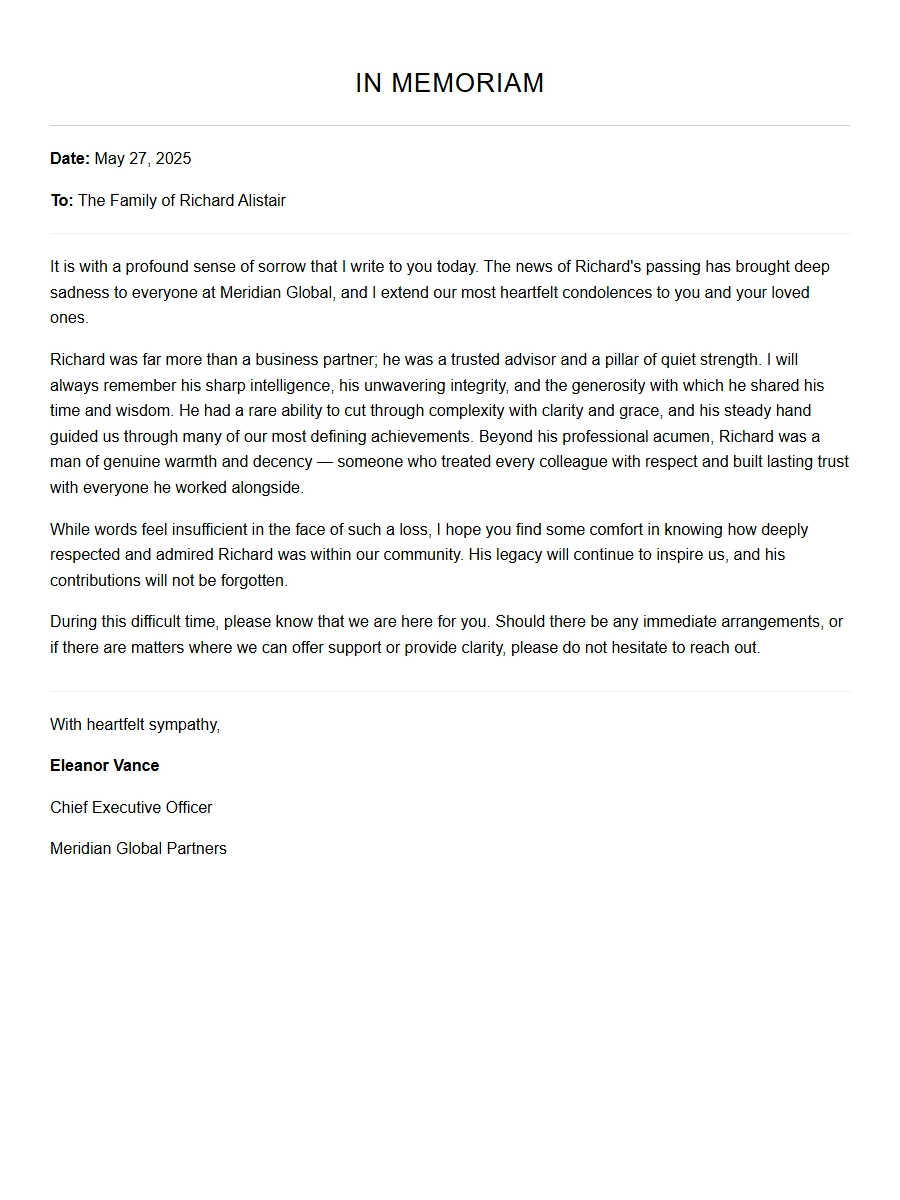 Formal Condolence Message for a Business Partner
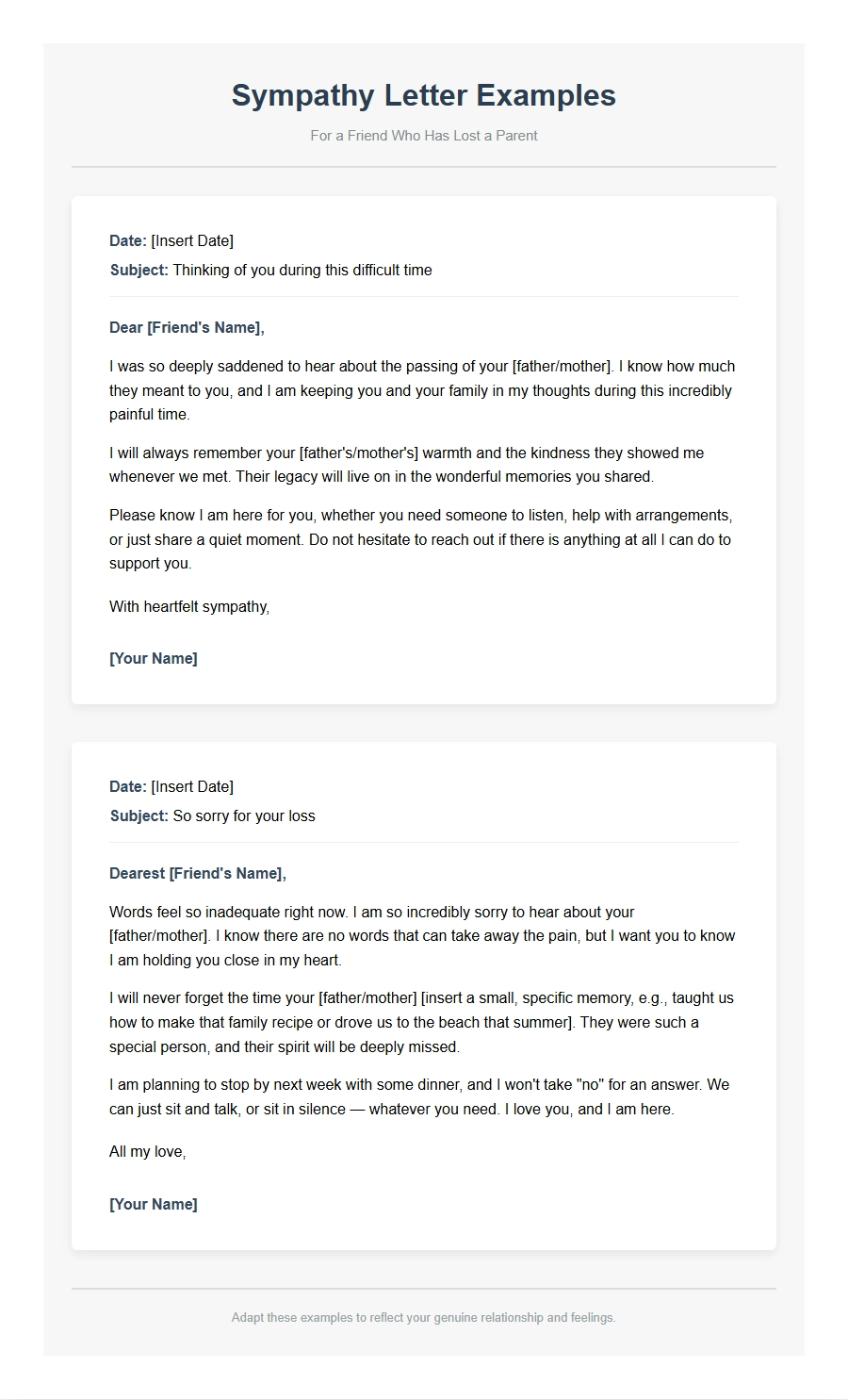 Sympathy Letter Examples for a Friend Who Lost a Parent
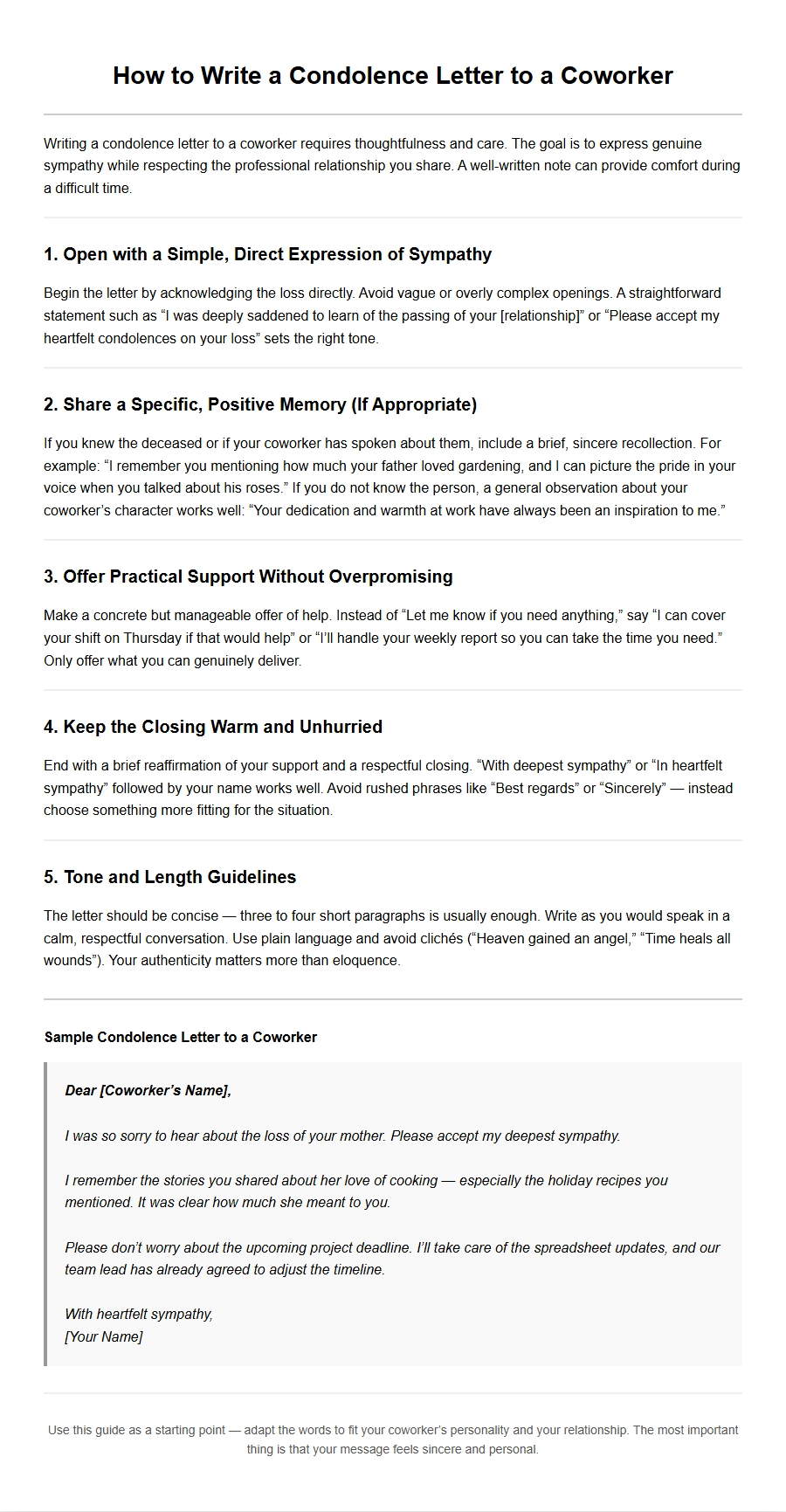 How to Write a Condolence Letter to a Coworker
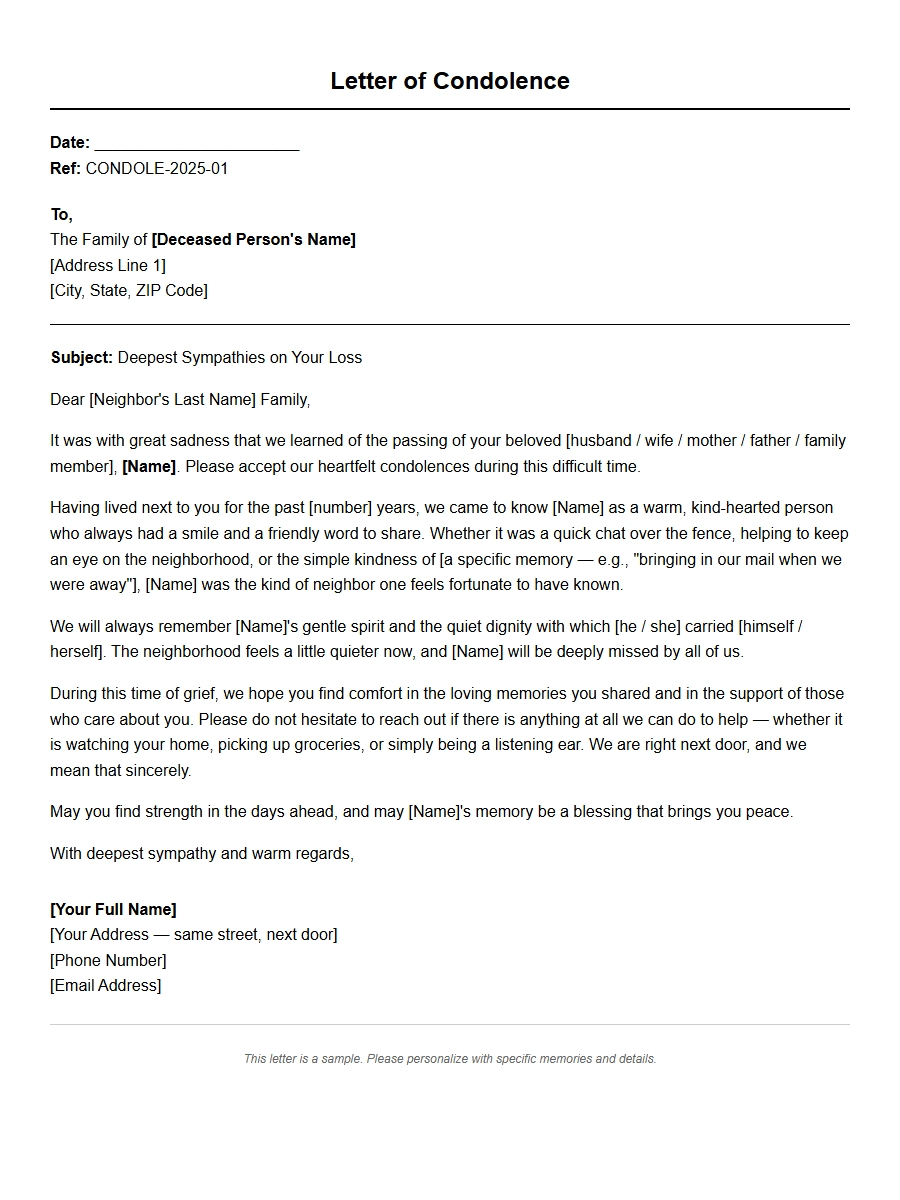 Condolence Letter Sample for a Neighbor
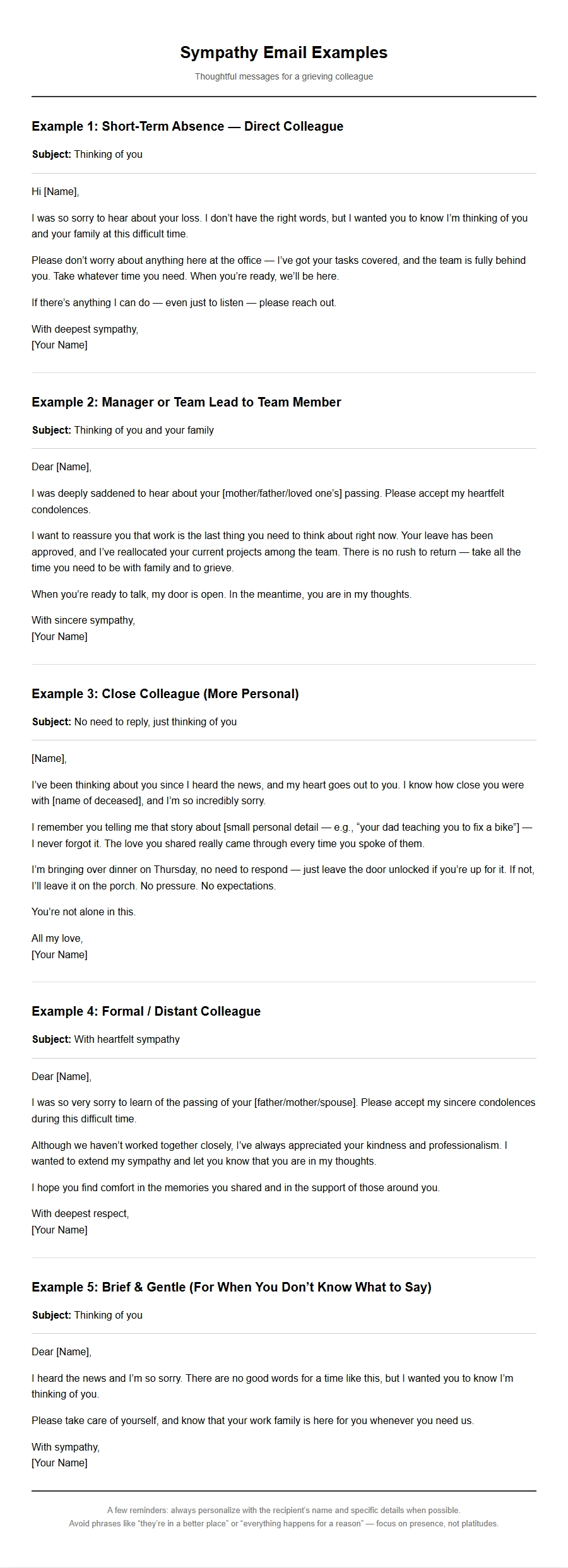 Sympathy Email Examples for a Grieving Colleague
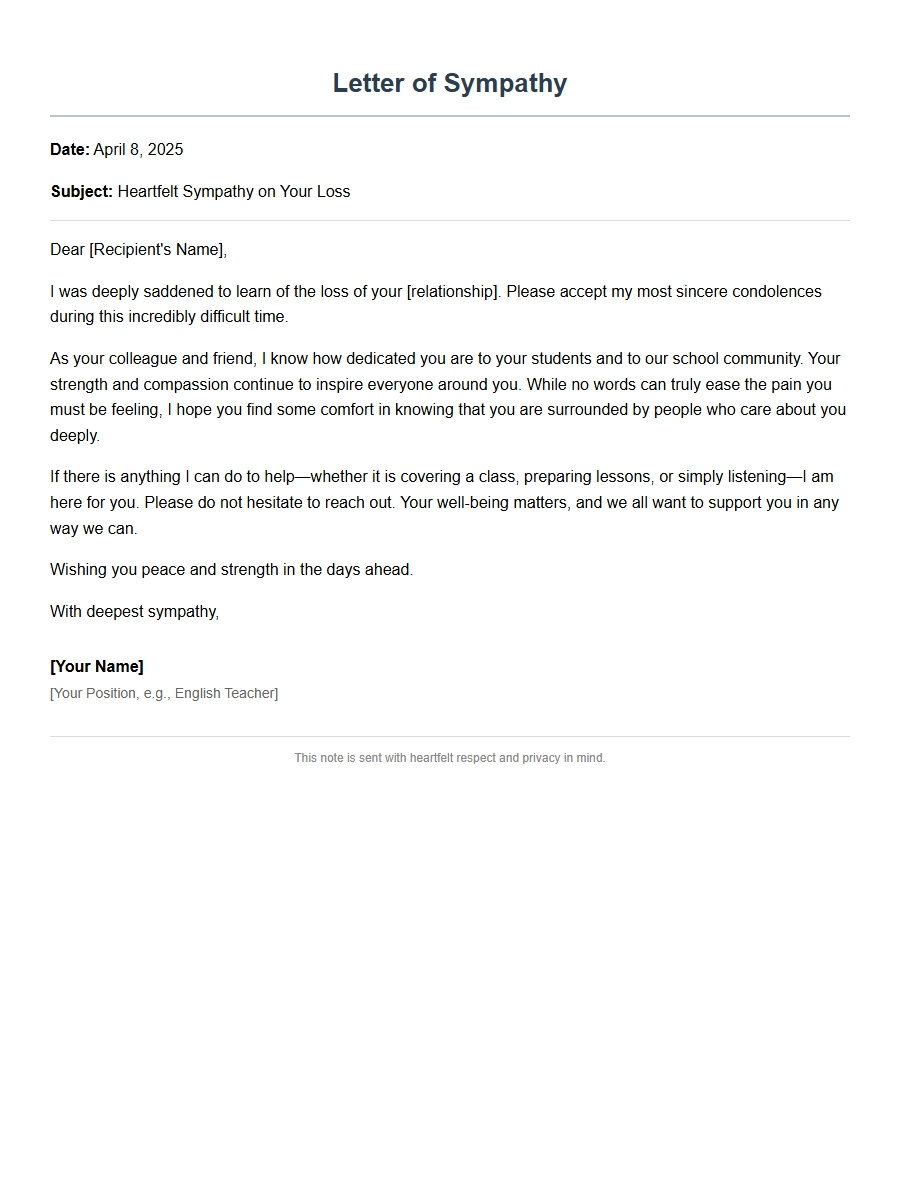 Condolence Words for a Teacher