You've just heard about a loss, and you want to write a condolence letter. But when the person is religious and you’re not—or vice versa—you freeze. How do you mention faith without sounding insincere, or avoid it without seeming cold? That blank page stares back.
Why using a letter sample isn’t cheating
A good sample gives you a structure to start from. It shows you where to place the salutation, how to open with empathy, and what phrases fit a religious context. You’re not copying—you’re adapting. The best condolence letters blend a template with your own words, so the recipient feels your genuine care. Samples save time and help you avoid awkward phrasing, especially when religion is involved.
Category: Condolence Letter Etiquette
How to decide which religious references to use
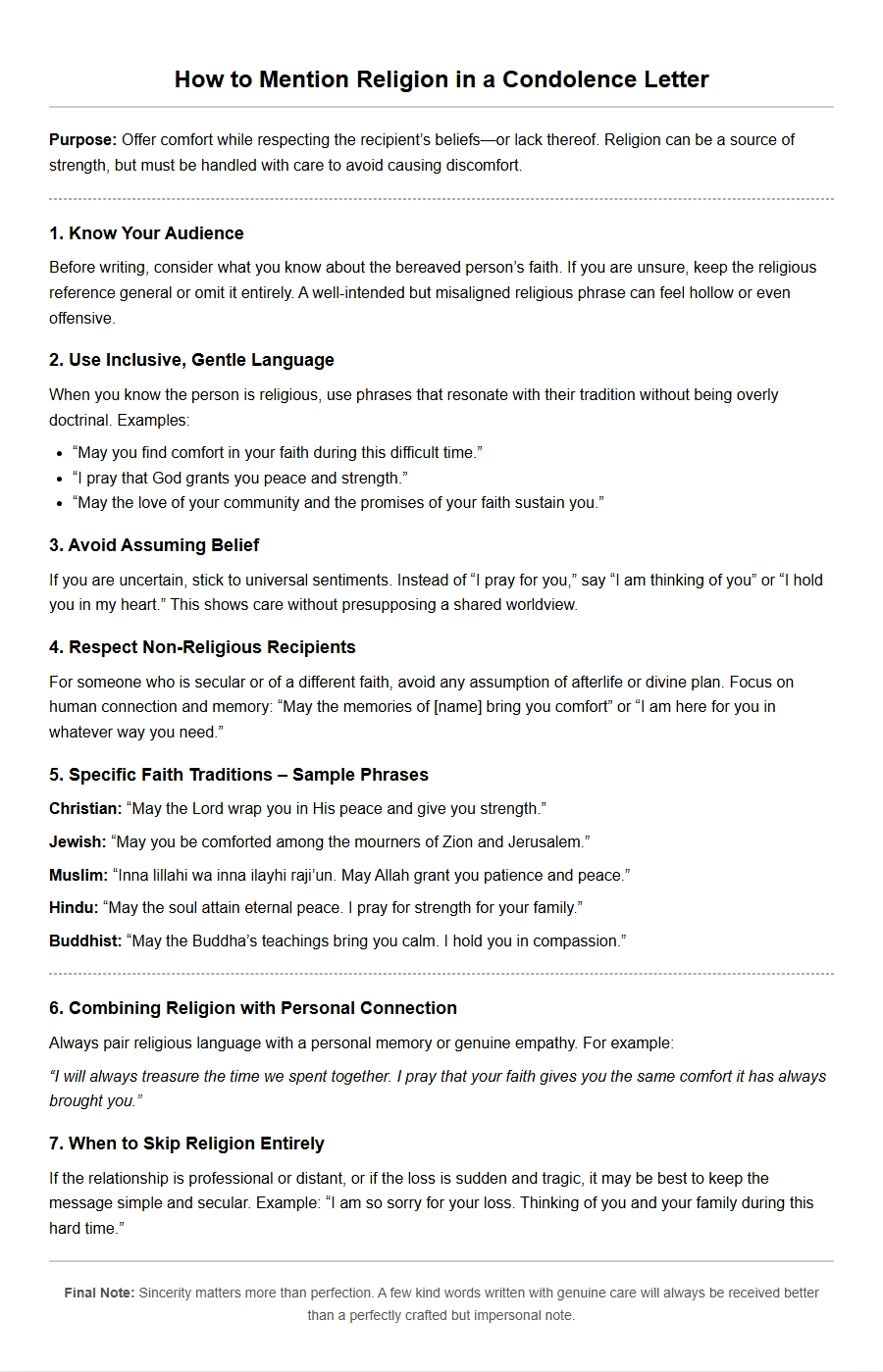
Start by asking: do you know the person’s faith? If you do, use language that fits their tradition. For a Christian, you might say “May you find comfort in God’s peace.” For a Jewish recipient, “May their memory be a blessing” is a common and respectful phrase. If you’re unsure, stick to broader spiritual terms like “I’m praying for you” or “May you feel surrounded by love.” Never fake a belief you don’t hold—people can tell. Instead, focus on shared humanity: “I’m holding you in my thoughts during this hard time.”
Common mistakes when mentioning religion in a condolence letter
The biggest error is assuming everyone shares your beliefs. Avoid phrases like “God needed another angel” unless you’re certain the family would welcome it. Another mistake is overloading the letter with scripture or religious references—it can feel preachy when someone is grieving. Keep it brief. One or two sincere mentions are enough. Also, watch your salutation and closing. “With heartfelt sympathy” works across all beliefs. “In God’s love” is fine if you know the recipient, but “Sincerely” is always safe.
Another mistake: ignoring the format. If you’re sending an email, keep the tone slightly less formal but still respectful. For a printed letter, use proper business letter format even if it’s personal—including your address and date. Don’t forget to proofread. A typo in a condolence letter can distract from your message.
How to adapt a sample without losing your voice
Take a sample that matches your situation—formal or informal, faith-based or neutral. Then rewrite the opening sentence in your own words. For example, a sample might say “I was deeply saddened to learn of your loss.” You could change it to “I’m so sorry to hear your mother passed away. I keep thinking of her smile.” The rest of the structure stays, but your personal memory makes it real. Adjust the tone to match your relationship: close friend, distant colleague, or neighbor.
Tailoring the opening paragraph to feel personal
The first few sentences are crucial. They set the tone and show you’re writing from the heart. Start with a specific memory or a simple acknowledgment of the loss. Then, if appropriate, mention faith naturally. For instance: “I know how much your faith meant to your father, and I pray you find strength in that same faith now.” This connects religion to the person you’re writing about, not to a generic belief.
A practical tip for mentioning religion when you’re unsure
Stick to universal themes: love, remembrance, support. You can say “I hope you feel the love of those around you” or “May the memories you shared bring you peace.” These work for any faith or none. If you want to include a religious note but don’t know the specifics, use a gentle phrase like “May you feel comfort in whatever gives you strength.” That respects the recipient’s own beliefs without assuming.
Don’t forget the business side of condolence letters
If you’re writing on behalf of an organization, use a letterhead design that looks professional but still warm. Keep the tone slightly more formal, but avoid stiff corporate language. Mentioning religion in a professional condolence letter should be minimal unless you know the person’s faith. Stick to “Our thoughts are with you” and let the recipient’s own faith community provide spiritual comfort.
Use these letters as a springboard, not a crutch
The best condolence letters feel both professional and personal. A sample shows you the way, but your real words make the difference. Practice helps, too. The more you write, the easier it becomes to blend structure with sincerity. Next time you need to write one, you’ll have a starting point—and the confidence to make it your own.
Including Christian references in a condolence letter
When writing a condolence letter to a Christian family, references to faith can provide great comfort. Common phrases include: “May you find peace in God’s love” or “I pray that the Lord grants you strength.” You might mention the hope of resurrection: “We take solace knowing that [Name] is now in the arms of Jesus, free from pain.”
Sample paragraph:
“I was deeply saddened to hear of your loss. Please know that you and your family are in my prayers. I trust that God’s grace will surround you during this difficult time. Remember the words of Psalm 34:18: ‘The Lord is near to the brokenhearted.’ May His eternal light shine upon [Name].”
Tips for respectful inclusion:
Use “God,” “Lord,” “Jesus” only if the recipient is known to hold those beliefs.
Pair religious comfort with personal memories of the deceased.
Offering Islamic condolences with Quranic verses
In Muslim tradition, the common condolence phrase is “Inna lillahi wa inna ilayhi raji’un” (Indeed we belong to Allah, and indeed to Him we will return). You can also say: “May Allah forgive [Name]’s sins and grant them Jannah.” Avoid direct mention of Jesus or the Trinity.
Example paragraph:
“I was heartbroken to learn of your father’s passing. May Allah Almighty grant him the highest rank in Jannah and shower His mercy upon his soul. I pray that Allah gives you and your family sabr (patience) and strength to bear this loss. For you and your family I ask for comfort—verily, from Allah we come and to Him we return.”
Important considerations:
Do not equate the deceased with Allah or use phrases like “rest in peace” without context.
Offering to pray (Dua) is highly valued.
Respect the 3-day mourning period mentioned in Islam.
Jewish condolence letter with traditional phrases
Jewish condolence letters often include “May the memory of the righteous be a blessing” or “Baruch Dayan HaEmet” (Blessed is the True Judge). It is customary to avoid visiting until after the funeral and to focus on comforting the mourners (nivum avelim).
Sample text:
“Dear [Name], I was so sorry to hear of your mother’s passing. May her memory be for a blessing. I know that words cannot take away the pain, but I want you to know that I am thinking of you during this time of shiva. Please do not hesitate to reach out if you need anything—even just to sit quietly together.”
Key phrases to include:
“Hamakom y’nachem etchem b’toch sh’ar avelei Tziyon v’Yerushalayim” (May God comfort you among the other mourners of Zion and Jerusalem).
“May you have no more sorrow.”
Offer practical help rather than clichés.
Hindu condolence with mention of reincarnation
In Hindu tradition, death is viewed as a transition of the soul (Atman) to a new body. Condolence messages often say “Om Shanti” or “May the soul attain Moksha.” You might reference the cycle of birth and rebirth: “The soul is immortal; it simply changes form.”
Example paragraph:
“My deepest sympathies on the loss of your beloved uncle. I pray that his soul finds peace in the lap of the Almighty and is granted liberation. As the Gita says: ‘For the soul there is neither birth nor death—it is eternal, unborn, and indestructible.’ May this belief bring you some solace. I am here for you if you need support.”
Do’s and Don’ts:
Do not say “rest in peace” without explaining Hindu context; instead use “peace to the soul.”
Offer to attend the cremation or post-funeral gathering if appropriate.
Respect the 13-day mourning period (sraddha).
Buddhist condolence expressing compassion
Buddhist condolence emphasizes impermanence (anicca) and compassion (metta). Common phrases: “May [Name]’s journey be peaceful” or “May you find strength in the Dharma.” Avoid mentioning a creator God. Focus on loving-kindness.
Sample wording:
“I was deeply saddened to learn of your sister’s passing. Please accept my heartfelt condolences. In this time of sorrow, I hold you in my thoughts of loving-kindness. May the Buddha’s teachings on impermanence remind you that all beings must take leave of this body. May you find peace in the knowledge that her karma carries her forward on a path of liberation. With metta, I offer my support.”
Appropriate gestures:
Lighting a candle or offering incense on behalf of the deceased.
Donating to a charity in their name.
Reciting a simple chant like “Om Mani Padme Hum” if you know the tradition.
Interfaith condolence letter respecting multiple beliefs
When the recipient’s faith is unknown or mixed, use neutral spiritual language. Avoid specific deities. Focus on universal themes: peace, comfort, love, and support.
Example letter:
“Dear [Name], I was heartbroken to hear about your husband’s passing. In this moment of profound loss, I want you to know that you are not alone. However you understand the divine, I pray that you feel a presence of comfort surrounding you. May the love of family and friends sustain you, and may the memory of [Name] bring you strength. I am here for you—no words needed, just a listening heart.”
Key principles:
Use phrases like “May you find peace,” “I hold you in my thoughts,” “I send you strength.”
Avoid direct scripture that might be unfamiliar or unwelcome.
Offer specific practical help rather than only spiritual comfort.
Condolence letter for a non-religious family with spiritual touch
For families who are secular but open to spiritual language, avoid organized religious terms but embrace concepts like “energy,” “nature,” or “eternal rest.” Acknowledge the deceased’s life without assuming an afterlife.
Sample content:
“I was so sorry to learn of your daughter’s passing. Words feel inadequate. I hope that you can find some comfort in the beautiful memories you shared. Though she is no longer physically with us, her spirit and the impact she made on our lives remain. May you feel the warmth of those who love you, and may the natural world remind you that life continues in different forms. I am holding you in my heart with gentle care.”
Tips:
Replace “pray” with “hope” or “wish.”
Say “may you find peace” rather than “God grant you peace.”
Emphasize community and memory over doctrine.
Mentioning specific religious rituals in a condolence letter
Sometimes mentioning rituals can show respect and solidarity. For example: “I will light a candle for [Name] during the Rosary” or “I will observe the Janaza prayer in spirit.” Be sure you know the ritual and its significance.
Sample paragraphs by tradition:
Religion
Suggested phrase
Christianity
“I will pray the Rosary for the repose of [Name]’s soul.”
Islam
“I will recite Surah Yaseen for [Name]’s forgiveness.”
Judaism
“I will say the Mourner’s Kaddish in memory of [Name].”
Hinduism
“I will offer puja for the peace of [Name]’s soul.”
General advice: Only mention a ritual if you genuinely intend to do it. It deepens the connection. Avoid listing rituals that you do not fully understand.
Using religious metaphors without specifics
If you want to sound spiritual but avoid naming a religion, use metaphors like “eternal garden,” “great beyond,” “light of remembrance,” or “peace like a river.” These resonate with many faith traditions.
Example:
“Dear [Name], I am so sorry for your loss. May you find solace in knowing that the love we share never dies—it simply transforms. I picture [Name] walking through an eternal garden, free from pain, surrounded by light and beauty. Hold onto that gentle image. And know that I am here, standing beside you in the shadows, ready to help however I can.”
Why it works:
It respects uncertainty about the recipient’s beliefs.
It offers comfort without dogma.
It can be adapted to any recipient.
Condolence letter from a secular perspective respecting religious beliefs
If you are non-religious but the recipient is religious, acknowledge their faith honestly: “I know your faith means a great deal to you, and I hope it gives you strength now.” Avoid debating or disclaiming your own views.
Sample letter:
“Dear [Name], I was devastated to hear about your mother’s passing. Though I do not share the same beliefs, I know how deeply your faith guides you. I sincerely hope that the promises of your tradition bring you comfort. Please know that I respect your grieving process and am here if you need a listening ear or practical help. I am thinking of you with sincere sympathy.”
Key points:
Do not apologize for your lack of belief; simply affirm theirs.
Do not use religious language yourself if you feel inauthentic.
Focus on your relationship with the recipient, not on theology.
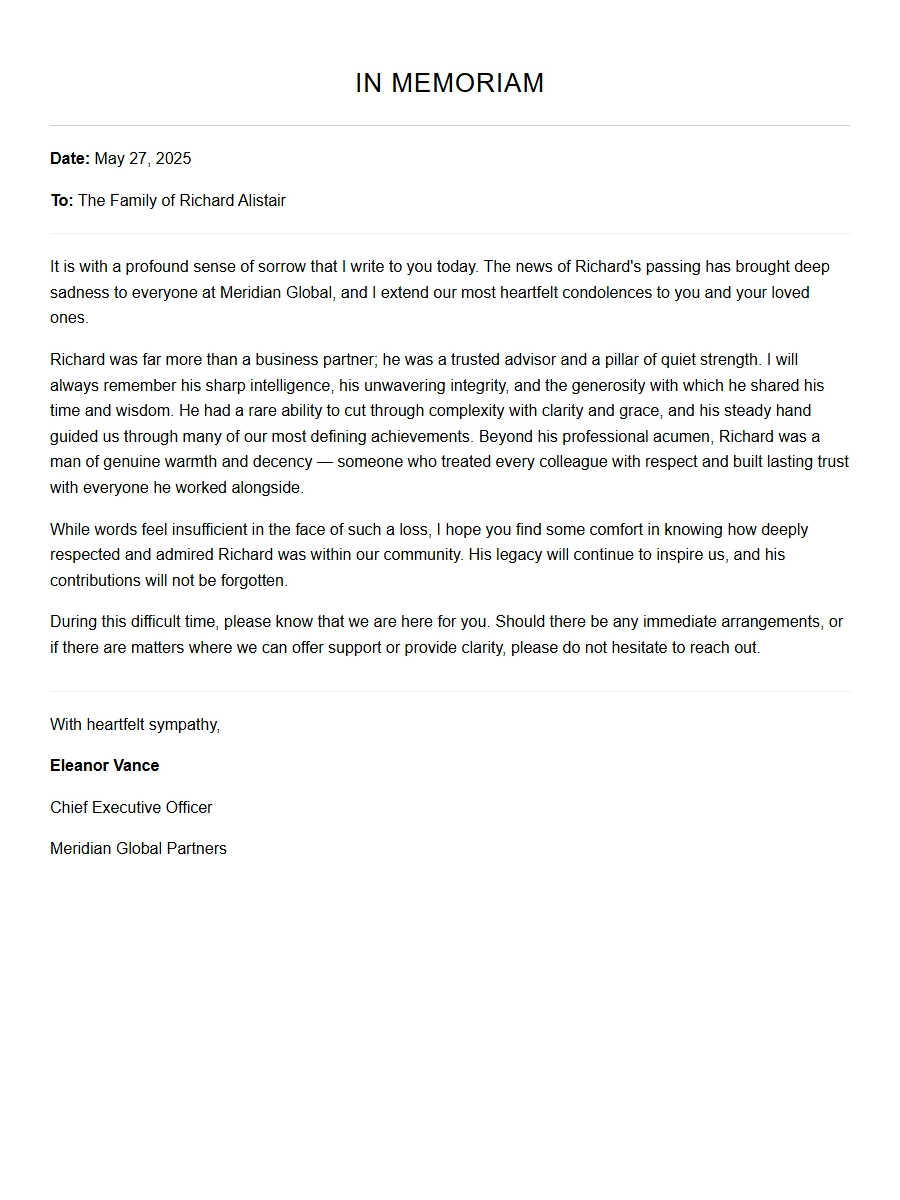 Formal Condolence Message for a Business Partner
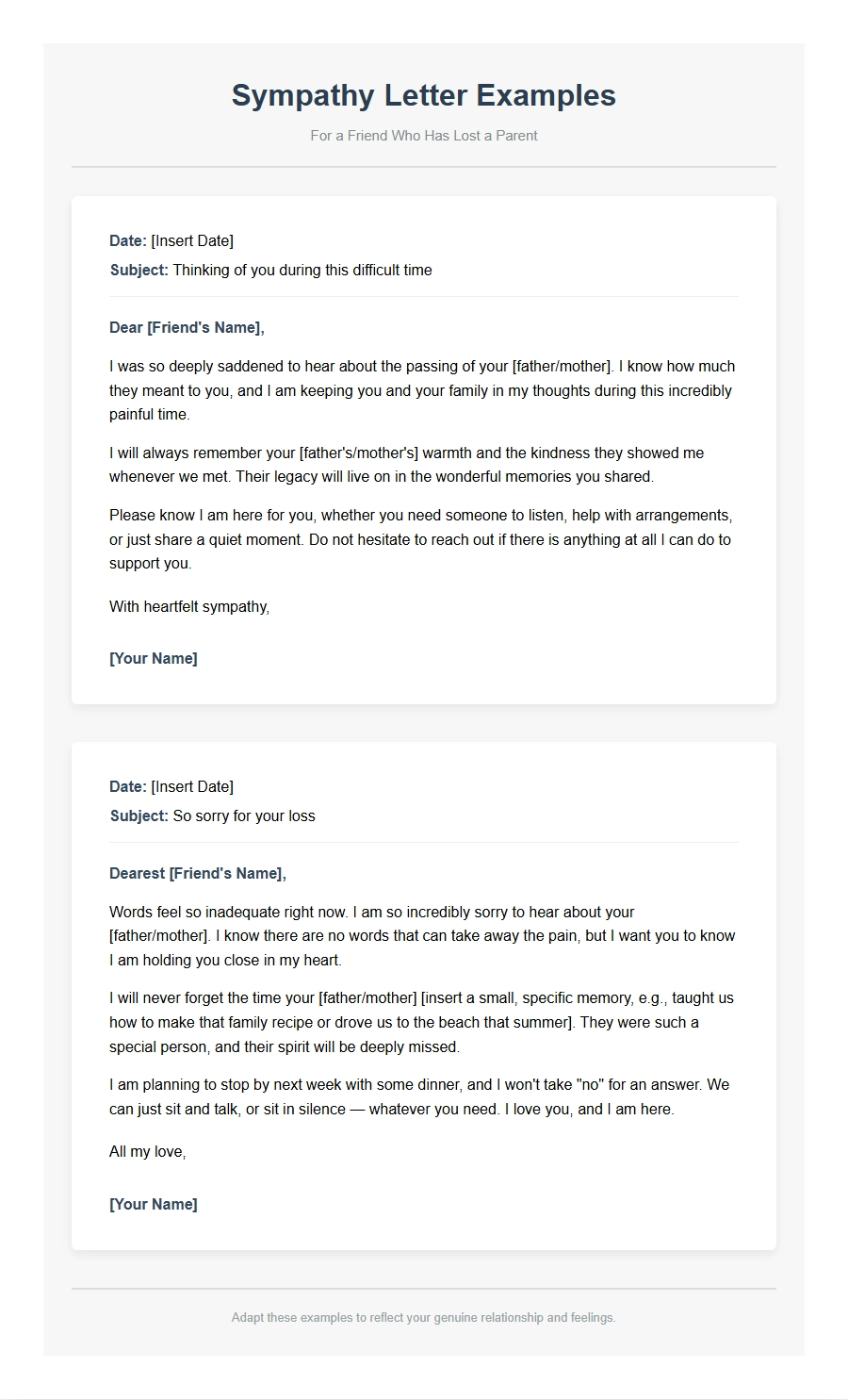 Sympathy Letter Examples for a Friend Who Lost a Parent
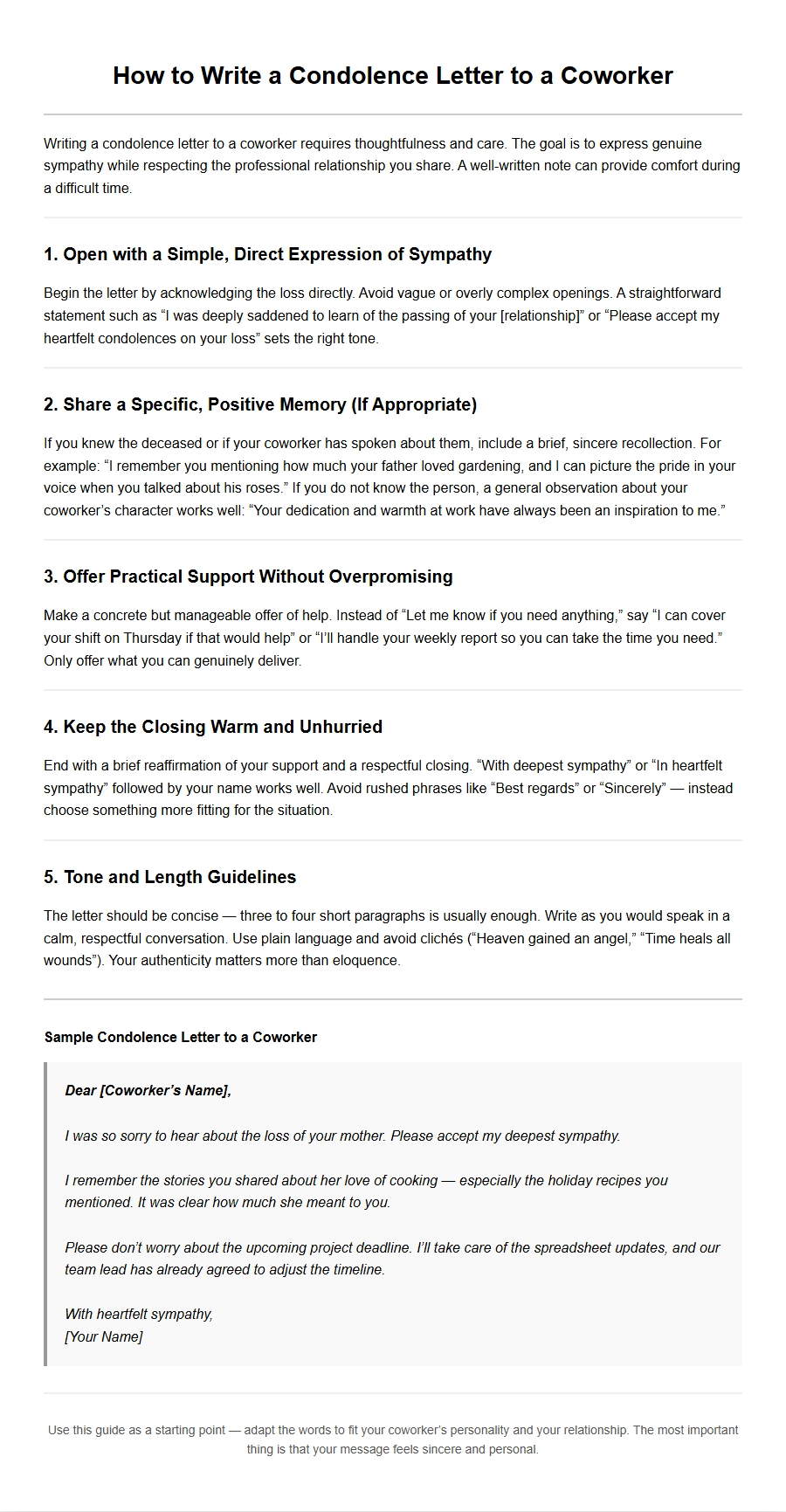 How to Write a Condolence Letter to a Coworker
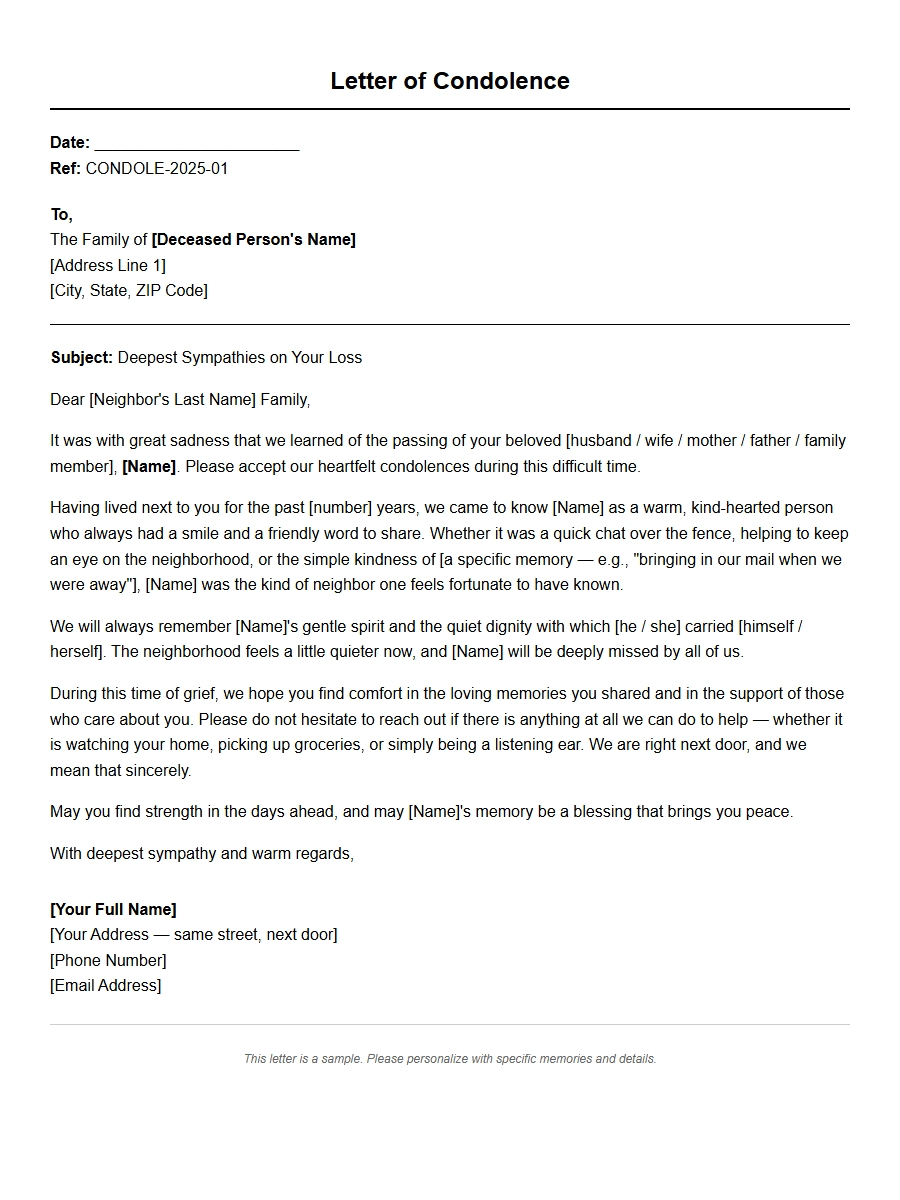 Condolence Letter Sample for a Neighbor
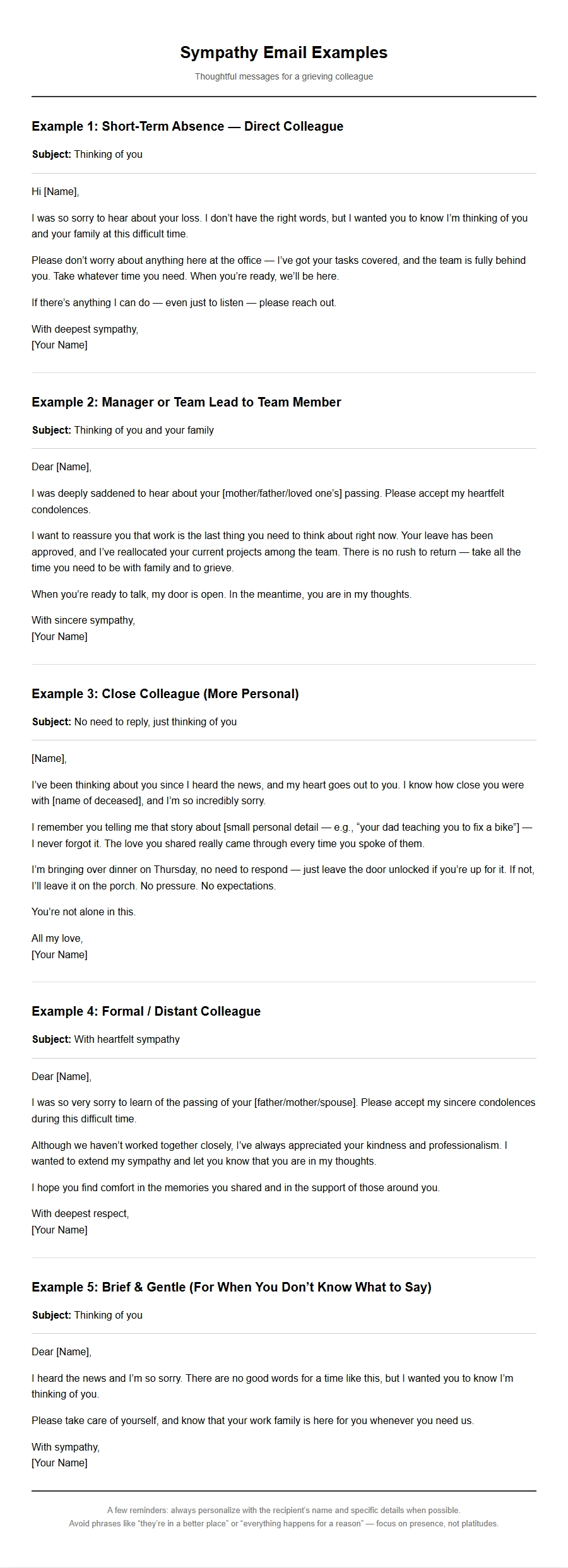 Sympathy Email Examples for a Grieving Colleague
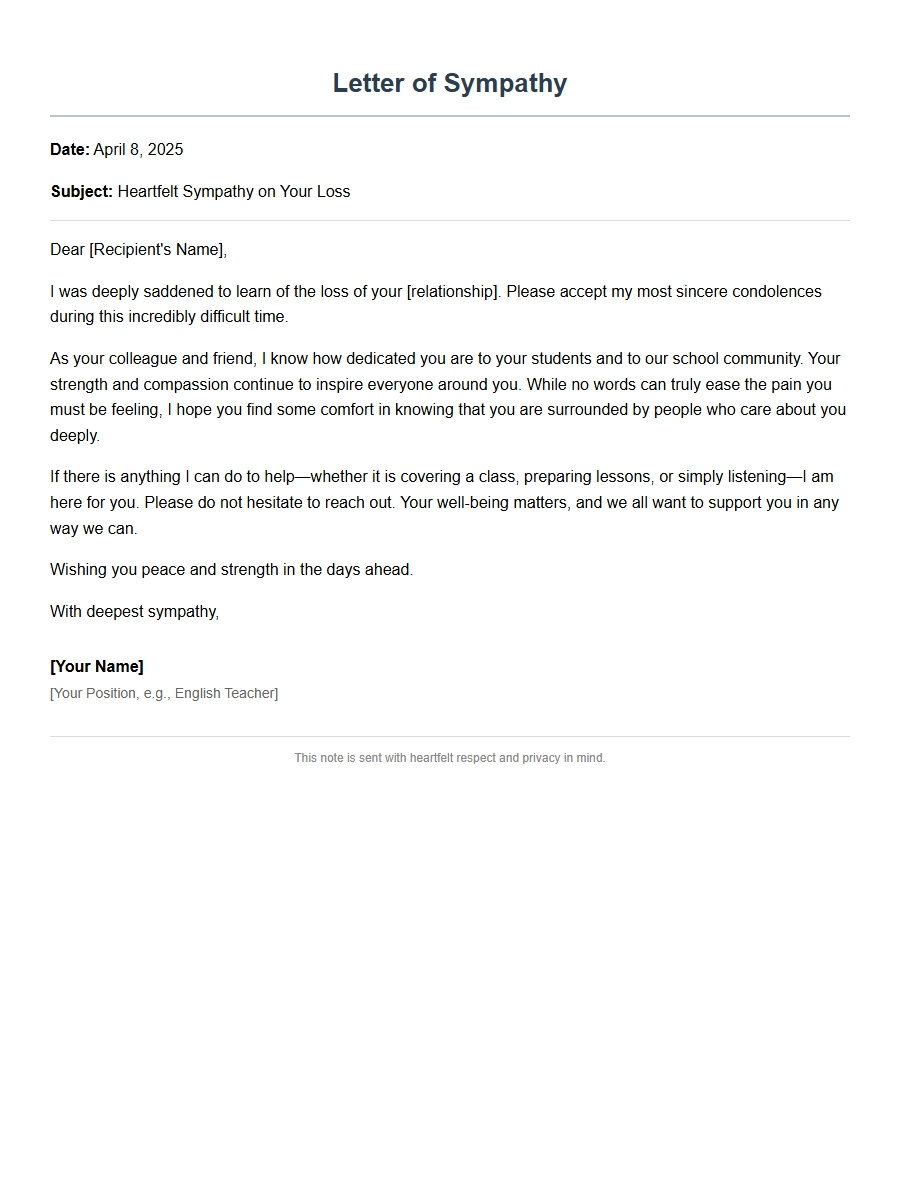 Condolence Words for a Teacher