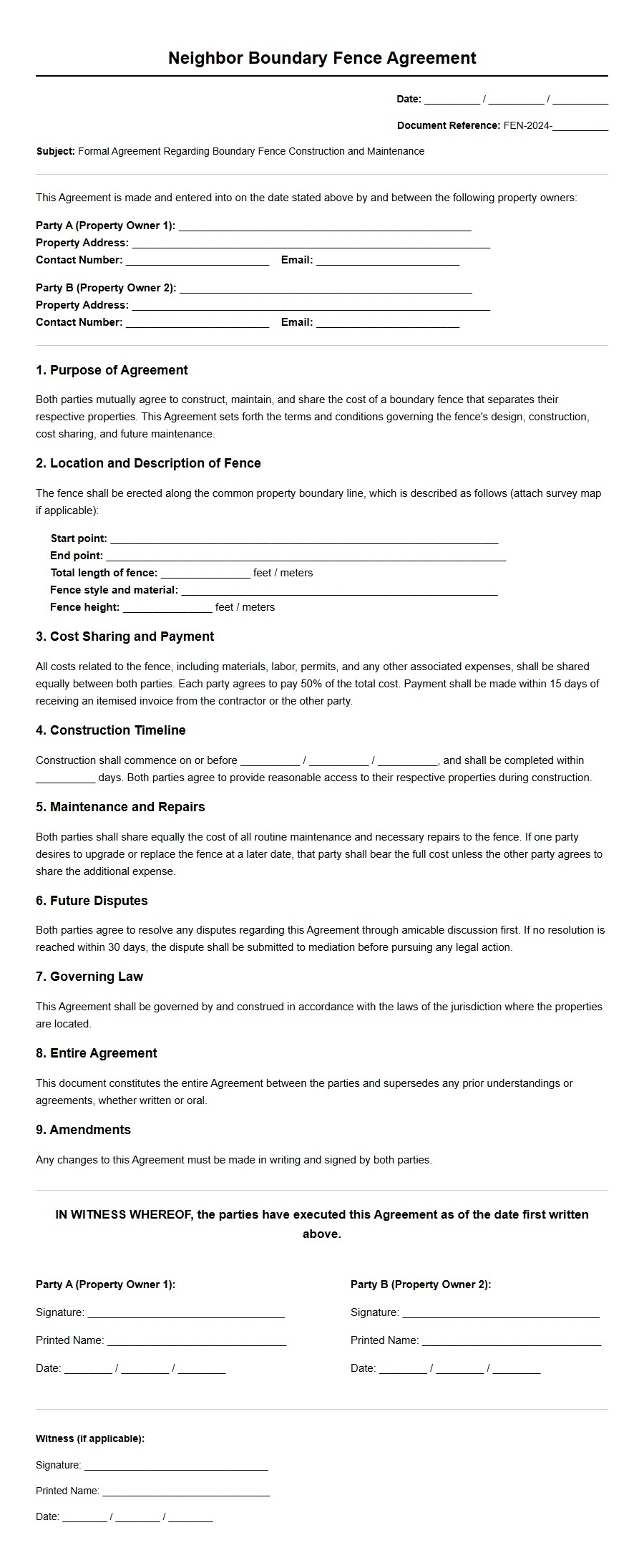
Staring at a blank page when you need to write about a fence dispute with your neighbor can feel paralyzing. You want to be firm but fair, clear but not confrontational. The right sample letter turns that anxiety into a confident, polished draft in minutes. It’s not cheating—it’s a smart, time-saving strategy that gives you structure, the right tone, and key phrases while leaving room for your own situation.
What is a neighbor dispute boundary fence agreement letter?
This is a formal or semi-formal letter you send to a neighbor when you need to discuss, propose, or confirm an arrangement about a property line fence. It covers who pays for repairs, where the fence goes, what materials to use, and how costs are split. It’s a written record that helps prevent misunderstandings and protects both of you if things get complicated later.
When would you use this kind of letter?
You might use it when a fence is old and falling down, when you want to install a new fence, or when your neighbor built something that seems to cross the boundary. Maybe you’ve tried talking in person but nothing got settled, or you just want everything in writing so there’s no confusion. A letter template gives you the business letter format and formal writing tips you need to sound professional without starting from scratch.
How to choose the right sample for your situation
Not all letter samples are the same. If you’re on good terms with your neighbor, a friendly, semi-formal tone works best. Keep the salutation warm (“Dear Sarah and Tom”) and focus on collaboration. If tensions are already high, a more formal professional correspondence style is safer. Use “Dear Mr. Johnson” and stick to facts. The sample you pick should match the temperature of your relationship.
For example, if you’re asking your neighbor to split the cost of a new fence, find a sample that includes cost-sharing language. If you’re responding to a complaint they made, look for a sample that starts with acknowledgment before stating your position. Matching the sample to your specific problem saves you editing time later.
Adapting a sample without losing your authentic voice
Here’s the trick. Take the structure and key phrases from the sample, but rewrite the opening to reflect your actual situation. Start with something like, “I wanted to follow up on our conversation last week about the fence along our shared property line.” That feels personal and specific. Then use the sample’s language for the middle parts—cost breakdown, timeline, proposal for next steps.
Common mistakes happen when people copy a sample word for word without changing the details. Your neighbor will notice if the letter sounds like it came from a generic website. Also, avoid outdated salutations like “To Whom It May Concern” when you know their name. And think about format—if you’re emailing, skip the letterhead design and use a clear subject line instead. If you’re printing, a simple letterhead with your name and address is fine.
Tailoring the opening paragraph to grab attention
Your first paragraph should state the purpose clearly and show good faith. Try something like:
“I’m writing to discuss the fence between our properties, which has some damage near the back corner. I’d like to propose a plan to repair it together so we can keep our yards private and secure.”
This is direct, polite, and leaves room for negotiation. You’ve set the tone in writing as cooperative without being weak.
Here’s a category you might find helpful: neighbor dispute boundary fence agreement letter.
What to include in the body of the letter
Cover these points in order: describe the current fence or problem, state the boundary line (if you have a survey, mention it), propose a solution (repair, replace, split cost), suggest a timeline, and ask for a response by a certain date. Letter writing etiquette says you should be clear about what you’re asking for but also leave the door open for discussion. End with an invitation to talk in person or by phone.
A smart tip is to mention that you’ve looked into the property lines. That shows you’ve done your homework without being aggressive. If you’ve had other issues with this neighbor before, keep this letter focused only on the fence. Dragging in old arguments will kill the chances of a fair agreement.
Mistakes to avoid
Don’t accuse your neighbor of anything in the first letter. Stick to facts: “The fence is leaning onto my side” not “You built the fence wrong.” Don’t ignore letter structure either. A missing date, no closing, or inconsistent spacing makes you look careless. Always include your contact info and a polite closing like “Sincerely” or “Best regards.”
If you’re sending this by email, use a clear subject like “Proposed fence repair – 123 Oak Street.” Skip long attachments. Just paste the letter into the email body and include your address. For printed letters, use a digital letter format that’s easy to read—black text on white, standard fonts, single spacing.
Proofreading before you send
Read your letter out loud. You’ll catch awkward phrases and spots where the tone shifts from polite to stiff. Ask someone you trust to read it too. A fresh pair of eyes can spot a sentence that sounds more demanding than you intended. Proofreading letter content is especially important for boundary disputes because one wrong word can make a neighbor defensive.
The best letters feel both professional and personal. You want your neighbor to read it and think, “This person is being reasonable and clear.” A sample gives you the scaffolding; you fill in the details that make it real. Don’t overthink it. Write a draft, tweak the tone, and send it. The more you do it, the faster it gets. Next time a fence issue comes up, you’ll know exactly how to start.
Browse Sample Ideas
Neighbor Fence Dispute Complaint Letter Template
Complaint Regarding Unauthorized Fence Extension
Dear [Neighbor's Name],
I am writing to formally complain about the recent extension of the fence along our shared property line. As you are aware, we previously agreed that the boundary fence would not exceed four feet in height and would remain within the surveyed property line. However, on [date], I noticed that the fence has been raised to six feet and extends approximately two feet onto my side of the property.
This unauthorized extension violates our verbal agreement and local zoning regulations. I kindly request that you remove the extra height and reposition the fence to its original agreed location within 14 days. Please refer to the attached survey map for exact boundary markers.
I prefer to resolve this amicably without involving legal authorities. Let me know a convenient time to discuss this further.
Sincerely, [Your Name]
Complaint About Fence Damage Caused by Neighbor's Tree
Dear [Neighbor's Name],
I hope this letter finds you well. Unfortunately, I must bring to your attention a recurring issue that has caused damage to the boundary fence between our properties. Over the past few months, the large oak tree on your side has grown branches that press against and scrape our shared fence, causing several panels to lean and the paint to peel.
Key issues observed:
Three fence posts are now cracked due to pressure from tree roots.
The fence boards have visible scratches and splits from branches.
Two sections are at risk of collapsing in a storm.
According to our previous agreement, both parties are responsible for maintaining the fence. I request that you trim the overhanging branches and remove any roots threatening the fence structure within 30 days. If left unattended, repair costs will increase significantly. Please respond at your earliest convenience.
Thank you for your cooperation, [Your Name]
Complaint Over Disputed Fence Placement
Dear [Neighbor's Name],
I am writing with deep concern regarding the new fence you recently installed along what you claim is the property line. I have obtained an updated land survey, which clearly shows that the fence has been placed three feet inside my property. This encroachment not only limits my use of a portion of my yard but also devalues my property.
Below is a summary of the survey findings:
Item
Your Claim
Survey Result
Fence location (distance from house)
50 ft
47 ft
Property line marker
East boundary post
2 ft east of fence
I request that you remove the fence and rebuild it correctly on the actual boundary line as marked by the surveyor. If you wish to split the cost of the new fence, we can discuss a revised agreement. Failure to correct this within 21 days may lead to formal legal action.
I hope we can settle this neighborly, [Your Name]
Complaint About Neighbor's Refusal to Share Fence Repair Costs
Dear [Neighbor's Name],
I am writing to formally remind you of our written agreement dated March 1, 2023, in which both parties agreed to share equally the cost of maintaining the boundary fence between our homes. The fence is now severely weathered, with several posts rotting and a large gap near the back gate.
I have obtained two repair estimates:
Estimate A – $1,200 (full panel replacement, labor included)
Estimate B – $950 (reinforcement and partial replacement)
Despite multiple requests over the past month, you have refused to contribute your half. As per our agreement, each of us is responsible for 50% of any reasonable repair. I request that you choose one estimate and pay your share within two weeks. If I proceed alone, I will have no choice but to deduct your portion from future shared expenses, as allowed by our contract.
Please reconsider to maintain goodwill, [Your Name]
Complaint Regarding Neighbor's Fence Painting Without Permission
Dear [Neighbor's Name],
I was surprised to see that you have painted our shared boundary fence a bright red color without consulting me beforehand. Our fence agreement, signed in June 2022, specifies that any changes to the fence appearance must be mutually approved. The current color clashes with my house and garden and violates the neighborhood’s aesthetic guidelines.
Important points from our agreement:
Fence color must be neutral (white, gray, or natural wood tone).
Any modifications require written consent from both parties.
No side of the fence may be painted without agreement.
I request that you return the fence to its original color within two weeks. If you wish to propose a different color, please present a sample for mutual approval. I hope you understand that this is about respecting our written terms.
Best regards, [Your Name]
Complaint About Neighbor's Fence Leaning Into My Yard
Dear [Neighbor's Name],
I am writing to formally complain about the state of the fence that runs along our property line. Over the past several months, the fence has progressively leaned into my yard by approximately 10 degrees. This has caused my flowerbeds to be crushed and limited my ability to mow along the border.
Below are the observed issues:
Issue
Impact on My Property
Fence tilt (approx. 15° inward)
Plants damaged, yard area reduced
Loose posts at section C
Safety hazard for children playing
Crossbars detaching
Fence may fall completely
Per our agreement, both parties are equally responsible for keeping the fence upright. I request that you join me in hiring a contractor to straighten and reinforce the fence within 30 days. I have quotes available. Let’s schedule a joint inspection next week.
Thank you for your prompt attention, [Your Name]
Complaint Over Neighbor's Pets Digging Under the Fence
Dear [Neighbor's Name],
I am writing to address a repeated problem concerning your dog, Max, who has been digging under the boundary fence and entering my yard. This has happened at least five times in the last two weeks. Each time, your dog damages the fence base, and I have had to fill the holes myself. I am also concerned for the safety of my small children and my own pets.
Specific incidents include:
March 3 – new hole dug under the west section, replaced soil.
March 7 – dog entered and chased my cat.
March 12 – fence bottom weakened, gap large enough for a small dog.
I request that you reinforce your side of the fence with a buried wire or concrete base to prevent further digging, and keep Max leashed when outside until the repair is complete. If this continues, I will have no choice but to file a complaint with animal control. Please address this immediately.
Sincerely, [Your Name]
Complaint About Neighbor's Illegal Fence Height
Dear [Neighbor's Name],
I am writing to formally object to the new fence section you recently added along the rear of our shared boundary. The fence now stands at eight feet tall, which exceeds the maximum allowed height of six feet per local zoning ordinances (Section 12.4 of the City Code). This blocks sunlight to my vegetable garden and creates an unpleasant shadow.
Relevant code details:
Maximum fence height in residential areas: 6 ft (Section 12.4)
Special provisions for fences on boundary lines require mutual consent
Penalties for non-compliance include fines and forced removal
I request that you reduce the fence height to six feet within two weeks. Alternatively, you could install a slatted design that allows light through while maintaining privacy. If you do not comply, I will have to report the violation to the city planning department. I prefer we settle this privately.
Best regards, [Your Name]
Complaint About Missing Fence Maintenance Agreement
Dear [Neighbor's Name],
I am writing to propose a formal fence maintenance agreement, as we currently have no written understanding regarding the ownership and upkeep of the fence between our properties. Recently, several boards have rotted and a gate hinge broke. Since there is no clear agreement, I have been bearing all the repair costs ($350 so far), but I believe this should be a shared responsibility.
I suggest the following terms for a new agreement:
Both parties equally share all maintenance, repair, and replacement costs.
Both must approve any changes to fence style, color, or height.
Repairs costing over $200 must be approved by both before proceeding.
Please review these terms and let me know if you’d like to meet to discuss and sign. If you do not respond within three weeks, I will assume you refuse to share costs, and I may replace the fence entirely on my own, placing it entirely within my property line to avoid future disputes.
I look forward to your reply, [Your Name]
Complaint Over Neighbor's Gate Opening Into My Property
Dear [Neighbor's Name],
I am writing to express my frustration about the new gate you installed on the boundary fence. The gate currently opens inward into my yard, encroaching onto my property by approximately three feet when fully opened. This not only violates the property line but also prevents me from using that area for storage or planting.
Issues caused:
Gate swings over my flower bed, damaging plants.
I cannot mow grass beneath the gate.
It creates a safety hazard for my children playing near the fence.
I request that you change the gate to open outward into your own yard or install a sliding gate that stays within the boundary line. According to our original fence agreement, any additions must not invade the other party’s space. Please correct this within two weeks. If you need assistance selecting a new gate design, I’m happy to help.
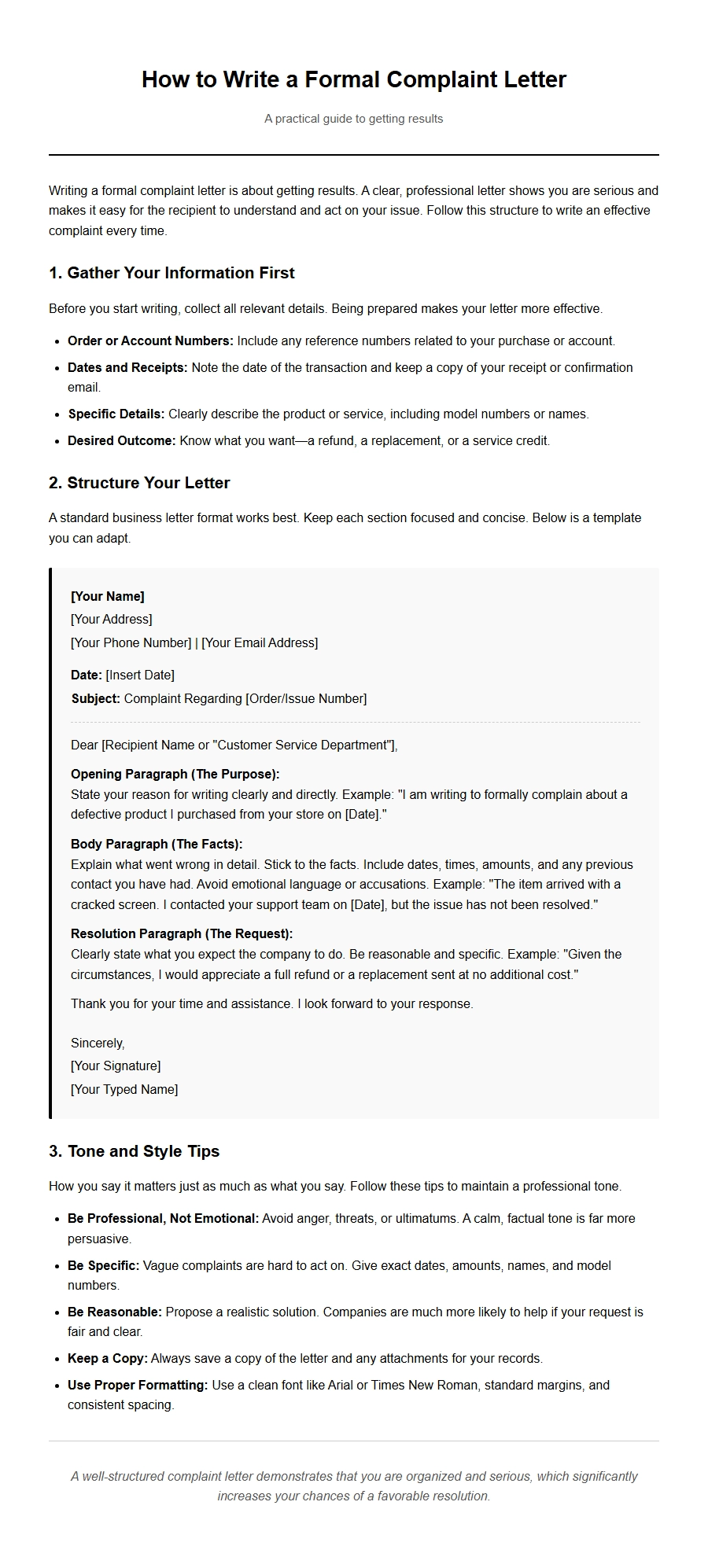 How to Write a Formal Complaint Letter
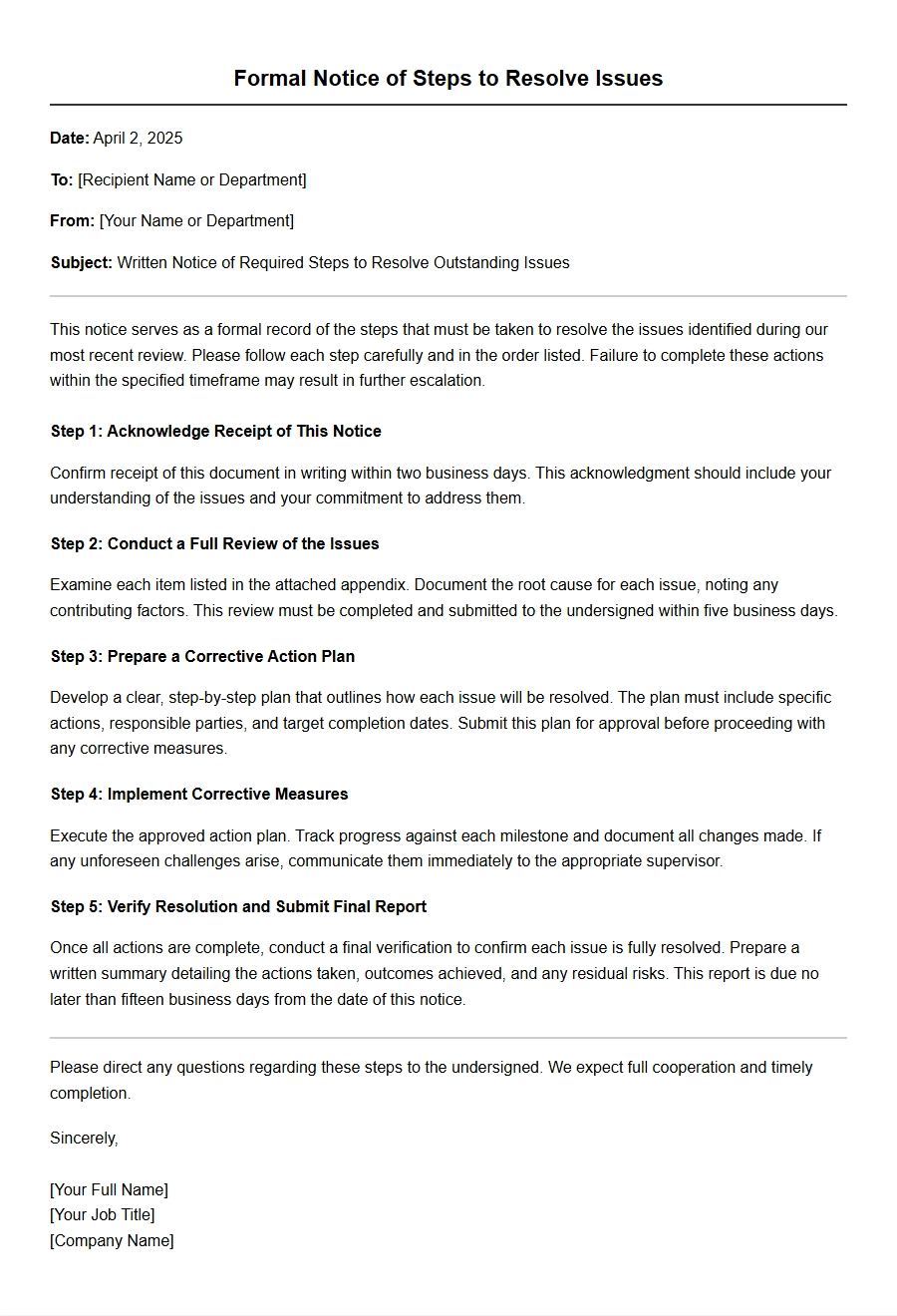 Steps to Resolve Issues via Written Notice
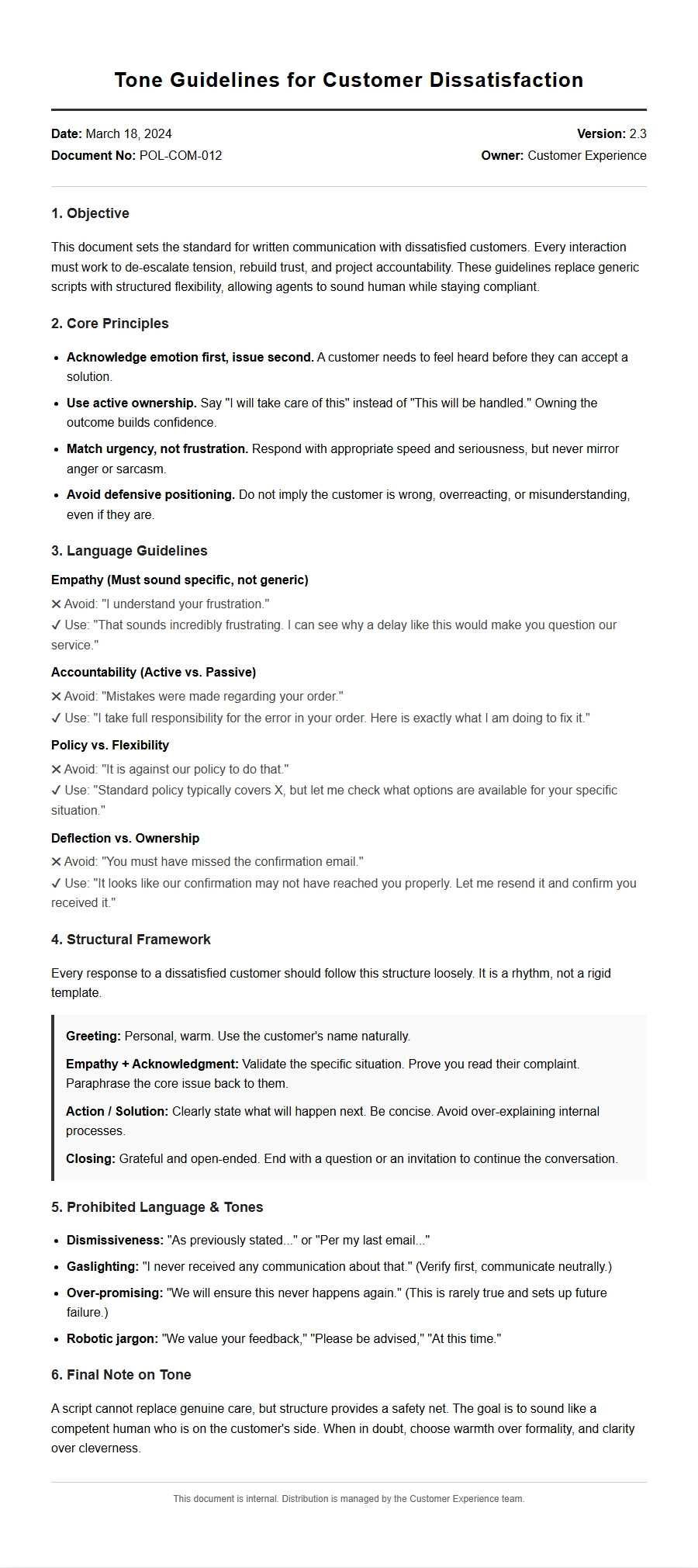 Tone Guidelines for Dissatisfied Customer Letters
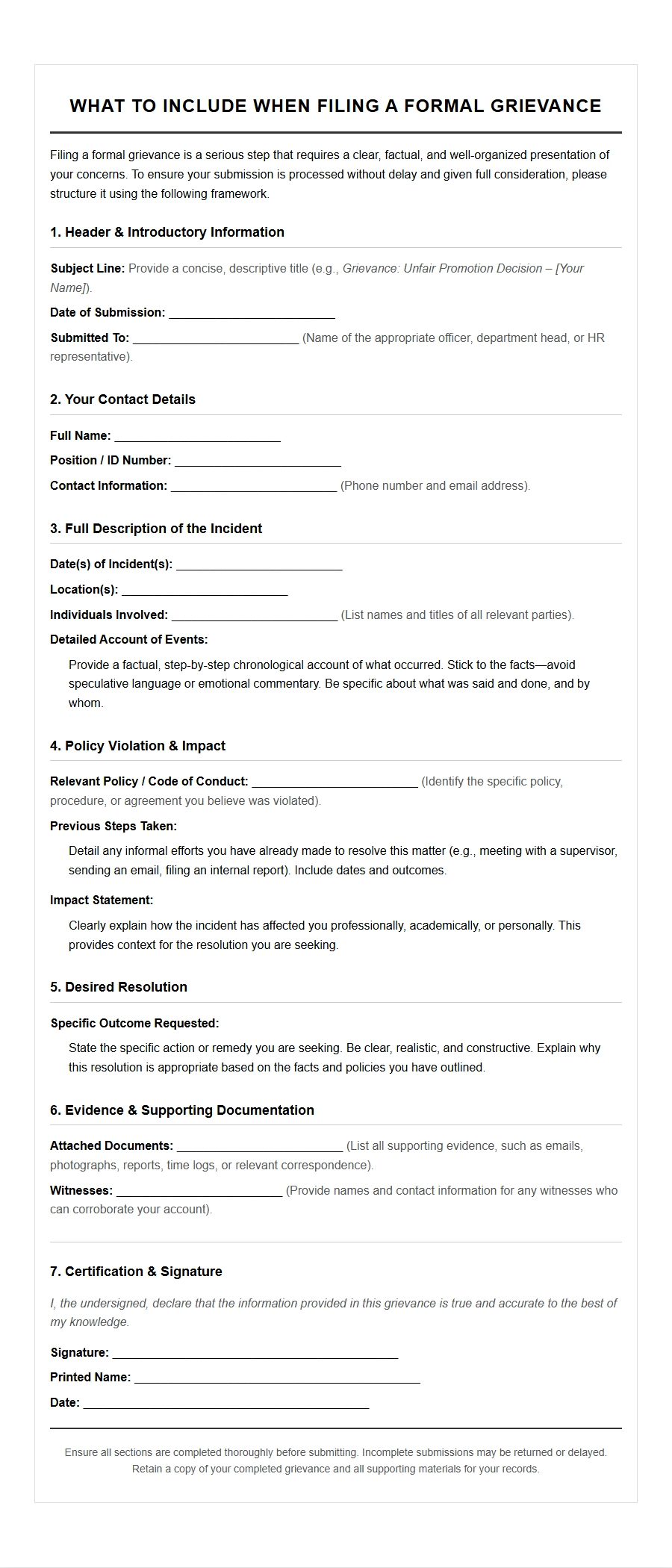 What to Include in a Formal Grievance Letter
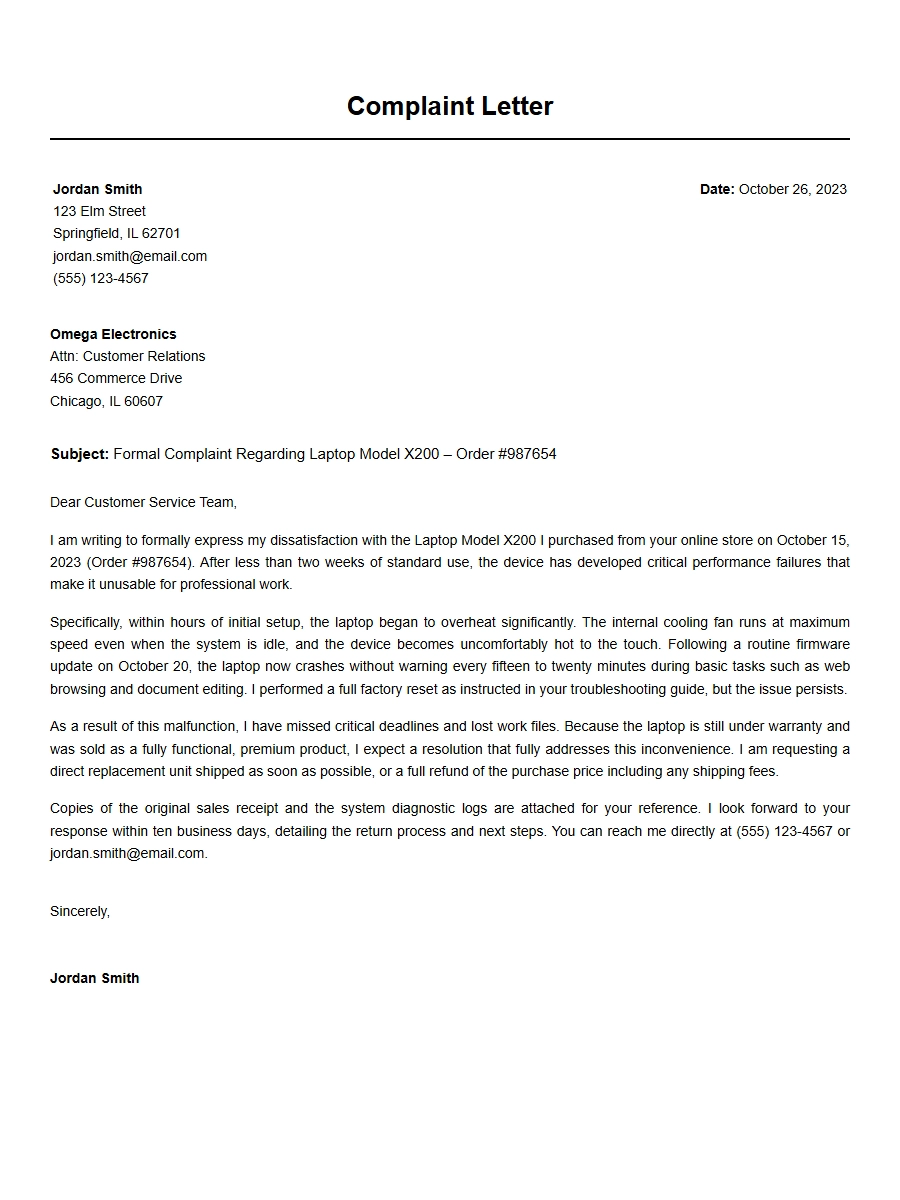 Structure of an Effective Complaint Letter
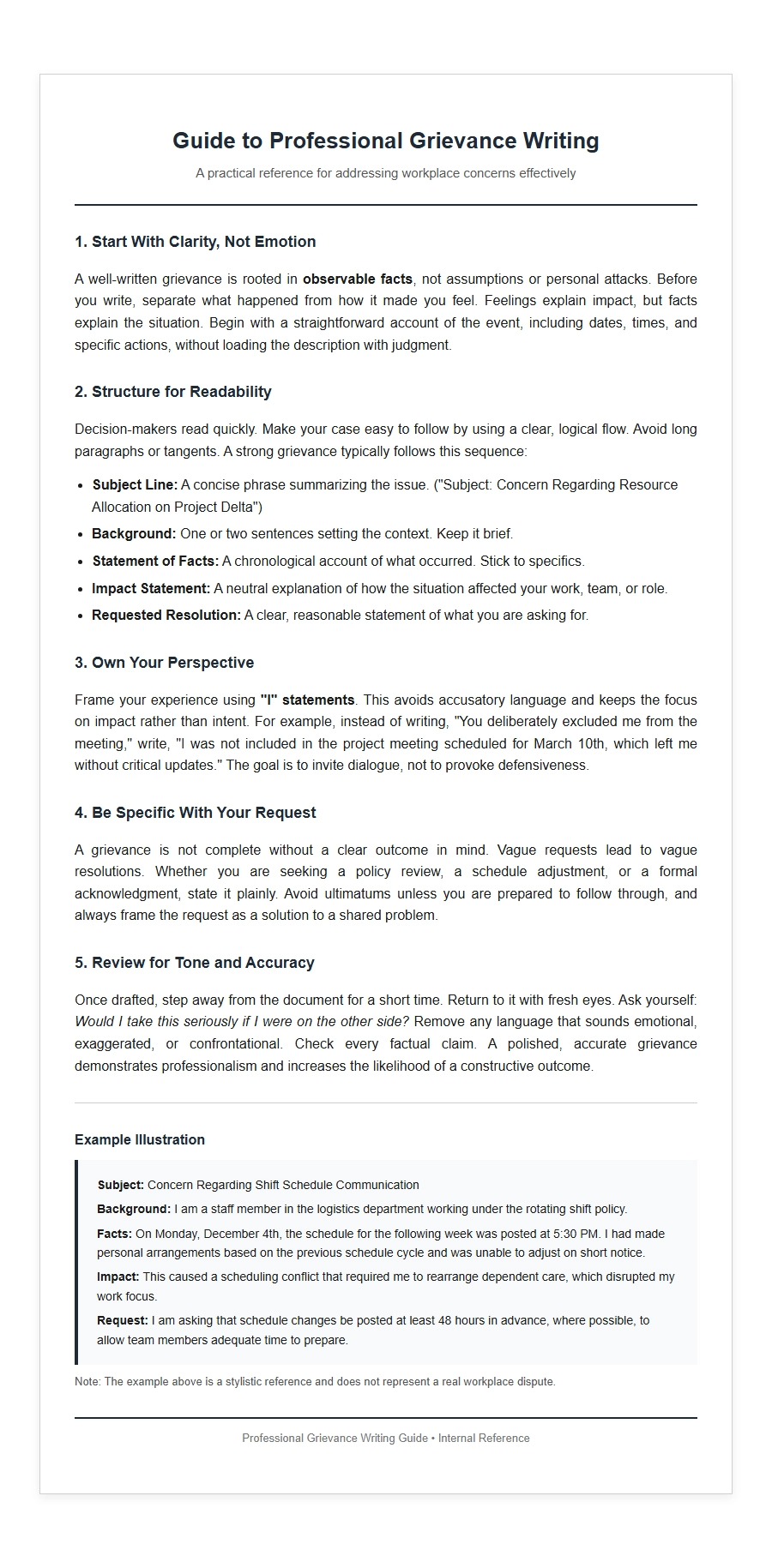 Best Practices for Writing Professional Grievance Letters