You’ve got a promising export opportunity, or maybe you need to formalize a partnership with a foreign supplier. But when you sit down to write the proposal, the blank page stares back. That’s normal. Drafting an international trade agreement proposal letter can feel like navigating customs paperwork — tedious and easy to get wrong. The good news? A solid sample turns that anxiety into a confident draft in minutes.
Using a letter template isn’t cheating. It’s a smart shortcut. Samples give you the right structure, professional tone, and key legal phrasing while leaving room for your specific terms. Think of it as a scaffold — you build your own deal on top of it.
Category: International Trade Proposal Letters
What an International Trade Agreement Proposal Letter Is — and Isn’t
This letter isn’t a contract. It’s a formal expression of interest or a starting point for negotiation. You send it to propose terms for importing goods, setting up a distribution deal, or collaborating on a joint venture across borders. The goal is to get the other party to the table, not to lock in every clause.
Because international trade involves different legal systems and cultural expectations, your letter needs to be both precise and flexible. A generic business letter format won’t cut it — you have to account for things like Incoterms, payment methods, and regulatory compliance.
How to Choose the Right Sample for Your Situation
Not all trade proposals are the same. Are you approaching a potential distributor in Germany? Or responding to a request from a buyer in Japan? The tone and level of formality differ. For a first contact, keep it semi-formal and focused on mutual benefit. For a follow-up after initial talks, you can be more direct about specific terms like pricing or delivery schedules.
Look for a sample that matches your stage in the deal. If you’re just introducing your company, a shorter letter with a clear value proposition works. If you’re already in talks, a longer letter with sections for each proposed term is better.
Tailoring the Sample Without Losing Your Voice
Don’t copy-paste. That’s the fastest way to sound robotic. Instead, treat the sample like a skeleton. Keep the letter structure — salutation, introduction, body, closing — but swap out generic phrases for your own language. For example, change “We are pleased to propose a mutually beneficial arrangement” to something more specific: “We see a strong fit between your distribution network and our line of organic spices.”
Your salutation and closing matter more than you think. In international correspondence, using the wrong title or closing can signal disrespect. When in doubt, use “Dear [Title] [Last Name]” and close with “Sincerely” — it’s safe across most cultures. If you’re writing to a partner you’ve met, “Best regards” is fine.
Common Mistakes That Undermine Your Proposal
One big one: assuming everyone formats letters the same way. In some countries, the date is written day-month-year. In the US, it’s month-day-year. A small detail, but it signals whether you’ve done your homework.
Another mistake is ignoring the medium. If you’re sending the letter as an email attachment, your digital letter format matters. Use a clean PDF with your letterhead design (company logo, address, contact info). For email body proposals, skip the letterhead and keep it short — attach the formal version.
And please, proofreading letter is not optional. A typo in a trade proposal can cost you trust. Read it aloud, or ask a colleague to review it.
Making Your Opening Paragraph Grab Attention
The first three lines determine whether the recipient continues reading. Start with a clear statement of who you are and why you’re writing. Example: “We are [Your Company], a manufacturer of solar panels based in Spain. We understand you are expanding your renewable energy suppliers in Southeast Asia, and we believe our products align with your requirements.”
Avoid vague openings like “I hope this letter finds you well.” That wastes space. Show you’ve done your research. That builds immediate credibility.
Adapting the Tone Without Overwhelming Formality
Tone in writing is about balancing professionalism with approachability. In an international trade proposal, err on the side of formality until you know the person. Use polite phrases like “We would be pleased to” rather than “We want to.” But don’t overdo it — a letter that’s too stiff sounds like a legal threat.
If you’ve exchanged emails before, mirror their level of formality. If they wrote “Hi John,” you can reply with “Hi Taro.” If they used “Dear Mr. Smith,” stick to that.
Using a Sample as a Springboard, Not a Crutch
A great sample gives you a head start on professional correspondence standards. But the best letters feel both professional and personal. After you’ve drafted your proposal, step back and ask: would I want to respond to this letter? If it reads like a robot wrote it, rewrite the opening in your own words.
Practice makes it faster. The more you write, the less you’ll rely on samples — but they’ll always be a handy safety net. For related types of proposals, you might find these useful:
You’ve got the sample now. Use it wisely. Customize it. Then send it with confidence — because the deal won’t close itself.
Templates and Samples
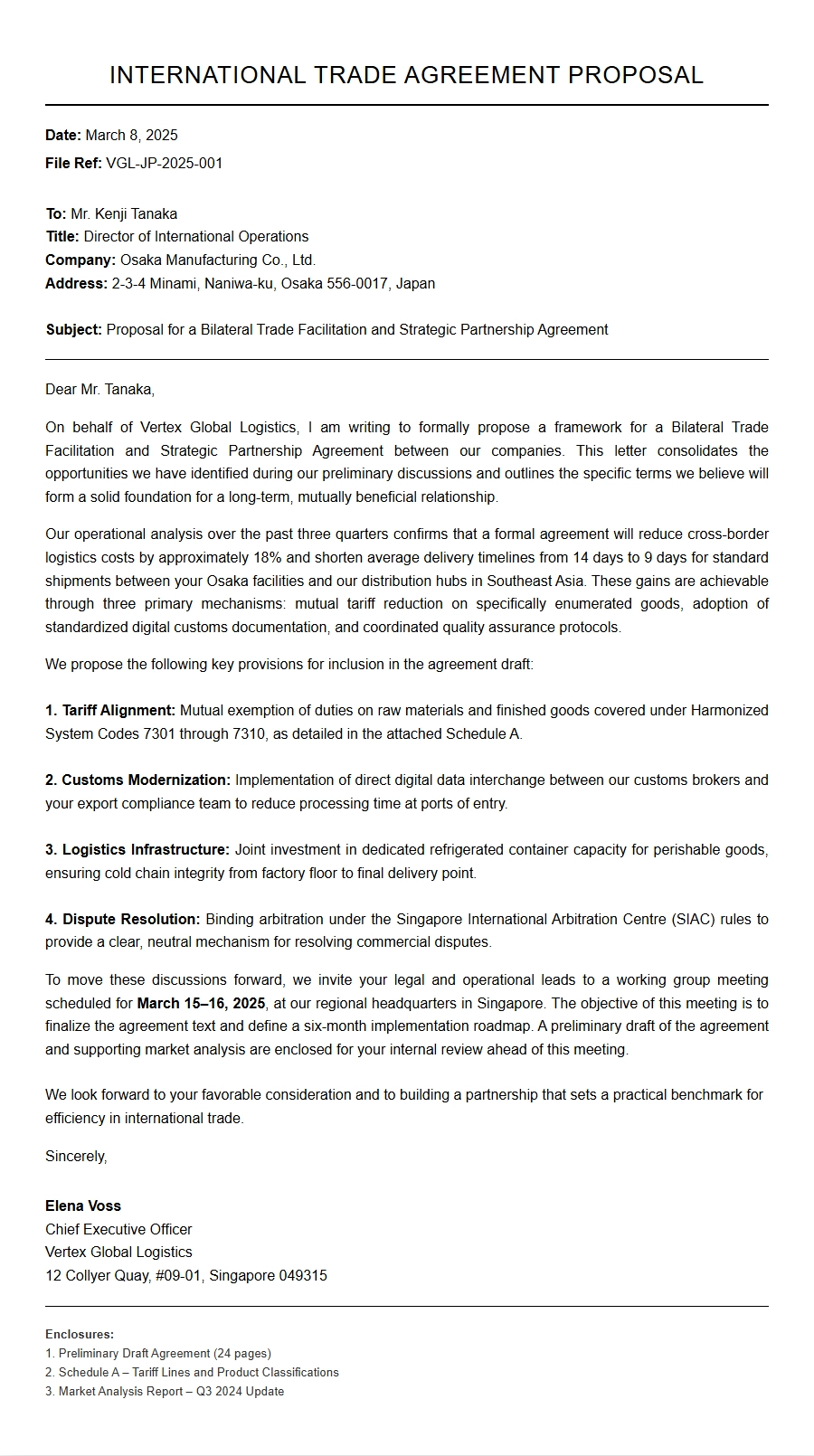
International Trade Agreement Proposal Letter
Export Textiles Trade Agreement Proposal
Reference: TEX-2024-015 Date: March 15, 2024 From: GlobalFabrics Ltd., 120 Commerce Street, Manchester, UK To: VogueApparel Inc., 45 Fashion Boulevard, New York, USA
We propose a comprehensive international trade agreement for the supply of premium cotton textiles. Our aim is to establish a long-term partnership with guaranteed volume commitments and competitive pricing.
Proposed Terms:
Product: Organic cotton fabric, 200 GSM, width 150 cm
Annual Volume: 500,000 meters
Price: USD 4.50 per meter (FOB Liverpool)
Payment: Letter of Credit at sight
Delivery: 60 days from order confirmation
Pricing Table (Annual):
Quarter
Quantity (meters)
Unit Price (USD)
Total (USD)
Q1
125,000
4.50
562,500
Q2
125,000
4.50
562,500
Q3
125,000
4.50
562,500
Q4
125,000
4.50
562,500
Total
500,000
2,250,000
We invite your review and look forward to negotiating a mutually beneficial agreement.
Distribution Agreement Proposal for Consumer Electronics
Reference: DAP-ELEC-2024-042 Date: April 2, 2024 From: TechVista GmbH, Kurfurstendamm 78, Berlin, Germany To: Pacific Distributors LLC, 300 Ocean Drive, Sydney, Australia
We propose an exclusive distribution agreement for our line of smart home devices in the Australian market. Our products include smart speakers, security cameras, and energy monitors.
Key Proposal Points:
Exclusive rights for a period of 3 years, renewable.
Minimum annual purchase: EUR 1,500,000.
Distributor discount: 25% off MSRP.
Marketing support: Co-op advertising up to EUR 100,000 per year.
Warranty: 2-year manufacturer warranty, with local service center support.
Estimated First-Year Revenue (EUR):
Product Category
Units
Wholesale Price
Total Revenue
Smart Speakers
10,000
50
500,000
Security Cameras
5,000
120
600,000
Energy Monitors
4,000
100
400,000
Total
19,000
1,500,000
We are confident this partnership will drive significant growth for both companies. Please review and let us know your interest.
Joint Venture Proposal for Agricultural Exports
Reference: JV-AGRO-2024-107 Date: June 10, 2024 From: GreenFields Co., 88 Harvest Road, Nairobi, Kenya To: NordicFoods AB, 12 Fjordgatan, Stockholm, Sweden
We propose establishing a joint venture to process and export organic avocados and mangoes from Kenya to the European Union. Our farm network can supply up to 20,000 metric tons annually.
Proposed Structure:
GreenFields will contribute land, farming expertise, and local labor.
NordicFoods will contribute processing technology, cold chain logistics, and EU market access.
Ownership: 50% each.
Initial capital: USD 5,000,000 (shared equally).
Profit sharing: proportional to ownership.
Expected Financials (Year 1):
Item
Amount (USD)
Total Revenue
12,000,000
Operating Costs
8,500,000
Gross Profit
3,500,000
Net Profit (after tax)
2,450,000
Each Partner's Share
1,225,000
We have prepared a detailed feasibility study and invite your team to visit our farms. This partnership will create a sustainable supply chain for premium organic produce.
Technology Licensing Agreement Proposal
Reference: LIC-2024-089 Date: May 20, 2024 From: InnoSys Corp., 300 Innovation Drive, San Jose, CA 95134, USA To: Shenzhen TechPartners Ltd., 88 Science Park Road, Shenzhen, China
We propose a non-exclusive licensing agreement for our patented wireless charging technology (Patent No. US 11,123,456 B2). This technology enables fast charging for smartphones and electric vehicles.
License Terms:
Territory: Greater China region.
Duration: 5 years from signature.
Royalty: 5% of net sales, with a minimum annual royalty of USD 500,000.
Upfront Fee: USD 250,000 (non-refundable).
Technical Support: Up to 200 hours per year included.
Royalty Projection (Year 1):
Product Category
Estimated Net Sales (USD)
Royalty (5%)
Smartphone Chargers
5,000,000
250,000
EV Charging Pads
8,000,000
400,000
Accessories
2,000,000
100,000
Total
15,000,000
750,000
We believe this technology will accelerate your product development. Please sign the attached non-disclosure agreement to proceed with detailed discussions.
Supply Agreement Proposal for Raw Materials
Reference: SUP-RAWM-2024-033 Date: July 5, 2024 From: MineralSource Ltd., 45 Mine Street, Johannesburg, South Africa To: EuroMetals GmbH, 7 Industriestrasse, Frankfurt, Germany
We propose a long-term supply agreement for high-grade manganese ore. Our mine has a proven reserve of 10 million metric tons and we can deliver consistently.
Proposed Terms:
Product: Manganese ore, Mn content 45% min.
Quantity: 50,000 metric tons per month.
Price: Based on monthly average of London Metal Exchange manganese price minus 5% discount.
Incoterm: CIF Rotterdam.
Duration: 3 years, with annual review.
Monthly Pricing Example (at LME price USD 200/ton):
Item
Per Ton (USD)
Total 50,000 Tons (USD)
LME Reference Price
200.00
10,000,000
Discount 5%
-10.00
-500,000
Net Price
190.00
9,500,000
Freight & Insurance (CIF)
15.00
750,000
Total CIF Price
205.00
10,250,000
We are ready to negotiate final terms and provide samples for quality testing. Let's schedule a meeting to advance this partnership.
Free Trade Zone Partnership Proposal
Reference: FTZ-2024-058 Date: August 12, 2024 From: Port of Dubai Free Zone Authority, P.O. Box 1234, Dubai, UAE To: GlobalTrade Corp., 500 Harbor Avenue, Singapore
We propose a strategic partnership to establish a distribution hub within the Jebel Ali Free Zone. Your company will benefit from zero customs duties, 100% foreign ownership, and streamlined logistics.
Benefits of This Agreement:
No corporate tax for 50 years.
Duty-free import of raw materials and re-export of finished goods.
On-site customs clearance within 4 hours.
Warehouse space available at USD 3 per sq ft per year.
Access to 120+ shipping lines.
Estimated Annual Savings for Your Company:
Cost Item
Current Overseas (USD)
In FTZ (USD)
Savings
Customs Duties
500,000
0
500,000
Warehousing
240,000
150,000
90,000
Logistics Time Cost
300,000
100,000
200,000
Total Annual Savings
1,040,000
250,000
790,000
We invite you to tour the facility and meet with our trade facilitation team. This proposal is valid for 90 days.
International Logistics Service Agreement Proposal
Reference: LOG-2024-074 Date: September 1, 2024 From: FastShip Logistics Inc., 700 Container Way, Hong Kong To: FreshFoods Export Ltd., 2 Orchard Street, Cape Town, South Africa
We propose a comprehensive logistics service agreement to handle your perishable goods exports to Asia. Our refrigerated container fleet and cold chain management ensure product freshness.
Services Included:
Door-to-door transportation (Cape Town to Shanghai, Tokyo, and Singapore).
Customs brokerage and documentation.
Real-time tracking via IoT sensors.
Insurance coverage up to 110% of cargo value.
Service Rates (per 20 ft reefer container):
Route
Ocean Freight (USD)
Documentation (USD)
Total (USD)
Cape Town – Shanghai
3,200
350
3,550
Cape Town – Tokyo
3,800
350
4,150
Cape Town – Singapore
2,900
350
3,250
We commit to transit times of 18–22 days with a 98% on-time record. Please review the full service level agreement attached. We look forward to a long-term collaboration.
Countertrade Agreement Proposal
Reference: CTR-2024-121 Date: October 10, 2024 From: PetroExport Co., 5 Energy Plaza, Caracas, Venezuela To: AgriMachines Ltd., 10 Industrial Park, Minsk, Belarus
We propose a countertrade arrangement: exchange of crude oil for agricultural machinery and equipment. This will help both parties overcome currency restrictions and expand trade volumes.
Proposed Exchange:
Our Supply: 500,000 barrels of heavy crude oil (API 22) per month.
Your Supply: Tractors (Model MTZ-82), combine harvesters, and spare parts.
Value Ratio: 1:1 at prevailing international market prices.
Estimated Monthly Trade Value (USD):
Item
Quantity
Unit Price (USD)
Total Value (USD)
Crude Oil
500,000 barrels
70
35,000,000
Tractors
200 units
50,000
10,000,000
Combine Harvesters
50 units
250,000
12,500,000
Spare Parts
Various
12,500,000
12,500,000
Total Countertrade
35,000,000
We can negotiate a clearing account mechanism to settle any imbalances. This proposal aligns with our bilateral trade goals.
Strategic Alliance Proposal for Manufacturing
Reference: SA-MFG-2024-145 Date: November 5, 2024 From: AutoParts Co., 100 Assembly Lane, Detroit, MI 48201, USA To: PrecisionComponents Ltd., 22 Industrial Zone, Pune, India
We propose a strategic alliance to co-manufacture automotive components for electric vehicles. Our combined capabilities can serve both the North American and Asian markets efficiently.
Alliance Framework:
Joint design and engineering using our proprietary EV drivetrain technology.
Production split: 60% in your Pune plant, 40% in our Detroit plant.
Shared intellectual property with royalty-free cross-licensing.
Minimum annual output: 100,000 units starting Year 2.
Projected Cost Savings (per unit):
Cost Category
Solo Production (USD)
Alliance Production (USD)
Savings
Raw Materials
450
400
50
Labor
200
120
80
Overhead
150
100
50
Logistics
80
60
20
Total
880
680
200
We have drafted a memorandum of understanding for your review. This alliance will create a competitive edge in the global EV supply chain.
Preferential Trade Agreement Proposal (Bilateral)
Reference: PTA-2024-198 Date: December 1, 2024 From: Ministry of Trade, Government of Atlantis, Capital City To: Minister of Commerce, Government of Pacifica, Port City
We propose a bilateral preferential trade agreement to reduce tariffs on key exports and boost economic integration between our nations. This aligns with our shared development goals.
Proposed Tariff Reductions:
Atlantis will reduce tariffs on Pacifican electronics (currently 15%) to 0% over 3 years.
Pacifica will reduce tariffs on Atlantis agricultural products (currently 20%) to 5% immediately.
Rules of origin: 40% regional value content.
Estimated Trade Impact (Year 1 of Agreement):
Sector
Current Trade (USD)
Projected Trade (USD)
Increase
Electronics (Pacifica to Atlantis)
500,000,000
650,000,000
30%
Agriculture (Atlantis to Pacifica)
300,000,000
450,000,000
50%
Services
100,000,000
150,000,000
50%
Total
900,000,000
1,250,000,000
~39%
We propose a joint working group to finalize schedules and dispute resolution mechanisms. This agreement will create thousands of jobs in both countries.
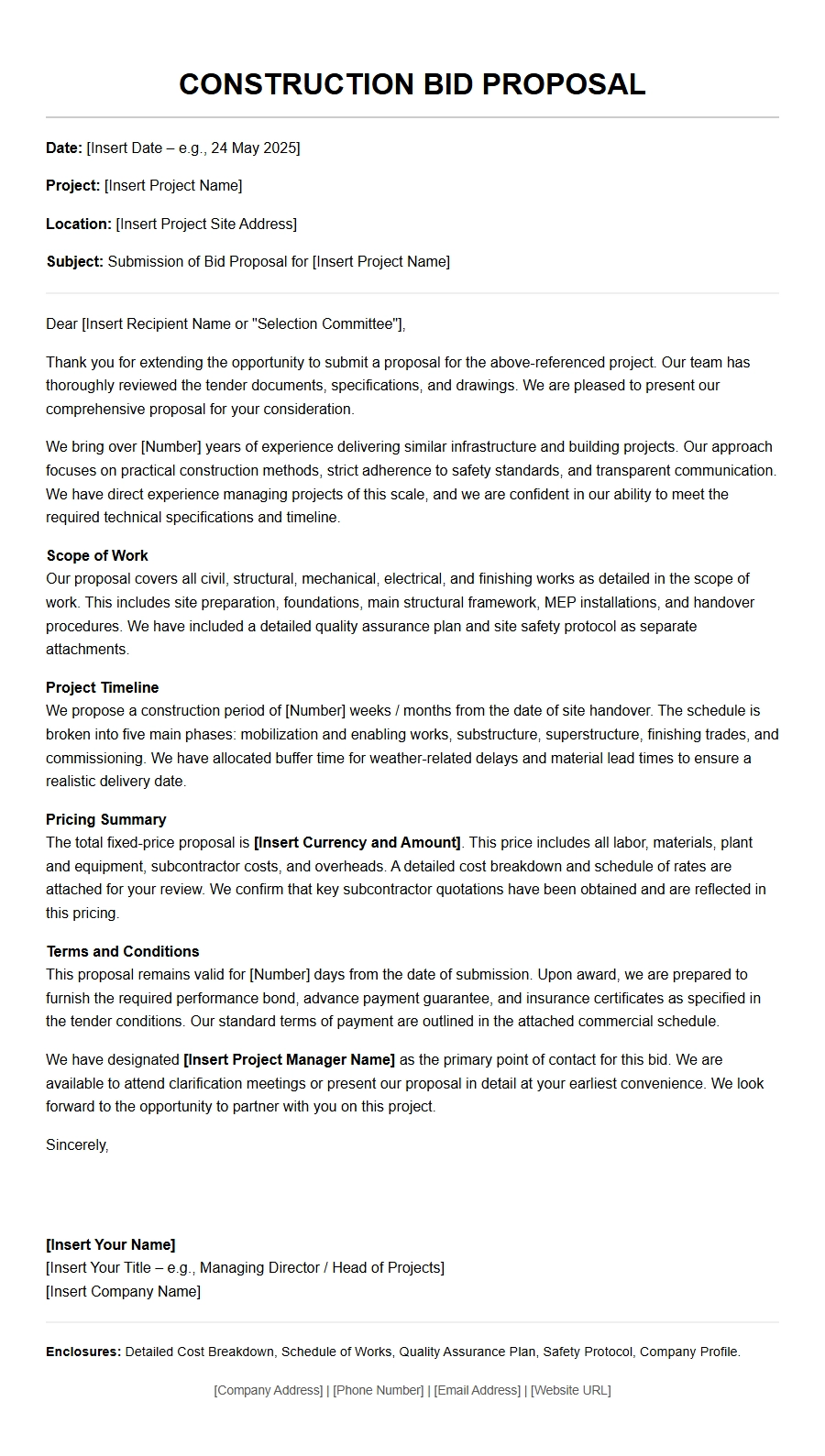 Sample Construction Bid Proposal Letter
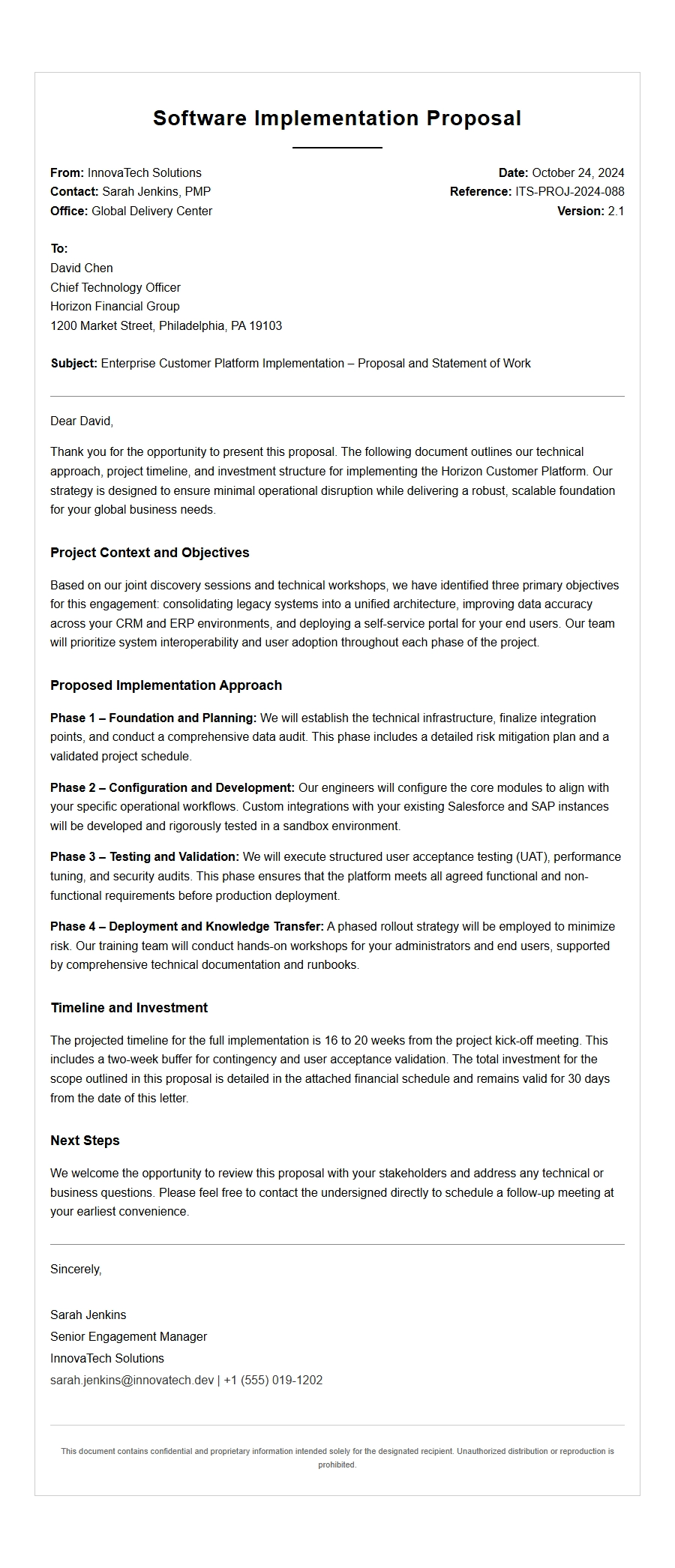 Enterprise Software Implementation Proposal Letter Example
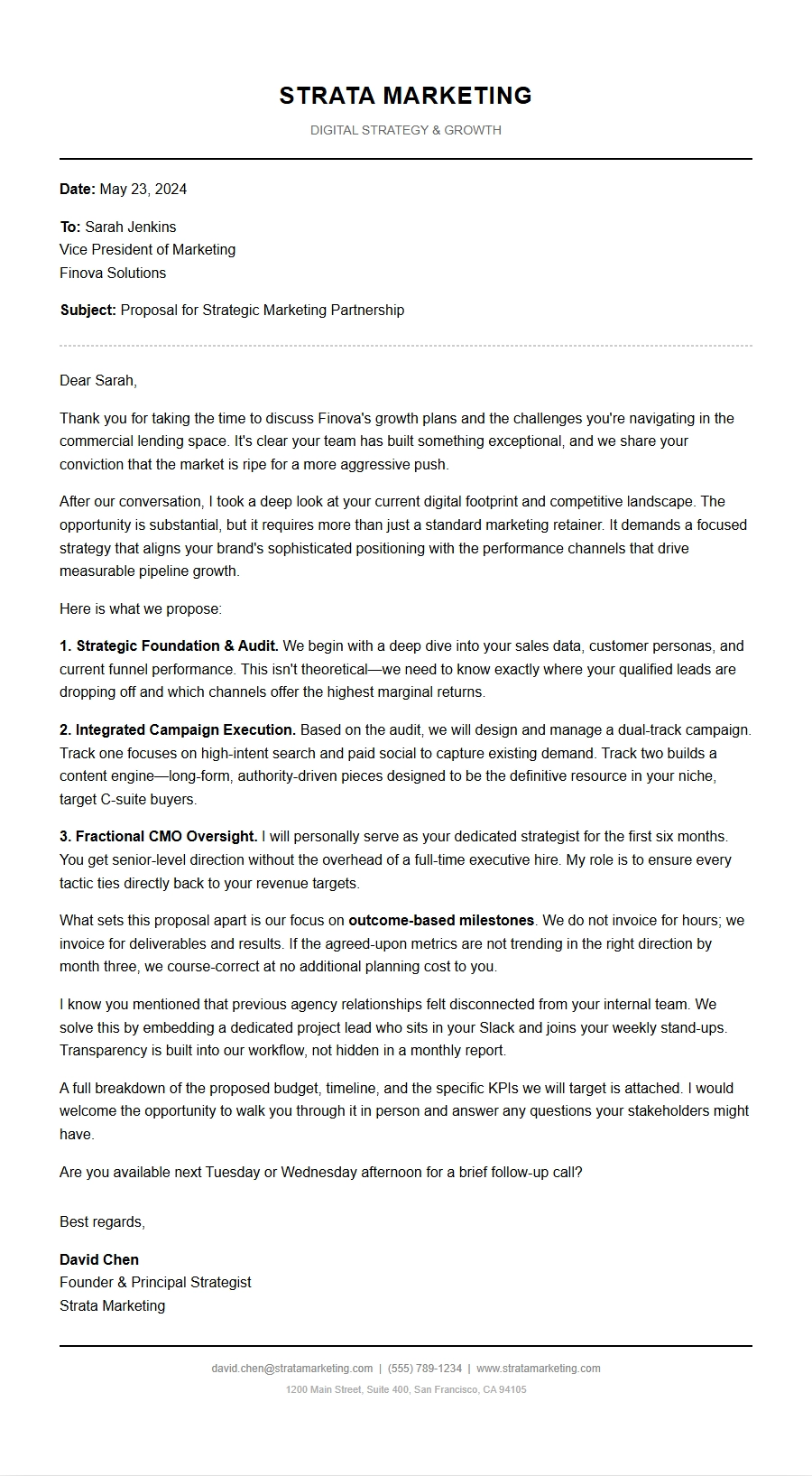 Marketing Agency Service Proposal Letter Template
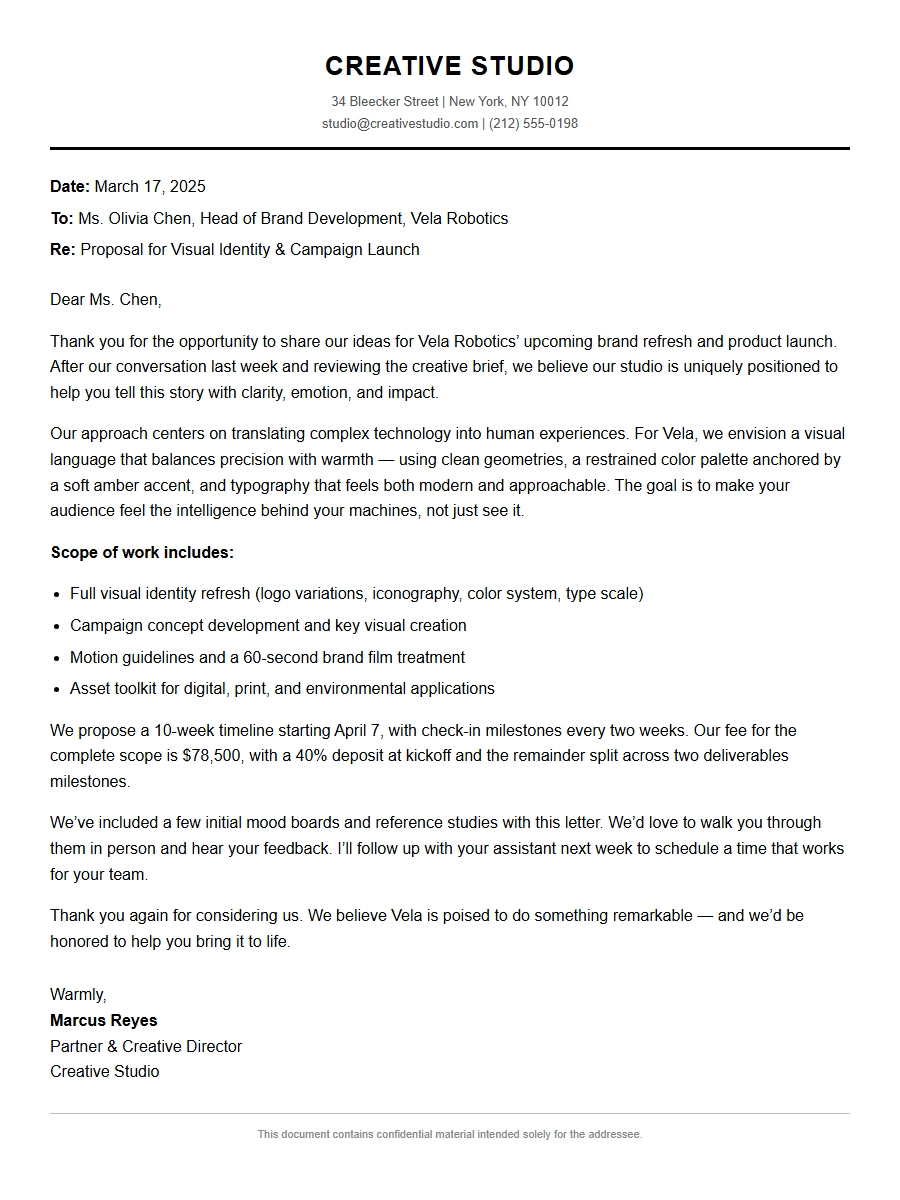 Creative Studio Project Proposal Letter
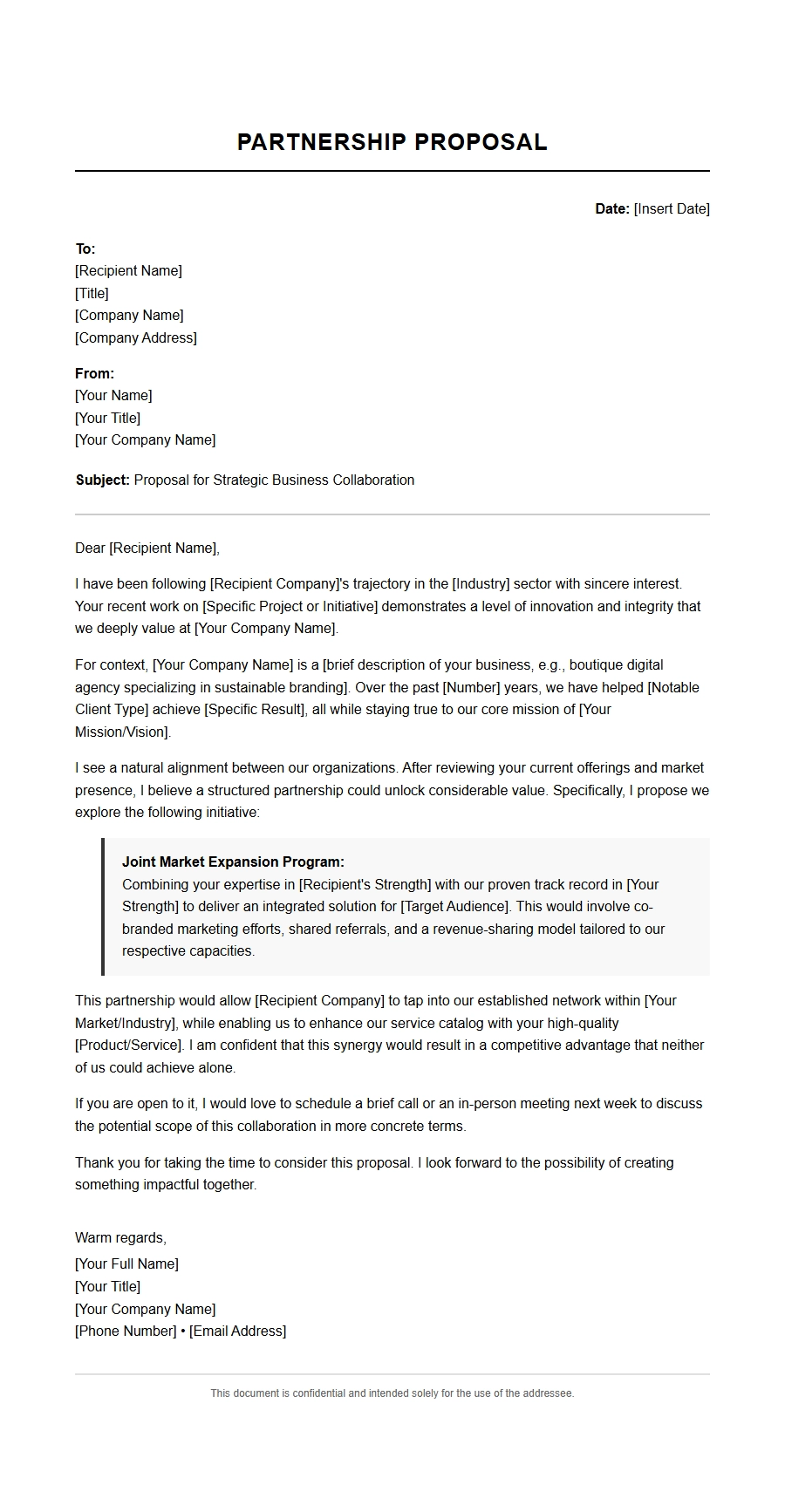 Small Business Partnership Proposal Letter Template
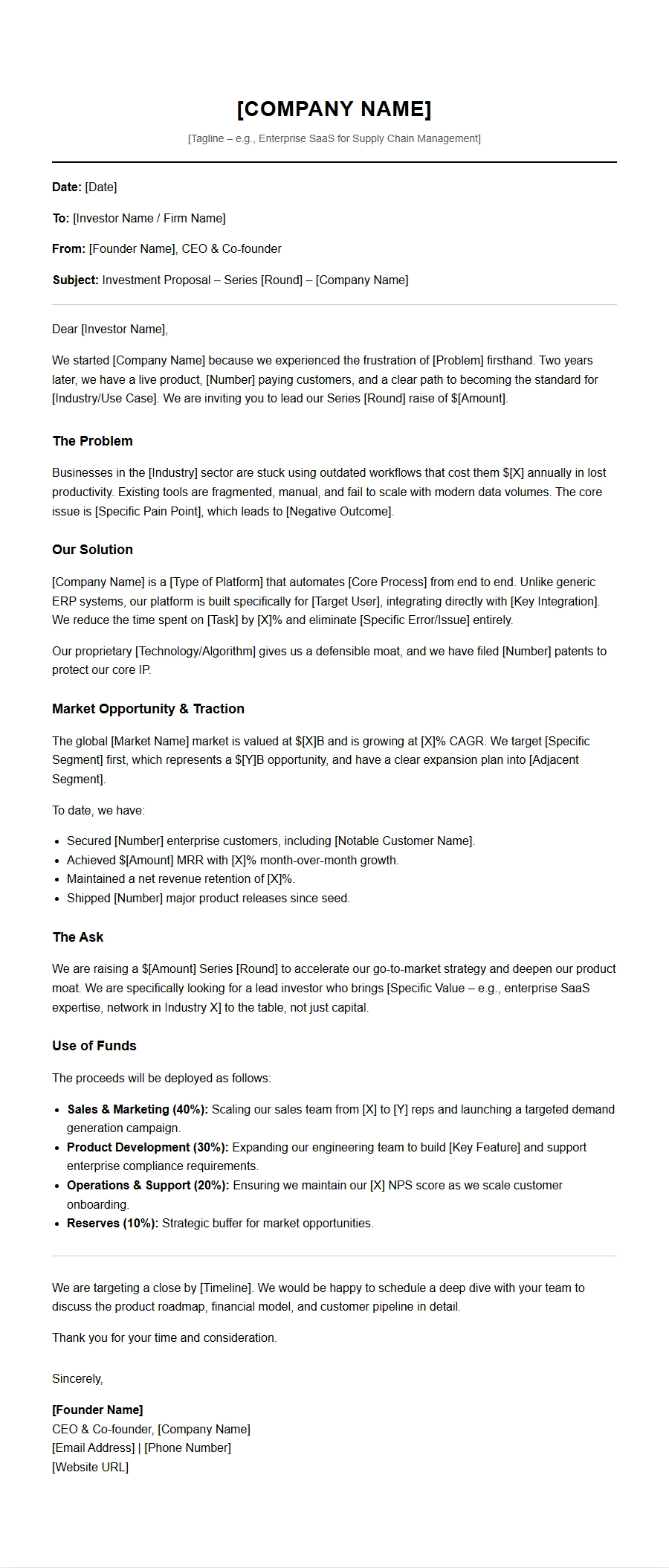 Startup Investment Proposal Letter Template