rejection of partnership proposal letter - Business Proposal Letters
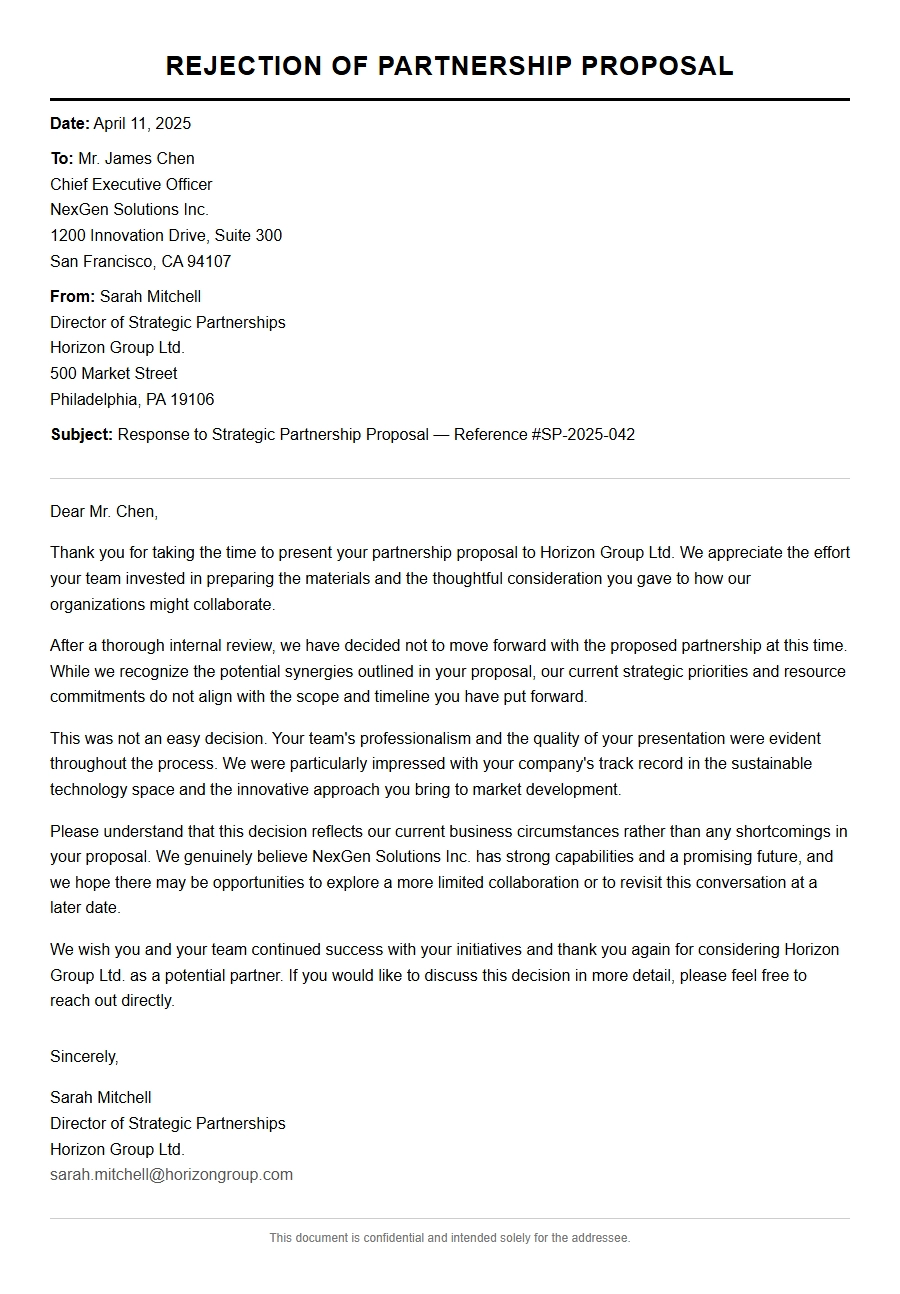
You’ve just received a partnership proposal that doesn’t fit your strategic direction. Maybe the timing is off, the financial terms don’t work, or the core values aren’t aligned. Saying no in writing can feel awkward—especially when you want to leave the door open for future opportunities. A well-crafted rejection of partnership proposal letter lets you decline politely without burning bridges. A solid sample gives you structure and tone, so you’re not staring at a blank page. Using a template isn’t cheating; it’s a smart time-saver that frees you up to personalize the message.
The key is to tailor the sample to your situation. First, decide on the level of formality. If you’ve been negotiating with a trusted contact, a semi-formal tone works. For a cold proposal from an unknown company, stick with standard business letter format. Start your letter with a genuine thank-you—acknowledge the effort behind the proposal. Then state your decision clearly but gently: “After careful review, we have decided not to move forward with this partnership at this time.” Avoid vague language like “maybe later” unless you mean it. Follow up with a brief, honest reason. It doesn’t have to be detailed—“our current priorities don’t align with this opportunity” is enough. Close by expressing appreciation and leaving the possibility open for future collaboration, if that’s true.
Common mistakes include using outdated salutations like “To Whom It May Concern” when you have a contact name, or ignoring the format difference between a printed letter and an email. For email, keep the subject line clear (e.g., “Update on partnership proposal — [Your Company Name]”) and skip the letterhead design. In printed or PDF letters, a clean letterhead adds professionalism. Always proofread the final draft—one typo can undermine the careful tone you’ve built.
Category: Business Proposal Letters
If you need inspiration for how to structure your refusal, look at examples from similar contexts. For instance, a dental office equipment lease proposal letter shows how to politely decline equipment terms while maintaining goodwill. The same diplomatic language can be adapted for partnership rejections. Likewise, a sub-contractor work proposal letter often includes clear reasons for declining subcontracts—a useful model for being direct without being rude. You might also find the tone from a strategic alliance proposal letter helpful, as it balances enthusiasm with realistic boundaries. Even a compliance audit support proposal letter demonstrates how to say no to additional services while preserving the relationship. Finally, a cost-effective service proposal letter shows how to decline based on budget constraints—a common reason in partnership rejections too.
When adapting any sample, keep your authentic voice. Change the template sentences to sound like you. If you’re naturally direct, don’t add unnecessary fluff. If you’re more relationship-focused, add a warm line about hoping to cross paths again. The best rejection letters feel both professional and personal. Ever received a letter that was too stiff? It feels robotic. Too casual undermines your credibility. Strike a middle ground by using standard salutation and closing (“Dear [Name],” “Sincerely,”) but conversational body paragraphs.
Practice makes this faster. After writing two or three rejection letters using a template, you’ll internalize the flow. You’ll know to keep it short (two short paragraphs are often enough), to avoid over-explaining, and to proofread once, then read aloud. The goal is to leave the other party respected and clear on your position. Use the sample as a springboard, not a crutch—and soon you’ll be able to draft these letters in minutes, with confidence.
Writing Examples
rejection of partnership proposal letter - Business Proposal Letters
Formal Rejection Due to Strategic Misalignment
Dear [Partner Name],
Thank you for submitting your partnership proposal dated [Date]. After careful evaluation by our strategic committee, we have decided not to proceed with the proposed collaboration.
The primary reason for this decision is a fundamental misalignment with our current long-term strategic goals. While your proposal shows significant potential, it does not fit within our prioritized growth areas for the next fiscal cycle.
Proposed Area
Our Assessment
Decision
Market expansion
Overlaps with existing internal initiatives
Declined
Product integration
Requires resources currently allocated elsewhere
Declined
We wish you success in finding a partner whose direction more closely matches yours. Sincerely, [Your Name]
Declining Partnership Due to Budget Constraints
Dear [Recipient],
We appreciate the time and effort you invested in preparing the partnership proposal. After thorough review, we regret to inform you that we cannot accept the proposal at this time.
Our decision is primarily due to current budgetary limitations. The financial commitment required by the proposed partnership exceeds our available discretionary funds for this fiscal year.
Proposed investment: $250,000 upfront
Annual operational co-funding: $80,000
Revenue share requirement: 15%
These figures, while reasonable, cannot be accommodated within our current budget forecast. We hope to revisit this opportunity when our financial outlook improves. Best regards, [Your Name]
Rejection Based on Overlapping Client Base
Dear [Contact],
Thank you for sharing your partnership proposal. We have reviewed it carefully and concluded that we must decline due to significant overlap in our respective client bases.
Our analysis shows that over 60% of the target clients you identified are already existing clients of our company. A formal partnership in this space could create conflicts of interest and potential channel confusion.
Client Segment
Overlap Percentage
Risk Level
Enterprise accounts
65%
High
SMB segment
42%
Medium
To avoid compromising our current relationships, we have decided not to move forward. We value your proposal and wish you the best. Regards, [Name]
Polite Decline for Pending Internal Restructuring
To the [Team/Department],
Thank you for the well-prepared partnership proposal. We have reviewed it internally and discussed it with several stakeholders.
Unfortunately, we need to decline for now because our organization is entering a period of internal restructuring over the next six months. During this transition, we are unable to commit to new external partnerships or allocate the necessary resources.
We recommend that you:
Reach out again in [Quarter/Year] when our situation stabilises.
Consider a pilot program on a smaller scale, if that is acceptable to you.
Maintain contact through [Email/Phone] for future opportunities.
We sincerely appreciate your proposal and hope to explore it again once our internal changes are complete. Sincerely, [Name]
Unanimous Board Decision to Pass
Dear [Proposal Contact],
We acknowledge receipt of your comprehensive partnership proposal dated [Date]. It was presented to our board of directors during their last meeting.
The board has reached a unanimous decision not to proceed with the partnership. After deliberation, they concluded that the proposed venture does not meet our current risk-return criteria.
Criterion
Requirement
Proposal Score
Revenue potential (Year 1)
$500K minimum
$380K
Market readiness
Proven technology
Prototype only
Regulatory alignment
Full compliance
Pending approvals
We encourage you to address these gaps and submit a revised proposal at a future date. Best regards, [Board Secretariat]
Rejection Due to Incompatible Business Models
Dear [Name],
Thank you for the detailed partnership proposal. Our team evaluated its fit with our operating model and has decided to decline.
The core incompatibility lies in the proposed revenue-sharing structure versus our subscription-based pricing model. Your proposal assumes a transaction-based commission, which would conflict with our existing customer contracts.
Integration challenge: Pricing inconsistency for clients
We also noted differences in go-to-market timelines. Unless these fundamental differences can be reconciled, we must pass on this opportunity. Warm regards, [Your Name]
Declining Proposal After Due Diligence Findings
Dear [Recipient],
We appreciate the effort you put into preparing your partnership proposal. As part of our standard process, we conducted due diligence on the opportunity.
Based on the findings, we must regrettably decline. Our due diligence revealed several concerns that we cannot overlook:
Financial stability: The partner company’s recent financial statements show declining liquidity ratios.
Legal exposure: There is an unresolved litigation that could affect partnership operations.
Operational capacity: The proposed joint resource pool appears insufficient.
We advise you to address these issues before seeking other partnerships. Thank you for your understanding. Sincerely, [Name]
Rejection for Lack of Synergy in Core Values
Dear [Contact],
Thank you for sharing your innovative partnership proposal. Our team studied it with great interest.
However, we have decided to decline because we believe there is insufficient synergy between our core organizational values and those expressed in your proposal. While the financial terms were acceptable, the cultural and ethical alignment fell short of our standards.
Value
Our Position
Proposal Alignment
Sustainability
Carbon-neutral by 2025
No clear plan
Data privacy
GDPR-first approach
Limited compliance detail
Community impact
Local hiring priority
Global outsourcing model
We hope you find a partner whose values more closely match your own. Best wishes, [Name]
Decline Due to Existing Exclusive Agreements
Dear [Proposal Team],
Thank you for your partnership proposal. We have reviewed it fully.
We must respectfully decline because we currently have existing exclusive agreements in the same product category with another organization. These agreements prevent us from entering into any new partnerships that would compete or conflict with them.
Exclusive agreement valid until: [Date]
Scope: [Region/Product line]
Non-compete clause: Yes, prohibits similar partnerships
We are unable to make an exception. Should the exclusive arrangement end in the future, we would be happy to revisit your proposal. Thank you for your understanding. Regards, [Name]
Rejection After Review of Market Conditions
Dear [Recipient],
We are grateful for the partnership proposal you submitted. After careful analysis of current market conditions and industry trends, we have decided not to proceed.
The market landscape has shifted significantly since the proposal was drafted. Key indicators suggest that the demand for the combined offering may not materialise as strongly as projected.
Factor
Projected (Proposal)
Current Forecast
Market growth rate
12% CAGR
4% CAGR
Customer adoption
Fast (2 years)
Slow (4+ years)
Competitor activity
Low
High (3 new entrants)
Given these changes, we believe the partnership carries more risk than initially anticipated. We encourage you to reevaluate your strategy and reach out again if conditions improve. Sincerely, [Name]
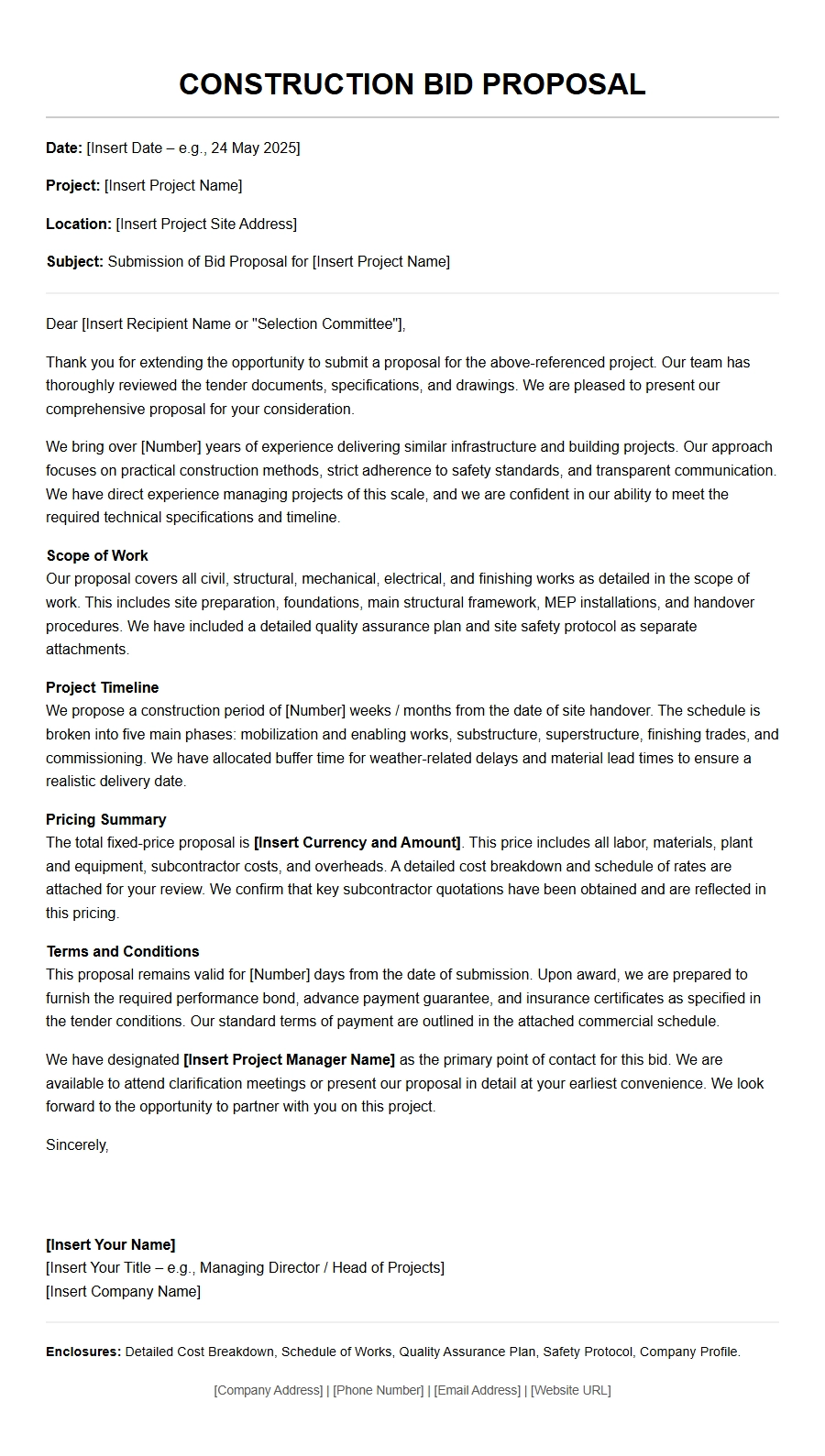 Sample Construction Bid Proposal Letter
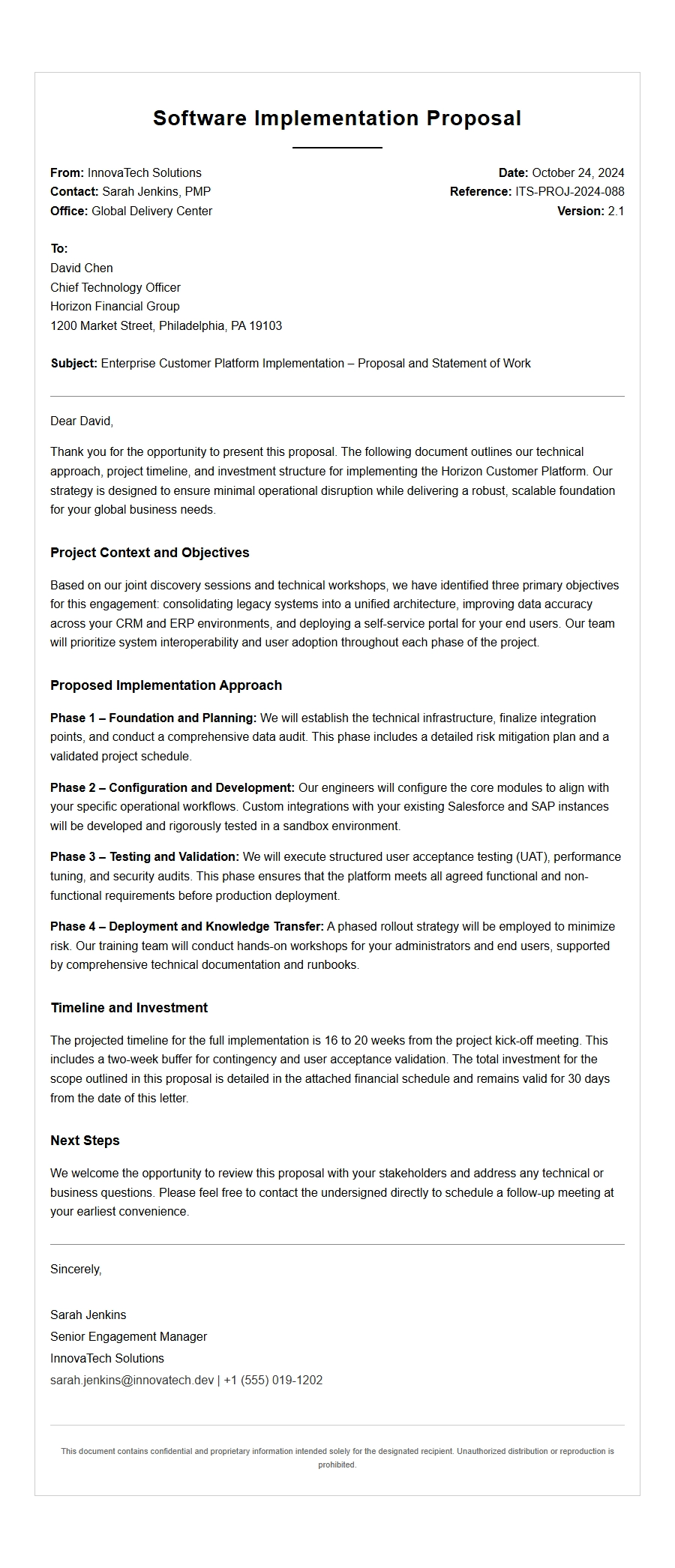 Enterprise Software Implementation Proposal Letter Example
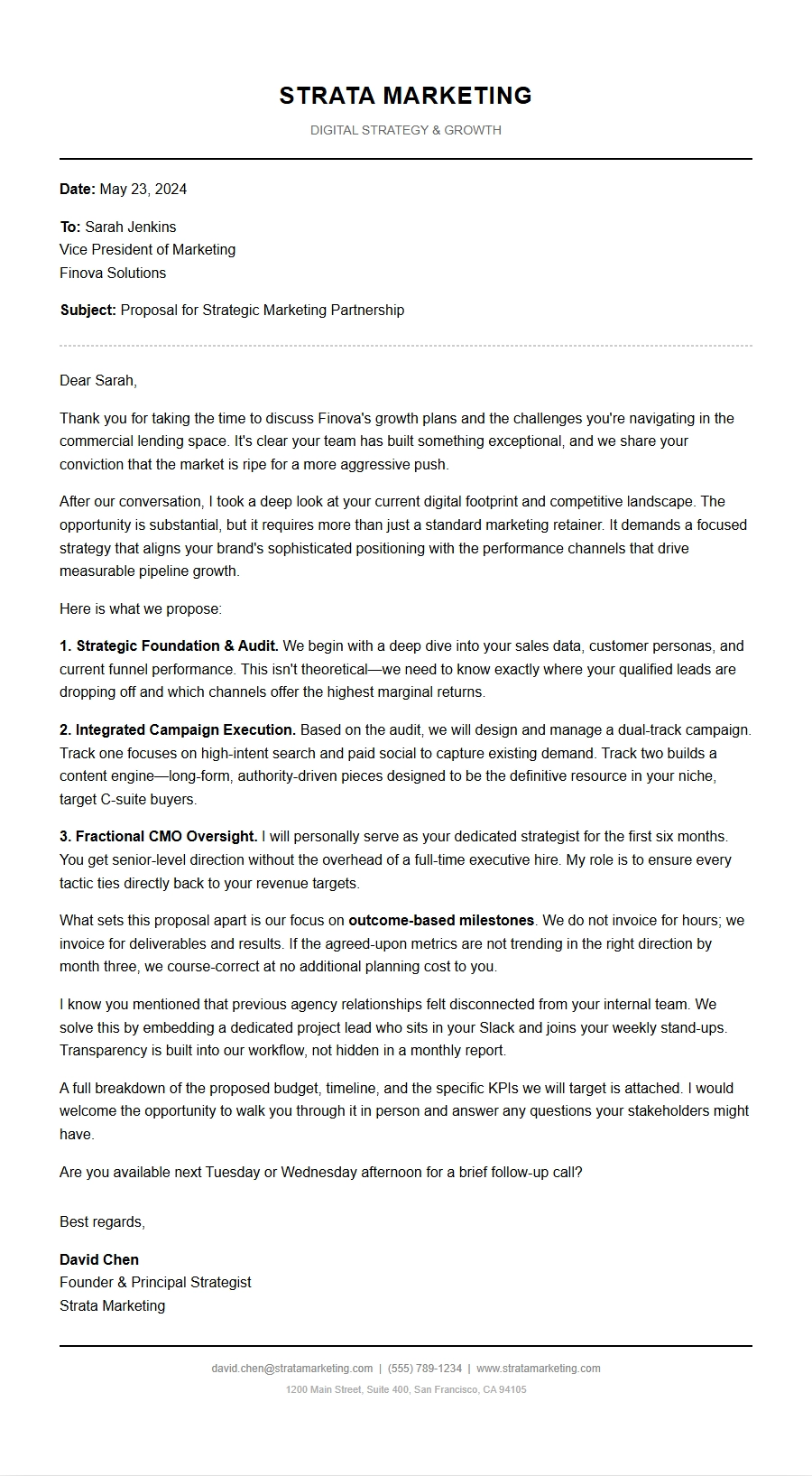 Marketing Agency Service Proposal Letter Template
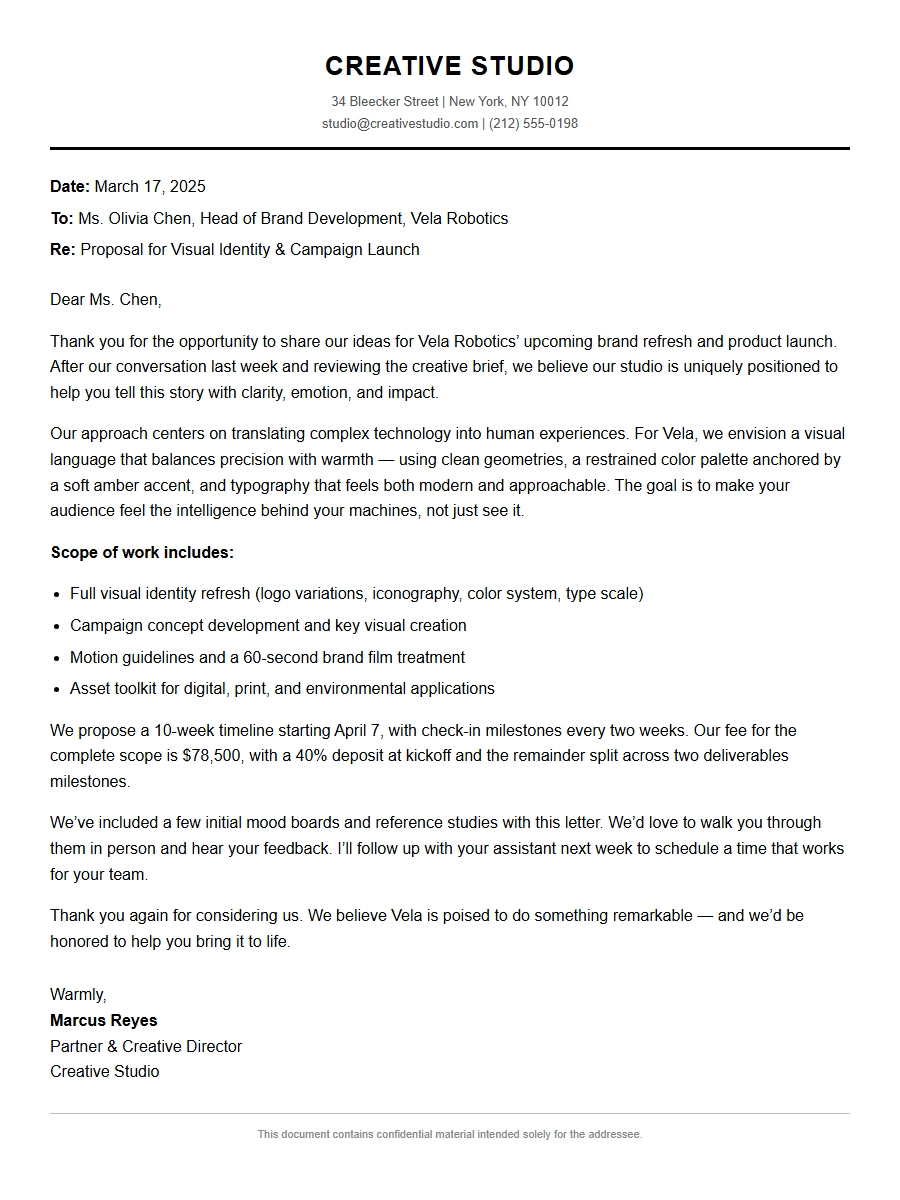 Creative Studio Project Proposal Letter
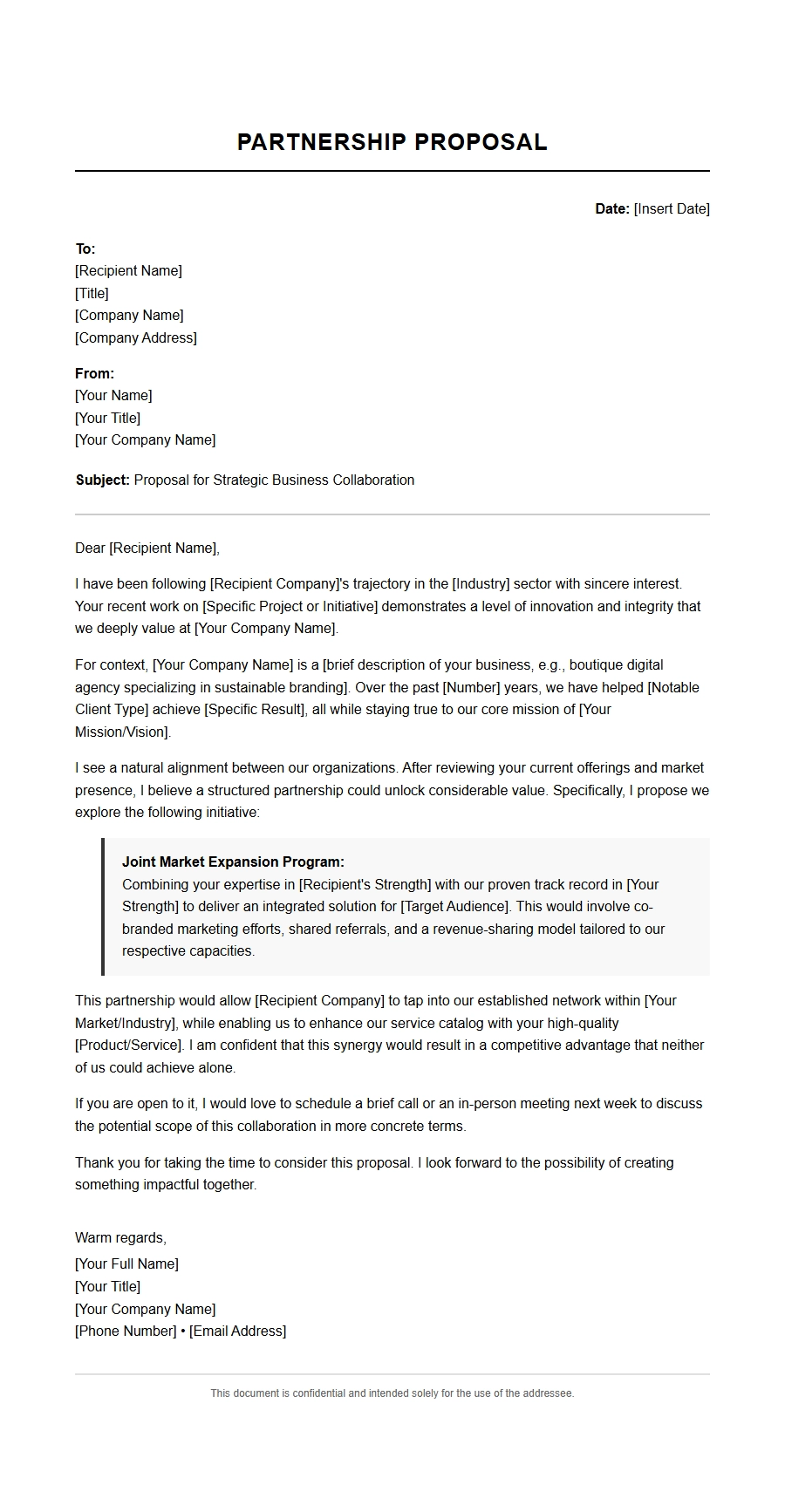 Small Business Partnership Proposal Letter Template
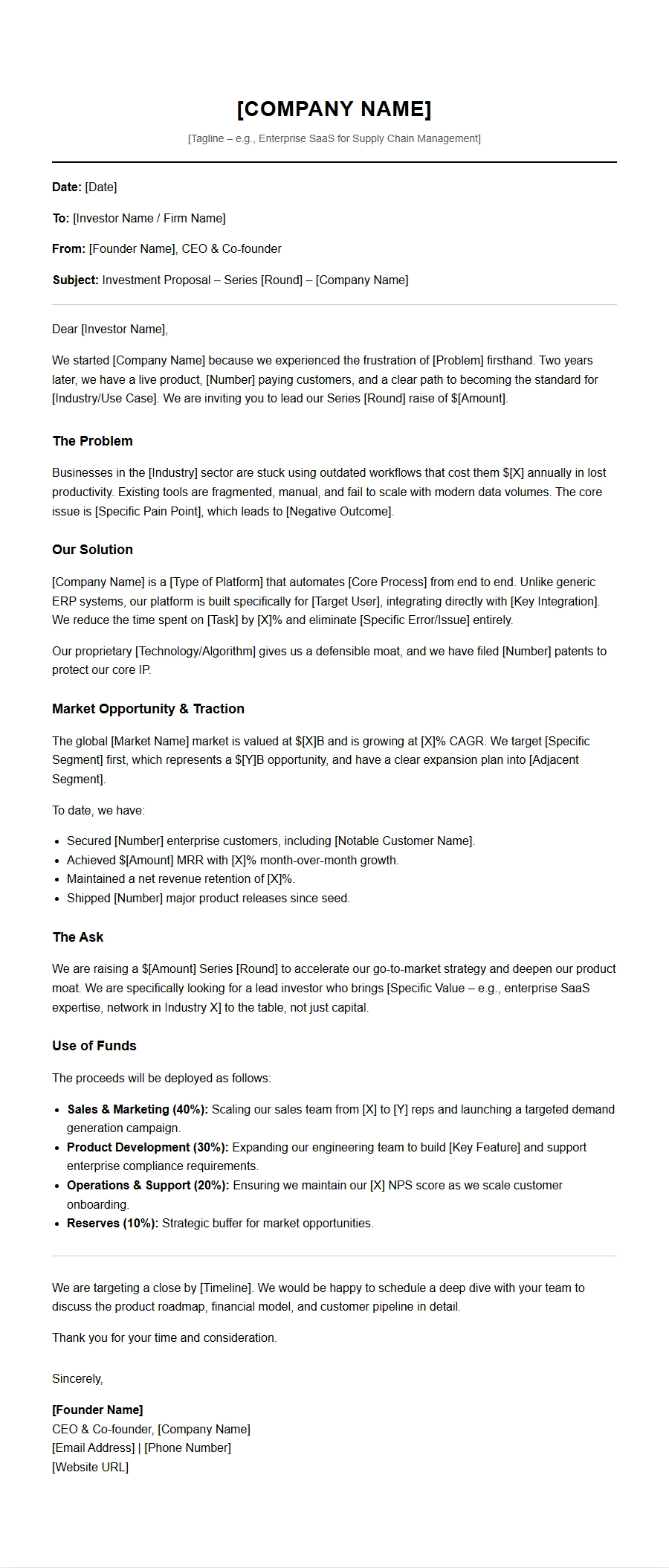 Startup Investment Proposal Letter Template