You need to get a marketing proposal out the door by end of day, but your draft reads like a generic sales pitch. It’s missing the details that make your agency’s approach feel tailored. Most frustrating? You know you’re losing the prospect’s attention with every vague sentence they scan.
Here’s the thing: using a marketing agency service proposal letter as a starting point isn’t cutting corners. It’s smart drafting. A good sample gives you the letter structure and professional correspondence framework you need, so you can spend your energy on what matters—customizing the strategy, the metrics, and the tone to the client you’re pitching to.
What this letter actually does
A marketing agency service proposal letter is the bridge between your initial conversation and the formal contract. It’s not a full proposal deck. It’s a concise document that restates the client’s problem, outlines your solution, and lays out the next steps. Think of it as a warm handshake on paper.
You’ll use this letter when you’ve already met with a prospect. Maybe you had a discovery call or a walkthrough of their current campaign results. Now you need to formalize what you discussed and show them exactly how your services will address their gaps. It’s more direct than a cold outreach but less rigid than a legal agreement.
How to pick the right sample without overthinking it
The best letter template for this situation mirrors the relationship you already have with the prospect. If you’ve had casual, fast-moving conversations, keep the tone in writing conversational but still professional. If the client is a formal enterprise, lean into standard business letter format with a proper salutation and closing.
Here’s a quick test: look at their last email to you. Does it start with “Hey [Name]” or “Dear [Name]”? Match that energy in your proposal letter. When you adapt a sample, the letterhead design also matters—use your agency’s branded header for printed versions and a clean signature block for digital letter format sent via email.
Adapting the sample without losing your voice
The goal isn’t to fill in blanks and hit send. That’s how you get a letter that feels like a form. Instead, read the sample once to understand the flow. Then rewrite the opening paragraph from scratch using your own notes from the client meeting.
For example, don’t write: “We are pleased to offer our marketing services.” That could apply to anyone. Write: “Last Tuesday, you mentioned your current SEO strategy isn’t capturing qualified leads from the healthcare sector. Here’s how we’ll fix that.” See the difference? The client reads this and thinks, “They listened.”
Inside the body, weave in letter writing etiquette without being stiff. If you’re referencing a letter of recommendation from a past client, mention it naturally: “A vendor in your network—whom we recently worked with on a similar campaign—mentioned you were exploring new approaches to content distribution.” It’s a subtle nod, not a brag.
Common mistakes you’ll want to skip
One of the biggest slip-ups is treating this letter like a cover letter examples for a job. It’s not. You’re not asking for a chance. You’re proposing a paid engagement. Keep the focus on their ROI, not your agency’s history.
Another mistake? Using outdated salutations. “To Whom It May Concern” tells the prospect you don’t remember who you’re writing to. If you must use a general opening, at least write “Dear Marketing Team at [Company Name].”
Also, pay attention to format. If you’re sending this as a PDF attachment, use letterhead design that’s clean and professional. If it’s pasted directly into an email body, skip the letterhead and use a simple text signature. Nothing kills a digital letter format faster than a header that doesn’t render correctly on mobile.
Tailoring the opening to grab attention fast
The first paragraph is where most customizable letter templates fail. They start with pleasantries. Instead, lead with a specific reference to the client’s need. Something like: “You mentioned that your current PPC campaigns are generating clicks but not conversions. This proposal outlines the optimization strategy we’d implement to fix that.”
That single sentence does more work than three paragraphs of fluff. It shows you were paying attention, it states the problem, and it promises a solution. From there, the rest of the letter flows naturally.
Proofreading before you send
You’d be surprised how many proposals lose credibility over a typo in the first sentence. After you adapt your resignation letter sample principles of clarity to this business context, run a final proofreading letter check. Read it out loud. If a sentence sounds awkward, cut it. If a claim feels vague, add a specific example or number.
The best proposal letters feel like the start of a real conversation. They’re professional enough to be taken seriously, but personal enough that the client remembers why they liked you in the first place. Use the sample as a scaffold, not a cage. The more you write these, the faster you’ll get at recognizing what to keep and what to rewrite. Eventually, you won’t need the sample at all—but until then, it’s a reliable shortcut that lets you focus on what actually wins the account: understanding the client’s business.
Templates and Samples
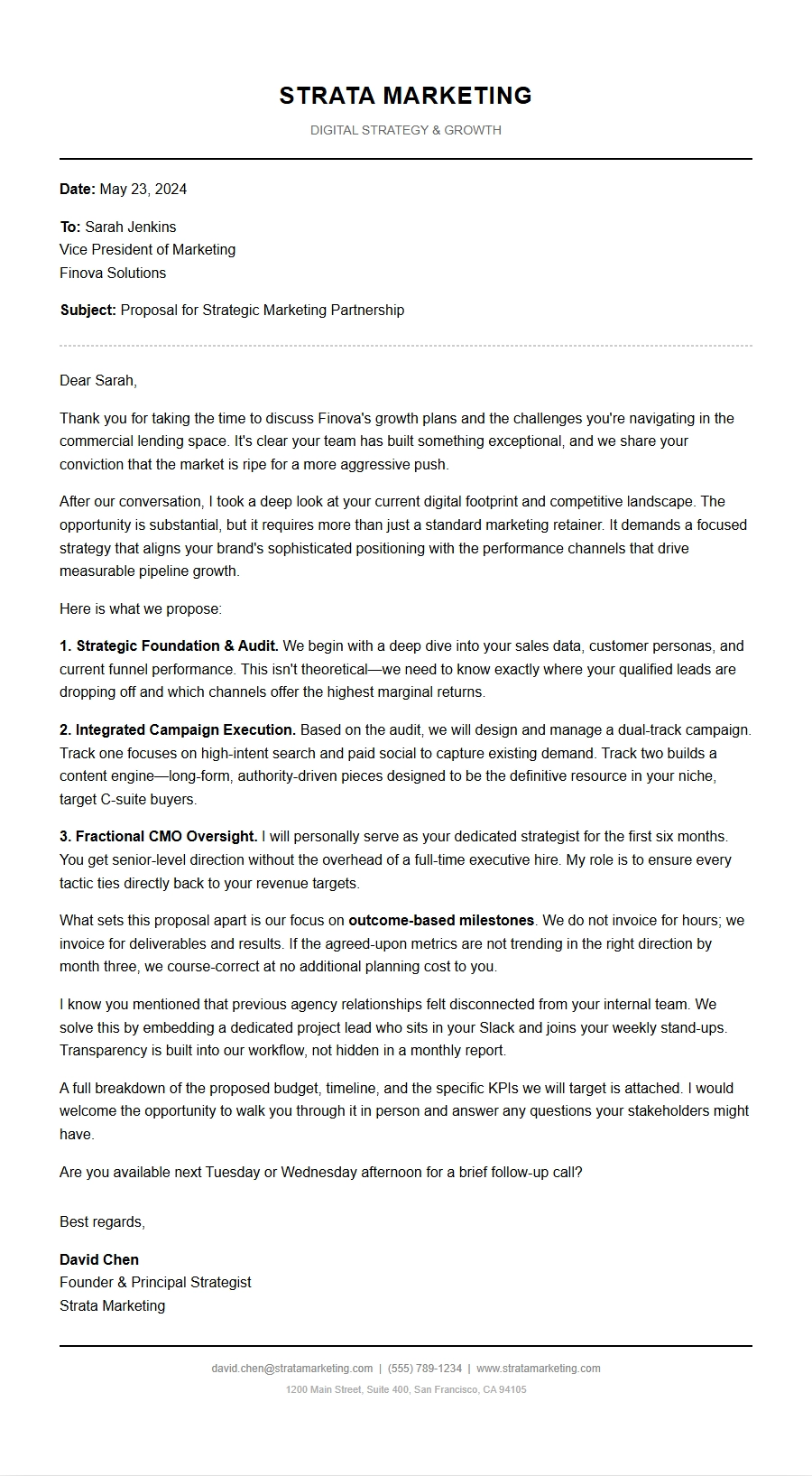
Marketing Agency Service Proposal Letter Template
Full-Service Digital Marketing Retainer Proposal
Dear Client,
Thank you for considering our agency for your digital marketing needs. We propose a comprehensive retainer package tailored to your e-commerce business. Our monthly retainer includes the following services:
We will assign a dedicated account manager and provide weekly updates plus a monthly strategic review. By combining these channels, we project a 20% increase in qualified traffic and a 15% boost in conversions within the first quarter.
We look forward to partnering with you to achieve measurable growth.
Social Media Management & Growth Proposal
Dear Restaurant Owner,
We are excited to present this proposal to elevate your social media presence and attract more diners. Our focus will be on Instagram and Facebook to showcase your menu, ambiance, and events.
Deliverables:
Daily content posts (photos, reels, stories)
Monthly 4K photo shoot of new dishes
Weekly engagement with followers and local influencers
Paid ad campaigns for special promotions
Monthly performance report
Service
Monthly Fee
Content Creation & Scheduling
$1,200
Community Management
$600
Paid Ad Management (ad spend extra)
$400
Monthly Photography Session
$800
Total: $3,000/month
We guarantee a 25% increase in follower growth and a 10% lift in foot traffic from social media referrals within 90 days. This proposal includes a 30-day cancellation clause and free initial audit.
SEO & Content Marketing Proposal
Dear B2B SaaS Team,
Our agency specializes in driving organic growth for technology companies. We propose a six-month SEO and content marketing program to improve your domain authority and generate qualified leads.
Our approach:
Technical SEO audit and fix
Keyword research targeting high-intent terms
Creation of 4 blog posts and 2 whitepapers per month
Guest posting on industry sites
Monthly analytics and adjustment
Phase
Timeline
Investment
Audit & Strategy
First 2 weeks
$2,500 (one-time)
Monthly Retainer (months 1-6)
Ongoing
$4,000/month
Total initial investment: $2,500 + $24,000 for 6 months
We expect a 40% increase in organic traffic and a 30% increase in demo requests by month six. Our track record includes similar results for three SaaS clients in the past year.
Pay-Per-Click Campaign Management Proposal
Dear Online Retail Team,
To accelerate your sales during peak seasons, we propose a fully managed PPC campaign across Google and Bing. We will handle strategy, ad creation, bidding, and optimization.
Campaign details:
Search & Shopping ads for top-performing products
Daily budget: $200/day (client funds)
Management fee: $800/month (10% of spend)
Expected CPC: $1.20 - $1.80
Conversion goal: 4%+
Metric
Month 1 (Launch)
Month 3 (Optimized)
Clicks
5,000
7,500
Conversions
200
350
ROAS
3x
5x
We will provide weekly summary reports and a monthly deep dive. Ad spend is billed directly from your accounts; we only invoice the management fee. Let's schedule a kick-off call this week.
Branding & Web Design Proposal
Dear Startup Founder,
First impressions matter. We propose a complete brand identity and website redesign to position your brand for investors and customers.
Total project: $10,700 (50% upfront, 50% upon completion). Timeline: 6-8 weeks from contract signing. We include one round of revisions per page.
Email Marketing Automation Proposal
Dear E-commerce Brand Manager,
We propose a sophisticated email marketing automation system to nurture your subscribers and recover abandoned carts. Our strategy uses segmentation and triggered flows.
Email flows to build:
Welcome series (5 emails)
Abandoned cart recovery (3 emails plus discount)
Post-purchase upsell (2 emails)
Re-engagement for inactive users (2 emails)
Monthly management includes:
Design and copy for broadcasts
A/B testing subject lines
List segmentation based on behavior
Analytics dashboard setup
Setup Fee
Monthly Retainer
Estimated Revenue Increase
$2,000
$1,500
15-20% from existing list
We require access to your Shopify or WooCommerce store. Our work will be data-driven, and you'll receive weekly performance snapshots. Let's transform your email channel into a profit center.
Influencer Marketing & PR Proposal
Dear Beauty Brand Director,
We present a targeted influencer campaign to increase brand awareness and sales among millennials. Our agency will identify, negotiate, and manage influencers across Instagram and TikTok.
Campaign structure:
10 micro-influencers (10k-50k followers) - product seeding + $200 each
3 mid-tier influencers (50k-200k followers) - $1,000 each + commission
1 macro-influencer (200k+ followers) - $5,000 integrated post
PR outreach to beauty bloggers and magazines
Item
Cost
Influencer fees & product
$10,000
Agency management fee
$3,000
PR materials & press kit
$1,500
Tracking & reporting
$500
Total budget: $15,000
We guarantee at least 1 million impressions and 15% engagement rate average. We will also secure 3 PR mentions. Campaign duration: 4 weeks. Let's launch next month.
Video Content Strategy Proposal
Dear Fitness Brand Manager,
Video is the most engaging format. We propose a 3-month video strategy to build your YouTube channel and TikTok presence with workout tutorials, nutrition tips, and client testimonials.
Content plan:
4 YouTube videos per month (10-15 min each)
12 TikTok/Reels per month (30-60 sec each)
1 live Q&A session weekly
Thumbnail design & SEO optimization
Production details:
In-house filming at your studio (2 days/month)
Professional editing with motion graphics
Captioning and transcript creation
Service
Monthly Fee
Strategy & scripting
$1,000
Production & editing
$3,500
Distribution & analytics
$500
Monthly total: $5,000
We expect a 200% increase in video views and 1,000 new subscribers per month. All content will be repurposed for other platforms. Ready to press record?
Local SEO & Google My Business Proposal
Dear Dental Practice Owner,
Attract more patients in your area with our local SEO service. We optimize your Google My Business profile and build local citations to dominate local search results.
Services included:
Google My Business audit, verification, and optimization
Local keyword research (e.g., "dentist in [city]")
On-page SEO with local schema markup
Online review generation and management
Local backlink building from directories and chambers
Item
One-time
Monthly
GMB setup & optimization
$500
—
Ongoing local SEO management
—
$1,200
Review management platform
—
$200
First month total: $1,900, then $1,400/month.
You can expect to appear in the local 3-pack within 60 days. We also provide a monthly report showing rankings, reviews, and calls generated from GMB. Let's fill your appointment book.
Performance-Based Lead Generation Proposal
Dear Real Estate Agency,
We propose a risk-free lead generation campaign where you pay only for qualified leads. Our agency will create and manage landing pages, social ads, and nurture sequences for your property listings.
How it works:
We design a high-converting landing page for each campaign
Run targeted Facebook and Google ads
Capture contact information with automated follow-up
Deliver leads to your CRM via Zapier
Pricing model:
Lead Type
Cost per Lead
Minimum
Buyer (looking to purchase)
$30
50 leads/month
Seller (listing appointment)
$50
20 leads/month
Renter
$15
100 leads/month
We invest in ad creation and copy; you only pay for validated leads (phone verified). Monthly reporting includes cost per acquisition and ROI. No retainer, no long-term contract. Let's generate your next client.
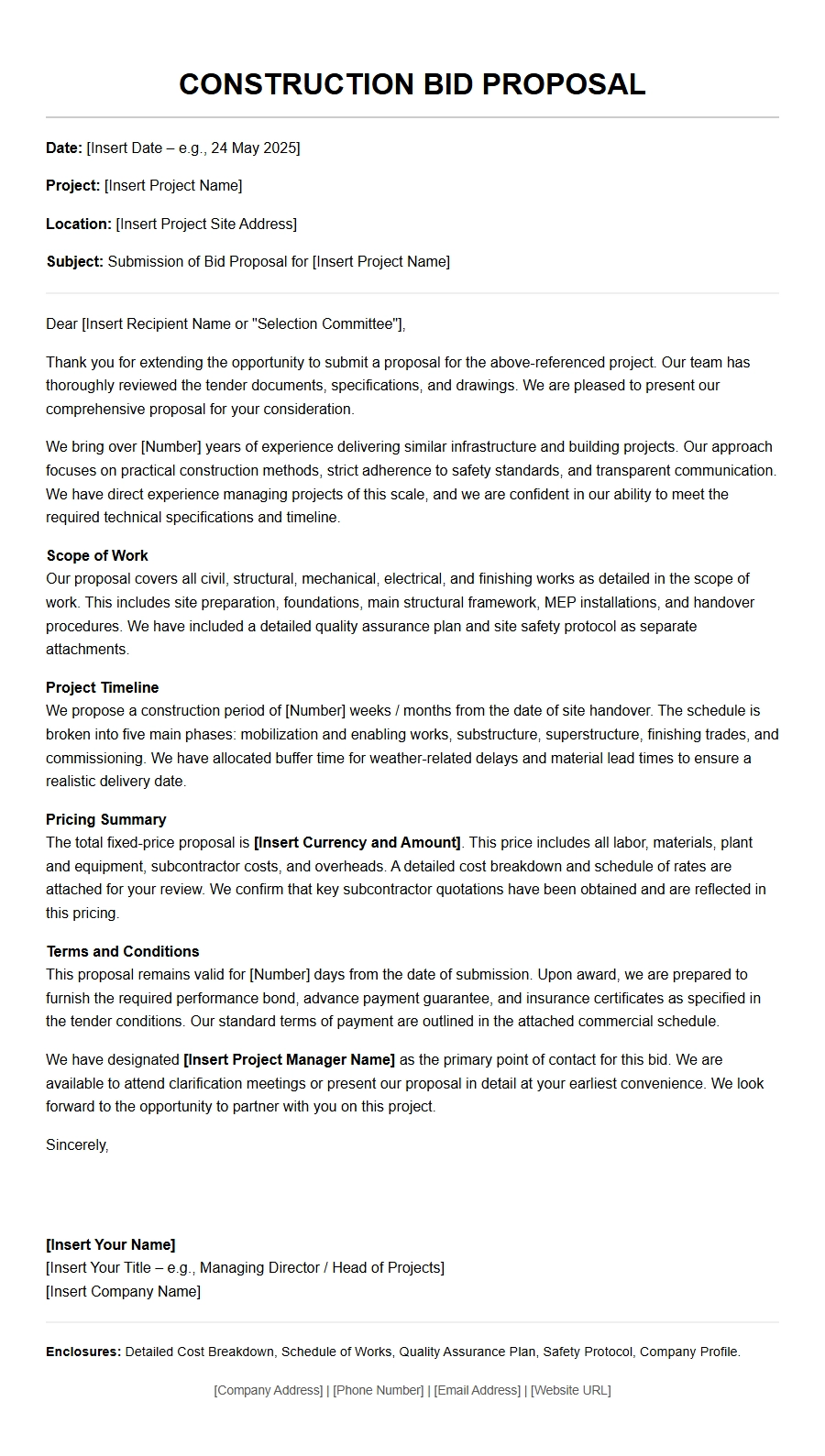 Sample Construction Bid Proposal Letter
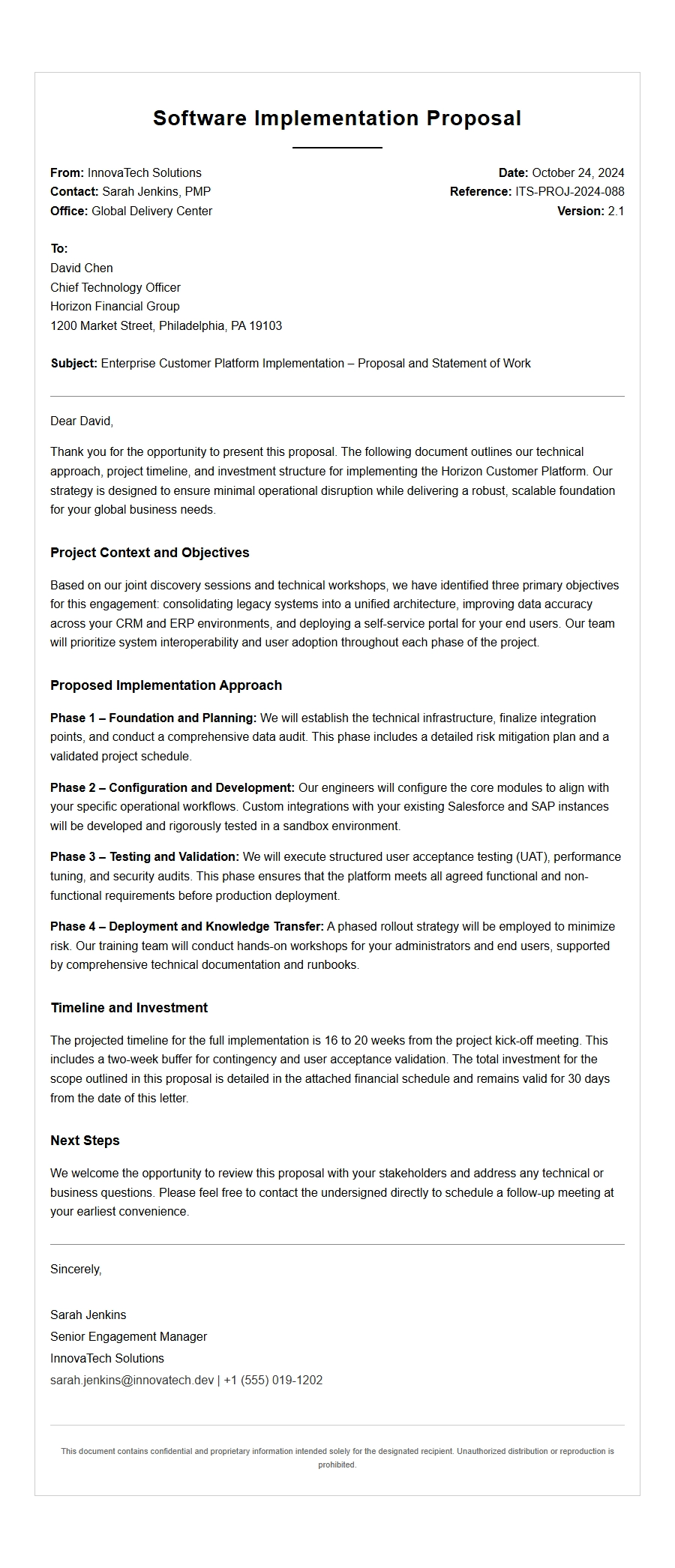 Enterprise Software Implementation Proposal Letter Example
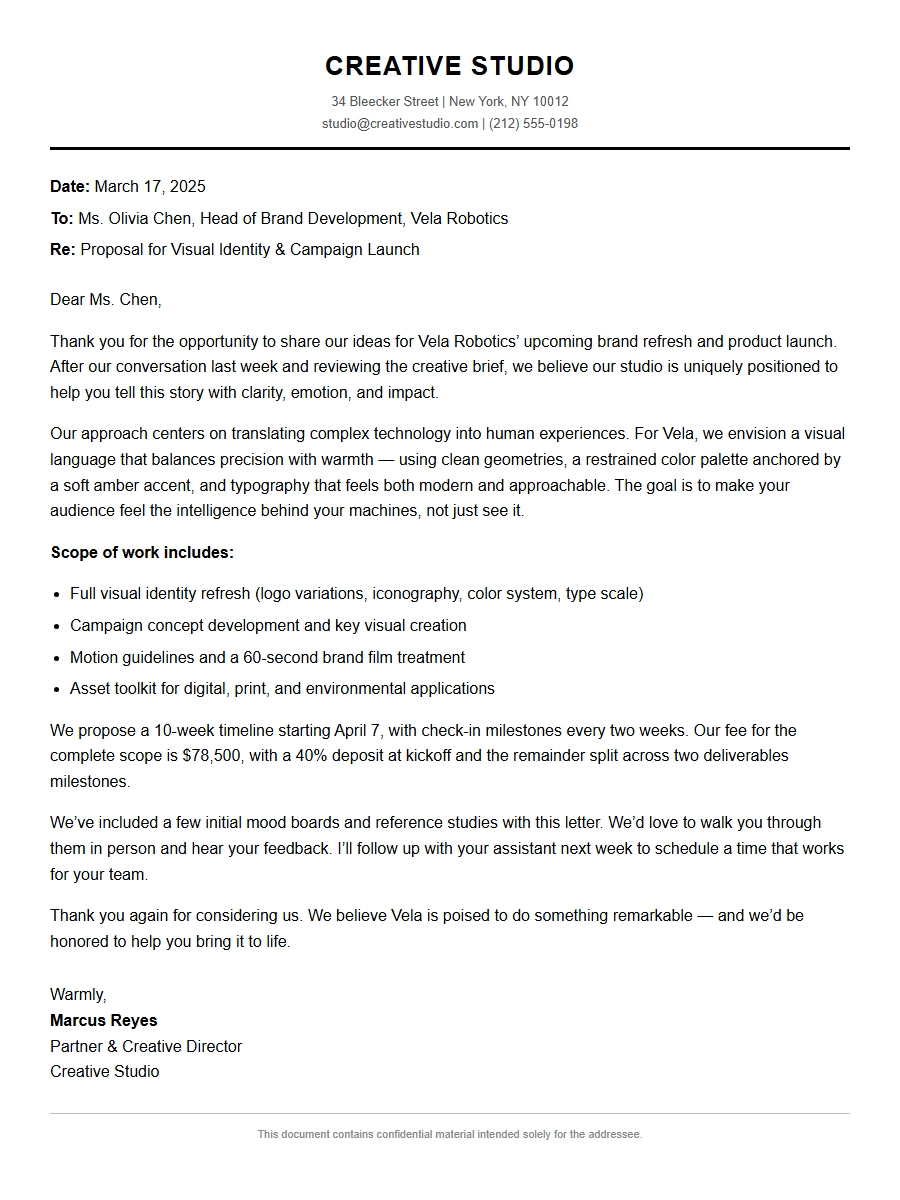 Creative Studio Project Proposal Letter
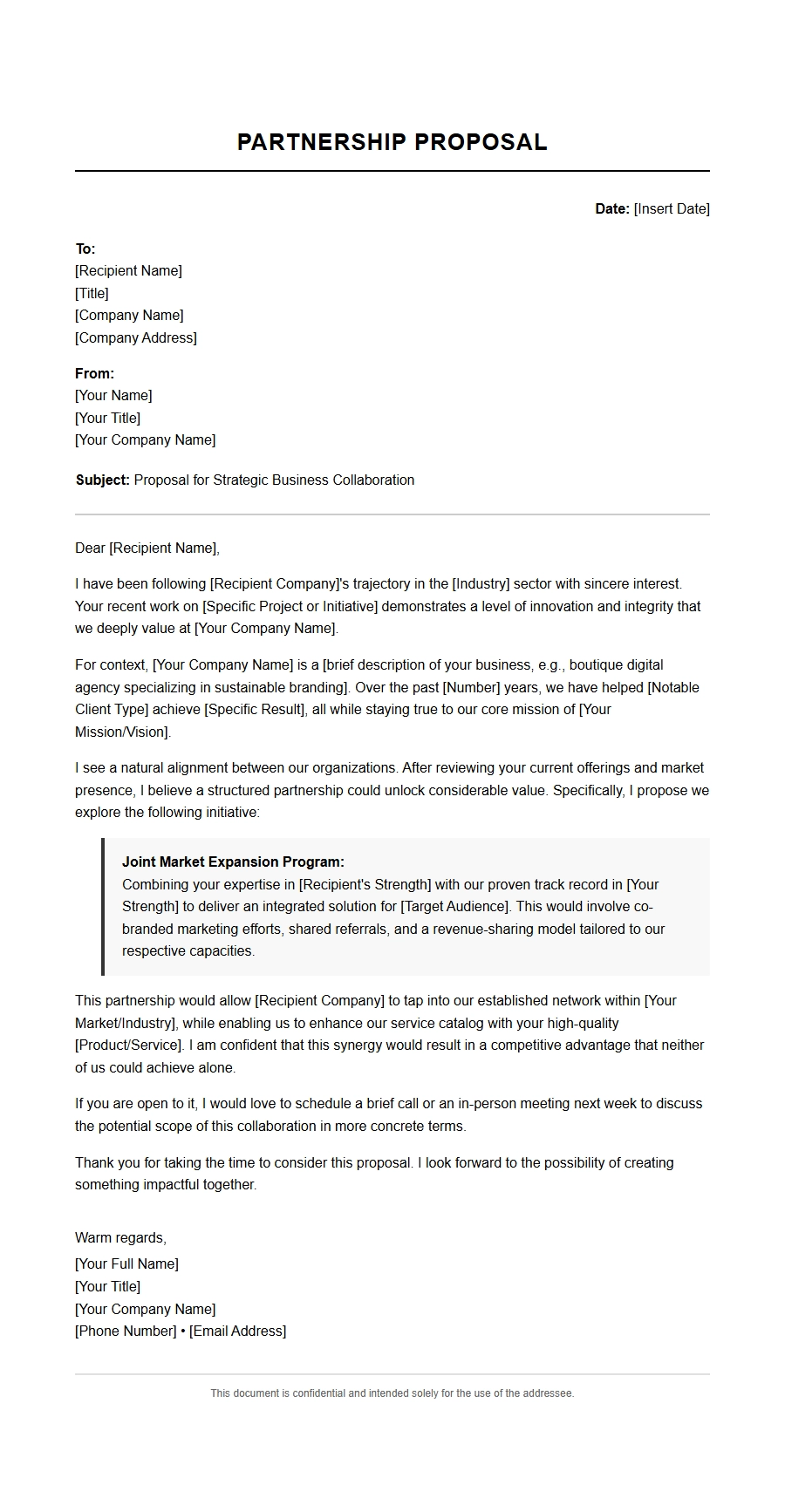 Small Business Partnership Proposal Letter Template
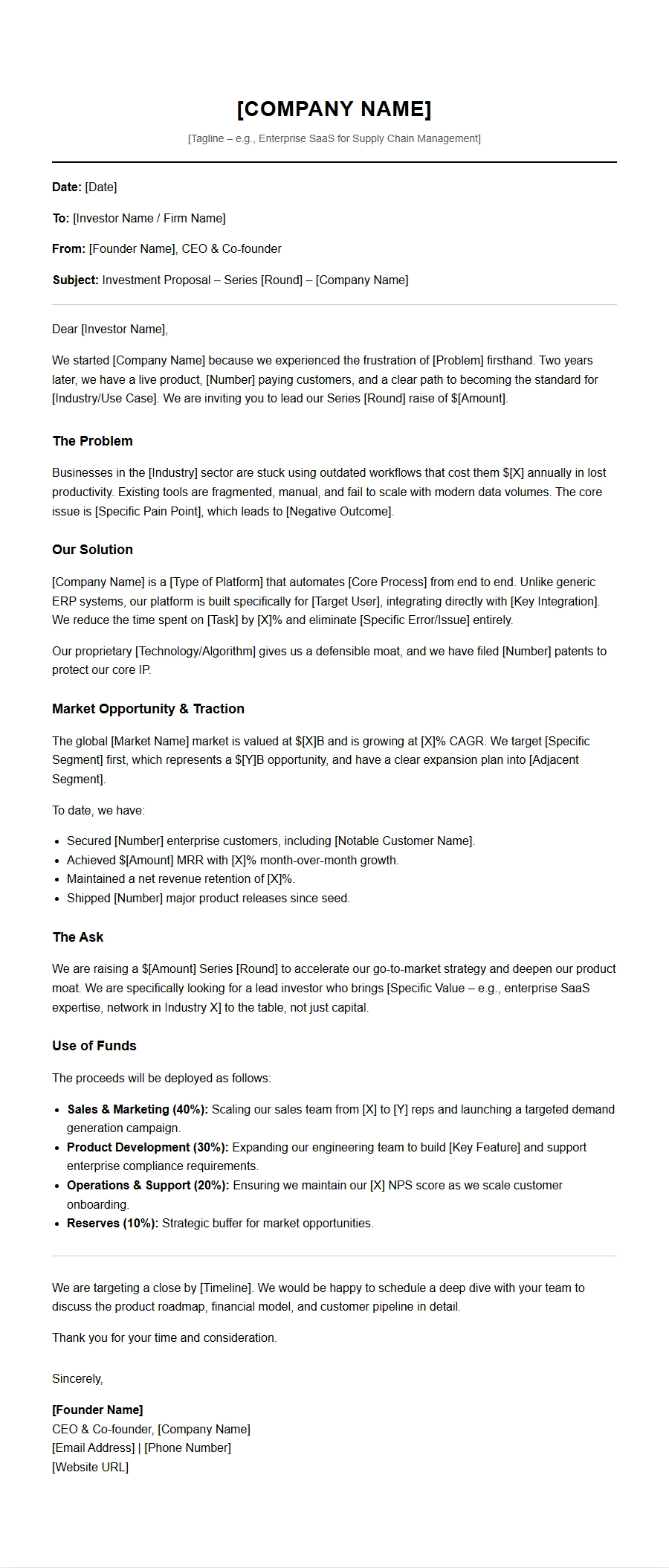 Startup Investment Proposal Letter Template
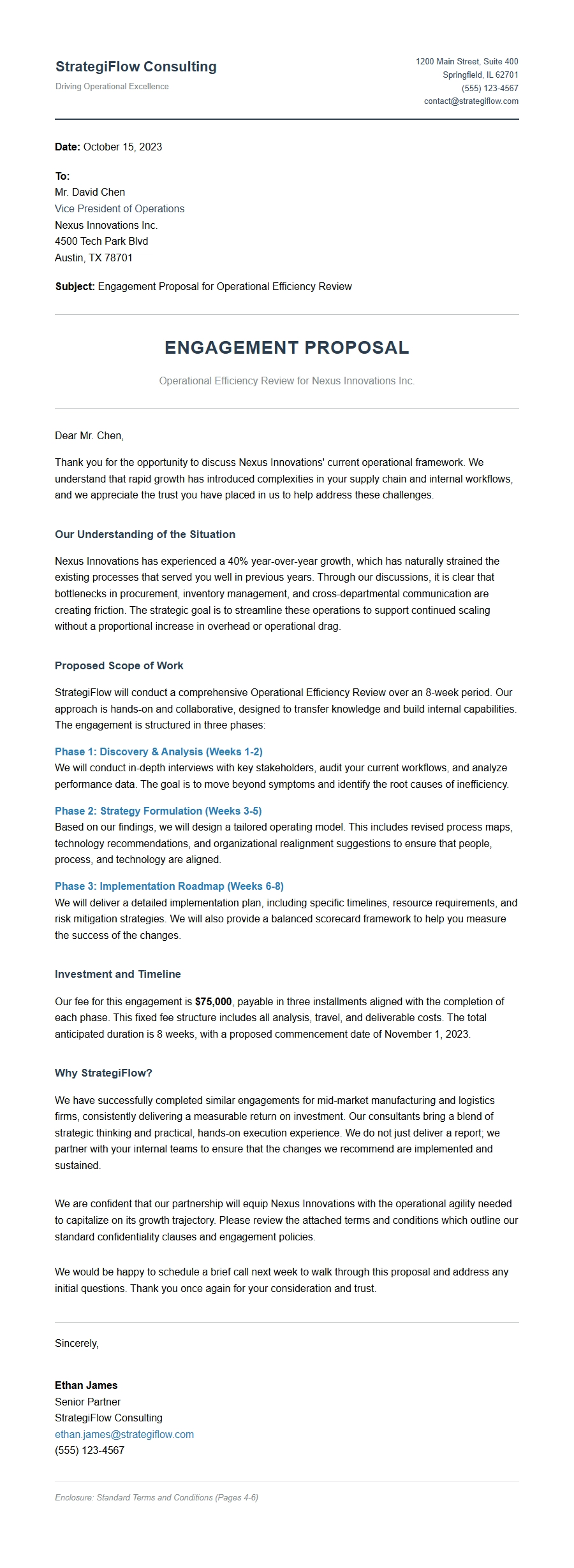 Consulting Engagement Proposal Letter Sample