Enterprise Software Implementation Proposal Letter Example
You need to send an enterprise software implementation proposal letter that convinces a busy executive to move forward—but you’re stuck on the first sentence. Maybe you’ve written proposals before, but this one feels different. Larger stakes, more technical detail, and a format that has to be both persuasive and precise. The blank page stares back, and the clock is ticking. That’s exactly where a well-chosen letter sample becomes your best shortcut.
Using a sample isn’t cheating—it’s smart strategy. A good letter template gives you the letter structure and business letter format you need, so you can stop worrying about layout and start focusing on the content that matters: your solution, timeline, and ROI. The trick is to pick a sample that matches the tone of your industry and the relationship you have with the reader. For enterprise software, professional correspondence should feel confident but not pushy, technical but not overwhelming.
Category: Business Proposal Letters
Start by scanning a few cover letter examples or proposal samples that feel close to your situation—maybe from a web development service proposal letter or a formal corporate business proposal letter. Notice how they open with a clear subject line and a direct statement of purpose. In your case, the opening paragraph should acknowledge the reader’s current challenge and immediately connect it to how your software solves it. Avoid vague phrases like “we are pleased to present.” Instead, say something like: “Your team has been managing customer data across five disconnected systems—here’s how our platform consolidates that into one dashboard.”
Once you have the sample as a scaffold, adapt it without losing your authentic voice. The salutation and closing should match your existing rapport. If you’ve spoken with the decision-maker before, use their first name. If not, a formal “Dear [Title] [Last Name]” works. For the body, swap out generic paragraphs with specifics: implementation phases, training plans, support milestones. Keep tone in writing respectful but direct. Enterprise buyers appreciate clarity over sales fluff.
A common mistake is treating a proposal letter like a novel. Keep paragraphs short—two to four sentences each. Use subheadings to break up sections like “Project Scope,” “Timeline,” and “Investment.” This helps the reader scan quickly. Also, think about digital letter format. Most proposals are sent as PDFs or inline emails, so avoid letterhead design that looks cluttered on a phone screen. Stick to a clean header with your logo, date, and recipient details.
Another trap: ignoring the call to action. End with a specific next step. “I’ll follow up on Thursday to discuss the implementation timeline” is better than “We look forward to hearing from you.” That small shift makes your letter feel like a conversation, not a monologue. And before you send, do a careful pass for proofreading letter errors—typos in a proposal about enterprise software suggest you might not be detail-oriented enough for the job.
Finally, remember the goal is not to write a perfect letter on the first try. Use the sample as a springboard—write a draft, then revise for tone and specificity. The more you practice adapting templates, the faster you’ll get. Over time, you’ll build a mental library of sentence starters and structures that feel natural. The best enterprise software implementation proposal letter reads like advice from a trusted colleague: clear, helpful, and straight to the point.
Samples to Guide You
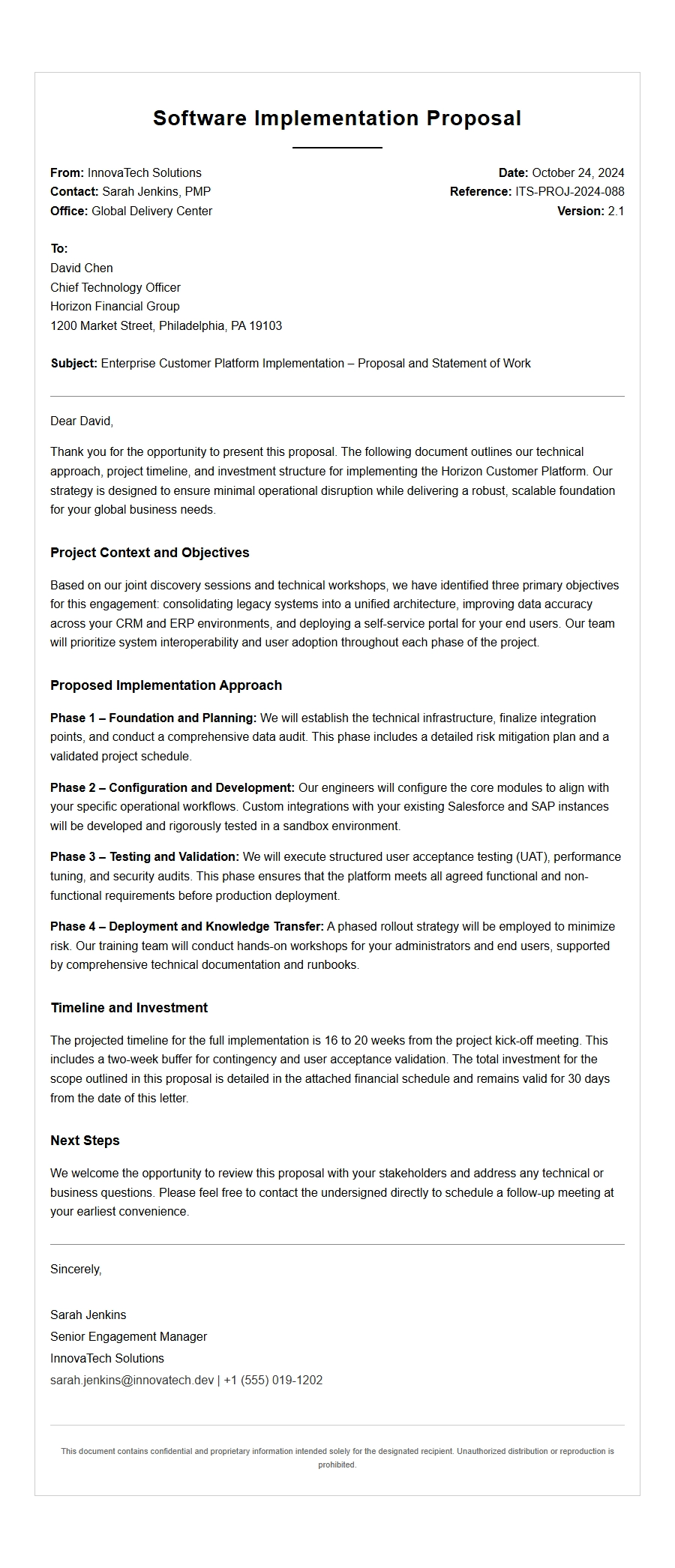
Enterprise Software Implementation Proposal Letter Example
Enterprise ERP System Implementation Proposal
Dear Mr. Henderson,
Following our recent discussions, we are pleased to submit this proposal for the implementation of EnterpriseCore ERP at Acme Manufacturing. Our solution addresses your need for integrated financial, inventory, and production modules.
Phase II: Inventory and warehouse management – 4 weeks
Phase III: Production planning and MRP – 8 weeks
Phase IV: User training and go-live support – 2 weeks
Investment Summary:
Component
Cost (USD)
Software licenses (100 users)
$120,000
Implementation services
$80,000
Training & documentation
$15,000
First-year support & maintenance
$24,000
Total
$239,000
We propose a project kickoff on June 1, 2025, with full go-live by September 30, 2025. Payment terms: 30% upon signing, 40% at Phase II completion, 30% upon final acceptance. We look forward to your approval.
Best regards, Jane Doe Senior Account Executive, TechSolve Inc.
CRM Integration Proposal for Enterprise Sales
Dear Ms. Patel,
Thank you for the opportunity to propose an integration of SalesForce Dynamics with your existing ERP and marketing automation tools. This proposal outlines a seamless data flow to unify customer insights.
Scope of Work:
API-based sync between CRM and ERP for order history and inventory.
Automated lead scoring and assignment rules.
Real-time dashboards for sales performance.
Custom reporting for pipeline analysis.
Proposed Timeline: 10 weeks from contract signing.
Pricing:
Item
Amount
Integration development
$55,000
Data migration & cleansing
$12,000
Testing & UAT
$8,000
Training (2 sessions)
$5,000
Total
$80,000
We recommend a project start within the next month to align with your Q3 sales ramp-up. Included are four post-launch support weeks at no extra charge.
Please review and let us know your preferred start date.
Sincerely, Mark Rivera Solutions Architect, DataFlow Systems
Custom Enterprise Software Development Proposal
To the Board of Directors,
After analyzing your request for a proprietary field service management platform, we propose building a bespoke solution tailored to GlobalTech Services. This software will replace three legacy tools.
Core Features:
Mobile app for technicians with offline mode.
Automated scheduling and dispatch using AI.
Real-time inventory tracking for spare parts.
Customer portal for service requests and status tracking.
Project Milestones:
Phase
Duration
Cost (USD)
Requirements & UX design
4 weeks
$30,000
Core development (web & mobile)
12 weeks
$180,000
Integration & testing
4 weeks
$40,000
Deployment & training
2 weeks
$20,000
Total
22 weeks
$270,000
Our team will assign a dedicated project manager and use Agile methodology with biweekly sprints. The price includes a 12-month warranty and 50 hours of post-launch support.
We are confident this investment will reduce your average service resolution time by 35%. Awaiting your decision.
Best regards, Dr. Alisha Chen VP of Engineering, InnovateStack
Cloud Migration Proposal for Legacy Systems
Dear Mr. Torres,
As part of your digital transformation initiative, we propose migrating your on-premise enterprise applications to AWS Cloud. This move will improve scalability and reduce infrastructure costs.
Migration Approach:
Phase I: Discovery and dependency mapping (2 weeks).
Phase II: Rehosting of non-critical workloads (4 weeks).
Phase III: Replatforming of core ERP and CRM (8 weeks).
Phase IV: Testing, security audit, and cutover (3 weeks).
Cost Estimate:
Category
Amount (USD)
Cloud infrastructure setup & migration
$95,000
Security & compliance configuration
$25,000
Performance optimization
$15,000
Training for IT team
$8,000
Total
$143,000
We project a 40% reduction in annual hosting costs after migration. Our team will provide a detailed runbook and 90 days post-migration support. Target go-live: October 1, 2025.
Please find the full technical plan attached. Happy to schedule a deeper walkthrough.
We are excited to present a proposal for implementing DataInsight Pro – a unified analytics platform for your organization. This solution will consolidate data from sales, operations, and finance into a single source of truth.
Deliverables:
Data warehouse architecture (Snowflake schema).
ETL pipelines from 5 source systems.
Interactive dashboards for executives and department heads.
Self-service analytics layer using Power BI.
Project Schedule:
Activity
Weeks
Data audit & mapping
3
ETL development
6
Dashboard design
4
User training & deployment
2
Investment: $175,000 (includes license for 50 named users for the first year). Subsequent annual maintenance: $35,000.
We anticipate a 20% improvement in decision-making speed within the first quarter post-implementation. We are ready to start as early as July 7, 2025. Please let us know if you need references from similar engagements.
Best regards, Rebecca Yang Director of Analytics, NumericWise
Enterprise Cybersecurity Suite Implementation Proposal
Dear Mr. Akers,
In response to your RFP for enhanced security, we propose adopting ShieldWall Enterprise – a comprehensive cybersecurity suite covering endpoint protection, network monitoring, and incident response.
Components:
Advanced endpoint detection and response (EDR) for 1,000 endpoints.
Security information and event management (SIEM) integration.
Vulnerability scanning and patch management.
24/7 SOC monitoring with a dedicated analyst.
Implementation Plan:
Phase
Duration
Cost (USD)
Assessment & architecture
2 weeks
$20,000
Deployment & integration
4 weeks
$60,000
Policy configuration & testing
2 weeks
$15,000
Team training
1 week
$5,000
Total: $100,000 plus first-year subscription of $85,000 (licenses). Ongoing support included in subscription.
We guarantee a 99.9% uptime for the SOC service. The project can commence within 2 weeks of contract. Attached is our compliance matrix.
We are pleased to submit this proposal for implementing SupplyChain Optimizer at your distribution centers in Chicago and Atlanta. This solution will streamline procurement, logistics, and supplier collaboration.
Key Features to be Deployed:
Automated purchase order generation based on inventory levels.
Real-time shipment tracking and carrier management.
Supplier portal for bid management and contracts.
Predictive analytics for demand forecasting.
Implementation Roadmap:
Step
Timeline
Cost
System configuration & integration
5 weeks
$65,000
Data migration from legacy system
3 weeks
$20,000
Testing (UAT & performance)
2 weeks
$10,000
Deployment & go-live support
2 weeks
$12,000
Total Investment: $107,000 (includes one-year license for 40 users). We project a 15% reduction in inventory carrying costs within 6 months.
We propose a kickoff meeting on August 12, 2025. Please let us know your availability for a detailed demo.
Best regards, Carlos Mendez Director of Supply Chain Solutions, LogiTech Partners
HRMS Modernization Proposal for Enterprise
To the HR Leadership Team,
We recommend replacing your current HR system with TalentHub Enterprise – a modern, cloud-based human resource management system that automates payroll, benefits, recruitment, and performance management.
Applicant tracking system (ATS) with AI screening.
Learning management system (LMS) integration.
Implementation Budget:
Component
Cost
Software subscription (first year, 500 employees)
$95,000
Setup & data migration
$35,000
Custom integrations (ERP & payroll)
$18,000
Administrator training
$7,000
Total
$155,000
The project will run for 14 weeks. A phased rollout allows pilots in select departments first. We also offer a dedicated HRMS consultant for 3 months post-launch.
We have successfully implemented similar solutions for companies of your size. Let’s schedule a call to discuss next steps.
Sincerely, Patricia Nguyen Senior HR Tech Consultant, PeopleFirst Systems
Enterprise Project Management Tool Implementation
Dear Mr. Brooks,
We propose deploying ProjSync Enterprise to standardize project management across your R&D, marketing, and IT departments. This tool will provide real-time visibility and resource allocation.
Functionality:
Agile and Waterfall project templates.
Time tracking and timesheet approval workflow.
Portfolio management with FTE budgeting.
Integration with Jira and Slack.
Implementation Plan:
Activity
Duration
Cost
Requirements workshop
1 week
$8,000
System configuration & branding
2 weeks
$15,000
Integration & data import
3 weeks
$22,000
User training (virtual, 4 sessions)
1 week
$6,000
Total: $51,000 (excludes annual subscription of $30,000 for 200 users). We provide a 30-day post-launch support period at no extra cost.
We can start as early as September 2, 2025. Reference implementations are available upon request.
Best regards, Tom Harrison VP of Enterprise Sales, WorkFlow Labs
Inventory Management System Upgrade Proposal
Dear Warehouse Operations Team,
Following our site visit, we propose upgrading your current inventory management system to StockSmart Pro. This solution will integrate with your barcode scanners, ERP, and e-commerce platforms.
Capabilities to be Enabled:
Real-time inventory tracking across 3 warehouses.
Automated reorder points and purchase suggestions.
Cycle counting module with mobile app.
Lot/batch tracking and expiration management.
Project Breakdown:
Item
Weeks
Cost
System installation and configuration
2
$18,000
Data migration (50,000 SKUs)
2
$12,000
Integration with ERP & scanners
3
$25,000
Superuser training
1
$5,000
Total: $60,000 (software licenses for 20 concurrent users: $10,000/year). We offer a 6-month warranty on all integrations.
Expected go-live: November 1, 2025. We anticipate a 25% reduction in stockouts after three months of use.
Thank you for considering our proposal. We are ready to answer any questions.
Sincerely, Diana Ross Account Manager, InventoryTech Solutions
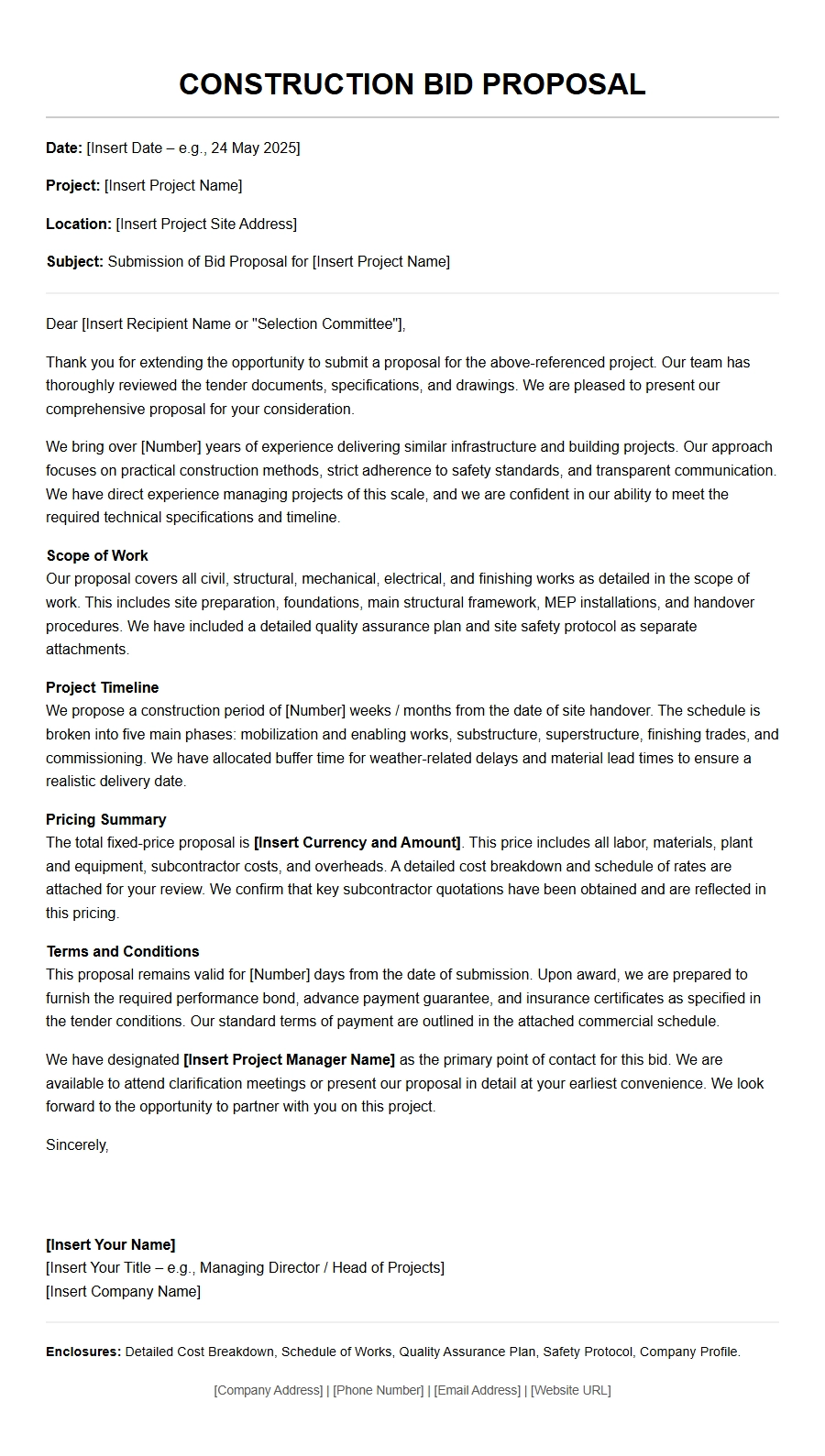 Sample Construction Bid Proposal Letter
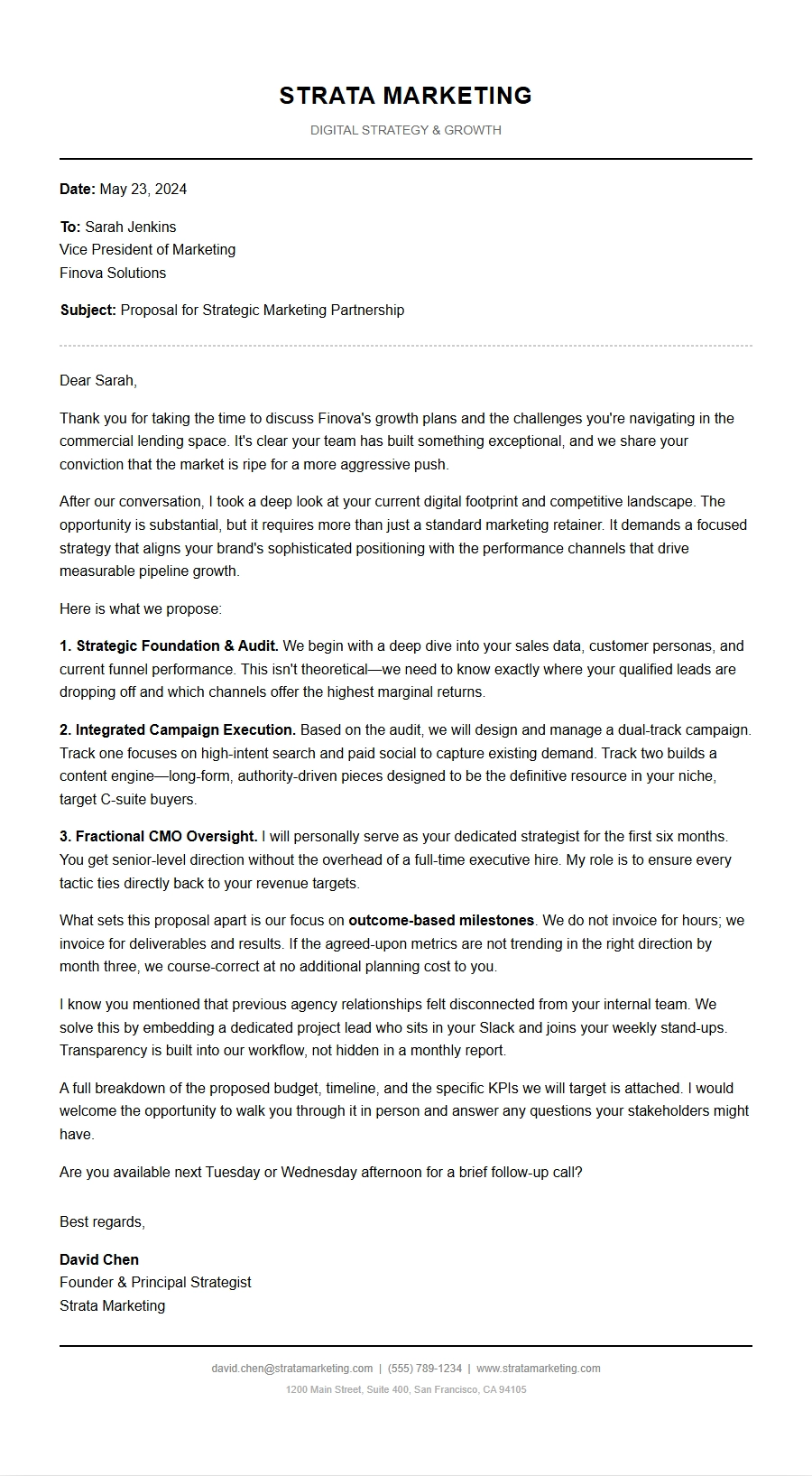 Marketing Agency Service Proposal Letter Template
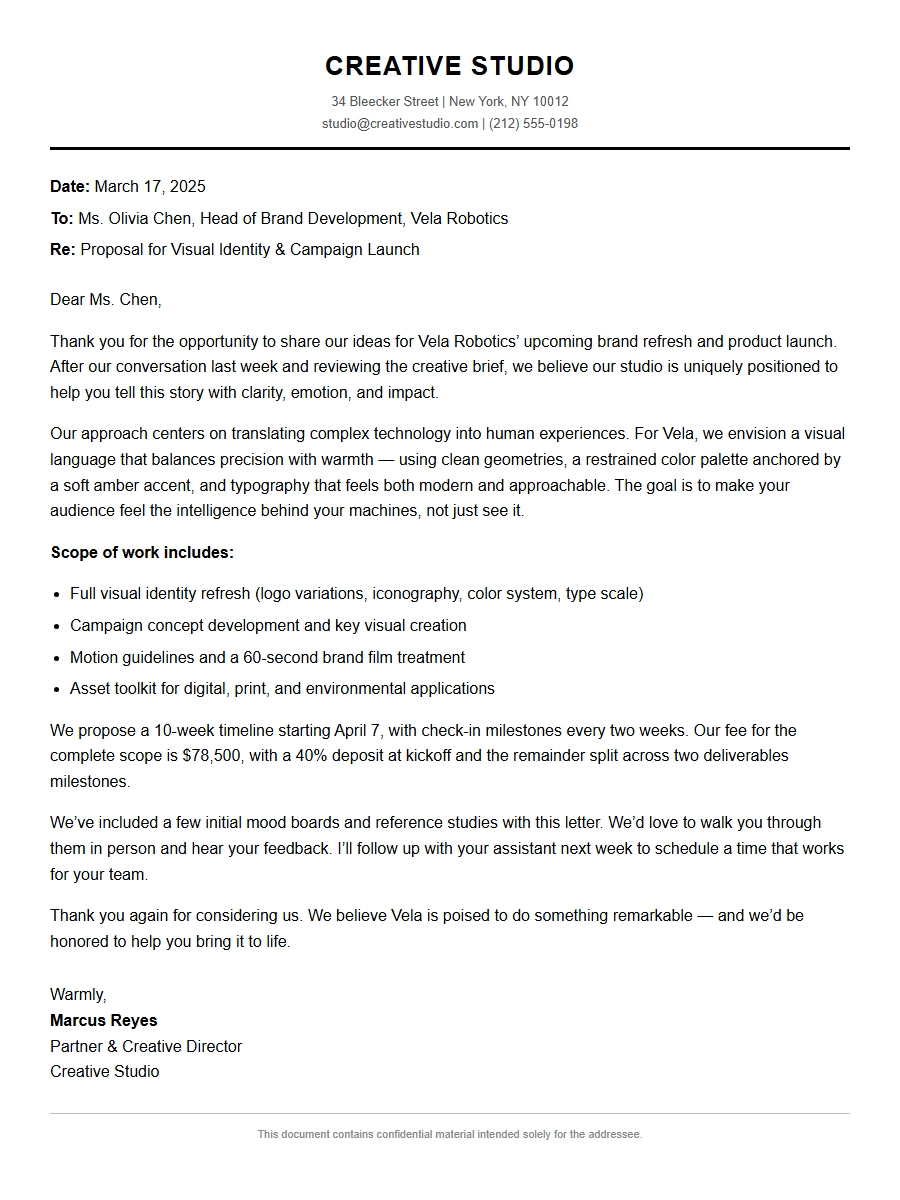 Creative Studio Project Proposal Letter
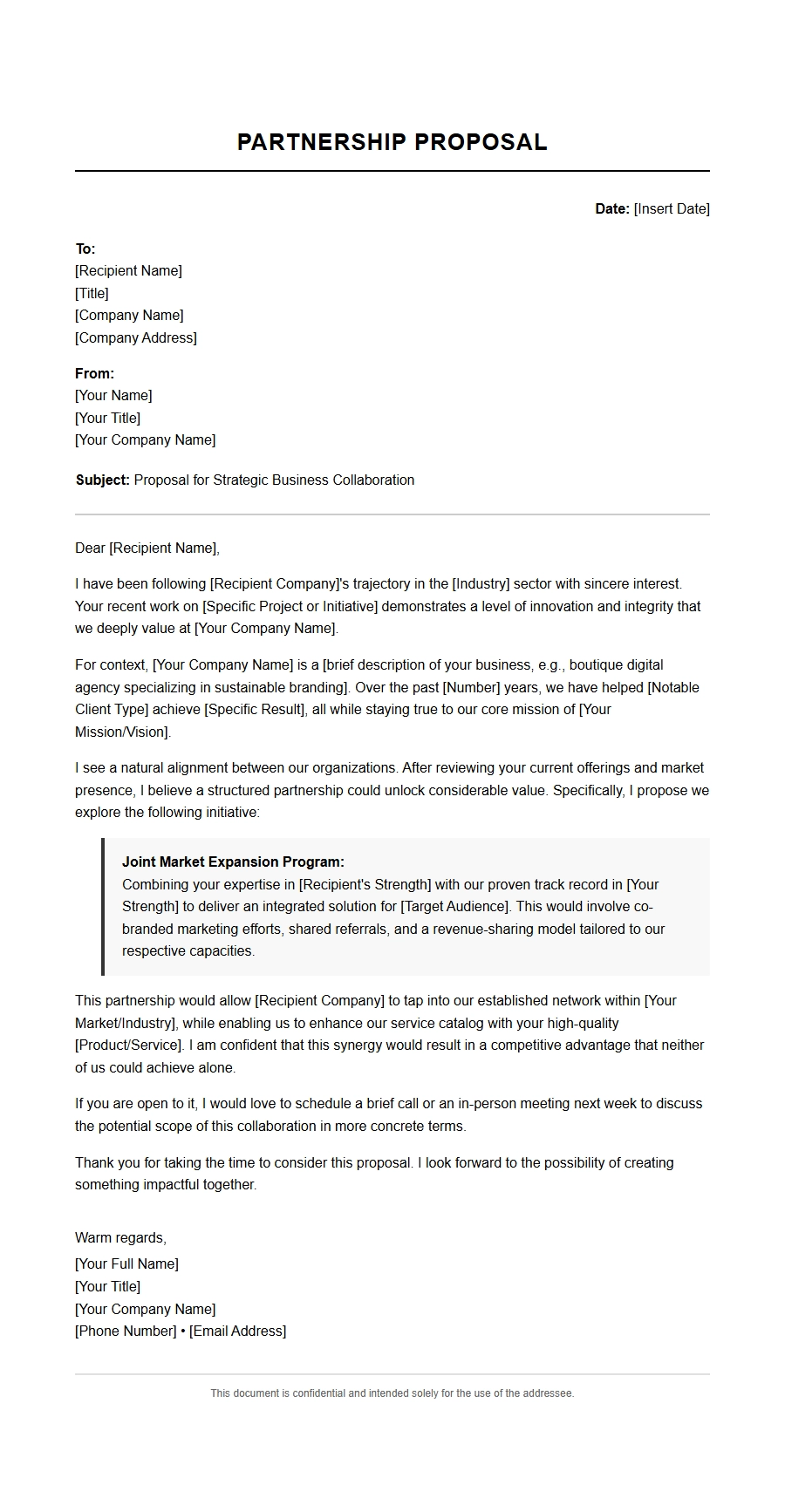 Small Business Partnership Proposal Letter Template
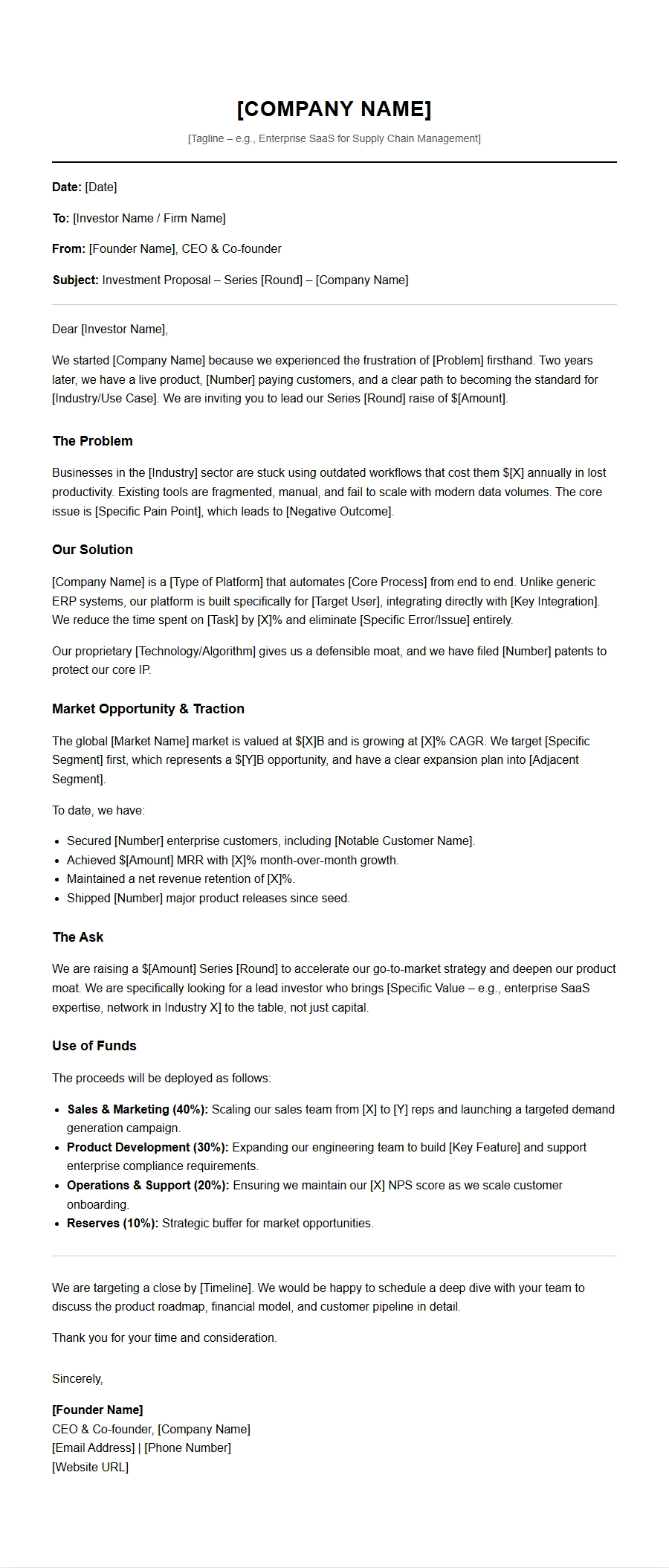 Startup Investment Proposal Letter Template
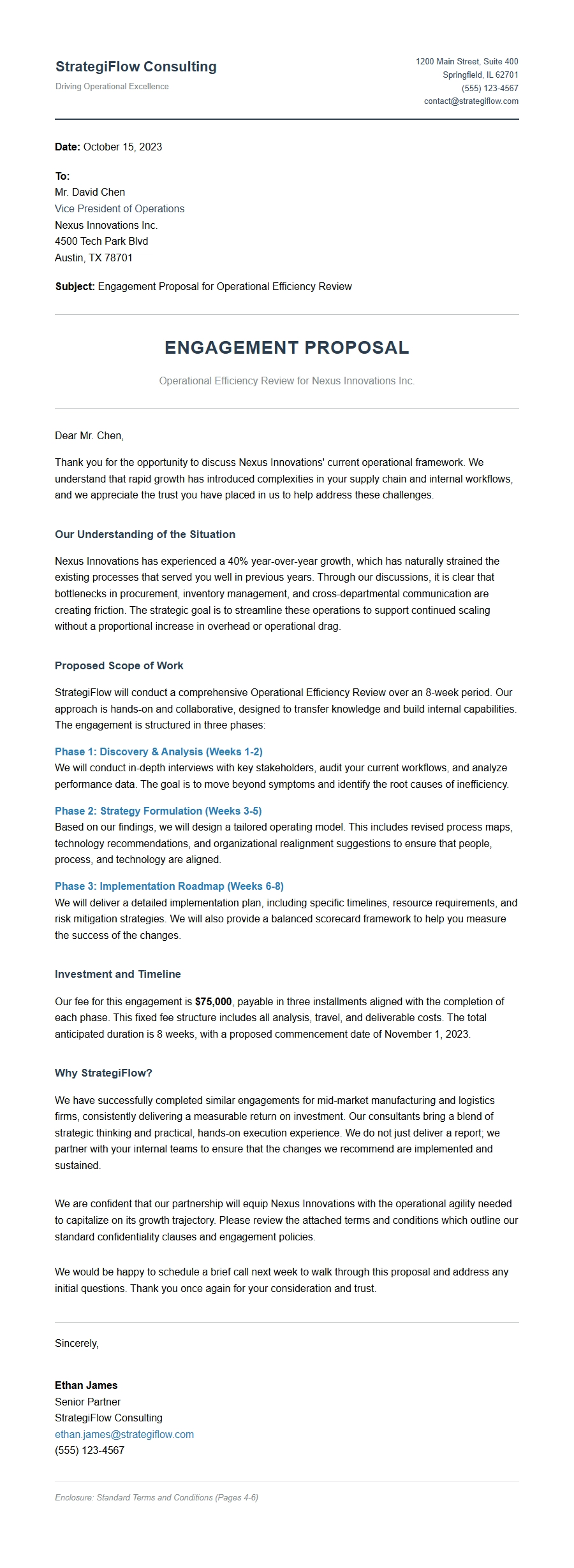 Consulting Engagement Proposal Letter Sample