You need to apply for a municipal contract, but the blank page is staring back at you. It’s a common feeling – and one that often leads to hours of second-guessing. But it doesn’t have to. A strong municipal contract application letter is your foot in the door with local government, and a good sample can turn that anxiety into a confident draft in minutes.
Using a letter template isn’t cheating – it’s a smart, time-saving strategy. A well-designed sample gives you the structure, tone, and key phrases you need, while leaving plenty of room for your own details. Think of it as a checklist that also writes the first draft. You still get to make it your own.
Category: Municipal Contract Application Letters
What a Municipal Contract Application Letter Really Is
This letter is your formal pitch to a city or county government. It explains who you are, why you’re qualified, and how you’ll deliver on the contract requirements. Unlike a cover letter for a job, this one is more like a proposal cover – it often accompanies a bid package or RFP response. The audience is a procurement officer or a review committee. They’re looking for clarity, compliance, and confidence.
How to Choose the Right Sample for Your Situation
Not all samples fit every context. If you’re responding to a formal RFP, you need a more structured business letter format with clear sections. If the opportunity is smaller or informal, a semi-formal tone might work. Look for a municipal contract application letter sample that includes a salutation (like “Dear Procurement Manager”), a clear subject line, and logical paragraphs. Avoid samples that feel too generic or outdated – they’ll make your letter sound stiff.
Once you have a sample, resist the urge to just swap in your company name and hit send. Instead, read it carefully and change the opening to reflect your specific project. For example, if the sample starts with “We are pleased to submit our proposal,” and you’re a small startup, tweak it to “Our team is excited to offer our services for…” The goal is to sound like you, not like a robot.
A quick tip: tailor the first paragraph to grab attention. Mention the contract name, a specific need you saw in the RFP, or a result you’ve achieved for similar clients. That shows you actually read the requirements. Ever received a letter that felt too stiff or too casual? Avoid that by matching the tone of the municipality’s own communications. If their request is formal, keep it formal. If they use plain language, you can be a little more conversational.
Common Mistakes That Undermine Your Letter
Many applicants trip on simple letter writing etiquette. Using “To Whom It May Concern” when you could have found the contact’s name is a red flag. Another mistake is ignoring format. If you’re sending an email, skip the full letterhead design – use a clean digital letter format instead. A printed letter, on the other hand, should include your company logo and physical address.
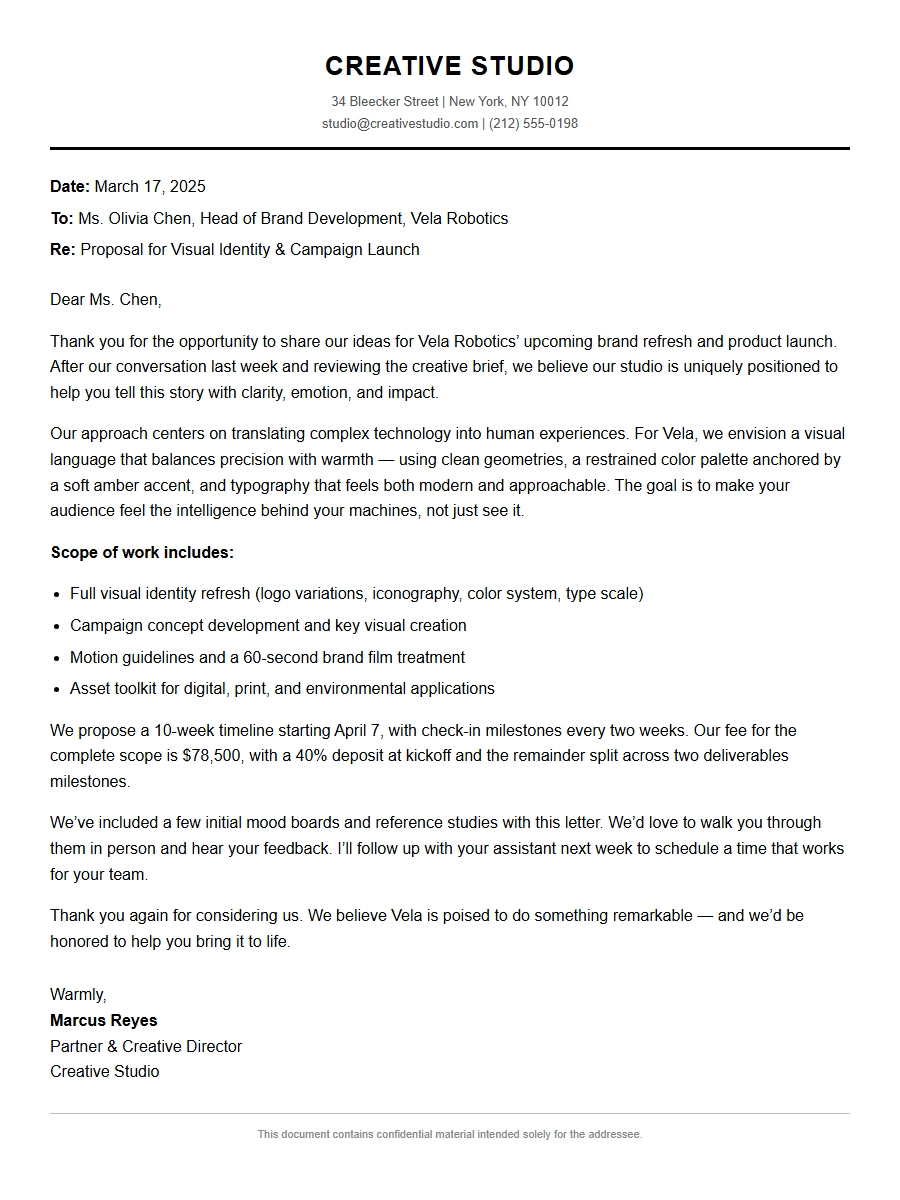
Also, don’t ignore salutation and closing. End with “Sincerely” or “Respectfully submitted,” not “Best” unless you’re absolutely sure the culture is relaxed. And always treat your letter with the same care as a creative studio project proposal letter when it comes to proofreading. One typo in a municipal letter can make you look careless.
Making the Tone Work for Government Readers
Government officials read dozens of these letters. Yours needs to be clear, respectful, and direct. Avoid vague claims like “we’re the best” – instead, state facts: “We have completed 12 similar projects on time and under budget.” Use tone in writing that shows competence without arrogance. If you’re unsure, read it aloud. Does it sound like a real person wrote it?
You can also borrow structural elements from a waste management service contract proposal letter if your work involves technical services – the emphasis on safety and compliance translates well to municipal contracts.
Practical Steps to Polish Your Letter
Once you’ve written the draft, put it aside for an hour. Then read it once for content, once for letter structure, and once for typos. Check that the subject line matches the contract ID. Confirm that you’ve included all attachments (like certifications or references). If the RFP asks for a concise executive summary proposal letter, make sure your letter doesn’t ramble – stick to one page when possible.
Finally, treat every letter as a customizable letter. Save your best version as a template, but always adjust it for each new opportunity. Your first try will take the longest. The second one will feel easier. That’s normal.
Use a sample as a springboard, not a crutch. The most effective municipal contract application letters feel both professional and personal – they show you’ve done your homework and you’re ready to deliver. With each letter you write, the process gets faster. And that blank page? It’ll stop being a source of stress.
Useful Writing Samples
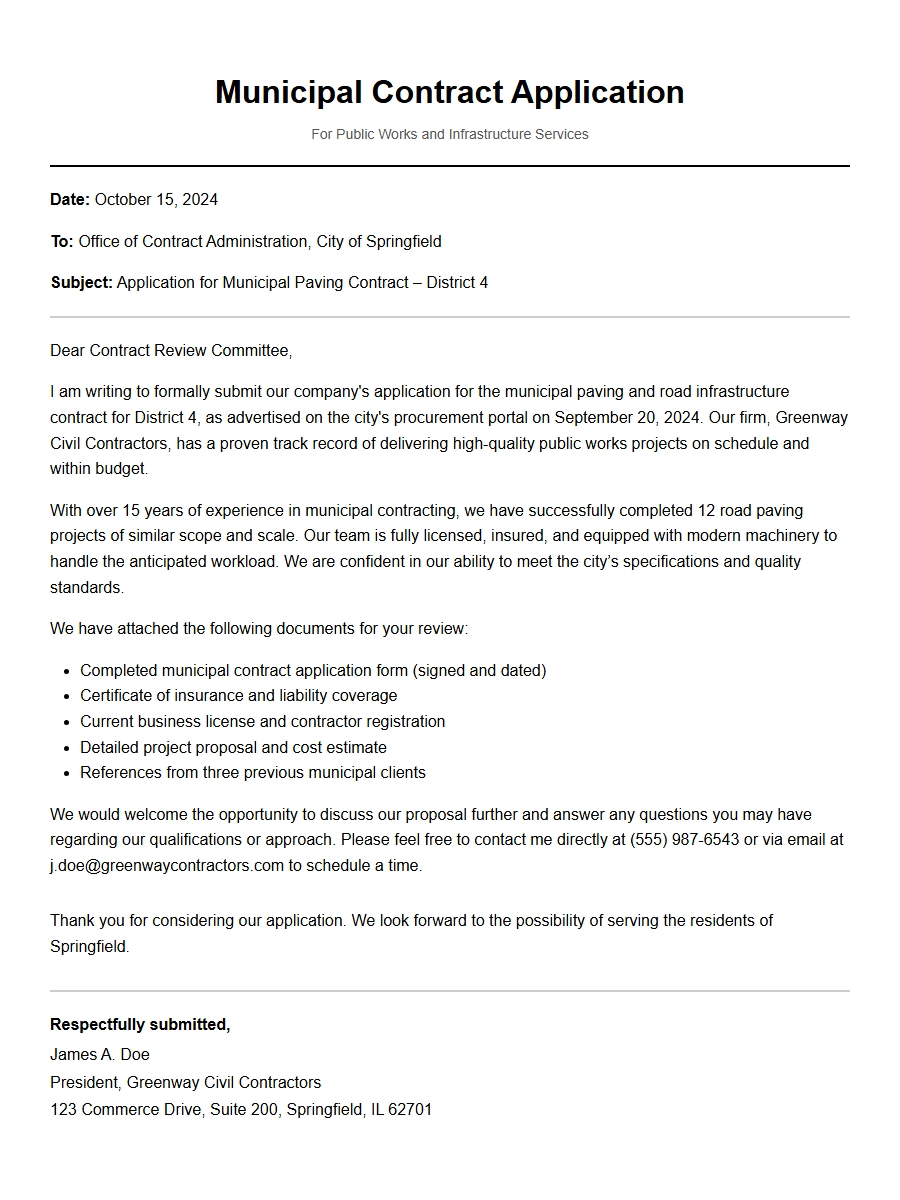
Municipal Contract Application Letter Sample
Cover Letter for Municipal Contract Proposal
Date: March 15, 2025
To: City Procurement Office, 123 Main Street, Metropolis
From: GreenScape Solutions Inc., 456 Oak Avenue, Metropolis
Re: Proposal for Municipal Park Maintenance Services – RFP #2025-07
Dear Procurement Officers,
We are pleased to submit our proposal in response to the above-referenced Request for Proposals. GreenScape Solutions has over a decade of experience in sustainable park maintenance, serving three neighboring municipalities with a 98% satisfaction rate. Our team is fully equipped to handle turf management, irrigation, waste removal, and seasonal planting.
Key highlights of our proposal:
24/7 emergency response for storm damage
Use of eco-friendly, non-toxic pesticides
Quarterly community engagement workshops
Pricing summary (annual contract):
Service
Monthly Cost
Annual Total
Lawn and turf care
$2,500
$30,000
Tree and shrub pruning
$1,800
$21,600
Irrigation system maintenance
$900
$10,800
Total
$5,200
$62,400
We look forward to the opportunity to serve the City of Metropolis. Enclosed are our detailed technical proposal, insurance certificates, and references.
Sincerely, Jane Doe, President GreenScape Solutions Inc. jane.doe@greenscape.com
Letter of Intent to Bid on Municipal Project
Date: April 1, 2025
To: City of Riverside, Engineering Department, 789 River Road, Riverside
Re: Notice of Intent to Bid – Downtown Street Resurfacing Project (Bid #2025-33)
Dear Director of Public Works,
Paving Pros LLC hereby expresses its formal intent to submit a bid for the above-named project. We have reviewed the preliminary drawings and specifications and confirm our capability to complete the work within the required timeline.
Company qualifications:
Licensed general contractor in the state (License #12345)
Completed 12 similar municipal resurfacing projects in the past three years
Bonding capacity up to $5 million
Anticipated project approach:
Mobilization and traffic control setup – 2 days
Milling and base repair – 5 days
Asphalt paving and striping – 8 days
Final inspection and punch list – 2 days
We will attend the pre-bid conference on April 8, 2025, and look forward to submitting a competitive proposal. Should you require any additional information, please contact our estimating team.
Respectfully, Mark Johnson, Estimating Manager Paving Pros LLC
Proposal for Municipal Waste Management Contract
Date: March 22, 2025
To: City of Greenfield, Public Works Department, 100 Civic Center Drive, Greenfield
Re: Response to RFP #2025-12 – Residential and Commercial Solid Waste Collection
Dear Committee Members,
EcoWaste Services is proud to submit this comprehensive proposal for the collection, transport, and disposal of municipal solid waste. Our plan emphasizes efficiency, environmental stewardship, and community education.
Proposed service schedule:
Waste Type
Collection Frequency
Vehicle Type
Household refuse
Weekly (Monday)
Automated side-loader
Recyclables
Bi-weekly (Wednesday)
Separated compartment truck
Yard waste
Weekly (Friday, seasonal)
Open-top dump truck
Bulky items
Monthly (by appointment)
Flatbed with liftgate
Pricing per household per month: $14.50 (fixed for three years).
We also include a free annual electronics recycling event, public outreach materials, and a dedicated city liaison. Our diversion rate target is 45% by Year 2.
Thank you for considering our offer. We are ready to begin service on July 1, 2025.
Sincerely, Laura Chen, Municipal Accounts Director EcoWaste Services
Application Letter for Municipal Road Repair Contract
Date: May 10, 2025
To: County of Summit, Administrator’s Office, 200 County Building, Summit City
From: Interstate Asphalt Group, 777 Highway Drive, Summit City
Re: Application for Qualified Contractor List – Road Repair and Resurfacing
Dear County Administrator,
Interstate Asphalt Group respectfully requests inclusion on the County’s qualified contractor list for road repair and resurfacing projects (Contract #2025-18). Our firm has successfully executed over $15 million in county road improvements over the past five years.
Key qualifications:
State DOT pre-qualification for hot mix asphalt (HMA) placement
OSHA safety certification with TRIR of 0.8
Fully staffed in-house lab for quality control testing
Recent relevant projects:
Project Name
Value
Completion Date
Reference
Oak Street Rehabilitation
$2.3M
Jan 2025
City of Summit
Route 45 Resurfacing
$4.1M
Nov 2024
County of Summit
Elm Avenue Reconstruction
$1.8M
Aug 2024
City of Greenfield
We are fully insured (general liability $2M, auto $1M, umbrella $5M) and bondable. Enclosed are our financial statements, safety manual, and detailed experience record.
We look forward to being part of your contract pool and serving future needs.
Respectfully, Robert Kim, Vice President Interstate Asphalt Group
Response to RFP for Municipal IT Services
Date: June 5, 2025
To: City of Lakeside, Technology Division, 50 Tech Park Way, Lakeside
Re: Proposal for Managed IT Support and Cybersecurity – RFP #2025-IT-03
Dear IT Director,
DataSys Solutions is highly pleased to respond to the City’s RFP for managed IT services. With 200 municipal clients nationwide, we bring proven expertise in network management, endpoint security, and cloud migration for government entities.
Service tiers proposed:
Basic: Help desk, patch management, backups ($3,500/month)
Re: Proposal for Comprehensive Park Maintenance – Bid #2025-09
Dear Superintendent,
Nature’s Touch Landscaping is honored to submit this proposal for the maintenance of Brookside's five municipal parks. Our approach combines horticultural excellence with cost-effective resource management.
Scope of services:
Mowing, edging, and fertilization of all turf areas
Pruning, mulching, and disease control for trees and shrubs
Playground safety inspection and soft surface maintenance
Litter patrol, restroom cleaning, and trash removal
Proposed crew and schedule:
Park
Acres
Weekly Hours
Assigned Team
Central Park
15
40
Team A (5 members)
Riverside Park
8
24
Team B (3 members)
Oakwood Gardens
5
16
Team A (partial)
Pine Forest Trail
12
20
Team C (4 members)
Sunset Playfield
6
18
Team B (additional)
Annual cost: $124,800 (monthly $10,400). We also offer a 5% discount for a three-year commitment.
We are excited about the chance to care for Brookside’s green spaces. References and work samples are attached.
Respectfully, Michael Torres, Owner Nature’s Touch Landscaping
Bid Proposal for Municipal Building Renovation
Date: April 20, 2025
To: City of Harborview, Building Department, 300 Civic Avenue, Harborview
From: Skyline Construction Co., 280 Builder Street, Harborview
Re: Bid for City Hall Annex Renovation – Project #2025-22
Dear Project Manager,
Skyline Construction is pleased to present our firm, fixed-price bid for the renovation of the City Hall Annex. The project includes structural upgrades, HVAC replacement, electrical modernization, and interior finishes.
Bid summary:
Work Category
Amount
Demolition and abatement
$45,000
Structural reinforcement
$95,000
Mechanical (HVAC)
$120,000
Electrical and low voltage
$88,000
Plumbing and fire protection
$52,000
Interior finishes (flooring, paint, ceiling)
$110,000
General conditions and profit
$65,000
Total Bid
$575,000
Schedule: 120 calendar days from notice to proceed. We will employ a minimum of 15 local tradespeople and adhere to all prevailing wage requirements.
Our bid is valid for 90 days. All bonds and insurance documents are included in the sealed package.
Thank you for your consideration. We are ready to start upon contract execution.
Sincerely, Sarah Lee, Estimating Director Skyline Construction Co.
Subcontractor Letter for Municipal Project
Date: July 8, 2025
To: Prime Contractor: BuildRight General Contractors, 500 Main Street, Metropolis
From: Metro Electrical Services, 800 Circuit Road, Metropolis
Metro Electrical Services is pleased to submit this subcontractor proposal for all electrical work on the above-referenced municipal parking garage project. We have reviewed the prime contract requirements and are confident in our ability to deliver high-quality work within the project schedule.
Scope of work includes:
Underground conduit and feeder installation
Lighting fixtures (LED) and emergency lighting system
Electric vehicle charging station wiring (15 units)
Fire alarm and security system rough-in
Service panel upgrades and meter provision
Pricing breakdown:
Line Item
Lump Sum
Rough-in electrical
$210,000
Finish electrical
$95,000
EV charging infrastructure
$48,000
Fire alarm system
$32,000
Testing and commissioning
$15,000
Total Subcontract
$400,000
We are licensed, bonded, and insured for the full amount. We can commence mobilization within 10 days of award. References from similar municipal projects are available upon request.
We look forward to partnering with BuildRight on this important city project.
Respectfully, James Okafor, President Metro Electrical Services
Proposal for Municipal Street Lighting Contract
Date: August 12, 2025
To: City of Highland Park, Transportation Department, 77 Light Avenue, Highland Park
From: BrightPath Energy Solutions, 200 Solar Way, Highland Park
Re: Proposal for LED Street Light Conversion and Maintenance – RFP #2025-30
Dear Director of Transportation,
BrightPath Energy Solutions is excited to propose a comprehensive conversion of Highland Park’s 1,200 street lights to energy-efficient LED fixtures, plus a 10-year maintenance program. We project a 60% reduction in energy consumption and a five-year payback through utility savings and incentive rebates.
Proposed implementation plan:
Phase 1 (Months 1-3): Retrofit 400 lights in downtown core
Phase 2 (Months 4-6): Retrofit 500 lights in residential areas
Phase 3 (Months 7-9): Retrofit 300 lights in industrial zone and parks
Cost summary:
Category
Year 1
Years 2-10 (annual)
LED fixture supply and installation
$960,000
$0
Warranty and extended maintenance
$0
$85,000
Annual utility savings
-$120,000
-$180,000
Net cost/benefit
$840,000
-$95,000 (savings)
All fixtures come with a 15-year manufacturer warranty. We will also install smart controls with remote dimming and fault detection. Our team is prequalified for municipal energy performance contracting.
Thank you for considering BrightPath. We are eager to light up Highland Park sustainably.
Sincerely, David Green, Municipal Energy Specialist BrightPath Energy Solutions
Letter for Municipal Water Treatment Contract
Date: September 18, 2025
To: City of Clearwater, Water Utilities Department, 1 Reservoir Drive, Clearwater
Re: Application for Water Treatment Plant Upgrade Contract – Bid #2025-WTP-06
Dear Utilities Director,
AquaPure Technologies submits this application in response to the City’s request for qualified contractors for the Clearwater Water Treatment Plant upgrade project. Our firm specializes in membrane filtration, chemical disinfection upgrades, and SCADA integration for municipal water systems.
Proposed upgrade components:
Replace existing sand filters with advanced membrane units (4 MGD capacity)
Install UV disinfection system for primary treatment
Upgrade chemical feed system with automated dosing
Integrate new SCADA platform for real-time monitoring
Project milestones:
Activity
Duration
Completion
Design and permitting
16 weeks
Week 16
Equipment procurement
20 weeks
Week 20 (parallel)
Construction and installation
36 weeks
Week 52
Startup and training
8 weeks
Week 60
Total project cost: $3.2 million (fixed price with escalation clause for materials beyond 10% index change). We have completed similar upgrades for five municipalities, including a 6 MGD plant in neighboring Lakewood.
Attached are our safety plan, quality assurance manual, and financial statement. We look forward to contributing to Clearwater’s water quality goals.
Respectfully, Dr. Helen Nguyen, Chief Engineer AquaPure Technologies Inc.
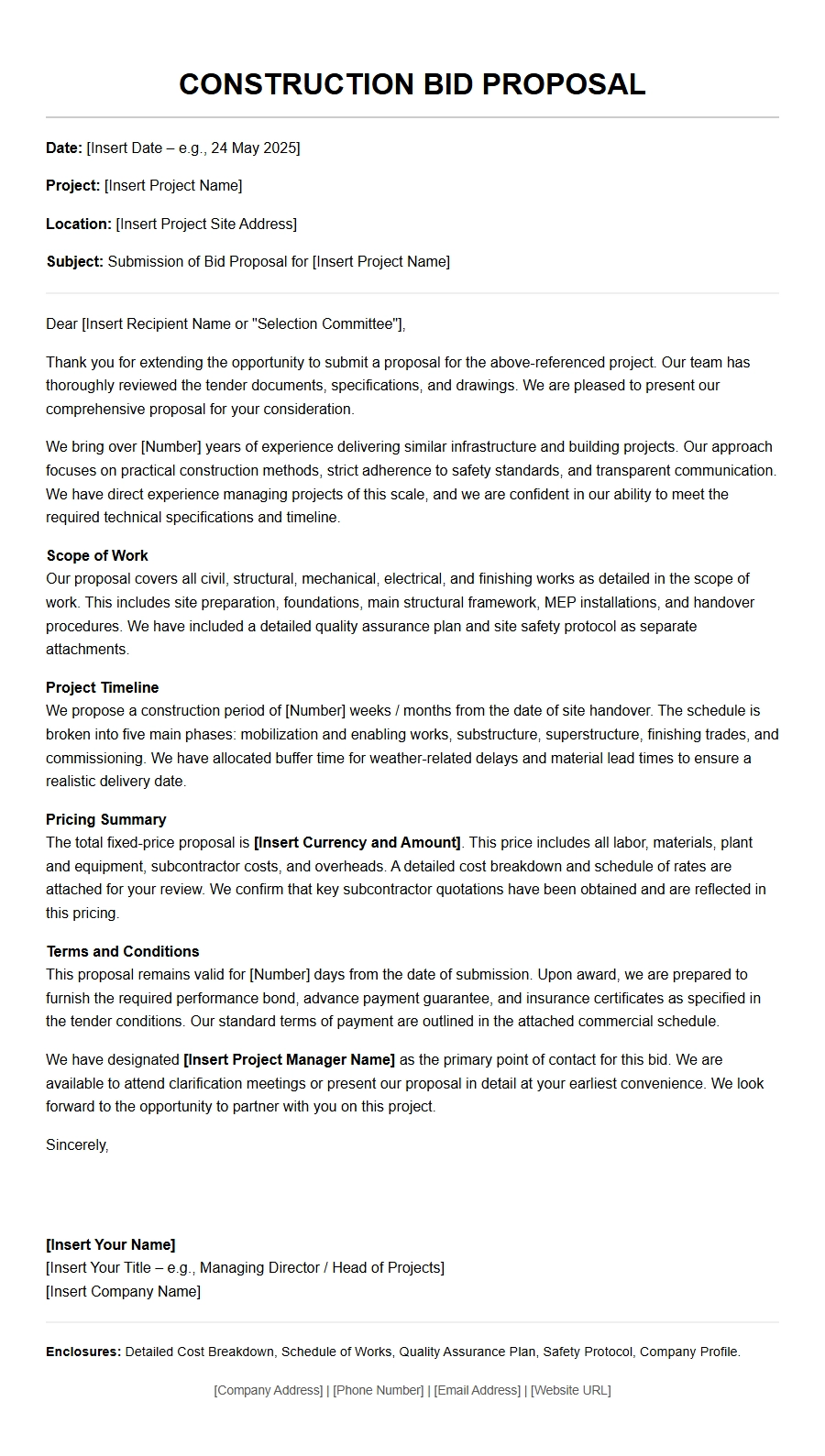 Sample Construction Bid Proposal Letter
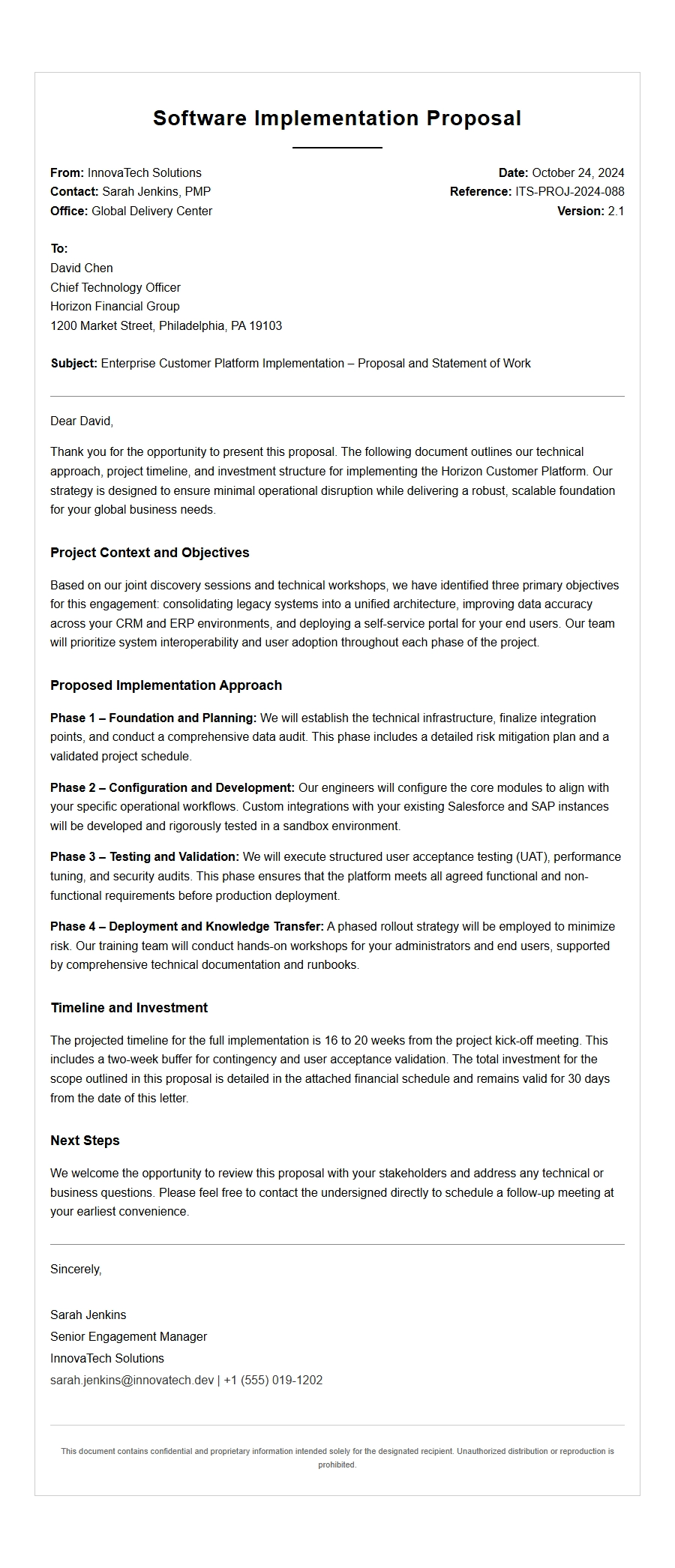 Enterprise Software Implementation Proposal Letter Example
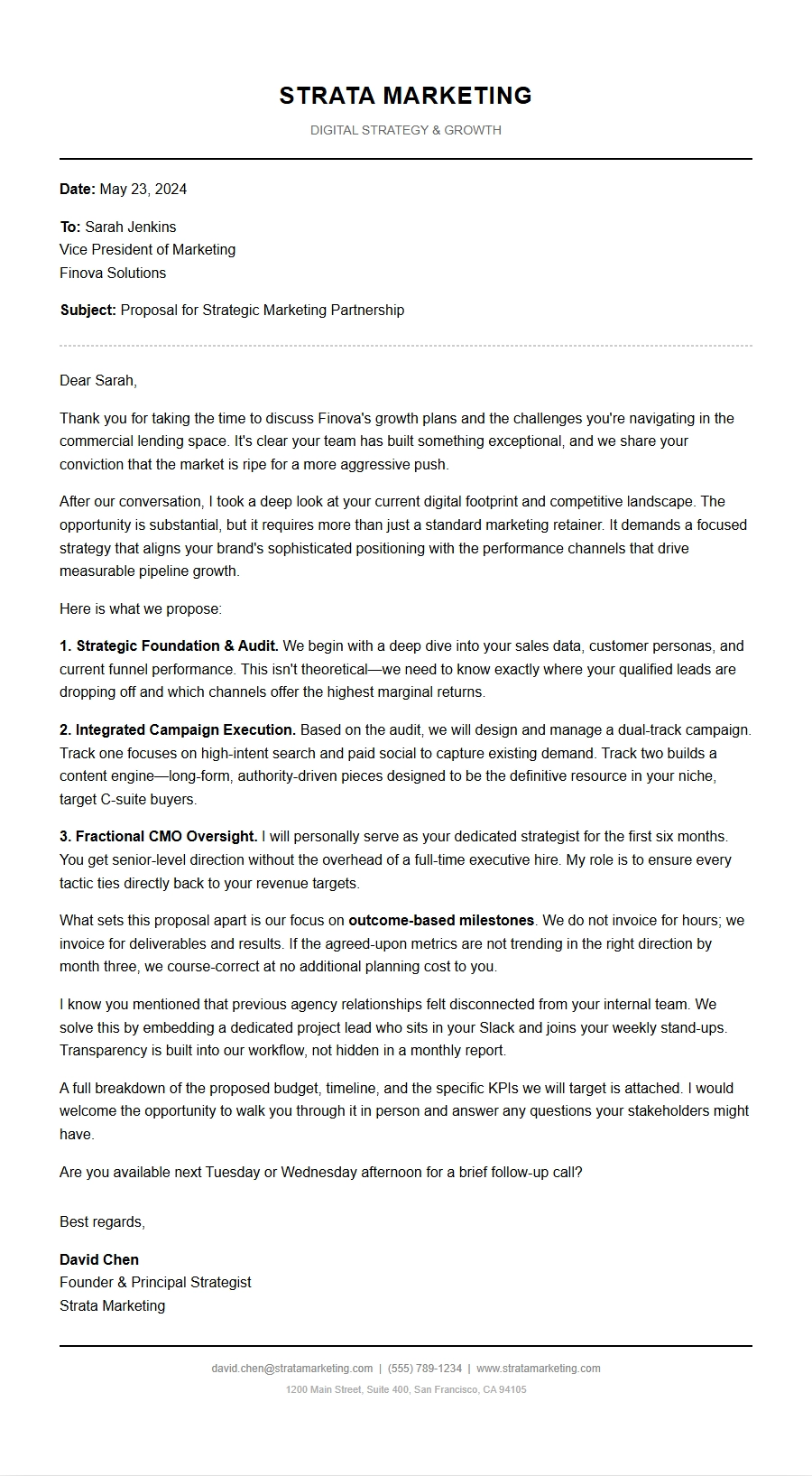 Marketing Agency Service Proposal Letter Template
 Creative Studio Project Proposal Letter
 Small Business Partnership Proposal Letter Template
 Startup Investment Proposal Letter Template