You’ve got a great app idea and a potential client who’s interested—but now you need to put it in writing. Staring at a blank page when you need to send a mobile app development proposal letter can feel like you’re back in school, guessing at the right format. The good news? You don’t need to start from scratch. A well-chosen sample gives you the structure, tone, and key phrases you need, leaving you free to focus on the details that make your proposal personal and convincing.
Why using a letter sample isn’t cheating
Every professional writer I know keeps a stash of templates and examples. Using a letter template saves you from worrying about the basics: where to put the date, how to address someone, or how to close politely. It’s not about copying; it’s about having a solid framework so you can concentrate on your specific offer, timeline, and pricing. Think of it like a recipe—you follow the structure, but you choose your own ingredients.
When you’re writing a mobile app development proposal letter, the core need is clarity. Your client wants to know exactly what you’ll build, how long it will take, and what it will cost. A sample that follows standard business letter format helps you present that information in a way that feels credible and familiar. It also keeps you from accidentally leaving out something important, like a clear call to action or your contact details.
Choosing the right sample for your situation
Not all proposal letters are the same. If you’re pitching to a startup founder who prefers a direct, semi-formal tone, a stiff traditional letter will feel off. If you’re writing to a corporate procurement team, you’ll want something more formal, with proper salutation and closing conventions. The best samples let you adjust the tone in writing without losing the professional backbone.
Look for a sample that includes placeholders for your app’s unique features—user authentication, payment integration, admin dashboard—so you don’t have to invent a structure from scratch. Avoid samples that feel too generic or salesy. A good proposal letter should sound like one human explaining a project to another, not a robot listing features.
How to adapt a sample without losing your voice
Let’s say you find a solid mobile app development proposal letter example. Great. Now read it through and underline the parts that feel like fill—the generic “we are pleased to present” phrases. Replace those with straightforward language. Instead of “We are confident that our solution will exceed your expectations,” try “Here’s how our team will handle the login flow and data sync.” That’s the kind of detail that builds trust.
A common mistake is copying the sample’s opening word for word. The reader can tell. Instead, tailor the first paragraph to grab attention. Mention something specific to their business: “Since your retail store uses X inventory system, our app will pull orders directly from that database, saving your team hours each week.” That single line shows you’ve done your homework and makes the letter feel customizable letter rather than a mass mailer.
Paying attention to format and email vs. printed letter
These days, many proposal letters are sent as email attachments or pasted directly into the body of an email. Know your digital letter format options. If you’re sending a PDF, include your letterhead design with your logo and contact info—it adds polish. If you’re writing the letter directly in an email, skip the fancy letterhead and use a clean subject line and a polite greeting.
One mistake I see often is using outdated salutations like “To Whom It May Concern” or “Dear Sir/Madam” for a known contact. If you have a name, use it. If you don’t, “Hello [Company Name] Team” works better. Also, remember that emails are shorter. A full business letter format inside an email can feel too long. Keep your paragraphs to three or four lines, and use white space to make it skimmable.
Before you hit send, run through a quick proofreading letter check. Read it out loud. If a sentence trips you up, simplify it. A clean, error-free proposal signals that you’ll deliver the same care in your code. And if you’re including a letter of recommendation from a past client as a supporting document, mention that briefly in the proposal—it adds credibility without bragging.
Category: Business Proposal Letters
Common mistakes to avoid
One big pitfall is treating the proposal like a feature list. Don’t just say “we’ll build a login screen, a dashboard, and a notification system.” Explain the benefit: “Users will log in with their existing Google account, see their order history on a clear dashboard, and get push alerts when their items ship.” That’s the difference between a dry list and a persuasive proposal.
Another mistake is ignoring letter writing etiquette for the recipient’s industry. If you’re pitching to a healthcare startup, mention compliance like HIPAA. If it’s a fintech app, bring up security standards. These small details show you understand their world, not just your own codebase.
Using the sample as a springboard, not a crutch
The best mobile app development proposal letter feels both professional and personal. It follows a reliable letter structure but still reads like you’re talking directly to the client. Your sample should be a starting point—a way to bypass the blank-page panic so you can focus on what matters: showing that you understand their problem and have a solid plan to solve it.
Practice makes this process faster. After writing a few proposals, you’ll start to recognize which cover letter examples or templates fit different situations. You’ll also get better at spotting when a sample is too rigid or too vague. Eventually, you’ll build your own set of go-to structures, adapted from the best parts of every sample you’ve used.
So next time you’re staring at an empty document, grab a sample. Treat it like a friendly outline. Fill it with your voice, your real experience, and your honest timeline. That mix of structure and authenticity is what turns a good proposal into a winning one.
Extra Samples
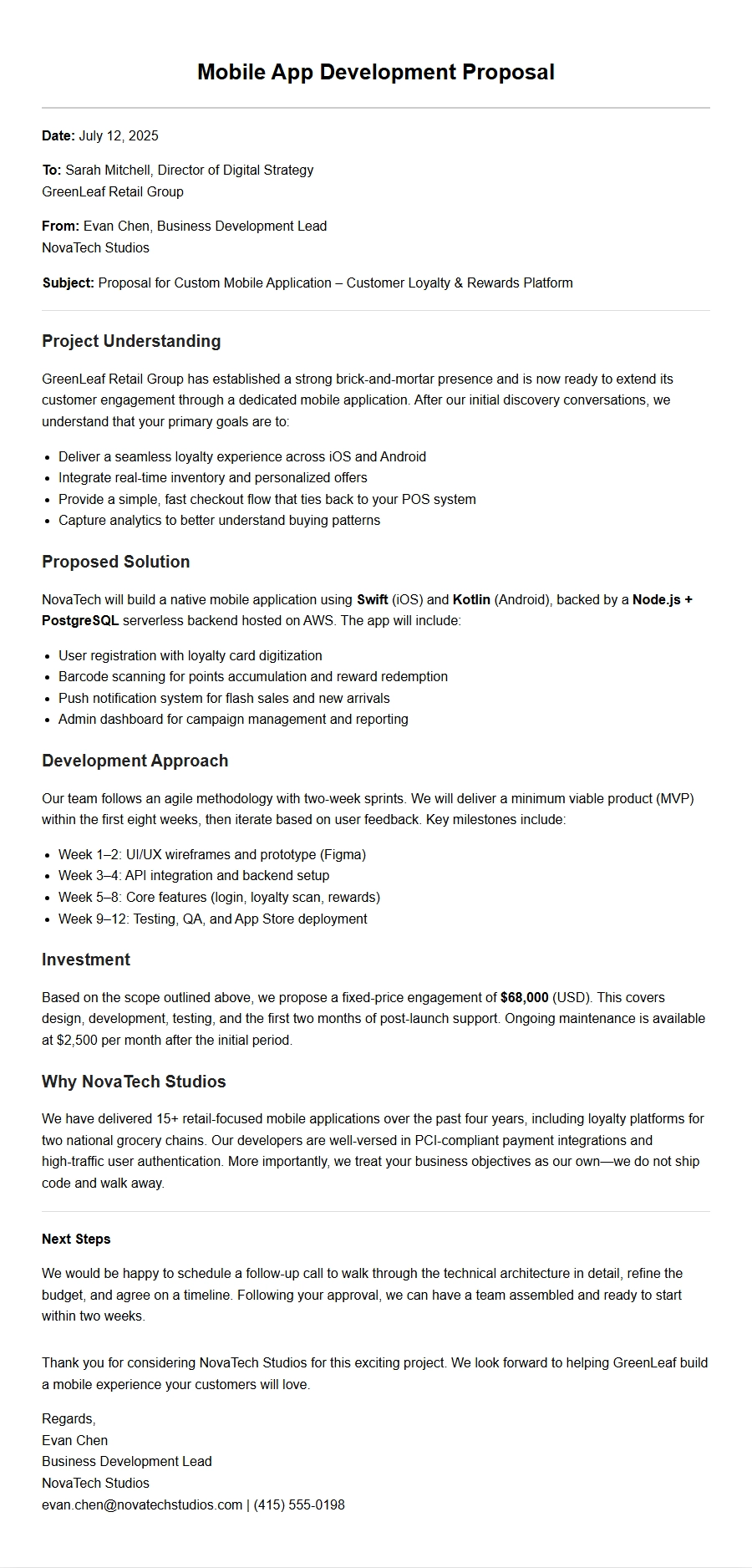
Mobile App Development Proposal Letter Sample
Fitness App Development Proposal
Dear Client,
We are pleased to submit this proposal for the development of your fitness application, FitPro. Our team will deliver a cross-platform solution with personalized workout plans, nutrition tracking, and social challenges.
Core Features:
User profile with health metrics
AI-based exercise recommendations
Calendar integration for scheduling
In-app messaging with trainers
Project Timeline:
Phase
Duration
Deliverable
Discovery
2 weeks
Requirements document
Design
3 weeks
Interactive prototypes
Development
8 weeks
Functional MVP
Testing & Launch
2 weeks
Live app store submission
Investment: $45,000 fixed price, with milestone payments. We look forward to your feedback.
Food Delivery App Proposal
Dear Prospective Partner,
We propose building QuickBite, a food delivery platform connecting local restaurants with hungry customers. Our solution emphasizes real-time tracking, dynamic pricing, and driver management.
Key Modules:
Restaurant dashboard with menu management
Order workflow with push notifications
Route optimization for delivery drivers
Payment gateway integration (Stripe)
Pricing Breakdown:
Component
Cost
UI/UX Design
$8,000
Backend & APIs
$18,000
Mobile Apps (iOS & Android)
$25,000
Admin Panel
$6,000
Testing & Deployment
$4,000
Total
$61,000
Delivery is 4 months from contract signing. We include 30 days of post-launch support.
Educational App Development Proposal
Dear School District,
We are excited to present LearnVault, an educational app designed to enhance remote learning with interactive lessons, quizzes, and performance analytics. This proposal covers development for K-12 schools.
Feature Highlights:
Adaptive learning paths based on student progress
Teacher dashboard for assignment creation
Discussion forums and peer collaboration
Progress reports exportable to PDF
Milestone Schedule:
Requirements gathering – 1 week
Wireframe approval – 1 week
Core development – 5 weeks
Pilot testing with 50 students – 2 weeks
Full release – 1 week
Total cost is $55,000, with 20% due upon signing, 40% at alpha launch, and 40% at final deployment.
Healthcare App Proposal (Telemedicine)
Dear Clinic Management,
We propose building DocConnect, a telemedicine application that enables secure video consultations, electronic prescriptions, and patient record management. Compliance with HIPAA is a priority.
Technical Approach:
End-to-end encryption for all communications
Integration with EHR systems (Epic, Cerner)
Appointment scheduling with automated reminders
E-prescription module using FHIR standards
Project Budget:
Item
Amount
UX Research & Prototyping
$9,000
Frontend (React Native)
$28,000
Backend (Node.js + PostgreSQL)
$22,000
Security Audit
$5,000
Cloud Infrastructure (1 year)
$3,500
Total
$67,500
Timeline is 16 weeks. We provide a 90-day warranty for bug fixes post-launch.
E-Commerce App Development Proposal
Dear Retail CEO,
This proposal details the creation of ShopSwift, a mobile shopping application with advanced filtering, one-tap checkout, and loyalty rewards. We target a 3-month development cycle.
Core Functionality:
Product catalog with image zoom and reviews
Personalized recommendations via machine learning
Cart management with saved items
Multiple payment options (card, digital wallet, COD)
Pricing Table:
Module
Effort (hours)
Cost
Design
120
$12,000
Frontend
300
$30,000
Backend
250
$25,000
Admin Panel
80
$8,000
Integration & Testing
100
$10,000
Total
850
$85,000
Milestone billing: 30% at contract, 30% after frontend demo, 30% at beta, 10% upon launch.
Travel App Development Proposal
Dear Travel Agency,
We propose VoyaJet, a travel companion app that combines flight booking, hotel comparison, and itinerary planning. Our focus is on a seamless user experience with offline maps.
Key Features:
Multi-city flight search with fare alerts
Hotel listing with virtual tours
Day-by-day itinerary builder
Currency converter and language translator
Team Composition:
1 Project Manager
1 UI/UX Designer
2 Mobile Developers (iOS + Android)
1 Backend Developer
1 QA Engineer
Cost Estimate: $75,000 – $95,000 depending on integration complexity. Development takes 5-6 months. We include 2 months of maintenance after release.
Social Networking App Proposal
Dear Investor,
We are excited to submit a proposal for CircleUp, a niche social networking app for local hobbyists. The platform enables event creation, interest-based groups, and real-time chat.
Functional Components:
User registration with social login (Google, Apple)
News feed with image & video upload
Group creation and moderation tools
Location-based event discovery
Private messaging with media sharing
Development Budget:
Phase
Cost
Duration
Concept & Design
$7,000
2 weeks
Core Features
$40,000
8 weeks
Social Features
$22,000
4 weeks
Testing & Launch
$6,000
2 weeks
Total
$75,000
16 weeks
We request 40% advance payment to start the project.
Real Estate App Development Proposal
Dear Brokerage Owner,
This proposal outlines HomeView, a real estate app for property listings, virtual tours, and mortgage calculator. The app will target both buyers and agents.
Core Modules:
Property search by location, price, and type
360-degree virtual tours with hotspots
Agent profile with contact forms
In-app appointment scheduling
Push notifications for new listings
Delivery Milestones:
Wireframes & approvals – Day 14
Property listing backend – Day 45
Virtual tour integration – Day 65
User testing & bug fixes – Day 80
Store submission – Day 90
Pricing is fixed at $50,000. Hosting and third-party API costs will be billed separately. We offer a 12-month warranty on software defects.
Productivity App Development Proposal
Dear Team,
We propose TaskFlow, a cross-platform productivity app that combines to-do lists, project boards, and time tracking. Ideal for remote teams looking for a lightweight alternative to heavy tools.
Feature Set:
Kanban boards with drag-and-drop
Recurring tasks and reminders
Pomodoro timer integrated with tasks
Team collaboration with comments and file sharing
Sync across devices via cloud
Development Estimate:
Resource
Rate
Hours
Cost
Project Manager
$80/hr
40
$3,200
Designer
$70/hr
60
$4,200
Mobile Developer
$100/hr
250
$25,000
Backend Developer
$90/hr
200
$18,000
QA Tester
$60/hr
80
$4,800
Total
630
$55,200
Timeline: 10-12 weeks. We provide weekly status reports and a demo after 6 weeks.
Fintech App Development Proposal
Dear CEO,
We present WalletPlus, a personal finance management app that tracks expenses, sets budgets, and offers investment recommendations. Our solution ensures PCI-DSS compliance.
Key Capabilities:
Automatic transaction categorization using AI
Goal-based savings with visual progress
Bill payment reminders and recurring transaction management
Secure biometric authentication
Integration with major banks via Plaid API
Cost Breakdown:
Area
Amount
Discovery & Architecture
$10,000
UI/UX Design
$12,000
Frontend Development
$30,000
Backend & API
$28,000
Security & Compliance
$8,000
Testing
$7,000
Total
$95,000
Estimated timeline: 20 weeks with bi-weekly sprint reviews. We require a 30% down payment to initiate the project.
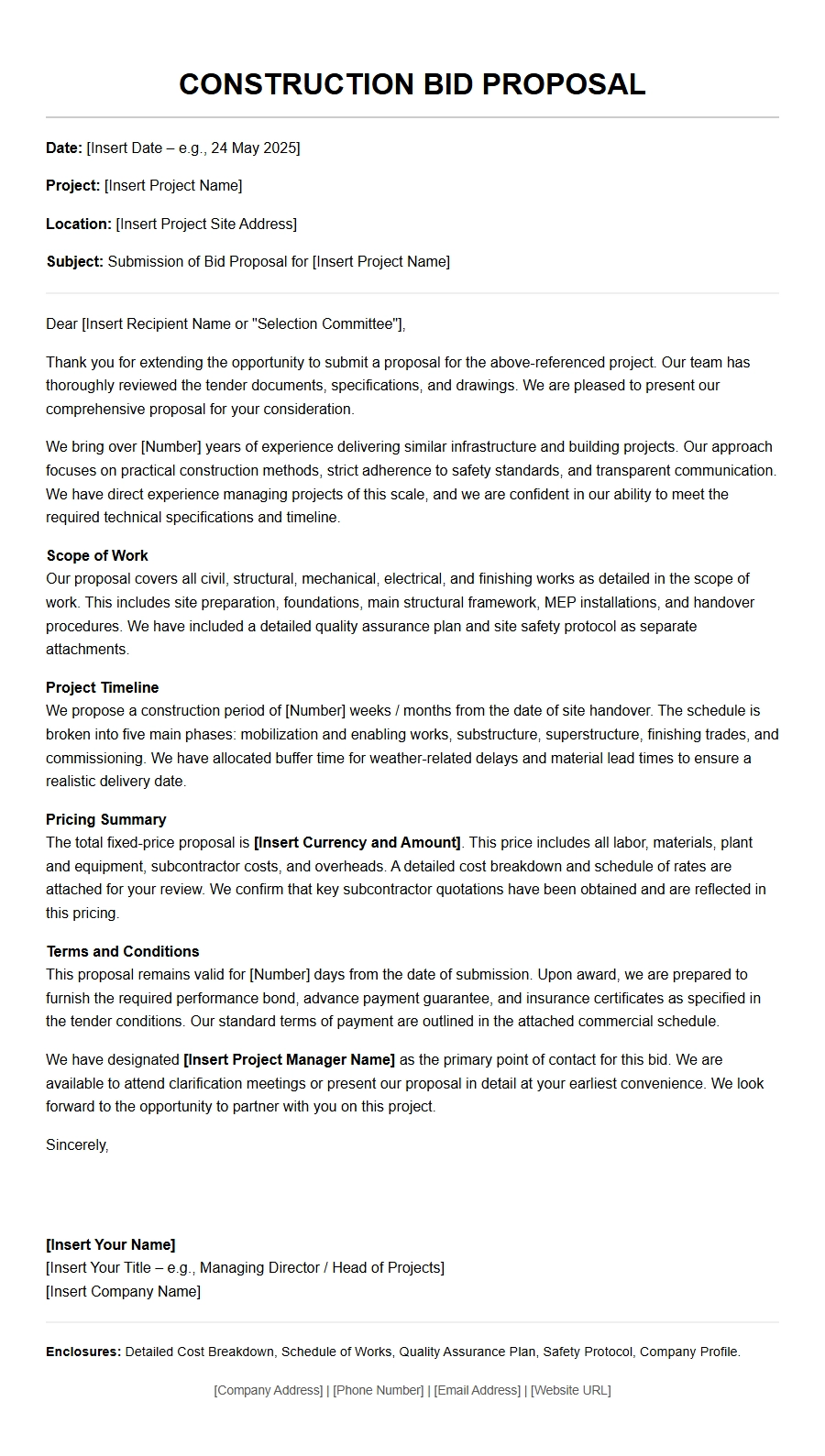 Sample Construction Bid Proposal Letter
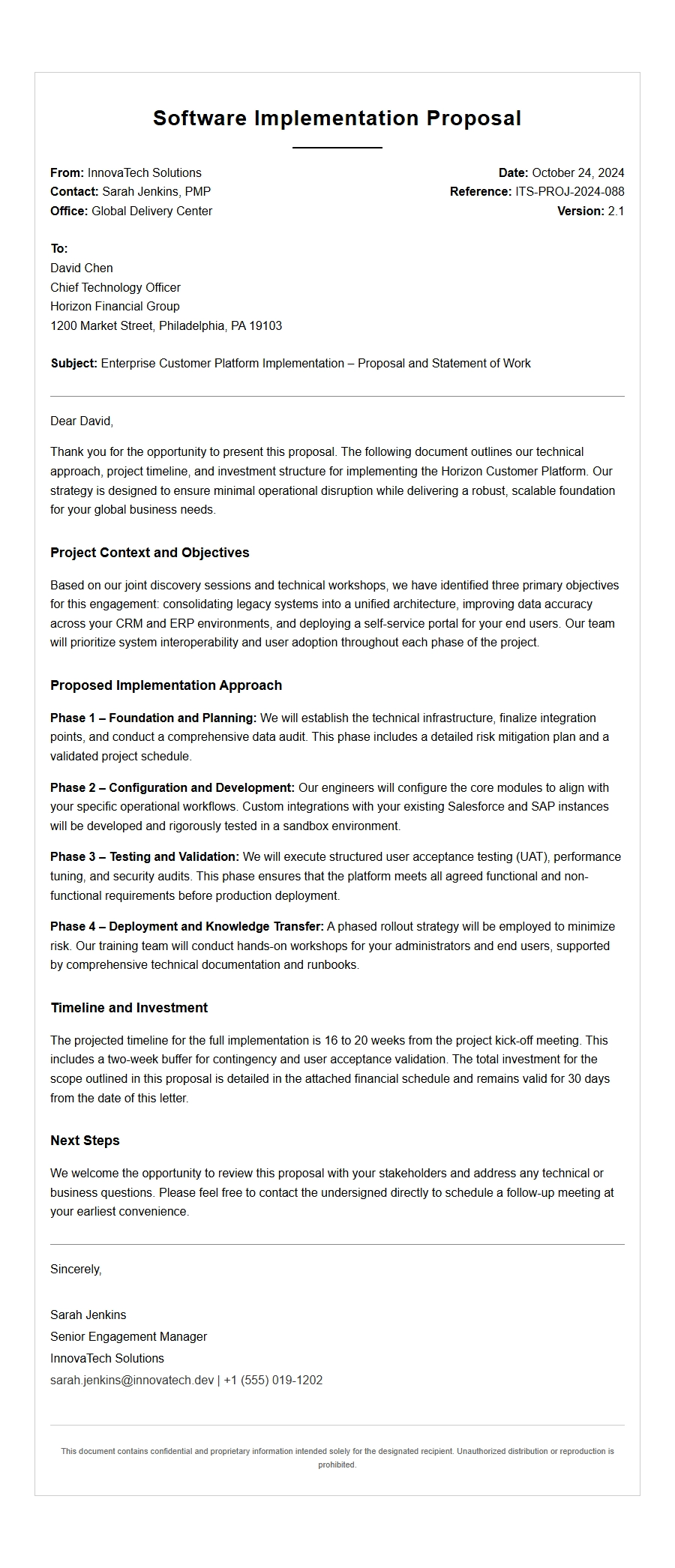 Enterprise Software Implementation Proposal Letter Example
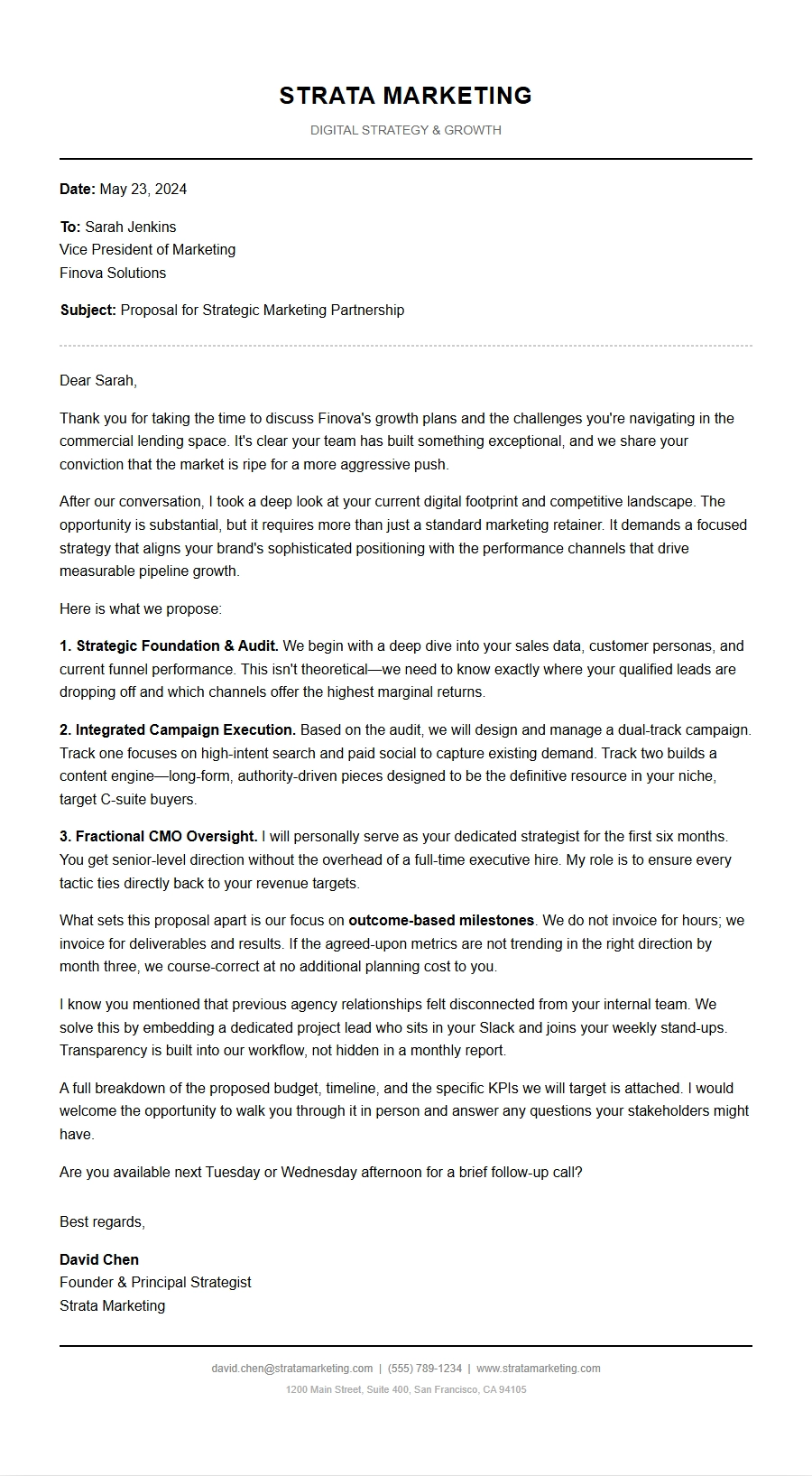 Marketing Agency Service Proposal Letter Template
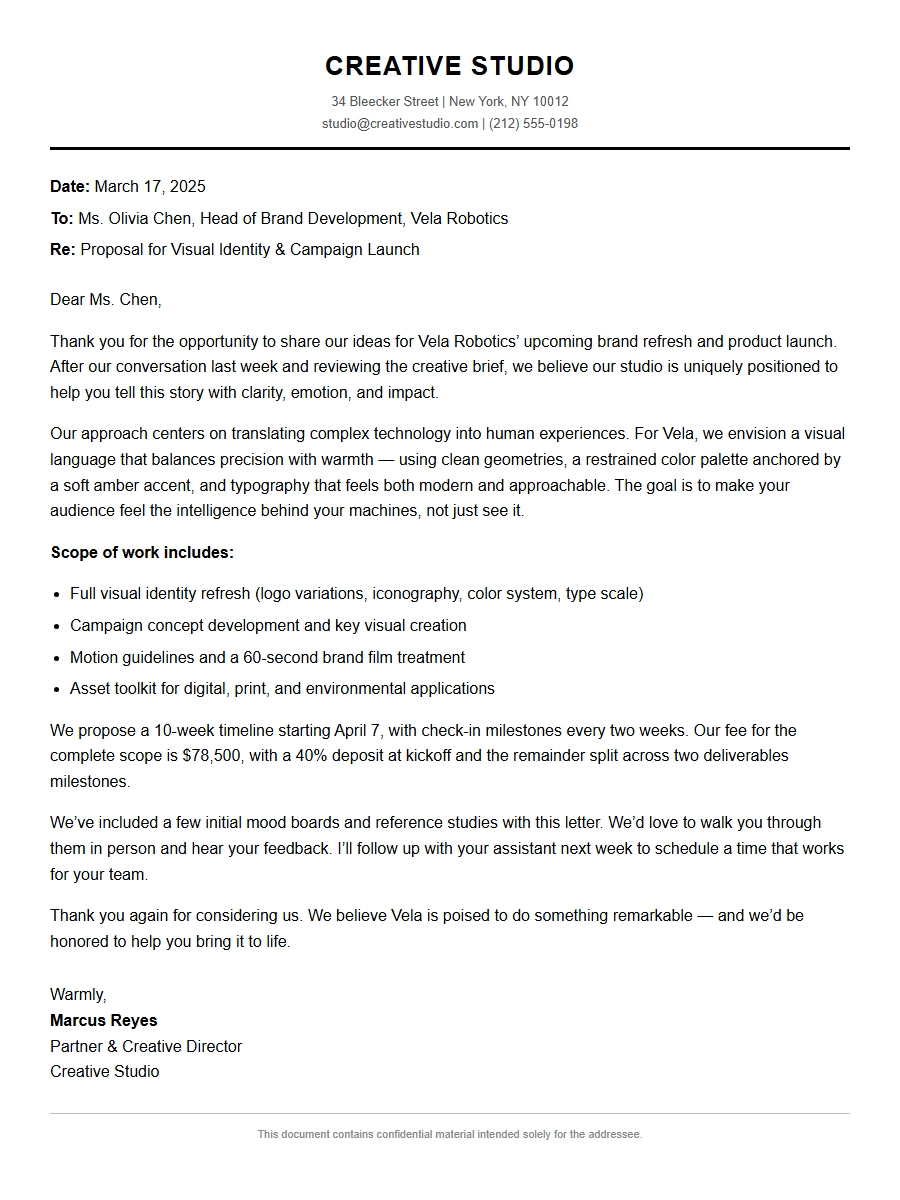 Creative Studio Project Proposal Letter
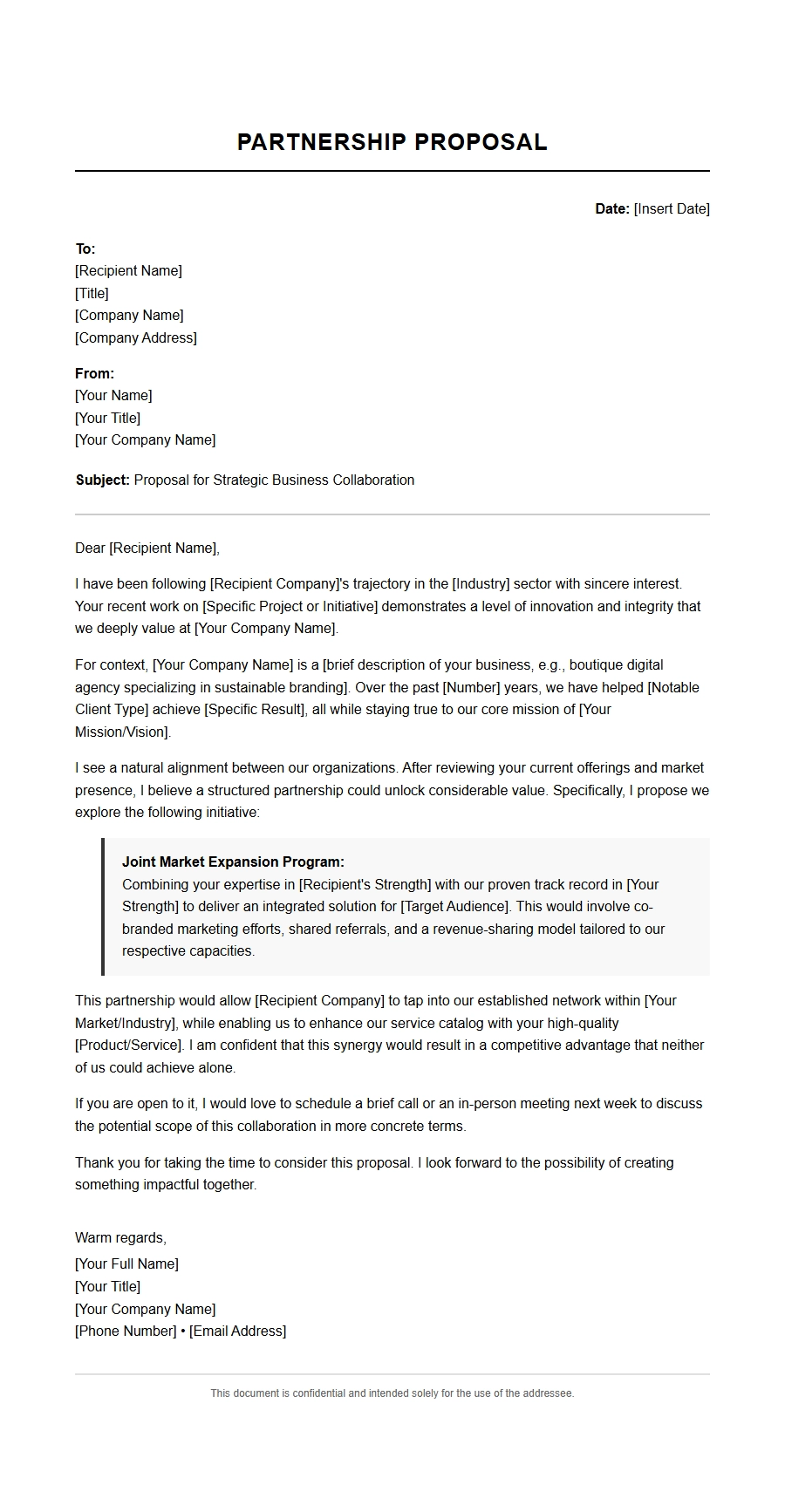 Small Business Partnership Proposal Letter Template
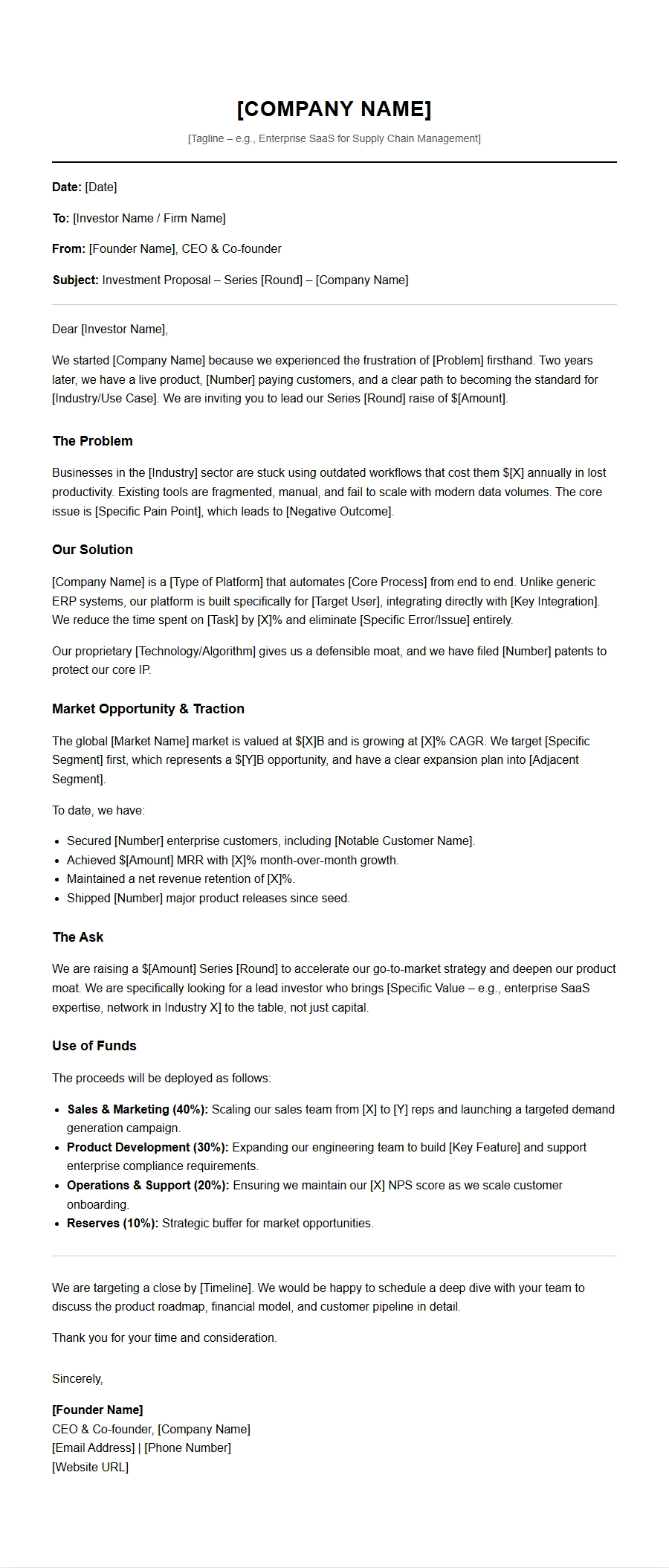 Startup Investment Proposal Letter Template