explaining medical leave absence to school - Personal Letters
Staring at a blank screen when you need to write a letter to your child’s school about a medical leave can feel overwhelming. You want to be clear, respectful, and persuasive—but also protect your family’s privacy. The pressure to get it right, especially when emotions are high, often freezes even confident writers. That’s where a solid sample helps.
Why a letter template isn’t cheating
Using a letter template for explaining medical leave absence to school is a smart shortcut, not a shortcut around quality. A good sample gives you a proven structure, the right tone, and key phrases you might forget when stressed. It also lets you see what a complete professional correspondence looks like—salutations, body, closing. You don’t have to invent the wheel; you just need to adjust it to your family’s situation. Templates save time and reduce anxiety, leaving room for genuine personalization.
[Category: Medical Leave Letter to School]
Choosing the right sample for your school
Not every school setting calls for the same formality. A note to a kindergarten teacher can be warmer and less structured than a letter to a university dean. Start by asking: Will this be printed on letterhead, emailed, or submitted through an online portal? For a formal printed letter, follow business letter format with your address, date, and recipient details. For an email, skip the letterhead but keep a clear subject line and respectful salutation and closing (e.g., “Dear Principal Martinez,” and “Sincerely,”). Many cover letter examples show this same shift between formats—adapt the approach to your audience.
Adapting the template without losing your voice
The best letters feel human, not robotic. After you pick a sample, rewrite the opening paragraph to reflect your specific situation. Instead of a generic “I am writing to inform you,” try: “Our son, Alex, has been diagnosed with a condition that requires extended medical leave. We appreciate the school’s support as we plan his return.” Keep the template’s structure, but inject your family’s tone—whether that’s matter-of-fact, grateful, or collaborative. Tone in writing matters more than fancy vocabulary. A simple, clear request often works better than elaborate explanations.
Common mistakes to avoid
Even a great sample won’t fix these errors. First, avoid outdated salutations like “To whom it may concern.” If possible, find the right person’s name—it shows effort. Second, don’t over-share medical details. You only need to state the reason briefly (e.g., “medical treatment” or “recovery from surgery”) unless the school requests documentation. Third, ignore formatting differences: a digital letter format in an email body shouldn’t have a traditional letterhead, but it should still use proper spacing and a professional letter structure. Finally, always proofread. A typo in a leave letter can seem careless. Follow basic proofreading letter steps: read aloud, check dates, and confirm names.
Quick tip: tailor the opening to grab attention
The first sentence sets the entire letter’s direction. Instead of starting with your child’s full history, state the purpose upfront: “I am writing to request a medical leave of absence for my daughter, Mia, starting on March 1.” Then briefly explain the need and the expected duration. This respects the reader’s time and shows you’ve followed formal writing tips for clarity. If you want to see how similar openings work in other contexts, check out how we handle resignation letter samples, apologizing for a missed appointment, or notifying guests about a venue change—each has a direct opening that respects the reader.
Take the sample as a springboard, not a crutch. Write your first draft, then set it aside for an hour. Read it again with fresh eyes—does it sound like you? Would you feel comfortable handing it to the principal? If something feels off, adjust the wording. Over time, writing these letters becomes faster because you internalize the pattern. Remember, the best letters combine the reliability of a template with the warmth of a real parent or guardian. That balance builds trust and gets your child the support they need.
Samples You Can Use
explaining medical leave absence to school - Personal Letters
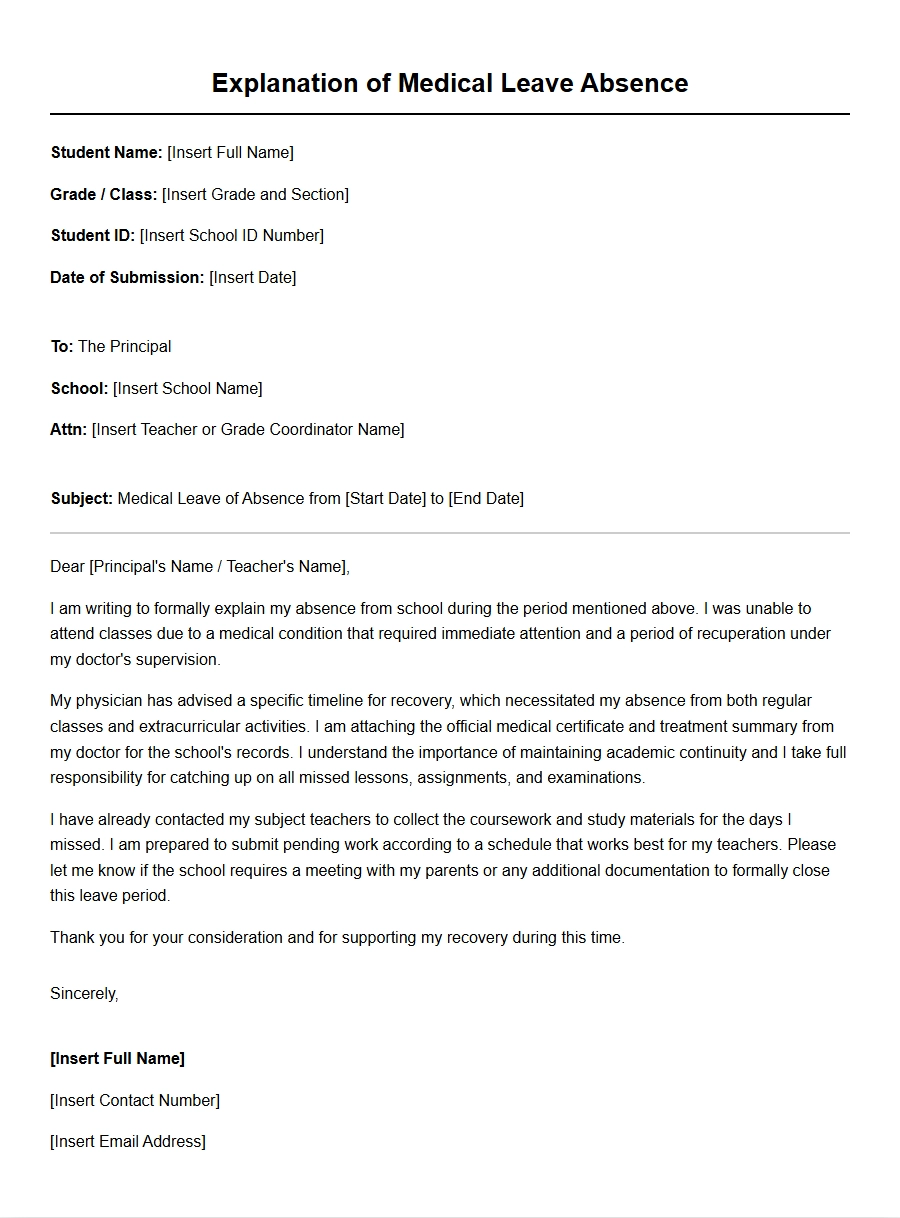
Letter to Teacher Regarding Child's Illness
Dear Mr. Thompson,
I am writing to explain my daughter, Emily’s, absence from your class on March 3rd through March 7th. She was diagnosed with a severe case of influenza by Dr. Rivera at Children’s Clinic. The doctor recommended she remain at home until she was fever-free for at least 24 hours without medication.
Emily is now feeling much better and is eager to catch up on missed work. I have attached a copy of the doctor’s note for your records. Please let me know if there are any assignments or tests she needs to make up. I would be happy to schedule a brief meeting if you require further details.
Thank you for your understanding and support during this time.
Sincerely, Laura Martinez Parent of Emily Martinez, Grade 5
Email to Principal for Extended Medical Leave
Subject: Request for Extended Medical Leave – Jonathan Park
Dear Principal Davis,
I am writing to formally request an extended medical leave of absence for my son, Jonathan Park, a sophomore at Westbrook High School. Jonathan has been diagnosed with a herniated disc and will require physical therapy three times per week for the next six weeks. His orthopedic surgeon, Dr. Sandra Chen, has recommended that he refrain from seated classroom instruction during the initial treatment phase to avoid aggravating his spine.
We have already spoken with the school nurse and the guidance counselor about a plan for remote assignments. Jonathan will submit all work via email and attend weekly video check-ins with his teachers. Please find the attached medical certification and treatment schedule.
We appreciate your cooperation in approving this leave from March 20 through April 30. Please let us know if any additional documentation is needed.
Thank you, Michael Park Phone: (555) 123-4567
Note to School Counselor for Mental Health Break
Dear Ms. Garcia,
This letter is to explain my absence from classes on February 12 and 13. I experienced a sudden onset of severe anxiety and depressive episodes that made it impossible for me to focus on schoolwork or interact with others. My therapist, Dr. Linda Osei, advised that I take two days off to practice self-care and attend an urgent therapy session.
I have attached the therapist’s note confirming my need for this short mental health break. I understand that I missed a math quiz and a lab report. I would like to arrange a meeting with you to discuss how I can make up these assignments without increasing my stress. I am committed to staying on top of my studies while prioritizing my well-being.
Thank you for your understanding and discretion.
Best regards, Alex Rivera Student ID: 8-7352
Follow-Up Letter After Surgery Recovery
Dear Mrs. Henderson,
I am writing to provide an update regarding my daughter, Sarah, who was absent from your third-grade class from April 10 through April 24 following her tonsillectomy. The surgery went smoothly, and her recovery at home has been progressing as expected. Dr. Mark Jenkins at Northern Pediatrics has now cleared her to return to school with no restrictions.
During her absence, Sarah completed the reading assignments you provided via email. She still needs to finish the math worksheet packet and the science project on plant growth. I have attached the daily journal she kept about her recovery, which may be used as a writing sample. Please let us know if any additional make-up work is required.
Thank you for your patience and support during Sarah’s recovery. We appreciate the school’s flexibility in allowing her to heal fully before returning.
Respectfully, Jennifer Walsh Parent of Sarah Walsh
Request for Excused Absences Due to Chronic Condition
To the Attendance Committee,
I am writing on behalf of my son, Lucas Nguyen, a 9th-grade student at Lincoln High, to request that his absences on January 8, 9, 15, and 22 be excused due to his chronic asthma condition. Lucas has severe allergic asthma that is triggered by seasonal pollens and cold air. These episodes required him to visit the pediatrician, Dr. Emily Tran, for nebulizer treatments during school hours.
We have provided a detailed medical summary from Dr. Tran outlining Lucas’s diagnosis and the necessity of prompt treatment even during instruction time. Lucas always obtains a doctor’s excuse note within 24 hours of each visit. We are working with the school nurse to develop an asthma action plan that will minimize future absences. Please excuse these four missed days under the district’s chronic illness policy.
Thank you for your understanding. We value Lucas’s education and will continue to manage his condition responsibly.
Sincerely, Mai Nguyen Parent contact: (555) 987-6543
Letter for Infectious Disease Quarantine
Dear Principal Owens,
I am writing to explain the absence of my daughter, Chloe, from school during the period of March 1 through March 10. Chloe was exposed to chickenpox at a family gathering and developed symptoms on March 2. Our family physician, Dr. Robert Liu, confirmed the diagnosis and ordered a 10-day home quarantine to prevent transmission to other students. The school nurse was notified on March 1 as soon as we suspected exposure.
Chloe has fully recovered, and she is no longer contagious. Dr. Liu has provided a clearance letter dated March 11, which we will present to the attendance office. During the quarantine, Chloe completed all assignments posted on Google Classroom. She is ready to return and will bring a signed note from the doctor verifying her clearance.
We appreciate the school’s cooperation in keeping other children safe. Please excuse these absences as medically necessary quarantine.
Best regards, Karen Lee Parent of Chloe Lee, Grade 2
Return-to-School Letter After Medical Emergency
Dear Mr. Ellis,
This letter is to accompany my son, David, as he returns to your homeroom class today, November 15. David was absent for three weeks after being hospitalized for a severe allergic reaction (anaphylaxis) on October 25. He was treated in the ICU and then spent two weeks recovering at home under the care of Dr. Anita Patel, an allergist. We now have an updated emergency action plan for his allergies to peanuts and tree nuts.
David is fully recovered and has been cleared for all regular activities, including gym class. He will carry two epinephrine auto-injectors at all times. We have already provided a new set of medications to the school nurse, along with the updated emergency plan signed by Dr. Patel. Please inform all of his teachers of these changes. David is eager to return to school and catch up on missed lessons. He has completed a short journal about his experience for language arts.
Thank you for your support during this frightening time. We feel confident that the school’s staff will keep David safe.
Gratefully, Susan Miller Parent of David Miller, Grade 7
Absence Notification for Family Medical Emergency
Dear Principal Robinson,
I am writing to explain my son, Marcus, missing school on April 5 and April 6 due to a family medical emergency. My wife, Marcus’s mother, suffered a sudden stroke and was rushed to the hospital. Marcus accompanied me to be with her during the critical first 48 hours. I understand that this is not a direct illness of the student, but the emotional stress and need for family support made it impossible for Marcus to attend class.
We have a hospital admission record from Mercy General Hospital confirming my wife’s emergency. Marcus is back in school today, April 7, and will meet with the school counselor to process the event. He missed two major assignments—a history essay and a math test. We would appreciate the opportunity for him to make these up within the next week. Please excuse these two days as family medical leave.
Thank you for your compassion during this difficult time.
Sincerely, David James Parent of Marcus James, Grade 11
Medical Leave Request for Student's Surgery
To the Attendance Office,
I am requesting a planned medical leave of absence for my daughter, Isabella, for May 10 through May 25. Isabella has been scheduled for an outpatient surgical procedure—removal of a cyst from her lower back—at St. Luke’s Ambulatory Center on May 10. The surgery requires general anesthesia, and her recovery at home is expected to take two weeks, with limitations on physical activity and prolonged sitting.
Her surgeon, Dr. Kevin Ng, has provided a preoperative note and a postoperative recovery timeline. We have attached both documents. We will also obtain a formal discharge summary on May 10 and submit it upon return. Isabella’s teachers have already been informed via email, and we will collect assignments during her leave. She will aim to submit work electronically where possible. Please excuse this absence as a planned medical leave.
We appreciate the school’s support in ensuring a smooth transition before and after surgery.
Thank you, Rebecca Torres Parent of Isabella Torres, Grade 8
School Excuse Note for Doctor's Appointment
Dear Ms. Chen,
Please excuse my son, Daniel, from school on Thursday, October 12, from 10:30 AM to 2:00 PM. He had a scheduled appointment with Dr. Kara Williams, a pediatric neurologist, for a routine EEG follow-up. The appointment took longer than expected due to additional testing, so Daniel was unable to return for his afternoon classes. He was present during the morning session.
Attached is a signed note from Dr. Williams’s office confirming the visit. Daniel will get his missed notes from a classmate and complete any homework he missed. I will ensure he catches up on his language arts homework and the science quiz scheduled for that day. Please mark his absence as excused medical appointment.
Thank you for your understanding.
Sincerely, Patricia Kim Parent of Daniel Kim, Grade 6
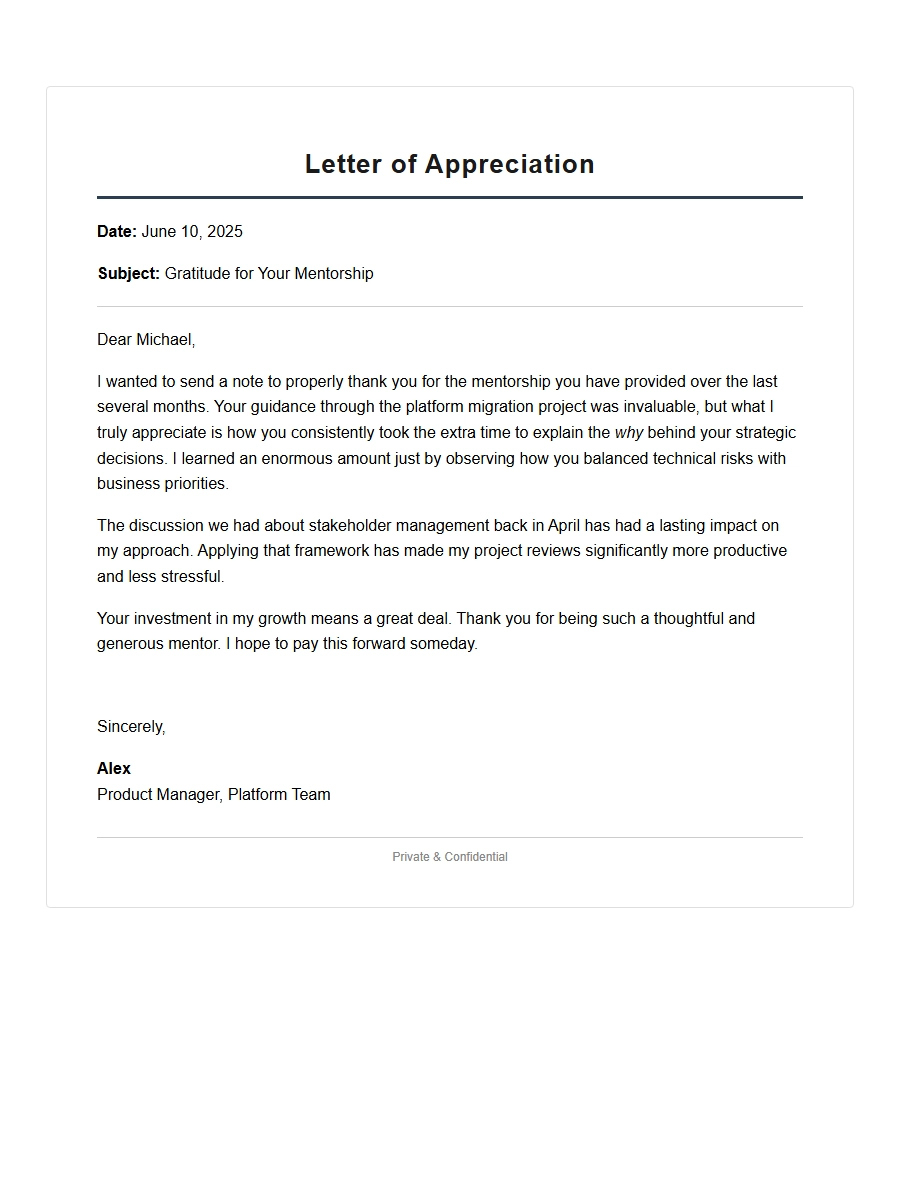 Thanking a Mentor for Guidance: Sample Messages
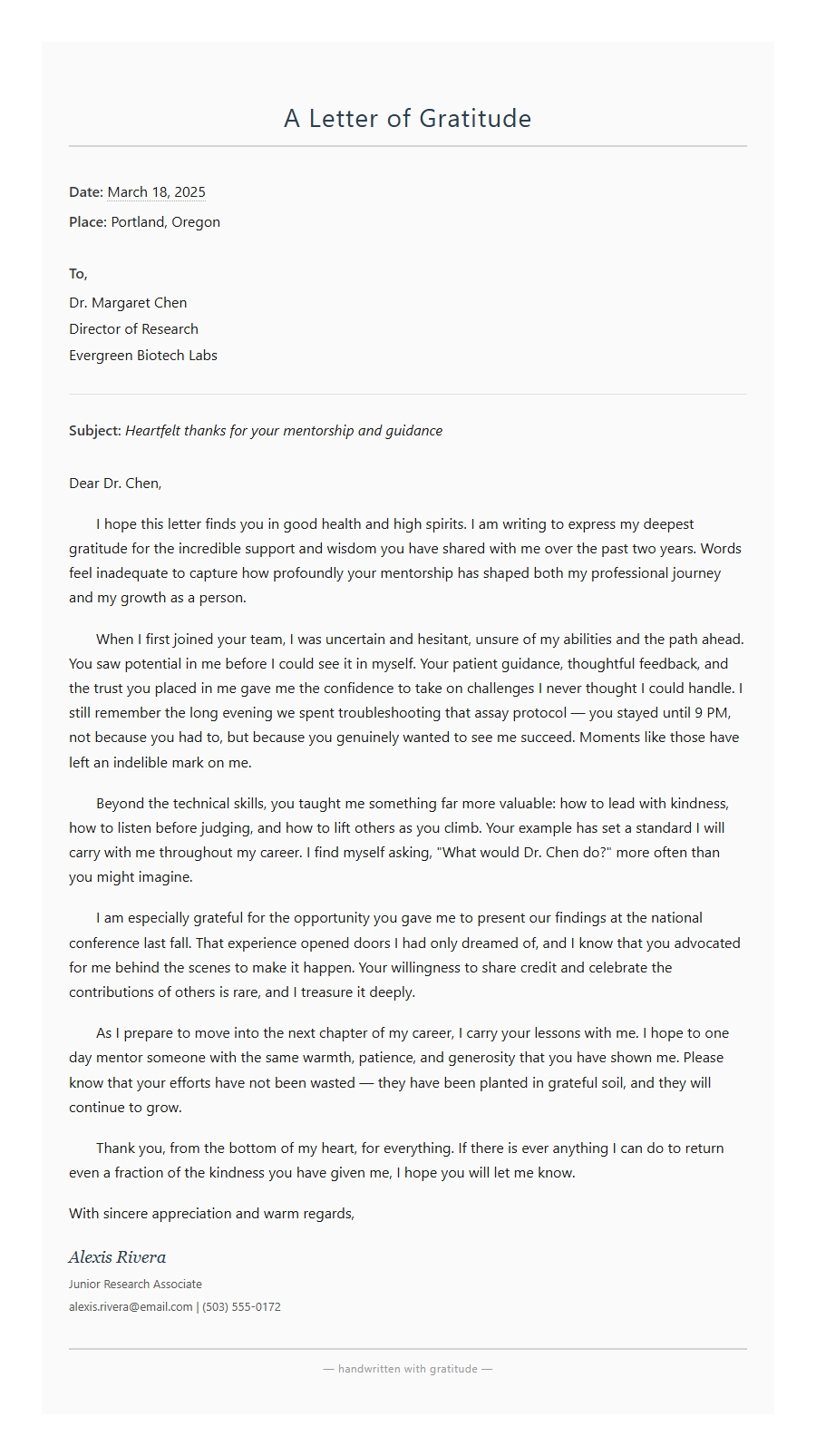 Expressing Gratitude: Handwritten Letter Example
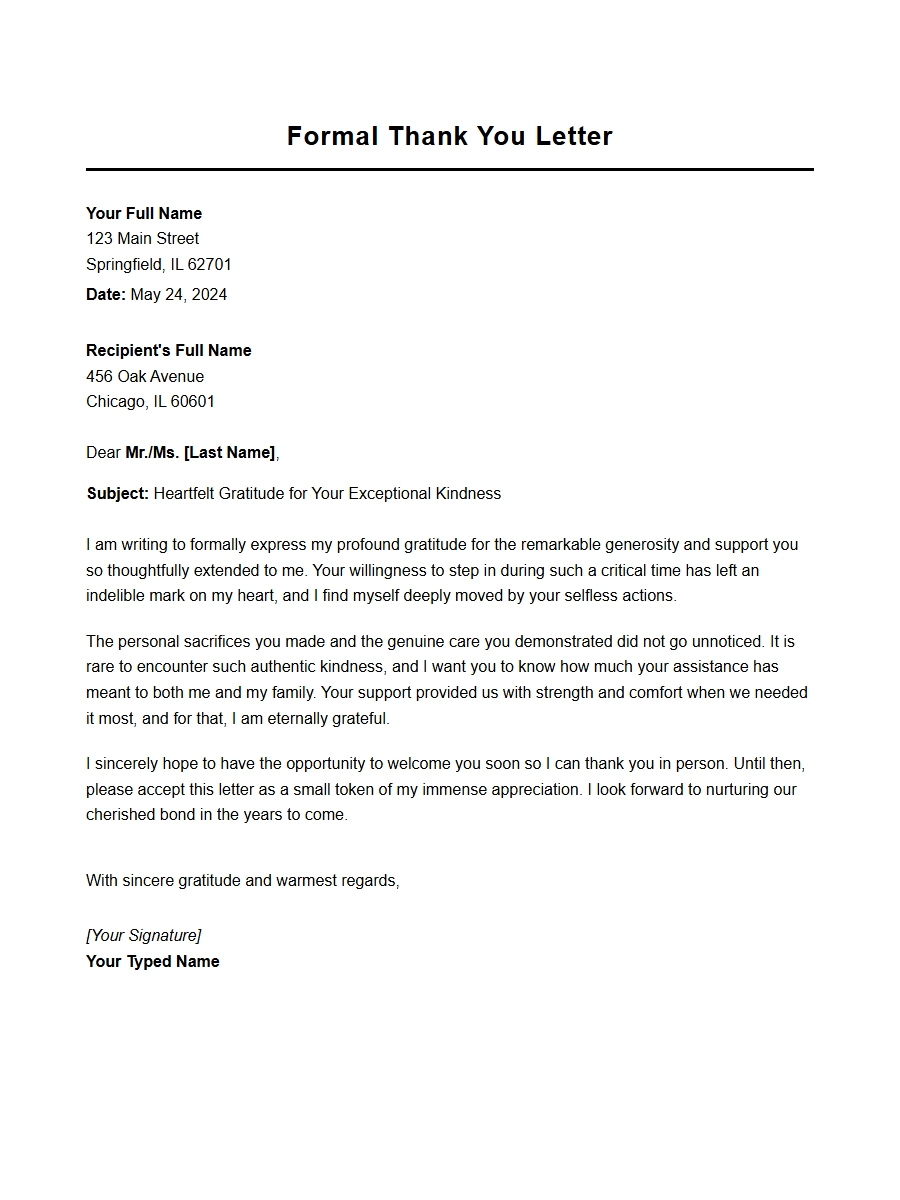 Expressing Thanks in a Formal Personal Letter
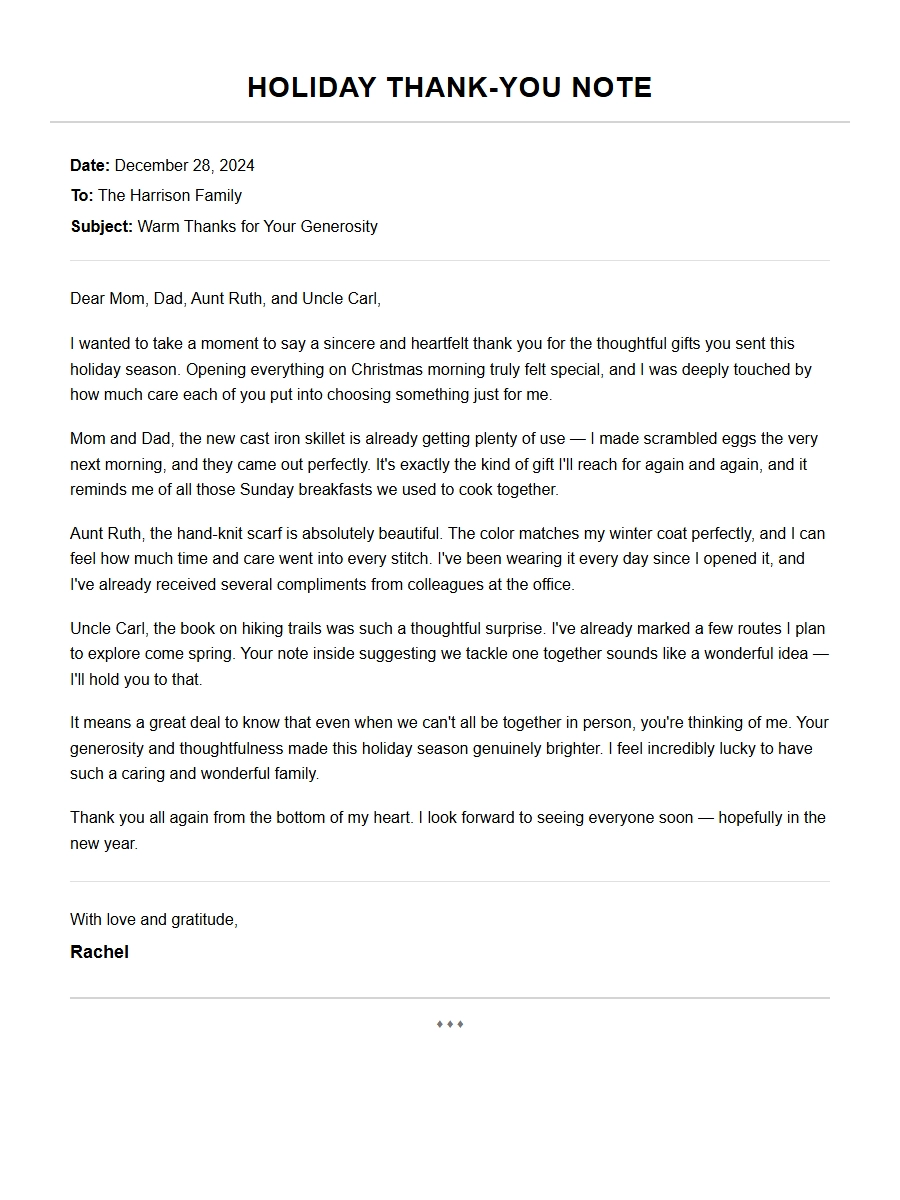 Thank You Letter Examples for Family Holiday Gifts
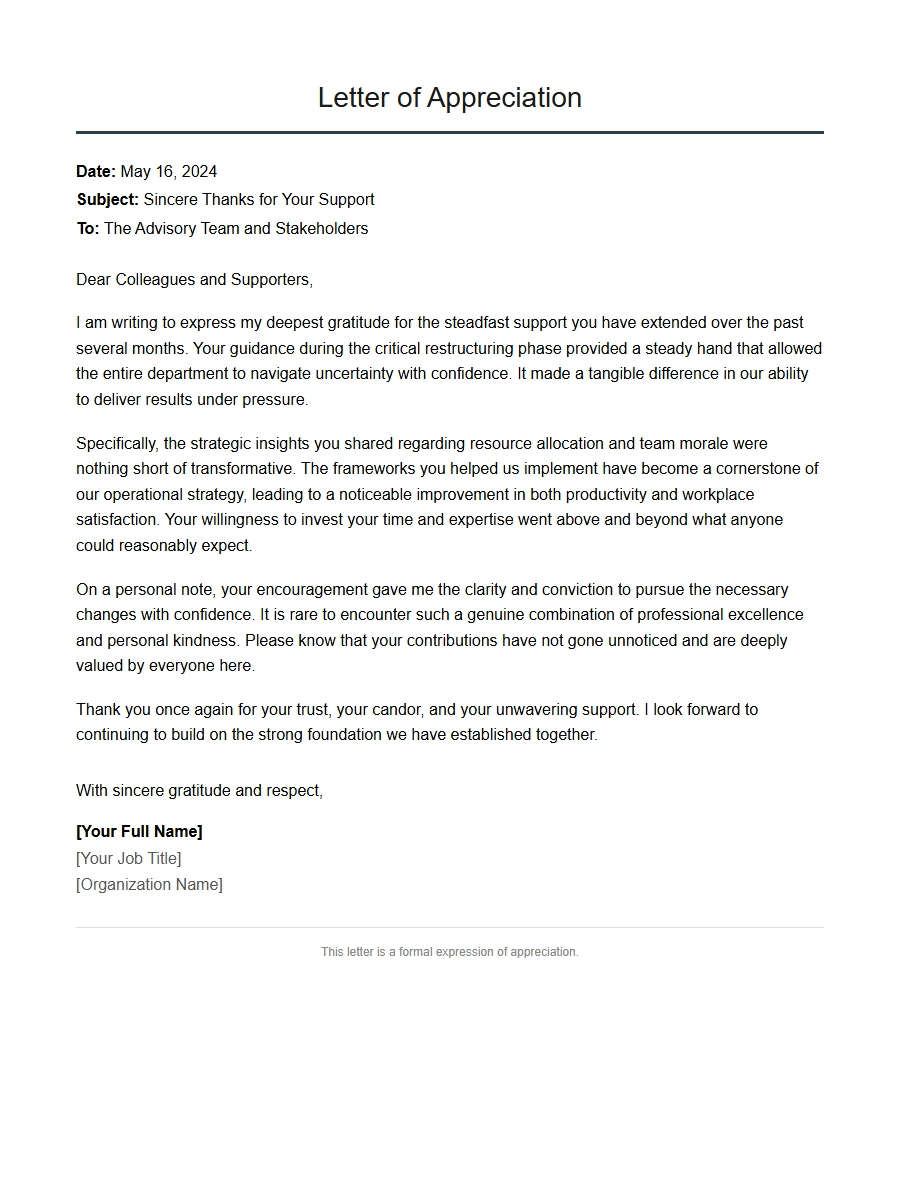 Sample Thank You Letter for Support
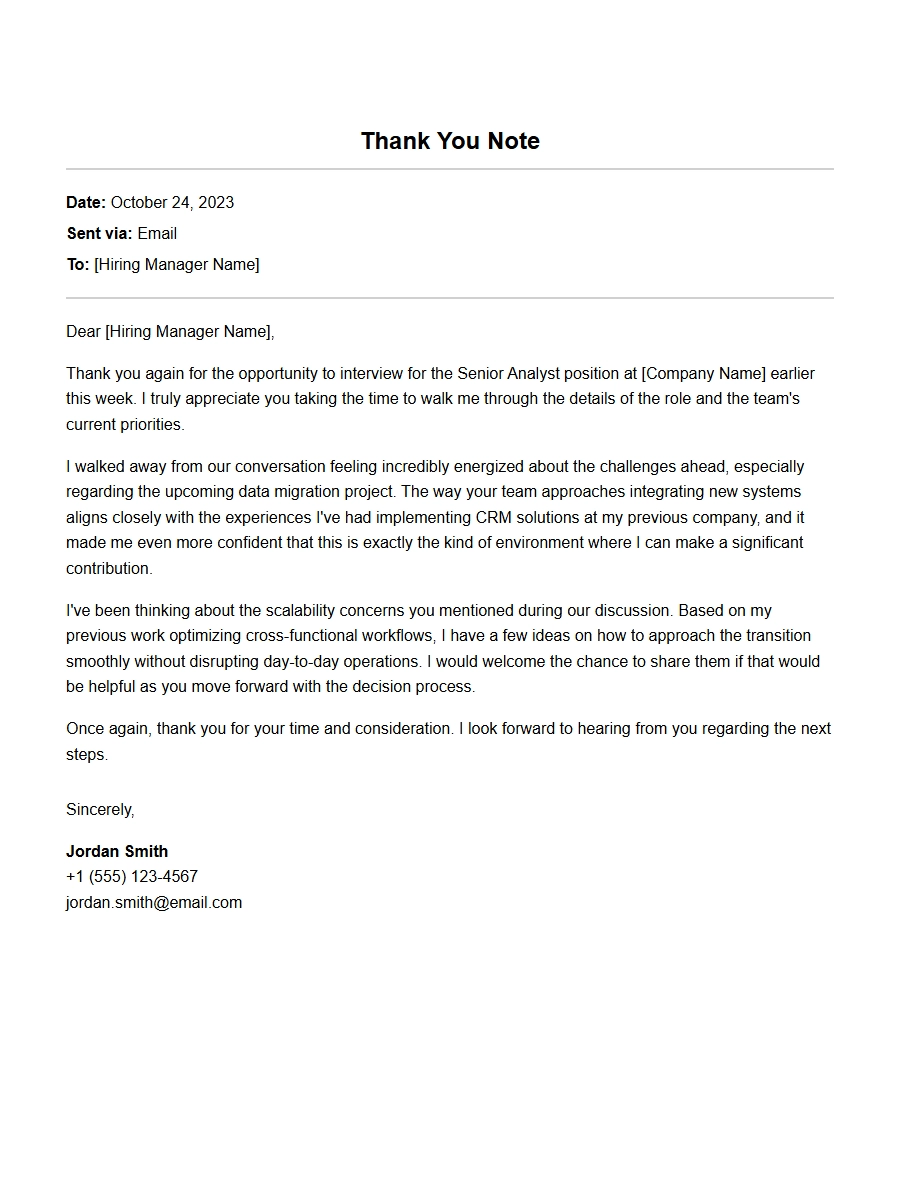 How to Write a Personal Thank-You Note After an Interview