Clarifying a Billing Error with Your Service Provider
Seeing an unexpected charge on your credit card statement or a bill from your internet provider that doesn’t match what you agreed to can make your stomach drop. You know you need to contact them, but the thought of writing a formal letter or email feels like a chore you keep putting off. That blank page stares back, and you wonder what tone to take—firm but polite? Detailed but not whiny?
That’s exactly where a good sample letter helps. Using a letter template isn’t cheating. It’s a smart shortcut that gives you the structure, the right salutation and closing, and professional phrasing so you can focus on explaining the error clearly. The best part? You still customize it with your specific details. Think of it as a skeleton you dress up with your own story.
Why a billing error letter needs structure
A billing dispute is a form of professional correspondence. You want the company to take you seriously, not push your email to the bottom of the pile. A well-written letter shows you’ve done your homework, you know what you’re talking about, and you expect a timely fix. That’s why following a business letter format matters—even if you’re sending an email.
Start with a clear subject line (e.g., “Billing Error on Invoice #12345 – Request for Correction”). Then include the date, your account number, and a concise opening paragraph. The sample you choose should mirror the level of formality your relationship with the provider requires. For a small vendor you know, a semi-formal tone works. For a large telecom company, you’ll want more formal writing tips in mind—things like avoiding slang and using polite language.
How to pick the right sample for your situation
You wouldn’t grab a resignation letter sample when you’re writing about an overcharge. So look for a template specifically about billing disputes or customer service complaints. Many sites offer customizable letter options for exactly this scenario. Pay attention to the letter structure: the best samples include a clear opening (what went wrong), a middle (evidence or reference), and a closing (what you want done).
If you’re unsure about the tone, lean slightly more professional than you think you need to. You can always dial it down in a follow-up. Letter writing etiquette says you should keep emotions in check. Instead of “You guys overcharged me and I’m furious,” write “I noticed a discrepancy on my most recent statement and would appreciate your help resolving it.”
Adapting a sample without losing your voice
Once you’ve found a good template, resist the urge to copy-paste and hit send. Read it aloud. Does it sound like you? If not, swap out stiff phrases for ones that feel natural. For example, instead of “Please find attached,” you can write “I’ve attached.” The tone in writing should be firm yet respectful—like talking to a customer service rep you want to help you.
A common mistake is using outdated salutations like “To Whom It May Concern” in an email. If you know the company’s billing department, address it to them directly. If you don’t, “Dear Billing Support Team” works. And for the closing, “Sincerely” or “Best regards” are safe bets. Don’t forget to include your phone number or account reference so they can act fast.
Mistakes to avoid when writing a billing dispute
One of the biggest blunders is ignoring proofreading letter requirements. A typo in your account number or the dollar amount can delay resolution. Read every line twice. Also, think about digital letter format—if you’re emailing, keep it short and use simple paragraph breaks. If you’re mailing a physical letter, consider simple letterhead design (your name and address at the top) to look organized.
Another trap: assuming the sample covers everything. Your situation might involve a contract clause, a promotional discount that fell off, or a charge you were promised would be waived. Make sure you explain the why behind the error. Provide dates, reference numbers, and any previous communication. That’s what makes your letter feel authentic and urgent.
Putting it all together
You don’t need to reinvent the wheel. Use a sample, tweak it, and send it off. If you’re also drafting other types of personal letters—like a tribute letter to a deceased relative or thanking a mentor for guidance—you’ll find our other templates helpful too. The same principles apply: pick the right format, keep it natural, and proofread.
Once you’ve written your billing error letter, you’ll likely get a faster response. And the next time a charge looks off, you’ll have a template saved to tweak in minutes. Practice makes the process faster, and soon you’ll be handling these like a pro. The goal is to sound both professional and human—because that’s what gets results.
Ready-to-Use Examples
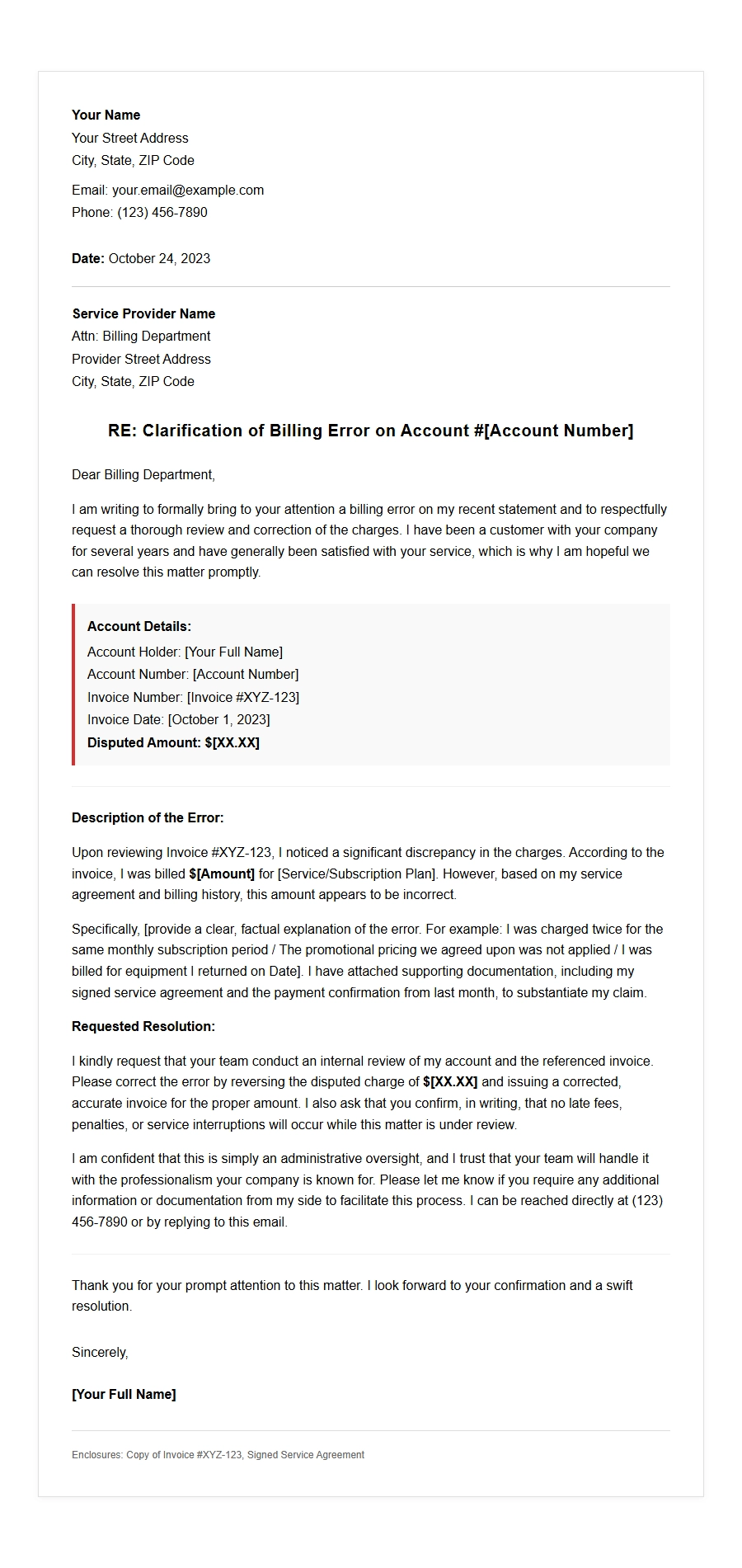
Clarifying a Billing Error with Your Service Provider
Request for Correction of Overcharge
Dear Customer Service,
I am writing to clarify a billing error on my latest statement. My account number is ACCT-98765 and the billing period is January 1-31, 2025. On the invoice dated February 5, 2025, I was charged $245.00 for services that should be $195.00 per my contract.
The discrepancy appears on line item "Premium Support Package" which was billed at $150.00 instead of the agreed $100.00. Below is a summary:
Description
Billed Amount
Correct Amount
Basic Service
$95.00
$95.00
Premium Support Package
$150.00
$100.00
Total
$245.00
$195.00
Please correct this overcharge of $50.00 and issue a credit to my account. I attach a copy of my contract showing the correct rate. Kindly confirm the adjustment by email.
Sincerely, Jane Doe
Dispute of Incorrect Late Fee
To the Billing Department,
I recently received my bill for February 2025 (account # SRV-4321) and noticed a $25.00 late fee assessed on January 31, 2025. I believe this is an error because I made my payment on January 15, 2025, well before the due date of January 20, 2025.
For clarification, here are the payment details:
Payment method: Online banking
Confirmation number: CONF-89123
Amount paid: $150.00
Date processed: January 15, 2025
My bank statement shows the funds were withdrawn on the same day. I kindly request that you reverse the late fee and update my account accordingly. If you need further proof, I can provide a screenshot of the transaction confirmation.
Thank you for resolving this promptly. Yours truly, John Smith
Clarification of Double Billing
Dear Billing Support,
I am writing to clarify an apparent double billing on my account #87654. For the month of March 2025, I was charged twice for the same service package: one on March 1 for $89.99 (invoice INV-301) and another on March 3 for the same amount (invoice INV-302).
Below is a comparison of the two charges:
Invoice
Date
Description
Amount
INV-301
Mar 1, 2025
Monthly Internet
$89.99
INV-302
Mar 3, 2025
Monthly Internet (duplicate)
$89.99
I only owe for one month. Please remove the duplicate charge of $89.99 from my account and refund the amount if already debited from my credit card. I appreciate your prompt attention to this matter.
Best regards, Lisa Brown
Inquiry About Unexplained Charges
To Whom It May Concern,
I need clarification regarding several unexplained charges on my recent bill (account #112233, statement date April 10, 2025). My usual monthly charge is $79.99, but this month I see an additional $34.50 under "Miscellaneous Fees - Item 432."
Here are the charges I question:
$14.00 - Regulatory Recovery Fee (never appeared before)
$20.50 - Late enrollment adjustment (no recent changes)
Please provide a detailed breakdown of these fees, including the specific policy or regulation that justifies them. I have not made any changes to my service plan this billing cycle. If these charges cannot be reasonably explained, I request they be removed.
I await your written response or an updated invoice showing corrections. Thank you for your assistance in clarifying this matter.
Sincerely, Michael Chen
Notification of Billing Discrepancy
Dear Customer Service Team,
I am notifying you of a billing discrepancy on my account #WXYZ-789. My standard monthly charge is $129.00 for the "Family Plan," but the invoice for May 2025 shows a charge of $159.00 without any prior notice of a rate increase.
For clarity, my account history shows:
Period
Amount Charged
Expected
April 2025
$129.00
$129.00
May 2025
$159.00
$129.00
The extra $30.00 appears as "Adjustment - Promo Expired," but I was never informed that my promotional discount would end in May. Please clarify the reason for this charge and either restore the original rate or provide documentation of the agreement allowing the increase. I would appreciate a corrected invoice or credit.
Respectfully, Sarah Williams
Formal Complaint About Billing Error
Dear Billing Complaints Department,
I am formally complaining about a billing error on my account (ACCT-4455) that has been ongoing for three months. Despite multiple phone calls, the issue remains unresolved. My bill for June 2025 incorrectly includes a charge of $65.00 for "Equipment Lease" which I returned in May 2025.
Below is a chronology of events:
May 10, 2025: Equipment returned (receipt #RET-678).
May 25, 2025: First call to support, promised correction.
June 5, 2025: Received bill with the lease charge again.
June 10, 2025: Second call, agent said credit would be applied.
June 30, 2025: Still no credit; new July bill shows same error.
I demand immediate removal of the $65.00 charge and a credit for the amounts wrongly collected. If this is not resolved within 10 business days, I will file a complaint with the Better Business Bureau. Please respond in writing confirming the correction.
Sincerely, Robert Davis
Follow-Up on Billing Correction Promise
To the Billing Supervisor,
This is a follow-up to my previous call on July 8, 2025 regarding a billing error on account #998877. I was assured that a credit of $45.00 would be applied within 3-5 business days for an overcharge on my July 1 invoice. As of today, July 20, 2025, no credit has appeared.
For reference, here are the details of the overcharge:
Item
Incorrect Amount
Correct Amount
Voice Mail Premium
$15.00
$10.00
International Roaming
$40.00
$0.00 (was not used)
Total Overcharge
$55.00
$10.00
The credit should be $45.00. I also note that my July 15 bill still shows the old incorrect charges. Please process the correction immediately and send me a confirmation email. I would like to avoid further escalation.
Thank you for your attention. Amanda Lee
Request for Itemized Bill After Error
Dear Billing Department,
I am writing to request an itemized bill for account #456789 after discovering a possible billing error on my last statement (August 2025). My summary bill shows a total of $312.00, which is significantly higher than my usual $210.00. However, the breakdown is missing key details.
Specifically, I need the following information for the charges labeled "Miscellaneous":
Date and time of each service provided
Service description (e.g., data usage, premium channel, etc.)
Per-unit cost and quantity
Any applicable taxes or fees
I believe there may be double-counted usage charges from July 31 to August 2. Please send a detailed invoice to my email address on file. Once I receive it, I can verify the correctness. If the charges are indeed erroneous, please adjust accordingly. I expect this itemized statement within 5 business days.
Thank you for your cooperation. Kevin Patel
Apology for Mistake and Request for Correction
To the Billing Department,
I recently noticed that I made a mistake on my account #332211 when entering the service address online, which may have caused the recent billing error. I incorrectly selected a premium plan instead of the standard plan on September 1, 2025, resulting in an overcharge of $30.00 for September and October.
Please find below the corrected details:
Correct plan: Standard - $49.99/month
Incorrect plan billed: Premium - $79.99/month
Difference per month: $30.00 (already charged for two months)
I apologize for the confusion. I kindly request that you retroactively correct my billing for September and October to reflect the standard rate and issue a refund of $60.00 to my credit card ending in 4567. If you need any verification or additional information, please contact me. I appreciate your help in fixing this.
Sincerely, Nancy Brown
Request for Billing Adjustment Due to Service Interruption
Dear Customer Relations,
I am writing to clarify a billing error related to service interruptions in November 2025. My account #567890 was billed in full ( $119.00 ) for the month, but I experienced 5 days of total outage from November 12 to 16, as confirmed by your support tickets #TKT-789 and #TKT-790.
According to your service guarantee, I should receive a pro-rated credit for the downtime. My request is as follows:
Period
Days Affected
Daily Rate ($119/30)
Credit Due
Nov 12-16
5
$3.97
$19.85
Please apply a credit of $19.85 to my next statement or refund it to my original payment method. I also noticed that the monthly fee was charged on November 1, before the outage was reported. I trust you will correct this promptly. Attached are the outage logs for reference.
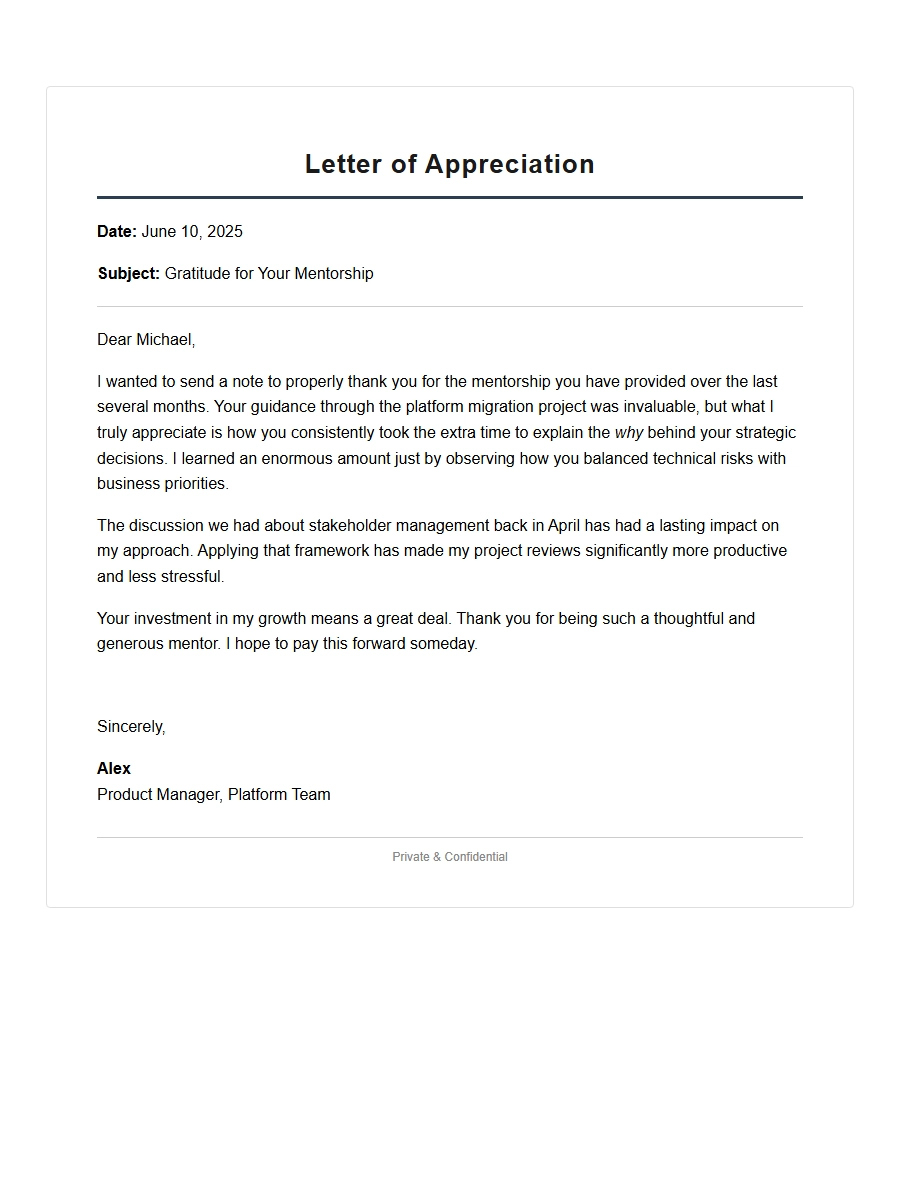 Thanking a Mentor for Guidance: Sample Messages
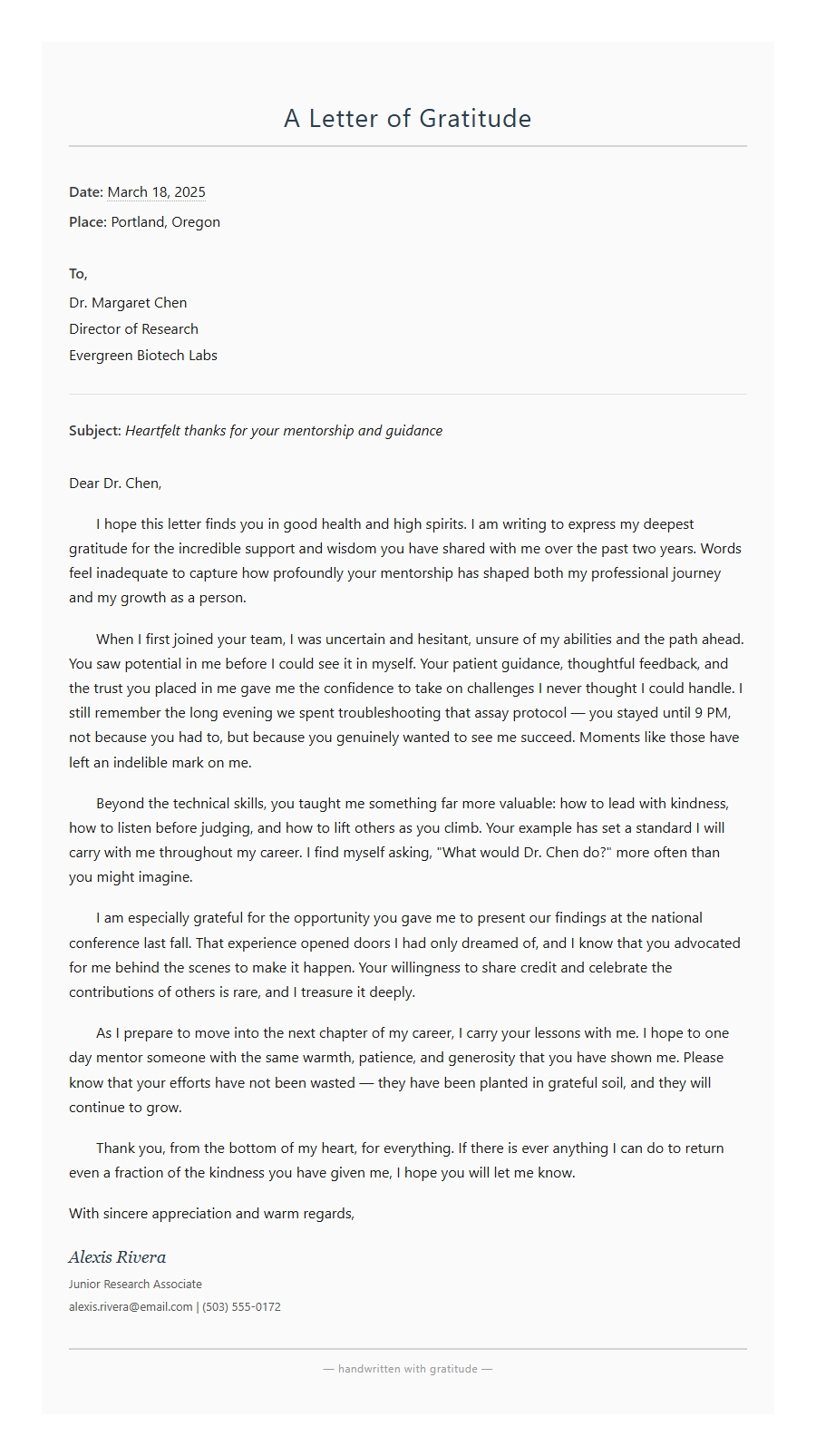 Expressing Gratitude: Handwritten Letter Example
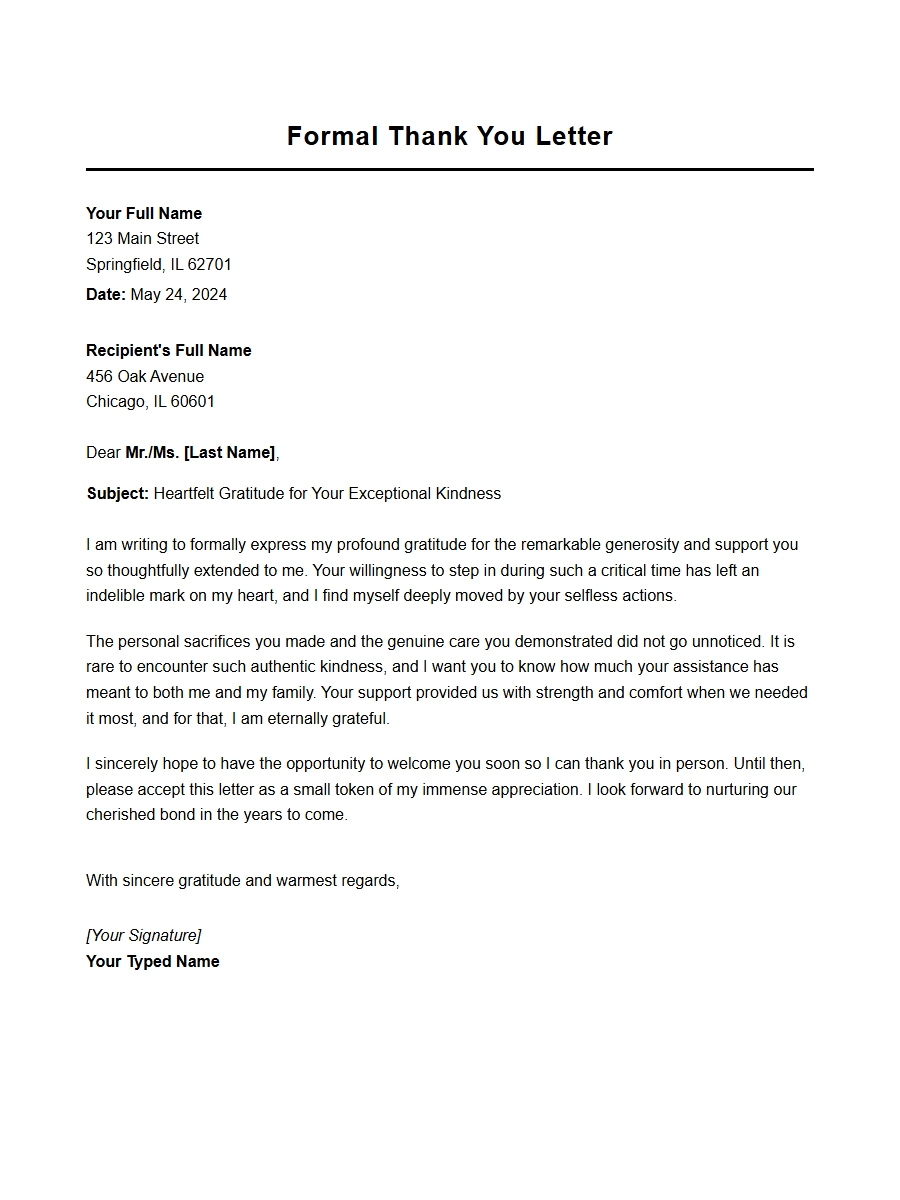 Expressing Thanks in a Formal Personal Letter
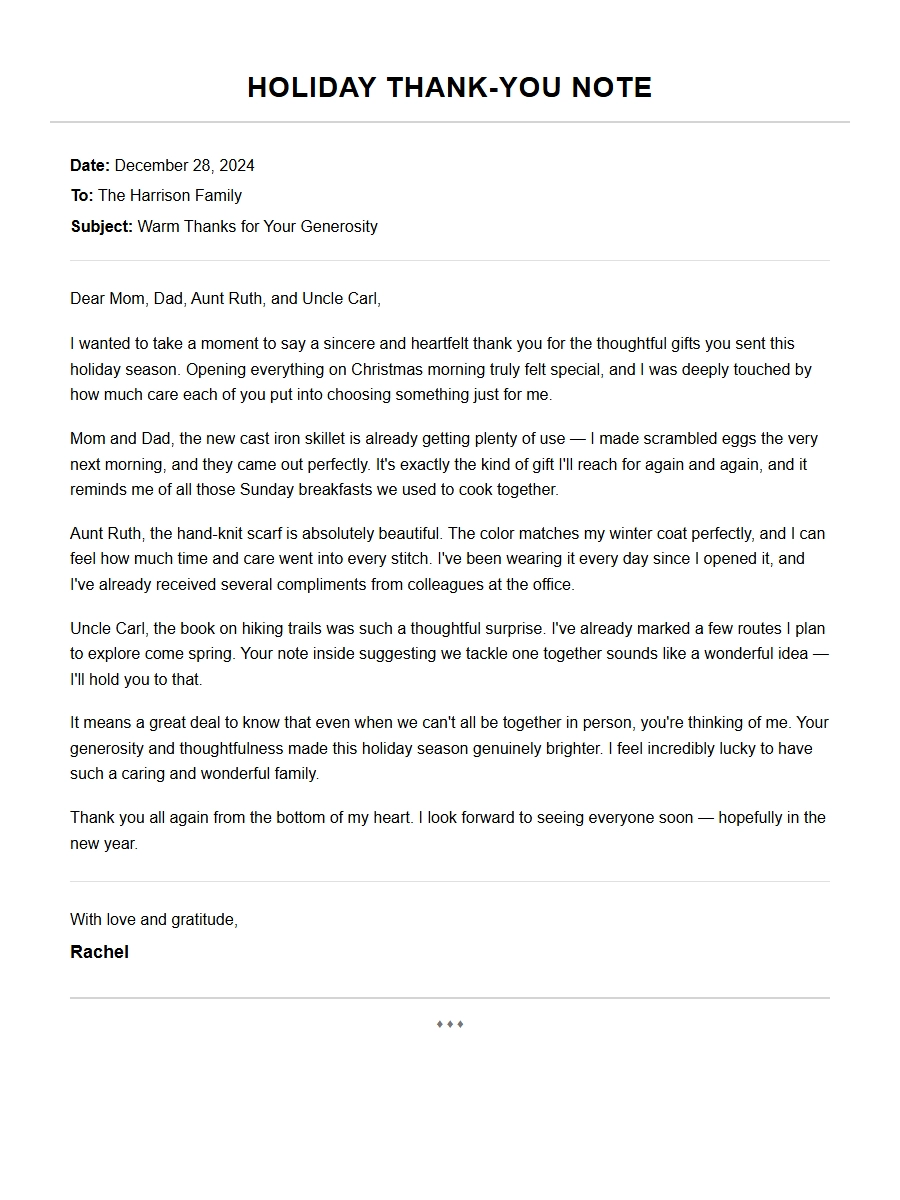 Thank You Letter Examples for Family Holiday Gifts
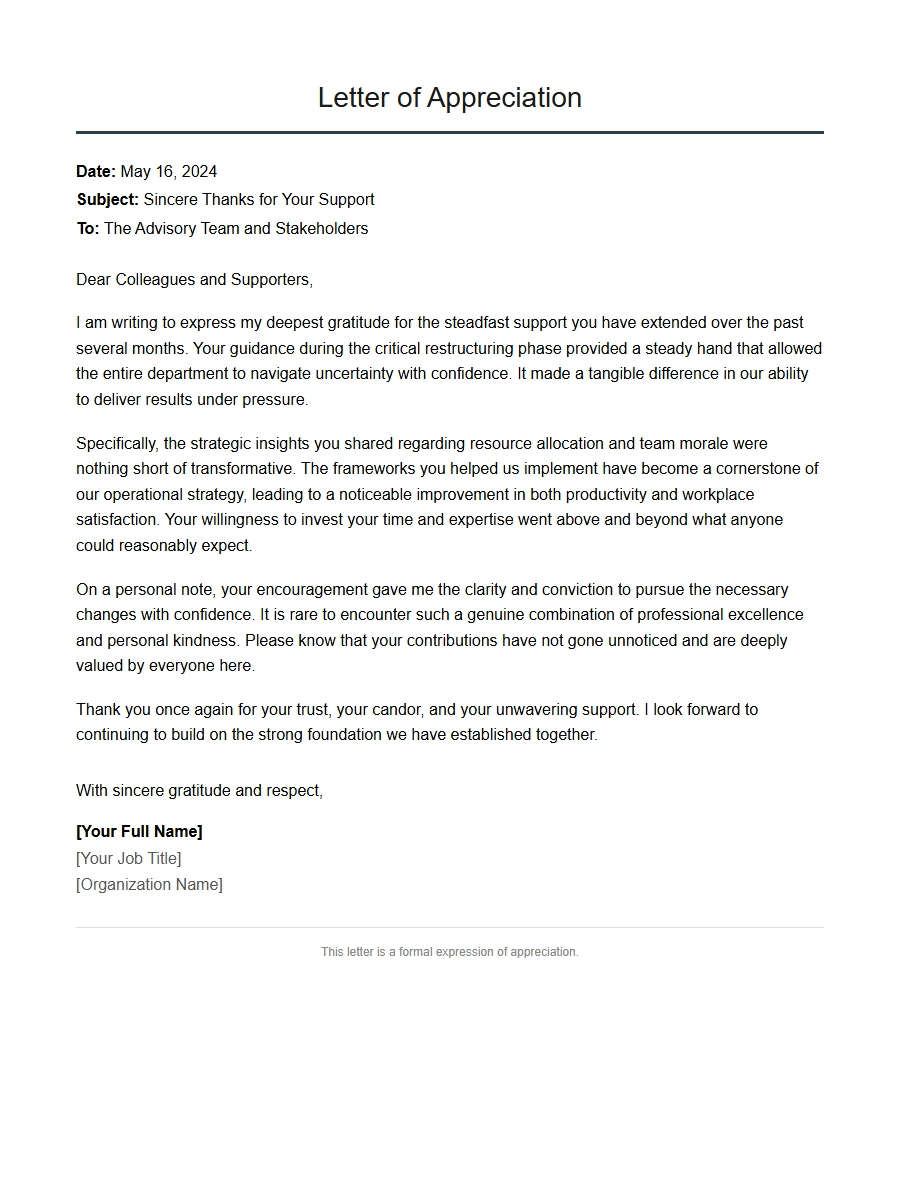 Sample Thank You Letter for Support
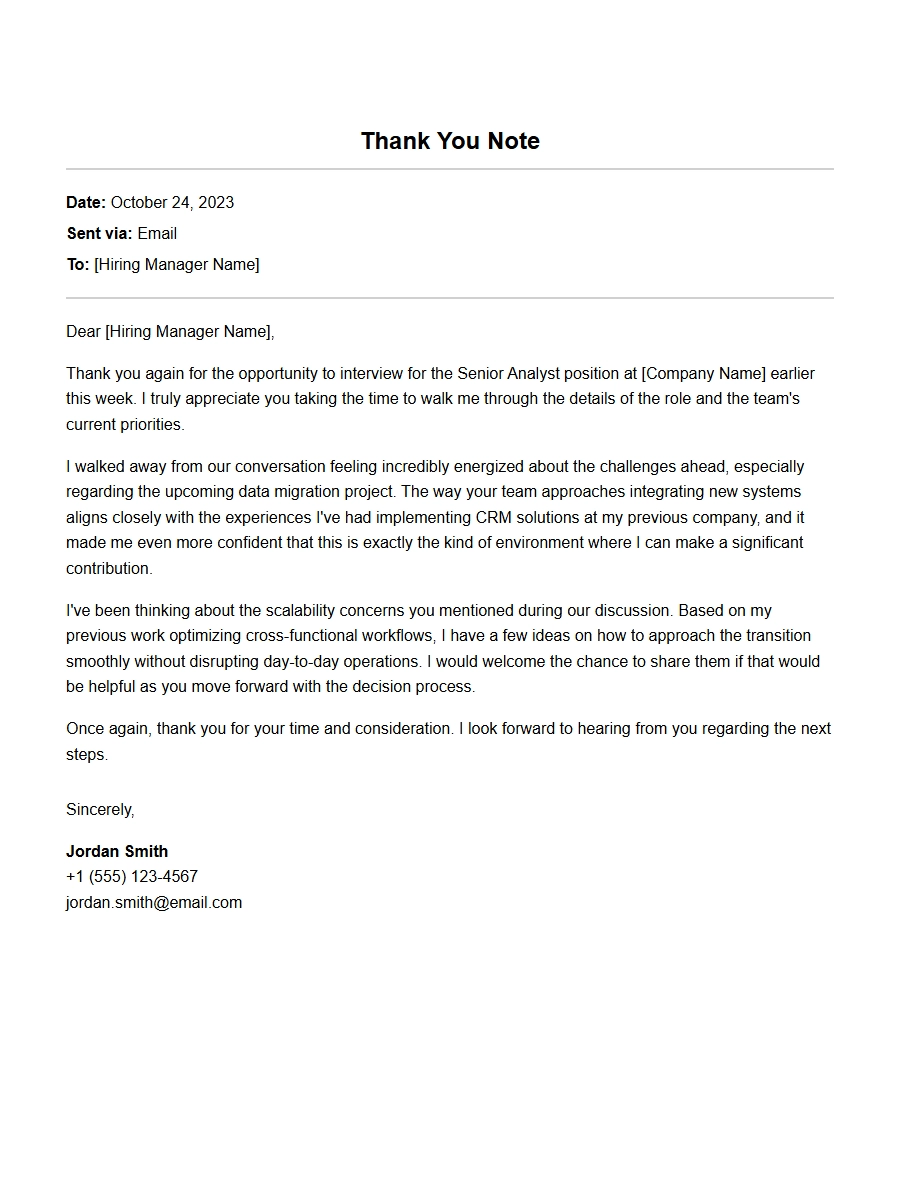 How to Write a Personal Thank-You Note After an Interview