You’ve made a big decision, and now comes the part that feels harder than it should be: telling your manager. You want to leave on good terms, but every draft you start sounds either too cold or too emotional. That blank page is frustrating. Using a resignation letter notice to manager template isn’t cheating—it’s a smart way to get the structure right so you can focus on what actually matters: your tone and your specific reason for leaving.
Why a template works better than writing from scratch
A good letter template gives you a framework. It handles the tricky parts of professional correspondence like the salutation and closing, so you don’t accidentally sound rude or forget a key detail. Think of it as a map. You still need to drive the car. The template shows you the letter structure, but you fill in the lane changes—your relationship with your boss, the project you’re handing off, the notice period you’ve agreed on.
Ever received a letter that felt too stiff or too casual? That’s where tone in writing matters most. A template helps you land somewhere in the middle: professional but human. It keeps you from accidentally using outdated phrases like “please accept this letter as formal notification” when a simple “I’m writing to let you know I’ll be resigning” sounds more natural and respectful.
How to pick the right sample for your situation
Not all resignation letters are the same. If you work in a very formal industry like law or finance, you’ll want a sample that uses traditional business letter format and includes your full address. If you’re in a startup or creative field, a shorter, email-style version works better. Look for a resignation letter sample that matches your workplace culture. That’s step one.
Step two is reading the sample out loud. Does it sound like something you would actually say? If not, tweak the language. Customizable letter templates are best because they let you swap out stiff phrases for your own words. For example, change “I have decided to pursue other opportunities” to “I’ve accepted a role that’s closer to my family” if that’s the truth. Honesty builds trust, and your manager will remember that more than a perfect sentence.
Common mistakes that hurt your message
The biggest mistake people make is copying the sample word-for-word without adapting it. That’s how you end up with a letter that sounds like everyone else’s. Another common error is ignoring the format. If you’re sending an email, you don’t need a letterhead design or a full address block. Just a clear subject line, a polite greeting, and your message. If you’re printing it, then yes, use a standard digital letter format with your contact info at the top.
Watch out for outdated salutations. “To whom it may concern” feels cold and impersonal when you’re writing to someone you’ve worked with closely. Use your manager’s name. And always, always proofread your letter before sending. A typo in a resignation letter can make you look careless on your way out. Read it twice. Once for content, once for mistakes.
Also note the difference between a resignation letter and other types of professional correspondence. You’re not asking for a favor or writing a letter of recommendation here. You’re announcing a decision. Keep the focus on your transition, not on complaints or lengthy explanations. Short and respectful is better.
Using a template has a hidden benefit
When you use a letter template, you naturally pay attention to letter writing etiquette. That means you remember to thank your manager for specific opportunities, mention a transition plan, and offer to help during the notice period. These small gestures leave a strong impression. Even if you’re leaving because you’re unhappy, a graceful exit keeps the door open for future connections.
For example, you can model the tone after other positive professional correspondence you’ve received. Think about how you’d write a thank-you note after a dinner party—grateful, specific, and warm. A resignation letter works the same way. You’re thanking them for the job, not just leaving.
If this is your first time writing a resignation letter or if you’re also working on a feedback submission or another professional note, keep the same mindset. Be clear. Be respectful. And let your personality come through.
Putting it all together
Start with a template, but make it yours. Open with a direct statement of resignation. Add a line of thanks that feels genuine. Mention your last working day. Offer to help with the transition. Close with goodwill and your signature. That’s it. No drama. No over-explaining. If you need to acknowledge a difficult situation, you can draw from the same approach you’d use when acknowledging a mistake in a personal note—honest, brief, and forward-looking.
After you send it, give your manager space to react. They might ask questions or want to talk. That’s normal. The letter is just the start of the conversation. If you need to follow up later with something more personal, you might find yourself writing a note that feels closer to a simple thank-you than a formal document. That’s okay.
One last thing: keep a copy for yourself. You’ll want to remember how you handled this transition professionally. And if you’re ever asked for a reference or a favor down the road, having a record of your graceful exit helps. Use the sample as a springboard, not a crutch. Practice makes the process faster. Next time you resign, you’ll know exactly what to say.
The best letters feel professional and personal at the same time. You can do both. Start with the template. Then write like yourself.
Useful Formats
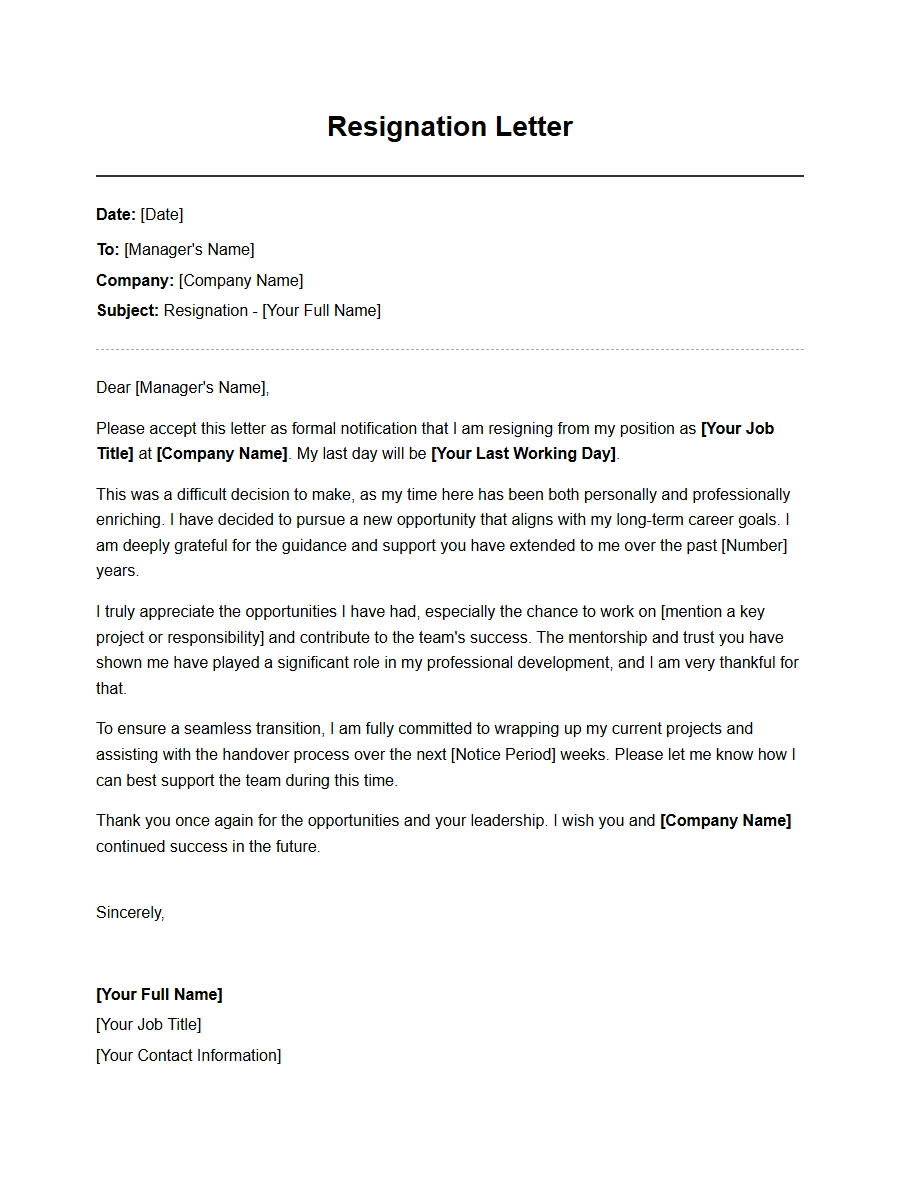
Notice to Manager Resignation Template
Standard Two-Week Notice
Dear [Manager Name],
Please accept this letter as formal notification that I am resigning from my position as [Your Job Title] at [Company Name]. My last day of work will be [Date: two weeks from today].
I am grateful for the opportunities I have had during my time here, especially the chance to work on [mention a specific project or skill]. To ensure a smooth transition, I will complete my current tasks and assist in training any replacement as needed.
I have prepared a list of my ongoing responsibilities and key contacts:
Finalize the [Project Name] report by end of this week.
Document standard operating procedures for [Process].
Introduce [Colleague Name] to all active client accounts.
Thank you for your leadership and support. I wish the company continued success.
Sincerely, [Your Name]
Short Notice Due to Personal Emergency
Dear [Manager Name],
I regret to inform you that I must resign from my position at [Company Name] effective immediately due to an unforeseen personal emergency. My last day will be [Date].
This decision was not easy, but I need to focus on resolving the urgent matter at home. I apologize for the short notice and any inconvenience this may cause.
To help with the transition, I have outlined key points for my successor:
All active files are stored in the [Shared Drive] under my name.
Weekly reports for [Client] are due every Friday.
The login credentials for [System] are with [IT Support].
I hope to stay in touch once my situation stabilizes. Thank you for your understanding.
Best regards, [Your Name]
Resignation for Better Opportunity
Dear [Manager Name],
I am writing to formally resign from my role as [Your Job Title] at [Company Name], effective [Date: two weeks from today].
After careful consideration, I have decided to accept an offer that aligns with my long-term career goals. I am deeply grateful for the mentorship and experiences I gained here, particularly in [specific area].
I remain committed to ensuring a seamless handover. Below is a table of my current tasks and transition plan:
Task
Status
Handover To
Q3 Budget Report
In progress
[Finance Team]
Client Onboarding
Complete
[Colleague Name]
Inventory Audit
Scheduled for next week
[Assistant Manager]
I hope our paths cross again. Thank you for everything.
Yours sincerely, [Your Name]
Resignation Due to Relocation
Dear [Manager Name],
Please accept this letter as my resignation from [Company Name]. My family and I are relocating to [City, State] at the end of [Month], and I must step down from my position. My final day will be [Date].
Working here has been a wonderful experience. I especially appreciate the flexibility you provided when I needed to adjust my schedule. To make the transition smooth, I will:
Complete all pending assignments by [Date].
Update the shared project tracker with notes on each task.
Schedule a meeting with [Team Lead] to transfer knowledge.
I would be happy to assist remotely during the first week after my departure if needed. Please let me know the best way to proceed with the exit formalities.
Thank you for your understanding and support.
Sincerely, [Your Name]
Resignation for Family Reasons
Dear [Manager Name],
I am writing to respectfully resign from my position at [Company Name], effective [Date: two weeks from today].
Due to increased family responsibilities, I need to dedicate more time to caring for my [elderly parent / young child]. This has been a difficult decision, as I truly value my work here.
I will do my best to ensure continuity. Here is a summary of unfinished work:
Project
Phase
Next Steps
Website Redesign
Wireframing
Review with UX team
Vendor Contract
Negotiation
Send final draft
I hope to return to the workforce soon. Thank you for the kindness you have shown me.
Warm regards, [Your Name]
Resignation Due to Health Issues
Dear [Manager Name],
I regret to inform you that I must resign from my role at [Company Name] due to ongoing health concerns. My last day of work will be [Date].
After consulting with my doctor, I need to prioritize my recovery and reduce stress. This decision was not made lightly, as I have enjoyed working with the team immensely.
To facilitate a smooth handover, I have prepared a detailed document of my daily responsibilities. I have also arranged the following:
All important files are in the Handover folder on the shared drive.
I will be available by email for two weeks after my departure for urgent questions.
I have briefed [Colleague Name] on ongoing client needs.
Thank you for your understanding and for the accommodations you provided earlier. I wish the company the best.
Best wishes, [Your Name]
Immediate Resignation Letter
Dear [Manager Name],
Please accept this as my immediate resignation from [Company Name]. Due to circumstances beyond my control, I must leave today, [Current Date].
I apologize for the lack of notice. I have compiled a quick-reference list to help minimize disruption:
My pending tasks are listed on the whiteboard in my cubicle.
Access credentials for [Database] are with the IT department.
Weekly reports for this week are already submitted.
Contact [Backup Person] for client escalation.
I will return my laptop and badge to HR by the end of the day. Please let me know if there is any additional paperwork needed.
Thank you for the opportunities I had during my employment.
Sincerely, [Your Name]
Retirement Resignation
Dear [Manager Name],
After many fulfilling years at [Company Name], I have decided to retire. My last day of employment will be [Date: 30 days from now].
It has been an honor to contribute to the company's growth and to work alongside such talented colleagues. I am particularly proud of [mention a major achievement].
To ensure a smooth transition, I have arranged the following handover meetings:
Week 1-2: Document all processes and share with [Successor Name].
Week 3: Train successor on key accounts and software.
Week 4: Final review and farewell.
I also have prepared a transition checklist on the company portal. Thank you for your guidance over the years. I look forward to staying in touch as an alumni.
Respectfully, [Your Name]
Resignation with Gratitude and Notice Period Table
Dear [Manager Name],
I am writing to formally resign from my position as [Your Job Title] at [Company Name], effective [Date: four weeks from today].
I cannot thank you enough for the mentorship and growth opportunities you provided. Working on [Project Name] was particularly rewarding. I leave with great memories and skills.
To make the transition seamless, I propose the following notice period schedule:
Week
Focus
Deliverables
1
Documentation & Knowledge Transfer
User guides, SOP updates
2
Training Replacement
Shadowing sessions, Q&A
3
Finalize Ongoing Projects
Close tickets, status reports
4
Handover & Exit
Return assets, exit interview
I am committed to meeting all deadlines during this period. Thank you again for the journey.
With appreciation, [Your Name]
Resignation After Probation Period
Dear [Manager Name],
I am writing to resign from my probationary role as [Your Job Title] at [Company Name]. My last day will be [Date: one week from today], in accordance with the probation notice clause.
After careful reflection, I have realized that this role is not the best fit for my skills and career aspirations. I want to be honest and allow the company to find a more suitable candidate quickly.
During my notice period, I will:
Complete the onboarding checklist for new hires.
Return all company property (laptop, keys, badge).
Provide feedback on my experience in the exit interview.
I appreciate the time and resources invested in my training. I wish the team continued success.
 Thanking a Mentor for Guidance: Sample Messages
 Expressing Gratitude: Handwritten Letter Example
 Expressing Thanks in a Formal Personal Letter
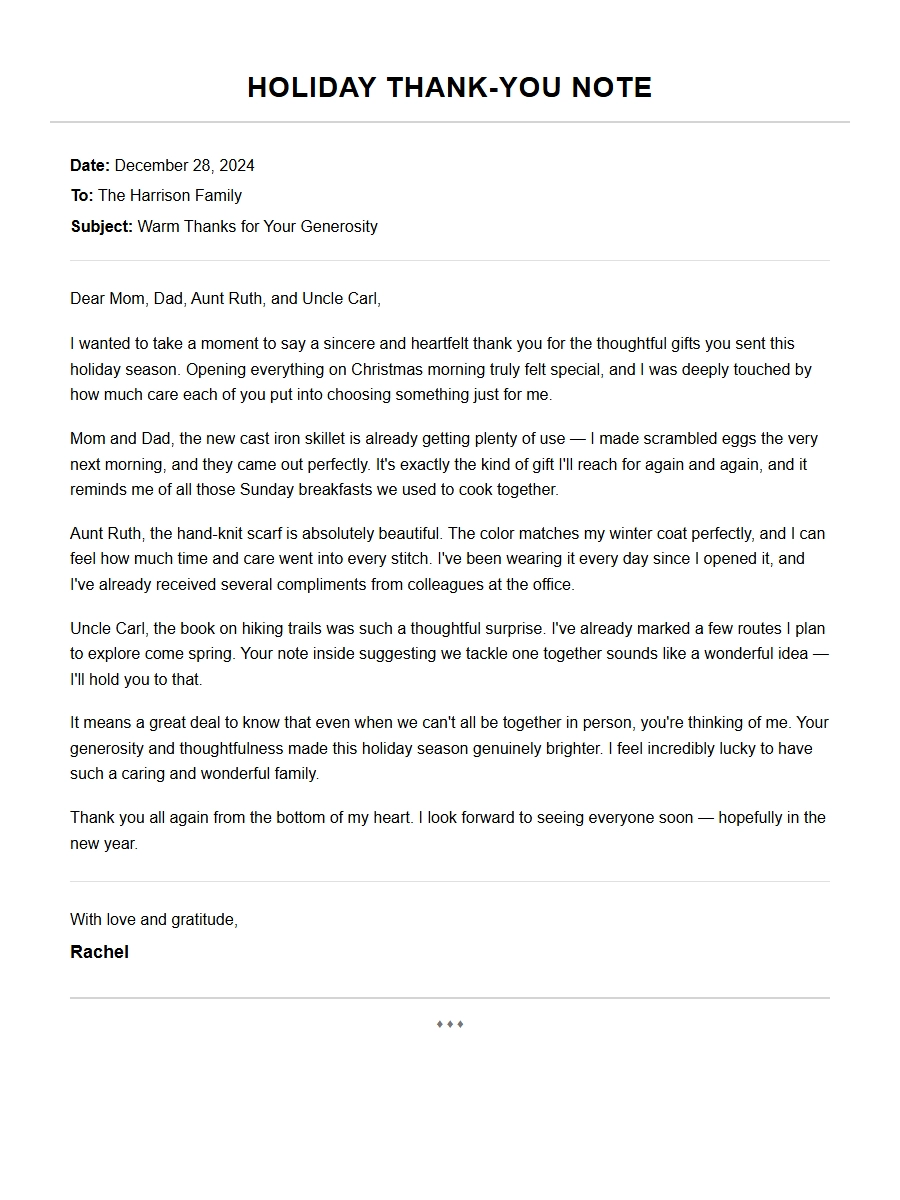 Thank You Letter Examples for Family Holiday Gifts
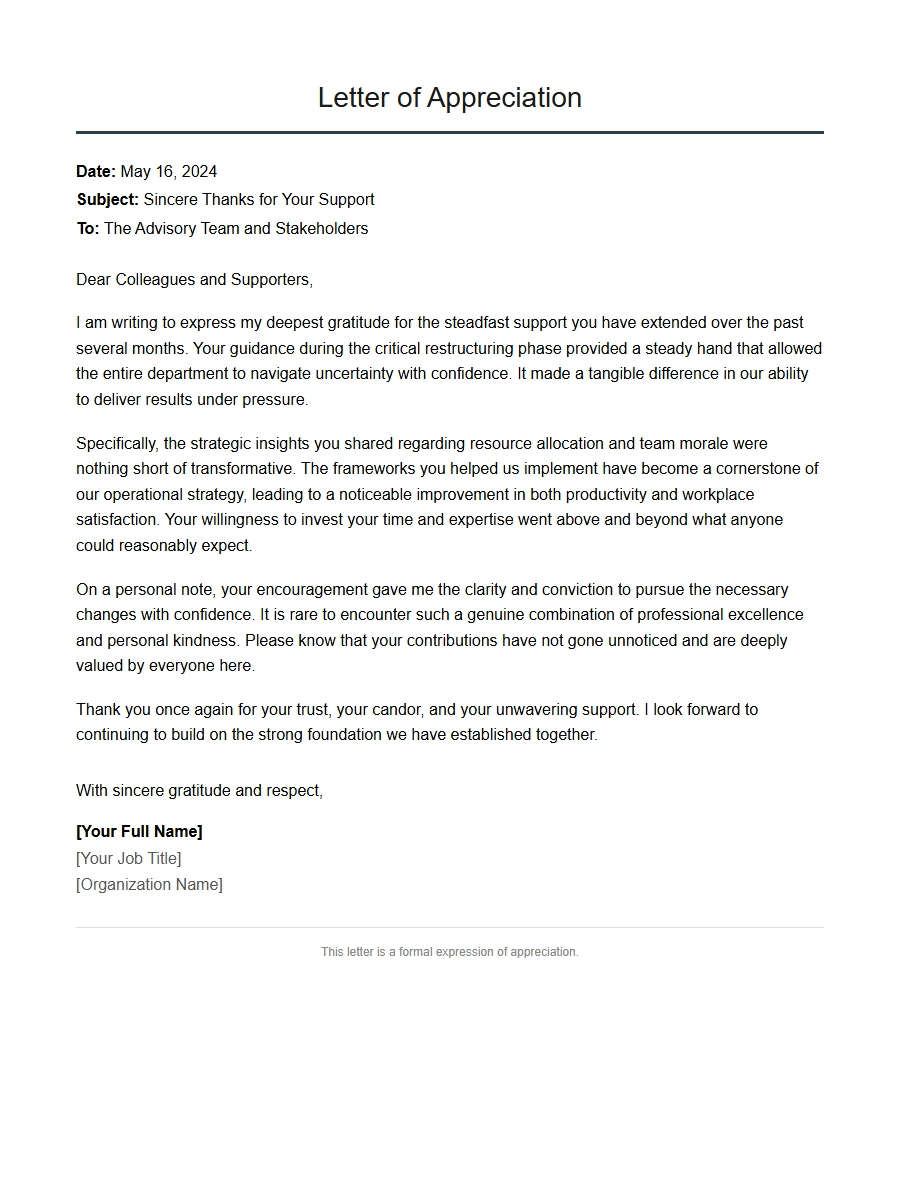 Sample Thank You Letter for Support
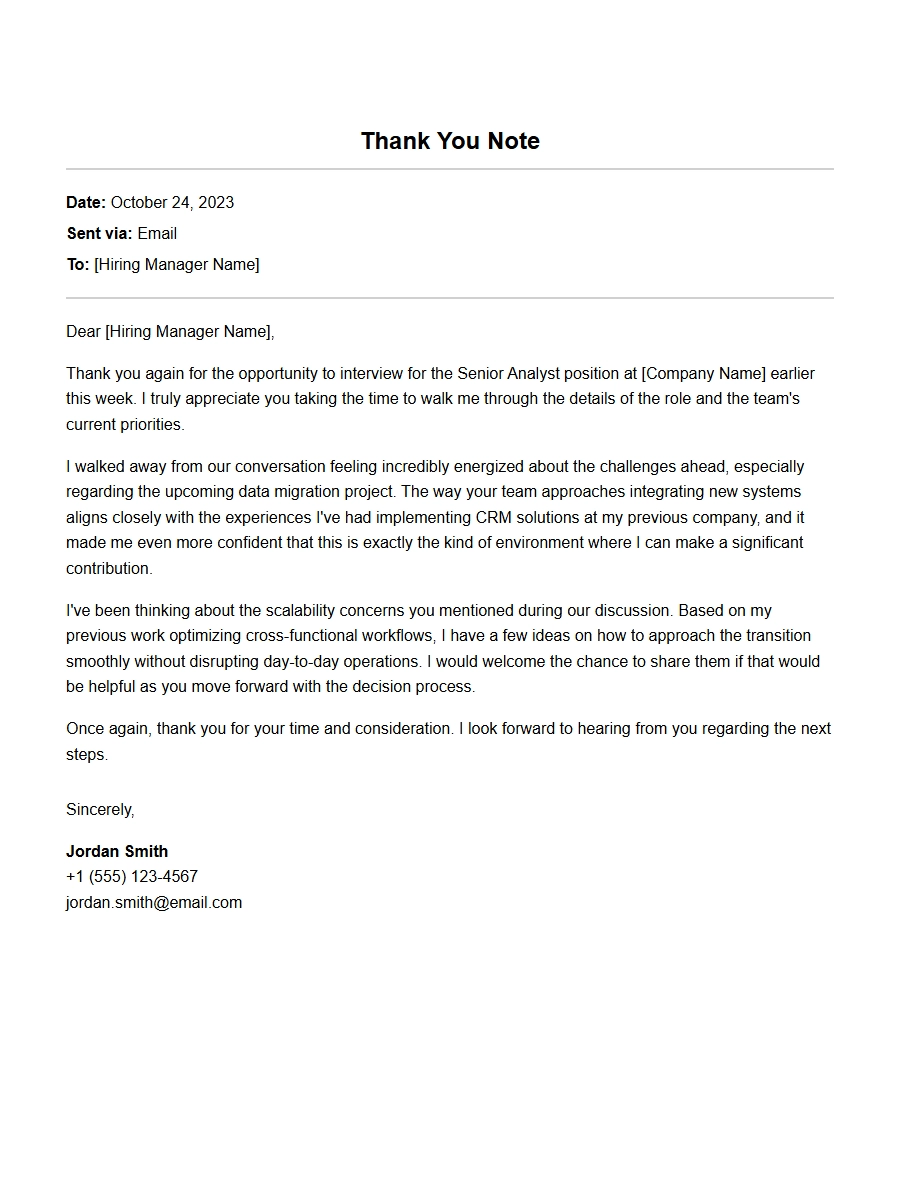 How to Write a Personal Thank-You Note After an Interview