escalation email to senior management regarding misconduct - Complaint Letters
You’ve seen something wrong—maybe a colleague crossed a line, a manager ignored a policy, or a pattern of behavior that needs to stop. Now you need to write an escalation email to senior management regarding misconduct. It’s a tightrope: you want to be clear and firm without sounding accusatory or emotional. The blank email field stares back at you, and the pressure to get it right can freeze even experienced professionals.
Here’s the truth: using a sample isn’t cheating. It’s a smart shortcut. A good letter template gives you the structure you need—where to put the subject line, how to open, what to include in the body, and how to close. It also keeps your tone professional while leaving room for your own voice. You’re not copying; you’re adapting. Think of it as borrowing a proven framework so you can focus on the facts, the impact, and what you’re asking for.
Category: Workplace Conduct and Escalation
Before you start typing, ask yourself: is this email for an internal investigation, a formal complaint, or a request for action? The answer shapes your tone. For misconduct, you want professional correspondence that is direct but measured. Avoid overly emotional language like “I’m furious” or vague phrases like “something should be done.” Instead, stick to what happened, when, and why it matters to the organization.
Let’s walk through how to build an escalation email that works. First, the subject line. Don’t bury the lead. Something like “Urgent: Report of Misconduct in [Department]” or “Escalation: Concerns Regarding [Name/Incident]” gives senior management immediate context. Next, the opening line. Start with a concise summary: “I am writing to escalate a serious concern regarding…” Then state your relationship to the issue—were you a witness, the target, or someone who learned of it secondhand? That establishes credibility.
The body is where you lay out the facts. Use a neutral, chronological style. For example: “On [date], I observed [specific action] during [meeting/event]. This violates [policy or code of conduct] because…” Attach any supporting documents like emails, photos, or reports. If you’ve already spoken to a lower-level manager, mention that—it shows you followed proper channels before going up.
One common mistake in formal writing tips is using outdated salutations. In an email to senior management, “Dear [Name]” is fine if you know who you’re writing to. If not, use “Dear [Title]” or “Dear Senior Leadership Team.” Never use “To Whom It May Concern” in an escalation—it feels too generic and impersonal. Also, remember that an email is not a printed letter. Keep your paragraphs short, use whitespace, and include a clear subject line. Avoid long attached files unless necessary; paste key evidence directly into the body if possible.
Tailoring the sample means matching your authentic voice to the seriousness of the situation. If you’re naturally direct, don’t pad it with fluff. If you’re more diplomatic, that’s okay too—just don’t soften the facts. For instance, instead of “There may have been a misunderstanding,” say “The behavior directly contravenes our harassment policy.” The senior team needs to feel the urgency without hyperbole.
Now, about tone. You don’t want to sound robotic or overly angry. Read your draft aloud. Does it sound like you? If a colleague read it, would they believe it came from you? That’s the sweet spot. After writing, always step away for an hour and then proofread. Check for typos, missing dates, or unclear pronouns (“he” vs “she”). A small error can undermine your credibility. Use a spell-checker, but also read it backward to catch missing words.
What if you’re unsure whether to send the email at all? That’s normal. But remember, escalation emails exist because some issues cannot be resolved at lower levels. If you’ve tried the chain of command and nothing changed, senior management needs to know. Your email becomes a record. For similar situations, you might also look at how to handle a complaint regarding rental property maintenance delays or other formal letters—the structure of documenting facts and expectations translates well.
Another angle: the closing. State clearly what you want. “I request a formal investigation” or “Please advise on next steps.” End with a thank you and your full name and contact information. Avoid “I hope this isn’t too much trouble.” You’re not asking a favor; you’re fulfilling a responsibility.
The best escalation emails feel both professional and personal. They show you care about the organization’s values and that you’re willing to stand up for what’s right. Use the sample as a springboard—not a crutch. With a little practice, you’ll find your own rhythm. And next time you face a blank email, it won’t feel so paralyzing.
Simple Examples
escalation email to senior management regarding misconduct - Complaint Letters
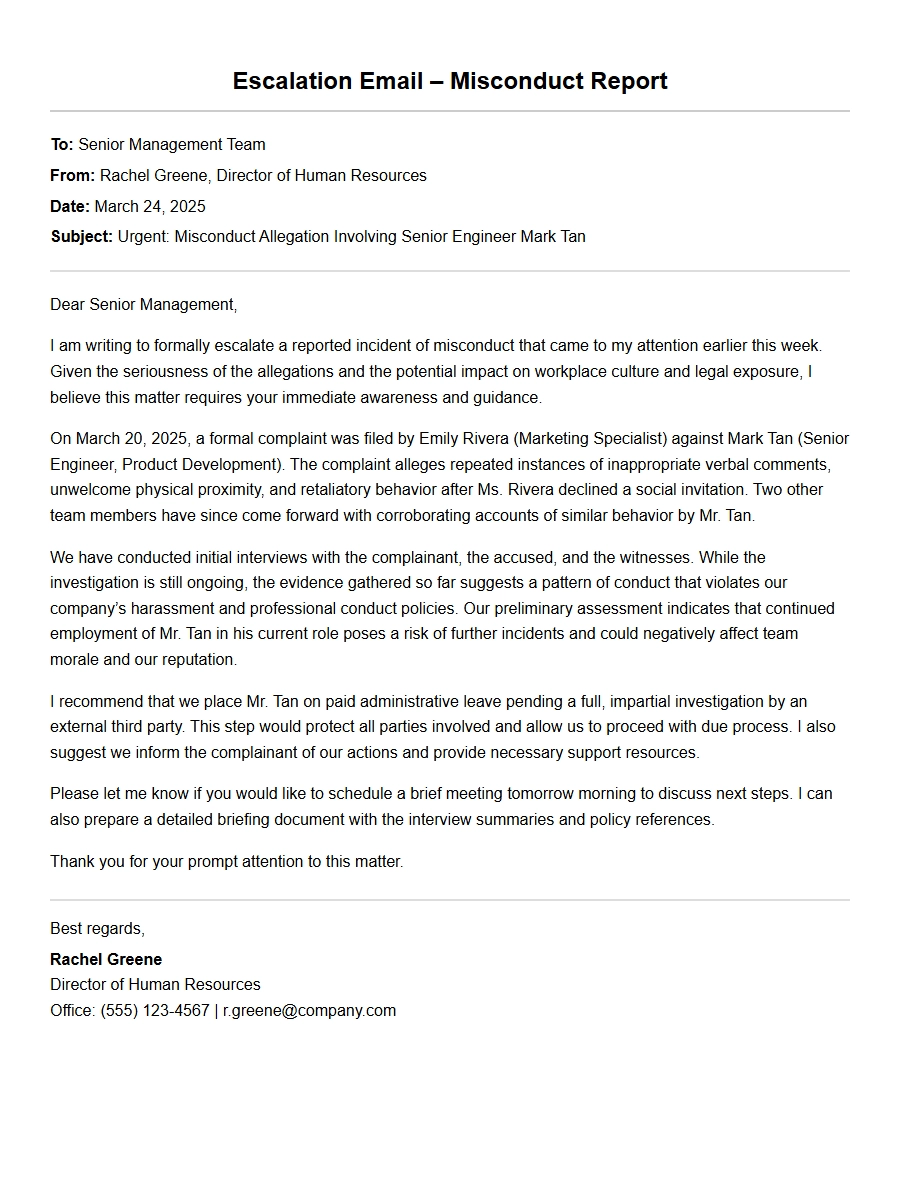
Formal Escalation: Harassment by Department Manager
To: Senior Management & HR Director From: Jane Doe, Senior Analyst Date: March 10, 2025 Subject: Urgent Escalation – Ongoing Harassment by Manager, Mark Stevens
I am formally escalating a serious misconduct issue. For the past three months, my direct manager, Mark Stevens (Marketing Dept), has subjected me and several colleagues to persistent verbal harassment, including derogatory comments and public belittling. Despite raising this informally with HR twice (on Jan 15 and Feb 20), no corrective action was taken.
Key incidents requiring immediate attention:
Jan 12: Mr. Stevens told me in a team meeting that my ideas were “worthless” and “a waste of company time.”
Feb 5: He sent an email copying the entire department mocking my presentation style.
Mar 2: He physically blocked my exit from a conference room and raised his voice, causing me to feel threatened.
Impact: I have taken two sick days due to stress, and three other team members have privately shared similar experiences.
Requested action: Please initiate an independent investigation immediately and place Mr. Stevens on administrative leave pending findings. I am prepared to provide written witness statements.
Escalation: Suspected Financial Misconduct by Senior Accountant
To: CFO & CEO From: Alex Chen, Internal Audit Date: April 2, 2025 Subject: Escalation – Irregular Transactions by Sarah Lee, Senior Accountant
I am escalating a serious breach of financial controls. During a routine audit of Q1 2025 expenses, I identified a pattern of unauthorized payments totalling $47,000 to a vendor named “DataSync Solutions” which does not appear on our approved vendor list.
Summary of irregularities (Jan–Mar 2025):
Date
Amount
Invoice #
Approved By
Jan 18
$12,500
DS-104
Sarah Lee
Feb 14
$15,000
DS-209
Sarah Lee
Mar 22
$19,500
DS-315
Sarah Lee
All payments were processed without the required dual approval. I have cross-referenced with the procurement team: “DataSync Solutions” is not registered in our system. When I confronted Ms. Lee informally, she became defensive and refused to explain.
Request: Please freeze these payments and launch a formal forensic investigation. I also recommend suspending Ms. Lee’s access to the payment system.
Escalation: Director’s Ethics Violation – Conflict of Interest
To: Board of Directors & General Counsel From: Maria Torres, Compliance Officer Date: May 15, 2025 Subject: Urgent Escalation – Director James Walker’s Conflict of Interest with Vendor ‘NexGen’
I am compelled to escalate a clear ethics violation. Director James Walker failed to disclose that his brother-in-law, Robert Kim, is the CEO of NexGen, a vendor awarded a $2.3M contract in December 2024. I have obtained the following evidence:
NexGen’s winning bid was 22% higher than the next lowest qualified bidder.
Mr. Walker chaired the procurement committee but did not recuse himself.
He omitted the relationship from his annual conflict-of-interest disclosure.
Actions taken so far: I raised this with Mr. Walker privately on May 2. He dismissed my concerns and warned me not to “overstep.” I then reported to the CEO, who has taken no visible action for two weeks.
Required escalation: I request that the Board’s Ethics Committee investigate immediately. I also recommend that the NexGen contract be suspended pending review, and that Mr. Walker be placed on leave to prevent any interference.
Escalation: Repeated Policy Breaches by Vice President
To: Chief Operating Officer & HR VP From: Chris Park, Operations Manager Date: June 8, 2025 Subject: Escalation – VP David Huang Violating Remote Work Policy & Overtime Rules
I am escalating a pattern of policy non-compliance by VP David Huang (Sales). Despite multiple warnings, he continues to:
Allow his entire team to work remotely without prior approval (policy requires VP sign-off, which he grants arbitrarily).
Authorize overtime for non-exempt employees without pre-funding via the proper system.
Ignore the mandatory weekly attendance reporting process.
Record of previous escalations:
Written warning from HR on Feb 10, 2025 – no change.
My direct email to Mr. Huang on March 22 requesting compliance – he replied “I know what’s best for my team.”
Second HR warning on May 1 – he skipped the subsequent compliance training.
Impact: His team’s overtime costs exceeded budget by $34K in Q2. Other VPs now complain of unfair treatment. This is a liability exposure.
Requested action: I request a formal disciplinary hearing and that Mr. Huang’s autonomy to override policies be temporarily revoked.
To: Senior Management & Safety Director From: Anita Rao, Floor Supervisor Date: July 12, 2025 Subject: Escalation – Repeated Safety Violations by Plant Manager, Tom Barlow
I am escalating a dangerous situation. Plant Manager Tom Barlow has consistently ignored my hazard reports about malfunctioning conveyor belts in Building 3. I filed three reports (May 5, May 28, June 15) identifying frayed cables and irregular stopping. Mr. Barlow told me to “stop making trouble” and refused to issue a shutdown order.
What happened since:
On June 30, a worker (Elena Santos) narrowly avoided injury when a cable snapped.
I emailed Mr. Barlow again that day, but he only replied “schedule maintenance for next quarter.”
Relevant safety log extracts:
Date Reported
Issue
Manager Response
May 5
Frayed cable, conveyor #3
“Not a priority”
May 28
Conveyor jams intermittently
“It’s fine”
Jun 15
Emergency stop button missing
“Ordered part, no ETA”
This is now a serious OSHA risk. I request an immediate safety audit and that Mr. Barlow be removed from oversight of Building 3 until he completes mandatory safety training.
Escalation: Data Breach Due To Negligence by IT Manager
To: Chief Information Officer & General Counsel From: Lisa Zhang, Data Protection Officer Date: August 20, 2025 Subject: Escalation – IT Manager Ken Russell’s Failure to Secure Customer Database
I am escalating a severe data protection breach caused by IT Manager Ken Russell’s negligence. On August 10, it was discovered that a database containing 15,000 customer records (including names, addresses, and credit card numbers) was accessible via a public IP address for at least 30 days.
Key facts:
Mr. Russell was personally responsible for the firewall configuration after a migration on July 5.
I flagged the vulnerability in a routine audit on July 20 – he dismissed it as “low risk” and took no action.
The vulnerability was exploited (we believe by an external scanner), and data was exfiltrated before we locked it down on August 10.
Regulatory exposure: This breach likely triggers mandatory notification under GDPR and CCPA. We have not yet notified affected customers or regulators.
Recommended actions:
Place Mr. Russell on administrative leave pending investigation.
Initiate a full forensic review of the breach scope.
Engage external legal counsel for notification procedures.
I await your immediate direction.
Escalation: Discrimination by Senior Director – Racist Remarks
To: CEO & Chief Diversity Officer From: Ravi Patel, Product Lead Date: September 5, 2025 Subject: Urgent Escalation – Racist Conduct by Senior Director Elaine Grant
I am formally escalating a case of racial discrimination. Senior Director Elaine Grant (Engineering) has repeatedly made derogatory comments about Asian employees. I have collected witness accounts and written evidence.
Specific incidents:
July 15, during a project review: Ms. Grant said, “I don’t know how you people from India even got engineering degrees.” (Witnessed by 4 team members).
August 3, in an email to her management team (which was forwarded to me): “We need to stop hiring so many Asians – they don’t fit our culture.”
August 28, she blocked my promotion citing “leadership potential concerns” while promoting a less experienced white peer.
Internal attempts: I reported this to HR on September 1. HR gave Ms. Grant a verbal warning. She then retaliated by excluding me from key meetings.
Request: I ask you to launch an independent investigation with an external mediator. I also request that Ms. Grant be removed from any decision-making affecting my career until the investigation concludes.
Escalation: Misuse of Company Resources by Executive
To: Board Audit Committee & CEO From: Samantha Green, Finance Controller Date: October 3, 2025 Subject: Escalation – Executive VP Linda Moore Using Company Funds for Personal Travel
I am escalating a clear misuse of company assets. Executive VP Linda Moore booked a first-class flight to Paris on September 15, claiming it was for a client meeting, but I have evidence that she spent three days sightseeing and only one day at the client site.
Expense report details (submitted Sep 30):
Item
Amount Claimed
Supporting Docs
First-class flights (NYC–CDG)
$8,200
Receipt, no client signature
Hotel (4 nights, Ritz Paris)
$6,400
Receipt, no business purpose noted
Meals & entertainment
$2,100
All restaurant receipts – no client present
When I asked for more details, Ms. Moore told me to “process it anyway” and that she “deserves a break.” I flagged this to the CFO last week, but no action has been taken.
Requested action: Please reverse the reimbursement, charge the personal portion to Ms. Moore, and conduct a review of her travel expenses for the past 12 months. I also recommend a written warning.
Escalation: Fraud by Accounts Payable Clerk
To: Chief Financial Officer & Head of Internal Audit From: Derek Okafor, Senior Accountant Date: November 15, 2025 Subject: Escalation – Suspected Invoice Fraud by Clerk Maria Santos
I am escalating evidence of fraud committed by Accounts Payable Clerk Maria Santos. She has created a shell vendor called “NorthStar Consulting” using a personal Gmail address and approved $28,000 in payments over the past four months.
Evidence summary:
Three invoices (total $28K) were approved by Ms. Santos herself, bypassing the required dual approval.
The invoice addresses match her home address (verified via postal code).
Bank deposits for “NorthStar” go to an account at First Federal Bank – Ms. Santos’s personal bank, according to HR records.
Timeline of payments:
Invoice Date
Vendor
Amount
Approval
Aug 5
NorthStar Consulting
$9,000
M. Santos
Sep 12
NorthStar Consulting
$11,000
M. Santos
Oct 20
NorthStar Consulting
$8,000
M. Santos
I have not confronted Ms. Santos yet to avoid tampering. I ask that you freeze these payments immediately and launch a forensic investigation. I also recommend placing Ms. Santos on leave pending the outcome.
Escalation: Hostile Work Environment Created by Senior Manager
To: VP of Operations & Employee Relations Director From: Diana Reyes, Team Lead Date: December 1, 2025 Subject: Escalation – Senior Manager Paul Jensen’s Bullying and Retaliation
I am escalating a hostile work environment caused by Senior Manager Paul Jensen (Customer Support). Over the last six months, he has publicly humiliated, micromanaged, and retaliated against team members who question him.
Specific examples of misconduct (confirmed by multiple witnesses):
September 15: He screamed at an employee (Tina Wu) in an open office, calling her “incompetent.” Tina filed a complaint and subsequently took stress leave.
October 22: He sent an email to the entire department mocking a junior staffer’s grammar, attaching the original email with red marks.
November 8: After I requested a team meeting to discuss his behavior, he reassigned my team’s best projects to another group and excluded me from strategic meetings.
Actions taken so far: I reported to the HR business partner on November 10. She spoke to Mr. Jensen, but his behavior worsened. Since then, two more team members have requested transfers.
My request: Please conduct a formal investigation using an external neutral party. In the interim, I ask that Mr. Jensen be relocated to a different floor and that all team members be allowed to report directly to another manager.
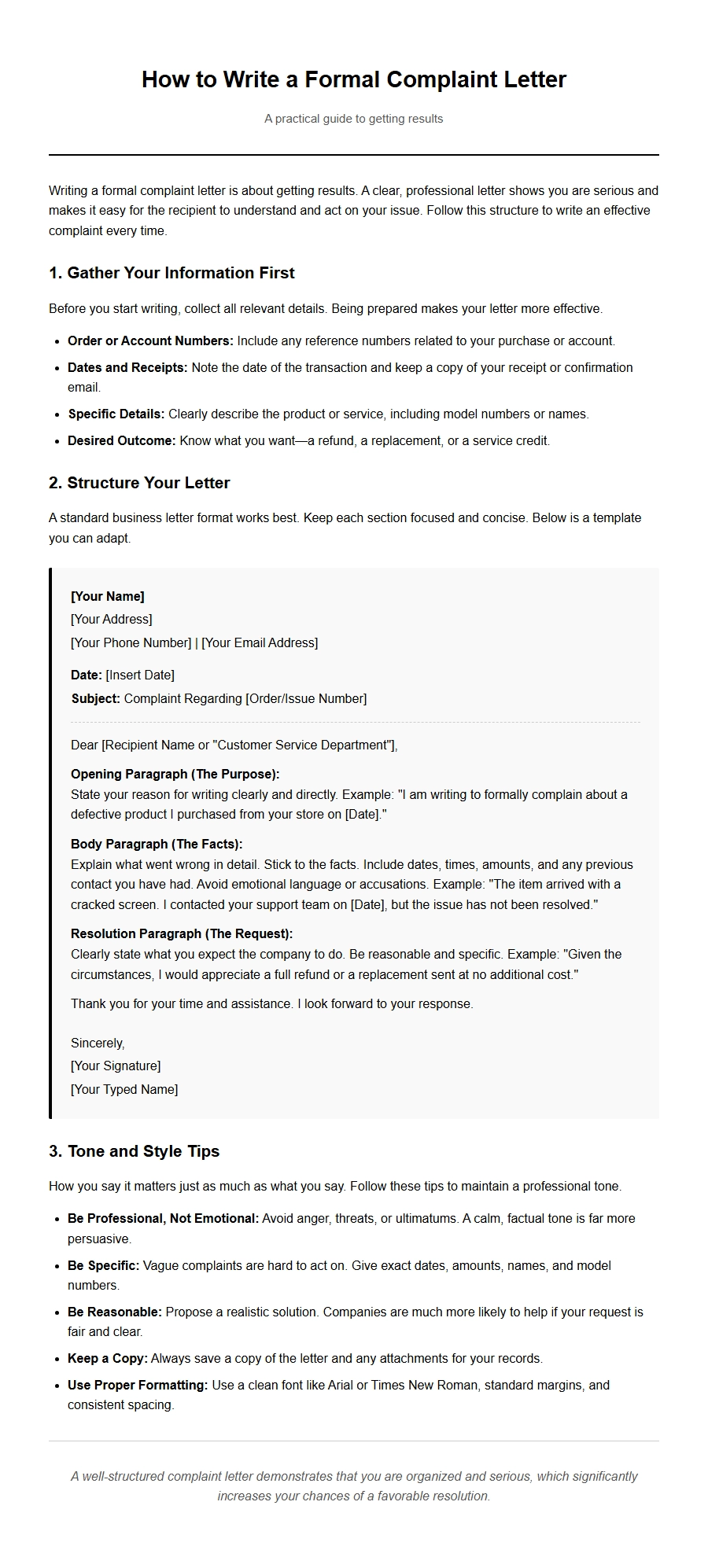 How to Write a Formal Complaint Letter
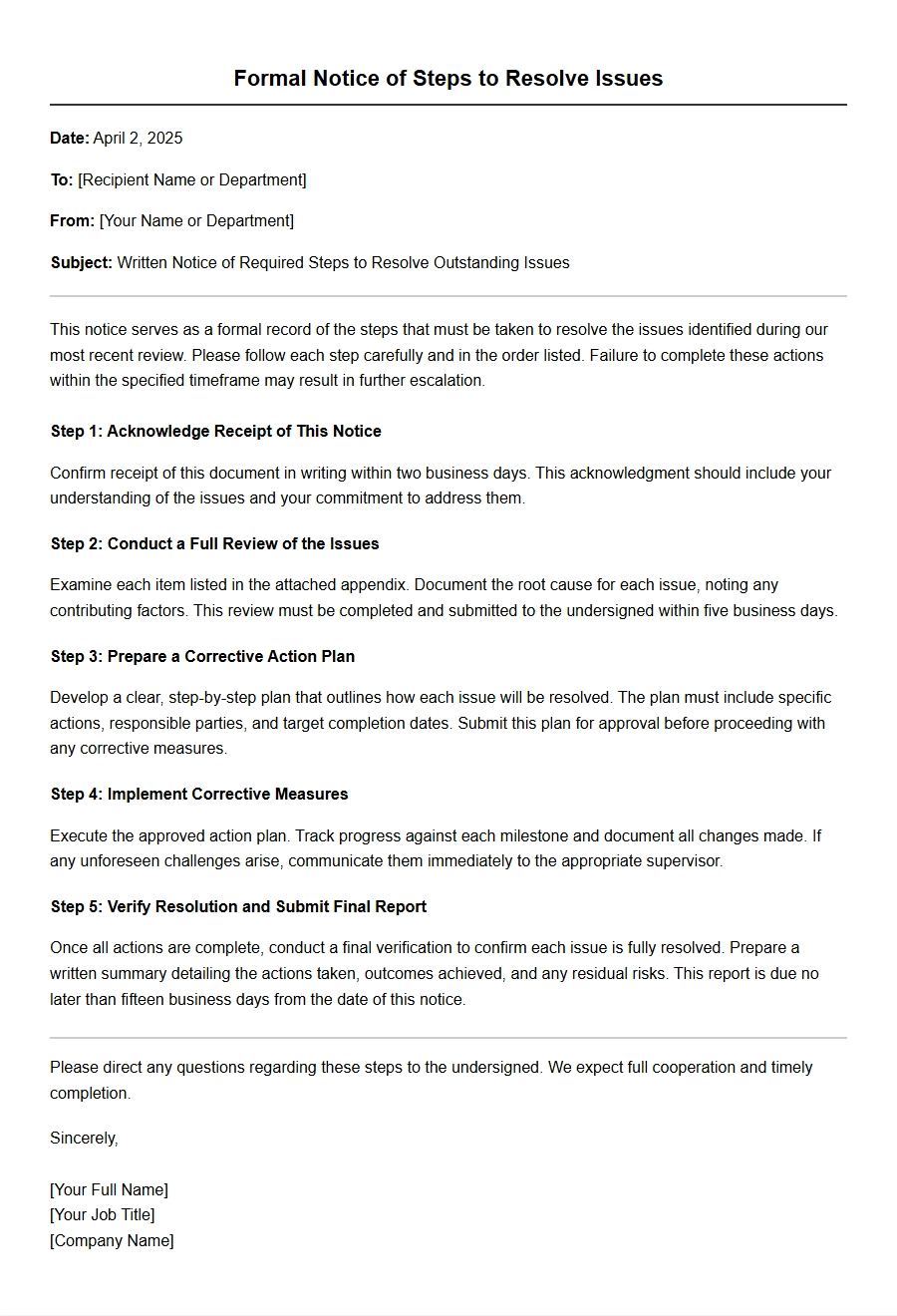 Steps to Resolve Issues via Written Notice
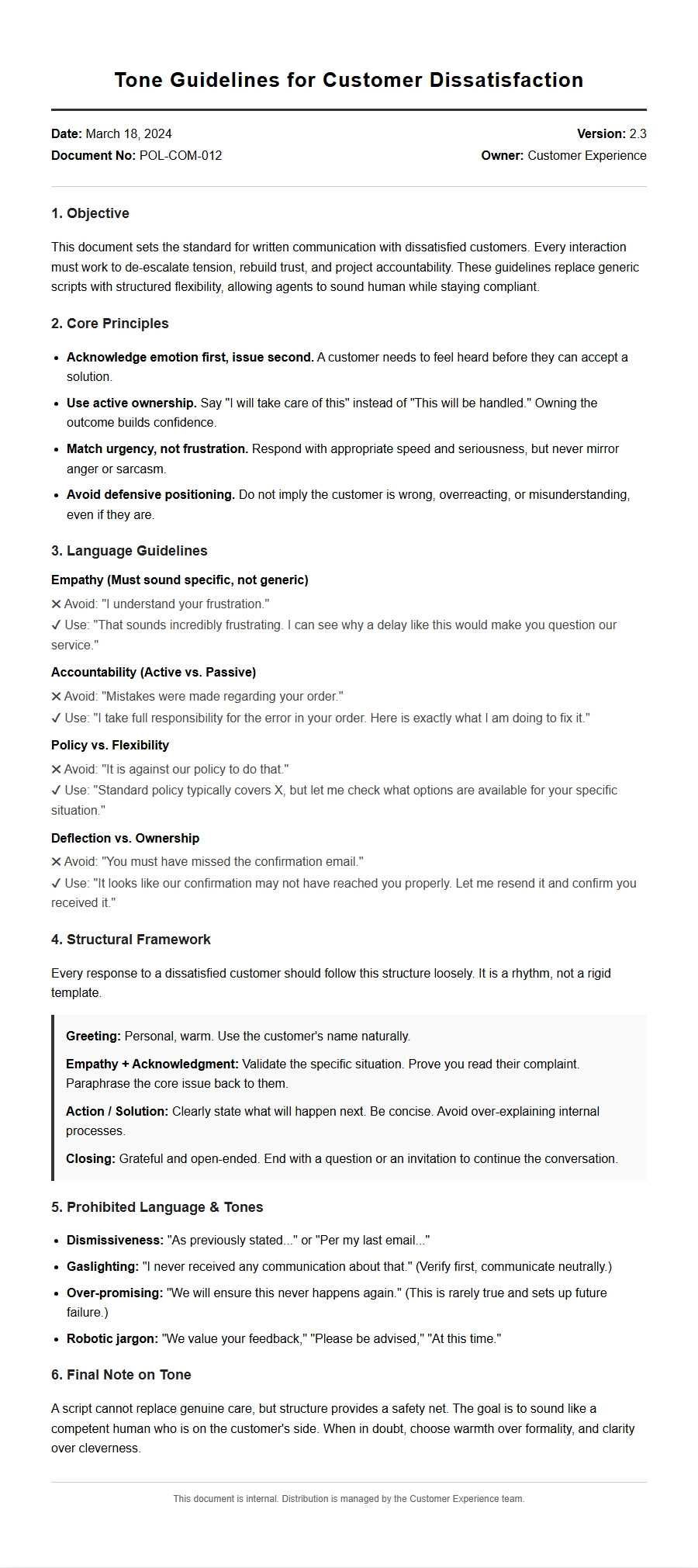 Tone Guidelines for Dissatisfied Customer Letters
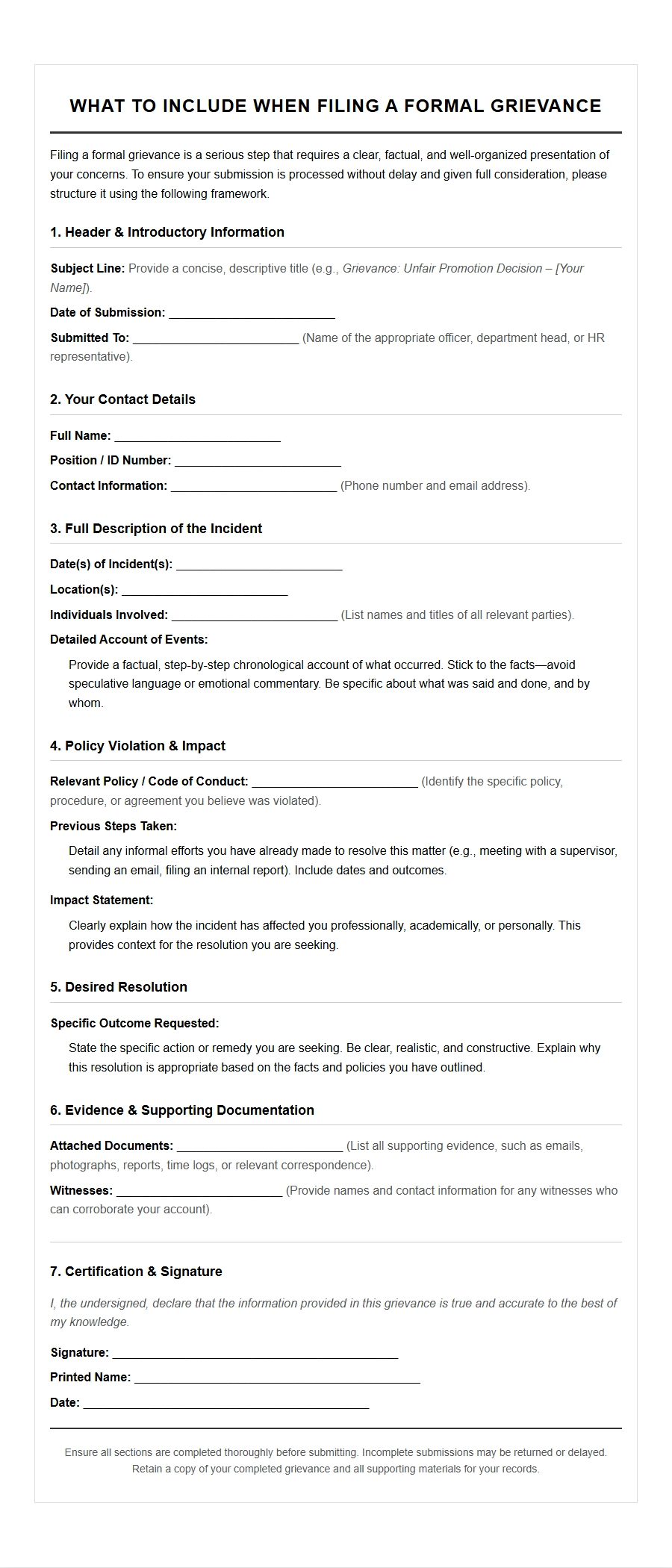 What to Include in a Formal Grievance Letter
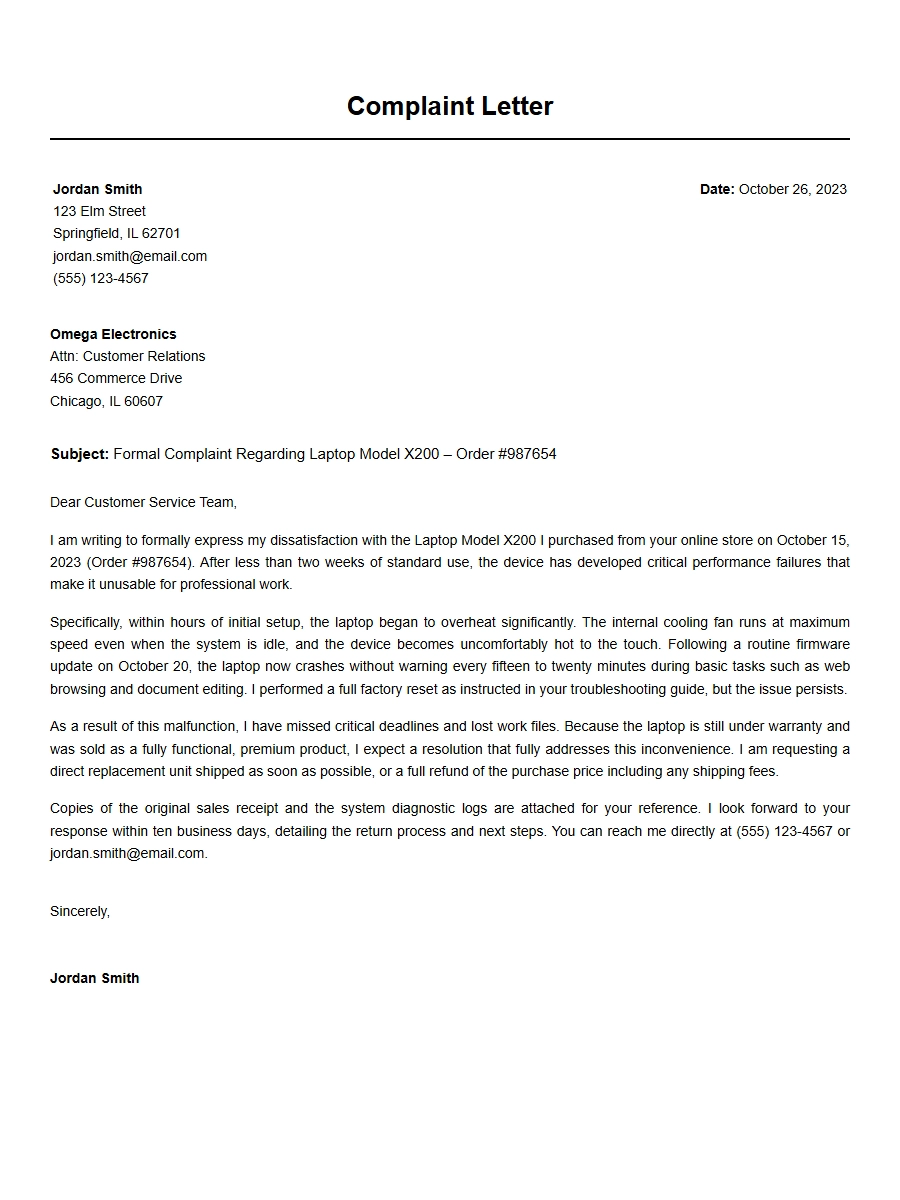 Structure of an Effective Complaint Letter
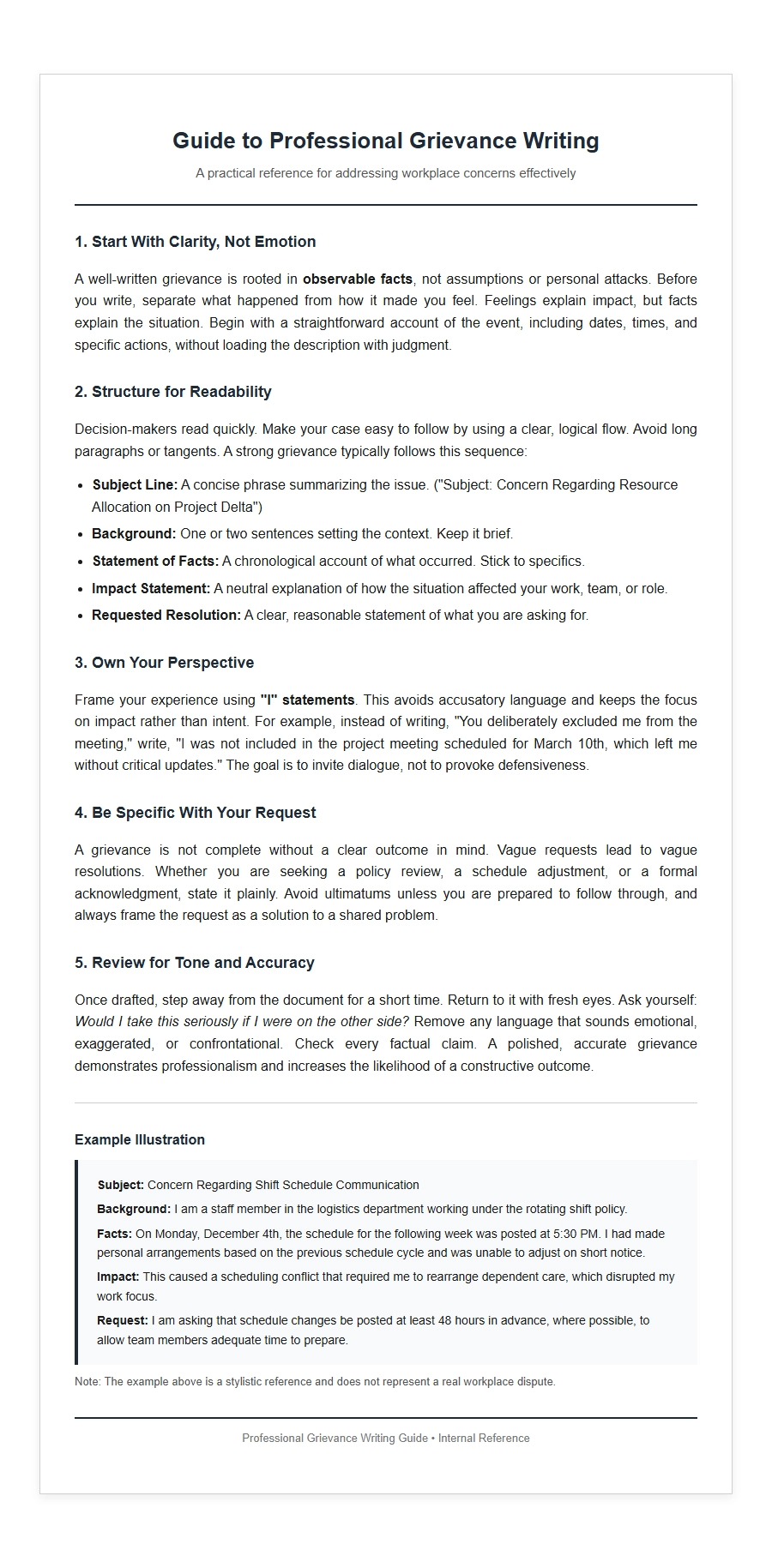 Best Practices for Writing Professional Grievance Letters