How to Update Your Employer on an External Opportunity
You found an interesting opportunity outside your company—maybe a dream job or just a role worth exploring. Now you need to tell your current boss. That conversation or email can feel awkward. You don’t want to seem disloyal, but you also don’t want to hide something that might come up anyway. A well-written letter (or email) can make this update professional, clear, and respectful.
Using a sample for this kind of letter isn’t cheating. It’s a smart way to start. A good letter template gives you a solid structure, the right tone, and key phrases you can personalize. It saves you from staring at a blank screen and helps you avoid common letter writing etiquette mistakes.
Category: Professional Correspondence
Why update your current employer about an external opportunity?
Some people think it’s better to stay quiet until they have an offer in hand. But depending on your company culture and relationship with your manager, giving a heads-up can be a sign of respect. It shows you value transparency and want to handle the situation maturely. It also gives your employer a chance to address any concerns you might have—maybe they’ll even make a counteroffer.
This isn’t a resignation letter. It’s an update. You’re saying, “I’m exploring something, and I wanted you to hear it from me.” The tone should be honest but not defensive.
How to choose the right letter sample for your situation
Not all business letter format samples work for this kind of message. Some are too formal, others too casual. Look for a sample that balances professionalism with warmth. If you email your boss regularly, a digital letter with a clear subject line like “Update regarding my career exploration” works fine. If your workplace prefers printed memos, stick to a traditional letterhead design or company letter format.
Industry matters too. In a startup, you might use a more direct tone. In a corporate law firm, you’d lean toward formal salutation and closing phrases. Pay attention to tone in writing—match it to your relationship with your manager.
Adapting a sample without losing your voice
Start by filling in the blanks: your name, date, recipient details. Then change the opening paragraph to state your purpose clearly. For example: “I wanted to let you know that I am actively considering an external opportunity that aligns with my career goals.” That’s direct without being alarming.
Next, explain why you’re telling them now. Maybe you value transparency, or you want to ensure a smooth transition if things move forward. Keep it short. Then close with appreciation for their support and a willingness to discuss further. A line like “I’d be happy to talk about this in person if that would be helpful” shows maturity.
One common mistake: using outdated salutations like “To Whom It May Concern” when you know the person’s name. Another: ignoring digital letter format rules—if you’re emailing, skip the full postal address and just use a professional subject line.
Quick tips to tailor your opening paragraph
Grab attention without drama. Start with a clear subject line (if email) or a straightforward sentence. Avoid apologies—you’re not doing anything wrong. Instead of “I’m sorry to inform you,” try “I’d like to share an update about my current job search.”
If you have a good relationship, you can add a personal note: “As you know, I’ve really enjoyed working on Project X, and this opportunity came up unexpectedly.” That keeps the tone human.
Proofread before you send
Even a short letter needs a quick review. Check for typos, awkward phrasing, and missing details. Read it aloud to catch anything that sounds too stiff or too casual. Good proofreading letter habits can save you from an embarrassing mistake. Also, double-check the recipient’s name and title—autocorrect can mess up names.
If you’re not sure about the tone, ask a trusted colleague to glance at it. You can also compare it to other cover letter examples or resignation letter sample formats to see how others handled similar situations.
Remember: this letter is about being transparent, not burning bridges. Even if you end up staying, you’ll have handled the conversation with grace. And if you leave, you’ll have set a professional tone for your exit.
Use this as a springboard, not a crutch
A good sample gets you started, but the best letters feel both professional and personal. Tweak the words so they sound like you. Practice writing a few versions—over time, the process gets faster. You’ll learn what works for your industry and your boss’s communication style.
Even an apology letter to a friend follows the same principle: be honest, be specific, and be considerate. Updating your employer about an outside opportunity is no different. Write with confidence, and let the sample guide you—not replace your own voice.
Simple Examples
How to Update Your Employer on an External Opportunity
Request to Apply for External Role
Subject: Permission to Apply for an External Opportunity
Dear [Manager's Name],
I am writing to formally inform you that I have come across an exciting career opportunity with another organization that aligns closely with my long-term professional goals. Before proceeding further, I wanted to be transparent with you and seek your guidance.
I value my current role at [Company Name] and am grateful for the growth I have experienced here. However, this external position would allow me to develop skills in [specific area]. I would like to request your permission to apply for this role, as I believe exploring it will not interfere with my current responsibilities.
I am committed to ensuring a smooth transition if my application progresses. Please let me know your thoughts or any company policies I should be aware of. I am happy to discuss this in person at your earliest convenience.
Thank you for your understanding.
Best regards, [Your Name]
Informing About a Job Offer Received
Subject: Job Offer Received - Seeking Your Input
Dear [Manager's Name],
I hope this message finds you well. I want to be upfront with you: I have received a job offer from another company. This was unexpected, and I am still evaluating my options.
Out of respect for you and the team at [Current Company], I wanted to inform you before making any final decision. I have enjoyed working here and appreciate the mentorship I have received. The external offer presents [briefly mention key aspects, e.g., higher salary, different role, location].
I would value your perspective on my career path here at [Current Company]. If there is any flexibility regarding my role, compensation, or growth opportunities, I am open to discussing how I might continue contributing here.
Please let me know a convenient time to talk. I appreciate your understanding.
I am writing to let you know that I have been presented with a compelling opportunity from another company. While I am excited about the possibility, my preference is to remain at [Current Company] if we can find a mutually beneficial arrangement.
Specifically, I would like to request a conversation to discuss the possibility of a counteroffer. The key factors attracting me to the external role include:
Increased compensation (approximately [percentage]% above my current salary)
Opportunity to lead a team in [specific domain]
More flexible remote work policy
I believe my contributions to the company, such as [mention a recent achievement], demonstrate my value. I am hopeful we can find a way for me to stay. Please let me know if you are open to discussing this further. I am available at your convenience.
Thank you for your time.
Respectfully, [Your Name]
Announcing Decision to Accept External Offer
Subject: Notice of Resignation - External Opportunity
Dear [Manager's Name],
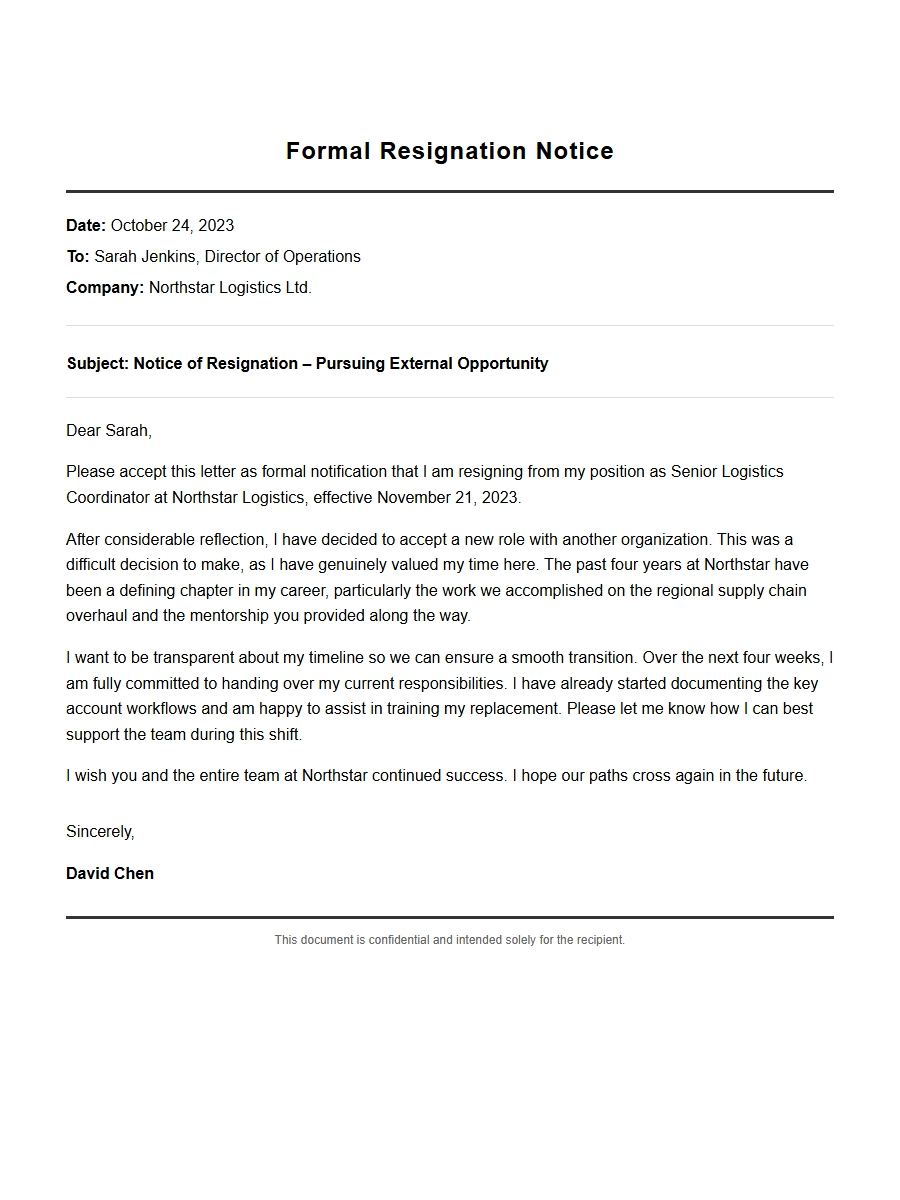
I am writing to formally inform you that I have decided to accept a position with another organization, and therefore resign from my role at [Current Company]. This was not an easy decision; I have truly valued my time here.
My last day of employment will be [date], which provides [X] weeks’ notice as per my contract. I will ensure a thorough handover of my projects and documentation to make the transition as smooth as possible for my team.
I want to thank you and the team for the support and growth opportunities. I have learned a great deal, particularly in [specific area]. I would be happy to assist in finding and onboarding my replacement during my remaining time.
I hope to maintain our professional relationship. Please let me know if there are any additional steps needed.
Best regards, [Your Name]
Exploring External Opportunity Without Committing
Subject: Exploring Career Opportunity Outside the Company
Dear [Manager's Name],
I believe in transparency, so I wanted to let you know that I have been approached by a recruiter about a role at another company. I am in the early stages of exploring this opportunity and have not made any commitments.
I remain fully dedicated to my work at [Current Company]. My current projects—[list one or two key deliverables]—are on track. My intention is to assess whether this external path aligns with my long-term goals, but I want to ensure you are not caught off guard.
I would appreciate any advice you can offer regarding my career development here. Are there upcoming opportunities that might be a good fit for my aspirations? I am open to discussing how we can align my interests with the company’s needs.
Thank you for your continued mentorship.
Warmly, [Your Name]
Requesting Part-Time or Reduced Hours to Pursue External Side Project
Subject: Proposal for Reduced Hours to Pursue External Project
Dear [Manager's Name],
I am writing to discuss a personal opportunity that has arisen. I have been offered a chance to work on a six-month external project in [field] that would significantly enhance my skills. I would like to remain at [Current Company] but request a temporary reduction in my hours to 30 per week.
This arrangement would allow me to:
Continue delivering high-quality work for my current team
Apply new knowledge from the external project to benefit our company
Avoid a full resignation while exploring this growth
I have already identified how to reallocate my core responsibilities. I am confident I can meet all deadlines. Please let me know if you are open to discussing this proposal. I value my role here and hope we can find a flexible solution.
Thank you for considering.
Best, [Your Name]
Updating Employer About a Second Round Interview
Subject: Update Regarding External Interview Process
Dear [Manager's Name],
As part of my commitment to transparency, I wanted to update you on the external opportunity I previously mentioned. I have been invited to a second round of interviews, scheduled for next week.
I want to reiterate that my work at [Current Company] remains my priority. I have planned my schedule to minimize any impact on my deliverables. Please find below the steps I have taken:
Date
Activity
Coverage Plan
May 10
Interview (2 hours)
I will work late that day
May 12
Follow-up meeting
Morning tasks completed early
I am still evaluating whether this move is right for me. If you have any concerns, I am happy to discuss them. I appreciate your support and openness throughout this process.
Sincerely, [Your Name]
Withdrawing from External Process After Discussion with Manager
Subject: Withdrawing from External Opportunity
Dear [Manager's Name],
Following our recent conversation, I have decided to withdraw my application for the external role. Your feedback about my growth prospects within [Current Company] and the new project assignment we discussed convinced me that my best path forward is here.
I want to thank you for taking the time to outline the upcoming opportunities in our department. Specifically, I am excited about:
The lead role in the Q4 product launch
The mentorship program you offered
The potential for a promotion review next cycle
I have already informed the other company of my decision. I am reaffirming my commitment to our team and look forward to contributing to our shared goals. Thank you for your guidance.
Best regards, [Your Name]
Informing About a Non-Compete or Conflict of Interest
Subject: Disclosure of External Opportunity - Potential Conflict of Interest
Dear [Manager's Name] and [HR Contact],
I am writing to disclose that I have been approached about an external opportunity with [External Company Name]. Because this company operates in a similar industry, I want to ensure transparency and avoid any perceived conflict of interest.
Based on my review of our company’s policies, I have noted the following:
My current role does not involve direct trade secrets of the external company
I have not shared any confidential information
The external role is in a complementary, not competing, service line
Nevertheless, I would like your guidance on whether proceeding would violate any agreements. I am attaching a brief summary of the external role for your review. I am open to any restrictions or requirements you may have. Please advise on next steps.
Thank you for your support.
Sincerely, [Your Name]
Negotiating Start Date Delay After Accepting External Offer
Subject: Request for Extended Notice Period
Dear [Manager's Name],
As you know, I have accepted an external opportunity. I want to ensure a smooth transition for my team. Given the complexity of my current projects, I propose extending my notice period by one week (to [date]).
This extra time would allow me to:
Complete the documentation for the [Project Name] handover
Train [colleague's name] on key processes
Finalize any pending deliverables without rushing
I have already spoken with the new employer, and they have agreed to a later start date. My goal is to leave [Current Company] on the best possible terms. Please let me know if this adjustment is acceptable. I appreciate your understanding.
 Thanking a Mentor for Guidance: Sample Messages
 Expressing Gratitude: Handwritten Letter Example
 Expressing Thanks in a Formal Personal Letter
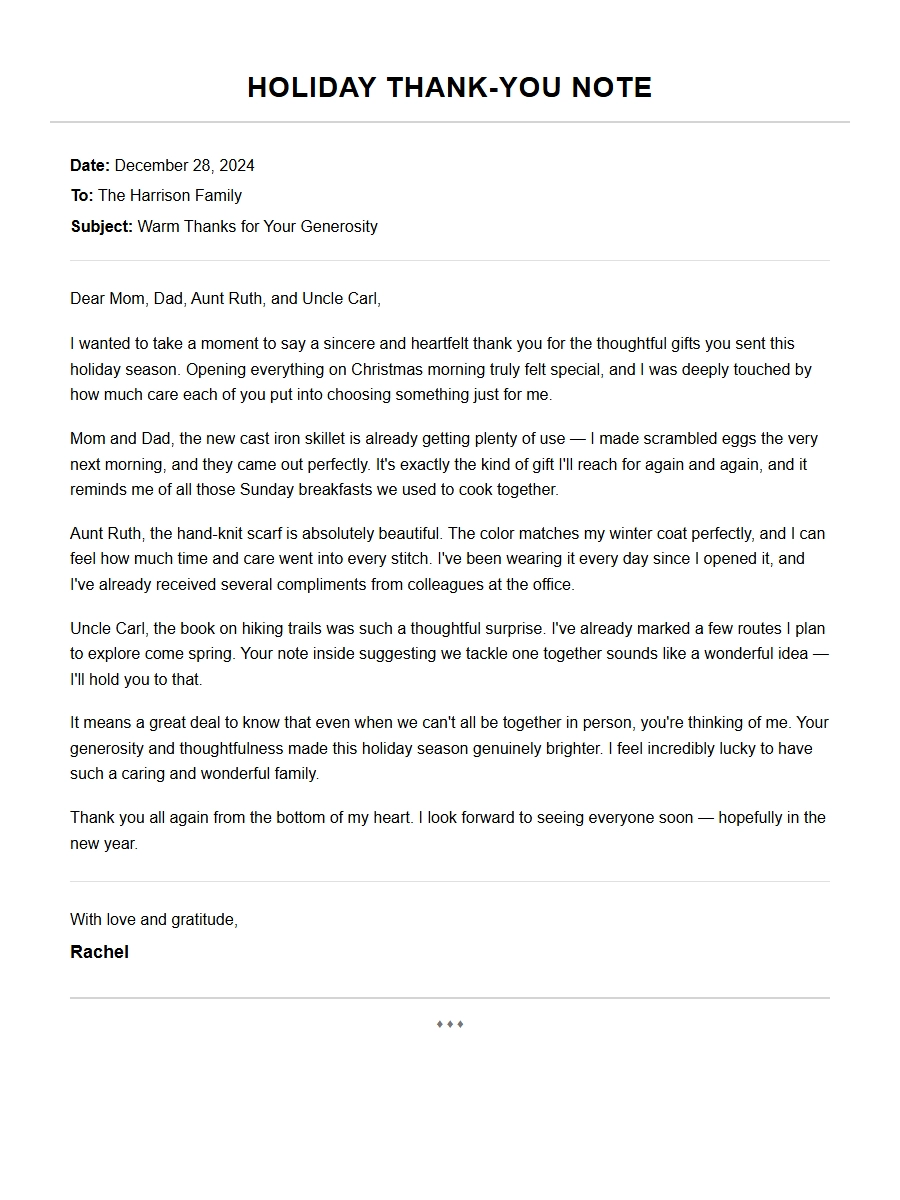 Thank You Letter Examples for Family Holiday Gifts
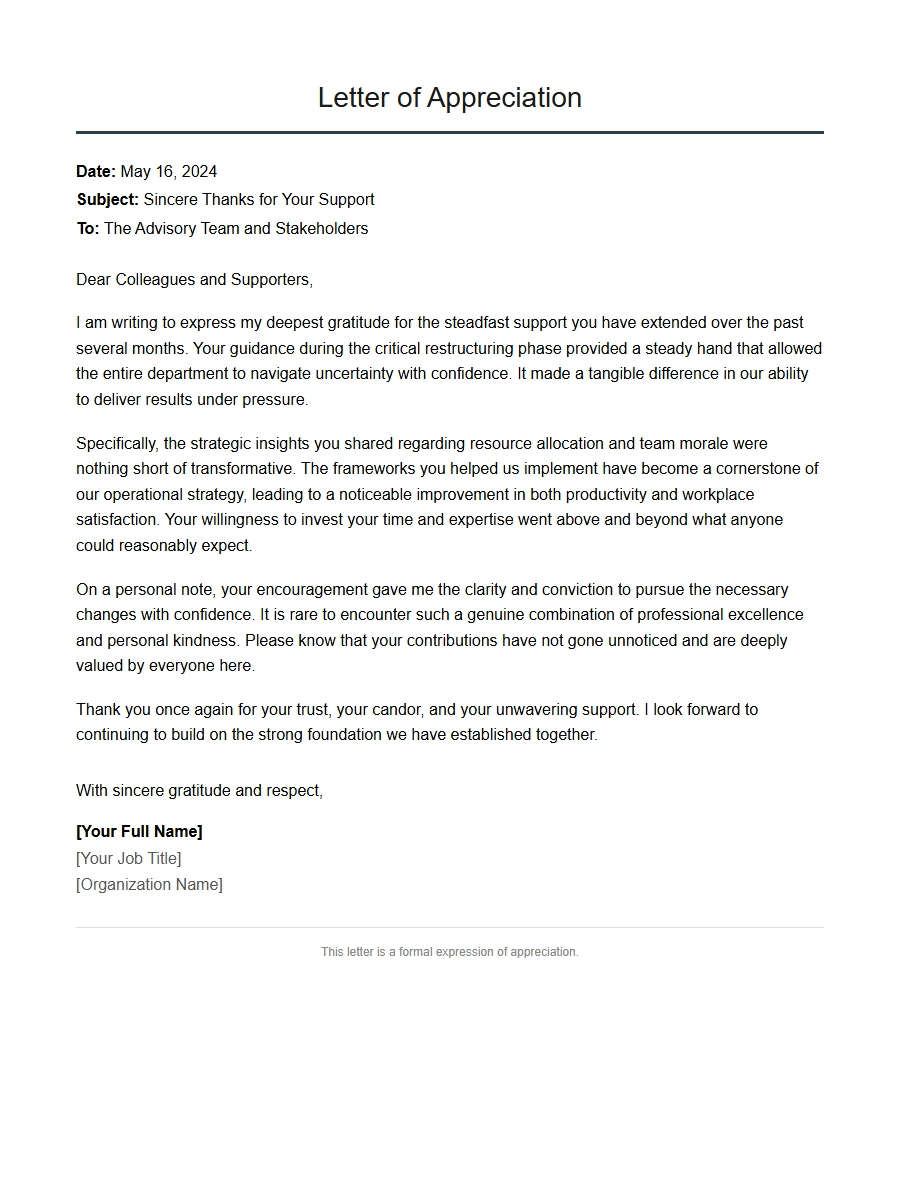 Sample Thank You Letter for Support
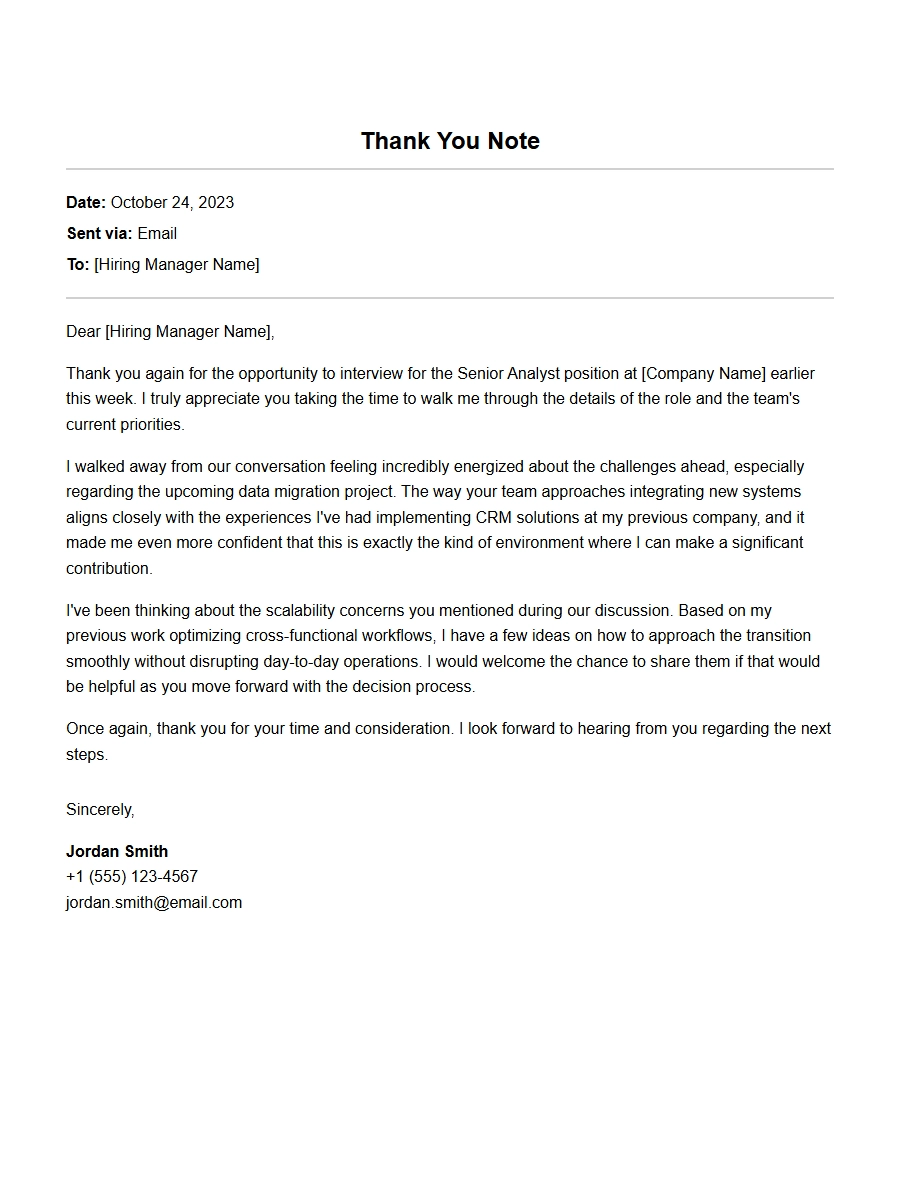 How to Write a Personal Thank-You Note After an Interview