You’re looking at a half-filled screen, unsure how to start a letter to a distant relative you haven’t spoken to in years. Maybe you feel guilty about the silence, or anxious that your words will land wrong. That’s normal. The good news is that a simple letter template can break the ice and give you a solid structure to work from. Using a sample isn’t cheating—it’s a smart way to overcome writer’s block and focus on what matters: reconnecting.
Why a sample makes writing easier
A good sample shows you the natural flow of professional correspondence, even for a personal letter. It gives you the right salutation and closing, a clear middle section, and a tone that doesn’t feel stiff. Think of it like a map. You don’t drive exactly where the map says—you adjust for your own detours. A customizable letter template works the same way. You keep the structure but swap in your own memories, questions, and warmth.
Choosing the right approach for a relative
The first decision is formality. A letter to a great-aunt you’ve never met needs a slightly more traditional tone in writing than one to a cousin you last saw at a wedding. If you’re unsure, lean toward polite and warm. You can always loosen up once you start writing. Formal writing tips still apply here: avoid slang, keep sentences clear, and don’t assume the reader knows all your inside jokes. For a relative you barely know, it’s better to be a bit too respectful than accidentally too casual.
How to adapt a sample without sounding robotic
Here’s the trick: read the sample, then set it aside. Jot down the main points you want to cover—how you found their address, a shared memory if you have one, what you’ve been up to, and a genuine question about their life. Then write from memory. Trust your own voice. If a sample says “I hope this letter finds you in good health” and that feels unnatural, change it to “I’ve been thinking about you and wanted to say hello.” Authenticity beats perfect phrasing every time.
Common mistakes that kill the connection
One big one is using an outdated salutation like “Dear Sir” or “To Whom It May Concern.” That works for a formal cover letter but feels cold to family. Stick to “Dear Aunt Maria” or “Hi, Cousin Joe.” Another mistake is making the letter all about you. Balance it. Share a little, then ask about them. Ever received a letter that listed achievements like a résumé? It feels weird. Focus on shared history and genuine curiosity.
When to think about digital format
If you’re sending the letter by email, the digital letter format changes things slightly. No letterhead design is needed—just a clear subject line like “Thinking of you” and a warm greeting. For a printed letter, you can add a simple header with your address and the date. Either way, don’t skip proofreading the letter before you send it. Typos happen, but a quick read-aloud catches most of them. Check for clarity, not perfection.
Category: Personal letters for reconnecting with family
Borrowing from other letter types
Sometimes, the letter you write to a distant relative isn’t just a catch-up—it might include a subtle explanation about why you’ve been out of touch. That’s similar to explaining a career gap in a cover letter. You don’t need to over-explain. A simple sentence like “Life got busy, but I’ve always thought of you” covers the gap without defensiveness.
If you’re reconnecting before a visit, your letter might include an invitation. The tone should feel natural, not forced. That’s where a sample for inviting someone to a housewarming party can give you ideas for wording that feels welcoming without pressure.
For a relative you’re meeting again after a long time, you might want to mention a change in plans or venue if you’re hosting a gathering. Check out this approach for notifying guests about a venue change to see how to keep the tone clear and friendly.
If your letter follows a difficult event—like learning about their illness or loss—you need extra care. A sample for writing a sympathy letter to a grieving family shows how to express support without intruding. The same principles apply: be brief, be sincere, and offer specific help if you can.
Finally, if you’re writing to thank them for something they did long ago, keep it simple and warm. The structure in thanking a customer for repeat business can be adapted easily—swap business language for personal appreciation.
Using the sample as a springboard, not a crutch
The best letters feel both professional and personal. They follow letter writing etiquette without sounding like a textbook. Start with a sample to get the letter structure right—your opening, body, and closing. Then rewrite it in your own words. Include a mention of your letterhead design if you’re mailing it, but don’t get hung up on formatting. What matters is that your relative feels seen and remembered.
Practice makes this faster. The first letter takes the most effort. The second one comes easier. And a single, well-written note can reopen a relationship that’s been quiet for too long.
Realistic Samples
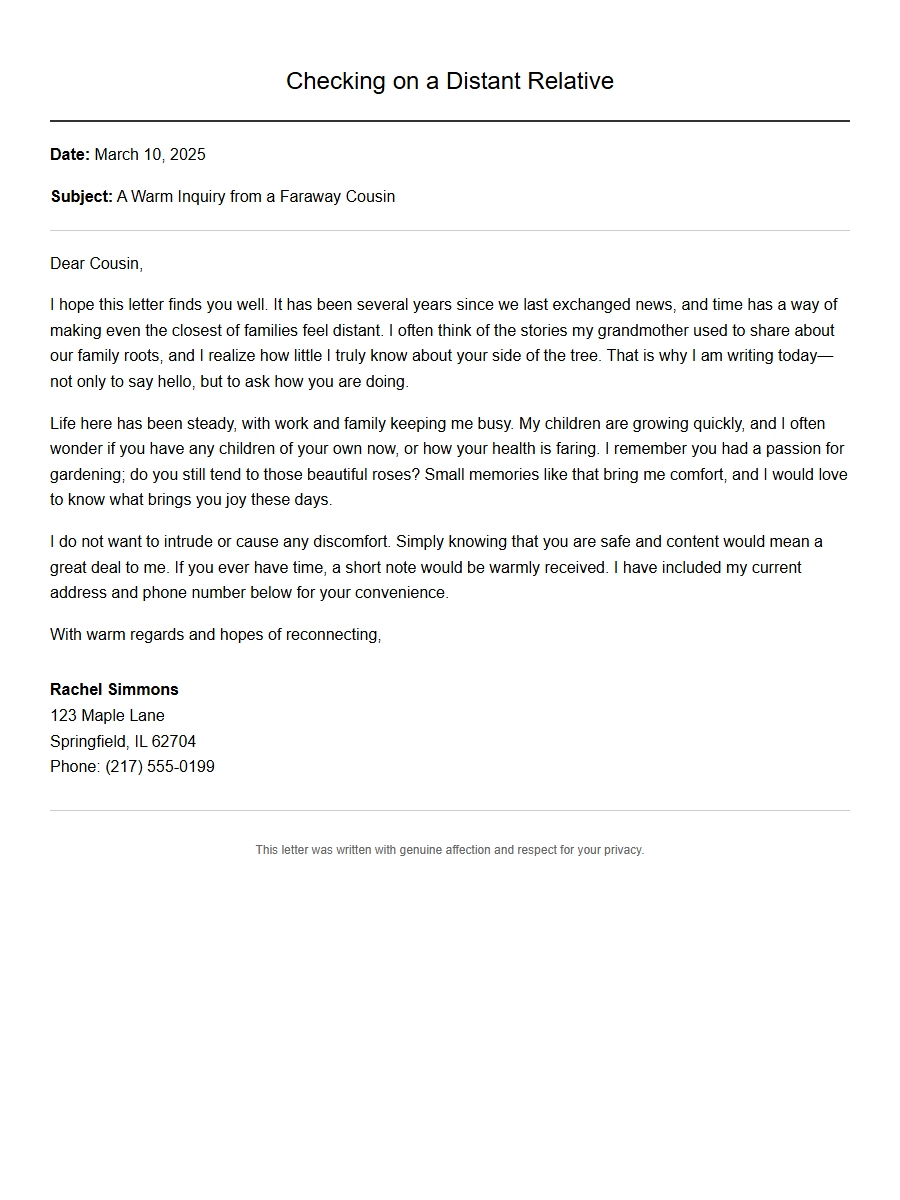
Writing a Letter to Check on a Distant Relative
Reconnecting After Many Years
Dear Cousin Margaret,
It has been far too long since we last spoke—I believe it was at Aunt Helen's funeral in 2015. I hope this letter finds you and your family in good health. I have often thought of you and wondered how life has treated you. The last I heard, your son James had just started college. Is he pursuing his passion for environmental science? I would love to hear about your garden, which I remember being so vibrant. Please write back when you have a moment. I am eager to catch up properly.
With warm regards, Your cousin, Robert
Concern After Natural Disaster
Dear Uncle Frank,
We were deeply worried when we saw the news about the flooding in your area. I hope you and Aunt Lucy are safe and that your home escaped serious damage. Please let us know as soon as you can—have you been able to return to the house? We have a spare room if you need a place to stay while things settle. I have tried calling but the lines seem down. Sending all our love and keeping you in our thoughts.
Warmly, Your niece, Sarah
Sharing Family News and Photos
Dear Cousin David,
I thought you might enjoy a little update from our side of the family. Grandmother turned 90 last month, and we had a lovely backyard party—she danced the polka! I have attached a few snapshots of the celebration (expect some in the mail). Also, my daughter Emily just got accepted into veterinary school. Time flies, doesn't it? How are your boys doing? Are they still playing soccer? I remember them scoring goals at the family picnic. Let's not let another year pass without news.
Best, Your cousin, Laura
Grandmother's 90th birthday party
Emily's vet school acceptance
New puppy we adopted (a golden retriever)
Asking About Health and Well-Being
Dear Aunt Marie,
I was thinking about you today and wanted to check in. How are you feeling after your recent knee surgery? I hope the physical therapy is going well and that those daily exercises aren't too painful. Please don't overdo it—rest is just as important. If you need someone to drive you to appointments or help with groceries, my son Tom is nearby and would be happy to assist. Just say the word. Sending you a big hug.
Take care, Your niece, Patricia
Day
Activity
Monday
PT session at 10 am
Wednesday
Doctor follow-up
Friday
Rest day
Invitation to a Family Reunion
Dear Cousin Emily,
It's time! The next family reunion is scheduled for July 15–17 at the old Miller farm. We wanted to make sure you and your family set aside the date. This year we are planning a potluck, a softball game, and an evening bonfire with storytelling. Last time you shared those hilarious tales about Grandpa's fishing trips—everyone still laughs about them. Could you bring your famous apple pie? Accommodations are available at the farmhouse or nearby inn. Please RSVP by June 1 so we can finalize the headcount.
Hope to see you there, Your cousin, Jonathan
RSVP Details:
Email: jonathan@familyreunion.org
Phone: 555-1234
Deadline: June 1
Offering to Help with Aging Parent
Dear Aunt Barbara,
I understand that looking after Uncle Joe has become more challenging since his stroke. I want you to know that I am here to help in any way I can. I could come over on Saturdays to give you a break—maybe take him for a walk in the park or just sit with him while you run errands. I also found a list of local support groups for caregivers that might be useful. Please don't hesitate to call. You have always been there for our family; let me be there for you now.
With love, Your niece, Christine
Support Resources:
Caregiver Support Group meets Tuesdays at the community center
Home health aide referrals available through County Aging Services
Free meal delivery program for seniors
Inquiring About Lost Family Heirloom
Dear Cousin Mark,
I recently came across an old photo of Grandma wearing a beautiful cameo brooch. That brooch was passed down to your mother, I believe, after Grandma passed. Do you happen to know where it is now? I am working on a family history scrapbook and would love to include a picture of it, or even borrow it if possible. I know it has sentimental value. Also, if you have any letters or diaries from that era, I would be grateful to see them. Let me know what you think.
Thank you, Your cousin, Rebecca
Cameo brooch (described as gold with ivory carving)
Letters from 1920s–1940s
Grandma's handwritten cookbook
Updating Contact Information
Dear Cousin Henry,
I realized it's been ages since we exchanged contact details, and I don't want to lose touch. Here are my current numbers. Please update your address book accordingly. Also, could you send me your latest email and phone? I recall you moved last summer—did the move go smoothly? I hope the new neighborhood is treating you well. Let's make a point to call each other more often. Maybe a monthly chat? Looking forward to hearing from you.
Take care, Your cousin, Lisa
Contact Method
Old
New
Phone
555-6789
555-4321
Email
lisa.old@email.com
lisa.new@email.com
Address
123 Oak St
456 Maple Ave
Reminiscing About Childhood Memories
Dear Cousin Thomas,
Do you remember the summers we spent at Granddad's lake house? I was thinking about the time we built that rickety raft and tried to sail it across the cove—it sank after ten feet! And the lemonade stand we ran, charging a nickel a glass. Those were such carefree days. I stumbled upon an old photo of us with our muddy faces after a frog-catching expedition. I'll include a copy with this letter. What memories stand out to you? Let's swap stories—it would be wonderful to hear your perspective.
Yours, Your cousin, William
Request for Genealogy Information
Dear Cousin Alice,
I have taken an interest in tracing our family tree and I recall you have a treasure trove of old records. I am especially looking for details about our great-grandparents—the ones who immigrated from Ireland. Do you have any immigration documents, marriage certificates, or passenger lists? Also, do you know the names of their parents? I would love to collaborate on this project. Below is what I have so far. Please add any corrections or additions.
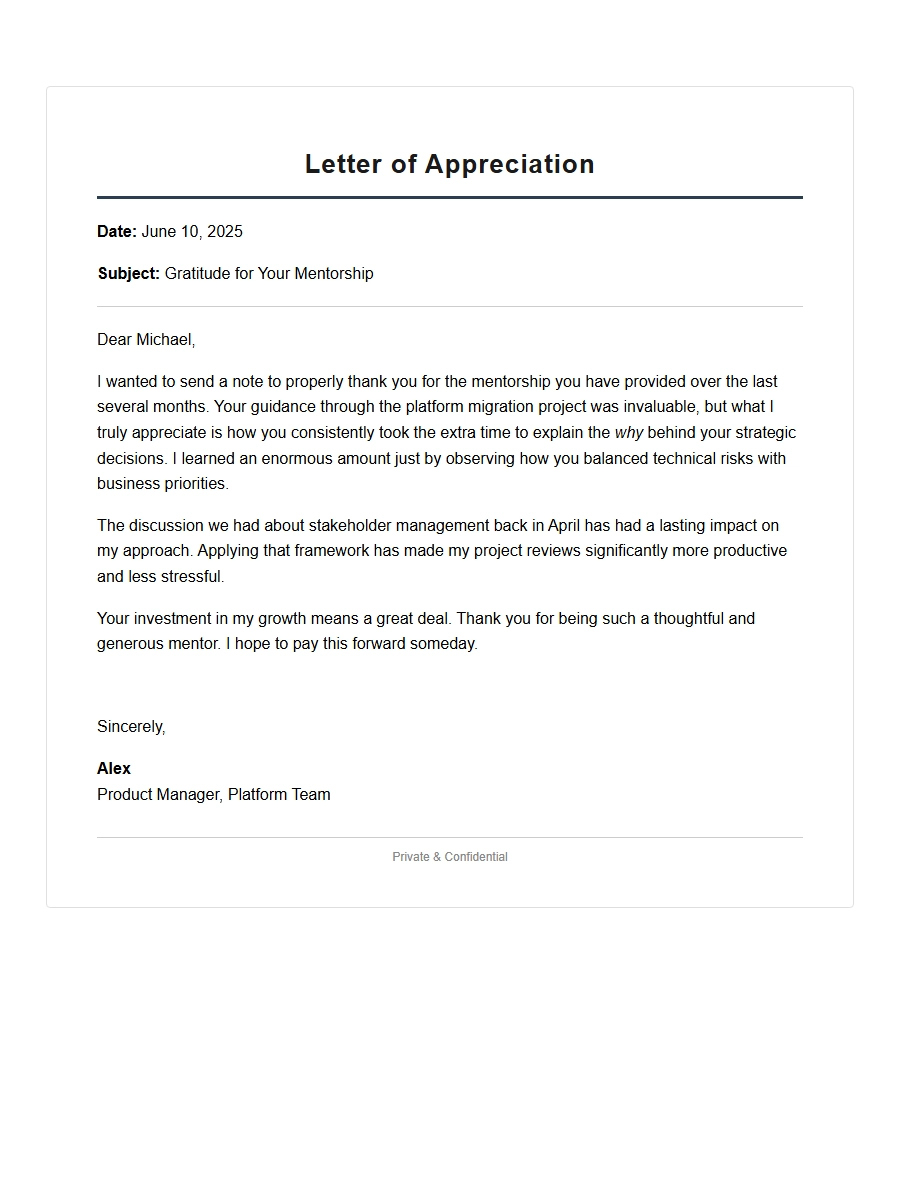 Thanking a Mentor for Guidance: Sample Messages
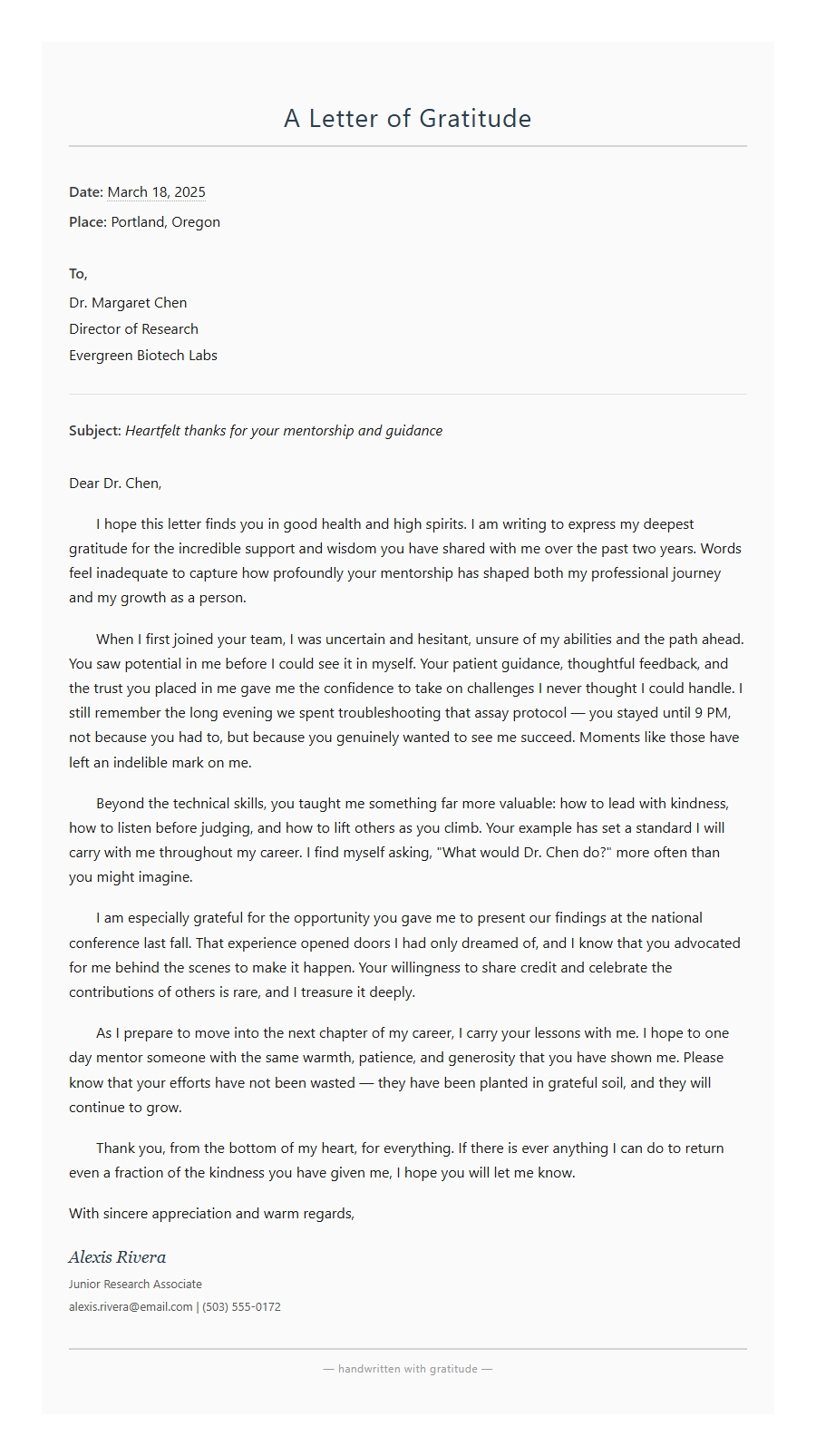 Expressing Gratitude: Handwritten Letter Example
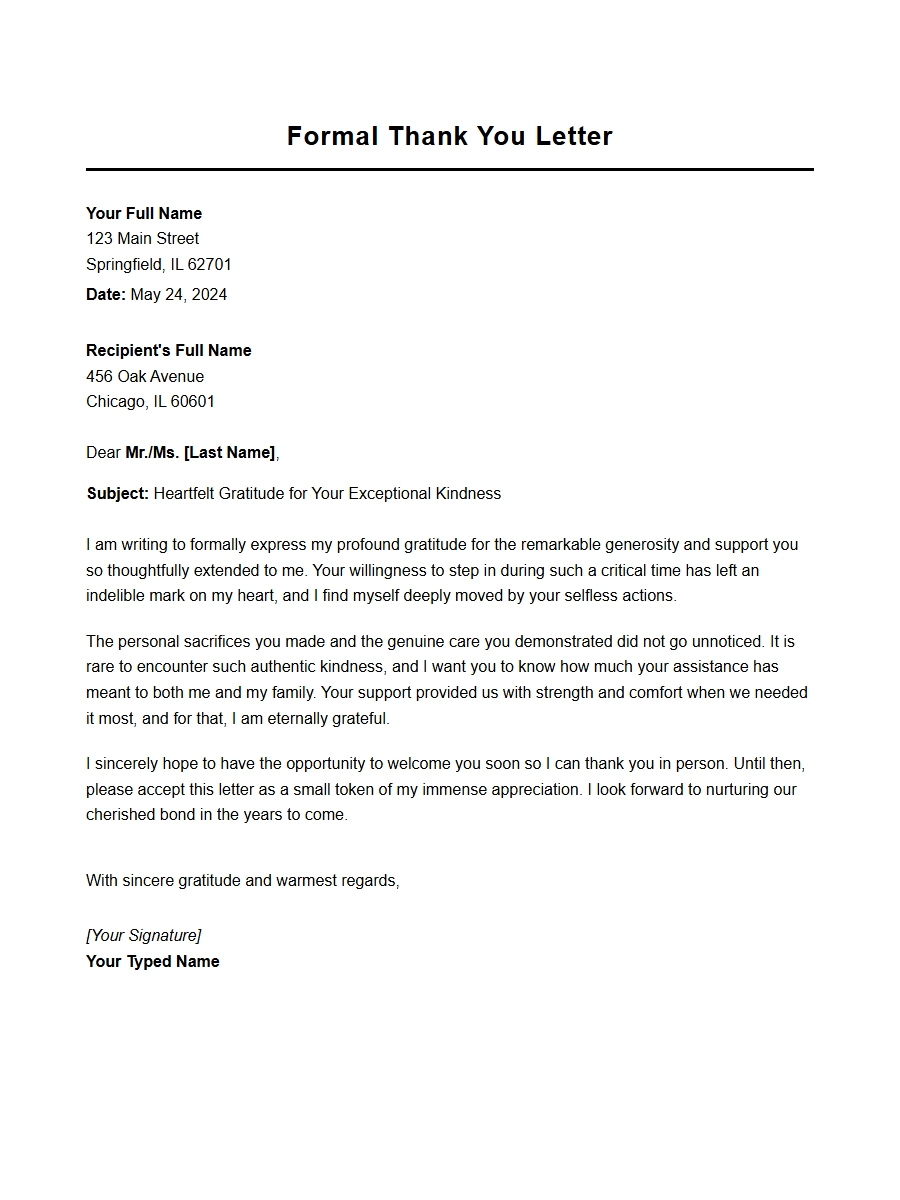 Expressing Thanks in a Formal Personal Letter
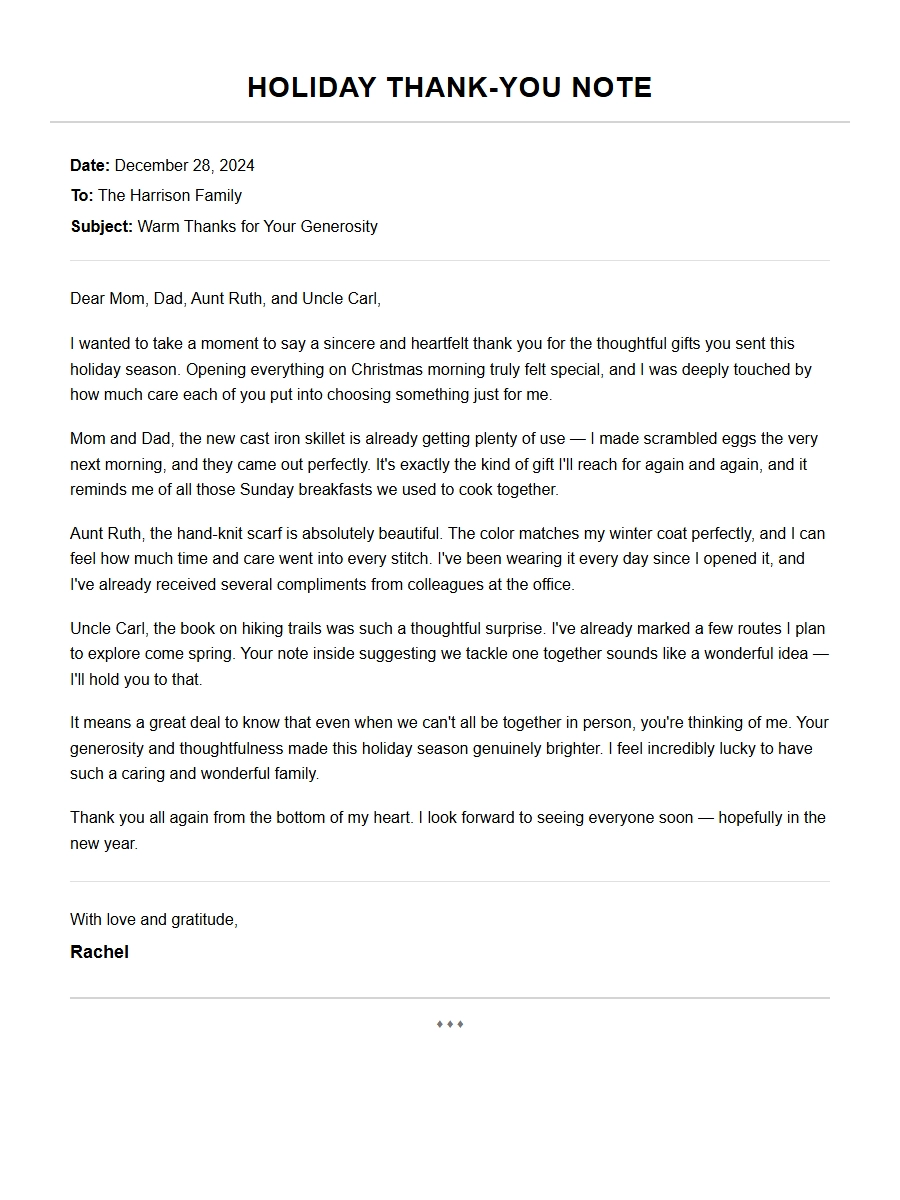 Thank You Letter Examples for Family Holiday Gifts
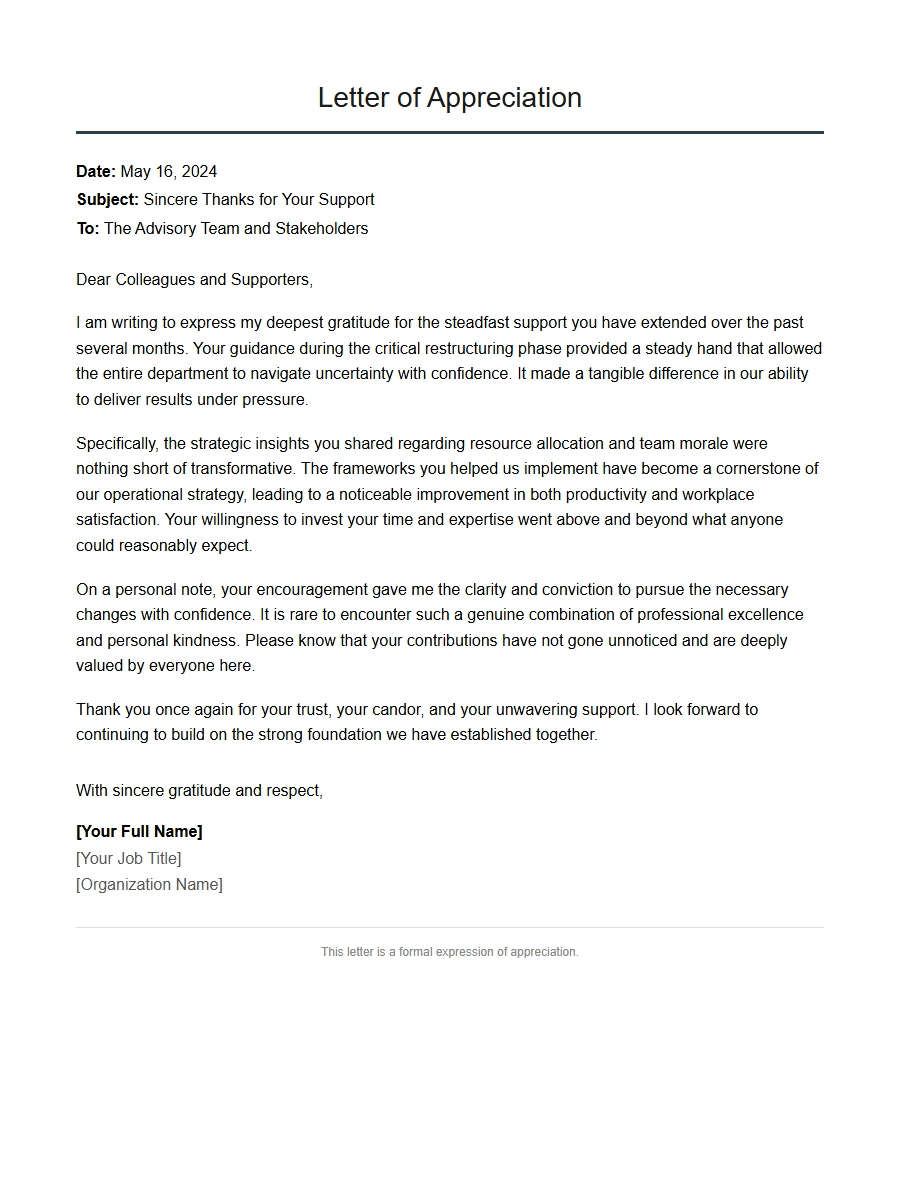 Sample Thank You Letter for Support
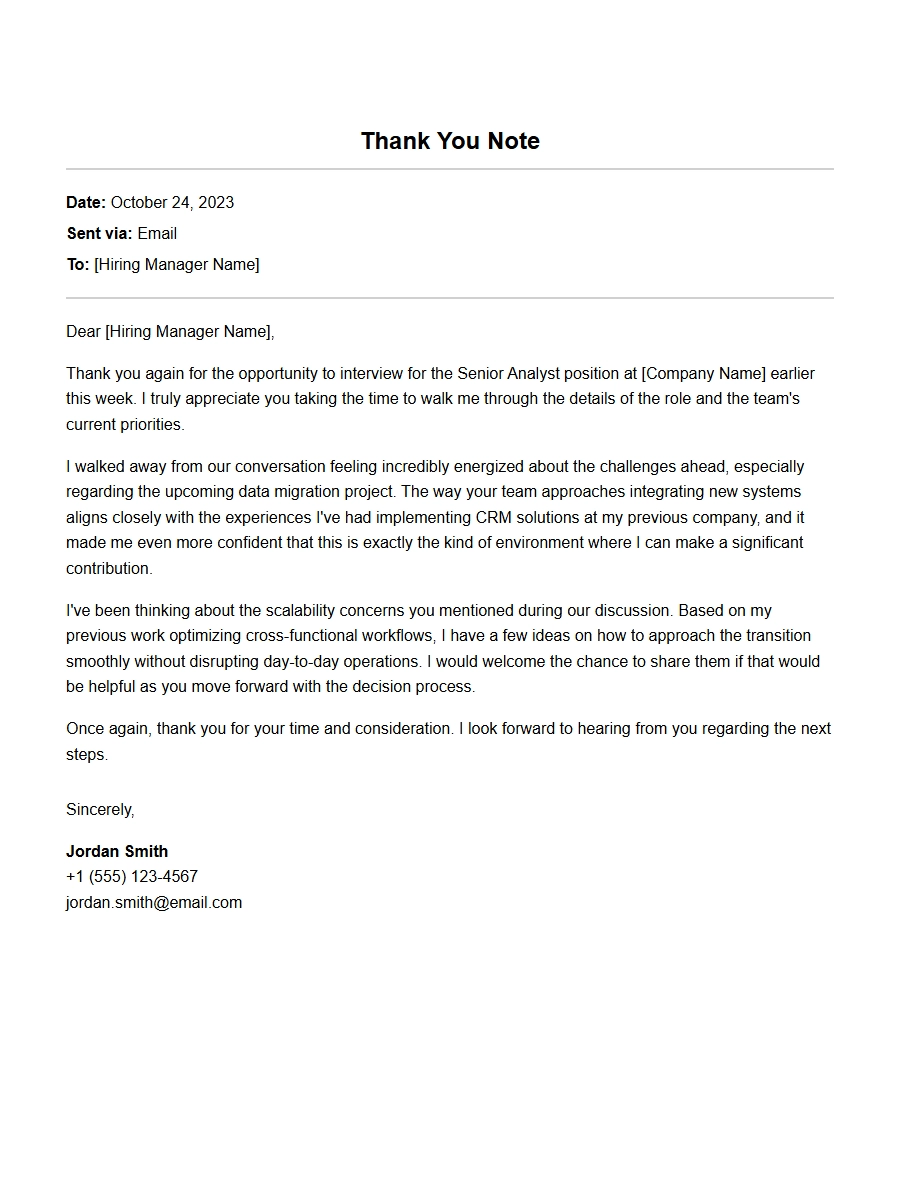 How to Write a Personal Thank-You Note After an Interview