How to Explain Your Tax Deduction Claim to Your Accountant
You’ve got a deduction that feels perfectly valid—maybe you worked from home, drove to meet clients, or bought equipment for your side business. But when you sit down to explain it to your accountant, the words don’t come. You worry you’ll sound like you’re making it up, or worse, that you’ll leave out some crucial detail that gets your claim denied.
That anxiety is real. But explaining a tax deduction claim to an accountant doesn’t need to be a high-wire act. The trick is knowing what to say and how to say it clearly. Think of it as sending a thank you note to your future self for not overpaying taxes.
Why a Written Explanation Works Better Than a Phone Call
Accountants deal with numbers all day. A verbal explanation can get jumbled, especially if you’re nervous or the details are complex. A short, written summary gives your accountant something concrete to review. It’s not about being formal—it’s about being clear.
A simple note or email that explains the expense, when it happened, and why it’s business-related can save you from a back-and-forth of questions later. It also creates a paper trail, which is always good practice in professional correspondence.
What Your Accountant Actually Needs to Know
Your accountant doesn’t need your life story. They need a few key facts to decide if a deduction is valid:
The amount you’re claiming.
The date the expense occurred.
The business purpose—exactly how this expense relates to your work.
Any supporting documents, like receipts or invoices.
For example, don’t just say “I bought a new laptop.” Say “I purchased a laptop on March 15 for $1,200, used exclusively for client project management and bookkeeping. Receipt attached.” That’s enough for an accountant to work with.
How to Structure Your Explanation
You don’t need a fancy letterhead design or a rigid business letter format. A clear email works fine. But if you prefer a printed note, follow basic letter writing etiquette: include a date, use a polite salutation and closing, and keep it to one page.
Here’s a simple structure:
State your request upfront. “I’d like to claim a deduction for home office expenses.”
Describe the expense. “I worked from home 40 hours a week from January to December. My home office is 200 square feet in a 2,000-square-foot house.”
Provide context. “This is my primary place of business, and I do not have access to an outside office.”
Attach proof. “I’ve included a copy of my utility bills and rent statement for the year.”
This approach respects your accountant’s time and makes their job easier. They can quickly check your numbers against tax rules.
Common Mistakes When Explaining a Deduction
One of the biggest errors is being too vague. Saying “I spent money on marketing” doesn’t tell your accountant much. Was it for a Facebook ad? A printed flyer? A sponsorship? Be specific.
Another mistake is mixing personal and business expenses without separating them. If you used your car for both errands and client visits, your accountant needs to know the percentage for business use. That’s where a log or mileage tracker is gold.
Also, don’t assume your accountant remembers every detail from last year. Even if you’ve claimed the same deduction before, a short refresher helps. It shows you’re organized and reduces the chance of an audit flag.
Tailoring Your Explanation for Different Situations
Sometimes you’re explaining a deduction for a new business expense, like a piece of equipment. Other times, it’s a recurring cost, like internet service. For one-off items, focus on the purchase reason. For ongoing costs, show how they support your work consistently.
If you’re explaining a deduction related to a home-based business, think of it like checking in with a distant relative—you want to be clear and include all the important news. Your accountant is the relative here, and the “news” is your financial activity.
For client-related expenses, such as meals or travel, note who you met with and the business discussed. That’s key to proving the expense is deductible.
The Right Tone for This Conversation
Keep your tone straightforward. You’re not begging for a favor. You’re providing information so your accountant can give you accurate advice. Avoid sounding defensive or overly apologetic. Just state the facts.
If you’re unsure about a deduction, it’s okay to say “I think this might qualify, but I’d like your opinion.” Accountants appreciate honesty far more than a fabricated story.
Proofreading Your Explanation
Before you send it, read your note once more. Check for typos, missing amounts, or unclear dates. Proofreading your letter is a small step that prevents big misunderstandings. A single wrong digit could throw off your entire return.
If you’re emailing, consider using a digital letter format—plain text is fine, but a PDF with your receipts attached looks clean and professional.
Using Samples as a Starting Point
If you’re still stuck, a letter template can help. It gives you a framework so you don’t forget the basics. But remember, a template is just a skeleton. You need to fill in your specific details to make it authentic. A customizable letter that sounds like you will always be more effective than a generic form.
Explaining a deduction doesn’t have to be the hardest part of tax season. Once you’ve written it down clearly, you can send it off and move on to other tasks. Over time, you’ll get faster at describing your expenses, and your accountant will appreciate the consistency.
Treat it like requesting accommodation for a student: clear, specific, and focused on what you need. The more you practice this kind of professional correspondence, the easier it becomes.
Your goal isn’t to impress your accountant with fancy language. It’s to give them the facts they need to help you save money legally. Get that right, and you’ve done your part.
Examples You Can Adapt
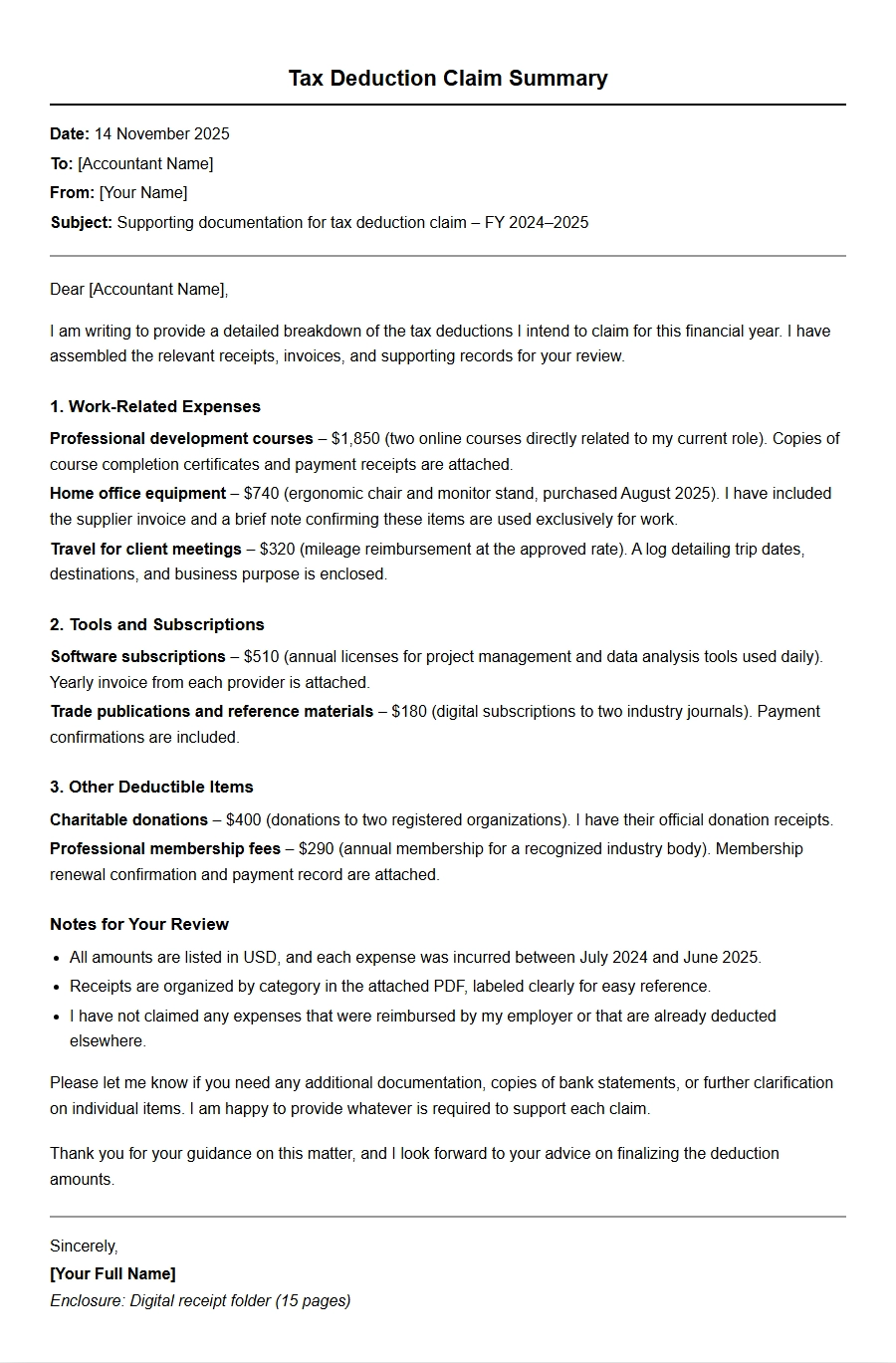
How to Explain Your Tax Deduction Claim to Your Accountant
Home Office Deduction Explanation
Dear Accountant,
I am writing to explain my claim for the home office deduction for tax year 2023. I use a dedicated room in my apartment exclusively for my freelance graphic design business. The room is 150 square feet out of a total 900 square feet. I am using the simplified method, which allows $5 per square foot up to 300 square feet. Based on my calculations, the deduction is 150 sq ft × $5 = $750. I have attached a floor plan and a photo of the space for documentation. Please let me know if you need any additional records, such as utility bills or rent receipts. I have highlighted the home office area on my lease agreement for your reference.
Thank you for your assistance.
Missing Charitable Donation Receipt
Dear Accountant,
I need to explain a charitable contribution of $2,500 to the local food bank in 2023, but I lost the official receipt. I have alternative documentation that I hope will suffice:
Bank statement showing a check #1042 written on Dec 15, 2023, payable to "Community Food Bank" for $2,500.
Email confirmation from the charity acknowledging the donation (attached).
Volunteer log showing I also donated 10 hours (not claimed as a deduction).
Per IRS rules, a canceled check and a written acknowledgment from the charity are acceptable if the receipt is missing. Please confirm if this meets requirements for itemizing deductions. I can request a duplicate receipt if necessary.
Thank you.
Business Mileage Log Summary
Dear Accountant,
I am providing a summary of my business mileage for 2023 to support the deduction claim. I drove my personal vehicle (2019 Honda Civic) for client meetings, supply runs, and networking events. Below is a breakdown:
Month
Business Miles
Purpose
Jan-Mar
1,200
Client meetings in city A
Apr-Jun
980
Supply runs and workshops
Jul-Sep
1,530
Networking events and conferences
Oct-Dec
1,110
Year-end client visits
Total
4,820
I used the standard mileage rate of 65.5 cents per mile for 2023, giving a deduction of $3,157.10. I have a contemporaneous log with odometer readings, dates, and destinations. Please review and advise if any adjustments are needed.
Medical Expense – Eyeglasses and Exams
Dear Accountant,
I am claiming medical expenses related to vision care in 2023. I paid for prescription eyeglasses and eye exams for myself and my dependent child. Details are as follows:
Eye exam (self): $150 on March 5, 2023 – Provider: VisionCare Center
Prescription glasses (self): $320 on March 12, 2023 – Receipt attached
Eye exam (child): $120 on June 10, 2023
Children’s glasses: $250 on June 18, 2023
Total qualified medical expenses: $840. Since my AGI is $45,000, and the 7.5% threshold is $3,375, these expenses alone are not enough to itemize. However, combined with other medical costs (dental, prescriptions) totaling $4,200, I can exceed the threshold. Please include all expenses in the Schedule A calculation. I have all receipts organized by date.
Education Expense – Professional Certification
Dear Accountant,
I am requesting your guidance on deducting the cost of a professional certification course I completed in 2023. I am a human resources manager, and I took a six-week course titled "Advanced Compensation and Benefits" to maintain and improve skills required in my current job. The course was not required by my employer but is directly related to my duties. Expenses incurred:
Item
Amount
Tuition
$1,800
Textbooks and materials
$320
Exam fee for final certification
$250
Round-trip mileage to class (200 miles @ 65.5¢)
$131
Total
$2,501
My employer did not reimburse any of these costs. I believe this qualifies as an unreimbursed employee expense (subject to 2% of AGI floor before 2018 changes, but for 2023 I understand they are no longer deductible under TCJA). Please confirm if I can claim this under other categories, such as business expense for self-employed status (I am not self-employed). If not, please advise if any education credit (Lifetime Learning Credit) might apply.
Self-Employed Health Insurance Premiums
Dear Accountant,
I am writing about my health insurance deduction for 2023. As a self-employed freelance writer, I paid my own health insurance premiums for myself and my spouse. I meet all requirements: I had net profit from my business, and neither I nor my spouse was eligible for employer-sponsored coverage. My premium payments for the year were as follows:
Medical insurance: $4,800 (monthly $400)
Dental insurance: $600
Vision insurance: $240
Total = $5,640. I have a letter from the insurance company confirming coverage and premium amounts. I understand this deduction is taken on Form 1040 Schedule 1, and it reduces both AGI and self-employment tax? Please clarify the effect. Also, note that I did not use any Marketplace subsidy. Thank you for your review.
IRA Contribution Deduction Clarification
Dear Accountant,
I am explaining my contribution to a Traditional IRA in 2023 to ensure it is properly deducted. I contributed $6,500 on February 15, 2024, designated for the 2023 tax year. I am single, age 45, and not covered by a retirement plan at work. My 2023 W-2 shows wages of $58,000. Since I am below the income phase-out limits ($73,000 for single in 2023), the full contribution is deductible. I have the contribution receipt from my brokerage. I understand that the deduction is taken on line 32 of Schedule 1 and reduces my AGI. Please confirm the amount and verify that my MAGI does not exceed the limit due to any other items. I also want to ensure I file Form 5498 later. Thank you.
Dependent Care Credit – Summer Camp
Dear Accountant,
I am seeking your help with the Child and Dependent Care Credit for 2023. My husband and I both work full-time, and we have a 7-year-old daughter. During summer break, she attended a day camp that provided care while we worked. The camp ran from June to August, and we paid $3,200. We also used our nanny for after-school care during the school year, costing $2,800. Total qualifying expenses = $6,000. Our earned income: mine $45,000, husband’s $50,000. We have one child, so the credit is based on up to $3,000 of expenses (since one qualifying person). Please calculate the credit percentage (based on AGI) and apply. I have the camp provider’s tax ID and receipts. Do I need Form 2441? Also, is there any interaction with the employer-provided dependent care FSA? We did not use an FSA.
Casualty Loss from Storm Damage
Dear Accountant,
I need to report a casualty loss from a severe thunderstorm that damaged my home in July 2023. A tree fell on my detached garage, causing roof collapse and damage to a stored vehicle. I live in a federally declared disaster area (county declared on July 20, 2023). My insurance reimbursement was $8,000 for the garage and $5,000 for the car. The adjusted basis of the garage was $15,000, and the car’s FMV before loss was $12,000. After insurance, my uncompensated losses are:
Garage: $15,000 basis - $8,000 insurance = $7,000
Car: $12,000 loss - $5,000 insurance = $7,000
Total uncompensated loss = $14,000. I understand that for personal-use property, the loss is reduced by $100 per event and by 10% of AGI. My AGI is $60,000, so the deductible amount is $14,000 - $100 - $6,000 = $7,900. However, because this is a federally declared disaster, I can choose to deduct it on the prior year return. Please advise the best approach and which forms (Form 4684) are needed. I have insurance claim documents and photos.
Moving Expenses for Job Relocation
Dear Accountant,
I relocated for a new job in 2023 and want to confirm whether moving expenses are deductible. I moved from Chicago, IL to Austin, TX because my new employer is based there. My new job is 1,200 miles from my old home, and I started work within one year of the move. My employer reimbursed $5,000, but my total moving costs were $8,200. I was not in the military, and I believe that for 2023, moving expenses for non-military taxpayers are no longer deductible due to the Tax Cuts and Jobs Act. However, please verify if the exclusion from income for the employer reimbursement still applies? My employer included the $5,000 on my W-2 as wages. I think that is not taxable if the move meets the conditions, but the reimbursement is still reported. Please clarify how to handle this. I have receipts for movers, travel, and temporary storage. Thank you.
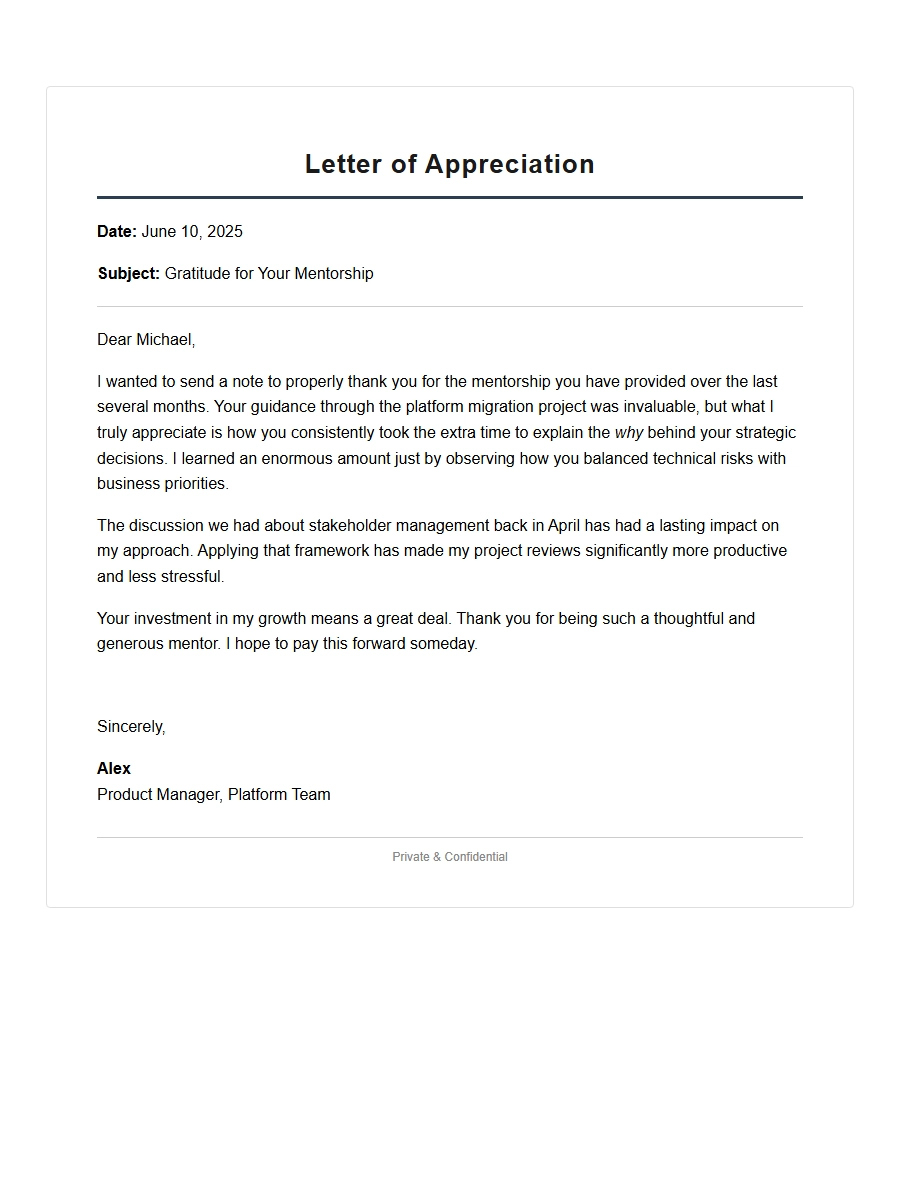 Thanking a Mentor for Guidance: Sample Messages
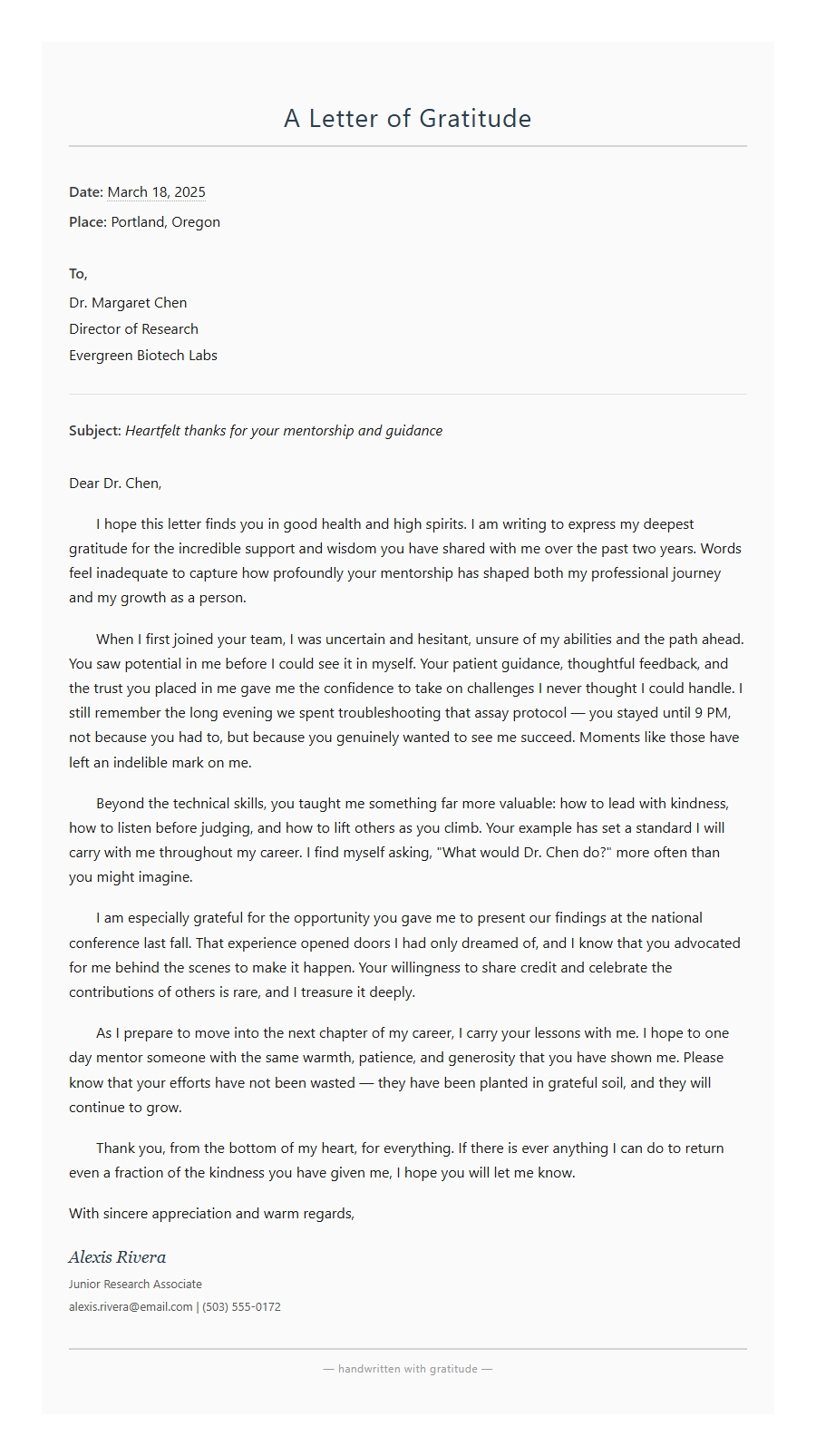 Expressing Gratitude: Handwritten Letter Example
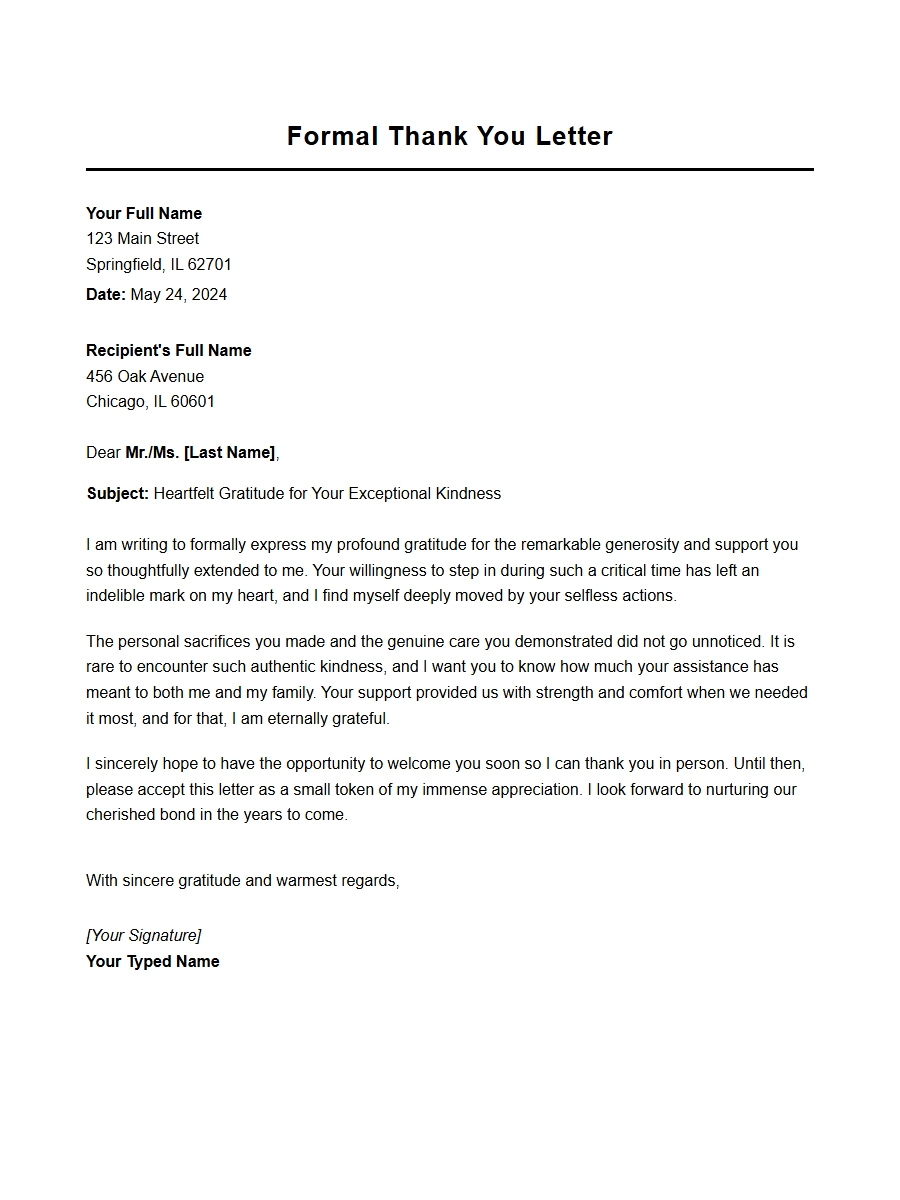 Expressing Thanks in a Formal Personal Letter
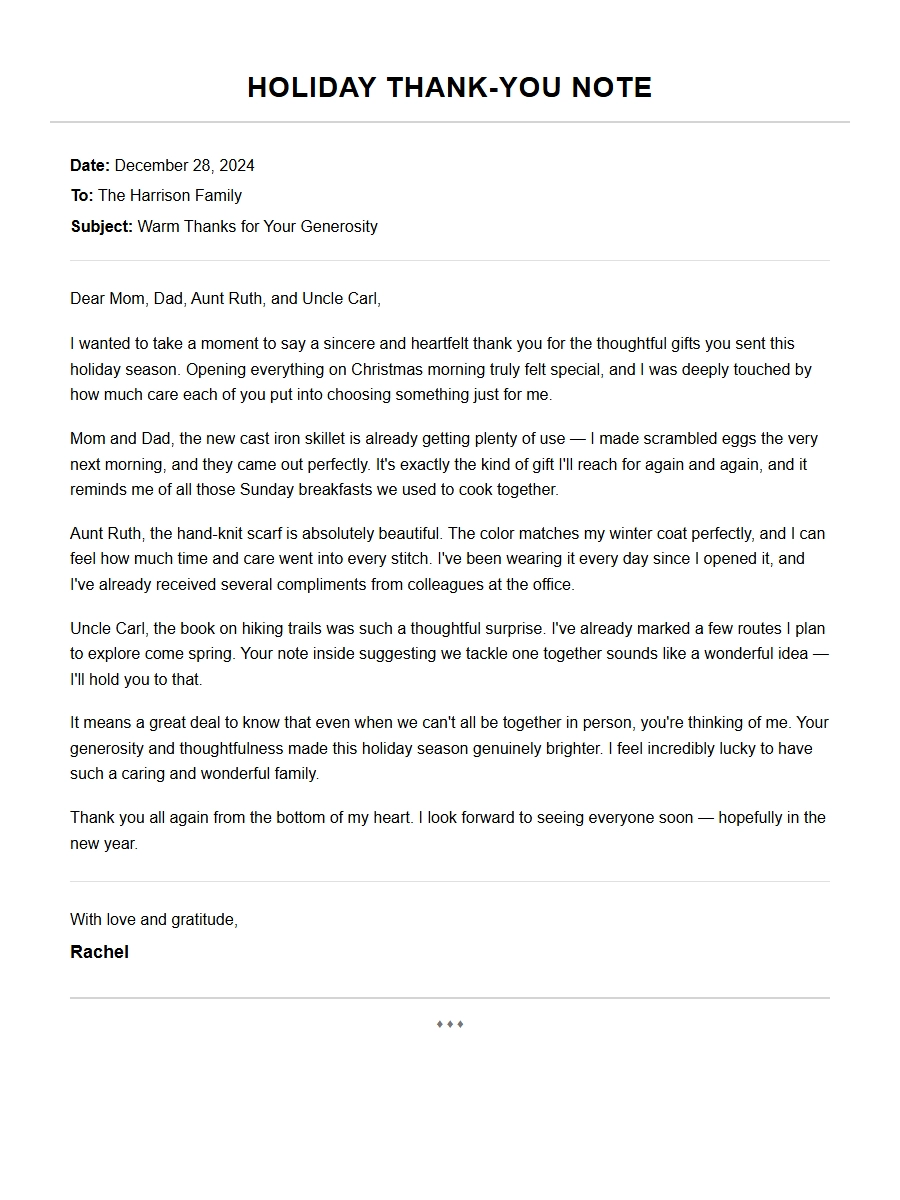 Thank You Letter Examples for Family Holiday Gifts
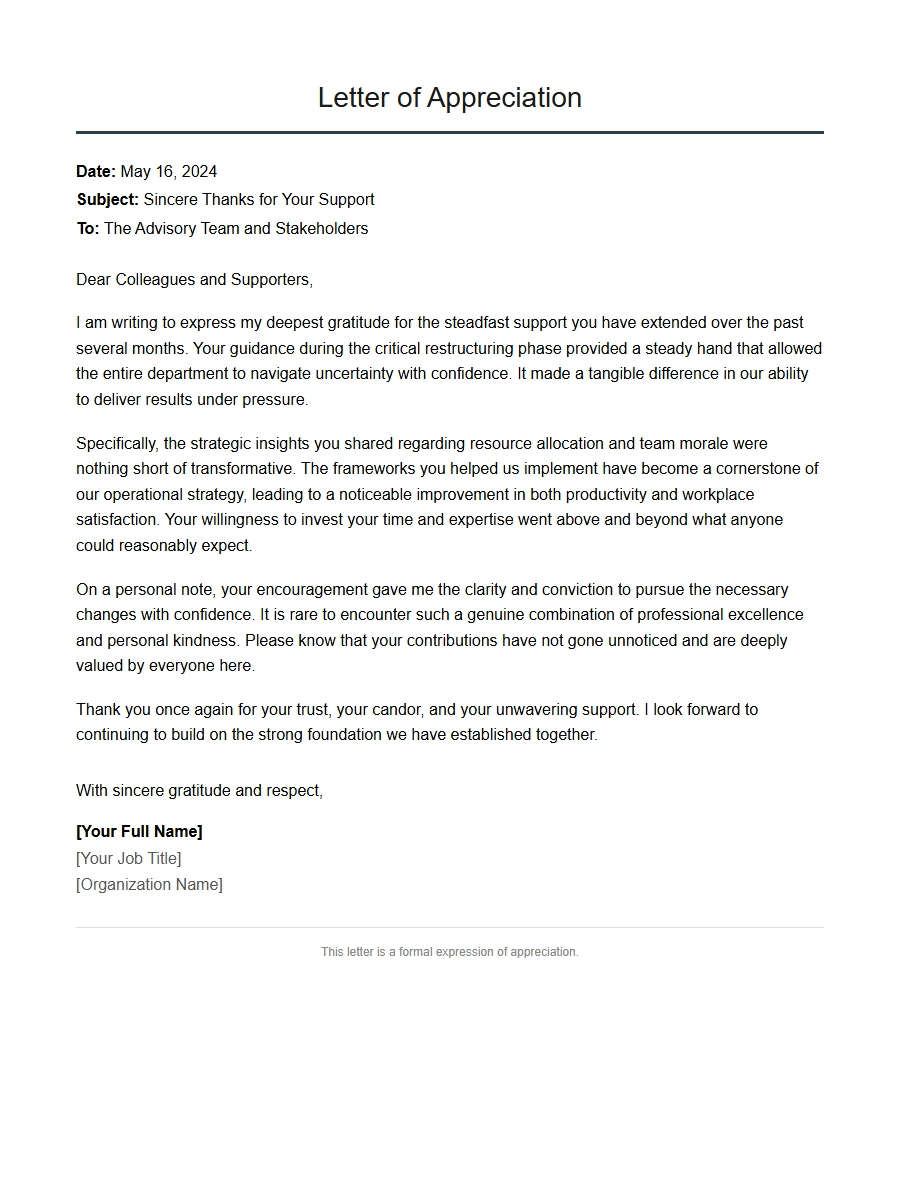 Sample Thank You Letter for Support
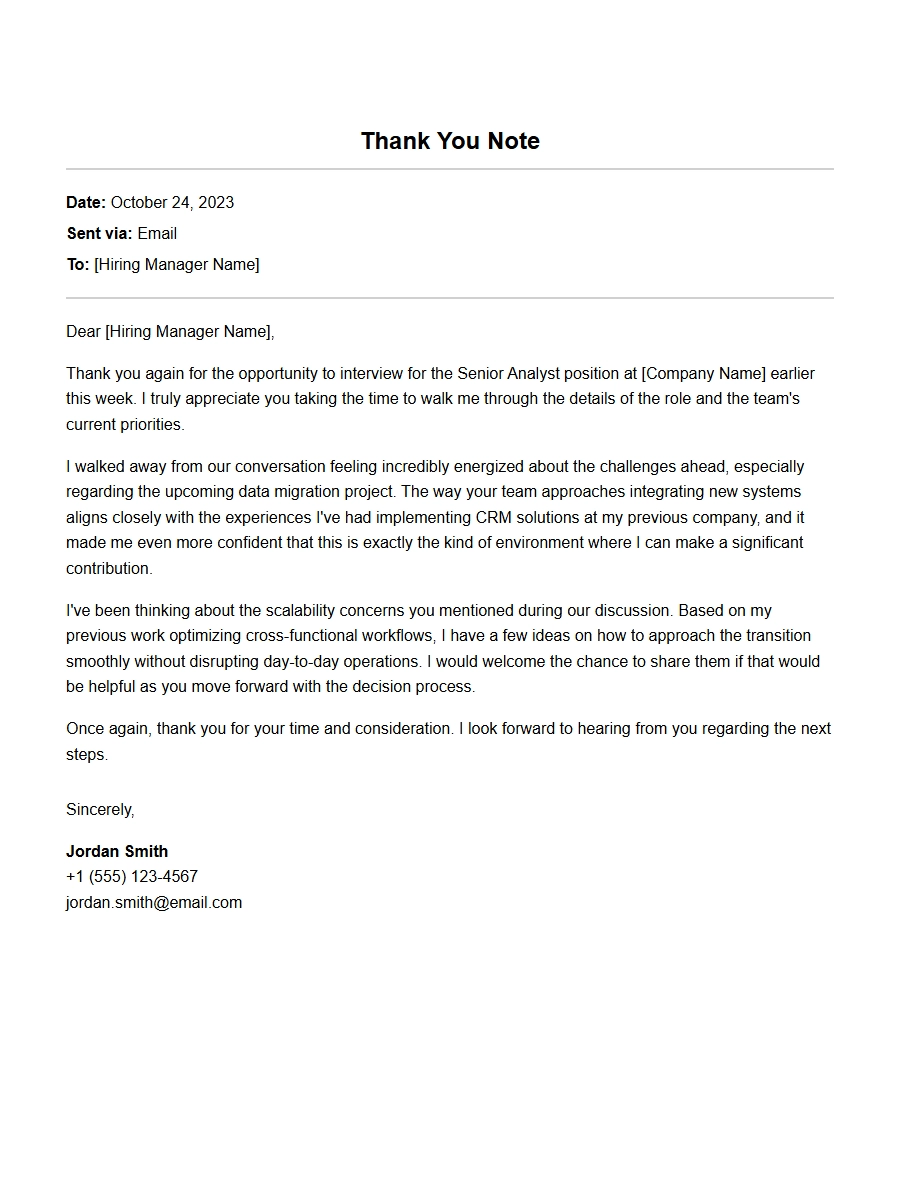 How to Write a Personal Thank-You Note After an Interview